129
Improving Context Modelling in Multimodal Dialogue Generation
Shubham Agarwal,∗ Ondˇrej Duˇsek, Ioannis Konstas and Verena Rieser
The Interaction Lab, Department of Computer Science Heriot-Watt University, Edinburgh, UK
∗
Adeptmind Scholar, Adeptmind Inc., Toronto, Canada
{sa201, o.dusek, i.konstas, v.t.rieser}@hw.ac.uk
Abstract
In this work, we investigate the task of tex-tual response generation in a multimodal task-oriented dialogue system. Our work is based on the recently released Mul-timodal Dialogue (MMD) dataset (Saha et al., 2017) in the fashion domain. We introduce a multimodal extension to the Hierarchical Recurrent Encoder-Decoder (HRED) model and show that this exten-sion outperforms strong baselines in terms of text-based similarity metrics. We also showcase the shortcomings of current vi-sion and language models by performing an error analysis on our system’s output.
1 Introduction
This work aims to learn strategies for textual re-sponse generation in a multimodal conversation directly from data. Conversational AI has great potential for online retail: It greatly enhances user experience and in turn directly affects user reten-tion (Chai et al.,2000), especially if the interaction is multi-modal in nature. So far, most conversa-tional agents are uni-modal – ranging from open-domain conversation (Ram et al.,2018; Papaioan-nou et al., 2017; Fang et al., 2017) to task ori-ented dialogue systems (Rieser and Lemon,2010, 2011;Young et al.,2013;Singh et al.,2000;Wen et al.,2016). While recent progress in deep learn-ing has unified research at the intersection of vi-sion and language, the availability of open-source multimodal dialogue datasets still remains a bot-tleneck.
This research makes use of a recently released Multimodal Dialogue (MMD) dataset (Saha et al., 2017), which contains multiple dialogue sessions in the fashion domain. The MMD dataset provides an interesting new challenge, combining recent
ef-forts on task-oriented dialogue systems, as well as visually grounded dialogue. In contrast to sim-ple QA tasks in visually grounded dialogue, e.g. (Antol et al.,2015), it contains conversations with a clear end-goal. However, in contrast to previ-ous slot-filling dialogue systems, e.g. (Rieser and Lemon,2011;Young et al.,2013), it heavily relies on the extra visual modality to drive the conversa-tion forward (see Figure1).
[image:1.595.340.489.432.581.2]In the following, we propose a fully data-driven response generation model for this task. Our work is able to ground the system’s textual response with language and images by learning the seman-tic correspondence between them while modelling long-term dialogue context.
Figure 1: Example of a user-agent interaction in the fashion domain. In this work, we are inter-ested in the textual response generation for a user query. Both user query and agent response can be multimodal in nature.
2 Model: Multimodal HRED over
multiple images
Lu et al.,2016). In contrast to standard sequence-to-sequence models (Cho et al., 2014; Sutskever et al.,2014;Bahdanau et al.,2015), HREDs model the dialogue context by introducing a context Re-current Neural Network (RNN) over the encoder RNN, thus forming a hierarchical encoder.
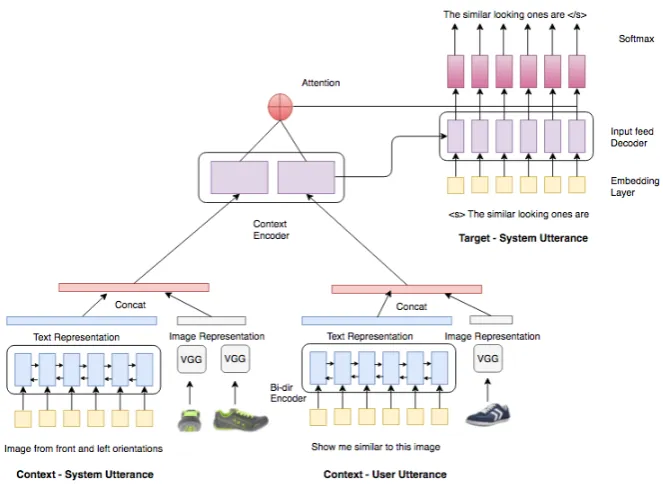
We build on top of the HRED architecture to include multimodality over multiple images. A simple HRED consists of three RNN modules: en-coder, context and decoder. In multimodal HRED, we combine the output representations from the utterance encoder with concatenated multiple im-age representations and pass them as input to the context encoder (see Figure2). A dialogue is mod-elled as a sequence of utterances (turns), which in turn are modelled as sequences of words and im-ages. Formally, a dialogue is generated according to the following:
Pθ(t1, . . . tN) = N
Y
n=1
Pθ(tn|t<n) (1)
wheretn is the n-th utterance in a dialogue. For
each m = 1, . . . , Mn, we have hidden states of
each module defined as:
htextn,m =fθtext(htextn,m−1, wm,n) (2)
himgn =limg([gθenc(img1), . . . gθenc(imgk)]) (3)
hcxtn =fθcxt(hncxt−1,[htextn,Mn, h
img
n ]) (4)
hdecn,m =fθdec(hdecn,m−1, wn,m, hcxtn−1) (5)
htextn,0 = 0; hcxt0 = 0; hdecn,0 =hcxtN (6)
where fθtext,fθcxt and fθdec are GRU cells (Cho et al.,2014).θrepresent model parameters,wn,m
is the m-th word in the n-th utterance and gθenc is a Convolutional Neural Network (CNN); here we use VGGnet (Simonyan and Zisserman,2014). We pass multiple images in a context through the CNN in order to get encoded image representa-tions gθenc(imgk). Then these are combined
to-gether and passed through a linear layerlimgto get the aggregated image representation for one turn of context, denoted by himgn above. The textual
representationhtextn,Mnis given by the encoder RNN fθtext. Both htextn,M
n and h
img
n are subsequently
concatenated and passed as input to the context RNN. hcxtN , the final hidden state of the context RNN, acts as the initial hidden state of the decoder RNN. Finally, output is generated by passinghdec
n,m
through an affine transformation followed by a softmax activation. The model is trained using
cross entropy on next-word prediction. During generation, the decoder conditions on the previous output token.
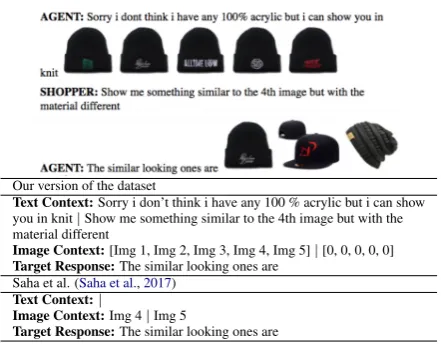
Saha et al. (2017) propose a similar baseline model for the MMD dataset, extending HREDs to include the visual modality. However, for simplic-ity’s sake, they ‘unroll’ multiple images in a sin-gle utterance to include only one image per utter-ance. While computationally leaner, this approach ultimately loses the objective of capturing multi-modality over the context of multiple images and text. In contrast, we combine all the image rep-resentations in the utterance using a linear layer. We argue that modelling all images is necessary to answer questions that address previous agent re-sponses. For example in Figure3, when the user asks “what about the 4th image?”, it is impossi-ble to give a correct response without reasoning over all images in the previous response. In the following, we empirically show that our extension leads to better results in terms of text-based sim-ilarity measures, as well as quality of generated dialogues.
Our version of the dataset
Text Context:Sorry i don’t think i have any 100 % acrylic but i can show you in knit|Show me something similar to the 4th image but with the material different
Image Context:[Img 1, Img 2, Img 3, Img 4, Img 5]|[0, 0, 0, 0, 0] Target Response:The similar looking ones are
Saha et al. (Saha et al.,2017) Text Context:|
Image Context:Img 4|Img 5
[image:2.595.307.528.422.594.2]Target Response:The similar looking ones are
Figure 2: The Multimodal HRED architecture consists of four modules: utterance encoder, image en-coder, context encoder and decoder. WhileSaha et al.(2017) ‘rollout’ images to encode only one image per context, we concatenate all the ‘local’ representations to form a ‘global’ image representation per turn. Next, we concatenate the encoded text representation and finally everything gets fed to the context encoder.
3 Experiments and Results
3.1 Dataset
The MMD dataset (Saha et al., 2017) consists of 100/11/11k train/validation/test chat sessions comprising 3.5M context-response pairs for the model. Each session contains an average of 40 dialogue turns (average of 8 words per textual re-sponse, 4 images per image response). The data contains complex user queries, which pose new challenges for multimodal, task-based dialogue, such as quantitative inference (sorting, counting and filtering): “Show me more images of the 3rd product in some different directions”, inference using domain knowledge and long term context: “Will the 5th result go well with a large sized mes-senger bag?”,inference over aggregate of images: “List more in the upper material of the 5th image and style as the 3rd and the 5th”,co-reference res-olution. Note that we started with the raw tran-scripts of dialogue sessions to create our own ver-sion of the dataset for the model. This is done since the authors originally consider each image as a different context, while we consider all the im-ages in a single turn as one concatenated context (cf. Figure3).
3.2 Implementation
We use the PyTorch1 framework (Paszke et al., 2017) for our implementation.2 We used 512 as the word embedding size as well as hidden dimension for all the RNNs using GRUs (Cho et al., 2014) with tied embeddings for the (bi-directional) encoder and decoder. The decoder uses Luong-style attention mechanism (Luong et al., 2015) with input feeding. We trained our model with the Adam optimizer (Kingma and Ba, 2015), with a learning rate of 0.0004 and clipping gradient norm over 5. We perform early stopping by monitoring validation loss. For image repre-sentations, we use the FC6 layer representations of the VGG-19 (Simonyan and Zisserman,2014), pre-trained on ImageNet.3
3.3 Analysis and Results
We report sentence-level BLEU-4 (Papineni et al.,
2002), METEOR (Lavie and Agarwal, 2007) and
ROUGE-L (Lin and Och, 2004) using the evalu-ation scripts provided by (Sharma et al., 2017).
1
https://pytorch.org/ 2Our code is freely available at:
https://github.com/shubhamagarwal92/mmd 3In future, we plan to exploit state-of-the-art frameworks
Figure 4: Examples of predictions using M-HRED–attn (5). Recall, we are focusing on generating textual responses. Our model predictions are shown in blue while the true gold target in red. We are showing only the previous user utterance for brevity’s sake.
We compare our results againstSaha et al.(2017) by using their code and data-generation scripts.4 Note that the results reported in their paper are on a different version of the corpus, hence not directly comparable.
Model Cxt BLEU-4 METEOR ROUGE-L Saha et al. M-HRED* 2 0.3767 0.2847 0.6235
T-HRED 2 0.4292 0.3269 0.6692
M-HRED 2 0.4308 0.3288 0.6700
T-HRED–attn 2 0.4331 0.3298 0.6710 M-HRED–attn 2 0.4345 0.3315 0.6712 T-HRED–attn 5 0.4442 0.3374 0.6797
M-HRED–attn 5 0.4451 0.3371 0.6799
Table 1: Sentence-level BLEU-4, METEOR and ROUGE-L results for the response generation task on the MMD corpus. “Cxt” represents con-text size considered by the model. Our best per-forming model is M-HRED–attn over a context of 5 turns. *Saha et al. has been trained on a different version of the dataset.
Table1provides results for different configura-tions of our model (“T” stands for text-only in the encoder, “M” for multimodal, and “attn” for using attention in the decoder). We experimented with different context sizes and found that output qual-ity improved with increased context size (mod-els with 5-turn context perform better than those with a 2-turn context), confirming the observation by Serban et al. (2016, 2017).5 Using attention clearly helps: even T-HRED–attn outperforms M-HRED (without attention) for the same context size. We also tested whether multimodal input has an impact on the generated outputs. However, there was only a slight increase in BLEU score (M-HRED–attn vs T-HRED–attn).
4https://github.com/amritasaha1812/
MMD_Code
5Using pairwise bootstrap resampling test (Koehn,2004),
we confirmed that the difference of HRED-attn (5) vs. M-HRED-attn (2) is statistically significant at 95% confidence level.
To summarize, our best performing model (M-HRED–attn) outperforms the model of Saha et al. by 7 BLEU points.6 This can be primarily at-tributed to the way we created the input for our model from raw chat logs, as well as incorporat-ing more information durincorporat-ing decodincorporat-ing via atten-tion. Figure4provides example output utterances using M-HRED–attn with a context size of 5. Our model is able to accurately map the response to previous textual context turns as shown in (a) and (c). In (c), it is able to capture that the user is ask-ing about the style in the 1st and 2nd image. (d) shows an example where our model is able to re-late that the corresponding product is ‘jeans’ from visual features, while it is not able to model fine-grained details like in (b) that the style is ‘casual fit’ but resorts to ‘woven’.
4 Conclusion and Future Work
In this research, we address the novel task of response generation in search-based multimodal dialogue by learning from the recently released Multimodal Dialogue (MMD) dataset (Saha et al., 2017). We introduce a novel extension to the Hierarchical Recurrent Encoder-Decoder (HRED) model (Serban et al.,2016) and show that our im-plementation significantly outperforms the model ofSaha et al.(2017) by modelling the full multi-modal context. Contrary to their results, our gen-eration outputs improved by adding attention and increasing context size. However, we also show that multimodal HRED does not improve signif-icantly over text-only HRED, similar to observa-tions by Agrawal et al. (2016) and Qian et al. (2018). Our model learns to handle textual cor-respondence between the questions and answers, while mostly ignoring the visual context. This in-dicates that we need better visual models to
en-6The difference is statistically significant at 95%
code the image representations when he have mul-tiple similar-looking images, e.g., black hats in Figure 3. We believe that the results should im-prove with a jointly trained or fine-tuned CNN for generating the image representations, which we plan to implement in future work.
Acknowledgments
This research received funding from Adeptmind Inc., Montreal, Canada and the MaDrIgAL EP-SRC project (EP/N017536/1). The Titan Xp used for this work was donated by the NVIDIA Corp.
References
Aishwarya Agrawal, Dhruv Batra, and Devi Parikh. 2016.Analyzing the behavior of visual question an-swering models.Proceedings of EMNLP.
Stanislaw Antol, Aishwarya Agrawal, Jiasen Lu, Mar-garet Mitchell, Dhruv Batra, C Lawrence Zitnick, and Devi Parikh. 2015. VQA: Visual question an-swering. In Proceedings of ICCV, pages 2425– 2433.
Dzmitry Bahdanau, Kyunghyun Cho, and Yoshua Ben-gio. 2015. Neural machine translation by jointly learning to align and translate. In Proceedings of ICLR.
Joyce Yue Chai, Nanda Kambhatla, and Wlodek Zadrozny. 2000. Natural language sales assistant-a web-based dialog system for online sales. In Pro-ceedings of AAAI.
Kyunghyun Cho, Bart Van Merri¨enboer, Caglar Gul-cehre, Dzmitry Bahdanau, Fethi Bougares, Holger Schwenk, and Yoshua Bengio. 2014. Learning phrase representations using RNN encoder-decoder for statistical machine translation. InProceedings of EMNLP.
Hao Fang, Hao Cheng, Elizabeth Clark, Ariel Holtz-man, Maarten Sap, Mari Ostendorf, Yejin Choi, and Noah A Smith. 2017.Sounding board–university of washington’s alexa prize submission. Alexa Prize Proceedings.
Diederik P Kingma and Jimmy Ba. 2015. Adam: A method for stochastic optimization. CoRR abs/1412.6980.
Philipp Koehn. 2004. Statistical significance tests for machine translation evaluation. InProceedings of EMNLP.
Alon Lavie and Abhaya Agarwal. 2007. METEOR: An automatic metric for MT evaluation with high levels of correlation with human judgments. In Proceed-ings of 2nd Workshop on Statistical Machine Trans-lation, pages 228–231.
Chin-Yew Lin and Franz Josef Och. 2004. Auto-matic evaluation of machine translation quality us-ing longest common subsequence and skip-bigram statistics. InProceedings of ACL, pages 605–612.
Jiasen Lu, Jianwei Yang, Dhruv Batra, and Devi Parikh. 2016. Hierarchical question-image co-attention for visual question answering. In Proceed-ings of NIPS, pages 289–297.
Minh-Thang Luong, Hieu Pham, and Christopher D Manning. 2015. Effective approaches to attention-based neural machine translation. Proceedings of EMNLP.
Ioannis Papaioannou, Amanda Cercas Curry, Jose L Part, Igor Shalyminov, Xinnuo Xu, Yanchao Yu, On-drej Duˇsek, Verena Rieser, and Oliver Lemon. 2017. Alana: Social dialogue using an ensemble model and a ranker trained on user feedback. Alexa Prize Proceedings.
Kishore Papineni, Salim Roukos, Todd Ward, and Wei-Jing Zhu. 2002. BLEU: a method for automatic evaluation of machine translation. InProceedings of ACL, pages 311–318.
Adam Paszke, Sam Gross, Soumith Chintala, Gre-gory Chanan, Edward Yang, Zachary DeVito, Zem-ing Lin, Alban Desmaison, Luca Antiga, and Adam Lerer. 2017. Automatic differentiation in pytorch. InNIPS-W.
Xin Qian, Ziyi Zhong, and Jieli Zhou. 2018. Multi-modal machine translation with reinforcement learn-ing.CoRR abs/1805.02356.
Ashwin Ram, Rohit Prasad, Chandra Khatri, Anu Venkatesh, Raefer Gabriel, Qing Liu, Jeff Nunn, Behnam Hedayatnia, Ming Cheng, Ashish Nagar, et al. 2018. Conversational AI: The science behind the alexa prize.CoRR abs/1801.03604.
Verena Rieser and Oliver Lemon. 2010. Natural lan-guage generation as planning under uncertainty for spoken dialogue systems. In Empirical methods in natural language generation, pages 105–120. Springer.
Verena Rieser and Oliver Lemon. 2011. Reinforcement learning for adaptive dialogue systems: a data-driven methodology for dialogue management and natural language generation. Springer.
Amrita Saha, Mitesh Khapra, and Karthik Sankara-narayanan. 2017. Multimodal dialogs (MMD): A large-scale dataset for studying multimodal domain-aware conversations.CoRR abs/1704.00200.
Iulian Vlad Serban, Alessandro Sordoni, Ryan Lowe, Laurent Charlin, Joelle Pineau, Aaron C Courville, and Yoshua Bengio. 2017. A hierarchical latent variable encoder-decoder model for generating di-alogues. InProceedings of AAAI, pages 3295–3301.
Shikhar Sharma, Layla El Asri, Hannes Schulz, and Jeremie Zumer. 2017. Relevance of unsupervised metrics in task-oriented dialogue for evaluating nat-ural language generation.CoRR abs/1706.09799.
Karen Simonyan and Andrew Zisserman. 2014. Very deep convolutional networks for large-scale image recognition. CoRR abs/1409.1556.
Satinder P Singh, Michael J Kearns, Diane J Litman, and Marilyn A Walker. 2000. Reinforcement learn-ing for spoken dialogue systems. InProceedings of NIPS, pages 956–962.
Ilya Sutskever, Oriol Vinyals, and Quoc V Le. 2014. Sequence to sequence learning with neural net-works. InProceedings of NIPS, pages 3104–3112.
Tsung-Hsien Wen, David Vandyke, Nikola Mrksic, Milica Gasic, Lina M Rojas-Barahona, Pei-Hao Su, Stefan Ultes, and Steve Young. 2016. A network-based end-to-end trainable task-oriented dialogue system.CoRR abs/1604.04562.