Predicting Audience’s Laughter During Presentations Using
Convolutional Neural Network
Lei Chen
Educational Testing Service (ETS) Princeton, NJ USA
Chong Min Lee
Educational Testing Service (ETS) Princeton, NJ USA
Abstract
Public speakings play important roles in schools and work places and properly us-ing humor contributes to effective pre-sentations. For the purpose of automat-ically evaluating speakers’ humor usage, we build a presentation corpus containing humorous utterances based on TED talks. Compared to previous data resources sup-porting humor recognition research, ours has several advantages, including (a) both positive and negative instances coming from a homogeneous data set, (b) con-taining a large number of speakers, and (c) being open. Focusing on using lexical cues for humor recognition, we systemati-cally compare a newly emerging text clas-sification method based on Convolutional Neural Networks (CNNs) with a well-established conventional method using lin-guistic knowledge. The advantages of the CNN method are both getting higher de-tection accuracies and being able to learn essential features automatically.
1 Introduction
The ability to make effective presentations has been found to be linked with success at school and in the workplace (Hill and Storey,2003;Stevens,
2005). Humor plays an important role in success-ful public speaking, e.g., helping to reduce pub-lic speaking anxiety often regarded as the most prevalent type of social phobia, generating shared amusement to boost persuasive power, and serv-ing as a means to attract attention and reduce ten-sion (Xu,2016).
Automatically simulating an audience’s reac-tions to humor will not only be useful for presenta-tion training, but also improve conversapresenta-tional
sys-tems by giving machines more empathetic power. The present study reports our efforts in recogniz-ing utterances that cause laughter in presentations. These include building a corpus from TED talks and using Convolutional Neural Networks (CNNs) in the recognition.
The remainder of the paper is organized as fol-lows: Section 2 briefly reviews the previous re-lated research; Section3 describes the corpus we collected from TED talks; Section4describes the text classification methods; Section 5 reports on our experiments; finally, Section 6 discusses the findings of our study and plans for future work.
2 Previous Research
Humor recognition refers to the task of deciding whether a sentence/spoken-utterance expresses a certain degree of humor. In most of the previous studies (Mihalcea and Strapparava, 2005; Puran-dare and Litman,2006;Yang et al.,2015), humor recognition was modeled as a binary classification task.
In the seminal work (Mihalcea and Strappar-ava, 2005), a corpus of 16,000 “one-liners” was created using daily joke websites to collect hu-morous instances while using formal writing re-sources (e.g., news titles) to obtain non-humorous instances. Three humor-specific stylistic features, includingalliteration,antonymy, and adult slang were utilized together with content-based features to build classifiers. In a recent work (Yang et al.,
2015), a new corpus was constructed from thePun of the Day website. Yang et al.(2015) explained and computed stylistic features based on the fol-lowing four aspects: (a) Incongruity, (b) Ambi-guity, (c) Interpersonal Effect, and (d) Phonetic Style. In addition, Word2Vec (Mikolov et al.,
2013) distributed representations were utilized in the model building.
Beyond lexical cues from text inputs, other research has also utilized speakers’ acoustic cues (Purandare and Litman, 2006; Bertero and Fung,2016b). These studies have typically used audio tracks from TV shows and their corre-sponding captions in order to categorize charac-ters’ speaking turns as humorous or non-humorous based on canned laughter.
Convolutional Neural Networks (CNNs) have recently been successfully used in several text categorization tasks (e.g., review rating, senti-ment recognition, and question type recognition).
Kim (2014); Johnson and Zhang (2015); Zhang and Wallace(2015) suggested that using a simple CNN setup, which entails one layer of convolu-tion on top of word embedding vectors, achieves excellent results on multiple tasks. Deep learning recently has been applied to computational humor research (Bertero and Fung,2016b,a). InBertero and Fung(2016b), CNN was found to be the best model that uses both acoustic and lexical cues for humor recognition. However, it did not outper-form the Logistical Regression (LR) model when using text inputs exclusively. Beyond treating hu-mor detection as a binary classification task, Bert-ero and Fung(2016a) formulated the recognition to be a sequential labeling task and utilized Re-current Neural Networks (RNNs) (Hochreiter and Schmidhuber,1997) on top of CNN models (serv-ing as feature extractors) to utilize context infor-mation among utterances.
From the brief review, it is clear that there is a great need for an open corpus that can sup-port investigating humor in presentations.1
CNN-based text categorization methods have been ap-plied to humor recognition (e.g., in (Bertero and Fung,2016b)) but with limitations: (a) a rigorous comparison with the state-of-the-art conventional method examined inYang et al.(2015) is missing; (b) CNN’s performance in the previous research is not quite clear; and (c) some important tech-niques that can improve CNN performance (e.g., using varied-sized filters and dropout regulariza-tion (Hinton et al.,2012)) were not applied. There-fore, the present study is meant to address these limitations.
1While we were working on this paper, we found a recent Master’s thesis (Acosta,2016) that also conducted research on detecting laughter on the TED transcriptions. However, that study only explored conventional text classification ap-proaches.
3 TED Talk Data
TED Talks2are recordings from TED conferences
and other special TED programs. Many effects in a presentation can cause audience laugh, such as speaking content, presenters’ nonverbal behaviors, and so on. In the present study, we focused on the transcripts of the talks. Most transcripts of the talks contain the markup ‘(Laughter)’, which rep-resents where audiences laughed aloud during the talks. This special markup was used to determine utterance labels.
We collected1,192TED Talk transcripts3. An
example transcription is given in Figure 1. The collected transcripts were split into sentences us-ing the Stanford CoreNLP tool (Manning et al.,
2014). In this study, sentences containing or im-mediately followed by ‘(Laughter)’ were used as ‘Laughter’ sentences, as shown in Figure 1; all other sentences were defined as ‘No-Laughter’ sentences. Following Mihalcea and Strapparava
(2005) and Yang et al. (2015), we selected the same numbers (n= 4726) of ‘Laughter’ and ‘No-Laughter’ sentences. To minimize possible topic shifts between positive and negative instances, for each positive instance, we randomly picked one negative instance nearby (the context window was
7 sentences in this study). For example, in Fig-ure1, a negative instance (corresponding to ‘sent-2’) was selected from the nearby sentences rang-ing from ‘sent-7’ to ‘sent+7’. More details about this data set can refer to Lee et al. (2016). The TED data set can be obtained by contacting the authors.
4 Methods
4.1 Conventional Model
FollowingYang et al.(2015), we applied Random Forest (Breiman,2001) to perform humor recog-nition by using the following two groups of fea-tures. The first group are humor-specific stylistic features covering the following4categories4:
In-congruity(2),Ambiguity(6),Interpersonal Effect (4), andPhonetic Pattern (4). The second group are semantic distance features, including the hu-mor label classes from5sentences in the training set that are closest to the sentence being evalu-ated (found by using ak-Nearest Neighbors (kNN)
2http://www.ted.com
3The transcripts were collected on 7/9/2015.
sent-7 . . . . . . .
No-Laughter He has no memory of the past, no knowledge of the future, and he only cares about two things: easy and fun.
sent-1 Now, in the animal world, that works fine.
Laughter If you’re a dog and you spend your whole life doing nothing other than easy and fun things, you’re a huge success!(Laughter)
sent+1 And to the Monkey, humans are just another animal species. . . . .
sent+7 . . .
Figure 1: An excerpt from TED talk“Tim Urban: Inside the mind of a master procrastinator”(http: //bit.ly/2l1P3RJ)
method), and each sentence’s averaged Word2Vec representations (n = 300). More details can be found inYang et al.(2015).
4.2 CNN model
Our CNN-based text classification’s setup follows
Kim(2014). Figure2depicts the model’s details. From the left side’s input texts to the right side’s prediction labels, different shapes of tensors flow through the entire network for solving the classifi-cation task in an end-to-end mode.
Firstly, tokenized text strings were converted to a 2D tensor with shape (L ×d), where L rep-resents sentences’ maximum length while d rep-resents the word-embedding dimension. In this study, we utilized the Word2Vec (Mikolov et al.,
2013) embedding vectors (d = 300) that were trained on 100 billion words of Google News. Next, the embedding matrix was fed into a 1D
convolution network with multiple filters. To cover varied reception fields, we used filters of sizes of fw −1, fw, and fw + 1. For each fil-ter size,nf filters were utilized. Then, max pool-ing, which stands for finding the largest value from a vector, was applied to each feature map (to-tal 3×nf feature maps) output by the 1D con-volution. Finally, maximum values from all of
3×nf filters were formed as a flattened vector to go through a fully connected (FC) layer to predict two possible labels (Laughter vs. No-Laughter). Note that for 1D convolution and FC layer’s in-put, we applied ‘dropout’ (Hinton et al., 2012) regularization, which entails randomly setting a proportion of network weights to be zero during model training, to overcome over-fitting. By using cross-entropy as the learning metric, the whole se-quential network (all weights and bias) could be
optimized by using any SGD optimization, e.g., Adam (Kingma and Ba, 2014), Adadelta (Zeiler,
2012), and so on. 5 Experiments
We used two corpora: the TED Talk corpus (de-noted as TED) and the Pun of the Day corpus5
(denoted as Pun). Note that we normalized words in the Pun data to lowercase to avoid a possibly elevated result caused by a special pattern: in the original format, all negative instances started with capital letters. The Pun data allows us to verify that our implementation of the conventional model is consistent with the work reported inYang et al.
(2015).
In our experiment, we firstly divided each cor-pus into two parts. The smaller part (the Dev set) was used for setting various hyper-parameters used in text classifiers. The larger portion (the CV set) was then formulated as a 10-fold cross-validation setup for obtaining a stable and com-prehensive model evaluation result. For the PUN data, the Dev contains 482 sentences, while the CV set contains4344sentences. For the TED data, the Dev set contains 1046 utterances, while the CV set contains8406utterances. Note that, with a goal of building a speaker-independent humor detector, when partitioning our TED data set, we always kept all utterances of a single talk within the same partition.
When building conventional models, we de-veloped our own feature extraction scripts and used the SKLL6python package for building
Ran-dom Forest models. When implementing CNN,
5The authors ofYang et al.(2015) kindly shared their data with us. We would like to thank them for their generosity.
6https://github.com/
Figure 2: CNN network architecture
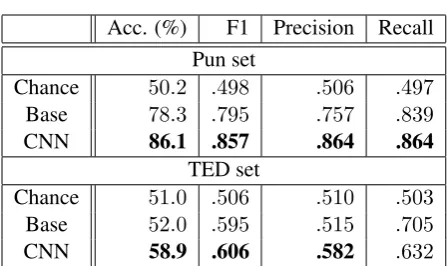
Acc. (%) F1 Precision Recall Pun set
Chance 50.2 .498 .506 .497
Base 78.3 .795 .757 .839
CNN 86.1 .857 .864 .864
TED set
Chance 51.0 .506 .510 .503
Base 52.0 .595 .515 .705
CNN 58.9 .606 .582 .632
Table 1: Humor recognition on both Pun and TED data sets by using (a) random prediction (Chance), conventional method (Base) and CNN method
we used the Keras Python package7. Regarding
hyper-parameter tweaking, we utilized the Tree Parzen Estimation (TPE) method as detailed in
Bergstra et al. (2013). After running 200 itera-tions of tweaking, we ended up with the follow-ing selection: fw is 6 (entailing that the vari-ous filter sizes are(5,6,7)),nf is100, dropout1
is 0.7 and dropout2 is 0.35, optimization uses
Adam (Kingma and Ba,2014). When training the CNN model, we randomly selected 10% of the training data as the validation set for using early stopping to avoid over-fitting.
On the Pun data, the CNN model shows consis-tent improved performance over the conventional model, as suggested inYang et al.(2015). In par-ticular, precision has been greatly increased from
0.762 to 0.864. On the TED data, we also ob-served that the CNN model helps to increase pre-cision (from 0.515 to0.582) and accuracy (from
52.0%to58.9%). The empirical evaluation results suggest that the CNN-based model has an advan-tage on the humor recognition task. In addition, focusing on the system development time,
gener-7Our code implementation was based on https://github.com/shagunsodhani/
CNN-Sentence-Classifier
ating and implementing those features in the con-ventional model would take days or even weeks. However, the CNN model automatically learns its optimal feature representation and can adjust the features automatically across data sets. This makes the CNN model quite versatile for support-ing different tasks and data domains. Compared with the humor recognition results on the Pun data, the results on the TED data are still quite low, and more research is needed to fully handle humor in authentic presentations.
6 Discussion
For the purpose of monitoring how well speak-ers can use humor during their presentations, we have created a corpus from TED talks. Com-pared to the existing corpora, ours has the fol-lowing advantages: (a) it was collected from au-thentic talks, rather than from TV shows per-formed by professional actors based on scripts; (b) it contains about 100 times more speakers com-pared to the limited number of actors in exist-ing corpora. We compared two types of lead-ing text-based humor recognition methods: a con-ventional classifier (e.g., Random Forest) based on human-engineered features vs. an end-to-end CNN method, which relies on its inherent rep-resentation learning. We found that the CNN method has better performance. More importantly, the representation learning of the CNN method makes it very efficient when facing new data sets.
[image:4.595.71.295.208.341.2]References
Andrew D. Acosta. 2016. Laff-O-Tron: Laugh Predic-tion in TED Talks. Master’s thesis, California Poly-technic State University, San Luis Obispo, CA. James Bergstra, Daniel Yamins, and David D Cox.
2013. Making a science of model search: Hyper-parameter optimization in hundreds of dimensions for vision architectures.ICML (1)28:115–123. D Bertero and P Fung. 2016a. A long short-term
mem-ory framework for predicting humor in dialogues. In Proceedings of NAACL-HLT. San Diego, CA. D Bertero and P Fung. 2016b. Deep learning of audio
and language features for humor prediction. In In-ternational Conference on Language Resources and Evaluation (LREC). Portoroz, Slovenia.
L Breiman. 2001. Random forests. Machine learning 45(1):5–32.
Monica Hill and Anne Storey. 2003. Speakeasy: on-line support for oral presentation skills. ELT Journal 57(4):370–376.
GE Hinton, N Srivastava, and A Krizhevsky. 2012. Improving neural networks by preventing co-adaptation of feature detectors. arXiv preprint arXiv:1207.0580.
Sepp Hochreiter and J¨urgen Schmidhuber. 1997. Long Short-Term Memory. Neural Computation 9(8):1735–1780.
R Johnson and T Zhang. 2015. Semi-supervised con-volutional neural networks for text categorization via region embedding. Advances in neural informa-tion processing.
Y Kim. 2014. Convolutional neural networks for sen-tence classification. InProc. EMNLP. Doha, Qatar, pages 1746–1751.
D Kingma and J Ba. 2014. Adam: A method for stochastic optimization. arXiv preprint arXiv:1412.6980.
Chong Min Lee, Su-Youn Yoon, and Lei Chen. 2016. Can we make computers laugh at talks? In Proceed-ings of the Workshop on Computational Modeling of People’s Opinions, Personality, and Emotions in Social Media (PEOPLES). The COLING 2016 Or-ganizing Committee, Osaka, Japan, pages 173–181. Christopher D. Manning, Mihai Surdeanu, John Bauer, Jenny Finkel, Steven J. Bethard, and David Mc-Closky. 2014. The Stanford CoreNLP natural lan-guage processing toolkit. InAssociation for Compu-tational Linguistics (ACL) System Demonstrations. pages 55–60.
Rada Mihalcea and Carlo Strapparava. 2005. Making computers laugh: Investigations in automatic humor recognition. In Proceedings of Human Language
Technology Conference and Conference on Empir-ical Methods in Natural Language Processing. As-sociation for Computational Linguistics, Vancouver, British Columbia, Canada, pages 531–538.
T Mikolov, I Sutskever, and K Chen. 2013. Distributed representations of words and phrases and their com-positionality. Advances in neural information pro-cessing systems.
Amruta Purandare and Diane J. Litman. 2006. Hu-mor: Prosody analysis and automatic recognition for F*R*I*E*N*D*S*. InEMNLP. Sydney, Australia. Betsy Stevens. 2005. What communication skills do
employers want? silicon valley recruiters respond. Journal of Employment Counseling42(1):2. Z Xu. 2016. Laughing Matters: Humor Strategies in
Public Speaking. Asian Social Science12(1):117. Diyi Yang, Alon Lavie, Chris Dyer, and Eduard Hovy.
2015. Humor recognition and humor anchor extrac-tion. InProceedings of the 2015 Conference on Em-pirical Methods in Natural Language Processing. Association for Computational Linguistics, Lisbon, Portugal, pages 2367–2376.
MD Zeiler. 2012. ADADELTA: an adaptive learning rate method.arXiv preprint arXiv:1212.5701. Y Zhang and B Wallace. 2015. A sensitivity