CUNI System for WMT17 Automatic Post-Editing Task
Duˇsan Variˇs and Ondˇrej Bojar
Charles University, Faculty of Mathematics and Physics, Institute of Formal and Applied Linguistics, Malostransk´e n´amˇest´ı 25, 118 00 Prague, Czech Republic
{varis,bojar}@ufal.mff.cuni.cz
Abstract
Following upon the last year’s CUNI sys-tem for automatic post-editing of machine translation output, we focus on exploit-ing the potential of sequence-to-sequence neural models for this task. In this sys-tem description paper, we compare sev-eral encoder-decoder architectures on a smaller-scale models and present the sys-tem we submitted to WMT 2017 Auto-matic Post-Editing shared task based on this preliminary comparison. We also show how simple inclusion of synthetic data can improve the overall performance as measured by an automatic evaluation metric. Lastly, we list few example out-puts generated by our post-editing system.
1 Introduction
Even with the recent substantial improvements of the machine translation (MT) quality mainly thanks to the increasingly popular neural models (neural MT, NMT), many errors still remain in the output require further post-editing. This can be done manually, or as the automatic post-editing (APE) task expects, automatically.
When phrase-based machine translation (PBMT) was the indisputable state of the art, some automatic post-editing (APE) systems were based on the PBMT techniques (Simard et al., 2007). With source-sentence information (B´echara et al., 2011), post-editing results were quite promising. It is therefore not surprising that with the rise of the neural machine transla-tion, neural APE systems based on the findings in NMT research were built (Pal et al., 2016) and even won last year’s WMT16 Shared Task (Junczys-Dowmunt and Grundkiewicz,2016).
In this paper, we present a baseline comparison of several recent neural sequence-to-sequence ar-chitectures, motivations behind our primary sub-mission for the WMT17 Shared Task and further improvements of this submission with regard to model size and additional synthetic data.
2 Experiments
In automatic post-editing, we are expected to take the output of an MT system that usually contains various errors (morphological, lexical etc.) and to generate a corrected version of the output. Most of the time, there is also additional information avail-able, e.g. the original sentence in the source lan-guage and sometimes also some internal scores or features from the primary MT system.
2.1 Examined Setups
If we look at the recent developments in the field of NMT, we can see that there are many differ-ent novel approaches that often bring significant improvements to the overall performance of the NMT system. It is natural to ask how these find-ings can be applied to APE task and how much they can contribute to the APE system perfor-mance. We experimented in two areas: (1) how to feed simultaneously the source sentence and the MT output (multi-source input), and (2) whether to use subword units or individual characters.
2.1.1 Multi-Source Input
All our experiments use both the source sentence and the MT output to be corrected. As far as en-coding the input is concerned, we examined two basic approaches. We tried using a single encoder that received the concatenation of the source sen-tence and the corresponding MT output as sug-gested byNiehues et al.(2016). The resulting in-put sequence becomes longer and it may thus be more difficult to encode, but it was reported that
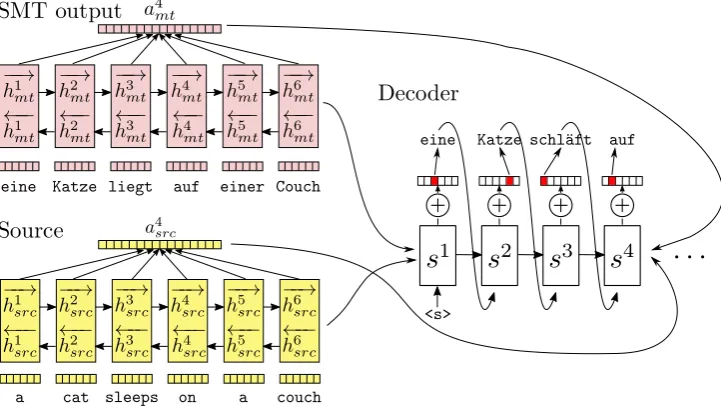
Figure 1: Illustration of a multiple-encoder sequence-to-sequence architecture as illustrated inLibovick´y et al.(2016).
(through the attention mechanism) the decoder is able to attend to relevant parts of the concatenated sentences when generating output.
As an alternative option, we also tried using two separate encoders, one for the source sentence and one for the MT output (Libovick´y et al.,2016) as shown in Figure 1. In this case, both encoders encode their corresponding input sequences sepa-rately and the concatenation of their final states is passed to the decoder. The attention is computed over the hidden states of both encoders as if they were produced by a single encoder.Libovick´y and Helcl(2017) present other options for combining the attention of multiple encoders, but the investi-gation of these methods is not covered in this pa-per.
2.1.2 Subword Units or Characters
All data-driven approaches to MT suffer in qual-ity when translating rare words (including words not seen during training at all) and NMT is no ex-ception. In out neural approach to APE, we would still like our APE system to address errors in rare words (e.g. by fixing their endings). A popular approach of reducing the vocabulary size in NMT is called byte-pair encoding (BPE,Sennrich et al., 2015) which creates a vocabulary of most frequent words, subword units and individual characters. This way, even rare words can be successfully han-dled by modifying their parts.
Another option is to use a fully character-level encoder-decoder architecture. However, this
ap-proach in its basic form results in much longer se-quences that are generally much harder to learn for the underlying recurrent neural network (RNN, Pascanu et al.,2012). Another downside is the in-creased training and inference time for each sen-tence. Recently,Lee et al.(2016) presented an en-coder architecture that uses RNN over the output of several hundreds convolutional filters that are applied on the character-level embeddings, com-bining the benefits of both convolutional and re-current approaches.
2.2 Baseline Comparison
Based on the approaches described in the previous section, we decided to compare the following sys-tem variations:
• a single encoder (concatenated input,
“con-cat”) vs. two separate encoders (“two-enc”),
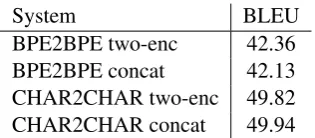
System BLEU BPE2BPE two-enc 42.36 BPE2BPE concat 42.13 CHAR2CHAR two-enc 49.82 CHAR2CHAR concat 49.94
Table 1: Automatic evaluation of the proposed ar-chitectures we trained. The model size was down-scaled to 5GB due to the limited computation re-sources.
The experiments were carried out in Neural Monkey1 (Helcl and Libovick´y, 2017), a
frame-work for sequence-to-sequence modeling. Most of the required neural network components together with necessary preprocessing and postprocessing were already implemented in the framework. We added the RNN over convolutional encoder in this work.
We used 12k sentences WMT16 APE training dataset for training and we computed BLEU (Pa-pineni et al.,2002) on WMT16 APE development dataset to compare the baselines. The evaluation was performed during training. We thus did not use beam search and simply greedily chose the most probable output at each decoding step to get the validation output.
The best results for each architecture are shown in Table 1. We can see that the character-level post-editing models outperform the subword-level models. However, the training was done using only a small dataset which may possibly indicate that the character level architecture is able to better exploit the training data. Nevertheless, we chose the character-level system for our remaining ex-periments.
3 CUNI System for WMT17 APE Task
After the baseline comparison of the smaller sequence-to-sequence models, we moved towards training of the primary submission for the WMT17 post-editing task.
3.1 Common Settings
We decided to use the two-encoder character-level architecture. Even though the single encoder character-level architecture with concatenated in-puts performed slightly better during the baseline evaluation, we believe that the multi-encoder
ar-1https://github.com/ufal/neuralmonkey
chitecture offers higher potential for further im-provement.2
The model was trained using GeForce GTX 1080 with 8GB memory with the following pa-rameters:
• shared character-level vocabulary size: 500
• encoder RNN size: 256
• input embedding size: 300
• segment size: 5
• highway network depth: 2
• convolutional filters (size, number of filters):
(1,150), (2,200), (3,250), (4,250), (5,300), (6,300), (7,350), (8,350)
• decoder RNN size: 512
• output embedding size: 300
During the inference, we used beam-search of beam size 20 and length normalization to penalize shorter sentences. Beam search parameters were chosen based on theLee et al.(2016).
First, we used only 23k sentences from WMT17 training dataset to train the system. We used this model as a baseline which we tried to further im-prove.
3.2 Synthetic Data
Since the basic training dataset provided for the task was rather small we also tried to include the training dataset from the previous WMT16 post-editing task and furthermore, we added the syn-thetic data (smaller dataset, ∼500k sentences) as provided by last year’s submission of Junczys-Dowmunt and Grundkiewicz (2016). To balance the ratio of genuine and synthetic sentences in the final dataset, we duplicated the WMT16 and WMT17 sentence pairs several times to match the size of the synthetic dataset. We then took all the data and shuffled them randomly to create a dataset consisting of ∼1M training sentences.
We used WMT16 APE dev set to evaluate the model during the training.
2This still needs to be confirmed though by the future
Source You can also perform many types of transformations by dragging the bounding box for a selection .
OrigMT Sie k¨onnen auch zahlreiche Transformationsarten durchf¨uhren , indem Sie den Begrenzungsrahmen f¨ur eine Auswahl . Synth Sie k¨onnen auch zahlreiche Transformationsarten durchf¨uhren , indem Sie den Begrenzungsrahmen f¨ur eine Auswahlziehen. Ref Sie k¨onnen auch zahlreiche Transformationsarten durchf¨uhren , indem Sie den Begrenzungsrahmen f¨ur eine Auswahl ziehen .
Source 3D comments added to other views are listed as components of that view in the Model Tree .
OrigMT 3D hinzugef¨ugten Kommentare zu anderen Ansichten als Komponenten anzuzeigen , die in der Modellhierarchie aufgef¨uhrt sind . Synth 3D-Kommentare zu anderen Ansichtenwerdenals Komponentenangezeigt, die in der Modellhierarchie aufgef¨uhrt sind . Ref Anderen Ansichten hinzugef¨ugte 3D-Kommentare werden in der Modellhierarchie als Komponenten dieser Ansicht aufgef¨uhrt .
Source Choose an option from the Key Algorithm menu . OrigMT W¨ahlen Sie eine Option aus dem Men¨u ” Algorithm . ” Synth W¨ahlen Sie eine Option aus dem Men¨u ” Algorithmu . ” Ref W¨ahlen Sie eine Option aus dem Men¨u ” Schl¨usselalgorithmus . ”
Source Shift-drag to constrain the movement of the object horizontally , vertically , or diagonally .
[image:4.595.341.494.312.382.2]OrigMT Halten Sie beim Ziehen des Zeigers ¨uber die Bewegung des Objekts horizontal , vertikal oder diagonal einzuschr¨anken . Synth Halten Sie beim Ziehen die Bewegung des Objekts die Bewegung des Objekts horizontal , vertikal oder diagonal eingeschr¨ankt . Ref Halten Sie beim Ziehen des Objekts die Umschalttaste gedr¨uckt , um nur horizontale , vertikale oder diagonale Bewegungen zuzulassen .
Figure 2: Sample outputs from the original MT and our submitted model “Synth”. In the first two examples, our model helped to produce correctly the main verb (in bold). In the third example, it introduced a spelling error (underlined). The last example shows that the model can also severely damage the sentence, introducing repetitions common in NMT output. The original output for the last sentence was not perfect either, it does not mention the shift key at all (and our model does not fix it).
3.3 Predicting Edit Operations
Finally, inspired by Libovick´y et al. (2016), we also trained a separate model that generates a se-quence of post-editing operations (“editops”) in-stead of directly generating the target sequence of characters. Aside from generating characters present in the training data, the model learns to use special tokens “<keep>” and “<delete>”, or to
normally produce characters present in the train-ing data, to indicate the modifications needed for the MT output. We used the same network param-eters and data (including the synthetic dataset) for the model with and without BPE.
3.4 Evaluation
We evaluated these three models using the WMT16 APE test set3, computing the BLEU
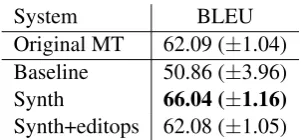
score on the produced outputs: baseline CHAR2CHAR setup (Baseline), the model trained with synthetic data (Synth) and the model which produces edit operations instead of com-plete sentences (Synth+editops). Table 2 shows the results of the evaluation.
We can see that even when we choose the best architecture based on the relative comparison and increase the model capacity (“Baseline”), it is still not enough to even get close to the original MT output quality (“Original MT”). Introducing ad-ditional synthetic data (“Synth”) fixed this and actually outperformed the original MT, reaching
3http://www.statmt.org/wmt16/ape-task.
html
System BLEU
Original MT 62.09 (±1.04)
Baseline 50.86 (±3.96)
Synth 66.04 (±1.16)
Synth+editops 62.08 (±1.05)
Table 2: Automatic evaluation of the final 8GB APE setups. The score of the original MT output is shown for comparison. The±values are empirical
confidence intervals reflecting the variance in the test set (Koehn,2004).
BLEU of 66.04. We chose this system as our pri-mary submission for the WMT16 APE task.
We were a little surprised that there was no im-provement when using model that learned to gen-erate post-editing operations (“Synth+editops”). When we manually examined the generated out-put, we found out that the system took the safer path of keeping most of the machine translation output because it probably resulted in fewer errors than trying to change it. This could be probably avoided by discouraging the model from keeping the whole MT output unchanged and we plan in-vestigating this approach in the future.
4 Conclusion
In this paper, we compared several sequence-to-sequence architectures that were previously pro-posed for the NMT task and evaluated their per-formance in automatic post-editing of English-to-German MT output. Our setup relies on the origi-nal source sentence and uses either subword units (BPE) or individual characters.
With additional synthetic data, we were able to improve over the original MT output in terms of BLEU, but a quick manual inspection reveals that errors can be easily also introduced and BLEU (or other automatic metric) is not likely to give a reli-able picture of the post-editing performance.
Acknowledgments
This work has been in part supported by the EU grants no. H2020-ICT-2014-1-644402 (Health in my Language) and H2020-ICT-2014-1-645452 (QT21), as well as by the LINDAT/CLARIN project of the Ministry of Education, Youth and Sports of the Czech Republic (project LM2015071) and Charles University SVV project no. 260 453.
Computational resources were also supplied by the Ministry of Education, Youth and Sports of the Czech Republic under the Projects CES-NET (Project No. LM2015042), CERIT-Scientific Cloud (Project No. LM2015085) provided within the program Projects of Large Research, Develop-ment and Innovations Infrastructures.
References
Hanna B´echara, Yanjun Ma, and Josef van Genabith. 2011. Statistical Post-Editing for a Statistical MT
System. InProceedings of the 13th Machine
Trans-lation Summit. pages 308–315.
Jindˇrich Helcl and Jindˇrich Libovick´y. 2017. Neural monkey: An open-source tool for sequence learn-ing. The Prague Bulletin of Mathematical Lin-guistics(107):5–17. https://doi.org/10.1515/pralin-2017-0001.
Marcin Junczys-Dowmunt and Roman Grundkiewicz.
2016. Log-linear combinations of
monolin-gual and bilinmonolin-gual neural machine translation models for automatic post-editing. In Pro-ceedings of the First Conference on Machine Translation, WMT 2016, colocated with ACL 2016, August 11-12, Berlin, Germany. The As-sociation for Computer Linguistics, pages 751– 758. http://aclweb.org/anthology/W/W16/W16-2378.pdf.
Philipp Koehn. 2004. Statistical Significance Tests for
Machine Translation Evaluation. InProceedings of
EMNLP 2004. Barcelona, Spain.
Jason Lee, Kyunghyun Cho, and Thomas
Hof-mann. 2016. Fully character-level neural machine
translation without explicit segmentation. CoRR
abs/1610.03017.http://arxiv.org/abs/1610.03017.
Jindˇrich Libovick´y and Jindˇrich Helcl. 2017. Attention strategies for multi-source sequence-to-sequence
learning. InProceedings of the 55th Annual
Meet-ing of the Association for Computational LMeet-inguistics (Volume 2: Short Papers). Association for Compu-tational Linguistics, Vancouver, Canada.
Jindˇrich Libovick´y, Jindˇrich Helcl, Marek Tlust´y,
Ondˇrej Bojar, and Pavel Pecina. 2016. Cuni system
for wmt16 automatic post-editing and multimodal translation tasks. InProceedings of the First Confer-ence on Machine Translation. Association for Com-putational Linguistics, Berlin, Germany, pages 646– 654. http://www.aclweb.org/anthology/W16-2361.
Jan Niehues, Eunah Cho, Thanh-Le Ha, and Alex
Waibel. 2016. Pre-translation for neural
ma-chine translation. In Nicoletta Calzolari, Yuji
Matsumoto, and Rashmi Prasad, editors,
COL-ING 2016, 26th International Conference on Com-putational Linguistics, Proceedings of the Con-ference: Technical Papers, December 11-16, 2016, Osaka, Japan. ACL, pages 1828–1836.
http://aclweb.org/anthology/C/C16/C16-1172.pdf.
Santanu Pal, Sudip Kumar Naskar, Mihaela Vela, and
Josef van Genabith. 2016. A neural network based
approach to automatic post-editing. In Proceed-ings of the 54th Annual Meeting of the Associa-tion for ComputaAssocia-tional Linguistics, ACL 2016, Au-gust 7-12, 2016, Berlin, Germany, Volume 2: Short Papers. The Association for Computer Linguistics.
http://aclweb.org/anthology/P/P16/P16-2046.pdf.
Kishore Papineni, Salim Roukos, Todd Ward, and
Wei-Jing Zhu. 2002. Bleu: A method for
au-tomatic evaluation of machine translation. In
Proceedings of the 40th Annual Meeting on As-sociation for Computational Linguistics. Asso-ciation for Computational Linguistics, Strouds-burg, PA, USA, ACL ’02, pages 311–318.
https://doi.org/10.3115/1073083.1073135.
Razvan Pascanu, Tomas Mikolov, and Yoshua
Bengio. 2012. Understanding the
explod-ing gradient problem. CoRR abs/1211.5063.
http://arxiv.org/abs/1211.5063.
Rico Sennrich, Barry Haddow, and Alexandra Birch.
2015. Neural machine translation of rare words
with subword units. CoRR abs/1508.07909.
http://arxiv.org/abs/1508.07909.
Michel Simard, Cyril Goutte, and Pierre Isabelle.