Language Model Information Retrieval with Document Expansion
Tao Tao, Xuanhui Wang, Qiaozhu Mei, ChengXiang Zhai Department of Computer Science
University of Illinois at Urbana Champaign
Abstract
Language model information retrieval de-pends on accurate estimation of document models. In this paper, we propose a docu-ment expansion technique to deal with the problem of insufficient sampling of docu-ments. We construct a probabilistic neigh-borhood for each document, and expand the document with its neighborhood infor-mation. The expanded document provides a more accurate estimation of the docu-ment model, thus improves retrieval ac-curacy. Moreover, since document expan-sion and pseudo feedback exploit different corpus structures, they can be combined to further improve performance. The experi-ment results on several different data sets demonstrate the effectiveness of the pro-posed document expansion method.
1 Introduction
Information retrieval with statistical language mod-els (Lafferty and Zhai, 2003) has recently attracted much more attention because of its solid theoreti-cal background as well as its good empiritheoreti-cal per-formance. In this approach, queries and documents are assumed to be sampled from hidden generative models, and the similarity between a document and a query is then calculated through the similarity be-tween their underlying models.
Clearly, good retrieval performance relies on the accurate estimation of the query and document mod-els. Indeed, smoothing of document models has
been proved to be very critical (Chen and Good-man, 1998; Kneser and Ney, 1995; Zhai and Laf-ferty, 2001b). The need for smoothing originated from the zero count problem: when a term does not occur in a document, the maximum likelihood esti-mator would give it a zero probability. This is un-reasonable because the zero count is often due to in-sufficient sampling, and a larger sample of the data would likely contain the term. Smoothing is pro-posed to address the problem.
While most smoothing methods utilize the global collection information with a simple interpolation (Ponte and Croft, 1998; Miller et al., 1999; Hiemstra and Kraaij, 1998; Zhai and Lafferty, 2001b), sev-eral recent studies (Liu and Croft, 2004; Kurland and Lee, 2004) have shown that local corpus structures can be exploited to improve retrieval performance. In this paper, we further study the use of local cor-pus structures for document model estimation and propose to use document expansion to better exploit local corpus structures for estimating document lan-guage models.
According to statistical principles, the accuracy of a statistical estimator is largely determined by the sampling size of the observed data; a small data set generally would result in large variances, thus can not be trusted completely. Unfortunately, in re-trieval, we often have to estimate a model based on a single document. Since a document is a small sam-ple, our estimate is unlikely to be very accurate.
A natural improvement is to enlarge the data sam-ple, ideally in a document-specific way. Ideally, the enlarged data sample should come from the same original generative model. In reality, however, since
the underlying model is unknown to us, we would not really be able to obtain such extra data. The essence of this paper is to usedocument expansion to obtain high quality extra data to enlarge the sam-ple of a document so as to improve the accuracy of the estimated document language model. Docu-ment expansion was previously explored in (Sing-hal and Pereira, 1999) in the context of the vec-tor space retrieval model, mainly involving selecting more terms from similar documents. Our work dif-fers from this previous work in that we study doc-ument expansion in the language modeling frame-work and implement the idea quite differently.
Our main idea is to augment a document prob-abilistically with potentially all other documents in the collection that are similar to the document. The probability associated with each neighbor document reflects how likely the neighbor document is from the underlying distribution of the original document, thus we have a “probabilistic neighborhood”, which can serve as “extra data” for the document for es-timating the underlying language model. From the viewpoint of smoothing, our method extends the ex-isting work on using clusters for smoothing (Liu and Croft, 2004) to allow each document to have its own cluster for smoothing.
We evaluated our method using six representative retrieval test sets. The experiment results show that document expansion smoothing consistently outper-forms the baseline smoothing methods in all the data sets. It also outperforms a state-of-the-art cluster-ing smoothcluster-ing method. Analysis shows that the improvement tends to be more significant for short documents, indicating that the improvement indeed comes from the improved estimation of the docu-ment language model, since a short docudocu-ment pre-sumably would benefit more from the neighborhood smoothing. Moreover, since document expansion and pseudo feedback exploit different corpus struc-tures, they can be combined to further improve per-formance. As document expansion can be done in the indexing stage, it is scalable to large collections.
2 Document Expansion Retrieval Model
2.1 The KL-divergence retrieval model
We first briefly review the KL-divergence retrieval model, on which we will develop the document
expansion technique. The KL-divergence model is a representative state-of-the-art language model-ing approach for retrieval. It covers the basic lan-guage modeling approach (i.e., the query likelihood method) as a special case and can support feedback more naturally.
In this approach, a query and a document are as-sumed to be generated from a unigram query lan-guage modelΘQand a unigram document language modelΘD, respectively. Given a query and a docu-ment, we would first compute an estimate of the cor-responding query model (ΘˆQ) and document model
(ΘˆD), and then score the document w.r.t. the query
based on the KL-divergence of the two models (Laf-ferty and Zhai, 2001):
D( ˆΘQ ||Θˆd) =
X
w∈V
p(w|ΘˆQ)×log
p(w|ΘˆQ)
p(w|Θˆd)
.
whereV is the set of all the words in our vocabulary.
The documents can then be ranked according to the ascending order of the KL-divergence values.
Clearly, the two fundamental problems in such a model are to estimate the query model and the doc-ument model, and the accuracy of our estimation of these models would affect the retrieval performance significantly. The estimation of the query model can often be improved by exploiting the local cor-pus structure in a way similar to pseudo-relevance feedback (Lafferty and Zhai, 2001; Lavrenko and Croft, 2001; Zhai and Lafferty, 2001a). The esti-mation of the document model is most often done through smoothing with the global collection lan-guage model (Zhai and Lafferty, 2001b), though re-cently there has been some work on using clusters for smoothing (Liu and Croft, 2004). Our work is mainly to extend the previous work on document smoothing and improve the accuracy of estimation by better exploiting the local corpus structure. We now discuss all these in detail.
2.2 Smoothing of document models
Given a document d, the simplest way to estimate
length of d. However, as discussed in virtually all
the existing work on using language models for re-trieval, such an estimate is problematic and inaccu-rate; indeed, it would assign zero probability to any word not present in document d, causing problems
in scoring a document with query likelihood or KL-divergence (Zhai and Lafferty, 2001b). Intuitively, such an estimate is inaccurate because the document is a small sample.
To solve this problem, many different smoothing techniques have been proposed and studied, usually involving some kind of interpolation of the maxi-mum likelihood estimate and a global collection lan-guage model (Hiemstra and Kraaij, 1998; Miller et al., 1999; Zhai and Lafferty, 2001b). For exam-ple, Jelinek-Mercer(JM) and Dirichlet are two com-monly used smoothing methods (Zhai and Lafferty, 2001b). JM smoothing uses a fixed parameterλto
control the interpolation:
P(w|Θˆd) =λ
c(w, d)
|d| + (1−λ)P(w|ΘC), while the Dirichlet smoothing uses a document-dependent coefficient (parameterized withµ) to
con-trol the interpolation:
P(w|Θˆd) =
c(w, d) +µP(w|ΘC) |d|+µ .
HereP(w|ΘC)is the probability of wordwgiven by the collection language modelΘC, which is usually estimated using the whole collection of documents
C, e.g.,P(w|ΘC) =
P
d∈Cc(d,w)
P
d∈C|d| .
2.3 Cluster-based document model (CBDM)
Recently, the cluster structure of the corpus has been exploited to improve language models for retrieval (Kurland and Lee, 2004; Liu and Croft, 2004). In particular, the cluster-based language model pro-posed in (Liu and Croft, 2004) uses clustering infor-mation to further smooth a document model. It di-vides all documents intoK different clusters (K = 1000 in their experiments). Both cluster
informa-tion and collecinforma-tion informainforma-tion are used to improve the estimate of the document model:
P(w|Θˆd) = λ
c(w, d)
|d| + (1−λ)
×[βP(w|ΘLd) + (1−β)P(w|ΘC)],
where ΘLd stands for document d’s cluster model
and λ and β are smoothing parameters. In this
clustering-based smoothing method, we first smooth a cluster model with the collection model using Dirichlet smoothing, and then use smoothed cluster model as a new reference model to further smooth the document model using JM smoothing; empirical results show that the added cluster information in-deed enhances retrieval performance (Liu and Croft, 2004).
2.4 Document expansion
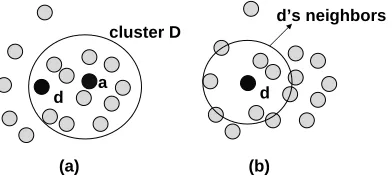
From the viewpoint of data augmentation, the clustering-based language model can be regarded as “expanding” a document with more data from the cluster that contains the document. This is intu-itively better than simply expanding every document with the same collection language model as in the case of JM or Dirichlet smoothing. Looking at it from this perspective, we see that, as the “extra data” for smoothing a document model, the cluster con-taining the document is often not optimal. Indeed, the purpose of clustering is to group similar doc-uments together, hence a cluster model represents well the overall property ofallthe documents in the cluster. However, such an average model is often not accurate for smoothing each individual document. We illustrate this problem in Figure 1(a), where we show two documentsdand ain cluster D. Clearly
the generative model of cluster D is more suitable
for smoothing documentathan documentd. In
gen-eral, the cluster model is more suitable for smooth-ing documents close to the centroid, such asa, but is
inaccurate for smoothing a document at the bound-ary, such asd.
To achieve optimal smoothing, each document should ideally have its own cluster centered on the document, as shown in Figure 1(b). This is pre-cisely what we propose – expanding each document with a probabilistic neighborhood around the doc-ument and estimate the docdoc-ument model based on such a virtual, expanded document. We can then ap-ply any simple interpolation-based method (e.g., JM or Dirichlet) to such a “virtual document” and treat the word counts given by this “virtual document” as if they were the original word counts.
cluster D
d d
d’s neighbors
(a) (b)
[image:4.612.365.491.55.143.2]a
Figure 1: Clusters, neighborhood, and document ex-pansion
clearly defined concept. In the narrow sense, only a few documents close to the original one should be included in the neighborhood, while in the wide sense, the whole collection can be potentially in-cluded. It is thus a challenge to define the neighbor-hood concept reasonably. Secondly, the assumption that neighbor documents are sampled from the same generative model as the original document is not completely valid. We probably do not want to trust them so much as the original one. We solve these two problems by associating a confidence value with every document in the collection, which reflects our belief that the document is sampled from the same underlying model as the original document. When a document is close to the original one, we have high confidence, but when it is farther apart, our confi-dence would fade away. In this way, we construct a probabilistic neighborhood which can potentially include all the documents with different confidence values. We call a language model based on such a neighborhood document expansion language model (DELM).
Technically, we are looking for a new enlarged document d0 for each document d in a text
collec-tion, such that the new document d0 can be used
to estimate the hidden generative model of d more
accurately. Since a good d0 should presumably be
based on both the original documentdand its
neigh-borhoodN(d), we define a functionφ:
d0 =φ(d, N(d)). (1)
The precise definition of the neighborhood con-cept N(d) relies on the distance or similarity
be-tween each pair of documents. Here, we simply choose the commonly used cosine similarity, though other choices may also be possible. Given any two document modelsX and Y, the cosine similarity is
[image:4.612.90.286.59.148.2]d
Figure 2: Normal distribution of confidence values.
defined as:
sim(X, Y) =
P
ixi×yi
pP
i(xi)2×Pi(yi)2
.
To model the uncertainty of neighborhood, we as-sign a confidence valueγd(b)to every documentbin the collection to indicate how strongly we believeb
is sampled fromd’s hidden model. In general,γd(b) can be set based on the similarity of band d – the
more similar b and d are, the larger γd(b) would be. With these confidence values, we construct a probabilistic neighborhood with every document in it, each with a different weight. The whole problem is thus reduced to how to defineγd(b)exactly.
Intuitively, an exponential decay curve can help regularize the influence from remote documents. We therefore wantγd(b)to satisfy a normal distribution centered around d. Figure 2 illustrates the shape
of this distribution. The black dots are neighbor-hood documents centered around d. Their
proba-bility values are determined by their distances to the center. We fortunately observe that the cosine sim-ilarities, which we use to decide the neighborhood, are roughly of this decay shape. We thus use them directly without further transformation because that would introduce unnecessary parameters. We set
γd(b)by normalizing the cosine similarity scores :
γd(b) =
sim(d, b)
P
b0∈C−{d}sim(d, b0)
.
Function φ serves to balance the confidence
be-tweendand its neighborhoodN(d)in the model
es-timation step. Intuitively, a shorter document is less sufficient, hence needs more help from its neighbor-hood. Conversely, a longer one can rely more on itself. We use a parameterαto control this balance.
the following pseudo term count:
c(w, d0) = αc(w, d) + (1−α)
× X
b∈C−{d}
(γd(b)×c(w, b)),
We hypothesize that, in general,Θdcan be estimated more accurately fromd0 rather thanditself because d0 contains more complete information about Θd. This hypothesis can be tested by by comparing the retrieval results of applying any smoothing method tod with those of applying the same method tod0.
In our experiments, we will test this hypothesis with both JM smoothing and Dirichlet smoothing.
Note that the proposed document expansion tech-nique is quite general. Indeed, since it transforms the original document to a potentially better “ex-panded document”, it can presumably be used to-gether with any retrieval method, including the vec-tor space model. In this paper, we focus on evalu-ating this technique with the language modeling ap-proach.
Because of the decay shape of the neighborhood and for the sake of efficiency, we do not have to ac-tually use all documents inC−{d}. Instead, we can
safely cut off the documents on the tail, and only use the topM closest neighbors for each document. We
show in the experiment section that the performance is not sensitive to the choice of M when M is
suf-ficiently large (for example100). Also, since
doc-ument expansion can be done completely offline, it can scale up to large collections.
3 Experiments
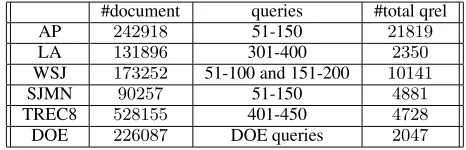
We evaluate the proposed method over six repre-sentative TREC data sets (Voorhees and Harman, 2001): AP (Associated Press news 1988-90), LA (LA Times), WSJ (Wall Street Journal 1987-92), SJMN (San Jose Mercury News 1991), DOE (De-partment of Energy), and TREC8 (the ad hoc data used in TREC8). Table 1 shows the statistics of these data.
We choose the first four TREC data sets for per-formance comparison with (Liu and Croft, 2004). To ensure that the comparison is meaningful, we use identical sources (after all preprocessing). In addi-tion, we use the large data set TREC8 to show that our algorithm can scale up, and use DOE because its
#document queries #total qrel
AP 242918 51-150 21819
LA 131896 301-400 2350
WSJ 173252 51-100 and 151-200 10141
SJMN 90257 51-150 4881
TREC8 528155 401-450 4728
[image:5.612.310.543.58.133.2]DOE 226087 DOE queries 2047
Table 1: Experiment data sets
documents are usually short, and our previous expe-rience shows that it is a relatively difficult data set.
3.1 Neighborhood document expansion
Our model boils down to a standard query likelihood model when no neighborhood document is used. We therefore use two most commonly used smoothing methods, JM and Dirichlet , as our baselines. The re-sults are shown in Table 2, where we report both the mean average precision (MAP) and precision at10
documents. JM and Dirichlet indicate the standard language models with JM smoothing and Dirichlet smoothing respectively, and the other two are the ones combined with our document expansion. For both baselines, we tune the parameters (λfor JM,
andµfor Dirichlet) to be optimal. We then use the
same values ofλorµwithout further tuning for the
document expansion runs, which means that the pa-rameters may not necessarily optimal for the docu-ment expansion runs. Despite this disadvantage, we see that the document expansion runs significantly outperform their corresponding baselines, with more than15%relative improvement on AP. The
parame-tersM andαwere set to100and0.5, respectively.
To understand the improvement in more detail, we show the precision values at different levels of recall for the AP data in Table 3. Here we see that our method significantly outperforms the baseline at ev-ery precision point.
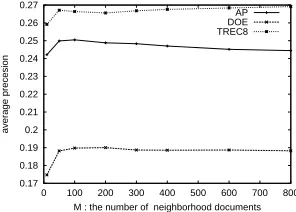
In our model, we introduce two additional param-eters: M andα. We first examineM here, and then
study αin Section 3.3. Figure 3 shows the
perfor-mance trend with respect to the values of M. The
x-axis is the values ofM, and the y-axis is the
non-interpolated precision averaging over all50queries.
Data JM DELM+JM (impr. %) Dirichlet DELM + Diri.(impr. %) AP AvgPrec 0.2058 0.2405 (16.8%***) 0.2168 0.2505 (15.5%***)
[image:6.612.126.486.55.131.2]P@10 0.3990 0.4444 (11.4%***) 0.4323 0.4515 (4.4%**) DOE AvgPrec 0.1759 0.1904 (8.3%***) 0.1804 0.1898 (5.2%**) P@10 0.2629 0.2943 (11.9%*) 0.2600 0.2800 (7.7%*) TREC8 AvgPrec 0.2392 0.2539 (6.01%**) 0.2567 0.2671 (4.05%*) P@10 0.4300 0.4460 (3.7%) 0.4500 0.4740 (5.3%*)
Table 2: Comparisons with baselines. *,**,*** indicate that we accept the improvement hypothesis by Wilcoxon test at significance level 0.1, 0.05, 0.01 respectively.
AP, TREC queries 51-150
Dirichlet DELM+Diri Improvement(%)
Rel. 21819 21819
Rel.Retr. 10126 10917 7.81% *** Prec.
0.0 0.6404 0.6605 3.14% *
0.1 0.4333 0.4785 10.4% *** 0.2 0.3461 0.3983 15.1% *** 0.3 0.2960 0.3496 18.1% *** 0.4 0.2436 0.2962 21.6% *** 0.5 0.2060 0.2418 17.4% *** 0.6 0.1681 0.1975 17.5% *** 0.7 0.1290 0.1580 22.5% *** 0.8 0.0862 0.1095 27.0% ** 0.9 0.0475 0.0695 46.3% **
1.0 0.0220 0.0257 16.8%
[image:6.612.76.297.187.361.2]ave. 0.2168 0.2505 15.5% ***
Table 3: PR curve on AP data. *,**,*** indicate that we accept the improvement hypothesis by Wilcoxon test at significant level 0.1, 0.05, 0.01 respectively.
M when M is sufficiently large, namely 100. The
reason is twofold: First, since the neighborhood is centered around the original document, whenM is
large, the expansion may be evenly magnified on all term dimensions. Second, the exponentially decay-ing confidence values reduce the influence of remote documents.
3.2 Comparison with CBDM
In this section, we compare the CBDM method us-ing the model performus-ing the best in (Liu and Croft, 2004)1. Furthermore, we also set Dirichlet prior
pa-rameterµ= 1000, as mentioned in (Liu and Croft,
2004), to rule out any potential influence of Dirichlet smoothing.
Table 4 shows that our model outperforms CBDM in MAP values on four data sets; the improvement
1We use the exact same data, queries, stemming and all other preprocessing techniques. The baseline results in (Liu and Croft, 2004) are confirmed.
0.17 0.18 0.19 0.2 0.21 0.22 0.23 0.24 0.25 0.26 0.27
0 100 200 300 400 500 600 700 800
average precesion
M : the number of neighborhood documents AP DOE TREC8
Figure 3: Performance change with respect toM
CBDM DELM+Diri. improvement(%)
AP 0.2326 0.2505 7.7%
LA 0.2590 0.2655 2.5%
WSJ 0.3006 0.3113 3.6%
SJMN 0.2171 0.2266 4.3%
Table 4: Comparisons with CBDM.
presumably comes from a more principled way of exploiting corpus structures. Given that clustering can at least capture the local structure to some ex-tent, it should not be very surprising that the im-provement of document expansion over CBDM is much less than that over the baselines.
Note that we cannot fulfill Wilcoxon test because of the lack of the individual query results of CBDM.
3.3 Impact on short documents
Document expansion is to solve the insufficient sam-pling problem. Intuitively, a short document isless sufficient than a longer one, hence would need more “help” from its neighborhood. We design experi-ments to test this hypothesis.
[image:6.612.351.499.192.298.2]average doc length 30% 50% 70% 100% baseline 0.1273 0.1672 0.1916 0.2168 document expansion 0.1794 0.2137 0.2307 0.2505
optimalα 0.2 0.3 0.3 0.4
[image:7.612.81.546.56.115.2]improvement(%) 41% 28% 20% 16%
Table 5: Impact on short documents (in MAP)
0.14 0.16 0.18 0.2 0.22 0.24 0.26
0.1 0.2 0.3 0.4 0.5 0.6 0.7 0.8 0.9
average precision
alpha 30%
50% 70% 100%
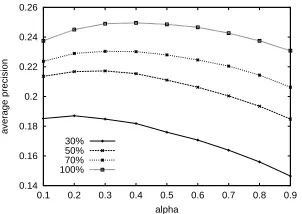
Figure 4: Performance change with respect toα
of documents but a shorter average document length. Table 5 shows the experiment results over docu-ment sets with different average docudocu-ment lengths. The results indeed support our hypothesis that doc-ument expansion does help short docdoc-uments more than longer ones. While we can manage to improve
41%on a30%-length corpus, the same model only
gets16%improvement on the full length corpus.
To understand howαaffects the performance we
plot the sensitivity curves in Figure 4. The curves all look similar, but the optimal points slightly migrate when the average document length becomes shorter. A 100% corpus gets optimal at α = 0.4, but 30%
corpus has to use α = 0.2 to obtain its optimum.
(All optimalαvalues are presented in the fourth row
of Table 5.)
3.4 Further improvement with pseudo feedback
Query expansion has been proved to be an effec-tive way of utilizing corpus information to improve the query representation (Rocchio, 1971; Zhai and Lafferty, 2001a). It is thus interesting to examine whether our model can be combined with query ex-pansion to further improve the retrieval accuracy. We use the model-based feedback proposed in (Zhai and Lafferty, 2001a) and take top 5 returned
docu-ments for feedback. There are two parameters in the model-based pseudo feedback process: the noisy
pa-DELM pseudo DELM+pseudo Impr.(%) AP 0.2505 0.2643 0.2726 3.14%*
LA 0.2655 0.2769 0.2901 4.77%
TREC8 0.2671 0.2716 0.2809 3.42%** DOE 0.1898 0.1918 0.2046 6.67%***
Table 6: Combination with pseudo feed-back.*,**,*** indicate that we accept the improve-ment hypothesis by Wilcoxon test at significant level 0.1, 0.05, 0.01 respectively.
[image:7.612.110.261.148.255.2]pseu. inter. combined (%) z-score AP 0.2643 0.2450 0.2660 (0.64%) -0.2888 LA 0.2769 0.2662 0.2636 (-0.48%) -1.0570 TREC8 0.2716 0.2702 0.2739 (0.84%) -1.6938
Table 7: Performance of the interpolation algorithm combined with the pseudo feedback.
rameterρand the interpolation parameterσ2. We fix ρ= 0.9and tuneσto optimal, and use them directly
in the feedback process combined with our models. (It again means thatσis probably not optimal in our
results.) The combination is conducted in the fol-lowing way: (1) Retrieve documents by our DELM method; (2) Choose top 5 document to do the model-based feedback; (3) Use the expanded query model to retrieve documents again with DELM method.
Table 6 shows the experiment results (MAP); in-deed, by combining DELM with pseudo feedback, we can obtain significant further improvement of performance.
As another baseline, we also tested the algorithm proposed in (Kurland and Lee, 2004). Since the al-gorithm overlaps with pseudo feedback process, it is not easy to further combine them. We implement its best-performing algorithm, “interpolation” (labeled as inter. ), and show the results in Table 7. Here, we use the same three data sets as used in (Kurland and Lee, 2004). We tune the feedback parameters to optimal in each experiment. The second last column in Table 7 shows the performance of combination of the “interpolation” model with the pseudo feedback and its improvement percentage. The last column is the z-scores of Wilcoxon test. The negative z-scores indicate that none of the improvement is significant.
4 Conclusions
In this paper, we proposed a novel document expan-sion method to enrich the document sample through exploiting the local corpus structure. Unlike pre-vious cluster-based models, we smooth each doc-ument using a probabilistic neighborhood centered around the document itself.
Experiment results show that (1) The proposed document expansion method outperforms both the “no expansion” baselines and the cluster-based mod-els. (2) Our model is relatively insensitive to the set-ting of parameterMas long as it is sufficiently large,
while the parameterαshould be set according to the
document length; short documents need a smaller
α to obtain more help from its neighborhood. (3)
Document expansion can be combined with pseudo feedback to further improve performance. Since any retrieval model can be presumably applied on top of the expanded documents, we believe that the pro-posed technique can be potentially useful for any re-trieval model.
5 Acknowledgments
This work is in part supported by the National Sci-ence Foundation under award number IIS-0347933. We thank Xiaoyong Liu for kindly providing us sev-eral processed data sets for our performance com-parison. We thank Jing Jiang and Azadeh Shakery for helping improve the paper writing, and thank the anonymous reviewers for their useful comments.
References
S. F. Chen and J. Goodman. 1998. An empirical study of smoothing techniques for language modeling. Techni-cal Report TR-10-98, Harvard University.
D. Hiemstra and W. Kraaij. 1998. Twenty-one at trec-7: Ad-hoc and cross-language track. InProc. of Seventh Text REtrieval Conference (TREC-7).
R. Kneser and H. Ney. 1995. Improved smoothing for m-gram languagemodeling. InProceedings of the Inter-national Conference on Acoustics, Speech and Signal Processing.
Oren Kurland and Lillian Lee. 2004. Corpus structure, language models, and ad hoc information retrieval. In SIGIR ’04: Proceedings of the 27th annual interna-tional conference on Research and development in in-formation retrieval, pages 194–201. ACM Press.
John Lafferty and Chengxiang Zhai. 2001. Document language models, query models, and risk minimiza-tion for informaminimiza-tion retrieval. In Proceedings of SI-GIR’2001, pages 111–119, Sept.
John Lafferty and ChengXiang Zhai. 2003. Probabilistic relevance models based on document and query gen-eration.
Victor Lavrenko and Bruce Croft. 2001. Relevance-based language models. In Proceedings of SI-GIR’2001, Sept.
Xiaoyong Liu and W. Bruce Croft. 2004. Cluster-based retrieval using language models. InSIGIR ’04: Pro-ceedings of the 27th annual international conference on Research and development in information retrieval, pages 186–193. ACM Press.
D. H. Miller, T. Leek, and R. Schwartz. 1999. A hid-den markov model information retrieval system. In Proceedings of the 1999 ACM SIGIR Conference on Research and Development in Information Retrieval, pages 214–221.
J. Ponte and W. B. Croft. 1998. A language modeling approach to information retrieval. InProceedings of the ACM SIGIR, pages 275–281.
J. Rocchio. 1971. Relevance feedback in information re-trieval. InThe SMART Retrieval System: Experiments in Automatic Document Processing, pages 313–323. Prentice-Hall Inc.
Amit Singhal and Fernando Pereira. 1999. Document expansion for speech retrieval. In SIGIR ’99: Pro-ceedings of the 22nd annual international ACM SIGIR conference on Research and development in informa-tion retrieval, pages 34–41. ACM Press.
E. Voorhees and D. Harman, editors. 2001. Proceedings of Text REtrieval Conference (TREC1-9). NIST Spe-cial Publications. http://trec.nist.gov/pubs.html. Chengxiang Zhai and John Lafferty. 2001a.
Model-based feedback in the KL-divergence retrieval model. InTenth International Conference on Information and Knowledge Management (CIKM 2001), pages 403– 410.