Investigating pupils’ interactions around digital texts: a
spatial perspective on the ‘classroom-ness’ of digital
literacy practices in schools.
BURNETT, Cathy <http://orcid.org/0000-0001-6087-244X>
Available from Sheffield Hallam University Research Archive (SHURA) at: http://shura.shu.ac.uk/15166/
This document is the author deposited version. You are advised to consult the publisher's version if you wish to cite from it.
Published version
BURNETT, Cathy (2013). Investigating pupils’ interactions around digital texts: a spatial perspective on the ‘classroom-ness’ of digital literacy practices in schools. Educational Review, 66 (2), 192-209.
Copyright and re-use policy
See http://shura.shu.ac.uk/information.html
1 Investigating pupils’ interactions around digital texts: a spatial perspective on the
‘classroom-ness’ of digital literacy practices in schools
Burnett, C. (2014). Investigating pupils’ interactions around digital texts: a spatial perspective on the ‘classroom-ness’ of digital literacy practices in schools. Educational Review, 66, 2, 192-209.
Abstract
This paper complements debates around use of new technologies and literacy in education by
proposing a focus on “classroom-ness.” It highlights the significance of incidental, everyday
and ephemeral practices associated with classroom technology-use. Using examples from a
study of primary pupils’ interactions around digital texts, it argues that we must acknowledge
the distinctiveness of technology-use in classroom contexts but also see the spaces associated
with those contexts as continually constructed, relational and heterogeneous. This helps us
look beyond binary distinctions - between in/out of school and global/local practices,
on/off-screen and on/off-line activity, material/virtual contexts and official/unofficial discourses - to
recognise the complex and nuanced ways that children make meaning around new
technologies. It is proposed that this theoretical lens – in recognising the complexity of
classroom-ness- can help us better understand the barriers and opportunities associated with
effective integration of new technologies in educational contexts.
2 Introduction
Much has been written about the diversity and range of practices associated with new
technologies and the need for literacy provision in schools to be more aligned to literacies in
everyday life. For some this is about preparing learners for a 21st century workforce
(Partnership for 21st Century Skills, 2007) or drawing on experiences children bring to the
classroom (Pahl and Rowsell,2012). Others emphasise the need to develop new pedagogies
that build on collaborative modes of knowledge generation and see knowledge as distributed
between people and sites rather than ‘owned’ by individuals (Jenkins,2006;Lankshear and
Knobel,2011;Facer,2011). A cross-cutting theme in such work is the potential for networked
technologies to overcome constraints of time and space enabling new and multiple networks
and more distributed and democratic forms of knowledge production.
In response, educators are increasingly finding ways of embedding digital texts within wider
literacy provision and using the internet to enable children to create and interact through
online media (Davies and Merchant,2009;Walsh,2011). This has been enabled by changing
equipment use; in the United Kingdom for example many primary (elementary) schools have
stopped locating computers in isolated laboratories and purchased portable devices such as
laptops or i-pads to be used flexibly across the curriculum. Despite such developments, there
is still work to be done in articulating and implementing appropriate pedagogies that
incorporate new kinds of texts (Livingstone,2009). Research reviews and studies of
educational uses of digital environments have suggested that new technologies are often
integrated in ways that are aligned to existing literacy pedagogies and practices
3 Engagement with digital texts in school is, of course, different from engagement in other
contexts. Use is framed by curricular learning outcomes rather than personal interests, needs
and preferences and can be inhibited by inconsistencies in teacher confidence, unavailability
of equipment, accountability measures linked to print literacies, and safeguarding procedures
which limit internet access. However, accounts of schools’ limited provision- or even
celebratory reports of teachers’ innovative practice- do not tell the whole story. What
children do around and with digital texts in classrooms is also significant. We know, for
example that children re-work schooled practices for their own purposes and that official and
unofficial discourses intersect as children reinterpret school literacy tasks
(Dyson,2002;Maybin,2006). Gaining insights into how this happens is, I suggest, important
to understanding the distinctiveness of technology-use in primary classrooms. If we are to
understand better the opportunities and challenges associated with using new technologies,
we need to know more about the practices associated with them in educational contexts.
In this paper, I argue that such understanding can be enhanced by drawing on theories of
space to investigate and recognise what I call the “classroom-ness” of digital literacy
practices. By “classroom-ness” I emphasise both the distinctiveness of classroom spaces and
their hybridity and fluidity. On one hand, I note how children’s interactions around digital
texts may be a response to their situatedness in classroom settings and so reflect and/or
uphold particular space/s. On the other, I draw on Massey (2005)’s work and Leander and
McKim (2003)’s notion of ‘siting’ across on/offline contexts to challenge the notion of
‘classroom’ as a single space and explore how children’s meaning-making is associated with
multiple spaces which articulate with each other in different ways. I illustrate this argument
4 argue that this perspective on classroom-ness - emphasising both distinctiveness and
hybridity and fluidity - can make an important contribution to highlighting the possibilities
for meaning-making that open-up (or not) when children engage with digital texts in
classrooms.
Space and educational contexts
This work builds on previous research into relationships between pupils, learning and the
physical environment. Some of this has focused on how the material environment-
architecture and artefacts - reflects and reinforces assumptions about learning, curricula and
the purpose of schooling (Lawn and Grosvenor,2005). Dixon (2007) for example describes
how organisation and availability of resources may help construct different kinds of ‘literate
subjects’. At the same time space can be seen as continually under construction and produced
through reflexive interactions between the physical environment, ideologies and social
practice (Lefebvre,1991;Soja,1996). As Lefebvre’s seminal work on space explores, space is
not a fixed background to social action but is socially produced. What people do is influenced
by spaces but spaces in turn are shaped by what people do, how people conceive them and
what they feel spaces should be like. This reflexive dynamic can generate possibilities for
change.
We see this in Jewitt, Bezemer, Jones and Kress’s multimodal analysis of a secondary
(subject) English classroom (Jewitt et al,2009) which explores how changes to resources
generated a “new material culture of secondary classrooms” (Jewitt and Jones,2005). They
note how displays, arrangements of desks and other equipment are important to how pupils
5 affordances of digital texts but “stuff” (Miller,2010) that is significant to meaning-making.
However, Jewitt and Jones also note how teachers draw on artefacts in various ways – as they
carry, make, display, and arrange them. In doing so, they improvise with and around
available technologies and help create the material culture of their classrooms. Jewitt and
Jones argue that, “New material cultures are as much a result of teacher agency as
governmental demand” (2005, 205). The character of educational space is not just determined
by the policies, values and resource decisions that influence the design of the material
environment but is provisional, generated through interactions between teachers, pupils,
architecture and available tools.
Nespor’s (1997) longitudinal study of one school highlights the complex and multiple factors
that contribute to this provisionality. He traces the web of practices – political, cultural,
embodied, adult and child-initiated, official and unofficial - that play out around a school
(Nespor,1997). He argues that we must avoid seeing a school as a “bounded system” (p.xi)
and suggests that “we have to peel back its walls and inspect the strings and rhizomes linking
it to the outside world (which is no longer outside)” (p.xi). Spaces therefore may be defined
by “articulations” (Nespor, 1997,171) between experiences in different domains and as such
are constantly shifting. Educational space is multi-layered and highly complex.
Acknowledging such complexity has implications for how we see relationships between
children’s identities and school literacy practices. Work in the field of new literacy studies
has highlighted the situatedness of literacy, and the reflexive relationships between literacies,
identities, and context (Barton and Hamilton,1998; Barton,2007;Street,1984). Various
6 example in her analysis of use of a writing table in an early years setting, Rowe (2008) notes
how children co-constructed their literate identities with adults as they interacted around
writing activities. At the same time we know from analyses of children’s interactions in
classroom contexts that official spaces are inflected by unofficial purposes as children
re-work and re-purpose tasks for their own ends (Dyson,2002; Maybin,2006). Intersections
between literacy and identity are not just confined to schooled versions of what makes a
‘good’ reader and writer - but play out differently according to different purposes. Children
may use their reading or writing as an ‘act of identity’ (Burgess and Ivanic,2010) in complex
ways; whilst physically located in classrooms, their identities may be multiple or ‘laminated’
(Holland and Leander, 2004).
Investigating ‘siting’ in on/offline educational contexts
In this article, I draw on Massey’s work to explore how a spatial perspective can be used to
examine the complexity of meaning-making around digital texts in classrooms. Massey
suggests three propositions: space is a “product of inter-relations”, “always under
construction” and consists of “coexisting trajectories” (Massey,2005, 9). By challenging the
idea that space is bounded in terms of location, her work both highlights the significance of
individual pathways and practices and recognises the role of broader structural forces. This
helps us see classrooms not just as contained within physical boundaries, but connected in
multiple ways to other places and the practices and meanings associated with them.
Notions of space are of course further complicated by online activities. Rather than seeing
digital technology as generating distinct virtual spaces, studies have emphasised that online
and offline environments are always inter-twined and embedded in broader social practices
(Leander and McKim,2003; Hine,2000). What happens offline helps construct how online
7 Just as the groundedness of virtuality ties it to a specificity of location so too space
and place are altered in their physicality and in their meaning through their
embeddedness in networks of communication. The ‘virtual’ world depends on and
further configures the multiplicities of physical space. This has ever been so; the new
media in that sense are not new; but they do reconfigure (or have the potential to
reconfigure) how these networks will operate. (2005,96)
If this is the case, we need to find ways of capturing relationships between what happens on
and off line and avoid seeing these as separate domains (Hine,2000). Leander and McKim’s
notion of “siting as a productive process” is useful here (Leander and McKim, 2003,213).
“Siting” refers to the processes through which spaces are produced. Rather than seeing digital
literacy practices as situated in particular sites – with location as the background to practice- I
argue that we need to pay attention to how literacy practices themselves work to establish or
site certain kinds of spaces. This helps us understand the kinds of literate identities available
and recognise the complexity of meaning-making across on/offscreen and on/offline
environments.
Studying siting
In exploring why it is helpful to examine the processes of “siting”, I use examples from a
small-scale study of technology-use in four primary classrooms in the United Kingdom. In
providing these examples, I do not seek to make generalisations but to illustrate how this
theoretical lens can help us better understand the barriers and opportunities associated with
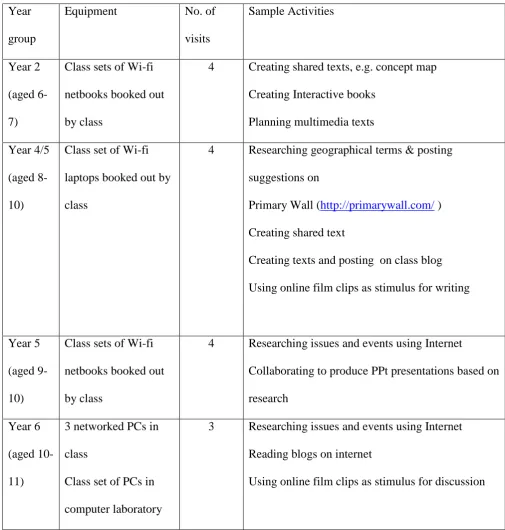
8 The teachers in these classrooms were all interested in the implications of new technologies
for literacy. Two were approached directly whilst two were recruited via an invitation to
participants on a Masters course on literacy pedagogy. The age of children, number and
length of observations are summarised in Table 1, which also includes information about
available equipment and activities observed. Visits were arranged when teachers had planned
for children to use what I called ‘networked’ or digitally connected texts. These included the
internet and various online resources as well as shared documents and wikis. During visits, I
conducted non-participant observations (total of 2530 minutes) and interviewed teachers and
children about their perceptions of lessons observed, their digital practices within and beyond
school, and attitudes towards these. I also examined texts accessed and produced. The
examples presented here are taken from observation data.
Sessions observed were not necessarily typical of ongoing practice; the teachers told me they
used these visits to experiment with new digital resources. The limited time spent in each
setting also meant that I was unable to observe individuals in detail or over time and gained
only brief insights into the social and cultural workings of each classroom. I was however
able to look across a range of events to explore different kinds of relationships between
space, practice and new technologies.
I relied on field-notes rather than audio/audiovisual recordings. Whilst this limited the detail
of my record and analysis, it enabled me to respond rapidly to changing patterns of
interactions, sometimes focusing on the whole class, sometimes individuals, pairs or groups.
Like Maybin (2006) and Dyson (2002), I was particularly interested in what occurred in
between and around official tasks. This provided insights into how children made sense of
9 Elsewhere I have argued (Burnett,2011a) that it is helpful to see space across on/offline
environments in terms of three interconnected dimensions: material, connected and textual.
The material refers to the physical dimension (bodies, walls, equipment, furniture and so
on), the textual to the words, images, etc on screen, and the connected to the people, places
and texts evoked during a literacy event; these might include places and people virtually
co-present (e.g. through online communication) as well as thoughts of people and places
prompted by texts. In distinguishing between these three dimensions, I recognise that texts
are both material and textual (Ormerod & Ivanic,2002) but find the
textual/material/connected distinction useful in helping to address the slipperiness of the
textual in digital contexts (websites, virtual worlds, etc); this extends beyond what is
immediately visible in a text’s material form. Importantly, I see material, textual and
connected dimensions as inter-related and suggest that together they help us to focus on
on/offline and on/offscreen as part of the same socially produced space.
In considering activity across these three dimensions, I observed how children moved around
the classroom and how they interacted physically with texts, equipment, objects and each
other (material); influenced by multi-modal analyses of interactions (Jewitt,2009), I noted not
only verbal but gestural, postural and positional aspects of meaning-making. I also observed
what children did on screen: features added, altered and deleted, screens visited and searching
strategies used (textual). Finally I noted any references to experiences from other times and
places, including comments, memories or questions related to their lives or to content
encountered through online texts (connected).
10 I used initial coding of incidents and then repeated re-readings of the data to consider how
children drew on resources available to them - texts, experiences, artefacts and each other. I
explored how this seemed to be linked to siting, considering who or what was excluded or
included, what mattered and what seemed to reinforce or challenge boundaries. I then used
constant comparison analysis to identify different categories of events that seemed significant
to the kinds of spaces sustained or generated. Wary of research that mines classrooms for data
with little regard for teachers’ perspectives (Comber,2007), I held a series of meetings with
the teachers to review my ongoing analysis and discuss the implications of the work. This
process of analysis led to the conceptualisation of classroom-ness described in this paper.
It is worth recognising some of the challenges faced. Defining a field is always problematic
(O’Toole,2010) as it implies a boundedness to practice that assumes knowledge of the
‘horizon of the lifeworld’ (Schutz,1973) and also contradicts the notion of space as hybrid
and fluid. This is particularly problematic in studies of on/offline experience (Hine,2000). My
analysis involved making decisions about what was significant to individuals and how space
was bounded from moment to moment. Inevitably my observations were selective and
subjective, limited to what I noticed and deemed relevant. Moreover, my physical presence in
the classroom privileged the material; insights into connections with other times or places
were partial, inferred through references made and what I observed on screen.
Despite these limitations, this focus on siting did foreground aspects of classroom digital
literacy practice that I suggest are relevant to discussions about use of digital texts in
educational contexts and I describe these below. I emphasise again that I do not attempt to
arrive at definitive descriptions of possible dimensions of classroom-ness or generalisations
11 in terms of my central argument. The classroom-ness lens may yield insights into different
kinds of spaces for learning in different educational settings. Instead, in describing
classroom-ness, I use examples from the study to explore the kinds of insights that this
theoretical lens can offer.
Some dimensions of the classroom-ness of digital literacy practices
The following examples of classroom-ness relate to minor incidents or events that could be
seen as inconsequential. I suggest however that these kinds of incidents are important in
understanding pupils’ experiences and uses of classroom-ness. I use Massey’s three
propositions – that space is a “product of inter-relations”, “always under construction” and
consists of “coexisting trajectories” (Massey,2005,9) - to structure an exploration of some
dimensions of the classroom-ness of digital literacy practices.
Space as a product of inter-relations: siting through convergence
Massey’s focus on space as a product of inter-relations highlights how spaces are not unitary
bounded entities but are the product of relations between multiple activities in different
domains that influence how people relate to each other and their surroundings. Space is not
fixed but relational. In the classrooms visited, spaces were shaped by decisions made in other
times and places. For example a regional organisation managed the schools’ firewalls,
blocking internet sites seen as unsuitable for school use. All four teachers spoke of resulting
frustrations: sites they regarded as valuable resources were often blocked and could only be
unblocked with a day’s notice. Consequently, opportunities for spontaneous internet use
12 Inter-relations between classrooms and other places, however, were not only forged by
administrators, policy-makers, teachers and head teachers. Inter-relatedness was also evident
as children drew on skills, strategies and preferences associated with out-of-school use, for
example as they chose fonts, changed colours and sizes, re-formatted pages and imported
images or searched the internet for sites encountered elsewhere. They also referenced texts
from outside school in playful ways, through comments, gesture or song. We see this in the
following episode which followed the introduction of a new set of laptops:
Introducing the new laptops Y4/5. As the teacher took the first laptop out of the
computer trolley, there was spontaneous applause from the class. He passed the
laptops out, one between two. One was given to two boys, Ben and Thomas, sitting
next to each other. Thomas stroked the laptop when it was first placed on his table. As
he opened it and pressed “on”, the word “Stone” slowly dissolved into view. [‘Stone’
is the laptop manufacturer’s logo.] Ben commented, “awesome that”. The screen went
black again and he sang, “Duh. Duh.Duh,” in ominous, suspense-movie tones.
Windows Explorer appeared.
The physical stroking of the laptop and the ritual of opening it, switching it on and watching
it boot up seemed to evoke a sense of performance which Ben playfully referenced through
his “Duh.Duh.Duh”. This response connects the event to other times and places; Ben’s
singing parodied the sense of anticipation associated with using the laptops for the first time
whilst also drawing on intertextual references to suspense movies (or at least their
conventions). This short episode was typical of many in which children improvised around
the task in hand, importing references to popular culture as they joked and played around
texts and the equipment that mediated them. In doing so they made use of their own “cultural
13 and voices. Such episodes suggest a classroom-ness that is not unitary or bounded for
children but always connected to other sites and associated experiences. At the same time,
the ways they drew on these cultural resources were shaped by their situatedness in
classrooms. Whilst most children observed had access to home computers, resourcing policy
and practice meant that the opening of the laptops was a special occasion in school. The
children’s spontaneous applause and Ben’s singing were oddly appropriate in the classroom
context – where new resources are rare and classroom technologies often lag behind those
encountered at home. Materiality was significant - the boys’ positioning at the table and the
physical opening of the laptop seemed to prompt their response; sitting next to each other
facing the screen, they were positioned as audience as the text appeared. This example
demonstrates how children’s activities and experiences from different times and locations
converge in any moment. Classroom-ness is not defined only by dominant discourses but
represents something more hybrid. The inter-relatedness of multiple locations - brought into
play partly by children’s actions and perspectives - means that classroom spaces are
constantly shifting. This brings me to another of Massey’s propositions: space is always
under construction.
Space as always under construction - siting through improvisation
In describing space as always under construction, Massey notes how practices constantly
work to sustain or re-work space and this is evident in children’s actions and interactions
around digital texts. Some help sustain official spaces. For example, I saw no child
deliberately visiting sites other than those selected by the teacher – although it would have
been easy to do so- and when they encountered unsanctioned sites, they moved quickly away.
However, children also generated unofficial spaces that over-layered or intersected with
14 framing interactions around screens (in line with different purposes and
preferences);
invading or squatting screens (through unofficial textual improvisation or error); shifts in patterns of organisation (as others’ on-screen activity prompted physical
movement).
I explore each of these below.
Framing interactions around screens
As screens make it easy to see what others are doing, managing public display of texts is an
important part of classroom computer use (Merchant,2007; Jewitt and Jones,2010). This was
significant to siting as children’s responses to the visibility of screens helped them construct
certain kinds of spaces, sometimes more and sometimes less individualised than the teacher
intended. At times, children worked to minimise public display and create individualised
spaces like those associated with writing on paper, e.g. shielding the screen with their arms
and using laptop screens as barriers to bound a temporary working space. Even when
working in pairs, they sometimes operated as parallel individuals, for example taking turns to
type single words or sentences, leaning back and gazing round the classroom when waiting
for their turn. They never discussed these arrangements and I saw no disagreements;
negotiations about turn-taking were unspoken and seemed built on established routines.
At other times, children worked independently on laptops or netbooks but boundaries
between individuals blurred. On one occasion for example, children were working
individually on netbooks to write electronic books using a programme containing a template
15 Public texts Y2. One boy, Ashley, had problems logging onto the netbook because he
had incorrectly entered the user-name and password.
The boy next to him, David, took control, leaning across to log him in.
David noticed that a girl’s story was being projected on the large interactive
whiteboard at the front of the class. (She was working at the teacher’s computer so her
work appeared on the screen). He noticed that she had started writing her story on the
space reserved on the template for the title and comments, “She's done it wrong.”
Next he looked back at his own screen: “I'm just going to make this text box bigger.”
He made the box bigger and then nudged Ashley:
“Hey -look at this.” He used a function key to shift rapidly between 2 screens.
A few minutes later, David read what he’s written to Ashley, who laughed.
David spotted what others were doing on screens and responded by positioning himself as
expert. He did this in different ways, shifting his role from critic to teacher to entertainer.
Public display allowed him various resources to recruit to this identity performance – the
perceived errors he spotted in others work, the manipulation of his text and his own story.
Here we see the reflexive relationship between identity, space and interactions around texts.
His comments and actions seemed to generate a social space centred round the group table in
which positioning in relation to his peers perhaps mattered more than completion of the task.
Invading or squatting screens
Children’s on-screen activity also seemed significant to siting. This included various forms of
on-screen play, including using function keys to toggle between different screens (as David
16 constructing geometrical shapes on the desktop. Sometimes this seemed to be for personal
gratification whilst at others about demonstrating a new trick to friends. Again, actions
seemed specific to classroom technology use, where children often had to wait for others to
log on or locate a site before they received instructions for a task; bandwidth meant that this
was often a slow process. Again on-screen display was significant. As they waited, children
sought reassurance by glancing at others’ screens and checking they were waiting too.
Consequently doodling often spread quickly round the class as children spotted others’
doodles and created similar ones themselves. This was rarely commented upon and was only
ever a minor distraction from the set task.
We could see these spontaneous and ephemeral compositions as a kind of squatting;
unofficial texts briefly resting on official homespaces that rapidly dissolved as the lesson
moved on and the doodles were obliterated. Relying on abstract shapes and patterns, this play
did not seem to subvert official tasks but occurred in the gaps between. Whilst partly enabled
by techniques learned in other places, the classroom location seemed significant. These
practices emerged as children worked on screen with large numbers of peers with technology.
As children worked on the same internal network, screens were invaded by what others, in
the same classroom, did– for example, deleting files, using the wrong log-in code. In some
cases this was a cause of irritation. In others it prompted playfulness and banter, as in the
following example:
Re-naming files Y4/5. Children were all trying to access the same program. The
teacher told them that it had somehow been re-named “lentil” so now everyone
needed to click on the ‘lentil’ icon. One child confessed to having accidentally
re-named it. A child from across the classroom shouted: “Good word!” and tried it out in
17 Such individual actions and accidents sometimes passed into classroom lore. During one
lesson, a boy complained that his laptop had crashed. Another’s comment- “that always
happens to him”- illustrates how children become familiar with each others’ habits,
preferences and frustrations. These kinds of interruptions are analogous to those associated
with other literacy tools- snapped pencils or lost erasers or rulers. Because children must
work together in classrooms with shared equipment, their actions are significant to their
peers’ text-making practices. These jokes however seemed to contribute to a sense of
community as children worked together in an environment where they could see each other’s
work (on screen) and where the screens they used were not reliably their own (as others could
influence what they saw or could do). In this context, unpredictable events were perhaps
normalised through humour which helped to sustain established classroom relations.
Shifts in patterns of organisation
At times, disruptions occurred which prompted slight shifts in how children moved around
the classroom. The following example (explored in more detail elsewhere- see
Burnett,2011b) illustrates how spaces may be reconfigured as texts, bodies, artefacts and
environments come together in different ways.
Writing a shared text: wind turbines Y4/5. Having previously discussed arguments for
building wind turbines, the children were working in groups, each with a laptop. The
teacher made a shared document available via the class blog, containing a table with
two headings: “for” and “against”. He asked the children to use pre-selected internet
sites to research possible counter-arguments and note these on the table. Anyone
could amend the content at any time. The table was also projected onto the interactive
18 At one point, the phrase “block the radar” was added to the table. I watched one
group’s response to this. It initially caused a stir as they did not know what it meant.
Realising that someone else had typed it, Thomas, wandered round until he found the
group responsible and asked them to explain. Ben, from the second group, stood up to
do so: facing Thomas, he used his arms to represent the turbine and mimed how radar
could be blocked by the moving blades. This occurred in the (usually unoccupied)
space between the tables. Once happy with the explanation Thomas returned to his
original table and passed it onto the others there, repeating the mime Ben had used.
Prompted by the appearance of “block the radar”, Thomas left his usual place to search for
the author. Whilst online collaboration in out-of-school contexts may often be characterised
by anonymity, in the classroom he wanted to know who wrote the comment so he could quiz
him about it. The resulting collaboration was not the online collaboration intended by the
teacher – Ben found out what he needed from talking rather than through the shared online
text. However, it did generate a shift. In many primary classrooms, official spaces are upheld
partly through organisation of children’s bodies – they sit at certain tables and are permitted
to move only for particular reasons and this has implications for who they interact with and
how they do so. This event disrupted this; children’s activity in the textual dimension
prompted interactions that ran counter to usual conventions and seemed to briefly help
construct another space. This physical movement also generated affordances for
communicating meaning, allowing the meaning of the text to be transduced (Kress,2003)
from screen to group discussion to gestural re-enactment as information about the wind
19 Co-existing trajectories: fluidity and hybridity in siting
The examples discussed so far exemplify the kinds of classroom-ness that emerged as
children drew on resources and opportunities available to them- official and unofficial. They
emphasise how actions in the material and textual environment are significant to this but also
how spaces are hybrid and fluid as different purposes map onto each other in different ways
and play out in practice. In this section, I explore another aspect of this hybridity and fluidity,
focusing on Massey’s third proposition about “co-existing trajectories”. Massey’s description
of place as a “meeting place” is helpful. For her place is not a unitary concept but involves
the coming together of different activities and experiences around a particular location. In
exploring how this was relevant to these classrooms, I consider how children moved through
and between multiple spaces.
Children were at once members of their group, their class, their school as well as other groups
linked to interests or perceived learning needs. This was evident in the frequent interruptions
and intrusions that occurred; it was common for visitors to arrive – children, teaching
assistants, head teachers and so on – to fetch children for activities such as music lessons,
reading aloud and play rehearsals. These interruptions emphasised that children were
members of multiple communities rendering classroom boundaries more fluid. The
expectation that children respond appropriately to these changing boundaries worked to
reinforce a particular kind of institutional space: a busy, complex, lively space in which
children ultimately do what (and go where) they are told. These changing boundaries
however were also over-layered by experiences of other times and places, as in the following
example:
New Zealand Earthquake (Y5).The children were sitting on rows of chairs in front of
20 earthquake. The teacher began by asking where New Zealand is and one child told her
that it is next to Australia. The teacher took a plastic blow-up globe from the shelf
behind her and pointed out United Kingdom and New Zealand. As she did this, a
child entered from another class and asked if anyone had a PE kit she could borrow.
[“PE kit” is a term used commonly in England to refer to the clothes worn for
physical education or sports lessons.]One child volunteered hers, fetched it and
passed it over.
Meanwhile the teacher continued with the lesson. She projected Google Maps
(http://maps.google.co.uk/) onto the screen in front of the children and zoomed in on
New Zealand. One child asked, “Shall we turn the lights off?” The teacher agreed
and the child did so. As they looked at the map, the teacher invited the children to
make comments about what they saw. Responses included:
“In Year One we used to have this person called Keaton and he lives in New
Zealand and he might be killed.”
“My next-door neighbour- he might be able to move out there.”
“My mum’s got an i-pod – she can see the whole world and it spins round.”
“And I went on Google Earth at home and you can play with it.”
This incident is situated in different locations. For example (and not exclusively), the children
were simultaneously in:
the teaching area in front of the board (arranged to support the teacher in leading
21 the classroom (associated with shared responsibility for the material environment
– illustrated as the child offers to turn off the lights to make visible an image on
the electronic whiteboard);
the school (with its assumptions about communal property as demonstrated by the
willing sharing of PE kits);
area surrounding school (with connections to home and friends);
the United Kingdom (defined in opposition to distant New Zealand);
the world.
We could see these locations in ever widening concentric circles: the classroom within the
school within the locality within the country within the world. However, we also need to
recognise the fluidity with which relationships between these locations were experienced.
The blow-up globe and Google Maps were introduced to help explore the wider world
beyond the classroom just as Google Earth (earth.google.com) and the i-pod mediated
encounters with the wider world at home. These artefacts and texts however were used within
local sites and used in ways that reflected and shaped these local spaces; playing on Google
Earth or watching a spinning Earth may feel different and mean different things at home and
at school.
At the same time, however, we gain insights into how children’s felt experiences beyond the
physical classroom space were significant to meaning-making within it. Studies of children’s
perceptions of place have shown us how children’s experiences of educational environments
are inflected by personal and individual resonances, linked for example to past events and
relationships (Clark,2010; Kelloch,2011). These children’s responses show how their
classroom experience of texts can be similarly inflected. In their responses to Google Maps,
22 distant events through felt connections to familiar experience. They also referred to their
wider experience of texts (Google Earth) and equipment (the i-pod). Multiple connections
and resonances mean that classroom internet use – like other classroom activities- is always
patterned by other uses in other sites and other experiences evoked by texts encountered.
Classroom literacy practices may be experienced differently for individuals and characterised
by intersections between what each brings to each moment (Burnett,2011b). Rather than
seeing locations within concentric circles, we could see these circles as constantly shifting,
foregrounded differently and intersecting with each other in different ways at different times.
Different locations dissolve into each other and merge so that places are felt in different
ways.
Conceptualising the classroom-ness of digital literacy practices: boundedness, fluidity
and hybridity
Massey’s tripartite conceptualisation of space - as “product of inter-relations”, “always under
construction” and consisting of “coexisting trajectories”, I argue, prompts us to acknowledge
two seemingly contradictory ideas: that classrooms are distinct sites for digital practices, and
that classroom spaces are fluid and hybrid. We can, I suggest, see how these two
contradictory ideas intersect by investigating what happens as children interact around digital
texts, as in the examples provided above. Interestingly all the incidents described here are
incidental and ephemeral. They are not unique or remarkable but the kinds of events that
occur every day in classrooms whether or not children are using new technologies. By
focusing on such examples we see how children’s responses to digital texts are framed by
locally negotiated meanings but also connected to other times and places and exist within
intersecting and longer trajectories. A focus on classroom-ness can help us see how
23 everyday classroom literacy practices. We see how what happens in the material, textual and
connected dimensions produce each other in multiple and complex ways.
Leander and McKim, provide us with a variety of ways of conceptualising siting across
on/offline spaces. Two of these- boundedness and flow- are particularly useful here. Looking
at boundedness emphasises who or what is included in a literacy event and who or what is
excluded. A focus on flow foregrounds the “paths of literacy practice” generated as
individuals move between different resources, purposes and media. I argue that in exploring
classroom-ness we need to recognise both boundedness and flow. A kind of settling occurs as
particular aspects are foregrounded and a space is bounded to privilege some people,
resources and meanings and exclude others. At the same time, flow is inevitable as each
moment resonates with other times and locations.
Of course dominant discourses of literacy education and primary practice as well as
frameworks and restrictions introduced by policy- makers are significant to the spaces
generated through and around new technologies in classrooms. We see this in various studies
of classroom practice, new technologies and teacher identity (Burnett,2011c; Honan,2010;
Merchant,2010). However we cannot conflate classroom-ness with regulation.
Classroom-ness does not just arise from what is or is not officially sanctioned. It is constructed through
classroom practices that are partly inflected by pupils’ preferences and purposes. This raises
questions about how different spaces – and the identities and activities associated with them -
are foregrounded and backgrounded.
In considering this complexity it is useful to re-visit some of the binaries that have patterned
our discussions around digital literacy practices. These include those linked to where things
24 global/local (Prinsloo, 2005; Barton, 2010);
in-school/out of school (Marsh,2003);
on-screen/off-screen (Leander and McKim,2003).
Also, our perceptions of the status and power relations associated with different kinds of
activities:
institutional/vernacular (Barton and Hamilton,1998);
official/unofficial (Maybin,2006;Dyson,2002).
And in turn our perceptions about how activities are experienced and enacted:
individual/collaborative; material/virtual (Hine,2000).
As has been argued (Bulfin and Koutsogiannis, 2012), such binaries can over-simplify our
understanding of the locatedness of literacy. Much has been written about the slippery
relationship between the global and local and how the “global” is, as Livingston (2010,781)
writes, ‘“local” at every point.” Prinsloo (2005) explores how new literacies are recruited as
‘placed resources’, noting how new technologies are used in ways that are site specific but
also also inflected by global movements. Barton (2010) meanwhile argues that the local is
always global- as literacies flow across sites mediated through equipment and networks that
work across global domains. A focus on the classroom-ness of digital literacy practices
highlights a similar kind of slipperiness in relation to the global/local and other binaries. It
helps us see how events at school are inflected by what happens elsewhere and how the
official and unofficial mingle in children’s digital practices. This in turn illuminates how
25 in different ways and children are positioned differently- and orientate themselves as readers
and writers differently- at different moments. It may also help us see how opportunities for
collaboration present opportunities to achieve individual purposes and how individual actions
can generate new ways of working together. Perhaps most pertinently we may also see how,
as Massey (2005,96) writes, “The ‘virtual’ world depends on and further configures the
multiplicities of physical space”; we see the “groundedness of virtuality” - as online
environments are inevitably experienced within the material classroom and through embodied
meaning-making– but also how children’s responses to what happens online and onscreen
may trigger different relationships with the physical environment.
Edwards, Ivanic and Mannion’s notion of “scrumpled geographies” (2009,496) is useful here;
they note how different possibilities are folded into any event. From this perspective, we
could see places as folded into places, so that different spaces for literacy are latent within
each space being produced. For Edwards et al, what is interesting is “the work that goes into
mobilizing and stabilizing certain situations as contexts” (2009,496). This is important as it
has significance for how children position themselves in relation to digital texts in the
classroom. A spatial perspective on classroom-ness I suggest, provides us with a lens through
which to examine and evaluate this mobilising and stabilising.
Conclusion
Given the current policy context it is imperative that we find ways of conceptualising and
investigating the complexity of meaning making around digital texts in educational contexts.
National policy statements have called for radical revisions to curriculum and provision: for
26 new technology as “a disruptive force. It innovates, and invents; it flattens hierarchies, and
encourages creativity and fresh thinking” (Gove,2012). In the United States, The National
Education Technology Plan (2010,8) calls for technology to “enable 24/7 and lifelong
learning.” Such ambitious statements, however, need to be tempered by ecological
understandings of educational practice which explore what happens when different policies,
preferences and priorities intersect.
A focus on classroom-ness offers a way of exploring such intersections. It provides a lens
through which to critique what happens in educational contexts and consider: who or what is
included or excluded from any practice; what is seen to count in any literacy event; and how
these different values and perspectives intersect. It alerts us to the flows that occur across
on/offline and on/offscreen literacy practices and the kinds of experiences and feelings made
available as this happens. This draws attention to how official and unofficial practices and
identities merge with each other in different ways and prompts us to question who is
empowered by these spaces and what modalities they are able to recruit to meaning-making.
Of course there is potential to go much further than I have gone in my small scale study: to
document how individuals are involved in siting over time, the kinds of spaces they
co-construct and how they position themselves and are positioned by others in relation to them.
There is also the potential to look more closely at how specific technologies are utilised – and
the different ways that their affordances are used to reflect and help construct different kinds
of spaces. More detailed and extended ethnographic studies, including fine-grained
multimodal interaction analysis (Jewitt, 2009), will be useful here.
If we accept that there is a spatial dialectic – if we see relationships between space and
practice as mutually constructive - then attention to space can also provide new directions for
27 see the world and our role within it. A focus on the heterogeneity of space can help us
understand barriers but also recognise new pedagogical possibilities. It prompts us to
consider how we might draw positively from classroom-ness. Rather than seeing classrooms
as inevitably impoverished sites for digital practices – where access and use is bounded and
curriculum constraints limit what is possible- we can focus on developing those distinctive
dimensions of classroom-ness that help generate productive sites for engaging with new
media. These may include the sense of community and shared engagement generated as large
groups of children work alongside adults in classrooms and which can be used to foster
experimentation, collaboration and creativity. It also includes recognising how spaces
constantly shift as a result of children’s diverse experiences, perspectives and relationships
and identifying the new possibilities that emerge as this happens. This is increasingly
important as we move towards greater integration of mobile technologies, media rich virtual
environments and opportunities for participation (Jenkins,2006) that will further challenge
how we see classrooms and how we plan and organise for learning.
References
Barton, D.2010.People and Technologies as Resources in Times of Uncertainty. Mobilities
6,no. 1:57-65.
Bourdieu, P. 1990.The Logic of Practice. Cambridge: Polity Press.
Allison, G.W. 1999.The implications of experimental design for biodiversity manipulations.
American Naturalist 153, no. 1:26–45.
Barton, D. and Hamilton, M.1998.Local Literacies. London: Routledge.
Barton, D. 2007. Literacy: An introduction to the ecology of written language. Oxford:
28 Bulfin, S. & Koutsogiannis, D.2012.New literacies as multiply placed resources: expanding
perspectives on young people’s literaciesacross home and school. Language and Education.
26, no.4:331-346.
Brandt, D. and Clinton, K.2002.Limits of the Local: Expanding Perspectives on Literacy as a
Social Practice. Journal of Literacy Research 34, no.3:337-356.
Burgess, A. and Ivanic, R.2010.Writing and Being Written: issues of identity across
timescales. Written Communication 27,no.2:228-255.
Clark, A.2010.In-between spaces in postwar primary schools; a micro-study of a ‘welfare
room’ (1977-1993). History of Education 39, no.6:767-778.
Comber, B.2007.The work of women teachers in primary literacy education: knowing and
doing.English in Education 41, no.2:7-26.
Davies, J. and Merchant,G.2009.Web 2.0 for Schools: Learning and Social Participation.
New York, NY: Peter Lang.
Dixon, K. 2007.A space to write: the construction of the writing subject in early schooling.
English Academy Review 24, no.2:85-101.
Dyson, A.H.2002.The Brothers and Sisters Learn to Write: popular literacies in childhood
and school cultures. New York: Teachers College Press.
Edwards, T., Ivanic, R.and Mannion, G. 2009.The scrumpled geography of literacies for
learning.Discourse: Studies in the Cultural Politics of Education 30, no.4:483-499.
Facer, K.2011..Learning Futures: Education, Technology and Socio-Technical Change.
London: Routledge.
Foucault, M.1975.Discipline and Punish: the birth of the prison. Trans. A.Sheridan. New
29 Gove, M..2012.Speech at Bett Show. Accessed 17th July 2012 at URL:
http://www.education.gov.uk/inthenews/speeches/a00201868/michael-gove-speech-at-the-bett-show-2012.
Hine, C.2000.Virtual Ethnography. London:Sage.
Holland, D. and Leander, K. 2004.Ethnographic Studies of Positioning and Subjectivity: An
Introduction. Ethos I,no.32:127-130.
Honan, E. 2010.Mapping discourses in teachers' talk about using digital texts in classrooms.
Discourse: Studies in the cultural politics of education 31, no.2:179-193.
Jenkins, H.2006.Confronting the Challenges of Participatory Culture. Chicago: MacArthur
Foundation. Accessed February 22nd 2012, at URL:
http://digitallearning.macfound.org/atf/cf/%7B7E45C7E0-A3E0-4B89-AC9C-E807E1B0AE4E%7D/JENKINS_WHITE_PAPER.PDF.
Jewitt, C.2009.(ed.)The Routledge Handbook of Multimodal Analysis. London: Routledge.
Jewitt, C. and Jones, K.2005.Managing Time and Space in the New English Classroom. In
Materialities of Schooling, ed. M.Lawn and I. Grosvenor, I., 201-214. Oxford: Symposium
Books.
Jewitt, C., Bezemer, J., Jones, K. and Kress, G.2009.Changing English? The impact of
technology and policy on a school subject in the 21st century. English Teaching: Practice
and Critique 8,no.3:8-20.
Kellock, A.2011.Through the lens: accessing children's voices in New Zealand on well‐being.
International Journal of Inclusive Education 15, no.1:41-55.
Kress, G.2003.Literacy in the New Media Age. London: Routledge.
Lankshear, C. and Knobel, M.2011.New Literacies: Changing Knowledge and Classroom
30 Lawn, M. and Grosvenor, I.2005.(eds.)Materialities of Schooling. Oxford: Symposium
Books.
Leander, K.and McKim, K.2003.Tracing the Everyday “Sitings” of Adolescents on the
Internet: A Strategic Adaptation of Ethnography across Online and Offline Spaces.
Education, Communication and Information 3,no.2:211–40.
Lefebvre, H.1991.The Production of Space. Trans. D. Nicholson-Smith. Oxford: Blackwell.
Livingston, D.2010.Keeping Knowledge in Site. History of Education 39, no.6:779-785.
Livingstone, S.2009.Children and the Internet. Cambridge: Polity Press.
Marsh, J.2003.One Way Traffic: Connections between literacy practices at home and in the
nursery. British Educational Research Journal 29,no.3:369-382.
Massey, D.2005.For Space. London: Sage.
Mavers,D.2007.Semiotic resourcefulness: A young child's email exchange as design. Journal
of Early Childhood Literacy 7,no.2:155-176.
Maybin. J.2006.Children’s Voices: Talk, Knowledge and Identity. Basingstoke: Palgrave.
Merchant, G.2007.Writing the Future in a Digital age. Literacy 41,no.3:118-128.
Merchant, G.2010.3D virtual worlds as environments for literacy learning. Educational
research 52,no.2:135-150.
Miller, D.2010.Stuff. Cambridge: Polity.
Nespor, J.1997.Tangled Up In School: Politics, Bodies, and Signs in the Educational
Process. Abingdon: Routledge.
Ormerod, F. and Ivanic, R.2002.Materiality in children’s meaning-making practices. Visual
Communication 1,no.65:65-91.
O’Toole, P.2010.Locating space in qualitative research: questioning culture through the
corporeal. In New Approaches to Qualitative Research: Wisdom and Uncertainty, ed.
31 Pahl, K. and Rowsell, J.2012.Literacy and Education. London: Sage.
Becta.2009.Harnessing Technology: Next Generation Learning 2008-14. [Online.] Accessed
6th April 2010 at URL:
http://publications.becta.org.uk/display.cfm?resID=37348&page=1835 .
Partnership for 21st Century Skills.2007. Partnership for 21st Century Skills Framework.
Accessed 22nd February 2012 at URL: http://www.p21.org/ .
Prinsloo, M. 2005.The new literacies as placed resources. Perspectives in Education
23,no.4:87-98.
Rowe, D.W. 2008.The Social Construction of Intentionality: Two-Year-Olds’ and Adults’
Participation at a Preschool Writing Center. Research in the Teaching of English, 42,no.40:
387-434.
Schutz, A. and Luckman, T.1973.The Structures of the Life-World. Trans. R.M. Zaner & T.H.
Engelhardt. London: Heinemann.
Scollon, R.2001. Mediated Discourse: The nexus of practice. London: Routledge.
Soja, E.1996.Thirdspace: Journeys to Los Angeles and Other Real and Imagined
Spaces. Oxford: Blackwell.
Street, B. 1984. Literacy in theory and practice. Cambridge University Press.
Street, B. 1995.Social Literacies: critical approaches to literacy in development, ethnography
and education. Harlow: Pearson Education.
United States Department of Education (USDE).2010. Transforming American Education:
Learning Powered by Technology. Draft National Educational Technology Plan 2010.
Accessed 22nd February 2012 at URL
32 Walsh, M.2011. Multimodal Literacy: Researching Classroom Practice. Sydney: e:lit.
Acknowledgements
This project was partly funded by a research grant from the United Kingdom Literacy
33 Table 1 Overview of visits
Year
group
Equipment No. of
visits
Sample Activities
Year 2
(aged
6-7)
Class sets of Wi-fi
netbooks booked out
by class
4 Creating shared texts, e.g. concept map
Creating Interactive books
Planning multimedia texts
Year 4/5
(aged
8-10)
Class set of Wi-fi
laptops booked out by
class
4 Researching geographical terms & posting
suggestions on
Primary Wall (http://primarywall.com/ )
Creating shared text
Creating texts and posting on class blog
Using online film clips as stimulus for writing
Year 5
(aged
9-10)
Class sets of Wi-fi
netbooks booked out
by class
4 Researching issues and events using Internet
Collaborating to produce PPt presentations based on
research
Year 6
(aged
10-11)
3 networked PCs in
class
Class set of PCs in
computer laboratory
3 Researching issues and events using Internet
Reading blogs on internet