PHAM, Thi Song Hanh <http://orcid.org/0000-0002-0764-9182>,
MONKHOUSE, Lien Le and BARNES, Bradley Richard
<http://orcid.org/0000-0002-7258-2877>
Available from Sheffield Hallam University Research Archive (SHURA) at:
http://shura.shu.ac.uk/11763/
This document is the author deposited version. You are advised to consult the
publisher's version if you wish to cite from it.
Published version
PHAM, Thi Song Hanh, MONKHOUSE, Lien Le and BARNES, Bradley Richard
(2017). The influence of relational capability and marketing capabilities on the export
performance of emerging market firms. International Marketing Review, 34 (5),
606-628.
Copyright and re-use policy
See
http://shura.shu.ac.uk/information.html
For Peer Review
The Influence of Relational Capability and Marketing Capabilities on the Export Performance of Emerging Market
Firms
Journal: International Marketing Review Manuscript ID: IMR-07-2014-0235.R2
Manuscript Type: Original Article
For Peer Review
The Influence of Relational Capability and Marketing Capabilities on the Export
Performance of Emerging Market Firms
Abstract
Purpose - Drawing on the resource based view this study focuses on the influence of
relational capability and marketing capabilities on export performance. The study also
examines the interaction effects of relational capability on the marketing capabilities - export
performance relationships.
Design/ methodology/ approach - A stratified random sample of 1,047 exporting firms were
approached. Survey data was collected from 333 Vietnamese exporting firms and analysed
using hierarchical moderated regression.
Findings - The results reveal that a firm’s relational capability not only strengthens the
efficiency of the export pricing capability – performance, marketing intelligence capability –
performance, and marketing communication capability - performance relationships, but is
also the strongest predictor of export performance amongst those capabilities identified.
Whilst engagement in market intelligence, product development, price setting and
promotional activities have a positive payoff, our findings confirm there is less need for
exporters to engage in after-sales service and distribution capabilities.
Originality/value - The study introduces the notion of relational capability alongside export
marketing capabilities as predictors of export performance. We also examine the moderating
influence of relational capability on the link between export marketing capabilities and export
performance. By focusing on Vietnam, the study provides fresh insights surrounding the
development pathway for firms in emerging markets.
Keywords: Relational capability, marketing capabilities, moderating impact, export
performance, the resource-based view, emerging markets, Vietnam.
Paper type: Research paper
For Peer Review
IntroductionIn recent years a growing body of literature has examined the contribution of marketing
capabilities to export performance (Murray et al., 2011; Morgan et al., 2012). However,
despite increased research attention among academics, relatively little has been concluded
within an emerging economy. When studies have been conducted in such markets, namely
China, hardly any attention has focused on the context of firms originating from these
markets. Firms from such markets tend to operate in less affluent environments and often
have more limited resources compared with those from advanced economies (Singh, 2009).
They are also often late to enter the international arena and frequently have less marketing
competence, skills and the knowledge needed to exploit export markets (Zhou et al., 2010).
Entering new markets and engaging in marketing activities in new territories that they
are less familiar with may raise issues of concern and make it difficult for emerging firms to
succeed on an international platform. Due to such resource constraints, the dilemma for these
firms is whether or not they should allocate resources to develop their export marketing
capabilities bearing in mind they frequently do not have core competencies in marketing.
Some empirical case based research suggests that the international success of small
manufacturing exporters from emerging economies may stem from their ability to facilitate
and nurture cooperative market relationships with strategic partners, rather than through
developing their own marketing expertise (Ceglie and Dini, 1999; Ghauri et al., 2003;
Humphrey and Schmitz, 1995).
This raises an interesting question regarding the role and significance of relational
capability as an additional contributor to marketing capabilities for enhancing export
performance. However, relational capability, a firm’s capability to create, develop and
manage business relationships has rarely been examined in conjunction with export
performance. Relational capability has been increasingly considered to play a crucial role in
For Peer Review
determining performance in the industrial marketing literature (Gualati, 1998; Muller and
Halinen, 1999; Ritter et al., 2004). This enables a firm to connect its resources with those of
other firms, which is particularly salient in the case of firms from emerging economies. Due
to being latecomers in terms of their entry into international markets, such firms may be wise
to tap into external resources for developing other capabilities. Building on this argument and
to bridge this void, the study will introduce the notion of relational capability alongside
export marketing capabilities as predictors of export performance among manufacturing
exporters in the emerging market of Vietnam. We also examine the potential moderating
influence of relational capability in strengthening the link between export marketing
capabilities and export performance, which has not previously been considered in the
literature.
The empirical setting of Vietnam for this study is timely bearing in mind the level of
economic development and optimism surrounding this market as we seek to draw fresh
insights from emerging economy exporters beyond China. Since the country joined the WTO
in 2007, Vietnam has established itself as a global production base with an increasing number
of international players sourcing goods from the country. An increasing number of MNEs and
mainland Chinese firms have shifted their production base from China to Vietnam (Zhao,
2011). The low cost base enables Vietnamese firms to effectively compete on price and
consequently export goods with increasing success. As a result, this study aims to provide
fresh insights relating to how such emerging exporters can build on both their relational and
marketing capabilities for generating success upon entering international markets.
Theoretical Background
The resource based view (RBV) (Barney, 1991) can be seen as a normative guide for a firm’s
export activities as it addresses the origins of competitive advantage by arguing that the
For Peer Review
performance differences among firms result from resources which may be firms’ assets or
capabilities that can be used to create inimitable internal capabilities (Murray et al., 2011).
Building on the resource based view of the firm, a number of studies have examinedthe link
between marketing capabilities and performance over the last two decades (Hooley et al.,
1999; Morgan et al., 2003; Murray et al., 2011).
Despite an increasing number of studies that have examined the marketing
capabilities - performance relationship in recent times, relatively little has been concluded
within an emerging economy context. It was not until 2003 did we see research in print that
involved an emerging economy (Fang & Zou, 2009; Morgan et al., 2003; Zou et al., 2003).
The work of Morgan et al. (2003) was particularly insightful as it provided a cross-national
comparison of exporters in both the U.K. and China. It successfully demonstrated the link
between marketing implementation capabilities and export performance across the two data
sets. Another paper by Zou et al. (2003) was equally instrumental in contributing to the field.
Instead of claiming a direct link between marketing capabilities and performance, their study
operationalized marketing capabilities through four unique dimensions resembling the
marketing mix and demonstrated their effect on low-cost advantage and branding advantage
for leveraging performance.
Another study drawing on data from close to 500 export ventures in China by Murray
et al. (2011) demonstrated how marketing capabilities mediate the market orientation -
performance relationship. The discovery of a mediating role for marketing capabilities is
interesting in respect of market orientation, as Morgan et al. (2009) found there to be an
interaction or moderating effect between the two. Also, we see evidence again that there
appears to be no universally accepted measure to capture marketing capabilities and these
authors opted to incorporate three of the four measures developed by Zou et al. (2003) i.e.
pricing capability, product development capability and marketing communication capability.
For Peer Review
This leaves the reader wondering why distribution capability was omitted. Research by Zhou
et al. (2012) found support that marketing capabilities appear more salient for firms operating
in developed rather than emerging countries. It should be noted however that studies
involving emerging markets have typically been undertaken in China. Although our review of
the pertinent literature clearly demonstrates that marketing capabilities play an important role
in enabling effective marketing strategy implementation in export venture operations, there is
no conclusive evidence if the same still holds true in emerging market contexts beyond
China.
Whilst the resource-based view maintains that a company’s unique resources and
capabilities can generate competitive advantage, the network approach assumes that
competence development can accumulate through interaction with other parties (Hakansson
1982, 1989; Hakansson and Snehota, 1995). Building effective relationships therefore serve a
crucial role for enhancing performance (Axelsson, 1992; Hakansson 1982, 1989; Hakansson
and Snehota, 1995). A firm’s ability to tap into appropriate external resources can be more
crucial than its other functional capabilities for leveraging performance (Muller and Halinen
1999; Ritter 1999; Ritter et al., 2004). In considering business relationships as key assets for
firms, several studies have focused on the issues surrounding the management of such
relations, among which, the firm’s capability to manage relationships has emerged as a hot
topic of debate.
Several scholars have attempted to measure and address a firm’s capability to manage
relationships. For example, Anand and Khanna (2000) consider “network capability” as the
number of alliances that firms have been involved in. Lorenzo and Lipparini (1999) regard
“relational capability” as the ability to interact with other companies, based on absorption,
combination and coordination. Ritter (1999) and Ritter and Gemunden (2003) meanwhile
used the term “network competence” to describe a firm’s ability to develop and utilise
For Peer Review
firm relationships. Despite a growth of literature surrounding the subject, it was not until the
work of Walter et al. (2005) that the development of a networking capability measure came
to full fruition.
Despite acknowledging that networking or relational capability has played an
increasingly significant role in determining performance in the industrial marketing literature,
it has been somewhat underutilised in the export marketing literature (see reviews of export
performance by Balabanis et al., 2004; Cavusgil and Zou, 1994; Chetty and Hamilton, 1993;
Katsikeas et al., 2000; Leonidou et al., 2002; Zou and Stan, 1998). This study therefore aims
to bridge this gap by introducing relational capability in an export marketing context.
Building on the resource based view of the firm and the notion that the more
capabilities a firm has the better its performance is likely to be, this study will investigate the
relationship between marketing capabilities and export performance. In addition and arguably
more fundamental, based on the network-led approach, the article considers relational
capability as a predictor of firm performance. Research by Zhou et al. (2010) suggests that a
firm’s ability to develop relationship networks can be particularly salient for enhancing
performance when entering new markets. Relational capability is therefore considered useful
as such skills may prove beneficial for helping to strengthen the relationship between certain
marketing capabilities and performance. In this study we examine the potential impact of
marketing and relational capabilities. In order for a more precise prediction on how each
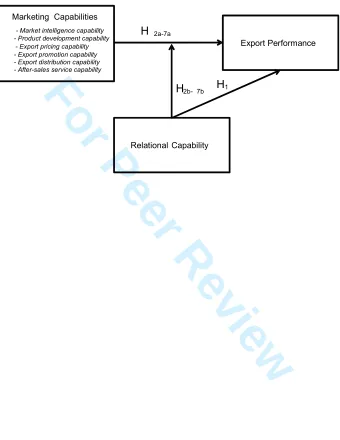
marketing capability influences export performance, in our concept (see Figure 1 below), we
decompose the marketing function into activities that feed into an export marketing process.
[Insert Figure 1 about here please]
For Peer Review
Development of HypothesesRelational Capability and Performance
Developing and maintaining mutually beneficial relationships with business partners have
been recognized as important determinants of a firm’s performance (Axelsson, 1992;
Hakansson, 1982; Hakansson and Snehota, 1995). Within the international context of this
study, relational capability reflects an exporter’s ability to share information and build
long-term relationships with their partners (Lages et al., 2009). This is particularly relevant in the
case of firms from emerging economies as they are latecomers on the global platform and the
possession of firm-specific advantage at home may not be sufficient to help them penetrate
international markets (Yiu, Lau and Bruton, 2007).
In international markets, exporting firms are commonly dependent on a small number
of stakeholders, thus the ability to develop and nurture relationships is crucial for enhancing
competitiveness and for generating business success (Barnes, Yen and Zhou, 2011;
Zolkiewski and Turnbull, 2002). Research by Piercy et al. (1997) suggests that compared
with conventional marketing there is a need to focus more attention on relationship building
when exporting. The capability to develop relationships with customers may therefore be
crucial for enhancing an exporter’s international performance. Moreover, relational capability
can also help export manufacturers to enhance their efficiency in the procurement process,
leading to a source of competitive advantage.
Research by Smirnova et al. (2011) in a Russian context suggests that enhancing a
firm’s relational capabilities can serve as a proxy for leveraging performance. The ability to
develop and manage relationships plays a critically important role in an exporter’s success
(Ling-yee and Ogunmokun, 2001). Thus the stronger and better an exporting firm’s
relationships are, the better it is likely to perform financially (Lages et al., 2009). Based on
this discussion relating to the benefits that relationship building can bring, we posit that:
For Peer Review
H1: High levels of relational capability among emerging economy exporting firms will
positively influence export performance.
Export Marketing Intelligence, Relational Capability and Performance
The acquisition of foreign market knowledge can benefit emerging economy exporting firms
as it prepares them to tackle export market demands and consider the type of offerings that
reflect local market conditions (Day, 1994; Morgan et al., 2003). To a large degree, the
marketing capability of firms is based on market knowledge which provides a resource that
can be held and is difficult for rivals to imitate (Krasnikov and Jayachandran, 2008). In
congruence with earlier studies (c.f. Aaby and Slater, 1989; Madsen, 1987; Zhou et al.,
2010) we posit export market intelligence as a critical factor that can discriminate successful
from unsuccessful exporters and through this lens argue that a firm’s effective capture and
use of such international intelligence can positively affect their export performance.
Export market intelligence frequently plays a crucial role when undertaking business
overseas, as the risks and costs associated with venturing into new international territories are
often more significant than those experienced with expanding sales in domestic markets
(McAuley, 1993). Because the acquisition of market knowledge and access to information
frequently serve as a pre-requisite for growth, those businesses that have a wide breadth of
contacts can utilise their networks to leverage export sales opportunities (Zhou et al., 2010).
Obtaining access to information and acquiring appropriate market knowledge can often prove
fruitful in helping marketers to evaluate their options and make effective marketing decisions
(Leonidou and Theodosiou, 2004). Specifically, emerging economy exporters that have high
capability for developing international relations can exploit opportunities that leverage export
sales. In other words, emerging economy exporting firms’ relational capability facilitates
their ability to acquire market intelligence which can improve export turnover. Based on the
above discussion, we hypothesize (H2) that: 3
For Peer Review
H2a: High levels of export market intelligence among emerging economy exporting firms
will positively influence export performance.
H2b: High levels of relational capability will strengthen the relationship between export
market intelligence capability and export performance.
Product Development, Relational Capability and Performance
Product development capability is defined in terms of the degree to which the firm can
develop and launch new products to satisfy export markets (Zou et al., 2003). In the context
of international markets, we are particularly concerned here with the firm’s ability to develop
new products and augmented services in order to cater for differences in environmental
forces, consumer behaviour, usage patterns and competitive situations (Murray et al., 2011).
It involves the development of a firm’s product and service offerings so they are more
suitable to satisfy the requirements of different consumers in export markets (Morgan et al.,
2012; Vorhies and Morgan, 2005).
Research by Leonidou et al. (2002) confirmed that product development is positively
linked to performance. These scholars posit that such emphasis can provide three key benefits
for exporting firms relating to better customer orientation, pricing flexibility and the ability to
stimulate more innovative thinking surrounding the development of new products for
domestic and international markets. By and large the development of products is considered
to have a significant positive effect on export sales, profits and growth (Zou and Stan, 1998).
In brief, we posit that through having product and service development capabilities to
cater for local markets, emerging economy exporters have a greater propensity for aligning
their offerings with the preferences of foreign customers, thus allowing their goods to be
more widely accepted in international markets. As the development of product-related
advantages cannot often be imitated by competitors, emerging economy exporters that
For Peer Review
provide offerings which are better articulated to meeting customer requirements will have
positional advantages leading to greater market acceptance.
The ability to anticipate changing customer preferences is often useful when adapting
or developing new products. One way to obtain information regarding market preference
trends is through working closely with exchange partners (Barnes, 2005). This is particularly
useful given that the capability to develop close and frequent interaction with buyers often
plays a crucial role in the product development process (Athaide and Stump, 2003).
Relationship development therefore serves as a useful proxy to effective supplier
involvement in the product development process and close relationships enable exchange
parties to learn further about rapid technological changes which ultimately accelerate
innovation (Walter et al., 2003).
Through nurturing close relationships with key exchange parties in advanced
economies, the focal firm is not only able to acquire greater information regarding market
preferences, but can also enhance the technology and innovation levels important for the
appropriate adaptation surrounding its export offerings. This is particularly important when
an emerging economy exporter supplies goods to advanced economies. The ability to
facilitate relationships and exchange information provides a firm with the opportunity to learn
about changing market preferences and trends, thus providing the vital ingredients to enable
them to effectively modify and adapt their offerings to best serve export markets. Relational
capability can therefore facilitate the firm in implementing export product development
responsibility more efficiently. In recognition of these arguments we hypothesize (H3) that:
H3a: High levels of product development capability among emerging economy exporting
firms will positively influence export performance.
H3b: High levels of relational capability will strengthen the relationship between export
product development capability and export performance.
For Peer Review
Export Marketing Communication, Relational Capability and Performance
Export marketing communication capability consists of activities including personal
communication (email, telephone), advertising, making personal visits to see channel partners
or customers and participating in international trade fairs etc. At a practical level, firms that
make personal visits to proactively promote and sell their goods in international markets
often generate export success (Terpstra and Sarathy, 1997). Trade fairs frequently provide an
avenue for exporters to personally communicate the benefits associated with their goods to
customers or potential channel partners who may be unfamiliar with both the supplier and
their product range (Styles and Ambler, 1994). Effectively developing export promotions
programmes can therefore prove valuable for a) seeking opportunities and overcoming
problems in new international markets, b) meeting new customers and obtaining
representation from new channel partners, as well as c) providing valuable support to help
facilitate greater international exposure (Kaynak and Kothari, 1984).
Given the globalization of markets, firms that emphasize differentiation through
advertising and promotion are more likely to succeed in a multitude of diverse markets than
those that do not (Helsen, Jedidi and DeSarbo, 1993). Effective export promotion can
therefore positively affect performance when undertaking export activities (Zou and Stan,
1998). We thus argue that the greater the extent an emerging economy exporter can engage in
export promotional activities and effectively develop an appropriate marketing
communications agenda, the better they are likely to perform in international markets.
Because industrial markets are often more complex, involve relatively more
individuals that can influence the purchase, and transactions are frequently much larger than
in consumer markets (Bonoma and Johnston, 1978), the ability for firms to develop an
effective and professional promotional mix strategy is often crucial to their market success.
Firms with personnel that have effective communication skills and can nurture relations
For Peer Review
through instigating export visits and engaging in appropriate export promotion activities, such
as advertising or trade fair participation have a strong likelihood of achieving international
success. Through having strong relational orientation skills, a firm has the ability to work
with their export partners to develop and implement a promotional policy that is suitable for
the export market. Based on this discussion, we posit the following (H4):
H4a: High levels of export marketing communication capability among emerging
economy exporting firms will positively influence export performance.
H4b: High levels of relational capability will strengthen the relationship between export
marketing communication capability and export performance.
Export Pricing, Relational Capability and Performance
Export pricing capability is referred to here as the extent to which an exporting firm can
effectively use and manage pricing tactics to extract the optimal revenue from the export
market (Dutta et al., 2003; Vorhies and Morgan, 2005; Zou et al., 2003). Price is the only
marketing mix variable that generates revenue and it is particularly important for firms
operating on an international scale to have control over, as it enables them to respond quickly
to market changes, so they can potentially enjoy higher revenues (Murray et al., 2011).
Research by Leonidou et al., (2002) reveals that pricing-related activities provide a means to
appropriate value and can significantly affect export performance.
Whilst Louter et al. (1991) suggest that such diversity relating to foreign markets
makes price adaptation necessary - we argue here that in order for emerging economy firms
to be sustainable on an international scale they need to have some autonomy in terms of the
prices they establish when entering foreign markets. Passively accepting low margins from
channel intermediaries or global procurement agents may therefore represent a recipe for
disaster. On reflection and in response, we posit that the extent to which emerging economy
For Peer Review
exporters are involved in establishing price levels and can flexibly manoeuvre based on
changing customer requirements and the competitive environment is of paramount
importance to the exporting performance of such firms (Cavusgil, 1996; Obadia, 2013;
Zeithaml, Varadarajan, and Zeithaml, 1988).
A key goal in marketing is for the supplier to understand customer needs and respond
by positioning its product offering appropriately in terms of a price value proposition that will
maximise returns. Exporting firms with a broad number of customers can utilise their
network to identify the optimum price that will provide maximum value creation and
appropriation (Palmatier, 2008). Moreover, exporters with strong relationship capability,
who, for example have effective communication and negotiation skills are able to command a
good price on their export orders. In other words, the better an export firm’s relational
capability, the more effective it is likely to be in establishing an appropriate export price for
its offerings which ultimately leads to greater performance (Fink, James, and Hatten, 2011).
Based on this discussion, we hypothesize (H5) that:
H5a: High levels of export pricing capability among emerging economy exporting firms
will positively influence their export performance.
H5b: High levels of relational capability will strengthen the relationship between export
pricing capability and export performance.
Export Distribution, Relational Capability and Performance
Export distribution capability in international markets revolves around providing support for
channel partners and maintaining appropriate channels for delivering value (Vorhies and
Morgan, 2005; Weitz and Jap, 1995; Zou et al., 2003). Such activities can involve operating
sales subsidiaries, channelling goods through host country agents or distributors, as well as
managing the physical movement of goods in export markets. The effort of exporting firms to
For Peer Review
develop distribution channels can often be vital to success. As such, emerging economy
exporters frequently do not have sufficient market knowledge or resources to open overseas
sales subsidiaries and often must rely on agents or distributors to leverage their goods in
foreign markets. Providing distribution support for such channel intermediaries may therefore
prove useful for fostering relational exchange and enhancing export performance (Cavusgil
and Zou, 1994; Leonidou et al., 2002). We therefore argue that emerging economy exporters
that can manage efficient delivery and support their channel partners will be ideally
positioned to succeed in international markets. Based on this argument, we posit that the
greater the extent emerging economy exporters engage with efficient distribution activities
and work effectively with their channel partners, the better their export outcome.
In addition, once a firm develops its export business, it often has a need to further
consider its international distribution responsibility and effectively manage multiple
relationships with other export channel intermediaries. Relationships are particularly seen as
important in an export channel environment as they often require participation from multiple
trading partners to perform activities jointly. Specifically, how exporters and importers
handle inter-firm relationship maintenance problems can contribute directly to the success of
the channel relationship (Ling-yee and Ogunmokun, 2001). Developing a mutually beneficial
relationship and avoiding conflict with a distribution channel member in the export market
cannot be practiced without good relational capability. In other words, the higher the
relational capability, the more effective a firm can positively influence and manage members
of its distribution channel (Yu, Cadeaux and Song, 2013). Following the above discussion,
we hypothesize (H6) that:
H6a: High levels of distribution capability among emerging economy exporting firms will
positively influence export performance.
For Peer Review
H6b: High levels of relational capability will positively strengthen the relationship
between export distribution capability and export performance.
After-sales Service, Relational Capability and Performance
After-sales service capability including customer servicing, warranty provision and spare
parts delivery can often bring about customer satisfaction and value provision. Providing
post-sales support in an export marketing context has been identified as an important attribute
that contributes to an exporting firm’s marketing capabilities (Morgan et al., 2012). The
provision of a warranty for example can augment the value of a product exported, as it can
offset foreign customers’ reservations concerning product performance and reduce
perceptions of risk relating to their purchase. This is particularly true when a firm enters new
overseas or geographically distant markets, as international customers often have concerns
about an exporter’s ability to provide adequate support services (Terpstra and Sarathy, 1997).
Furthermore it has been noted in the literature that customer service i.e. the provision of
pre-sales and after-pre-sales service represents a critical success factor in international markets that is
correlated with export performance (Leonidou et al., 2002).
Paying attention to customers after the sale with responsive proactive service and
support can often set a company apart from its competitors (Galbreath and Rogers, 1999).
Without effective relationship orientation, a firm may become complacent with its customer
base and not meet their requirements. In contrast, exporters with a strong ability to manage
customer relationships often look to provide a desired level of service that will satisfy their
customers so they remain loyal. In other words, high levels of relational capability will
enhance the relationship between after sales service and export sales. Taking the above
discussion into account, we posit that the provision of in market support services among
emerging economy exporters will enhance their performance. Based on our discussion we
hypothesize (H7) that: 3
For Peer Review
H7a: High levels of after-sales service capability provided by emerging economy
exporting firms will positively influence export performance.
H7b: High levels of relational capability will strengthen the relationship between after
sales service and export performance.
Research methods
Emerging market context
The research context for this study is Vietnam, which over recent years has been undertaking
a transition from a state-controlled to a market driven economy, with the aim of becoming
more integrated with world markets (Jenkin, 2004). Up until the end of the 1980s with the
advent of the ‘doi moi’ (renovation) policy in 1986, Vietnam’s international trade was
restricted within the socialist bloc, therefore isolating it from the rest of the world. Over the
past two decades, a combination of trade deregulation and macroeconomic stabilization has
helped bring about healthy economic growth (Kokko et al., 2006; The World Fact Book,
2012). Similar to China and compared with the rest of the region Vietnam stands out for
achieving high economic growth (World Bank, 2010). Due to the national government’s
strong measures to promote export, especially after becoming a member of ASEAN and the
WTO, Vietnam has become a major exporter of garments, crude oil, seafood, rice and a range
of manufactured goods, which total over 57 billion US dollars (General Department of
Vietnam Customs, 2012).
Vietnam is an ideal market for this study, as firstly it represents a country that has
been under-researched among business and management scholars. Second, as an emerging
economy market, it is home to a significant number of manufacturing firms that have not yet
fully embraced the marketing concept. Thus, our study on marketing capabilities is timely
bearing in mind the level of economic development, optimism surrounding the country and a
For Peer Review
need to draw more evidence from emerging economy exporters from other countries outside
China. By focusing on Vietnam, the study also has the potential to shed light on the
development pathway for firms in other emerging economies of the world that share similar
institutional settings. In the context of emerging markets, where international players
frequently visit to locate suppliers, this empirical study aims to provide fresh insights relating
to how such emerging exporters can develop their marketing capabilities and utilise external
relationships for generating success on entering international markets.
Data collection
Prior to developing a research instrument for this study, preliminary discussions were
undertaken with managers in ten exporting firms. This procedure was undertaken to verify
the structure of the proposed research instrument in the context. It was specifically helpful in
clarifying the measurement items proposed. Following on from this, a pre-test was
undertaken with a further thirty managers from several manufacturing industries. The
instrument was initially developed in English and translated into Vietnamese. In order to
achieve linguistic equivalence, the questionnaire was later back translated into English.
Three independent Vietnamese official business directories were used as a sampling
frame for the main study. Based on the assumption that foreign firms inherit high levels of
marketing capabilities and export networks from their parent companies, they were excluded
from the survey. A stratified random sample of 1,047 export manufacturing firms were
initially approached and asked to participate in the survey. Data were collected through a
structured questionnaire, which was mailed to senior managers who held responsibilities for
exporting or international activities in each firm, and who were knowledgeable about the
subject and capable of answering the questions at large.
For Peer Review
MeasuresRelational capability (RC) was measured as a first order construct consisting of 9 items
adapted from studies by Walter et al. (2005), Theoharakis et al. (2009) and Fitja et al. (2013).
Export market intelligence capability (MI) was captured by 5 items taken from the work of
Zou et al. (2003), Murray et al. (2011) and Morgan et al. (2012). Product development
capability (Pro) was operationalized through the use of 4 items developed by Zou et al.
(2003), Vorhies & Morgan (2005), Murray et al. (2011) and Morgan et al. (2012). Export
marketing communication (MC) was measured via 4 items adapted from Zou et al. (2003),
Murray et al. (2011) and Morgan et al. (2012). Our export pricing capability (Pri) scale was
developed based on 4 items from Zou et al. (2003), Dutta et al. (2003), Vorhies and Morgan
(2005), Murray et al. (2011) and Morgan et al. (2012). Export distribution capability (Dis)
was reflected by 4 items from Zou et al. (2003), Vorhies and Morgan (2005), Murray et al.
(2011) and Morgan et al. (2012). The construct after sales service capability (AS) was
measured as a first order construct reflected by 4 items adopted from Zou et al. (2003),
Murray et al. (2011) and Morgan et al. (2012). Finally, our dependent variable, export
performance (EP) was captured using 9 items adapted from Murray et al. (2011), Morgan et
al. (2004), Katsikeas et al. (2000), Zou et al. (1998) and Large et al. (2009). All the items
were measured using 11 point Likert scales (anchored by 0 “Not at all” to 10 “Very High”).
Two control variables were used in the study: a) firm size (lg.size) measured in terms
of the number of employees - then normalised by a logarithm, and b) international
experience (lg.ex), measured by the number of years a firm had been involved in export
business - then normalised by a logarithm. Variables relating to organisational factors such as
firm size and international experience potentially can influence a firm’s export performance
and should be controlled for when conducting empirical research on other intervening
variables.
For Peer Review
Firm size is widely accepted in the export literature as a determinant of international
expansion (Cavusgil, 1984; Johanson and Vahlne, 1977). Small firms, with resource
constraints, generally produce small volumes with few products, and hence are at a
disadvantage with respect to unit costs, limiting their export profit potential. Large firms are
believed to have a greater ability to expand resources and absorb risks than smaller ones
(White et al., 1998). They are thought to possess an above-average ability to seize profit, to
leverage in a lower cost of capital and to diversify their operation portfolios and
internationalise more easily (Cavusgil, 1984). Firm size was therefore used as a control
variable in the research model.
Export experience is popularly cited in the export performance literature as a
determinant of export performance (Madsen, 1989). According to the stage theory of
internationalisation (Johanson and Vahlne 1977), the more international experience a firm
has, the better the firm grows in international markets. Therefore, a firm’s export experience
can be a predictor of export performance and should be used as a control variable. A
complete list of the entire measurement items used in the study can be seen in Appendix 1.
Survey
A mail survey was administered in this study and we initially made contact with each of the
firms prior to sending out the questionnaire. This was primarily undertaken in order to
identify the firm’s suitability for participation in the study and identify a willing and able key
respondent to develop a rapport with. Follow-up phone calls were also made and two further
waves of mailing. In total 339 firms returned the questionnaire, however six forms were
incomplete, so a grand total of 333 were used for the analysis - yielding a 31.8% response
rate. In order to check for non-response bias, we followed the procedure described by
Armstrong and Overton (1977) whereby early and late respondents were compared. The
For Peer Review
results suggest that no significant differences were found among the groups, leading us to
conclude that non-response bias does not appear a problem in this study.
Of the sample, on average, firms employed 647 staff and had been exporting for 10.4
years. Twenty-four percent were small firms (employing from 10 to 49 employees), 38%
were medium sized (50-300 employees) and 38% were large (above 300 employees). The
largest firm had over 4500 employees and the smallest had 15 employees. The longest time
period that a firm had been exporting for was 35 years and the shortest was 3 years. Twenty
five percent of the firms in the sample had less than 5 years trade experience, 41% had been
in business between 5 and 10 years and 34% had more than 10 years experience. Regarding
the industrial sectors; 41% produced textile garments, 17% supplied furniture, 14% footwear,
10% agricultural food, 8% tea beverage, 6% electronics and 4% produced bicycles. In terms
of export markets; 9% of the firms exported to one market, 55% of the sample exported to
between 2 and 5 countries and 36% marketed their goods to more than 5 countries. In light of
their customer base; no firm had only one foreign customer, 64% had 2 to 5 regular foreign
customers and 36% supplied more than 5 export customers.
To assess multicollinearity, collinearity statistics were conducted among each pair of
independent variables. The VIF values ranged from 1.65 to 2.21 and the tolerance values
ranged from 0.45 to 0.61. This would suggest that multicollinearity does not appear to be an
issue associated with the independent variables used in this study (Hair et al., 2005). We also
examined the possibility of common methods bias by following Podsakoff et al. (2003) and
employed two tests i.e. Harman’s one-factor test and confirmatory factor analysis. Firstly, all
the variables were entered into an exploratory factor analysis and no single factor emerged,
nor did it account for the majority of the variance. As a result, we conclude that no general
factor is apparent. Secondly, a confirmatory factor analysis model was run whereby all the
variables were allocated to one factor. In examining the model fit, the analysis revealed that
For Peer Review
the single-factor model did not fit the data well (χ2 44, N=2232=3304.609, p=.000, GFI=.744,
CFI= .597, TLI=.496, SRMR=.1395 and RMSEA =.182). The results suggest that common
method bias is not of concern and is unlikely to confound the interpretations of our results.
To assess the validity and reliability of our measurement model, we performed a
confirmatory factor analyses (CFA) in which each item was restricted to load only on its a
priori specified factor and were allowed to correlate with one another. We refined the
measurement model by taking out the indicators with factor loadings lower than 0.7 and then
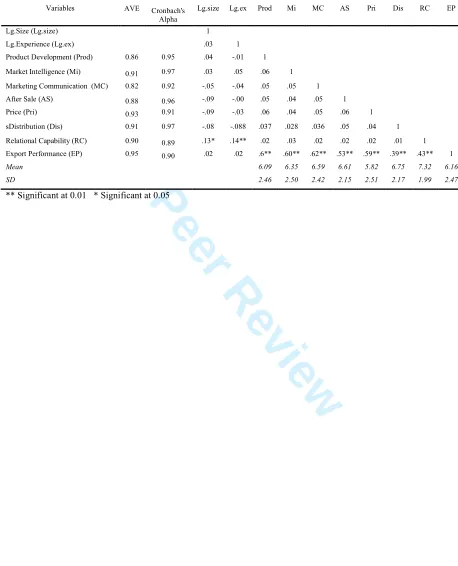
re-ran the CFA. A summary of the results i.e. the average variance extracted and the construct
reliabilities of the final measurement model are shown in Table 1. The overall fitness indices
suggest a good fit for the measurement model (χ2 (499) = 1305.48, p<.01; CFI= 0.96,
NFI=0.94, TLI=0.95, RFI= 0.93 and RMSEA= 0.70). Each item significantly loaded on its
respective construct (p<.001) with ranges from 0.87 to 0.98. Each construct had high
composite reliability (ranging from .90 to .97), exceeding the usual .70 benchmark (Hair et
al., 2005). Convergent validity was considered satisfactory as the standardized loading for
each of the items and the average variance extracted (AVE) both exceeded the 0.5 threshold
recommended by Hair et al. (2005). The internal consistency of the multi-item scales was
also judged to be satisfactory as the Cronbach’s alpha coefficients each exceeded the 0.7
cut-off recommended by Santos (1999). Discriminant validity was also evident as the squared
correlation among the constructs was less than their individual AVE (Fornell and Larcker,
1981).
[Insert Table 1 about here please]
For Peer Review
FindingsTo test our hypotheses, we used hierarchical moderated regression (Aiken and West, 1991;
Jaccard, Turrisi and Wan, 1990). The control variables of firm size and international
experience were first entered into the regression equation in Step 1. The independent
variables, i.e. the marketing capabilities as well as relational capability were then entered in
Step 2. Finally, a third regression equation was calculated (Step 3) using the interaction term
composed of relational capability and the independent variables. Mean centred scores for the
main effect variables and the moderating variable i.e. relational capability were used to
eliminate the possibility of multicollinearity (Aiken and West, 1991). We tested for the
moderating effects by examining the beta-coefficients of the interaction terms, their
significance, as well as the change in the adjusted R2 attributed to the interactions (Jaccard et
al., 1990).
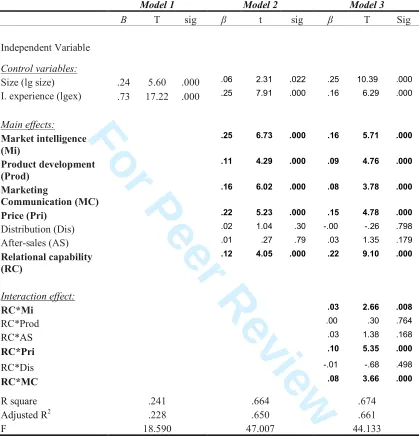
As shown in Table 2, the control variables are significant in Model 1. However, when
the main effect variables are entered into the model, the adjusted R2 increased to 0.65,
suggesting that the items included in Model 2 are useful predictors of export performance.
Finally, when the interaction effects are also added (Model 3), the results suggest that this
provides the best overall model fit (adjusted R2 = 0.66) for predicting export performance.
[Insert Table 2 about here please]
The impact of relational capability has a significant positive impact on export performance (β
= 0.22, t = 9.10, p < 0.01) and hypothesis H1 is accepted. The findings also signal that high
levels of market intelligence serve as a useful catalyst for leveraging export performance
among emerging economy exporters from Vietnam (β = 0.16, t = 5.71, p < 0.01). We
therefore find support for hypothesis H2a. The results provide evidence to suggest there is a 3
For Peer Review
significant association between Vietnamese exporters with high levels of product
development capability and export performance (β = 0.09, t = 4.76, p < 0.05), thus we find
support for hypothesis H3a. Export marking communication capability was also found to be a
significant predictor of export performance among Vietnamese exporters (β = 0.08, t = 3.78,
p < 0.01) and we therefore accept hypothesis H4a. Our findings also suggest that export
pricing serves as a significant predictor of export performance (β = 0.15, t = 4.78, p < 0.01)
and we therefore accept hypothesis H5a.
In contrast to hypotheses H2a, H3a, H4a, and H5a our data provides no empirical support
for hypotheses H6a and H7a. We reject these two, as the findings demonstrate that
strengthening export distribution capabilities and providing after-sales support do not appear
to be significant predictors of performance in the context of our Vietnamese exporting sample
(β = -0.00, t = -0.26, p = 0.80, and β = 0.03, t = 1.35, p = 0.18; respectively).
In terms of the moderation effects, our findings reveal that relational capability
strengthens the relationship between market intelligence gathering and firm performance (β =
0.03, t = 2.66, p < 0.01). Thus, we find support for hypothesis H2b. Our findings also reveal
that among emerging economy exporters from Vietnam that relational capability serves to
strengthen the export marketing communication capability - export performance (β = 0.08, t
=3.66, p < 0.01) and export pricing capability - export performance (β = 0.10, t =5.35, p <
0.01) relationships. Thus, we find support for hypothesis H4b and H5b respectively. However,
our data provides no empirical support for hypotheses H3b, H6b and H7b. We reject these three
in the context of our Vietnamese exporting sample as we found that relational capability does
not serve to strengthen the relationships between these three marketing related capabilities
and performance (β = 0.00, t = 0.30, p = 0.76; β = -0.00, t = -0.26, p = 0.80 and β = 0.03, t =
1.35, p = 0.18) respectively.
For Peer Review
DiscussionIn terms of the independent predictor variables highlighted in Table 2, our findings confirm
the direct impact of relational capability, marketing intelligence, export pricing, product
development, and marketing communication on export performance. The findings also
suggest that the ability to develop relationships is the most significant predictor of export
market performance in the context of this study surrounding Vietnamese exporters. In
addition to the direct influence on export performance, relational capability strengthens the
contribution of marketing intelligence, export pricing and marketing communication
capability on export performance. Due to the critical role of relational capability, it is
important that firms appoint key marketing personnel that have the ability to develop and
manage relationships (Lorenzo and Lipparini, 1999). Our findings provide further evidence to
support the view that the relational aspect role of business is particularly salient in an
international context (Piercy et al., 1997), especially for emerging economy exporters from
Vietnam as they grapple to enter new foreign markets.
Regarding the market intelligence capability, it appears that Vietnamese exporters can
benefit from the acquisition of such data as they grapple with their ‘liability of newness’ in
entering new international markets and seek to supply offerings that reflect well on local
market conditions (Morgan et al., 2003). Firms from emerging market economies are
therefore encouraged to do their groundwork and gather export market intelligence in
advance of tackling international markets. This is likely to benefit export managers at large
by reducing their export market risk and providing them with enhanced data on markets
where opportunities lie (Vorhies et al., 2011; Zhou et al., 2010). Our findings therefore
provide corroboratory support to earlier work (Aaby and Slater, 1989), albeit in an emerging
For Peer Review
context, that export market intelligence plays a pertinent role in assisting firms to successfully
venture into new markets.
The finding relating to product development capability re-iterates the importance
attached with taking a flexible approach in order to best serve export markets, which by
nature may be quite distinct from the domestic situation in terms of market conditions and
customer requirements. The ability of emerging economy exporters to develop and configure
their goods and processes is therefore crucial to help such firms better cater for the needs of
the local market, satisfy consumers and leverage performance advantages (Murray et al.,
2011).
Relating to the marketing communication capability, emerging economy exporters
would be wise to invest in such overseas promotional activities in order to enhance their
performance. This finding is particularly apt as it provides a clear signal for firms that they
should aim to proactively participate and undertake such activities. We warn that simply
appointing overseas distributors or agents and expecting them to self-promote goods on
behalf of the principal supplier may not necessarily breed success for emerging economy
exporters. In response, such firms should consider making regular market visits which
coincide with activities undertaken by their channel partners. Participating in appropriate
trade fairs for example, may prove useful in order for Vietnamese firms to foster better links
with distributors, agents and customers. Internationally renowned exhibitions often provide
an ideal ambiance for generating greater market exposure and company recognition. They
also provide an opportunity for export managers to meet end users and customers in order to
effectively promote their offerings (Terpstra and Sarathy, 1997). Our findings provide further
evidence to support the earlier work by Zou and Stan (1998) surrounding the positive impact
of effective engagement in export promotional activities on export performance, as the
relationship also holds here in the context of emerging economy exporters from Vietnam.
For Peer Review
The findings relating to the export pricing capability signals an important message to
emerging exporters from Vietnam, as it suggests that having high levels of flexibility with
regards to setting export prices appears to be a significantly high predictor of export
performance. Emerging economy firms should therefore try to develop pricing strategies that
are aligned with their cost structures, competitor’s offerings and customer requirements. This
is particularly important for young international ventures to consider, especially those from
emerging economies who lack foreign market experience, as escalating costs associated with
export including carriage, insurance, duties, export credit and obtaining payment are not
always clearly visible. By and large our findings suggest that in the emerging economy
context of Vietnam, exporters can benefit from having some degree of flexibility over their
pricing, as this serves to influence performance. In this respect, having the capability to
respond quickly to changing market conditions can prove fruitful for generating optimal
revenue (Murray et al., 2011; Zou et al., 2003). Our findings confirm that effective pricing is
crucial in order for emerging market firms from Vietnam to leverage performance
advantages.
Our study did not find evidence for the role of distribution and after-sale service
capabilities. The research suggests that once Vietnamese exporters have established
themselves in terms of delivering appropriate product offerings at optimum prices and are
willing to engage in international promotional activities, they would be wise to allow for their
international distributors or agents to take responsibilities for in-market logistics and the
provision of after-sales support. Perhaps this is sensible bearing in mind they are closer to
end-users and have superior market knowledge regarding the extent to which service and
logistical planning is needed and should be managed.
The interaction between Vietnamese exporters’ relational capability and export
marketing intelligence capability was found to positively correlate with export performance.
For Peer Review
We remind Vietnamese exporters of the benefits associated with investing appropriately in
export marketing staff that can facilitate relationships and broker market knowledge for
leveraging performance advantages in export markets (Zhou et al., 2010). Our findings thus
advocate that emerging economy exporters that have high capabilities for developing
international relationships are ideally positioned to exploit foreign market intelligence
sources and leverage export success.
Our findings confirm that the significant interaction between Vietnamese exporters’
relational capability on the export marketing communication capability - export performance
relationship signals to Vietnamese exporters the importance of developing suitable
promotional materials for export markets to maximise their potential. Similarly, relational
capability also had a positive moderating effect on the export pricing capability - export
performance relationship. This would suggest that having the ability to develop fruitful
relationships is crucial in helping Vietnamese firms obtain optimal prices for enhancing their
export performance.
Conclusion, Implications and Future Research
In an attempt to figure out which capabilities can contribute to leverage export performance
among emerging market firms, this study has examined the role of relational capability
alongside export marketing capabilities as predictors of export performance. It has also
investigated the potential moderating impact of relational capability in strengthening the link
between export marketing capabilities and export performance.
Through drawing on a large scale sample of manufacturing exporters from an
emerging economy market, the research makes a useful empirical contribution to the
literature in supporting the argument that firms from developing countries should invest in
marketing activities to generate export success, which, to-date has not been fully explored
For Peer Review
(Kaplinsky, 2000; Humphrey and Schmitz, 2004). The previous literature in this area has
tended to be somewhat more conceptual in nature, or based on a limited number of
observations. Moreover, whilst some of these studies have recommended the role of
marketing functions, they have often not tended to clearly indicate how each specific
marketing capability can contribute to firm development in emerging international markets.
In addition to highlighting four pertinent marketing capabilities that serve as
significant predictors of export performance, our study demonstrates the pertinent role that
relational capability can play among Vietnamese exporting firms in leveraging performance
advantages. Specifically, relational capability surfaces as the most significant predictor of
export performance outright, it also emerged as having a significant moderation effect on
Vietnamese exporters’ marketing intelligence capability and export performance, as well as
their pricing capability on export performance. Thus theoretically, the study offers fresh
insights surrounding the significance of relational capability on export success in the context
of emerging economy exporters, as it not only serves as a major predictor of performance but
can also serve to strengthen the acquisition of export market intelligence - performance and
pricing autonomy - performance relationships.
At the practitioner level, the findings advocate that managers from emerging economy
exporting firms should seek to take on further marketing responsibilities, rather than allowing
such aspects to be governed by their channel partners - as this will provide beneficial gains
for their long-term development. Interestingly, the findings of the study reveal that not all
marketing activities will lead to export success. While engagement in export market
intelligence gathering, product development capability, and taking responsibility for export
promotional campaigns and pricing can significantly contribute, we discover that enhancing
distribution capabilities and after sales service do not influence performance. Firms therefore
need to focus on these significant predictors in order to obtain better economic returns.
For Peer Review
Although the research findings generally support the view that taking on additional
marketing responsibility will allow firms in emerging economies to be better off, some
caution of care should be taken by practitioners, as doing more does not necessarily lead to
greater returns as shown in the case of distribution and after sales service. Export pricing,
export marketing communication, export market intelligence and export product development
should be prioritised for emerging economy exporters. Meanwhile, it appears pragmatic that
distribution management and after sales service should be delegated to channel
intermediaries, as these activities tend not to have a significant impact on performance if they
come under the emerging exporter’s remit.
The findings also re-iterate the significance of having key personnel in place that are
relationship orientated and who have the ability, communication skills and cultural nuance to
nurture and develop such relations on an international scale. Specifically, the study confirmed
that relational capability serves to strengthen the impact of a firm’s engagement in market
intelligence gathering, promotion (marketing communication) and price setting on export
performance. Having effective relational capability therefore facilitates a firm’s ability to
conduct market intelligence and promotion activities more efficiently, thus enabling it to
perform well on the export stage. It also enables a firm to become more responsive in terms
of making market price adjustments to capture greater economic returns. This shows that it is
vital for emerging economy exporters to enhance their relational capability skills in order to
develop international networks and foster export success. All this is notwithstanding the fact
that relational capability emerged as the largest predictor of performance from all the
independent variables tested.
Despite several contributions, the study also has its limitations. First, it focuses on the
issue from the perspective of Vietnam as an emerging economy exporter and in this respect
data was solely collected from the supplier’s angle in just one country. We therefore warn
For Peer Review
that some caution is necessary when interpreting the data, as other emerging markets may not
share the same traits as experienced here. Future research should aim to examine this
phenomenon in other emerging economy markets and even extend the study in order to
incorporate a dyadic perspective that takes account of buyers too. In addition, as export
development represents a dynamic process which is affected by a huge number of
determinants, this study was constrained to a limited number of variables. Further work may
also wish to expand these variables and consider additional factors, such as export credit
terms, payment and other service attributes. It may also prove useful to investigate pricing
autonomy and specifically introduce to the concept other aspects such as brand recognition
and innovation.
Future research of a longitudinal nature may also bolster the findings, as undertaking
export marketing responsibility in a particular year, may contribute to export performance in
future years. Finally, although the research followed current practice in the export
performance literature by adopting a composite construct to assess export performance i.e.
combining economic performance indicators with managerial perceptions, perhaps more
objective measures could be included in future studies. In an ideal world, this would prove
really fruitful, however obtaining such data is often impossible in emerging economies and
even if such data would be available, its validity could be questioned.
References
Aaby, N.E. and S.F. Slater (1989), “Management influences on export performance: a review of the empirical literature 1978-88,” International Marketing Review, Vol. 6 No. 4, pp. 7-26.
Aiken, L.S., and West, S.G. (1991), Multiple Regression: Testing and Interpreting Interactions, Sage Publications, Newbury Park, CA.
Armstrong, J.S. and Overton, T.S. (1977), “Estimating Nonresponse Bias in Mail Surveys,” Journal of Marketing Research, Vol.14 No.3, pp. 396-402.
For Peer Review
Athaide, G. A., and Stump, R.L. (2003), “A Taxonomy of Relationship Approaches During Product Development in Technology-Based, Industrial Markets,” Journal of Product Innovation Management, Vol.16 No.5, pp. 469-482.
Axelsson, B (1992), “Network research – Future issues”, in Axelsson, B., and G. Easton (ed.),
Industrial Network:A New View of Reality, Roughtedge.
Barnes, B. R. (2005), "Is the Seven-Year Hitch Premature in Industrial Markets", European Journal of Marketing, Vol.39 No.5/6, ISSN 0309-0566.
Barnes, B. R., D.A. Yen, and L. Zhou (2011), "Investigating Guanxi Dimensions and Relationship Outcomes: Insights from Sino-Anglo Business Relationships", Industrial Marketing Management, Vol. 40 No.3, pp. 510-521.
Barney, J. B. (1991), “Firm Resources and Sustained Competitive Advantage,” Journal of Management, Vol. 17, pp. 99-120.
Bazan, L. and L. Navas-Aleman (2004), “The Underground Revolution in the Sinos Valley: a Comparison of Upgrading in Global and National Value-Chains”, in H. Schmitz (ed.), Local Enterprises in the Global Economy: Issues of Governance and Upgrading, Cheltenham: Edward Elgar.
Bonoma, T. V. and Johnston, W.J. (1