Teacher knowledge and initial teacher education in the
English learning and skills sector
MAXWELL, Bronwen <http://orcid.org/0000-0002-8022-9213>
Available from Sheffield Hallam University Research Archive (SHURA) at:
http://shura.shu.ac.uk/2933/
This document is the author deposited version. You are advised to consult the publisher's version if you wish to cite from it.
Published version
MAXWELL, Bronwen (2010). Teacher knowledge and initial teacher education in the English learning and skills sector. Teaching Education, 21 (4), 335-348.
Copyright and re-use policy
See http://shura.shu.ac.uk/information.html
Teacher knowledge and initial teacher education in the English learning and
skills sector
Abstract
Recent reforms of initial teacher education (ITE) in the learning and skills sector (LSS) in England are standards based and emphasise subject specialism. The reforms are underpinned by objectivist epistemological assumptions which are incompatible with socio-cultural theories of professional knowledge, and ignore the diverse teaching roles and contexts in the sector and wider systemic issues. A qualitative scoping study found that LSS in-service trainee teachers drew on three types of knowledge resources, or clusters of ‘rules’ for practice, in their teaching: -these were related to their subject/vocational area, generic teaching and learning processes and specific learners and groups. Trainees generated knowledge resources through participation in their workplace, ITE course and other social contexts, and from embedded and encoded workplace knowledge. Trainees’ beliefs, values and prior experiences were both a knowledge resource and influenced their engagement with knowledge generation activities. It is argued that using a knowledge resources perspective, which recognises how trainees generate knowledge and seeks to bridge gaps in their access to knowledge resources, would be more effective in supporting trainees’ development than the current reforms.
Introduction
The learning and skills sector (LSS) in England spans further education (FE) colleges, personal and community development learning, work-based training and learning in other adult settings such as prisons. Those undertaking teaching roles have a range of job titles such as tutor, lecturer or trainer. In this paper ‘teacher’ is used to encompass all these roles and ‘trainee’ is used to refer to any teacher undertaking a LSS initial teacher education (ITE) qualification. Over
three-quarters of new teachers undertake ITE on a part-time, in-service, basis once they have begun teaching (DfES, 2003). Reform of LSS ITE has led to the creation of a highly centralised and controlled curriculum. However, there is a growing body of opinion that the reforms are limiting, rather than enhancing, trainee development and do not form an adequate basis for improving the quality of ITE (Fisher & Webb, 2006; Lucas, 2007; Simmons & Thompson, 2007).
This paper focuses on the development of professional knowledge during LSS ITE. With the notable exception of Lucas (2007), this is a largely neglected research area. The paper begins by exploring the ways in which teacher professional knowledge has been conceptualised. It is then argued that two aspects of the LSS ITE reforms - the use of national standards and the emphasis on subject specialism - are underpinned by epistemological assumptions that are contrary to current socio-cultural understandings of professional knowledge, and do not take account of the diverse work contexts in the sector. This indicates that improving LSS ITE requires the
development of a more sophisticated understanding of how trainees construct knowledge. To address this, the findings of a small-scale scoping study of the ways in which trainees generate knowledge resources, that is the ‘rules’ that guide everyday work practices (Sanders, 2006), is reported. These findings, together with other literature, are used to further illuminate the policy issues. In conclusion, it is argued that focusing on supporting trainees’ access to knowledge resources, in ways that take account of personal histories and work contexts, offers a more appropriate base for an ITE curriculum than the recent reforms.
Conceptualising teacher professional knowledge
This section reviews three approaches to conceptualising teacher professional knowledge, each based on different epistemological assumptions. The earliest approach, based on a traditional conceptualisation of knowledge as an objective, external, fixed entity is exemplified by Shulman’s (1987) typology of school teacher knowledge. Shulman distinguished between subject content knowledge, general pedagogical knowledge, curriculum knowledge, pedagogical content knowledge, knowledge of learners, and knowledge of educational purposes and contexts. Pedagogical content knowledge is ‘that special amalgam of content and pedagogy’ (Shulman, 1987, p. 8), which comprises ‘the way of representing and formulating the subject to make it comprehensible to others’, and ‘an understanding of what makes the learning of specific topics easy or difficult’ (Shulman, 1986, p. 9). Shulman, therefore, positioned the knowledge trainee teachers need to develop as that which could be, largely, organised and presented in a text book. However, this fails to take account of the different ways in which individuals construct knowledge and the mediating effect of teaching contexts. Indeed, Shulman in later work (Shulman &
Shulman, 2004) recognised the important omission of communities and contexts. Nonetheless, the notion of unproblematically codifying teacher knowledge which all trainees need to acquire and an emphasis on pedagogical content knowledge, continues to dominate policymaking.
learning, which assume that knowledge is provisional, fluid and contested. Professional
knowledge is positioned as that which can be constructed through trainees engagement in social practices. Focusing on the ways in which trainees construct knowledge resources, that is the ‘rules’ that frame everyday work practices (Saunders, 2006), provides a useful conceptual lens for advancing our understanding of the development of professional knowledge during LSS ITE. Knowledge resources may be ‘formal, explicit and technical on the one hand, and informal, tacit, social, cultural and discursive on the other hand’ and are produced and accessed through socio-cultural practices (Saunders 2006, p.16).
Differing socio-cultural conceptualisations of teacher knowledge arise depending on whether or not it is assumed that individual knowledge can be separated from social knowledge. Wenger (1998) construes all knowledge as social and located in communities of practice. In contrast, Eraut (2004, p.202), distinguishes personal knowledge from cultural knowledge and similarly Verloop, Van Driel and Meijers (2001) distinguish the knowledge base of teaching from a
teacher’s personal knowledge base. Teachers’ personal knowledge, which underlies their actions, spans ‘conscious and well-balanced opinions to unconscious and unreflected intuitions’ (p. 446) and is shaped by personal factors:
This personal knowledge of each teacher is highly determined and “coloured” by his or her individual experiences, personal history (including learning processes), personality variables, subject matter knowledge and so on. (p. 443)
This section has charted a shift in the conceptualisation of teacher professional knowledge from an objectivist epistemology, where knowledge is fixed and external to the teacher, to a socio-cultural conceptualisation where knowledge that is provisional, fluid, and contested is constructed through participation in social practices. The position of the individual within socio-cultural constructions of knowledge remains disputed.
LSS ITE reforms - epistemological and contextual assumptions
This section focuses on two aspects of the LSS ITE reforms: the use of national standards (LLUK, 2007) and the emphasis on subject specialism; arguing that the implicit epistemological and contextual assumptions, together with the ways in which the standards have been enacted, raise questions about the appropriateness of the reforms. Attention is also drawn to the omission of wider systemic issues in official documents.
Implicit within the LSS national standards is the assumption that it is possible to capture complex professional knowledge and skills in written statements. This is underpinned by an objectivist view of knowledge as codifiable, universal and applicable across contexts (Nasta, 2007), and runs contrary to more recent socio-cultural conceptions of professional knowledge. The tacit nature of much professional knowledge (Schön 1991), which makes procedural knowledge inherently difficult to declare, together with the difficulties in apprehending the links and associations within higher forms of conceptual knowledge, exacerbate the problem of codifying teacher knowledge. Furthermore, producing a single set of standards for all LSS teachers is problematic due to the diverse, multi-specialist and ‘connective’ (Lucas, 1995) teaching roles that they undertake.
courses and ignoring trainees’ engagement in workplace learning, limits the extent to which they can support trainees’ knowledge development. Consideration of workplace learning is crucial since this is where trainees recontextualise, or transform, prior learning and subject knowledge into pedagogic knowledge, and as a consequence improve their practices (Lucas, 2007). Nasta’s (2007) study indicates that trainees only engage with the standards to the extent necessary to gain their ITE qualification, relying instead on workplace interactions to generate professional
knowledge:
Trainees saw their day-to-day interactions in their working lives as far more significant than deeply internalizing a set of national standards. (p. 14)
The lack of opportunities for trainees to develop subject specialist knowledge and pedagogy has been presented in official documents as a crucial deficit of LSS ITE (DfES, 2003; Ofsted, 2003). These criticisms ignore the diversity of teaching work and subject specialisms in the LSS. LSS curricula are less likely to be structured in subjects than in schools or higher education.
Vocational curricula are often atomized in direct relation to workplace roles, which cross traditional subject boundaries, and LSS teachers undertake complex student-centred and connective roles, that extend far beyond delivering subject knowledge (Fisher & Webb, 2006; Lucas, 2007). Consequently, the notion of what might constitute subject knowledge and pedagogy is problematic in some LSS contexts, an issue compounded by the difficulties in codifying teacher knowledge, explored earlier.
The reforms are silent on the wider systemic problems that may restrict trainees’ opportunities to construct professional knowledge. Contextual issues, such as the effects of public sector
modernisation and the marketised climate, have led to casualised employment, heavy workloads for in-service trainees and an impoverished and fragmented professional culture (Lucas, 2007; Simmons & Thompson, 2007). These conditions limit trainees’ opportunities to construct knowledge through workplace participation. This is compounded as trainees marginalise
themselves from workplace communities of practice, which they perceive to be characterised by low morale and a lack of commitment to students (Bathmaker & Avis, 2005).
In summary, the objectivist epistemological assumptions underpinning the LSS ITE reforms are contrary to current socio-cultural understandings of teacher knowledge. The reforms take insufficient account of the diversity of LSS teaching roles and contexts and of wider systemic issues that impinge on trainee knowledge development.
Trainees’ experiences of knowledge construction - Scoping study methodology
The preceding discussion indicates that, in order to improve LSS ITT, a more developed
understanding of how LSS trainees construct knowledge is needed than is evident in the reforms. This section summarises the methodology of a small-scale scoping study that was undertaken to sharpen understanding and depiction of the professional knowledge LSS trainees draw on in their everyday practices, and explore trainees’ access to knowledge resources. A scoping study is a useful device to clarify issues and outline the agenda for further research in an area, such as LSS ITE, where there is a limited research base.
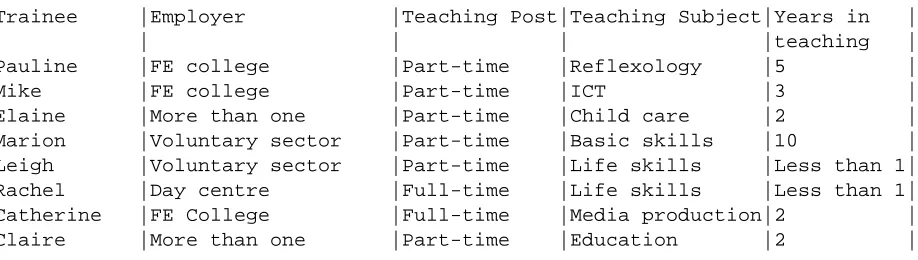
in-service trainees at one new university, towards the end of the first year of their two year part-time ITE course. The sample (Table 1) is not representative of the in-service trainee population as a whole. However, the range of teaching subjects, learner groups and settings provide insights into the diverse contexts within which trainees generate knowledge.
Table 1: Trainee Characteristics about here
Interview design took account of the situated and tacit nature of much teacher knowledge. Interviewees were asked to recount specific examples of recent practices in planning, managing and assessing learning, and giving feedback to learners. They were also asked to describe recent critical incidents in their practices. Probing questions were used to elicit the types of knowledge resources they drew on in their practices, and the practices they had engaged in to generate those knowledge resources. Artefacts, such as lesson plans and assessment materials, were used to help interviewees recall events and uncover tacit understandings (Eraut, 2000). A dialogic approach (Knight & Saunders, 1999), where the interviewer and the interviewee co-construct knowledge, was adopted in the final part of the interview. Trainees were asked to recall specific examples of types of activities through which they had generated knowledge resources for their teaching, and then to consider how significant the activity was in shaping their practice.
As this was a scoping study it was important to allow theory to emerge from the data. Analysis began with the construction of individual vignettes to illuminate trainees’ practices, the
knowledge resources they drew on to inform these practices, and the activities and interactions that generated those knowledge resources. This was followed by cross-case analysis. Common themes were identified through interpretive reading of the transcripts and iterative cycles of in-vivo coding using the NVivo software package. Trainees’ narratives revealed that they drew on three main types of knowledge resources to shape their everyday practices. The activities through which trainees generated these knowledge resources were then explored in greater depth, by refining coding, testing emergent findings using the NVivo search function and constructing tables and mind maps linking individual data to common findings.
Findings: trainees’ experiences of generating knowledge resources
Three main types of knowledge resources, or clusters of ‘rules’ used in practice, emerged from trainees’ narratives. The first cluster was related to their subject or vocational area, and the second focused on generic teaching and learning - that is ‘rules’ that are applicable in a range of teaching contexts, and not specifically related to a particular subject or learning group. The third type of knowledge resource was constructed with, and focused on, specific learning groups and individuals. The purpose of this section is to illuminate the ways in which trainees generated these knowledge resources. Findings related to the three types of knowledge resource are presented in turn. This is followed by findings on trainees’ beliefs, values and prior experiences, which emerged both as an important source of knowledge resources, and a crucial influence on trainees’ attitudes towards engagement in knowledge generation activities.
Subject or vocational knowledge resources
together with work experience, as the main source of subject or vocational knowledge resources. Five of the trainees regularly read literature to keep up to date with their vocational or subject area. Three of these trainees made much greater use of reading as a resource for generating subject/vocational knowledge than for generating generic learning and teaching knowledge resources:
I have to keep up to date in childcare procedures and practices so that influences me quite a lot especially with things like child protection. … That’s why I don’t have time to read for [the ITE course]! (Elaine)
Pauline, a practicing reflexologist, also engaged in professional updating activities, such as attending courses and watching videos.
The importance of subject knowledge as a source of knowledge resources for teaching varied between trainees. For Catherine, who taught media production, it was the strongest influence on her teaching decisions. She made judgements about teaching methods and learners’ work on the basis of how things are done in the film-making industry. In contrast Rachel and Leigh, who both taught Life Skills, found it difficult to identify a subject knowledge base that underpinned their work. A common theme in trainees’ accounts was moving from using subject frameworks to plan teaching to a stronger focus on learners’ needs and interests. This is illustrated in Mike’s account of changing his approach to planning adult information technology (IT) classes:
[When I started teaching] I was actually thinking in terms of the subject knowledge rather than what people might want to do with it. (Mike)
In summary, trainees primarily drew on their prior academic and work experience to construct subject or vocational knowledge. The extent to which subject/ vocational knowledge resources shaped trainees practices varied, but for most the influence of subject frameworks declined with increasing interaction with learners.
Generic learning and teaching knowledge resources
Trainees generally conceptualised teaching as a generic activity, at times making links between this and their subject/vocational area, but rarely describing knowledge that could be classified as pedagogical content knowledge. Trainees generated generic learning and teaching knowledge resources through participation in teaching and ITE, interactions with others, and engagement with organisational ‘ways of doing things’, awarding body requirements and national core curricula.
The experience of teaching
Apart from Elaine, all the trainees’ narratives included examples of generating practical - ‘know how’- knowledge resources through teaching activity. They predominantly described a pragmatic ’trial and error’ approach where they adopted what worked and made changes as a result of negative experiences, as Rachel’s account of teaching life skills illustrates:
When I started bringing things in from home, it got their interest going and they were able to pick things up and look at them, … and they were getting a lot more out of it. (Rachel)
Most trainees descriptions of generating knowledge resources through teaching activity included engaging in reflection-on-action (Schön, 1991), though they rarely labelled it ‘reflection’.
Applying Grundy’s (1987) typology of reflection, trainees predominantly described engaging in practical ‘know what I ought to do’ reflection. There were few instances of engagement in critical ‘know why’ reflection, which incorporates self and social awareness.
Participation in ITE
Trainees constructed practical knowledge resources from feedback on observations of their teaching, conducted as part of their ITE programme, and practical and propositional (‘know what’) knowledge resources from participation in course activities. Knowledge generated from observations was most frequently drawn on by trainees to develop their planning documentation, create new resources and implement new teaching strategies. Perhaps unsurprisingly, given the individualised nature of observations and the different teaching contexts, the specific strategies trainees adopted varied. For example, while Catherine made changes to how she managed groups, Claire developed her questioning strategy and moved away from a ‘content heavy’ approach. Six of the trainees considered observations very significant in shaping their practice, while two thought they were quite significant.
Four trainees rated participation in ITE course activities as very significant in shaping their practice and four considered it quite significant. Participation in course activities generated knowledge resources related to planning, managing and facilitating, differentiating and assessing learning, and resource production. Realising that different people learn in different ways was an integral part of all trainees’ accounts of their ITE course experience. As Catherine explained:
Up until I started doing the PGCE I just … assumed that everybody learnt in the same way that I did, … but now I’m realising that isn’t how other people learn.
For some trainees this new understanding led to changes in the way they planned and thought about learning and teaching - they placed less emphasis on the structure of their subject and took more account of learners’ needs and characteristics.
‘Knowing more’ as a result of course participation, however, did not necessarily lead to changes in practices. Attitudinal changes, drawing on new understandings of why practices were
important, were also necessary:
I used to fill in lesson plans… but not really use them as I do now. I just thought it was just a daft paper exercise, but it’s [the ITE course] helped me to see the significance of what I do. (Rachel)
Participation in the ITE course helped Marion and Catherine uncover their tacit knowledge. For Catherine this focused around developing greater awareness of her own practices:
Marion considered that the opportunities to reflect on her own practice, and uncover her tacit knowledge, had led her to think at a different level to the intuitive way she thought when teaching, so helping her develop a higher level of understanding.
Interactions with others
Trainees’ opportunities to construct knowledge resources through interaction with other teachers varied. Four of the trainees expressed strong feelings of isolation and had very limited
opportunities for legitimate peripheral participation in work-based communities of practice. However, trainees’ narratives demonstrated that, when interactions occurred, both direct advice and chance remarks could lead to significant practice changes. Direct instructions from line-managers to trainees were infrequent. When they were given instructions they usually related to paperwork and procedures, rather than learning and teaching processes.
Some trainees used discussions with family and friends to construct knowledge. For example, Pauline talked to a dyslexic family member to develop understanding of the likely impact of different support strategies. Peers on the ITE programme provided another human knowledge resource, the impact on knowledge construction being strongest when trainees shared either a subject or vocational area, or taught similar types of learners. Knowledge constructed with peers and work colleagues sometimes contradicted knowledge resources embedded in the ITE
programme. This particularly related to planning learning, as Leigh’s comments on his discussion with peers on the ITE programme illustrates – ‘A lot of other people are, you know, ‘We don’t do lesson plans.’
Organisational ’ways of doing things’
In reviewing organisational literature, Blackler (1995) drew attention to the concepts of embedded knowledge - ‘knowledge which resides in systemic routines’ (p1024), and encoded knowledge – ‘knowledge conveyed by signs and symbols...such as books, manuals and codes of practice’ (p1025). Trainees, in this study, constructed knowledge about the ’way things are done round here’ through participation in organisational routines and by using organisational documents. However, some trainees struggled to make sense of knowledge encoded in documents, initially finding it difficult to use lesson plan proformas, tracking documentation and teaching resources prepared by others. For example, Mike found it ‘very difficult to juggle with somebody else’s workbooks’ in IT workshops.
There was substantial variation between trainees in the extent to which the courses they taught were prescribed by their organisation. While Leigh had no framework to adhere to and could make all course design decisions himself, Elaine had no scope to vary her programme.
Mimicking other teachers’ practices, which were encoded in student feedback forms, was evident in Rachel’s and Catherine’s accounts of how they had constructed knowledge resources for assessing learning:
So nobody’s ever looked at what or how I’m assessing. I just kind of looked at what somebody else had written and sort of picked out similar phrases and things. (Catherine)
Knowledge embedded and encoded in awarding body requirements and national core curricula
practices. For Mike the assessment requirements provided a frame of reference for teaching decisions:
These courses were for OCN [the Open College Network] so there were very definite criteria the learners had to meet, so I would basically design activities so that they could produce something which would prove that they had met the criteria.
Similarly, the competencies prescribed in the national skills for life and pre-entry curricula shaped Marion’s and Rachel’s practices. In meeting awarding body requirements and using national curricula trainees generated knowledge resources that were compatible with the models of
learning and teaching implicit within the framework, without necessarily gaining awareness of the underpinning models.
In summary, trainees accessed generic learning and teaching knowledge resources, which they drew on in their everyday practices, through a range of participative activities including teaching, ITE, interactions with others, and engagement with knowledge embedded and encoded within their organisation, and in awarding body and national curricula processes and documents.
Knowledge resources constructed with and about learning groups and individual learners A distinct dynamic area of knowing was constructed within the learner-tutor relationship. This differed from generic knowledge of learning and teaching processes in being bound to, and created with and about, individual learners and specific learner groups. Pauline described how she began to construct knowledge resources through interactions with learners:
As a new teacher you think … you are supposed to tell your students everything … and that’s how they will learn. But it’s just as you’ve done this for a period of time you then look at different learners and you think well why if I’m doing the same thing why’s it worked for that person and not worked for this other person, so then you become aware how your learners are reacting and how they work.
With the exception of Catherine, all the trainees made frequent references to constructing
knowledge with learners and told stories, like Paulines, of how through interactions with learners over time they had developed new understandings and practices. They also, again with the exception of Catherine, thought that weighing up how learners would respond to their actions was either a quite or very significant influence on their practice decisions. Catherine, in contrast to the other trainees, struggled to develop good working relationships with her learners and recounted significant difficulties that arose in her practice. She perceived at times that she had ’failed’.
The knowledge resources trainees generated about and through interaction with specific learners
and groups, appeared to be qualitatively different from Shulman’s (1987) decontextualised and
more generalised knowledge about learners and their characteristics. Viewing this through the lens of social learning theory, it appears that communities of practice comprising trainees and their learners were established within most trainees’ teaching contexts.
a new teaching method he had deployed. However, often knowledge construction was intuitive. For example, trainees would realise that something was not working for a particular learner and instinctively set about addressing this. In doing so they created knowledge resources which helped them support that learner. A strong emotive concern for learners and an empathetic approach characterised trainees’ descriptions of these instances of knowledge construction, mirroring Avis and Bathmaker’s (2004) finding that LSS trainees exhibit a strong ethic of care.
In summary, knowledge resources created with and about individual learners and specific groups formed an important element of the resources trainees drew on in their everyday practices.
Trainee’s beliefs, values and prior knowledge
Trainees’ beliefs, values and prior experiences were found to be an important source of knowledge resources, as well a strongly influence on their attitudes towards, and engagement with, activities and interactions that generated knowledge resources.
Prior experiences as a learner were an important source of knowledge resources. Three trainees
rated these experiences as very significant, and five as quite significant, in shaping their practices. Negative experiences, usually held as emotional memories, were particularly influential in
determining trainees’ practices. For example, Pauline’s decision to use an informal quiz as a formative assessment method was based on her ‘nerve-wracking’ experience, of having an exam at the beginning of every class during her professional training. She explained:
If I found something horrible I would never ever do it to my students. …Cos I couldn’t bear for them to feel horrible either.
Trainees also ‘copied’ teaching approaches that they had experienced as learners. The most extreme example was Claire, who only felt able to teach courses she had participated in as a student:
I honestly really struggle to feel confident and/or competent teaching something that I haven’t experienced myself.
Marion explained how knowledge constructed from course content, in this case a communications degree, was drawn on to develop her understanding of teaching relationships. In turn she used this understanding as a knowledge resource to shape her practice:
Although [the communications degree] was a very theoretically based degree I am able to apply that in a practical sense. ….I’m not a person who could stand at the front of a class and tell people things without knowing that I had got their support to tell them.
resources through interactions with colleagues. Although Catherine had access to legitimate peripheral participation in a community of practice, through daily interactions with colleagues, she did not use this to construct knowledge:
I’ve had more professional, industrial experience than either of my two … colleagues … So they’re kind of experienced teachers, but I feel that I’ve got more industry experience so they can’t really tell me how to teach.
Life-experiences provided another source of knowledge resources for trainees. For example,
Marion drew attention to the link between her experiences as mother and her teaching:
I think the fact that I am a mother … is a very big thing …. because I think that as a mother you see a child at all stages in its life …, so when I see them [her children], I see the person who is, … the person who was, and possibly the person who will be, and I think I can do that with my students too.
Links between trainees’ beliefs and values and their approaches to practice were evident in three cases. Leigh and Rachel, both working with students with learning disabilities, placed a high value on respecting their students. Mike thought his faith influenced the way he related to learners. Like prior experiences, trainees’ beliefs and values were both a source of knowledge resources and influenced trainees’ engagement with other knowledge resources. As Marion observed, in considering her engagement with reading on the ITE course, trainees may resist new ideas that clash with existing personal beliefs – ‘If I am reading something and I don’t entirely agree with it, I’ll probably not read it’.
In summary trainees’ prior experiences, particularly as learners, and within their vocational or subject area, together with their beliefs and values, are drawn on to provide knowledge resources for practice, and also influence their attitudes towards other knowledge resources, and their engagement in knowledge generating activities.
Findings Summary
Trainees drew on three types of knowledge resources in their everyday practices. They constructed subject and vocational knowledge resources from prior learning and professional experience, supplemented with professional updating. Generic learning and teaching resources were generated through participation in teaching and ITE, interactions with colleagues, family and friends, and from embedded and encoded organisational, awarding body and national curricula ‘ways of doing things’. Knowledge resources constructed with and about individuals and learning groups were particularly influential on trainees’ practices. Trainees’ beliefs, values and prior experiences were a knowledge resource and a filter that affected the extent and nature of their engagement with other knowledge resources and knowledge generation activities. A larger scale study may reveal other types of knowledge resources and additional ways in which trainees construct knowledge resources.
Implications for LSS ITE Policy
While caution is needed in making claims from this small-scale study, the alignment of the findings with other papers supports the case, made earlier, that the LLUK (2007) national
standards provide only limited support for trainees’ knowledge development. Firstly, trainees in this research, as in Nasta’s (2007) study, did not utilise the national standards as a knowledge resource, maybe because the standards fail to provide a meaningful representation of the complex roles and contexts found in the LSS (Lucas, 2007). Secondly, trainees’ practices were strongly influenced by the knowledge resources they generated through workplace interactions,
particularly with learners, whereas the standards marginalise the importance of constructing knowledge, and their enactment by mapping to ITE courses ignores workplace learning. Thirdly, trainees’ descriptions of knowledge development aligned more closely with socio-cultural theories than the objectivist view implicit within the standards. Finally, the model of reflection embedded in the national standards ignores the strong influence of beliefs, values and prior experiences on trainees’ practices and engagement with other knowledge resources found in this and many other studies (Wideen, Mayer-Smith and Moon, 1998). Furthermore, in the LSS, Bathmaker & Avis. (2005, p. 60) found that trainees’ over reliance on their own experience meant that they ‘were unable to question and challenge the “common-sense” assumptions behind their own former learning experiences’, supporting the case that the omission of critical reflection in the standards impedes trainees’ knowledge development.
The lack of pedagogic content knowledge in trainees’ accounts, in this study, could be due to deficits in their training programme. Alternatively, it could provide further evidence that the conceptualisation of ‘subject’ in the LSS ITE reforms, which implicitly draws on Shulman’s (1986) concept of pedagogical content knowledge, is not appropriate. Although this is a very small sample, it is surprising that none of the trainees engaged in workplace activities that generated pedagogical content knowledge. This could be attributed to some trainees’ isolation and lack of opportunity to participate in subject related communities of practice. However, the lack of development of pedagogical content knowledge, together with the finding that trainees’ move from a subject to a learner orientation, aligns with the argument made earlier that the connective nature of trainees’ roles, teaching context characteristics and vocational curricula in the LSS mean that subject pedagogy has less importance than assumed in the reforms. This is not to posit that the development of trainees’ subject pedagogy is unimportant, but that addressing subject pedagogy needs to be balanced with recognition of the importance of generic knowledge and of co-constructing knowledge with learners.
A knowledge resources perspective – a way forward for LSS ITE?
Adopting a knowledge resources perspective, rather than a prescriptive standards-driven subject-focused approach to LSS ITE, offers, I would argue, a richer and more developmental approach to professional formation. This would focus on bridging the gaps in trainees’ access to participation in activities and interactions were they can generate the knowledge resources required for
practice, enabling account to be taken of differences in trainees’ starting points, roles and teaching contexts. Creating genuinely differentiated programmes for trainees in this way may also address the continuing weakness of ITE programmes in meeting individual needs (Ofsted 2008).
Implementing a knowledge resources approach would require changes to ITE programmes, so that trainees develop critical awareness of how: knowledge is constructed; the activities and
knowledge with learners; and the ways in their beliefs, values and prior experiences may be limiting knowledge construction. Both teacher educators and mentors could support and challenge trainees’ critical reflection on the knowledge they have developed and the process of knowledge construction. A stronger focus on collaborative reflection in ITE programmes would challenge trainees to recognise limiting beliefs that inhibit them in generating knowledge resources.
If trainees are to construct the knowledge required for effective practice they need a breadth of experience, access to workplace communities of practice, and ‘a complex relationship with many “experts” in multiple learning contexts’ (Lucas 2007, p. 97). However, there is a growing body of evidence that LSS trainees’ access to these opportunities is problematic (for example: Bathmaker and Avis, 2005), indicating that employers need to review the ways in which their workplace facilitates, and impedes access. Changes to induction and the ways in which course teams operate, and extending mentors’ roles to encompass supporting trainees’ engagement in work-based communities of practice, have the potential to improve access. Ways also need to be found to strengthen links between the knowledge resources trainees generate through their interactions with learners and other aspects of their training.
Further areas for research to inform both policy and ITE practice arise from this discussion. Firstly, there is a need to gain a deeper understanding of ways in which ‘subject’ pedagogy is constructed and may be accessed in the LSS. Secondly, greater understanding of the ways in which LSS workplaces promote and inhibit trainees’ development, including the ways in which trainees construct knowledge with learners, is needed to create the ‘pedagogy of the workplace’ advocated by (Lucas, 2007).
Adopting a knowledge resources approach presents a challenging agenda for researchers, requires significant change by trainees, teacher educators and employers, and would make systemic
weaknesses in the LSS visible. However, it offers a developmental approach to trainees’ professional formation that is absent from the current reforms.
References
Avis, J., & Bathmaker, A-M. (2004). Critical pedagogy, performativity and a politics of hope: Trainee further education lecturer practice. Research in Post-Compulsory Education, 9(2), 301-313.
Bathmaker, A-M., & Avis, J. (2005). Becoming a lecturer in further education in England: The construction of professional identity and the role of communities of practice. Journal of Education for Teaching, 31(1), 47-62.
Blackler, F. (1995). Knowledge, knowledge work and organizations: An overview and interpretation.
Organizational Studies 6, 1021-1046
Department for Education and Skills (DfES). (2003). The future of initial teacher education for the
learning and skills sector: An agenda for reform. Sheffield: DfES.
Eraut, M. (2000). Non-formal learning and tacit knowledge in professional work. British Journal of Educational Psychology, 70(1), 113-136.
Eraut, M. (2004). Transfer of knowledge between education and workplace settings. In H. Rainbird, A. Fuller & A. Munro (Eds.), Workplace learning in context (pp. 201-221). London:
Routledge.
learning and skills sector in England: The context, a response and some critical issues. Journal of Further and Higher Education, 30(4), 337-349.
Grundy, S. (1987). Curriculum: Product or praxis. East Sussex: Falmer Press.
Knight, P. T., & Saunders, M. (1999). Understanding teachers’ professional cultures through interview: A constructivist approach. Evaluation and Research in Education, 13(3), 144-156. Lifelong Learning UK. (2007). New overarching professional standards for teachers, trainers and
tutors in the lifelong learning sector. Retrieved August 4, 2007, from
http://www.lifelonglearninguk.org/documents/standards/professional_standards_for_itts_02
Lucas, N. (1995). Challenges facing teacher education: A view from a post-16 perspective. Forum, 37(1), 11-13.
Lucas, N. (2007). Rethinking initial teacher education for further education teachers: From a standards to a knowledge-based approach. Teaching Education, 18(2), 93-106.
Nasta, T. (2007). Translating national standards into practice for the initial training of further education (FE) teachers in England. Research in Post-Compulsory Education, 12(1), 1-17.
Ofsted. (2003). The initial training of further education teachers: A survey HMI 17. Retrieved August 15,
2005, from http://ofsted.gov.uk/publications
Ofsted. (2008). The initial training of further education teachers: Findings from the 2006/7 inspections of courses leading to national awarding body qualifications. Retrieved April 6, 2008, from
http://www.ofsted.gov.uk/assets/Internet_Content/Shared_Content/Files/2008/jan/itt_fet.pdf Saunders (2006) From ’organisms’ to ’boundaries’: the uneven development of theory narratives in
education, learning and work connections. Journal of Education and Work, 19(1), 1-27.
Schön, D. A. (1991). The reflective practitioner. how professionals think in action. Aldershot: Avery, Ashgate Publishing Ltd.
Shulman, L. S. (1986). Those who understand: Knowledge growth in teaching. Educational Researcher, 15(2), 4-14.
Shulman, L. S. (1987). Knowledge and teaching: Foundations of the new reform. Harvard Educational Review, 57(1), 1-22.
Shulman, L. S., & Shulman, J. H. (2004). How and what teachers learn: A shifting perspective. Journal of Curriculum Studies, 36(2), 257-271.
Simmons, R., & Thompson, R. (2007). Aiming higher: How will universities respond to changes in initial teacher training for the post-compulsory sector in England? Journal of Further and Higher Education, 31(2), 171-182.
Verloop, N., Van Driel, J. H., & Meijer, P. (2001). Teacher knowledge and the knowledge base of teaching. International Journal of Educational Research, 35(5), 441-461.
Wenger, E. (1998). Communities of practice: Learning, meaning and identity. Cambridge: Cambridge
University Press.
Table 1 Trainee Characteristics