www.wjpr.net Vol 3, Issue 6, 2014. 1676
FORMULATION AND DEVELOPMENT OF SUSTAINED RELEASE
MATRIX TABLETS OF METFORMIN HYDROCHLORIDE
*Javed A.Mirza1, Dr. A.P.Pingle1, Nanasaheb Kale1, Mayur Gandhi1, Sandesh More1, Govind Dhongale1
1
N.D.M.V.P Samajs College Of Pharmacy, Gangapur Road, Nashik
ABSTRACT
Objective of the present study is to formulate and evaluate the matrix
tablets of Metformin hydrochloride. Formulations were designed by
using 32 Factorial designs and a total of nine formulations were
prepared (F1-F9). Preformulation tests were performed for
identification of drug and characterization of polymers. Blend of
powders of respective formulations were evaluated for Bulk density,
tapped density, Hausner’s ratio, Carr’s Compressibility index, Angle of
repose. Tablets were prepared by direct compression method and
evaluated for thickness, hardness, friability, weight variations and drug
content. Dissolution studies were performed and percent cumulative
release was found to be satisfactory with 93.14% and formulation was found to be stable at
400C±20C and 75% RH.
KEY WORDS: Metformin Hydrochloride, Matrix tablet, type 2 Diabetes mellitus, Factorial design.
INTRODUCTION MATRIX TABLET[1]
Matrix tablets is a promising approach for the establishment of extended-release drug therapy
as tablets offer the lowest cost approach to sustained and controlled release solid dosage
forms. Matrix tablets may be defined as the “oral solid dosage forms in which the drug or
active ingredient is homogeneously dispersed throughout the hydrophilic or hydrophobic
matrices which serves as release rate retardants”. These systems release drug in continuous
manner by dissolution-controlled and diffusion-controlled mechanisms. Under gastric pH
conditions, matrix tablet slowly erodes. However at a pH corresponding to the upper small
Volume 3, Issue 6, 1676-1686. Research Article ISSN 2277 – 7105
Article Received on 28 June 2014,
Revised on 23 July 2014, Accepted on 18 August 2014
*Correspondence for
Author
Javed A.Mirza
N.D.M.V.P Samajs College Of
Pharmacy, Gangapur Road,
www.wjpr.net Vol 3, Issue 6, 2014. 1677
intestine, the tablet disintegrates rapidly to reduce coated particles, which in turn slowly
releases drug. Two different release mechanisms are operative, either of which is zero-order
erosion and decreasing surface area, and dissolution of coated particles, but the overall tablet
release profile comprising the two mechanisms in sequence is nearly linear for most of the
dose in the tablet. The result in the ability to control active pharmaceutical ingredient’s blood
level’s in a narrow range, above the minimum effective level and below toxic level. This type
of sustained-release tablet has clearly shown the potential of the tablet as a reliable sustained
release dosage form with good release profile precision. Introduction of matrix tablet as
sustained release (SR) has given a new breakthrough for novel drug delivery system (NDDS)
in the field of Pharmaceutical technology. It excludes complex production procedures such as
coating and pelletization during manufacturing and drug release rate from the dosage form is
controlled mainly by the type and proportion of polymer used in the preparations. One of the
least complicated approaches to the manufacture of sustained release dosage forms involves
the direct compression of blend of drug, retardant material and additives to formulate a tablet
in which the drug is embedded in a matrix of the retardant. Alternatively drug and retardant
blend may be granulated prior to compression.
Advantages Offered By Matrix Tablets[1]
1. Maintains therapeutic concentrations over prolonged periods.
2. Avoids the high blood concentration.
3. Reduction in toxicity by slowing drug absorption. Minimize the local and systemic side
effects.
4. Improvement in treatment efficacy.
5. Better drug utilization. Minimize drug accumulation with chronic dosing.
6. Can be made to release high molecular weight compounds.
7. Increase the stability by protecting the drug from hydrolysis or other derivative changes
in GIT.
8. Reduction in health care cost.
9. Usage of less total drug.
10.Improvement of the ability to provide special effects. Ex: Morning relief of arthritis
through bed time dosing. Improved patient compliance.
Disadvantages of Matrix Tablets[1]
www.wjpr.net Vol 3, Issue 6, 2014. 1678
2. Greater dependence on GI residence time of dosage form.
3. Increased potential for first-pass metabolism.
4. Delay in onset of drug action.
5. Release rates are affected by food and the rate transit through the gut.
Release rate continuously diminishes due to increased diffusional resistance.
MATERIALS AND METHODS MATERIALS AND CHEMICALS
Following are the materials and chemicals were used for formulation development.
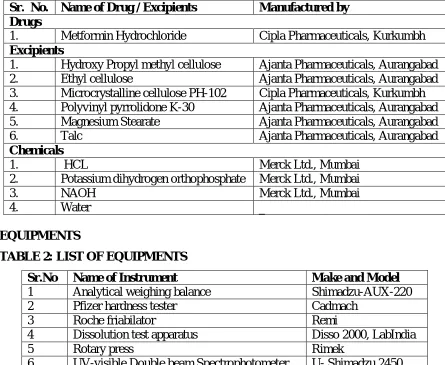
Table 1: List of Materials and Chemicals
Sr. No. Name of Drug / Excipients Manufactured by Drugs
1. Metformin Hydrochloride Cipla Pharmaceuticals, Kurkumbh
Excipients
1. Hydroxy Propyl methyl cellulose Ajanta Pharmaceuticals, Aurangabad
2. Ethyl cellulose Ajanta Pharmaceuticals, Aurangabad
3. Microcrystalline cellulose PH-102 Cipla Pharmaceuticals, Kurkumbh 4. Polyvinyl pyrrolidone K-30 Ajanta Pharmaceuticals, Aurangabad
5. Magnesium Stearate Ajanta Pharmaceuticals, Aurangabad
6. Talc Ajanta Pharmaceuticals, Aurangabad
Chemicals
1. HCL Merck Ltd., Mumbai
2. Potassium dihydrogen orthophosphate Merck Ltd., Mumbai
3. NAOH Merck Ltd., Mumbai
4. Water _
[image:3.595.73.518.286.651.2]EQUIPMENTS
TABLE 2: LIST OF EQUIPMENTS
Sr.No Name of Instrument Make and Model
1 Analytical weighing balance Shimadzu-AUX-220
2 Pfizer hardness tester Cadmach
3 Roche friabilator Remi
4 Dissolution test apparatus Disso 2000, LabIndia
5 Rotary press Rimek
6 UV-visible Double beam Spectrophotometer U- Shimadzu 2450
Evaluation of powdered characteristics[4] Density
The bulk density was determined by gently pouring the powders into a 50 ml volumetric
cylinder to a total volume of 20 ml. After weighing the above volume of powder, the bulk
www.wjpr.net Vol 3, Issue 6, 2014. 1679
(ml) For the measurement of tap density, the cylinder was tapped over a 0.5 inch vertical
drop, using a tap density tester, until a constant volume was observed.
Hausner’s ratio
Hausner’s ratio gives an idea regarding the flow of the blend. It is the ratio of tapped density
to the apparent density.
Compressibility index
The compressibility index measures of the propensity of powder to be compressed. The
packing ability of drug was evaluated from change in volume, which is due to rearrangement
of packing occurring during tapping. It is indicated as Carr’s compressibility index (CI).
Angle of repose
Angle of repose is defined as the maximum angle possible between the surface of pile of
powder and horizontal plane. The angle of repose was determined by the funnel method. A
glass funnel was secured with its tip at a given height (H) above a piece of graph paper placed
on a horizontal surface. Powder was poured through the funnel until the apex of the conical
pile touched the tip of the funnel. The angle of repose was calculated with the formula
OR
Where, = is the angle of repose,
h = height of the conical pile and
r = radius of the conical pile.
Preparation of matrix tablet
Matrix tablets containing 500mg of Metformin HCl along with various amount of polymers
such as HPMC K100M, Ethyl cellulose and other inactive ingredients were mixed and tablet
were prepared by direct compression technique. In the first step, active and inactive
ingredients (except magnesium Stearate) weighed accurately and were screened through a
mesh sieve. Required materials except lubricant were then combined and passed through
40-mesh sieve. In, the screened powder following the addition of given amount of lubricant
powder was again mixed. Before compression, the surfaces of the die and punch were
www.wjpr.net Vol 3, Issue 6, 2014. 1680
tablets using rotary tablet compression machine (Rimek tablet machine, Minipress) equipped
with 13 mm flat circular punch. All the preparations were stored in airtight containers at room
temperature for further study.
Table.3. Composition of Metformin Hydrochloride Tablet
Ingredients F1 F2 F3 F4 F5 F6 F7 F8 F9
Metformin
hydrochloride 500 500 500 500 500 500 500 500 500
HPMC 80 120 160 80 120 160 160 80 120
Ethyl
cellulose 40 60 80 80 40 60 40 60 80
Pvp k30 10 10 10 10 10 10 10 10 10
Avicel 102 160 100 50 120 120 60 80 40 80-
Talc 5 5 5 5 5 5 5 5 5
Magnesium
Stearate 5 5 5 5 5 5 5 5 5
Total 800 800 800 800 800 800 800 800 80
EVALUATION OF TABLETS[4]
The compressed matrix tablets were evaluated for thickness, weight variation, hardness and
drug content.
1. Thickness
The thickness of tablet was determined using micrometer screw gauge. Six tablets from each
batch of formulation were used and mean thickness value and SD was calculated for each
formulation.
2. Hardness
For each formulation, the hardness of six tablets was measured using the Pfizer hardness
tester and mean value and SD was calculated.
3. Weight variation
To study the weight variation, 20 tablets of each formulation were weighed using an
electronic digital balance. The average weight of each tablet was calculated and from that the
percentage deviation in weight was calculated.
4. Friability
For each formulation the friability of 6 tablets was determined using Roche Friabilator. (Remi
www.wjpr.net Vol 3, Issue 6, 2014. 1681 5. Drug content
Five tablets were weighed and powdered. Weigh accurately a quantity of the powder
equivalent to 0.1 g of Metformin HCl shake with 50 ml of 6.8 pH phosphate buffer for 10
minutes, and add sufficient buffer to produce 100.0 ml and filter. After suitable dilution with
solvent measure the absorbance of the resulting solution at the maximum at about 233 nm.
Calculate the content of C4H11N5, HCl, at the maximum at about 233 nm.
6. In-vitro drug release study
In vitro drug release studies of the prepared matrix tablets were conducted for a period of 12
hours by using an USP 24 Dissolution Apparatus type II(2000) (Labindia) at 37± 0.5° C. The
agitation speed was 100 rpm. The Dissolution study was carried out in 900 ml 0.1N HCl at
37±0.5 ºC for first 2 hours and then in 900 ml of phosphate buffer (pH 6.8).5ml of the sample
was withdrawn at regular intervals and the same volume of fresh dissolution medium was
replaced to maintain the volume constant. The samples withdrawn were filtered and the drug
content in each sample was analyzed after suitable dilution with a Shimadzu 2501PC UV/VIS
spectrophotometer at 233 nm. The amount of drug present in the samples was calculated with
the help of calibration curve constructed.
7. Stability Study
Optimized Metformin HCl matrix tablets were packed in thick aluminum foil strips
laminated with The packed tablets were placed in stability chamber maintained at 40±2°C
and 75±5% RH for 1 month. The samples were withdrawn after one month and were
observed for changes on the physical parameter (i.e. change in color, appearance of spot, any
bad odor, smoothness). Samples were evaluated for drug content and in-vitro drug release.
RESULTS AND DISCUSSIONS COPMATIBILITY STUDY BY IR
www.wjpr.net Vol 3, Issue 6, 2014. 1682 Table no.4. Interpretation of IR Spectra of Mixture
Band assignment Wave no observed(CM-1) Wave no reported(CM-1)
N-H 3367.28 3300-3500
C-N 1079.37 1030-1230
C-H 2917.59 3000-3300
C-O 1048.38 1000-1300
O-H 3402.23 3200-3400
C-H str 2921.74 3000-3300
C-H bend 1468.31 1300-1500
Table.5.Powder flow characteristics
Formulation no Bulk Density gm/cm3 Tapped Density gm/cm3 Hausner’s Ratio Carr’s Index % Angle of Repose(Ɵ)
F1 0.34 0.38 1.11 10.52 22.46
F2 0.3 0.33 1.10 9.09 20.12
F3 0.32 0.36 1.125 11.11 23.41
F4 0.34 0.39 1.14 12.82 26.82
F5 0.35 0.40 1.14 12.50 25.36
F6 0.34 0.39 1.14 12.82 27.82
F7 0.36 0.40 1.11 10.00 22.58
F8 0.3 0.32 1.06 6.25 17.34
F9 0.3 0.34 1.13 11.76 24.21
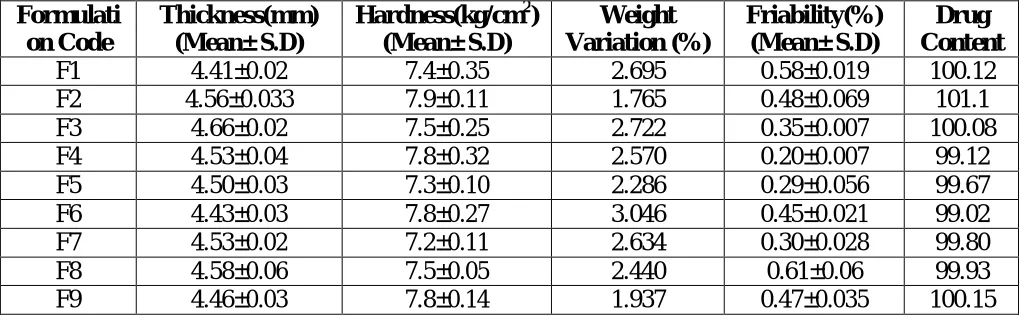
Table.6. Various evaluation parameters of Metformin HCl tablet formulations containing HPMC K100 M and ethylcellulose
Formulati on Code
Thickness(mm) (Mean± S.D)
Hardness(kg/cm2) (Mean± S.D) Weight Variation (%) Friability(%) (Mean± S.D) Drug Content
F1 4.41±0.02 7.4±0.35 2.695 0.58±0.019 100.12
F2 4.56±0.033 7.9±0.11 1.765 0.48±0.069 101.1
F3 4.66±0.02 7.5±0.25 2.722 0.35±0.007 100.08
F4 4.53±0.04 7.8±0.32 2.570 0.20±0.007 99.12
F5 4.50±0.03 7.3±0.10 2.286 0.29±0.056 99.67
F6 4.43±0.03 7.8±0.27 3.046 0.45±0.021 99.02
F7 4.53±0.02 7.2±0.11 2.634 0.30±0.028 99.80
F8 4.58±0.06 7.5±0.05 2.440 0.61±0.06 99.93
[image:7.595.43.555.496.656.2]www.wjpr.net Vol 3, Issue 6, 2014. 1683 Fig.2.Effect of polymer HPMC K 100 M and ethyl cellulose on release pattern of Metformin hydrochloride
Table.7. Release Models
BATCH NO ZERO ORDER FIRST ORDER HIGGUCHI
F1 0.940 0.876 0.991
F2 0.939 0.878 0.988
F3 0.971 0.895 0.991
F4 0.921 0.882 0.988
F5 0.910 0.886 0.982
F6 0.969 0.896 0.985
F7 0.975 0.897 0.984
F8 0.944 0.873 0.991
F9 0.959 0.898 0.991
Table.8.Evaluation parameters of Formulation F3 stored at 400C for 1month
Parameter After 1 month
Appearance White color
Thickness(mm) 4.5 Hardness(kg/cm2) 7.8 Friability (%) 0.20 Drug content (%) 99.12
Table.9. % Cumulative release of formulation F3
Time(hr) % cumulative release after 1 month
1 25.82
2 39.14
3 47.47
4 53.45
6 63.78
8 76.16
10 85.42
www.wjpr.net Vol 3, Issue 6, 2014. 1684 DISCUSSION
Compatibility studies
Mixture of Metformin HCL and different excipients were compared with HPMC and Ethyl
cellulose and it was found from the spectra that principle peaks of drug Metformin HCL was
retained and there was no interaction between drug and polymers.
Powder flow characteristics
Formulation (F1-F9) were evaluated for angle of repose, tapped density, bulk density,
compressibility index, Hausner’s ratio and angle of repose. The results of Hausner’s ratio was
found to be in the range of 1.06-1.14 which shows excellent to good flow. The results of
compressibility index were found to be in the range of 6.25-12.82% which according to
standard values shows excellent flow. Results of angle of repose were found to be in the
range of 17.34-27.82 which according to standard values shows excellent to good flow.
Evaluation of Tablets
The tablet formulations were subjected to various evaluation tests such as thickness,
diameter, hardness, and friability, uniformity of weight, drug content, and in vitro dissolution.
The results for all the formulations are shown in Table. The thickness of all the formulations were varies within ranges from 4.1-4.58 all the formulation showed uniform thickness. The
weight variation test was carried out as per official method and it was found that all formulation to be within the limit (as per pharmacopoeial standard) The content uniformity
test was also carried out as per official method and it was found that different batches shown
good content uniformity. It was found that all batches shown percent drug content more than
98 %. The tablet hardness of all the formulations was determined and it was found sufficient in the range 7.1-7.9 kg/cm2. Another measure of tablet hardness was the friability. A compressed tablet that loses less than 1 % of their weight is generally considered acceptable.
For all formulation tried here the weight loss was less than 1 % hence acceptable.
In-vitro release study
The in vitro drug release characteristics were studied in 900 ml 0.1N HCl for a period of 2
hours and 6.8 pH phosphate buffer for Remaining 10 hrs using USP XXIII dissolution
apparatus 2. According to the USP release pattern, the conventional formulation release not
less than 70% in 45 minute. Various formulations were tried here and out of that F3 was the
www.wjpr.net Vol 3, Issue 6, 2014. 1685 Influence of quantity of HPMC K100M and addition of Ethylcellulose on in vitro release rate of Metformin HCl from Matrix Tablets.
To study the effect of HPMCK 100M and ethyl cellulose on release of Metformin
Hydrochloride, optimization was applied and 32 factorial design was selected and accordingly
9 batches (F1-F9) were prepared with different varying concentrations of HPMC K 100 M
and ethyl cellulose batches Fig reveal the effect of quantity of HPMC K 100M and ethyl
cellulose on release of Metformin Hydrochloride from the tablet matrix. As expected the
release rate was slower with higher quantities and higher viscosities of HPMC and ethyl
cellulose. Formulation F1, F2 and F8 shows drug release 95.45%, 93.13% and 94.44% within
8 hrs respectively. Formulation F4 and F5 shows complete release of drug within 10hrs only
with 94.22 and 95.55 respectively. Formulation F3, F6, F7 and F9 shows complete release of
drug within 12hrs but formulation F3 shows comparatively slower release of drug than other
formulation and hence formulation F3 has been selected as optimized formulation. Different
kinetic treatments (zero order, first order, and Higuchi’s square root equation were applied to
interpret the release of Metformin HCl from different matrices. The data was given in Table.
The Higuchi’s square root equation gave consistently higher values (0.982 to 0.991) for all
formulations. First order kinetic treatment gave lower values (0.882 to 0.898). Zero order
kinetic treatment gives higher values (0.910 to 0.975).
Stability studies
Form stability studies it was established that the formulation F3 stable at 400c and 75% RH
and does not show significant variation in appearance, thickness, friability, hardness and drug
content and percent cumulative release.
ACKNOWLEDGEMENTS
First of all, I would like to express my deep and sincere gratitude to my guide Dr. A.P.PINGLE his invaluable suggestions, encouragement, and guidance have been instrumental in completion of this project. Without their efforts and constant support, this
www.wjpr.net Vol 3, Issue 6, 2014. 1686 REFERENCES
1. Tapaswi Rani Dash, Pankaj Verma,Matrix Tablets: An Approach towards Oral Extended
Release Drug Delivery, International Journal of Pharma Research & Review, Feb 2013;
2(2):12-24
2. Lieberman, H.A., Lachman, L., and Schwartz, J.B. (1989) Pharmaceutical and dosage
form: Tablet, 2th ed. Marcel Dekker, Inc. pp:188-190.
3. Lachman, L., Lieberman, H.A. and Joseph, L.K. (1991) The Theory and Practice of
Industrial pharmacy. 4th ed. India: Varghese Publishing house, pp. 171-172,
183-184;293-301: 317.
4. Government of India, Indian Pharmacopoeia Commission. Ministry of Health and Family
Welfare (2007) Indian Pharmacopoeia. Ghaziabad: India. pp. 135-138: 177-184.
5. Handbook of Pharmaceutical Excipients, Washington DC, American
Pharmaceutical Association / Pharmaceutical Society of Great Britain, 19862180-2181
6. The Official Compendia of Standards. The United States Pharmacopoeial Convention
(2006). United States Pharmacopoeia 29 - National Formulary 24, Rockville, Toronto:
Webcom Ltd, pp. 242 <616>; 643 <1174>: 2709.
7. John Rojas, Cesar González, Carolina Rico, Oswaldo Saez, Formulation of a modified
release metformin.HCl matrix tablet: influence of some hydrophilic polymers on release
rate and in-vitro evaluation, Brazilian Journal of Pharmaceutical Sciences vol. 47;
3:jul./sep.2011.
8. Chinmaya Keshari Sahoo*1, A. Amulya Reddy2, Vandana Kethavath2 et al,Designing of
sustained release Metformin hydrochloride tablets for the treatment of type-II diabetes
mellitus, International journal of universal pharmacy and bioscience,12-20
9. M. Rajesh, Mohan Kumar pippalla, KRSC. Bharath Kumar et al, Formulation and
evaluation of extended release tablets of Metformin hydrochloride, International journal
of pharmaceutical, chemical and biological sciences,2012;2(3):318-324
10.Rangasamy Manivannan, Venkatachalam Sriram, Bandaru Lakshmi Narayana Rao et al,
Formulation and evaluation of Metformin hydrochloride sustained release tablets
,International journal of Biopharmaceutics,2013;4(2):73-79
11.Bhupendra Prajapati, Rakesh Patel, Dhaval Patel, Payal Shah, Metformin hydrochloride
sustained release tablet using different matrixing tablet-journal of science and