© 2019, IRJET | Impact Factor value: 7.211 | ISO 9001:2008 Certified Journal
| Page 2302
Traffic Sign Classification and Detection using Deep Learning
Shalinia G
11
Student, Dept of CSE, MSRIT, Karnataka, India
---***---Abstract -
Traffic signs afford crucial direction to trafficsupervision, differing between admonitions, street condition data and goal information. Traffic signs detection and classification has a significant job in the unmanned autonomous driving. Distinct methods were contemplated in the previous years to handle this problem, still the performance of these approaches needs to be enhanced to fulfil the necessities in real time applications. Vigorous and continuous traffic-sign identification algorithms must be utilized if self-driving vehicles are turned out to be exemplary in the streets of the future. Deep learning methods aids to get accuracy in the process of traffic sign recognition even though with presence of some disturbances. The dataset can include both gray images and color images which is demonstrated here. The images are divided for training and testing. The efficient methods such as Convolution Neural Network and Support Vector Machine are used for the mechanism. The comparison is given for using gray scale images and color images.
Keywords: Traffic sign recognition, CNN, SVM, Classification, Deep Learning
1. INTRODUCTION
Traffic-sign identification and classification is an intriguing part in computer-vision and it is particularly important with regards to self-governing vehicle innovation. Traffic-sign recognition is an innovation by which a vehicle can perceive to recognize the traffic sign put on the street for example, "speed limit" or "turn ahead". Traffic signs can be analyzed utilizing front oriented cameras in numerous modern vehicles and trucks. They insist the driver by providing commands, admonitions and some of the times by taking control of the vehicle itself. For instance, in a 40 km/hr speed zone, if the driver surpasses that speed, the framework gives warnings. On the off chance that the driver keeps on driving the system will take the control. Understanding scene is the definitive objective of computer vision, distinguishing and grouping objects of different sizes in the scene is a significant sub-task. As of late, deep learning strategies have demonstrated predominant execution for some undertakings such as speech recognition and image classification. One specific alternative of deep neural networks is convolutional neural networks (CNNs), have delineated their qualities
for errands consisting image detection, classification and localization.
Traffic signs might be partitioned into various classes based on to the function, and in every classification they might be further divided into subclasses with comparative nonexclusive shape and appearance however changed subtleties. This proposes traffic-sign recognition ought to be completed as a two-stage task: detection pursued by classification. The detection step uses shared data to recommend bounding boxes that may contain traffic-signs in a specific classification, while the classification step utilizes contrasts to figure out which specific sort of sign is present.
Google Colaboratory which is used for the implementation is an explorative tool for machine learning research. It’s a Jupyter notebook environment that needs no setup to utilize. Colaboratory works with most real programs, and is most completely tried with work area forms of Chrome and Firefox. Code is executed in a virtual machine committed to your record. Virtual machines are reused when inert for some time, and have a superlative lifetime authorized by the system. Colaboratory is expected for intelligent use. Long-running foundation calculations, especially on GPUs, may be halted. The German traffic sign detection benchmark dataset is used for experiment and evaluation the proposed approach. This dataset was collected in different scenarios of real traffic scenes. Training dataset consists of 43 traffic sign classes, with 39,209 images. The image data contains a test set within about 12,630 images.
© 2019, IRJET | Impact Factor value: 7.211 | ISO 9001:2008 Certified Journal
| Page 2303
of CNN such as batch normalization, activation andmaxpooling. Adam is a versatile learning rate enhancement algorithm that has been structured explicitly for training deep neural networks. Adam is a flexible learning rate approach, which implies, it registers singular learning rates for various parameters. The name is derived from moment evaluation, and the reason it is called that is on the grounds that Adam utilizes estimations of first and second moments of gradient to adjust the learning rate for each weight of the neural network. Finally the accuracy for train and test data is obtained, which is used for comparison. The confusion matrix is produced for the predicted outcome.
2. LITERATURE SURVEY
Street security and traffic management is a very accusatory current issue and a theme dive for research by experts over the globe. Regular events of fatal accidents bringing about the loss of lives and different assets. There can be various incitements prompting these disasters like poor street upkeep, neglectful driving, mental condition of driver, casual attitude of pedestrians. Another major reason prompting to this may be the poor law implementation and improvised upkeep of street traffic signs. Blocked or then again decayed signs may delude the driver. One of the approach involves four stages to detect traffic signals. Those are Image procurement (remove deblurring), Color segmentation (to detect color), Blob detection (region & shape) and Classification using multiple neural network (high accuracy).
One more methodology focuses on the recognition and classification of traffic signs dependent on the investigations on traffic signs abroad and home which likewise incorporate the present state, mechanical issues and advancement inclination. Joined with the noteworthy highlights of the shape and inward structure of the traffic signs, three new components put together algorithms with respect to street signs ID have been actualized, including image pretreatment, include feature extraction and classifier. The feature extraction work of traffic signs is led with the algorithms utilizing a combination of Deep Boltzmann Machines and Canonical Correlation Analysis. Contrasted with the algorithms on the basis of HOG and LBP feature extraction, the DBM-CCA has higher accuracy.
The present method emphasis on Convolution Neural Network and Support Vector Machine. Convolutional Neural Networks has two exclusive points of interest of extracting feature. One is known as local perceptional vision. It is commonly viewed that individual’s vision of the outside world is from local to global. Also, the spatial
contact of local pixel in the image is more intently, while the far off is generally feeble. Therefore, it is no important to complete the global image, every neuron just requires to percept locally. At that point in the more elevated amount, we simply need to get together the local information to get the global information. The other advantage is known as the weights of Shared. With respect to an image, the factual properties of one section are equivalent to others. It implies that we can apply the attributes we learned in one section to the others. So for every positions in an image, we can include the same learning qualities. From that point onward, we can include different convolutional kernels, adapting f arrows are classified: straight, turn-left, turn-right, straight or turn-left, so set p = 4. Based on Hold-out Method guideline, we haphazardly pick 70% images as the training samples and the remaining 30% images as the testing samples. The samples are partitioned into more types of feature. Different images produced by different convolutional kernels can be viewed as the different channels of an image.
Support vector machine (SVM) has astounding favorable position in managing with small sample, nonlinear and high dimension issues. It is convenient for the classification of traffic signs. The pith of SVM is to convert linear and indivisible problem to high dimension space by picking an appropriate kernel function, influencing it to turn out to be linearly separable, and after that to look the optimal separating hyperplane. One of the method is to choose the polynomial kernel function:
K(x,z) = (x·z + 1 ……….(1)
In this case, the decision function is:
f (x) = sign ∑ ……….(2)
The analogous SVM is a p polynomial classifier. Four types o positive samples and negative samples, the previous containing 4 kinds of directional arrows, the final containing other images precluding the arrows
3. PROPOSED METHODOLOGY
© 2019, IRJET | Impact Factor value: 7.211 | ISO 9001:2008 Certified Journal
| Page 2304
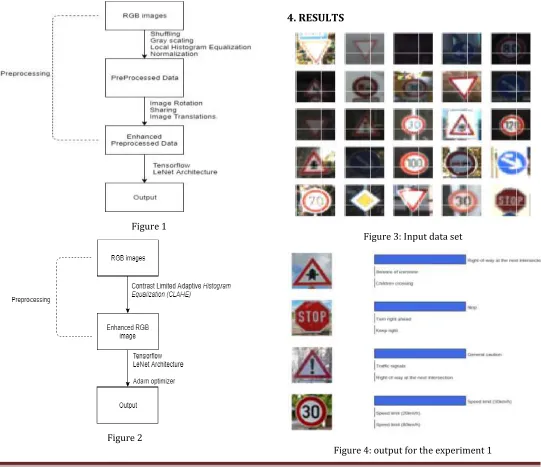
100, Dropout at FC 0 layer = 0.6, Dropout at FC 2 layer = 0.6, Dropout at Conv 1 layer = 0.7. Figure 1 represents the data flow of the experiment done.
Experiment 2: For the comparative study we have taken only RGB images and used to improve the image quality for better visualization Contrast Limited Adaptive
Histogram Equalization (CLAHE) is been applied on the
RGB images. The enhanced RGB images are been used as input and by using tensorflow with LeNet architecture and Adam optimizer the data is been trained and tested. . Figure 2 represents the data flow of the experiment done.
Figure 1
Figure 2
3.1Requirements
System Requirements:
64 bit windows 8 or higher version operating
system is required. Minimum core 2 Duo or 2.4
GHz processor is needed. And minimum 4GB
RAM is necessary.
Software Requirements:
Google Colab
4. RESULTS
[image:3.612.37.578.249.716.2]Figure 3: Input data set
© 2019, IRJET | Impact Factor value: 7.211 | ISO 9001:2008 Certified Journal
| Page 2305
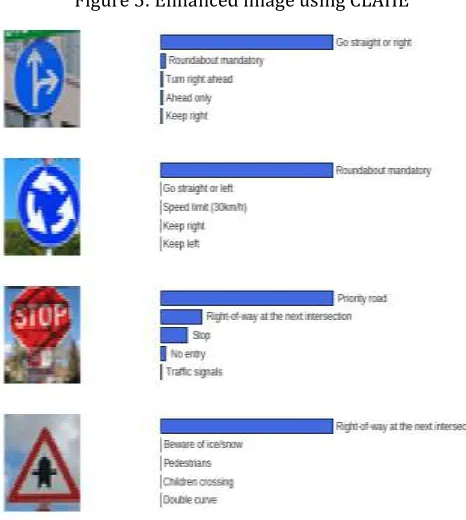
Figure 5: Enhanced image using CLAHEFigure 6: output for experiment 2
In this result we could find variation in the result as there were distortion in the sign board.
Figure 7: Confusion matrix: CLAHE method The accuracy of the experiment 1 is 94.8% and the accuracy of the experiment 2 is 98.3%.
5. CONCLUSION
The proposed system includes efficient feature extraction methods which results in appropriate outcomes. The CNN and SVM are the finest techniques of Deep Learning which ensures accuracy in the achieved output. The Adam method incorporates all the aspects of CNN. The work includes processing of both Gray and RGB color images, in which RGB images gives more accuracy ie 98.3%. This algorithm has a best speculation, and it can be trusted that it is used to identify more conventional traffic signs.
REFERENCES
[1] Joshua Paolo, Mabanta, Michael Kevin L, “Traffic sign integrity analysis using deep learning”, IEEE 14th
International colloquium on signal processing & its applications 2018.
[2] Wang Canyong, “Traffic sign detection and recognition based on deep learning”, International conference on robots & intelligent system 2018.
[image:4.612.41.274.310.570.2]© 2019, IRJET | Impact Factor value: 7.211 | ISO 9001:2008 Certified Journal
| Page 2306
[4] Songwen Pei, Fuwu Tang, “Localized traffic signdetection with multi-scale deconvolution networks”, Cornell University Library 2018.
[5] Feng Lin, Yan Lai, “A traffic sign recognition method based on deep visual feature”, Electromagnetic Research Symposium, China 2016.
[6] Chen Li, Cheng Yang, “The research on traffic sign recognition based on deep learning”, National Science and Technology Supporting Program of China 2016.
[7] Arun Nandewal, Abhishek Tripathi & Satyam Chandra, “Indian traffic sign detection and classification using neural networks”, an international journal of engineering sciences 2016.
[8] Van-Dung Hoang et al., “Improving Traffic Signs Recognition Based Region Proposal and Deep Neural Networks”, Springer International Publishing AG, part of Springer Nature 2018.
[9] Zhe Zhu, Dun Liang, Songhai Zhang et al., “Traffic-Sign Detection and Classification in the Wild”, CVPR.
[10] Uday Kamal, Sowmitra Das, Abid Abrar, Md. Kamrul Hasan, “Traffic-Sign Detection and Classification Under Challenging Conditions: A Deep Neural Network Based Approach”, Technical Report, September 2017.