Study on Effect of Different Varieties Configuration upon
Yield of Yan Mountain Chestnut
Qian Wang, Shuchai Su, Di Zhao, Yanru Kou
Key Laboratory for Silviculture and Conservation, Ministry of Education, Beijing Forestry University, Beijing, China. Email: [email protected]
Received February 7th, 2012; revised March 1st, 2012; accepted March 28th, 2012
ABSTRACT
In order to improve the yield and quality of 5 new Castanea mollissima varieties “Zipo”, “Zunyu” and traditional Yan Mountain Castanea mollissima cultivars “Duanci”, “Yanhong” and “Donglingmingzhu”, we carried out an experiment to study effect from different varieties configuration on yield of Yan Mountain chestnut. The result indicated that: cross-pollination had a significant impact on both fruiting rate and seed-setting rate; cross-pollination improved the nut number in each burr of each variety, in which “Duanci” was the biggest beneficiary, whose number of nut per burr in-creased from 1.08 to 2.77, 156% higher than that of the self-pollination combination; nut weight showed no significant difference in Xenia Effection; “Zunyu” improved the yield of “Yanhong” most; “Donglingmingzhu” was regarded as the best tree to improve “Zunyu”’s yield; the best variety to improve yield of “Zipo” was “Zunyu”; “Donglingmingzhu” and “Duanci” improved yield of each other most.
Keywords: Castanea mollissima Bl; Configuration; Fruiting Rate; Seed-Setting Rate; Number of Nuts per Burr; Nut
Weight; Yield
1. Introduction
Chestnut (Castanea mollissima) was considered as one of Chinese endemic species and the nutrient-rich nuts have unique flavor and great economic value [1]. Meanwhile, Chinese chestnut is quite competitive in world markets because it has good taste and easily peeled off astringent seed capsule [2]. Yan Mountain chestnut mainly grow in Qianxi, Zunhua, Xinglong, Kuancheng, Qinglong counties, Hebei province and Huairou, Miyun, Pinggu and Chang- ping areas in Beijing. All of the nuts have exquisite shape, delicate meat and are high in sugar content. The nuts are famous for being fried with the trade name “Tianjin Sweet Chestnut” or “JingDong Chestnuts”. Varieties mainly cultivated in Yan Mountain area are Yanghong, YanChang, YanMing, Timazhenzhu, Zipo, Zunyu, Huai Huang, Huai- jiu, Zunhuaduanci and so on.
Castanea mollissima is a typical kind of cross-polli- nation plants and its self-pollination seed-setting rate is very low which only reached 10% to 40% [3]. Many scholars had carried out related researches. Such as Mokay, he has already confirmed that the infertility under self-pollination on some chestnut seedling trees was due to incompatibility between male gametes and female gametes [4]. In addition, the stigma of pistil has strong selectivity on pollen, so affinity between different cultivars combinations are different. The test cross about
different chestnut varieties conducted by Wenbang Fan and other experts showed that fruiting rate in case of self- pollination was much lower as against that of cross- pollination [5]. As a result, fruiting rate and seed-setting rate will ultimately affect yield of chestnut.
The experiment carried out by Kong Dejun indicated that per standard unit the number of nut per burr and nut weight increased, the yield of each tree will be improved respectively by 0.669 and 0.246 standard unit, which showed that these two traits could be considered as two key factors that affect the yield of chestnut [6].
basis to improve the yield of new chestnut orchard.
2. Materials and Methods
2.1. Overview of Test Site and Background
The pollination experiment was carried out in the chest- nut breeding base in Zunhua City, Hebei Province which is located at 40˚11′50″N latitude and 117˚58′30″E longi- tude. It is in the north of Tangshan City and belongs to warm temperate semi-humid monsoon climate and has four distinct seasons. The annual average sunshine hours is 2608.2 hours, annual average temperature is 10.9˚C, and lowest temperature is –25.7˚C. Frost-free period reaches 182 days and its precipitation is 724.7 millimeters. This chestnut breeding base was selected as the test site was because Zunhua is one of the main chestnut production bases in north China.
Zunhua Chestnut mainly distributed in northern and western mountains areas along the Great Wall which is rich in gneiss. Weathered gneiss soils which contains large number of iron, managanese, sulfur, boron and other inorganic nutrients, coupled with low temperatures, large temperature difference and abundant rainfall here, make it suitable for growth of chestnut.
Castanea mollissima cv. “Zunhua pagoda 54”has been tested by Chinese Academy of Sciences and the result showed that it contained 10% sugar, 55.07% starch, 6.21% crude protein, 3.3% crude fat, vitamin C 4.5 milli- gram per 100 gram, vitamin B 10.289 milligram per 100 gram and vitamin E 0.275 milligram per 100 gram. The quality of Castanea mollissima cv. “Zunhua pagoda 54” turned out to be the top compared with chestnut across the country. In addition, 80% of Zunhua chestnuts were exported to Japan and many Southeast Asian countries, earning a great reputation in the international arena.
2.2. Experiment Materials
According to research objectives, new varieties Castanea mollissima cv.“Zipo”, “Zunyu”, which were bred during “The Eleventh Five-year Plan” in China and the tradi- tional Yan Mountain cultivars Castanea mollissima cv. “Duanci”, “Yanhong”, “Donglingmingzhu” as research ma- terials for mutual pollination on the basis of germplasm resources survey. Pollens of all 5 varieties were respec- tively collected for reciprocal pollination and varieties selection are as followed in Table 1.
There were totally 25 combinations and the design is as follows in Table 2.
2.3. Test Method
The research materials were healthy, non-pest, well-ma- naged and in similar growth conditions. 20-year-old Cas- tanea mollissima cv.“Yanhong”,“Zunyu”,“Zipo”,“Dong-
Table 1. Varieties selection.
Number Variety Code
1 Castanea mollissima cv.“Yanhong” A
2 Castanea mollissima cv. “Zunyu” B
3 Castanea mollissima cv. “Zipo” C
4 Castanea mollissima cv. “Donglingmingzhu” D
5 Castanea mollissima cv. “Duanci” E
Table 2. Pollination combinations design.
Female Male
A B C D E A A × A A × B A × C A × D A × E B B × A B × B B × C B × D B × E C C × A C × B C × C C × D C × E D D × A D × B D × C D × D D × E E E × A E × B E × C E × D E × E
lingmingzhu” and “Duanci” were respectively and ran- domly selected as female parent. 7 - 8 similar female flow- ers in the east, west, north and south of each tree were picked out for pollination and there were totally 30 flow- ers in each tree.
The process of pollination is as follows:
Ziplock bags were applied to bag the female flowers before their stigmas” appearing.
It was the most appropriate season for pollination when the angle between stigma and stigma became 30˚ - 45˚ and most anther of male inflorescence turned yellow from green at this time. Ziplock were put on the female flowers again immediately after the pollination. The job was repeated two times 2 days later.
Bags were taken off from the female flower and tags were hanged to branches to indicate male parents when all male flowers withered. Meanwhile, fruiting rate were calculated.
Gather chestnut and investigate their empty shell rate, seed-setting rate and so on after the chestnut was har- vested.
2.4. Statistics
The number of female inflorescence was recorded when pollinating. The fruiting condition was written down while ziplock bags were removed after all male flowers had withered and the number of empty shell, number of nut per burr, nut weight and yield were recorded when chestnut were collected.
3. Result and Discussion
3.1. Affect from Different Combinations on Fruiting Rate and Seed-Setting Rate
Empty shell of chestnut, commonly known as no fruit, means nuts in shells did not develop or just leave the seed coat [12-14]. It is considered as no empty shell even when there is only one seed in it. To some extent, the level of seed-setting rate can be used as indicator for strength of pollination affinity. That is, the higher the seed-setting rate is, the stronger the affinity will be and it could be considered as a good combination [15]. Mean- while, seed-setting rate is considered to be a key factor to effect the yield [16]. So a cross-pollination experiment was carried out on Castanea mollissima cv.“Yanhong”, “Zunyu”, “Zipo”, “Donglingmingzhu” and “Duanci and fruiting rate and seed-setting rate of 5 cultivars are follows
as Figures1-5.
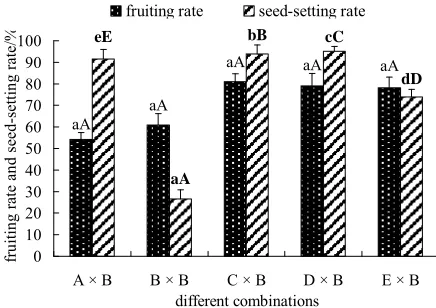
It can be seen from Figure 1 that: both fruiting rate (42.9%) and seed-setting rate (23.3%) of self-pollination combination “Yanhong × Yanghong” (A × A) was very low. However, fruiting rate and seed-setting rate of cross- pollination combinations “Zunyu × Yanghong” (B × A), “Zipo × Yanghong” (C × A), “Donglingmingzhu × Yang- hong” (D × A) and “Duanci × Yanghong” (E × A) were significantly higher than that of “Yanhong × Yanghong” (A × A), which reached the same result with Fan Wen- bang [17].
Considering different cross-pollination combinations, seed-setting rate showed significant difference, but the fruiting rate of the 4 cross-pollination combinations showed no evident difference with each other.
Figure2 showed that fruiting rate and seed-setting rate of
self-pollination combination “Zunyu × Zunyu” (B × B) was only 61.0% and 26.5%. Although seed-setting rate of cross-pollination combination “Yanhong × Zunyu” (A × B) (91.5%) was the highest of all, its fruiting rate de-creased even lower as against that of the self-pollination combination “Zunyu × Zunyu” (B × B). Thus, “Yan- hong” was considered not to be the suitable pollination tree for“Zunyu”. Difference among fruiting rate of “Zipo × Zunyu” (C × B) (81.0%), “Donglingmingzhu × Zunyu” (D × B) (79.1%) and “Duanci × Zunyu” (E × B) (78.1%) were not so evident, while seed-setting rate of “Zipo × Zunyu” (C × B) (93.8%)and “Duanci × Zunyu” (E × B) (73.9%) was lower than that of “Donglingmingzhu × Zunyu” (D × B) (95.0%). Meanwhile, fruiting rate showed no significant difference with each other among the 5 combinations, but on the contrary, seedsetting rate mani- fest much difference with each other, which indicates that fruiting rate and seed-setting rate were not so consis- tent with each other and the condition of fruiting rate did not affect seed-setting rate much.
As shown in Figure3 that fruiting rate (73.3%) and seed-setting rate (44.5%) of self-pollination combination “Zipo × Zipo” (C × C) were still the lowest of all. All seed-setting rate of combinations “Yanhong × Zipo” (A × C), “Zunyu × Zipo” (B × C), “Donglingmingzhu × Zipo”
abAB abAB
abAB
bB bB bB
bB
70 80 90 100
ed
-s
ettin
aA 50 60
a
nd s
e
cC
40
A × A B × A C × A D × A E × A
different combinations
aA
20 30
iting
0 10
fr
u
r
ate
g
ra
te
/%
fruiting rate seed-setting rate
[image:3.595.318.536.377.531.2]a: Small letters on the post indicate significance level on 5% and capital
Figure 1-5 .
letters indicated significance level on 1%. Letters in bold described differ- ences between seed-setting rate and those letters in light showed differences between fruiting rate and it applies to
Figure 1. Fruiting and seed-setting conditions of Yanhong (A) under different pollinations.
fruiting rate seed-setting
aA aA
aA
dD 80
90
tin
g rate/
aA
cC bB
70
-set aA
aA
0 10 20 30 40 50 60
A × B B × B C × B D × B E × B
different combinations
fr
uitin
g r
ate an
d s
eed
rate eE
100
[image:3.595.309.536.572.707.2]%
Figure 2. Fruiting and seed-setting conditions of Zunyu (B) under different pollinations.
aA aA aA aA aA
bB bB
aA
bB bB
30 40 50 60 70 80 90 100
iting
r
ate
a
nd s
ee
d-se
ttin
0 10 20
A × C B × C C × C D × C E × C different combinations
fr
g
rate
/%
fruiting rate seed-setting rate
u
aA
aA
aA
aA
aA
aA bB bB
bB
bB
0 10 20 30 40 50 60 70 80 90 100
A × D B × D C × D D × D E × D different combinations
fr
uit
ing
ra
te
a
nd s
ee
d-se
tti
ng
ra
te
/%
[image:4.595.59.285.86.232.2]fruiting rate seed-setting rate
Figure 4. Fruiting and seed-setting conditions of Dongling- mingzhu (D) under different pollinations.
abA
aA abA
60 80
ed
-s
et
abA bA
aA
s
e
tin
cC cC cC
100 120
g
ra
te/
bB
0 20 40
fru
it
in
g rate
an
d
A × E B × E C × E D × E E × E
different combinations
[image:4.595.70.288.271.410.2]% fruiting rate seed-setting rate
Figure 5. Fruiting and seed-setting conditions of Duanci (E) under different pollinations.
(D × C) and “Duanci × Zipo” (E × C) were above 95%. However, considering fruiting rate, “Donglingmingzhu × Zipo” (E × C) (81.9%) was higher than that of “Yanhong × Zipo” (A × C) (74.3%), “Zunyu × Zipo” (B × C) (77.1%), “Duanci × Zipo” (E × C) (73.3%). Fruiting rate did not show evident difference among these 5 varieties and seed- se
ingmingzhu” (E × D
combinations “Yanhong × Yanghong” (A × A), “Zunyu ×
o × Zipo” (C × C) and “Dongling-
ons were very high, especially “Zunyu f
u” (B), “Z
erage number of nut (B × A), “Zipo × Yang-
)
to 2. ss-pollination, 45% higher than that of
er of nut per burr of “Yanhong ×
Zipo” (A ngling-
ingzhu tting rate of the 4 cross-pollination combinations also
showed no significant difference between each other.
Figure 4 showed that fruiting rate of self-pollination
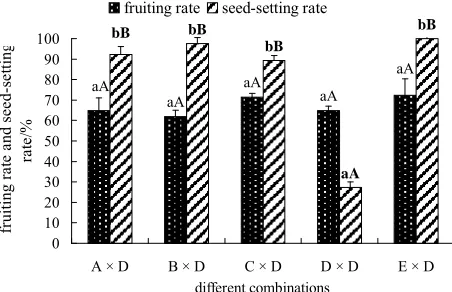
combination “Donglingmingzhu × Donglingmingzhu” (D × D) was 64.9%, but its seed-setting rate was only 27.3%. In comparison with “Yanhong × Donglingmingzhu” (A × D) (64.8%) and “Zunyu × Donglingmingzhu” (B × D) (61.9%), seed-setting rate of “Zipo × Donglingmingzhu” (C × D) (71.4%) and “Duanci× Dongl
) (72.4%) were much more higher. However, fruiting rate of “Zipo × Donglingmingzhu” (C × D) (89.3%) was much lower than that of“Duanci × Donglingmingzhu” (E × D) (100%).
It can be seen from Figure5 that fruiting rate of self- pollination combination“Duanci × Duaci” (E × E) was 83.8%, but its seed-setting rate was only 19.0%. From the 4 figures above this we can see all of self-pollination
Zunyu” (B × B), “Zip
mingzhu × Donglingmingzhu” (D × D) depicted the same thing that fruiting rate of them were the lowest of all. That is because the stigma of pistil has strong selectivity on pollen, which leads to infertility under self-pollination conditions [18]. Seed-setting rate of all the other 4 cross- pollination combinati
× w
Duanci” (B × E) and “Zipo × Duanci” (C × E), both o hich were over 95.0%. Seed-setting rate of the 4 cross- pollination combinations showed significant difference in comparison with that of self-pollination combination “Duanci × Duanci” (E × E), but in which “Yanhong × Duanci” (A × E), “Zunyu × Duanci” (B × E) and “Zipo × Duanci” (C × E) depicted no evident difference with each other.
In all, cross-pollination had a significant impact on fruiting rate and seed-setting rate of chestnut. Although there were some difference among cross-pollination com- binations, they were not so significant.
3.2. Affect from Different Combinations on Number of Nut per Burr
As can be indicated in Figure6: number of nut per burr of Castanea mollissima cv.“Yanhong” (A),“Zuny
ipo” (C), “Donglingmingzhu” (D) and “Duanci” (E) were respectively 1.56, 1.48, 1.30, 1.50 and 1.08.
By comparison with self-pollination combination“Yan- hong × Yanghong” (A × A), the av
per burr of“Zunyu × Yanghong”
hong” (C × A), “Donglingmingzhu × Yanghong”(D × A and “Duanci × Yanghong” (E × A), increased from 1.56
26 after cro
“Yanhong × Yanghong” (A × A), in which combina- tion“Duanci × Yanghong” (E × A) ,whose number of nut per burr became 2.34, turned out to be the highest and was 1.5 times as much as that of“Yanhong × Yanghong” (A × A).
The average number of nut per burr of “Yanhong × Zunyu” (A × B), “Zipo × Zunyu” (C × B), “Donglin- gmingzhu × Zunyu” (D × B) and “Duanci × Zunyu” (E × B) rose from 1.48 to 2.16 after cross-pollination, 46% higher than that of “Zunyu × Zunyu” (B × B), in which combination “Yanhong × Zunyu” (A × B), whose number of nut per burr was 2.35, ranked first among the cross- pollination combinations and turned out to be 59% higher than that of “Zunyu × Zunyu” (B × B).
The average numb
× C), “Zunyu × Zipo” (B × C), “Do × Zipo” (D × C), and “Duanci × Zipo” (E × C) m
aA bAB bB bB bB bB
aA bB bB bAB
aA bBbB bBbB
aA bBbB bB
A × B × C C × C D × E × C A × B × D C × D D × E × D A × B × C × D × E × bB aA bcB cB bcB cB 0.00 0.50 1.00 1.50 2.00 2.50 3.00 3.50 A × A
B × A C × A D ×
A
E × A A ×
B
B × B C × B D ×
B
E × B
C C D D E E E E E
num be r of nu t pe r bu r different combinations r l letters indica nce level on 1%. These letters just showed differences in
figure given above, 5 sets of data de- sitive ef- 5 varie
Nut weigh omic
haracteris [19,20].
u” (B), “Zunyu × Zipo” (B × C) (7.64 gram)had the heaviest nut weight among com- f “Yan- hong × Donglingmingzhu” (A × D) (5.25 gram) and
b, Small letters on the post indicate significance level on 5%, capita te significa
[image:5.595.55.287.84.192.2]the corresponding group (e.g. The first group were composed by A × A, B × A, C × A, D × A and E × A, so the letters on their post just indicated differ- ences among A × A, B × A, C × A, D × A and E × A, not relating to the other 4 groups, neither did the letters on the post of the other 4 groups) and it also applies to Figure 7.
Figure 6. Number of nut per burr of different varieties.
become 2.73, ranked first among the cross-pollination combinations and was 133% higher than that of “Zipo × Zipo”(C × C).
By comparison with self-pollination combinations “Donglingmingzhu × Donglingmingzhu” (D × D) and “Donglingmingzhu × Duanci” (E × E), the average number of nut per burr of “Donglingmingzhu” (D) and “Duanci” (E) respectively increased from 1.50 to 2.37and 1.08 to 2.77 after cross-pollination, both increased rapidly by 58% and 156%.According to the figure, “Zunyu × Dong- lingmingzhu” (B × D) and “Duanci × Donglingmingzhu” (E × D), whose number of nut per burr were 2.45 and 2.85, turned out to be the highest in the corresponding combinations, respectively 1.63 and 2.64 times as much as that of “Donglingmingzhu × Donglingmingzhu” (D × D) and “Donglingmingzhu × Duanci” (E × E).
According to the
picts the same result that evident consistent po fect was found in number of nut per burr in all of the
ties after cross-pollination.
3.3. Affect from Different Combinations on Nut Weight
t of chestnut is a very important econ tic related to varieties evaluation c
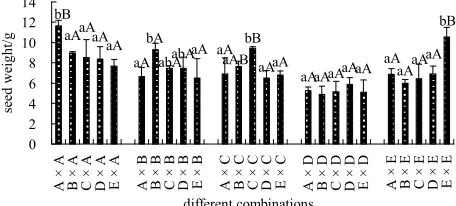
Figure 7 showed that nut weight of “Yanhong” (A),
“Zunyu” (B), “Zipo” (C), “Donglingmingzhu” (D) and “Duanci” (E) under self-pollination were respectively 11.63 gram, 9.31 gram, 9.44 gram, 5.86 gram, 10.53 gram. Nut weight of “Zunyu × Yanghong” (B × A) (8.96 gram) was the heaviest among combinations crossed with “Yanhong” (A), nut weight of “Zipo × Zunyu” (C × B) (7.47 gram) ranked first by comparison with combi- nations crossed with “Zuny
binations crossed with “Zipo” (C), nut weight o
aA aA bB bB aA aA aA aA aAaA aAaA bB aAB aA abAabAaA bA aA aA aA aA aA 12 14
t weight showed no signi- ficant difference in Xenia Effection and reached the same
s were significant among ese 4 per burr an weight.
aA 0 2 4 6 8 10
A × A B × A C × A D × A E ×
A
A ×
B
B × B C × B D ×
B
E ×
B
A ×
C
B × C C × C D ×
C
E ×
C
A × D B × D C × D D × D E ×
[image:5.595.310.538.87.190.2]D A × E B × E C × E D × E E × E different combinations se ed w eig ht/g
Figure 7. Nut weight of different varieties.
“Yanhong×Duanci” (A × E) (6.87 gram) respectively turned out to be first among combinations crossed with “Donglingmingzhu” (D) and “Duanci” (E). It indicated that nut weight of each self-pollination combination was the highest, and all of nut weights of these cross-pol- lination combinations were evidently lower than that of the corresponding self-pollination combinations except for“Donglingmingzhu” (D). However, difference among nut weight of cross-pollination combinations were not evi- dent, which indicates that nu
result with Zhou Jing [18].
3.4. Affect from Different Combinations on Yield
The variety which could improve seed-setting rate and fruiting rate of the female parent most was always con- sidered to be the best to combine with it according to many references. However, yield of these female parents would probably not be the highest. It can be seen from
Figure7 that difference about seed-setting rate, fruiting rate,
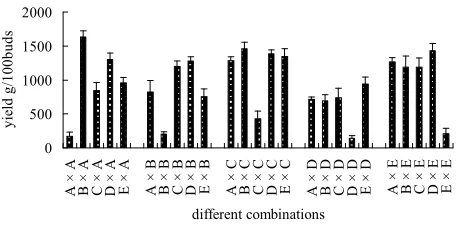
number of nut per burr and nut weight were not so sig-nificant among different varieties. However, Figure 8 showed that yield difference
these varieties. Therefore, yield is decided by th factors: seed-setting rate, fruiting rate, number of nut
d nut
From Figure8 we can see that yield of “Yanhong” (A), “Zunyu” (B), “Zipo” (C), “Donglingmingzhu” (D) and “Duanci” (E) under self-pollination were significantly lower than that of under cross-pollination. “Zunyu” (B) improved the yield of “Yanhong” (A) most; “Dongling- mingzhu” (D) was regarded as the best tree to improve “Zunyu” (B)’s yield; the best variety to improve “Zipo (C)”’s yield was “Zunyu” (B); “Donglingmingzhu” (D) and “Duanci” (E) improved each other most.
4. Conclusions
4.1. Assessment on Relationship between Cross-Pollination and Fruiting Conditions
0
A × A B × A C × A D × A E × A A ×
B
B ×
B
C ×
B
D ×
B
E × B A ×
C
B ×
C
C ×
C
D ×
C
E × C A × D B × D C × D D × D E × D A × E B × E C × E D × E E ×
E
[image:6.595.60.288.82.195.2]different combinations
Figure 8. Yield of different varieties.
500
yi
el
d g/
1000 1500 2000
10
0bu
ds
properly, because stigma of pistil has strong selectivity
on different variet pollination t
would lead differ and seed-setting
rate
ns on Number of Nut per Burr
ion trees was 17.9%
i province
t
ut number per burr of 5 female parents was basically the me and they all changed according to nuts content of corresponding male parents.
4.3. Affect from Different Combinations on Nut Weight
The 5 varieties of chestnut demonstrated the same thing that nut weight of each self-pollination combination rank first in all. Nut weight of cross-pollination combinations decreased greatly as against that of self-pollinations com- binations except for Castanea mollissima cv. “Dong- lingmingzhu” (D). However, nut weight of cross-polli- nations showed no significant difference with each other,
18 ].
-
te, but also by nut
ct of fruiting rate,
f-pollination combinations were extremely
pported by Silviculture and Conserva-
to express profound gratitude to
[2] Y. W. Sun, “Chinese Fruit and Fruit Resources,” Shang- hai Science and Technology Press, Shanghai, 1983. [3] G. G. Jiang, “Early-Yield Cultivation Techniques of Chest-
nut,” China Forestry Press, Beijing, 1995, p. 421.
[4] J. W. MoKay, “Self-Sterility in the Chinese Chestnut,”
American Society for Horticultural Science, Vol. 41, 1942,
pp. 156-160.
[5] B. W. Fan and S. J. Luo, “A Study on the Percentages of Fertile Fruit of Different Cross Combinations of Chestnut Varieties,” Journal of Jiangxi Agricultural University,
Vol. 15, No. 4, 1993, pp. 371-375.
[6] G. P. Wang, D. J. Kong and Q. X. Liu, “Correlation and Path Analyses on the Main Factors Influencing Chinese Chestnut Yield per Plant,” Journal of Anhui Agriculture
Science, Vol. 36, No. 4, 2008, pp. 1281-1304.
[7] Y. J. Zhang, “Study on the Relationship between NPK sari
ies pollen. Different ence in fruiting rate
rees number per burr and nut weight. Figure8 indicated that yield of cross-pollination combinations differ much from each other, and the comprehensive effe
rate. The study on fruiting rate and seed-setting rate of 5 varieties of Yan Mountain chestnut indicated that: cross- pollination had a significant impact on both fruiting rate and seed-setting rate. Differences of seed-setting
seed-setting rate, nut number per burr and nut weight had extremely significant effect on the yield.
Yield of sel among cross-pollination were evident, but not so signi-
ficant among fruiting rate.
4.2. Assessment on Affect from Different Combinatio
Artificial pollination test conducted on chestnut by Xia Renxue showed: by comparison with cross-pollinations trees, empty shell rate of self-pollinat
higher, and the average nut number per burr was 0.74 lower [21]. What’s more, experiment about fruiting and seed-setting characteristics of 8 self-pollination chestnut cultivars carried out by Liu Qingxiang of Hebe
also showed that the average nut number per burr greatly decreased under self-pollination conditions [22]. Figure 6 showed that empty shell rate of 5 Yan Mountain chestnu
advi
varieties which was self-pollinated is extremely high. However, there came a rapid increase on average nut number per burr after cross-pollination, which proved that cross-pollination did significantly promote the nut number per burr of 5 Yan Mountain chestnut varieties. result, it depicts the same conclusion with Xia Renxue As a
and Liu Qingxiang. At the same time, diversification of
which revealed that nut weight showed no significant difference in Xenia Affection and depicts the same con- clusion with Zhou Jing [
n sa
4.4. Affect from Different Combinations on Yield
The variety which promoted yield of Castanea mollis- sima cv. “Yanhong” (A),“Zunyu” (B),“Zipo” (C),“Dong- lingmingzhu” (D) and “Duanci” (E) most was not neces
ly the variety which improved its fruiting rate and seed-setting rate most, because yield was decided not only by fruiting rate, seed-setting ra
lower than that of cross-pollinations, in which Castanea mollissima cv. “Zunyu”(B) improved the yield of “Yan- hong” (A) most; “Donglingmingzhu” (D) was regarded as the best tree to improve “Zunyu” (B)”syield; the best variety to improve yield of “Zipo” (C)was “Zunyu”(B); “Donglingmingzhu”(D) and “Duanci” (E) improved each other most.
5. Acknowledgements
This study was sution, Ministry of Education. Wang Qian, Zhao Di and Liu Wanping would like
sor for her painstaking support, encouragement, su- pervision, and useful suggestions throughout this re- search.
REFERENCES
Content in Chestnut Fruiting Branches and Its Produc- tion,” Forest Research, Vol. 20, No. 2, 2002, pp. 58-60. [8] B. Lu, Z. X. Shao and W. M. Yang, “Early-Maturing and
High-Yielding New Chestnut Varieties—Yun Feng, Yun Fu,” Forest Research, Vol. 18, No. 3, 2000, pp. 43-44.
[9] Y. C. Yang and D. H. Wu, “Management and Reform Measures for Low-Yield Chestnut in Yuping County,”
Forest Research, Vol. 18, No. 4, 2000, pp. 39-40.
[10] D. G. Jian, D. H. Zhang and T. L. Xu, “Production Situa-tion and Development Strategy of Chinese Chestnut,”
Zhejiang Forestry Science and Technology, Vol. 20, No.
5, 2000, pp. 79-82.
[11] J. Z. Yuan, “Problems and Thinking in the Development of Chinese Economic Forest,” Research on Forest and
Fruit Tree of Hebei, Vol. 10, No. 2, 1997, pp. 226-232.
[12] C. C. Zhao, “Empty Shell Causes and the Prevention Tech- niques of Chestnut,” Hebei Fruits, No. 4, 2008, p. 52.
[13] M. Y. Yao, “Empty Shell Causes and the Control Meas- ures of Chestnut,” China Forestry, No. 9, 2008, p. 62.
[14] W. P. Zhu, “Empty Shell Causes and the Countermea- sures of Chestnut,” Modern Agricultural Science and
Technology, No. 17, 2009, p. 119.
[15] Z. F. Xie and J. X. Chen, “Chestnut Cultivation for Early Fruiting and Fertility,” Guangdong Science and Technol- ogy Press, Guangzhou, 2000, p. 62.
[16] Q. S. Zhou, “Effect on the Main Traits of Pear Fruit from Xenia Affection,” Fruit Science, Vol. 5, No. 4, 1998, pp. 176-180.
[17] B. W. Fan and S. J. Luo, “Study on Cross Combinations of Different Chestnut Varieties,” Journal of Jiangxi
Ag-ricultural University, Vol. 15, No. 4, 1993, pp. 371-375.
[18] J. Zhou and S. J. Guo, “Effects of Pollination Tree and Pollen Vitality on Fruiting Rate and Seed-Setting Rate of
Castanea mollissima,” Journal of Liaoning Forestry Sci-
ence & Technology, No. 5, 2009, pp. 5-9.
[19] J. L. Zhang, H. W. Sun and Y. M. Ma, “Fuzzy Compre-hensive Evaluation on Quality of Chestnut,” Journal of
Shandong Agricultural University, Vol. 32, No. 4, 2001,
pp. 475-478.
[20] D. X. Shen, “Breeding of Fruit Trees,” China Agriculture Press, Beijing, 2000.
[21] R. X. Xia and M. T. Ma, “Study on Reason of Empty- Shell of Chestnut (Castanea mollissim a Bl.). I. Effect on Chestnut’s Empty-Shell from Pollination and Fertiliza- tion,” Journal of Huazhong Agricultural University, Vol.
8, No. 3, 1989, pp. 242-247.
[22] Q. X. Liu, G. P. Wang and D. J. Kong, “Study on Fruiting Characteristics of Hebei Major Chestnut Varieties,”
He-bei Agricultural Sciences, Vol. 13, No. 8, 2009, pp. 11-