THE EFFECTS OF ORGANIZATION DEVELOPMENT INTERVENTIONS [ODI] ON THE WORKER
PERFORMANCE IN THE CO
Faculty of the Graduate School, Cebu Doctors’ University,
(In Partial Fulfillment of the Requirements of the Degree Doctor of Organization Development and Transformation)
Received 19th October, 2012, Received in revised form 24
ABSTRACT
This study is an analytical descriptive research study to assess the attainment of peak
achieve the degree of effectiveness of the interventions in ensuring that the organization works towards the employee profile
confidence, competence, working conditions and communication and to determine the behavioral changes among the leadership and the employees after conducting the interventions to improve the overall performance of the Co
Lewin’s Field Theory as expounded by Dessler (1980). The pre and post intervention instrument is a questionnaire which is an Ken Hultman (2003). Fifty eight employees of Co-operative College were asked t
performed on fifteen categories of the areas of commitment, confidence, competence, working conditions and communication.
conducting planned interventions in June 2008. During the period May to December 2008, the researcher worked with the staff of the College on various te building and other group activities to ensure consistency in addressing the issues that emerged during the pre
intervention survey instrument was given again to the employees (using the same survey instrument as the pre intervention). assessment and the post intervention evaluation were statistically t
for improvements significant at 0.05 levels. The results of the survey showed significant improvements in the obtained t post assessment, which means that the intervention offered were successful.
data were statically significant therefore the organization development interventions were
College of Kenya. The results recommend that further intervention activities will be conducted to sustain the continued improved performance of attain optimal (peak) performance.
TABLE OF CONTENTS
CHAPTER 1
THE CHALLENGE Introduction
Organizational Analysis Organization Problems Theoretical Background Review of related literature Conceptual Framework Schema of the Study
CHAPTER 2
THE RESEARCH FOCUS Purpose
Statement of the Problem Hypothesis
Significance of the Study
Scope and Limitation of the Study Definition of Terms
CHAPTER 3
THE RESEARCH DESIGN Methodology of the Study
ISSN: 0975-833X
DOCTORAL DISSERTATION
THE EFFECTS OF ORGANIZATION DEVELOPMENT INTERVENTIONS [ODI] ON THE WORKER
PERFORMANCE IN THE CO-OPERATIVE COLLEGE OF KENYA
NAIROBI – KENYA
Esther Njoki Gicheru
Faculty of the Graduate School, Cebu Doctors’ University, Mandaue City, Philippines
Email: [email protected]
(In Partial Fulfillment of the Requirements of the Degree Doctor of Organization Development and Transformation)
December -2008
October, 2012, Received in revised form 24th November, 2012, Accepted 23th December, 2012, Published online 14
This study is an analytical descriptive research study to assess the attainment of peak performance of the Co-operative College of Kenya. The study aimed to achieve the degree of effectiveness of the interventions in ensuring that the organization works towards the employee profile
conditions and communication and to determine the behavioral changes among the leadership and the employees after conducting the interventions to improve the overall performance of the Co-operative College of Kenya. The theoretical framework of this study
Lewin’s Field Theory as expounded by Dessler (1980). The pre and post intervention instrument is a questionnaire which is an
operative College were asked to rate themselves through the pre-intervention survey, on how well they performed on fifteen categories of the areas of commitment, confidence, competence, working conditions and communication.
tions in June 2008. During the period May to December 2008, the researcher worked with the staff of the College on various te building and other group activities to ensure consistency in addressing the issues that emerged during the pre-intervention surv
intervention survey instrument was given again to the employees (using the same survey instrument as the pre intervention).
assessment and the post intervention evaluation were statistically treated using the means. The t-test was used for comparison of the pre and post intervention data The results of the survey showed significant improvements in the obtained t-value from the difference of the pre a post assessment, which means that the intervention offered were successful. The analysis of the pre intervention assessment and post test intervention evaluation data were statically significant therefore the organization development interventions were successful in improving the workers’ performance of the Co
The results recommend that further intervention activities will be conducted to sustain the continued improved performance of
Copy Right, IJCR, 2012, Academic Journals
Research Respondents Research Environment Research Instrument
Procedure for Gathering Data Statistical Analysis
CHAPTER 4
PRESENTATION, ANALYSIS INTERPRETATION OF DATA
Confidence Working Conditions Communication Commitment Confidence Competence
TRANSFORMATIONAL INDICATORS
CHAPTER 4
Summary Findings
Conclusion and Recommendations
REFERENCES APPENDIX
International Journal of Current Research
Vol. 5, Issue, 01, pp.255-295, January,2013
INTERNATIONAL
THE EFFECTS OF ORGANIZATION DEVELOPMENT INTERVENTIONS [ODI] ON THE WORKERS
OPERATIVE COLLEGE OF KENYA
Mandaue City, Philippines
(In Partial Fulfillment of the Requirements of the Degree Doctor of Organization Development and Transformation)
December, 2012, Published online 14th January, 2013
operative College of Kenya. The study aimed to achieve the degree of effectiveness of the interventions in ensuring that the organization works towards the employee profiles in the areas of commitment, conditions and communication and to determine the behavioral changes among the leadership and the employees after The theoretical framework of this study is based on Kurt Lewin’s Field Theory as expounded by Dessler (1980). The pre and post intervention instrument is a questionnaire which is an adaptation of the tool developed by intervention survey, on how well they performed on fifteen categories of the areas of commitment, confidence, competence, working conditions and communication. The results formed the basis for tions in June 2008. During the period May to December 2008, the researcher worked with the staff of the College on various team intervention survey. In December 2008, a post intervention survey instrument was given again to the employees (using the same survey instrument as the pre intervention). The data from the pre intervention test was used for comparison of the pre and post intervention data value from the difference of the pre and The analysis of the pre intervention assessment and post test intervention evaluation successful in improving the workers’ performance of the Co-operative The results recommend that further intervention activities will be conducted to sustain the continued improved performance of the workers to
, Academic Journals. All rights reserved.
Research Respondents Research Environment
Procedure for Gathering Data
PRESENTATION, ANALYSIS AND INTERPRETATION OF DATA
TRANSFORMATIONAL INDICATORS
Conclusion and Recommendations
CHAPTER 1
THE CHALLENGE THEORITICAL FRAMEWORK
INTRODUCTION
The Co-operative College of Kenya, hereinafter referred to as COCK, is the highest learning training institution in co-operative studies in Kenya. Within the Kenyan education sector, the Co-operative College features as a middle level institution that provides in-service training to the co-operative movement and government employees of the Ministry in charge of co-operatives. Its clients also include pre-service candidates from secondary schools who are absorbed in the labor market after completion of their studies. Furthermore the college provides consultancy and research services to the co-operative sector and related organizations. The college was started way back in 1967 to train the personnel of the co-operative sector. The College was established with the support of the Nordic Countries in collaboration with the Government of Kenya. The Government assisted with the Nordic countries provided initial funding and later after the withdrawal of the donor support in 1993, the Government continued funding the college. The full funding by the Government continued until 1998 when the college was granted a semi-autonomous status through an act of parliament, the Co-operative College of Kenya Act, 1995, which was operationalized in 1998. The act prompted the College to take responsibility of its partial funding with the aim of acquiring self sustainability in the long run. Currently the College has moved to a point where sixty percent of its budget is met by the institution through generated income and only forty percent is met by the Government.
The Vision statement of the College states that the College aspires to be a leader in the provision of Co-operative Education and Training, Research, Consultancy and Information. The mission of the college is to provide quality education, training, research, consultancy, information and related services with emphasis to the co-operative sector through relevant Programmes, Information Data-base, Outreach and Competent Personnel. The broad aim of the College is to equip the staff of the co-operative movement and those in the Ministry of Co-operative Development & Marketing with appropriate managerial and supervisory skills, to enable them contribute more effectively to the development of co-operatives. Through its various programmes and courses the College seeks to foster national unity and social cohesion in fulfilling its mandate of being the standard bearer in the field of Co-operative Education and Training.
The specific objectives are as follows:
(a) To provide Co-operative Education and training for various categories of the personnel of the Co-operative Movement and the Government officers and serve as a center of academic excellence for the co-operative movement in Kenya.
(b) To promote the development and expansion of opportunities for continuing education in co-operative management and finance as approved by the academic board.
(c) To provide consultancy services in co-operative Management and other development areas relating to co-operatives.
(d) To undertake research in disciplines relating to co-operative management either directly or through approved institutions.
(e) To conduct examinations and to award diplomas, certificates and make other awards of the college. (f) To develop syllabi and curricula for co-operative
education and training.
(g) To examine and make proposals for the establishment of constituent training centers, departments and faculties.
(h) To collaborate with other national and International co-operative colleges and universities and institutions in the field of co-operative education and training, in research and consultancy services, and exchange programs.
The management of Cock is clearly illustrated by its organization structure below:
Figure I show that the organization has a council that provides leadership and governance to the organization. The council is composed of the Chairman, seven members elected/nominated from the co-operative movement and three from relevant government departments. The council is in charge of policy formulation, hiring of employees, soliciting for funding, making decisions and is the custodian of the assets of the College. The director is the secretary to the council and is in charge of day to day management of the college, policy implementation and decision making. The director is the Chief Executive Officer of the organization and is therefore in charge of coordinating the activities of the organization. She supervises employees under her who include the Deputy Director Finance and Administration who is in charge of finance and administrative matters, the Deputy Director Academic who is in charge of academic matters, and the Deputy Director Research and Consultancy and Outreach programmes. The officers in charge of the internal Audit, Marketing and Public relations and Planning/Monitoring /Evaluation also report directly to the Director. Under each of the Deputy Directors there are various levels of departments and units related to the respective discipline. The deputy directors supervise the officers working under them and report to the Director.
as well as Deputy Director Research and Out-Reach programmes. There are various functional committees worthy of mention though not reflected in the organizational chart which include: The Academic Board is a statutory board charged with duties of handling college academic matters and advises the council appropriately. The Assessment committee receives and processes the results of all college students and determines their performance. The Human Resource Advisory Committee is responsible for human resource development. The committee advises the director on placement, training needs and promotion.
Organizational Analysis
The organization is guided by a five year strategy plan (2004-2009). The strategic plan was developed through a participatory process which involved the key stakeholders and the employees of the college. The SWOT analysis of the College had identified critical strategic issues in six main strategic areas based on the specific objectives enlisted earlier namely:
Programme diversification and content which is related to specific objective (b) to promote the development and expansion of opportunities for continuing education in co-operative management and finance as approved by the academic board.
Human resource management which is related to the specific objectives ( b) and f)
Organizational Transformation which is related to specific objective (d)
Stakeholder involvement and participation which is related to specific objectives h)
Strategic marketing which is related to specific objective(h)
Improvement and expansion of physical facilities which is related to specific objective (g)
Specific targets were agreed on that would guide the implementation of the strategic plan. After setting the targets the means to deliver the strategy were identified which should have been followed with a review of the formal structure and hierarchies, followed by the selection, development and leadership of people to create a work environment and culture that supports each element of the strategy framework. Though the vision had guided the college to undertake the activities contained in the strategic plan quite a number of issues were still outstanding. Management meetings did not take place regularly as envisaged in the plan. The lack of the envisaged training affected the workers’ confidence leading to inadequate planning and setting of performance targets. It is in the planning where objectives and competence requirements would be agreed on and these in turn would lead to performance improvement and personal development plans. A review of the strategic plan conducted during the month of April, 2008 through a workshop attended by the senior members of staff and the College Council rmade the following revelations:
Under programme diversification and content there was underperformance and the set targets were not fully achieved. There was inadequate collaboration between and within departments and budget allocations were inadequate. There was therefore a tendency to concentrate on short term issues at the expense of longer term strategic needs. Product innovation
and development has been an issue. The departmental targets for the performance contract period of 2007/2008 were not set and the departments did not have operational plans. Under human resource development, the Human Resource Management Systems at the college (that is training, supervisory), concrete incentives such as remuneration (living wage, reward systems), promotion and performance review processes, career structures, (organizational work culture) are not consistently handled. Furthermore workers operate within rigid guidelines covering these processes tending to stifle innovation and engender laxity. At the College salaries are guaranteed, “high – flyers” are not recognized in any meaningful way. There are weaknesses in the reward system, non-performers easily “free-ride”, and working conditions are therefore not conducive to high performance.
There were issues that were not achieved specifically in the areas review of terms and conditions of service which included, review of salaries, establishment of medical scheme, development of transport policy. Inadequate competencies were not fully addressed especially in areas of communication skills, delivery methods of training, and computer literacy. This manifested in lack of confidence on the side of workers and inadequate communication within the organization.
Existing scheme of service for employees was not fully implemented. College staff were said to be lower in grades compared to mainstream civil service. There were no systematic reward systems. Staff development policies were not being adhered to. The performance appraisal system is operated as a top-down and largely bureaucratic system owned by the HR department rather than the line managers. It looks at what has gone right or wrong rather than looking forward to future development needs. Furthermore, there is no link between the appraisal and the business needs of the organization. Majority of the Co-operative College of Kenya staff had been seconded from the former Ministry of Co-operative Development and consequently the prevailing attitude manifests guaranteed job security, relatively lower than optimal performance and some degree of moonlighting. The time-lag and action on corrective/disciplinary measures on staff leads to unresolved issues of discipline on the part of some staff. This calls for a renewal of organizational culture and a complete change of attitude and mindset. The academic level of the staff needs to be upgraded.
Under stakeholder involvement linkages with various stakeholders were not adequately addressed which led to failure to understand the needs of the stakeholders which manifested in lack of commitment as perceived by the stakeholders. Under strategic marketing, the marketing plan was not fully implemented. Field visits were not conducted as envisaged due to pressure of work as a result of understaffing; leading to less increase in student population as anticipated. Under improvement and expansion of physical facilities the anticipated outreach centers were not established except within Nairobi due to inadequate staffing. Thus decentralization of the college to establish outreach centers was not achieved.
achieved resulting in undesirable working conditions. There is a tendency to concentrate on short term issues at the expense of longer term strategic needs. The departmental targets for the performance contract period of 2007/2008 were not set and the departments did not have operational plans. Furthermore in all the Administration and Academic Units, the Human Resource function is not well coordinated. Coordination of the various departments would result in synergy being experienced in the organization. As it is now there is no evidence of collaboration where by people have developed strong bonds of trust between each other and created time to discuss ideas. Within any team there will be a variety of skills, abilities, and commitments. There is notable absence of strategic thinking and employee empowerment strategies; the vision, mission and values should be focused clearly and understood by the council, management and employees. The Human Resource Policy does not provide for a strategic approach to learning and development within the college. It does not provide a framework for the identification of corporate skills, needs, both current and for future and for the identification and incorporation of the learning needs of individuals. The College is not consistent when dealing with staff issues resulting in:
Inadequacy in attracting and retaining, developing and managing quality employees.
Inadequate policy in balancing work and family commitments.
Inadequate preparedness in meeting diverse client needs
Slow acceptance of change
Inadequate mechanisms to two way communication.
The researcher studied the report of the strategic plan review exercise and also held discussions with the Human Resource officer of the cooperative college and the line managers and summarized the issues of concern on commitment to work, confidence, competence working conditions and communication. The researcher would like to identify the changes in the organization and to find out if these changes are necessary. Moreover the study would recommend how to achieve improved or peak performance.
Organizational Problems
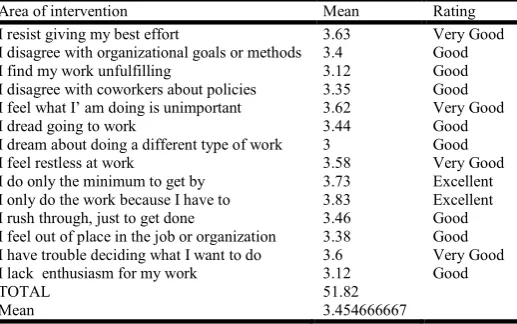
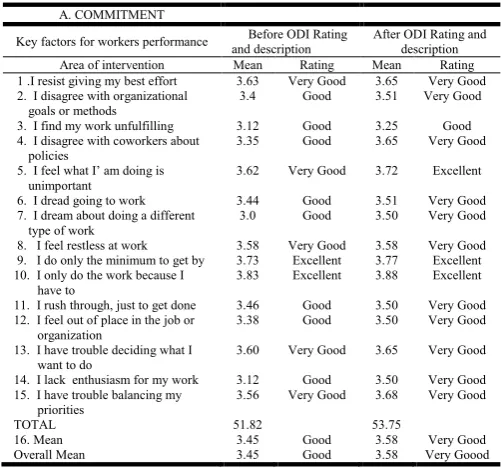
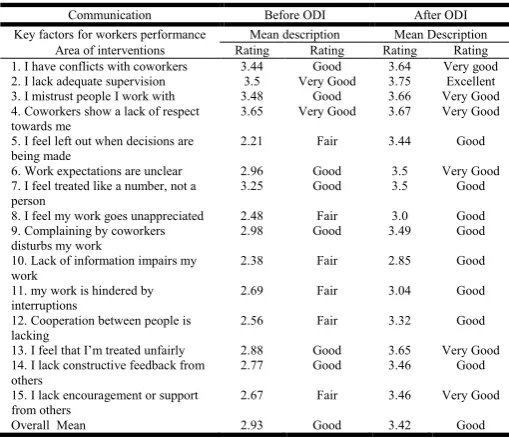
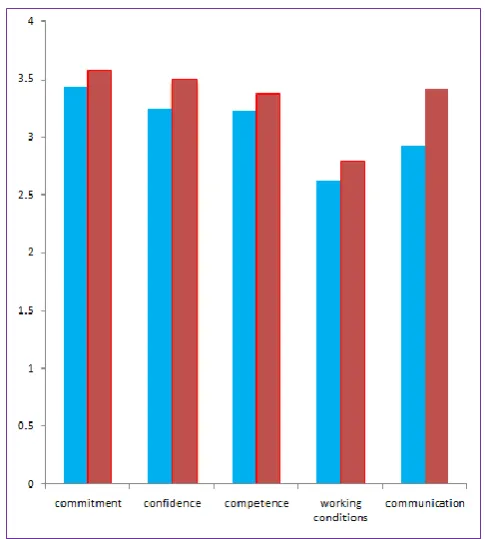
There was need to confirm the perceived problems through the use of the standardized instrument by Ken Hultman. The results of the pre-intervention assessment are presented in tables 1-5. On commitment only two areas out of fifteen were perceived as excellent by the respondents five items as very good and eight items as good giving a mean rate of ‘good’. On confidence only one out of fifteen items was perceived as excellent, three items as very good and eleven items as good giving a mean rate of ‘good’. On competence there was a similar trend of perception with a mean rating of “Good”. The perception on working conditions was fair and communication was perceived as good though with a tendency towards fair.
The mean ratings shown below provided evidence that some performance improvement initiatives were required for the Co-operative College to reach its optimum level of performance. The ratings did not show that the organization was performing poorly. Rather they indicated that there was room for improvement. As Michael Armstrong has suggested, the improvement of performance is a fundamental part of
performance management. The aim should be the positive one of maximizing high performance, although this involves taking steps to deal with underperformance (Armstrong, 2006). The table below shows the pre-intervention results at a scale of 0-4; for the pre-intervention data.
[image:4.595.309.568.158.320.2]PRE INTERVENTION RESULTS
Table 1. Committement
Area of intervention Mean Rating
I resist giving my best effort 3.63 Very Good I disagree with organizational goals or methods 3.4 Good I find my work unfulfilling 3.12 Good I disagree with coworkers about policies 3.35 Good I feel what I’ am doing is unimportant 3.62 Very Good
I dread going to work 3.44 Good
I dream about doing a different type of work 3 Good I feel restless at work 3.58 Very Good I do only the minimum to get by 3.73 Excellent I only do the work because I have to 3.83 Excellent I rush through, just to get done 3.46 Good I feel out of place in the job or organization 3.38 Good I have trouble deciding what I want to do 3.6 Very Good I lack enthusiasm for my work 3.12 Good
TOTAL 51.82
Mean 3.454666667
[image:4.595.307.564.385.570.2]On commitment only two areas out of fifteen were perceived as excellent by the respondents five items as very good and eight items as good giving a mean rate of ‘good’ at 3.4.
Table 2. Confidence
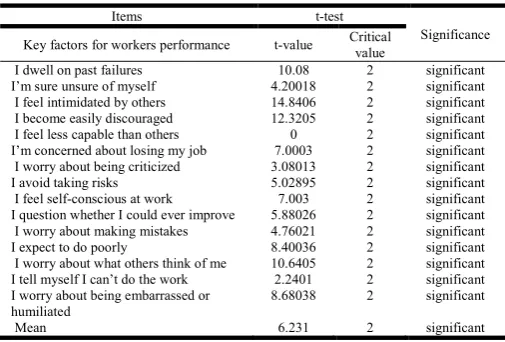
Area OF Intervention Mean Rating I dwell on past failures 3.38 Good I’m sure unsure of myself 3.73 Very Good I feel intimidated by others 3.13 Good I become easily discouraged 3.12 Good I feel less capable than others 3.77 Excellent I’m concerned about losing my job 3 Good I worry about being criticized 3.25 Good
I avoid taking risks 3.04 Good
I feel self-conscious at work 2.79 Good I question whether I could ever improve 3.29 Good I worry about making mistakes 2.83 Good
I expect to do poorly 3.35 Good
I worry about what others think of me 3.35 Good I tell myself I can’t do the work 3.65 Very Good I worry about being embarrassed or
humiliated
2.73 Good
TOTAL 48.73
[image:4.595.307.564.399.770.2]Mean 3.248666667 Good
Table 3. Competence
Area of intervention Mean Rating
I expect too much of myself 2.58 Fair I feel that I’d be better at a different job 3.17 Good I have the trouble staying on top of the job 3.54 Very Good I lack the necessary knowledge or
understanding
3.63 Very Good
I struggle to keep up with changes 2.92 Good I put things off until the last minute 3.4 Good I lack the required skill or ability 3.27 Good
I feel burned out 3.04 Good
I take too much time to complete tasks 3.63 Very Good I have trouble staying within the budget 1.96 Poor Some of the tasks are too difficult 3.1 Good I have problems with the quality of my work 3.75 Excellent I make too many mistakes 3.6 Very Good I have trouble getting enough work done 3.52 Very Good Even my best effort seems inadequate 3.33 Good
TOTAL 48.44
Table 4. Working Conditions
Area of intervention Mean Rating
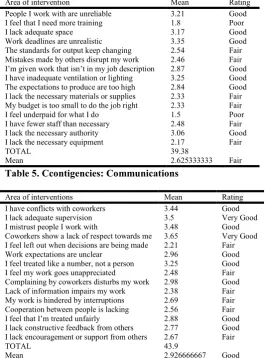
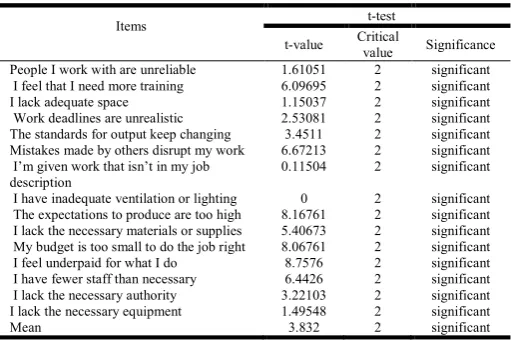
People I work with are unreliable 3.21 Good I feel that I need more training 1.8 Poor
I lack adequate space 3.17 Good
Work deadlines are unrealistic 3.35 Good The standards for output keep changing 2.54 Fair Mistakes made by others disrupt my work 2.46 Fair I’m given work that isn’t in my job description 2.87 Good I have inadequate ventilation or lighting 3.25 Good The expectations to produce are too high 2.84 Good I lack the necessary materials or supplies 2.33 Fair My budget is too small to do the job right 2.33 Fair I feel underpaid for what I do 1.5 Poor I have fewer staff than necessary 2.48 Fair I lack the necessary authority 3.06 Good I lack the necessary equipment 2.17 Fair
TOTAL 39.38
Mean 2.625333333 Fair
Table 5. Ccontigencies: Communications
Area of interventions Mean Rating
I have conflicts with coworkers 3.44 Good I lack adequate supervision 3.5 Very Good I mistrust people I work with 3.48 Good Coworkers show a lack of respect towards me 3.65 Very Good I feel left out when decisions are being made 2.21 Fair Work expectations are unclear 2.96 Good I feel treated like a number, not a person 3.25 Good I feel my work goes unappreciated 2.48 Fair Complaining by coworkers disturbs my work 2.98 Good Lack of information impairs my work 2.38 Fair My work is hindered by interruptions 2.69 Fair Cooperation between people is lacking 2.56 Fair I feel that I’m treated unfairly 2.88 Good I lack constructive feedback from others 2.77 Good I lack encouragement or support from others 2.67 Fair
TOTAL 43.9
Mean 2.926666667 Good
Summary of the Five Categories
The organization diagnosis revealed that the causes of the problems of achieving peak performance centered on the areas of employees’ commitment, confidence, competence, working conditions and communication. Respondents indicated the causes of their performance problems to dwell on the following areas. They suggested the actions needed for improvement as well as the expected outcomes and the time frame. The listing below gives a summary of the issues the respondents raised.
Working Conditions
Inadequate incentives because there are no structures in place
Budget for research is inadequate-
Limited attention for HR function in budgeting allocation
Under placement of the college in categorization of state corporations
Understaffing in Key areas
Lack of performance monitoring tools
Poor Training Strategy
Lack of clear set standards by the management hence crippling the efforts by the security staff to measure to the required standards
Lack of training and updated security policies-
Lack of necessary equipment
Allocation of other duties at times without prior notice
Unclear development path
Poor tenure of service
Lack of motivation
Poor team work
I feel what I do is not appreciated
Remuneration is too low
Upward mobility not properly addressed
Promotions should be pegged on age limit
Lack of cleaning equipment /materials
Most cleaning staff are casuals
Having inadequate equipment for work
Having new casuals every now and then-Competence
Lack of proper induction-
Poor staff relationships-
Feeling underpaid for what I do
Most equipment are obsolete
Inadequate funds -
Upgrading of the college is long overdue-
Stagnation on one job group for 12 years-
Using underperforming vehicles
Poor terms and conditions of service
Presence of nepotism and tribalism
Mistakes done by other people disrupt my work-
Expenditure exceeding income-
Thinking on how to finance the budget deficit-
Uncompleted orientation-
Public transport to the college not reliable making me waste time traveling to and from college -
Communication
Lack of communication-Communication
Poor communication- Communication
No feed back on the letters I write-Communication
Commitment
Expecting too much of myself-Commitment
Attitude change for people to take security as a profession rather than plan B after failure-Commitment
Attitude change for people to take security as a profession rather than plan B after failure-Commitment
Competence
Employing people to posts which they do not have qualifications and experience-Competence
Lack of competence and skills -Competence
Lack of skilled personnel -Competence
Respondents suggested improvement as follows:
Management to recognize performance when on merit
Look for donor support to supplement on college income
Enhance my education that will make me be promoted
Upgrade the college to a higher status
Reduce the expenditure on education by the end of 2008
The management should place employees in proper job groups
Placement of employees in the correct job groups because some employees with same qualification are placed in lower job groups
Give promotions where necessary
Improve terms and conditions of service
Avail transport
Employ high qualified staff
Increase budgetary allocation for the HR function
Review Co-operative College of Kenya ACT
Enhance capacity building in key results areas
Establish effective performance monitoring bench marks/ tools
Undertake TNA for staff development purposes
Invite a security consultant to give a lecture on security
Training for security staff is essential
Provision of necessary equipment
Develop proper job descriptions
Proper career development path
Comprehensive planning and budgeting
The management should enlighten staff on what is going on through regular meetings
Staff welfare should be given more priority
Good communication among staff
Management should come up with motivation incentives
Staff performance appraisal should be taken seriously
Salary reviews should be prioritized
Professional qualifications and performance should be prioritized
Quality cleaning materials and equipment
Organizations to have clear communication both horizontal and vertical
People to be employed on permanent basis
Training of staff in relevant fields
Regular meetings involving all cadres of staff
Better remuneration
Training opportunities should be offered on merit and not selectively
Motivate staff by giving credit where its due
To put down our targets every year and achieved targets
The top management to act
Respondents indicated the specific actions they would take to achieve each goal as below
Arrange to sensitize donors on the need for collaboration
Review training projections
Undertake salary review and implement staff welfare programmes which include medical insurance schemes.
Introduce performance based rewards e.g. responsibility and sitting allowance
Lobby for change for categorization from tertiary institution to research and training institution
Strategic recruitment and staff development
All college employees shall sign performance contracts
Undertake strategic training based on TNA report
Enhance professionalism in the area of security
Working hours need to be reviewed for security officers to be alert
Proper survey should be conducted for the college to know the number of security staff needed.
It depends on the management’s initiative and will
Be open about the management weaknesses as indicated in 2A above
Quality cleaning equipment and materials needed
To ensure there is flow of communication to everyone
Purchase of new equipment immediately
Induction programme and training for all new staff
Initiate the process of hiring staff with administration
Make a proposal for acquisition of machines and equipments
I will improve on my communication to others and also socialize well with my o-workers
I would like to go for training and attend seminars and workshops
Acquire good facilities
Give pay rise to the employees
I will apply for training opportunities at the college
Issue my budget projections early
Organize a forum to discuss the staff grievances
Having knowledge of my work and a good working environment
Looking for scholarship
Respondents also gave their opinion of how they will measure results of action taken as follows:
If changes I have proposed occur
Re-aligning what I do with strategic plan
Ensuring that I undergo training
Carry out baseline survey
By HR evaluating me
By ensuring that all offices keep security records updated
Encouraging attitude change on security by offering short courses
Reduction of working hours for security officers to 8 hours a day
Employee satisfaction survey and suggestion box to know the staff’s feelings
By improving the standard and quality of training
By issuing appraisal forms to the officers concerned
By making sure I do my work to the best of my knowledge and strength
When there is high standards of cleanliness
When I will attend school
By establishing a check list indicating what has been done or not
By ensuring there are adequate staff in place
Vehicle purchased through tender
By monitoring how one is doing his work
Putting in place a suggestion box
Carrying out an employee satisfaction survey
This year
Ongoing
One year after implementation of the recommended interventions
If administration has good will, it will take them 2 years
Annually
Immediately I realize my failures
Immediately
As soon as possible
Always
When the pay is raised
The listing of the causes of performance improvement, the goals set for improvement and expected outcomes reveal that there is room for performance improvement until the ratings have achieved the excellent level. The responses indicate that there was need for improvement at all levels ranging from the workers to the management.
Theory
The theory adapted to this study is based on Kurt Lewin’s Field Theory. Lewin’s model proposes that a worker’s behaviour in a factory (B) is a function of or is influenced significantly by the personality or personal characteristics of the worker (P) as well as the environment or climate (E). Dessler (1980) expounding on Lewin’s work explained the ‘Field Theory’ which holds that group behaviour is an intricate set of interactions and forces that affect both group structure and individual bevaviour. He refers to Lewin’s work in the 1930s which was motivated by his desire to link human behaviour and the environment. Dessler acknowledges Lewin’s model describing the relationship between an individual and his environment: B=f (P.E.).
REVIEW OF RELATED LITERATURE AND STUDIES
Lewin’s contribution to change in the workplace began shortly after the Second World War. Alex Bevalas, one of Lewin’s students worked with Alfred Marrow.s Harwood manufacturing company and to explore ways to enhance productivity by using action research methods in which workers participated in experimental changes in methods. The conditions they created resulted in what we would call a learning organization today; workers were encouraged to experiment with different methods; to discuss them among themselves, and to choose the methods which they agreed were most effective. Groups of workers increased their own quotas after discovering and employing new methods (Marrow, 1969). Kurt Lewin developed a management technique known as Force Field Analysis, for diagnosing situations. This is useful when looking at variables involved in planning and implementing a change programme. It is also of use in team building projects, when attempting to overcome resistance to change. Lewin assumes that in any situation, there are both driving and restraining forces that influences any change that may occur.
Driving forces
Driving forces are those forces affecting a situation that are pushing in a particular direction; they tend to initiate a change and keep it going. In terms of improving productivity in a work
group, pressure from a supervisor, incentive earnings, and competition may be examples of driving forces.
Restraining Forces
Figure 1.2
Restraining forces are forces acting to restrain or decrease the driving forces. Apathy, hostility, and poor maintenance of equipment may be examples of restraining forces against increased production. Equilibrium is reached when the sum of the driving forces equals the sum of the restraining forces. Equilibrium represents the present level of production.
Equilibrium
This equilibrium or present level of productivity can be raised or lowered by changes in the relationship between the driving and the restraining forces. For illustration, consider the dilemma of the new manager who takes over a work group in which productivity is high but whose predecessor drained the human resources. The former manager had upset the equilibrium by increasing the driving forces (that is being autocratic and keeping continual pressure on subordinates) and thus achieving increases in output in the short-run. By doing this, however, new restraining forces developed, such as increased hostility and antagonism, and at the time of the former manager’s departure the restraining forces were beginning to increase and the results manifested themselves in turnover, absenteeism, and other restraining forces, which lowered productivity shortly after the new manager arrived. Now a new equilibrium at a significantly lower productivity is faced by the new manager.
should use. Kurt Lewin’s field theory led to the development of actual field research on human behaviour. With boldness Lewin manipulated complex situational variables in natural settings. His approach has guided experiments in the field of social cognition, social motivation, and group processes. Most importantly, lewin helped develop action research. Action research uses empirical social research, social action and controlled evaluation. Lewin viewed the social environment as a dynamic field which impacted in an interactive way with human consciousness. “Adjust elements of the social environment and particular types of psychological experience predictably ensue. In turn, the person’s psychological state influences the social field or milieu”. Lewin was well known for his terms ‘life space’ and ‘field theory’. He was even better known for practical use of his theories in studying group dynamics, solving social problems related to prejudice, and group therapy (t-groups). Lewin sought to not only describe group life, but to investigate the conditions and forces which bring about change or resist change in groups. In the Field (or matrix) approach, Lewin believed that for change to take place, the total situation has to be taken into account. If only part of the situation is considered, a misrepresented picture is likely to develop.
Smith (2001) describing Lewins theory had this to say:
For Kurt Lewin, behaviour was determined by totality of an individual’s situation. In his field theory, a ‘field’ is defined as ‘the totality of coexisting facts which are conceived of as mutually interdependent’ (Lewin 1951:240). Individuals were seen to behave differently according to the way in which tensions between perceptions of the self and of the environment were worked through. The whole psychological field or ‘lifespace’, within which people acted had to be viewed, in order to understand behaviour. Within this individuals and groups could be seen in topological terms (using ma-like representations). Individuals participate in a series of life spaces (such as the family, work, school and church), and these were constructed under the influence of various force vectors (Lewin 1952).
Dessler, Jones (n.d.) in support of the field theory observed that although this theory may seem obvious to us now, it is important to remember the conceptual jump it represented in the 1930s. Early psychologists did not believe in behaviourism. Many psychologists at the time believed in the psychoanalytic theory that held human motives to be blind pushes from within. Lewin thought of motives as goal-directed forces. He believed that ‘our behaviour is purposeful; we live in a psychological reality or life space that includes not only those parts of our physical and social environment that are important to us but also imagined states that do not currently exist’ (Tesser 340). According to Dessler, what lewin emphasized was that a person’s behaviour is not just some function of economic rewards. Instead, it is a complex product of the person’s personality and the environment in which he works. Lewin’s theory helped to emphasize that the employee behaviour was a
variable not a given in the organization.
Christopher Mabey et al. argue, a major source of strategic human resource management (SHRM) ideas and assumptions
is the concern to enhance organizational performance by two sorts of (potentially conflicting) performance improvement measures: measures that increase employee involvement and commitment, and measures that improve organizational efficiencies (i.e. the output /input ratio). Much SHRM literature argue that organizational performance is improved when employees stop merely fulfilling the basic formal contractual requirements and start showing mutual loyalty and commitment to the enterprise and its goals.
According to Laurie J. Mullins (2005) the effective management of people takes place in the context of the wider environmental setting, including the changing patterns of organizations and attitudes to work. He argues that a global economy, increased business competitiveness, the move towards customer-driven markets, advances in scientific knowledge, especially telecommunications and office automation, have led to a period of constant change and the need for greater organizational flexibility. In addition Muzyaka D. (2001) portends that new ideas of how to motivate and deploy people have developed. A new contract is evolving that involves the exchange of value. Individuals need to be encouraged and permitted to achieve: to perform to their highest potential, for their benefit and that of the employer. Organizations are encouraging staff to craft more flexible, value-laden, and specific rules governing their relationships. It is for these reasons that Cloke and Goldsmith (2002) refer to the age of traditional management coming to an end and the decline of hierarchical, bureaucratic, autocratic management. They contend that management is an idea whose time is up and organizations that do not recognize the need to share power and responsibility with all their workers will lose them. Reason and Bradbury (2001) argue that the workplace is central to our existence. Hence it is not surprising that social scientists have studied behaviour in the workplace in depth. They make reference to the work of the socio-technical school in which behavioural scientists (Pasmore, 1988; Trist, 1981; weibord, 1987) brought together Lewin’s approach to action research with Bion’s, (1946) theories about leaderless groups, and on Bertanffy’s (1950) work on systems thinking to investigate and later intervene in a number of issues pertaining to workplace arrangements that could increase both human dignity and organizational effectiveness.
co-operation of followers. Many writers have argued for the demise of ‘top down’ leadership. Benin adds, ‘The most urgent projects require the coordinated contributions of many talented people working together and no change can occur without willing and committed followers. This means the leadership of the organization needs to be examined to work out a model of leadership that is non-positional, team-based, or empowering. Greiner (1972) argues that there is need for change in the management style of top management and other organizational leaders as organizations evolve and mature. The way an organization manages its people impacts on its performance. Few would deny this simple statement and numerous company reports and studies have confirmed a link between possession of effective human resource strategies and organizational performance. Research over the last few years has clarified the features of good people management practices associated with high performance and how these can be used strategically, in combination (DTI, October 2003, p. 3.)
Mary Parker Forret and Chester Barnard were early advocates of a more humanistic perspective on management that emphasized the importance of understanding human behaviours, needs and attitudes in the workplace as well as social interactions and group processes (daft, 2000). One of the subfield based on the humanistic perspective is the human relations movement. According to Curt Tausky (1978) the human relations school of thought considers that truly effective control comes from within the individual worker rather than from strict, authoritarian control. This school of thought recognized and directly responded to social pressures for enlightened treatment of employees. In a series of studies at a Chicago electric company which came to be known as the Hawthorne studies, experiments on worker productivity began in 1924. The experiments attributed employees increased output to managers treatment of them during the study.
The Hawthorne studies began the human relations approach to management, whereby the needs and motivation of employees became the primary focus of Manager (Bedeian, 1993). Understanding what motivated employees and how they were motivated was the focus of many researchers following the publication of the Hawthorne Study Results (Tarpstra, 1979). Five major approaches that have led to our understanding of motivation are Maslow’s needs- hierarchy theory, Herzberg;s two factory theory, Vroom’s expectancy theory, Adams’ equity theory and Skinner’s reinforce theorty. According to Maslow the behavior of an individual at a particular moment is usually determined by his or her strongest need. It would seem significant, therefore, for Managers to have some
understanding about the needs that are commonly most important to people. Abraham Maslow developed an interesting and useable framework that helps explain the strength of certain needs. According to Maslow, there seems to be a hierarchy into which human needs arrange themselves as illustrated in figure below:-
The physiological needs are shown at the top of the hierarchy because they tend to have the highest strength until they are somewhat satisfied. These are the basic human needs. Peter Davis writing on Human Resource Management in Cooperatives has emphasized the importance of working in teams, empowering employees, ensuring participation in decision making and establishing effective two-way channels of communication (Davis 2005). According to Davis HRM captures and encompasses a number of messages drawn from modern management thinking which include:-
Greater emphasis on horizontal teams and reduced hierarchy
Blurring of the distinction between management and non-management
Devolved responsibility for people management to line management and away from personnel managers (the role of personnel professional is to support and facilitate management in this task) treating human resource planning as an integral part of strategic planning.
Recognizing that employees have the potential for growth and development within the organization (HRM enables this growth and development to move in line with the adaptive needs of the organization).
Recognizing that employees’ development can draw on the discipline of HRM for its own purposes.
Understanding that value-based, HRM can greatly facilitate improved stakeholder relations and the realization of optimum standards of service in an organization(Davis 2005).
flexibility (At Kinson). Further conflict concerns the unitalist approach to goal congruence within the strategic approach to HRM, as this ignores divergent interests. Indeed Legge identifies elements of pluralism in normative models of HRM the emphasis on placing the “right” people for the “right” job as an important means of integrating HRM with organizational goals, resulting in a unitarist framework. With its underlying assumption of goal congruence, this denies the existence of conflict.
Empirical evidence in the U.K. and U.S.A. suggest that there have been substantial moves towards the uptake of HRM dimensions, but there is little evidence of these dimensions being integrated into the overall business strategy of organizations. If we reflect on these conflicts and the different emphasis, one thing that we can see has been lost (even in the so called soft version of HRM) is the very foundation upon which modern Personnel Management was built namely, welfare. We may not be comfortable with the strongly paternalistic tone of the original approach but it is essential for an organization to have a strong sense of the welfare of its staff as being an end not a means. Co-operative College is not expected to be a singe-tract, single purpose organization. It exists to provide services for clients; one such service might well be to provide employment of a better quality than is available from contemporary organizations.
Davis (2005) portends that for any organization to succeed in this competitive environment, it has to guarantee learning and growth through metrics that address the question of how the firm must learn, improve, and innovate in order to meet its objectives. Much of this objective is employee centered. It requires that the organization achieves strategic alignment throughout the organization. Whereas strategy is articulated in terms meaningful to top management, to be implemented it must be translated into objectives and measures that are actionable at lower levels in the organization. Sambrook and Stewart(2004) writing on the the concept of life-long learning have demonstrated that life-long learning will remain, an important issue as a country develops into a “learning society”. Work organizations are becoming important partners in this learning society, as they provide ever more opportunities for continuous learning to their employees, in order to optimize organizational learning. Companies that explicitly encourage and support worker learning, from a strategic perspective, are called learning organizations. This new focus on employee learning changes the role of the Human Resource Development (HRD) function. The role of HRD within “learning organization” is becoming clearer, but many uncertainties remain for HRD professionals especially with regard to the question of how to bring their new roles into practice. There are only a few instruments to help HRD officers in this regard. Yet, many interesting initiatives are being undertaken by HRD practitioners to support strategic learning processes of the organization as a whole.
SUPPORTING STUDIES
In a study carried out to examine these HRD initiatives (Stewart and Sambrook), the objective was to first clarify the specific European outlook on the role that HRD, (in learning organizations) can fulfill in life-long learning thus contributing to the discussion on a “European Model of life long learning”.
Secondly, the study aimed to contribute to the further professionalism of HRD in Europe, by providing both conceptual perspectives and practical examples.Reference was made to some case study descriptions which were made from HRD functions within 30 large learning oriented organizations throughout Belgium, Finland, Germany, Italy, the Netherlands and the United Kingdom. Additionally a survey was held under a large group of 65 companies. Based on a literature review, comparisons were made with Japanese and US organizations.
The study, on the aspect of creating an infrastructure for life long learning recommended that there was need for co-operation between the different parties in order to support learning in the work-place, companies could seek co-operation with higher institutions for vocational education and with universities. If learning initiatives in Europe are to meet the needs of industry, leaders of industry must ensure that their views are taken into account in the design of such initiatives. It is essential therefore that industrialists participate fully in professional, national and European initiatives, to foster and take forward lifelong learning (Chaplin, 1993). In the same study the Human Resource Development professionals indicated that strategies to support the business, to stimulate learning and knowledge sharing will become the most important strategies for the future. The study further indicated that the factors that appear to burden the change process most strongly, are a lack of time on behalf of the employees and managers, a lack of clarity on Human Resources Developments role, insufficient learning culture and low flexibility of the organizational structure. Hongoro, Mcpake et al. in a study entitled Human Resource Studies in Health for poor transitional countries investigated the importance of human resources in health. The purpose of the study was to understand why after years of concerted effort in building Human Resource capacity in many countries, health workers remained demoralized and underperforming. The research focused on wider systemic and not just health service related factors in-order to identify options for improving human resource capacity in healthy. The other aspect investigated was the healthy system’s ability to improve the quality of services, access to these services by the poor, choice and consumer responsiveness centers on human resource capacity. Methodologically, four partner countries were brought together in a workshop. The workshop generated priority areas for research inhuman resources in the member countries (Bangladesh, Uganda, South Africa, and Russia). Key research questions were generated which attempted to capture all the cross-cutting themes reflected in the countries concerns on human resources, which included:
1. What are the systemic determinants of incentive structures that Health workers are facing in the four countries?
2. How are these systemic factors influencing staff training, development, retention and performance? 3. Does current external Human Resource capacity meet
the needs of the Health system (including those generated by health sector reforms)?
4. How health sector are reforms changing incentive structures and influencing staff retention and performance?
The study made contributions to the need for Health Systems research in providing approaches to finding mechanisms to redress human resource problems. The study brought out broad study areas in human resources in health and some suggestions of possible data sources that could be used to study them. Abraham Maslow carried out his investigation into human behaviour between 1939 and 1943. Maslow suggested that there are five set of goals which may be called basic needs. These are:
Physiological
Safety
Love
Esteem and
Self-actualization or self-fulfillment
He arranged these into a series of different levels or the order of importance of these basic needs. Man’s basic needs are physiological, for example hunger, thirst, and sleep etc. when these are satisfied they are replaced by safety needs reflecting his desire for protection against danger or deprivation. These in turn, when satisfied, are replaced by the need for love or belonging to, which are functions of man’s gregariousness and his desire to belong to a group, to give and receive friendship and to associate happily with people. When these needs are satisfied, there is the esteem needs, i.e. the desire for self esteem and self- respect, which are affected by a person’s standing reputation, and his need for recognition and appreciation. Finally, individuals have a need for self actualization or a desire for self-fulfillment, which is an urge by individuals for self-development, creating and job satisfaction. In the past, management reward systems have attempted to satisfy an individual’s lower level needs for safety and physiological security, for protection against deprivation and the threat to a worker or his family. However, management reward systems are now or should be endeavoring to satisfy esteem and self fulfillment.
CONCEPTUAL FRAMEWORK
The conceptual framework was based on an action research conforming to the famous Hawthorne experiments at the Western Electric Company in America (1924-32), and the subsequent publication of research findings. The studies indeed marked the turning point in the development of human relations movement. Among the people who wrote about the Hawthorne experiments was Elton Mayo (1880-1949) The Hawthorne experiments generated new ideas concerning the importance of workgroups and leadership, communications, output restrictions, motivation and job design. The experiments demonstrated the power of action research in dealing with pressing real issues.
They undoubtedly marked a significant step forward in providing a further insight into human behaviour at work and the development of management thinking. In a review of humane approaches to management, Crainer asserts that: ‘the hawthorne Studies were important because they showed that views of how managers behaved were a vital aspect of motivation and improved performance. Also the research revealed the importance of informal work groups. (Crainer, S.
Key Management Ideas: Thinkers that changed the
management world, third edition, financial Times Prentice Hall
(1998), p. 111.
SCHEMA OF THE STUDY
[image:11.595.313.557.360.667.2]Such a system would provide for non-financial rewards such as recognition, provision for opportunities to succeed, skills development and career planning and enhancing job engagement and commitment. The interventions focused on the problem areas identified in the pretest: The main areas were performance management at organizational level which includes review of mission statement, value statement, critical success factors and strategies. The organizational performance measures considered include financial performance, operational performance and people performance. The other areas were improving team performance: setting work objectives, work-plans, team performance reviews; and also improving individual performance through training and more involvement in decision making: increasing ability by recruiting, selecting and learning and developing; increasing motivation by the provision of extrinsic and intrinsic rewards and increasing opportunity by providing the employees with opportunity to use, practice and develop their skills. Task forces have been established to work in the various areas that require interventions. These include review of terms and conditions of service, Staff establishment, Governance organs, Co-operative College Act, training and development programme for employees. The results of the appointed teams will form the basis for further interventions.
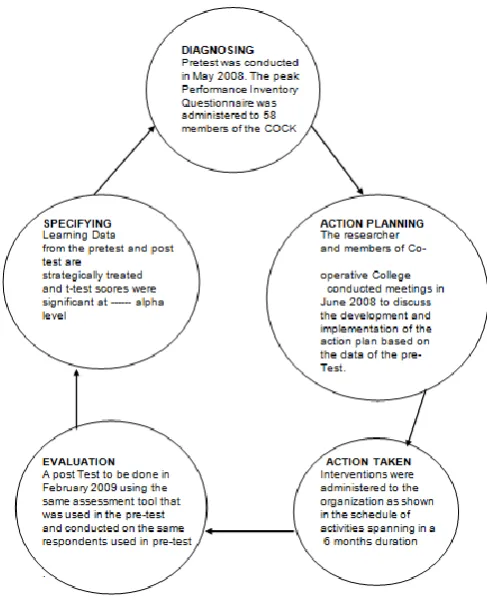
Fig. 1.5. The Action research Cycle
The above interventions provided a framework for the formulation of the schema of study given above and its schedule of intervention activities given below.
actors to contribute effectively to the achievement of the mission.
The college needs to identify its opportunities and challenges and strategize itself to be continuously legitimate and relevant.
The college should identify its key stakeholders and their expectations. Strategies should be applied to cultivate and maintain a sense of ownership and willingness to contribute ideas, efforts and resources.
The college needs to reform the culture and behaviour acquired from the previous period when it was part of the Ministry of Co-operative Development.
The council, management, staff and students need to acquire and maintain a private sector attitude and know that they have a key role in the sustainability of the college.
The college should authentically adhere to its core values which will dictate corporate behaviour and motivate all key actors to be ethical, responsible, transparent, accountable and committed to high performance standards.
TIME SCHEDULE
The following diagram shows the intervention activities adapted for the study.
CHAPTER 2
THE RESEARCH FOCUS
The purpose
The purpose of this study was to evaluate the effects of Organizational Development Interventions on the Workers Performance at the co-operative college of Kenya.
Statement of the Problem
The study presented the data on the five identified problems before and after the planned interventions. Specifically it answered the following research questions:
What are the profiles of the respondents’ evaluation before and after interventions in the following areas?
1.1 Commitment 1.2 Confidence
1.3 Competence 1.4 Working conditions 1.5 Communication
2. Are there significant differences in the data before and after intervention?
3. What are the transformation indicators?
4. What recommendations may be given to maintain the effects of the intervention?
HYPOTHESIS
This null hypothesis was to be accepted or rejected.
There were no significant differences between the pretest and post test data on the perception of the respondents on performance management profile before and after organization Development Interventions on the following:
1. Level of employees’ Commitment 2. Level of employees’ Confidence 3. Level of employees’ Competence
4. Employees’ perception of working conditions 5. Employees’ perception of communication
SIGNIFICANCE OF THE STUDY
The study will benefit the following:-
Management of the Co-operative College:
The study will help the management to rethink on its treatment of its workers, the existing workplace policies and procedures. Management will develop a performance management programme to improve the effectiveness and efficiency of the College.
The Organization
The study will provide the organization with insights on what is hindering peak performance and learning.
The Community
Improved performance of the workers at the College will add value to the community through improved services to the College’s customers, suppliers and other stakeholders.
Scope and limitation
Scope
The study focused on the impact of organization development interventions on the workers’ peak performance at the Co-operative College of Kenya. Those involved in the study included senior managers and other full time employees of the College.
Limitation