Jointly Embedding Knowledge Graphs and Logical Rules
Shu Guo†‡, Quan Wang†‡∗, Lihong Wang§, Bin Wang†‡, Li Guo†‡
†Institute of Information Engineering, Chinese Academy of Sciences, Beijing 100093, China ‡University of Chinese Academy of Sciences, Beijing 100049, China
{guoshu,wangquan,wangbin,guoli}@iie.ac.cn
§National Computer Network Emergency Response Technical Team
Coordination Center of China, Beijing 100029, China [email protected]
Abstract
Embedding knowledge graphs into continuous vector spaces has recently attracted increasing interest. Most existing methods perform the embedding task using only fact triples. Logi-cal rules, although containing rich background information, have not been well studied in this task. This paper proposes a novel method of jointly embedding knowledge graphs and log-ical rules. The key idea is to represent and model triples and rules in a unified framework. Specifically, triples are represented as atomic formulae and modeled by the translation as-sumption, while rules represented as complex formulae and modeled by t-norm fuzzy logic-s. Embedding then amounts to minimizing a global loss over both atomic and complex for-mulae. In this manner, we learn embeddings compatible not only with triples but also with rules, which will certainly be more predictive for knowledge acquisition and inference. We evaluate our method with link prediction and triple classification tasks. Experimental re-sults show that joint embedding brings signif-icant and consistent improvements over state-of-the-art methods. Particularly, it enhances the prediction of new facts which cannot even be directly inferred by pure logical inference, demonstrating the capability of our method to learn more predictive embeddings.
1 Introduction
Knowledge graphs (KGs) provide rich structured in-formation and have become extremely useful re-sources for many NLP related applications like
∗Corresponding author: Quan Wang.
word sense disambiguation (Wasserman-Pritsker et al., 2015) and information extraction (Hoffmann et al., 2011). A typical KG represents knowledge as multi-relational data, stored in triples of the for-m (head entity, relation, tail entity), e.g., (Paris, Capital-Of, France). Although powerful in representing structured data, the symbolic nature of such triples makes KGs, especially large-scale KGs, hard to manipulate.
Recently, a promising approach, namely knowl-edge graph embedding, has been proposed and suc-cessfully applied to various KGs (Nickel et al., 2012; Socher et al., 2013; Bordes et al., 2014). The key idea is to embed components of a KG including en-tities and relations into a continuous vector space, so as to simplify the manipulation while preserving the inherent structure of the KG. The embeddings contain rich semantic information about entities and relations, and can significantly enhance knowledge acquisition and inference (Weston et al., 2013).
Most existing methods perform the embedding task based solely on fact triples (Bordes et al., 2013; Wang et al., 2014; Nickel et al., 2016). The only re-quirement is that the learned embeddings should be compatible with those facts. While logical rules con-tain rich background information and are extreme-ly useful for knowledge acquisition and inference (Jiang et al., 2012; Pujara et al., 2013), they have not been well studied in this task. Wang et al. (2015) and Wei et al. (2015) tried to leverage both em-bedding methods and logical rules for KG comple-tion. In their work, however, rules are modeled sep-arately from embedding methods, serving as post-processing steps, and thus will not help to obtain
.QRZOHGJH /RJLF
[image:2.612.75.298.61.169.2](QWLW\HPEHGGLQJV 5HODWLRQHPEHGGLQJV 7UXWKYDOXHVLQ>@ /RJLFDOFRQQHFWLYHV
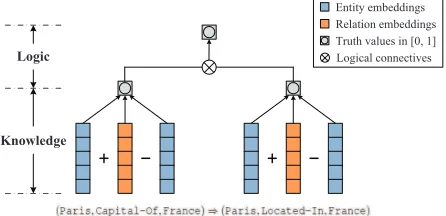
Figure 1:Simple illustration of KALE.
better embeddings. Rockt¨aschel et al. (2015) recent-ly proposed a joint model which injects first-order logic into embeddings. But it focuses on the rela-tion extracrela-tion task, and creates vector embeddings for entity pairs rather than individual entities. Since entities do not have their own embeddings, relations between unpaired entities cannot be effectively dis-covered (Chang et al., 2014).
In this paper we introduce KALE, a new approach that learns entity and relation Embeddings by joint-ly modeling Knowledge And Logic. Knowledge triples are taken as atoms and modeled by the trans-lation assumption, i.e., retrans-lations act as transtrans-lations between head and tail entities (Bordes et al., 2013). A triple (ei, rk, ej) is scored by ∥ei+rk−ej∥1, whereei,rk, andej are the vector embeddings for entities and relations. The score is then mapped to the unit interval[0,1]to indicate the truth value of
that triple. Logical rules are taken as complex for-mulae constructed by combining atoms with logical connectives (e.g.,∧and⇒), and modeled by t-norm fuzzy logics (H´ajek, 1998). The truth value of a rule is a composition of the truth values of the constituen-t aconstituen-toms, defined by specific logical connecconstituen-tives. In this way, KALE represents triples and rules in a uni-fied framework, as atomic and complex formulae re-spectively. Figure 1 gives a simple illustration of the framework. After unifying triples and rules, KALE minimizes a global loss involving both of them to obtain entity and relation embeddings. The learned embeddings are therefore compatible not only with triples but also with rules, which will definitely be more predictive for knowledge acquisition and in-ference.
The main contributions of this paper are summa-rized as follows. (i) We devise a unified framework
that jointly models triples and rules to obtain more predictive entity and relation embeddings. The new framework KALE is general enough to handle any type of rules that can be represented as first-order logic formulae. (ii) We evaluate KALE with link prediction and triple classification tasks on WordNet (Miller, 1995) and Freebase (Bollacker et al., 2008). Experimental results show significant and consistent improvements over state-of-the-art methods. Partic-ularly, joint embedding enhances the prediction of new facts which cannot even be directly inferred by pure logical inference, demonstrating the capability of KALE to learn more predictive embeddings.
2 Related Work
Recent years have seen rapid growth in KG em-bedding methods. Given a KG, such methods aim to encode its entities and relations into a continu-ous vector space, by using neural network architec-tures (Socher et al., 2013; Bordes et al., 2013; Bor-des et al., 2014), matrix/tensor factorization tech-niques (Nickel et al., 2011; Riedel et al., 2013; Chang et al., 2014), or Bayesian clustering strate-gies (Kemp et al., 2006; Xu et al., 2006; Sutskever et al., 2009). Among these methods, TransE (Bordes et al., 2013), which models relations as translating op-erations, achieves a good trade-off between predic-tion accuracy and computapredic-tional efficiency. Various extensions like TransH (Wang et al., 2014) and Tran-sR (Lin et al., 2015b) are later proposed to further enhance the prediction accuracy of TransE. Most ex-isting methods perform the embedding task based solely on triples contained in a KG. Some recent work tries to further incorporate other types of infor-mation available, e.g., relation paths (Neelakantan et al., 2015; Lin et al., 2015a; Luo et al., 2015), relation constraints (Krompaßet al., 2015), entity type-s (Guo et al., 2015), and entity detype-scriptiontype-s (Zhong et al., 2015), to learn better embeddings.
made by embedding models, via integer linear pro-gramming or Markov logic networks. In their work, however, rules are modeled separately from ding models, and will not help obtain better embed-dings. Rockt¨aschel et al. (2015) proposed a joint model that injects first-order logic into embeddings. But their work focuses on relation extraction, cre-ating vector embeddings for entity pairs, and hence fails to discover relations between unpaired entities. This paper, in contrast, aims at learning more pre-dictive embeddings by jointly modeling knowledge and logic. Since each entity has its own embedding, our approach can successfully make predictions be-tween unpaired entities, providing greater flexibility for knowledge acquisition and inference.
3 Jointly Embedding Knowledge and Logic We first describe the formulation of joint embed-ding. We are given a KG containing a set of triples
K ={(ei, rk, ej)}, with each triple composed of t-wo entities ei, ej ∈ E and their relation rk ∈ R. HereE is the entity vocabulary and R the relation
set. Besides the triples, we are given a set of logical rulesL, either specified manually or extracted auto-matically. A logical rule is encoded, for example, in the form of∀x, y : (x, rs, y) ⇒ (x, rt, y), stat-ing that any two entities linked by relationrsshould also be linked by relationrt. Entities and relations are associated with vector embeddings, denoted by
e,r ∈ Rd, representing their latent semantics. The proposed method, KALE, aims to learn these em-beddings by jointly modeling knowledge triplesK
and logical rulesL.
3.1 Overview
To enable joint embedding, a key ingredient of KALE is to unify triples and rules, in terms of first-order logic (Rockt¨aschel et al., 2014; Rockt¨aschel et al., 2015). A triple(ei, rk, ej)is taken as a ground atom which applies a relationrkto a pair of entities eiandej. Given a logical rule, it is first instantiated with concrete entities in the vocabularyE, resulting in a set of ground rules. For example, a universal-ly quantified rule∀x, y : (x,Capital-Of, y) ⇒ (x,Located-In, y)might be instantiated with the
concrete entities ofParisandFrance, giving the ground rule (Paris,Capital-Of,France) ⇒
(Paris,Located-In,France).1 A ground rule
can then be interpreted as a complex formula, con-structed by combining ground atoms with logical connectives (e.g.∧and⇒).
Let F denote the set of training formulae, both
atomic (triples) and complex (ground rules). KALE further employs a truth functionI : F → [0,1]to
assign a soft truth value to each formula, indicating how likely a triple holds or to what degree a ground rule is satisfied. The truth value of a triple is deter-mined by the corresponding entity and relation em-beddings. The truth value of a ground rule is deter-mined by the truth values of the constituent triples, via specific logical connectives. In this way, KALE models triples and rules in a unified framework. See Figure 1 for an overview. Finally, KALE minimizes a global loss over the training formulaeF to learn
entity and relation embeddings compatible with both triples and rules. In what follows, we describe the key components of KALE, including triple model-ing, rule modelmodel-ing, and joint learning.
3.2 Triple Modeling
To model triples we follow TransE (Bordes et al., 2013), as it is simple and efficient while achieving state-of-the-art predictive performance. Specifically, given a triple(ei, rk, ej), we model the relation em-beddingrk as a translation between the entity em-beddingseiandej, i.e., we wantei+rk≈ej when the triple holds. The intuition here originates from linguistic regularities such asFrance−Paris=
Germany−Berlin (Mikolov et al., 2013). In relational data, such analogy holds because of the certain relation Capital-Of, through which we will getParis+Capital-Of = Franceand Berlin+Capital-Of=Germany. Then, we score each triple on the basis of ∥ei+rk−ej∥1, and define its soft truth value as
I(ei, rk, ej) = 1−
1
3√d∥ei+rk−ej∥1, (1)
where dis the dimension of the embedding space. It is easy to see thatI(ei, rk, ej) ∈ [0,1]with the constraints ∥ei∥2 ≤ 1, ∥ej∥2 ≤ 1, and ∥rk∥2 ≤
1Our approach actually takes as input rules represented in
1.2 I(ei, rk, ej)is expected to be large if the triple holds, and small otherwise.
3.3 Rule Modeling
To model rules we use t-norm fuzzy logics (H´ajek, 1998), which define the truth value of a complex for-mula as a composition of the truth values of its stituents, through specific t-norm based logical con-nectives. We follow Rockt¨aschel et al. (2015) and use the product t-norm. The compositions associat-ed with logical conjunction (∧), disjunction (∨), and negation (¬) are defined as follow:
I(f1∧f2) =I(f1)·I(f2),
I(f1∨f2) =I(f1) +I(f2)−I(f1)·I(f2),
I(¬f1) = 1−I(f1),
wheref1andf2are two constituent formulae, either
atomic or complex. Given these compositions, the truth value of any complex formula can be calculat-ed recursively, e.g.,
I(¬f1∧f2) =I(f2)−I(f1)·I(f2),
I(f1⇒f2) =I(f1)·I(f2)−I(f1) + 1.
This paper considers two types of rules. The first type is∀x, y: (x, rs, y)⇒(x, rt, y). Given a ground rulef ,(em, rs, en)⇒(em, rt, en), the truth value is calculated as:
I(f)=I(em, rs, en)·I(em, rt, en)
−I(em, rs, en) + 1, (2)
whereI(·,·,·)is the truth value of a constituent triple,
defined by Eq. (1). The second type is ∀x, y, z : (x, rs1, y)∧(y, rs2, z)⇒(x, rt, z). Given a ground
rulef ,(eℓ, rs1, em)∧(em, rs2, en)⇒(eℓ, rt, en),
the truth value is:
I(f)=I(eℓ, rs1, em)·I(em, rs2, en)·I(eℓ, rt, en)
−I(eℓ, rs1, em)·I(em, rs2, en) + 1. (3)
The larger the truth values are, the better the ground rules are satisfied. It is easy to see that besides these two types of rules, the KALE framework is general enough to handle any rules that can be represented as first-order logic formulae. The investigation of other types of rules will be left for future work.
2Note that 0 ≤ ∥ei+rk−ej∥1 ≤ ∥ei∥1 +∥rk∥1 + ∥ej∥1≤3√d, where the last inequality holds because∥x∥1=
∑
i|xi| ≤
√
d∑ix2
i =
√
d∥x∥2for anyx∈Rd, according to the Cauchy-Schwarz inequality.
3.4 Joint Learning
After unifying triples and rules as atomic and com-plex formulae, we minimize a global loss over this general representation to learn entity and relation embeddings. We first construct a training setF
con-taining all positive formulae, including (i) observed triples, and (ii) ground rules in which at least one constituent triple is observed. Then we minimize a margin-based ranking loss, enforcing positive for-mulae to have larger truth values than negative ones:
min
{e},{r} ∑
f+∈F ∑
f−∈N
f+ [
γ−I(f+) +I(f−)]+,
s.t. ∥e∥2 ≤1,∀e∈ E; ∥r∥2 ≤1,∀r∈ R. (4)
Heref+ ∈ F is a positive formula, f− ∈ Nf+ a
negative one constructed forf+, γ a margin
sepa-rating positive and negative formulae, and [x]+ ,
max{0, x}. Iff+ ,(ei, rk, ej)is a triple, we con-structf−by replacing eithereiorej with a random entitye∈ E, and calculate its truth value according to Eq. (1). For example, we might generate a neg-ative instance (Paris,Capital-Of,Germany)
for the triple(Paris,Capital-Of,France). If
f+,(em, rs, en)⇒ (em, rt, en)or(eℓ, rs1, em)∧
(em, rs2, en)⇒(eℓ, rt, en)is a ground rule, we
con-struct f− by replacingrt in the consequent with a random relationr ∈ R, and calculate its truth value according to Eq. (2) or Eq. (3). For example, given a ground rule (Paris,Capital-Of,France) ⇒
(Paris,Located-In,France), a possible
neg-ative instance(Paris,Capital-Of,France)⇒ (Paris,Has-Spouse,France)could be gener-ated. We believe that most instances (both triples and ground rules) generated in this way are truly negative. Stochastic gradient descent in mini-batch mode is used to carry out the minimization. To satis-fy theℓ2-constraints,eandrare projected to the unit
ℓ2-ball before each mini-batch. Embeddings learned
in this way are required to be compatible with not only triples but also rules.
3.5 Discussions
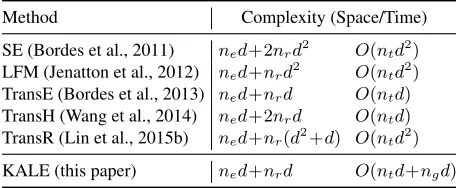
Method Complexity (Space/Time) SE (Bordes et al., 2011) ned+2nrd2 O(ntd2)
LFM (Jenatton et al., 2012) ned+nrd2 O(ntd2) TransE (Bordes et al., 2013) ned+nrd O(ntd)
TransH (Wang et al., 2014) ned+2nrd O(ntd)
[image:5.612.71.299.58.152.2]TransR (Lin et al., 2015b) ned+nr(d2+d) O(ntd2) KALE (this paper) ned+nrd O(ntd+ngd)
Table 1:Complexity of different embedding methods.
of the embedding space, andne/nr/nt/ngis the num-ber of entities/relations/triples/ground rules. The re-sults indicate that incorporating additional rules will not significantly increase the space or time complex-ity of KALE, keeping the model complexcomplex-ity almost the same as that of TransE (optimal among the meth-ods listed in the table). But please note that KALE needs to ground universally quantified rules before learning, which further requiresO(nunt/nr)in time complexity. Here, nu is the number of universally quantified rules, andnt/nr is the averaged number of observed triples per relation. During grounding, we select those ground rules with at least one triple observed. Grounding is required only once before learning, and is not included during the iterations.
Extensions.Actually, our approach is quite general. (i) Besides TransE, a variety of embedding method-s, e.g., those listed in Table 1, can be used for triple modeling (Section 3.2), as long as we further define a mappingf :R → [0,1]to map original scores to
soft truth values. (ii) Besides the two types of rules introduced in Section 3.3, other types of rules can also be handled as long as they can be represented as first-order logic formulae. (iii) Besides the prod-uct t-norm, other types of t-norm based fuzzy logics can be used for rule modeling (Section 3.3), e.g., the Łukasiewicz t-norm used in probabilistic soft log-ic (Br¨ocheler et al., 2010) and the minimum t-norm used in fuzzy description logic (Stoilos et al., 2007). (iv) Besides the pairwise ranking loss, other type-s of lotype-stype-s functiontype-s can be detype-signed for joint learn-ing (Section 3.4), e.g., the pointwise squared loss or the logarithmic loss (Rockt¨aschel et al., 2014; Rock-t¨aschel et al., 2015).
4 Experiments
We empirically evaluate KALE with two tasks: (i) link prediction and (ii) triple classification.
Dataset # Ent # Rel # Train/Valid/Test-I/Test-II # Rule FB122 9,738 122 91,638 9,595 5,057 6,186 78,488 WN18 40,943 18 141,442 5,000 1,394 3,606 119,222
Table 3:Statistics of datasets.
4.1 Experimental Setup
Datasets. We use two datasets: WN18 and FB122. WN18 is a subgraph of WordNet containing 18 rela-tions. FB122 is composed of 122 Freebase relations regarding the topics of “people”, “location”, and “s-ports”, extracted from FB15K. Both WN18 and F-B15K are released by Bordes et al. (2013)3. Triples on each dataset are split into training/validation/test sets, used for model training, parameter tuning, and evaluation respectively. For WN18 we use the o-riginal data split, and for FB122 we extract triples associated with the 122 relations from the training, validation, and test sets of FB15K.
We further create logical rules for each dataset, in the form of ∀x, y : (x, rs, y) ⇒ (x, rt, y) or
∀x, y, z : (x, rs1, y)∧(y, rs2, z) ⇒ (x, rt, z). To
do so, we first run TransE to get entity and relation embeddings, and calculate the truth value for each of such rules according to Eq. (2) or Eq. (3). Then we rank all such rules by their truth values and man-ually filter those ranked at the top. We finally create 47 rules on FB122, and 14 on WN18 (see Table 2 for examples). The rules are then instantiated with con-crete entities (grounding). Ground rules in which at least one constituent triple is observed in the train-ingset are used in joint learning.
Note that some of the test triples can be inferred by directly applying these rules on the training set (pure logical inference). On each dataset, we fur-ther split the test set into two parts, test-I and test-II. The former contains triples thatcannot be directly inferred by pure logical inference, and the latter the remaining test triples. Table 3 gives some statistics of the datasets, including the number of entities, re-lations, triples in training/validation/test-I/test-II set, and ground rules.
Comparison settings.As baselines we take the em-bedding techniques of TransE, TransH, and Tran-sR. TransE models relation embeddings as transla-tion operatransla-tions between entity embeddings. TransH
∀x, y:/sports/athlete/team(x, y)⇒/sports/sports team/player(y, x)
∀x, y:/location/country/capital(x, y)⇒/location/location/contains(x, y)
∀x, y, z:/people/person/nationality(x, y)∧/location/country/official language(y, z)⇒/people/person/languages(x, z)
∀x, y, z:/country/administrative divisions(x, y)∧/administrative division/capital(y, z)⇒/country/second level divisions(x, z)
∀x, y: hypernym(x, y)⇒ hyponym(y, x)
∀x, y: instance hypernym(x, y)⇒ instance hyponym(y, x)
∀x, y: synset domain topic of(x, y)⇒ member of domain topic(y, x)
Table 2:Examples of rules created.
and TransR are extensions of TransE. They further allow entities to have distinct embeddings when in-volved in different relations, by introducing relation-specific hyperplanes and projection matrices respec-tively. All the three methods have been demonstrat-ed to perform well on WordNet and Freebase data.
We further test our approach in three different sce-narios. (i) KALE-Trip uses triples alone to perform the embedding task, i.e., only the training triples are included in the optimization Eq. (4). It is a linear-ly transformed version of TransE. The onlinear-ly differ-ence is that relation embeddings are normalized in KALE-Trip, but not in TransE. (ii) KALE-Pre first repeats pure logical inference on the training set and adds inferred triples as additional training data, until no further triples can be inferred. Both original and inferred triples are then included in the optimization. For example, given a logical rule∀x, y: (x, rs, y)⇒
(x, rt, y), a new triple(ei, rt, ej)can be inferred if
(ei, rs, ej) is observed in the training set, and both triples will be used as training instances for embed-ding. (iii) KALE-Joint is the joint learning scenari-o, which considers both training triples and ground rules in the optimization. In the aforementioned example, training triple(ei, rs, ej)and ground rule
(ei, rs, ej) ⇒ (ei, rt, ej) will be used in the train-ing process of KALE-Joint, without explicitly in-corporating triple (ei, rt, ej). Among the method-s, TransE/TransH/TransR and KALE-Trip use only triples, while KALE-Pre/KALE-Joint further incor-porates rules, before or during embedding.
Implementation details. We use the code provid-ed by Bordes et al. (2013) for TransE4, and the code provided by Lin et al. (2015b) for TransH and Tran-sR5. KALE is implemented in Java. Note that Lin et al. (2015b) initialized TransR with the results of
4https://github.com/glorotxa/SME
5https://github.com/mrlyk423/relation extraction
TransE. However, to ensure fair comparison, we ran-domly initialize all the methods in our experiments. For all the methods, we create 100 mini-batches on each dataset, and tune the embedding dimensiond in {20,50,100}. For TransE, TransH, and Tran-sR which score a triple by a distance in R+, we
tune the learning rate η in {0.001,0.01,0.1}, and
the margin γ in {1,2,3,4}. For KALE which s-cores a triple (as well as a ground rule) by a soft truth value in the unit interval[0,1], we set the
learn-ing rate η in {0.01,0.02,0.05,0.1}, and the mar-ginγ in{0.1,0.12,0.15,0.2}. KALE allows triples and rules to have different weights, with the former fixed to 1, and the latter (denoted byλ) selected in
{0.001,0.01,0.1,1}.
4.2 Link Prediction
This task is to complete a triple(ei, rk, ej)witheior ejmissing, i.e., predicteigiven(rk, ej)or predictej given(ei, rk).
Evaluation protocol. We follow the same evalua-tion protocol used in TransE (Bordes et al., 2013). For each test triple(ei, rk, ej), we replace the head entityeiby every entitye′iin the dictionary, and cal-culate the truth value (or distance) for the corrupted triple (e′i, rk, ej). Ranking the truth values in de-scending order (or the distances in ade-scending order), we get the rank of the correct entityei. Similarly, we can get another rank by corrupting the tail entityej. Aggregated over all the test triples, we report three metrics: (i) the mean reciprocal rank (MRR), (ii) the median of the ranks (MED), and (iii) the proportion of ranks no larger thann(HITS@N). We do not re-port the averaged rank (i.e., the “Mean Rank” metric used by Bordes et al. (2013)), since it is usually sen-sitive to outliers (Nickel et al., 2016).
Test-I Test-II Test-ALL
MRR MED HITS@N (%) MRR MED HITS@N (%) MRR MED HITS@N (%)
3 5 10 3 5 10 3 5 10
FB122
TransE 0.220 29.0 25.7 32.4 40.6 0.296 5.0 40.0 50.8 57.8 0.262 10.0 33.6 42.5 50.0 TransH 0.218 29.0 25.0 31.3 39.2 0.297 6.0 37.5 48.5 56.3 0.249 12.0 31.9 40.7 48.6 TransR 0.219 31.0 24.7 30.8 38.9 0.273 9.0 32.4 42.8 51.6 0.261 15.0 28.9 37.4 45.9 KALE-Trip 0.201 25.0 23.9 31.6 40.1 0.309 5.0 40.9 51.3 58.0 0.261 11.0 33.3 42.4 50.0 KALE-Pre 0.203 25.0 24.1 31.7 40.2 0.368 4.0 47.3 55.4 61.4 0.294 9.0 36.9 44.8 51.9 KALE-Joint 0.229 21.0 26.3 33.8 42.2 0.357 4.0 44.0 53.0 59.3 0.299 9.0 36.1 44.3 51.6
WN18
[image:7.612.73.538.59.238.2]TransE 0.248 4.0 40.9 60.6 77.0 0.363 3.0 59.4 70.8 81.4 0.331 3.0 54.3 67.9 80.2 TransH 0.242 4.0 39.2 60.1 75.9 0.482 2.0 63.5 70.8 79.3 0.415 3.0 56.7 67.8 78.3 TransR 0.240 4.0 40.1 57.7 71.6 0.449 3.0 55.7 64.5 74.3 0.391 3.0 51.3 62.6 73.5 KALE-Trip 0.250 4.0 40.6 62.3 78.1 0.393 2.0 61.9 71.2 80.6 0.353 3.0 56.0 68.7 79.9 KALE-Pre 0.248 4.0 40.4 61.5 78.2 0.451 3.0 69.6 77.5 85.3 0.395 3.0 61.4 73.0 83.3 KALE-Joint 0.260 4.0 43.6 64.1 79.2 0.563 2.0 67.6 73.8 81.0 0.478 2.0 60.9 71.1 80.5
Table 4:Link prediction results on the test-I, test-II, and test-all sets of FB122 and WN18 (raw setting).
Test-I Test-II Test-ALL
MRR MED HITS@N (%) MRR MED HITS@N (%) MRR MED HITS@N (%)
3 5 10 3 5 10 3 5 10
FB122
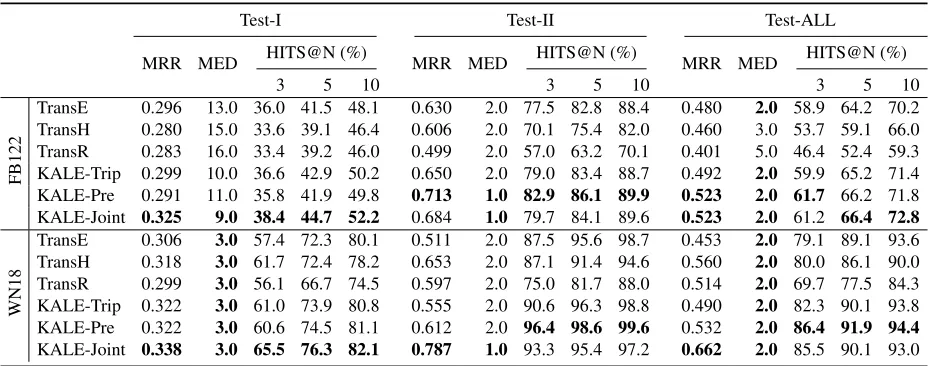
TransE 0.296 13.0 36.0 41.5 48.1 0.630 2.0 77.5 82.8 88.4 0.480 2.0 58.9 64.2 70.2 TransH 0.280 15.0 33.6 39.1 46.4 0.606 2.0 70.1 75.4 82.0 0.460 3.0 53.7 59.1 66.0 TransR 0.283 16.0 33.4 39.2 46.0 0.499 2.0 57.0 63.2 70.1 0.401 5.0 46.4 52.4 59.3 KALE-Trip 0.299 10.0 36.6 42.9 50.2 0.650 2.0 79.0 83.4 88.7 0.492 2.0 59.9 65.2 71.4 KALE-Pre 0.291 11.0 35.8 41.9 49.8 0.713 1.0 82.9 86.1 89.9 0.523 2.0 61.7 66.2 71.8 KALE-Joint 0.325 9.0 38.4 44.7 52.2 0.684 1.0 79.7 84.1 89.6 0.523 2.0 61.2 66.4 72.8
WN18
TransE 0.306 3.0 57.4 72.3 80.1 0.511 2.0 87.5 95.6 98.7 0.453 2.0 79.1 89.1 93.6 TransH 0.318 3.0 61.7 72.4 78.2 0.653 2.0 87.1 91.4 94.6 0.560 2.0 80.0 86.1 90.0 TransR 0.299 3.0 56.1 66.7 74.5 0.597 2.0 75.0 81.7 88.0 0.514 2.0 69.7 77.5 84.3 KALE-Trip 0.322 3.0 61.0 73.9 80.8 0.555 2.0 90.6 96.3 98.8 0.490 2.0 82.3 90.1 93.8 KALE-Pre 0.322 3.0 60.6 74.5 81.1 0.612 2.0 96.4 98.6 99.6 0.532 2.0 86.4 91.9 94.4 KALE-Joint 0.338 3.0 65.5 76.3 82.1 0.787 1.0 93.3 95.4 97.2 0.662 2.0 85.5 90.1 93.0
Table 5:Link prediction results on the test-I, test-II, and test-all sets of FB122 and WN18 (filtered setting).
and a possible corruption (Lyon,Located-In, France). Both triples are valid. In this case, rank-ingLyonbefore the correct answerParisshould not be counted as an error. To avoid such phenome-na, we follow Bordes et al. (2013) and remove those corrupted triples which exist in either the training, validation, or test set before getting the ranks. That means, we removeLyonfrom the candidate list be-fore getting the rank of Paris in the aforemen-tioned example. We call the original setting “raw” and the new setting “filtered”.
Optimal configurations. For each of the method-s to be compared, we tune itmethod-s hyperparametermethod-s in the ranges specified in Section 4.1, and select a best model that leads to the highest filtered MRR score on the validation set (with a total of 500 epochs over
the training data). The optimal configurations for KALE are: d= 100,η= 0.05,γ= 0.12, andλ= 1
on FB122;d= 50,η= 0.05,γ= 0.2, andλ= 0.1on
WN18. To better see and understand the effects of rules, we use the same configuration for KALE-Trip, KALE-Pre, and KALE-Joint on each dataset.
[image:7.612.74.540.263.446.2]train-Raw Filtered
Test-Incl Test-Excl Test-Incl Test-Excl
MEAN / MED / HITS@10 MEAN / MED / HITS@10 MEAN / MED / HITS@10 MEAN / MED / HITS@10
FB122
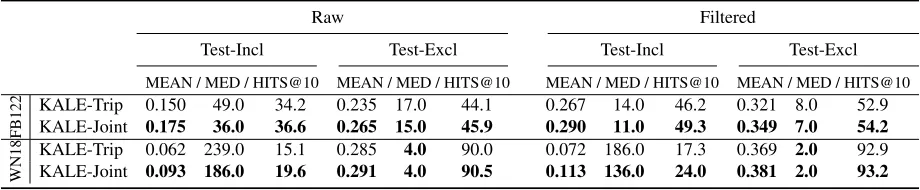
KALE-Trip 0.150 49.0 34.2 0.235 17.0 44.1 0.267 14.0 46.2 0.321 8.0 52.9 KALE-Joint 0.175 36.0 36.6 0.265 15.0 45.9 0.290 11.0 49.3 0.349 7.0 54.2
WN18
[image:8.612.76.536.58.153.2]KALE-Trip 0.062 239.0 15.1 0.285 4.0 90.0 0.072 186.0 17.3 0.369 2.0 92.9 KALE-Joint 0.093 186.0 19.6 0.291 4.0 90.5 0.113 136.0 24.0 0.381 2.0 93.2
Table 6:Comparison between KALE-Trip and KALE-Joint on Test-Incl and Test-Excl of FB122 and WN18.
ing instances in KALE-Pre, or encoded explicitly in training ground rules in KALE-Joint, making this set trivial for the rules to some extent. From the result-s, we can see that in both settings: (i) KALE-Pre and KALE-Joint outperform (or at least perform as well as) the other methods which use triples alone on almost all the test sets, demonstrating the superi-ority of incorporating logical rules. (ii) On the test-I sets which contain triples beyond the scope of pure logical inference, KALE-Joint performs significant-ly better than KALE-Pre. On these sets KALE-Joint can still beat all the baselines by a significant margin in most cases, while KALE-Pre can hardly outper-form KALE-Trip. It demonstrates the capability of the joint embedding scenario to learn more predic-tive embeddings, through which we can make better predictions even beyond the scope of pure logical inference. (iii) On the test-II sets which contain di-rectly inferable triples, KALE-Pre can easily beat all the baselines (even KALE-Joint). That means, for triples covered by pure logical inference, it is trivial to improve the performance by directly incorporat-ing them as trainincorporat-ing instances.
To better understand how the joint embedding s-cenario can learn more predictive embeddings, on each dataset we further split the test-I set into two parts. Given a triple(ei, rk, ej)in the test-I set, we assign it to the first part if relationrkis covered by the rules, and the second part otherwise. We call the two parts Test-Incl and Test-Excl respectively. Ta-ble 6 compares the performance of KALE-Trip and KALE-Joint on the two parts. The results show that KALE-Joint outperforms KALE-Trip on both parts, but the improvements on Test-Incl are much more significant than those on Test-Excl. Take the fil-tered setting on WN18 as an example. On Test-Incl, KALE-Joint increases the metric MRR by 55.7%, decreases the metric MED by 26.9%, and
increas-es the metric HITS@10 by 38.2%. On Tincreas-est-Excl, however, MRR rises by 3.1%, MED remains the same, and HITS@10 rises by only 0.3%. This obser-vation indicates that jointly embedding triples and rules helps to learn more predictive embeddings, es-pecially for those relations that are used to construct the rules. This might be the main reason that KALE-Joint can make better predictions even beyond the scope of pure logical inference.
4.3 Triple Classification
This task is to verify whether an unobserved triple
(ei, rk, ej)is correct or not.
Evaluation protocol. We take the following evalu-ation protocol similar to that used in TransH (Wang et al., 2014). We first create labeled data for evalua-tion. For each triple in the test or validation set (i.e., a positive triple), we construct 10 negative triples for it by randomly corrupting the entities, 5 at the head position and the other 5 at the tail position.6 To make the negative triples as difficult as possible, we corrupt a position using only entities that have ap-peared in that position, and further ensure that the corrupted triples do not exist in either the training, validation, or test set. We simply use the truth values (or distances) to classify triples. Triples with large truth values (or small distances) tend to be predict-ed as positive. To evaluate, we first rank the triples associated with each specific relation (in descending order according to their truth values, or in ascending order according to the distances), and calculate the average precision for that relation. We then report on the test sets the mean average precision (MAP)
6Previous work typically constructs only a single negative
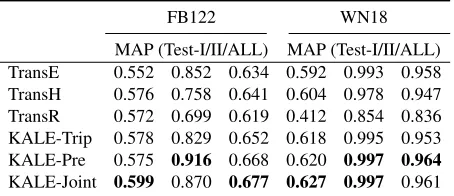
FB122 WN18 MAP (Test-I/II/ALL) MAP (Test-I/II/ALL) TransE 0.552 0.852 0.634 0.592 0.993 0.958 TransH 0.576 0.758 0.641 0.604 0.978 0.947 TransR 0.572 0.699 0.619 0.412 0.854 0.836 KALE-Trip 0.578 0.829 0.652 0.618 0.995 0.953 KALE-Pre 0.575 0.916 0.668 0.620 0.997 0.964 KALE-Joint 0.599 0.870 0.677 0.627 0.997 0.961 Table 7: Triple classification results on the test-I, test-II, and test-all sets of FB122 and WN18.
aggregated over different relations.
Optimal configurations. The hyperparameters of each method are again tuned in the ranges specified in Section 4.1, and the best models are selected by maximizing MAP on the validation set. The optimal configurations for KALE are: d= 100,η= 0.1,γ= 0.2, andλ= 0.1on FB122; d= 100, η= 0.1,γ= 0.2, and λ= 0.001 on WN18. Again, we use the
same configuration for KALE-Trip, KALE-Pre, and KALE-Joint on each dataset.
Results.Table 7 shows the results on the I, test-II, and test-all sets of our datasets. From the results, we can see that: (i) KALE-Pre and KALE-Joint out-perform the other methods which use triples alone on almost all the test sets, demonstrating the superi-ority of incorporating logical rules. (ii) KALE-Joint performs better than KALE-Pre on the test-I sets, i.e., triples that cannot be directly inferred by per-forming pure logical inference on the training set. This observation is similar to that observed in the link prediction task, demonstrating that the joint em-bedding scenario can learn more predictive embed-dings and make predictions beyond the capability of pure logical inference.
5 Conclusion and Future Work
In this paper, we propose a new method for joint-ly embedding knowledge graphs and logical rules, referred to as KALE. The key idea is to represent and model triples and rules in a unified framework. Specifically, triples are represented as atomic for-mulae and modeled by the translation assumption, while rules as complex formulae and by the t-norm fuzzy logics. A global loss on both atomic and com-plex formulae is then minimized to perform the em-bedding task. Emem-beddings learned in this way are
compatible not only with triples but also with rules, which are certainly more useful for knowledge ac-quisition and inference. We evaluate KALE with the link prediction and triple classification tasks on WordNet and Freebase data. Experimental result-s result-show that joint embedding bringresult-s result-significant and consistent improvements over state-of-the-art meth-ods. More importantly, it can obtain more predic-tive embeddings and make better predictions even beyond the scope of pure logical inference.
For future work, we would like to (i) Investigate the efficacy of incorporating other types of logical rules such as ∀x, y, z : (x,Capital-Of, y) ⇒
¬(x,Capital-Of, z). (ii) Investigate the
possibil-ity of modeling logical rules using only relation em-beddings as suggested by Demeester et al. (2016), e.g., modeling the above rule using only the embed-ding associated with Capital-Of. This avoids grounding, which might be time and space ineffi-cient especially for complicated rules. (iii) Inves-tigate the use of automatically extracted rules which are no longer hard rules and tolerant of uncertainty.
Acknowledgments
We would like to thank the anonymous reviewers for their insightful comments and suggestions. This re-search is supported by the National Natural Science Foundation of China (grant No. 61402465) and the Strategic Priority Research Program of the Chinese Academy of Sciences (grant No. XDA06030200).
References
Islam Beltagy and Raymond J. Mooney. 2014. Efficient markov logic inference for natural language semantics. InProceedings of the 28th AAAI Conference on Arti-ficial Intelligence - Workshop on Statistical Relational Artificial Intelligence, pages 9–14.
Kurt Bollacker, Colin Evans, Praveen Paritosh, Tim S-turge, and Jamie Taylor. 2008. Freebase: a collab-oratively created graph database for structuring hu-man knowledge. In Proceedings of the 2008 ACM SIGMOD International Conference on Management of Data, pages 1247–1250.
Antoine Bordes, Nicolas Usunier, Alberto Garcia-Dur´an, Jason Weston, and Oksana Yakhnenko. 2013. Trans-lating embeddings for modeling multi-relational da-ta. InProceedings of the 27th Annual Conference on Neural Information Processing Systems, pages 2787– 2795.
Antoine Bordes, Xavier Glorot, Jason Weston, and Yoshua Bengio. 2014. A semantic matching energy function for learning with multi-relational data. Ma-chine Learning, 94(2):233–259.
Matthias Br¨ocheler, Lilyana Mihalkova, and Lise Getoor. 2010. Probabilistic similarity logic. InProceedings of the 26th Conference on Uncertainty in Artificial Intel-ligence, pages 73–82.
Kai-wei Chang, Wen-tau Yih, Bishan Yang, and Christo-pher Meek. 2014. Typed tensor decomposition of knowledge bases for relation extraction. In Proceed-ings of the 2014 Conference on Empirical Methods in Natural Language Processing, pages 1568–1579. Thomas Demeester, Tim Rockt¨aschel, and Sebastian
Riedel. 2016. Regularizing relation representations by first-order implications. InProceedings of the 2016 Conference of the North American Chapter of the As-sociation for Computational Linguistics: Human Lan-guage Technologies - Workshop on Automated Knowl-edge Base Construction, pages 75–80.
Shu Guo, Quan Wang, Lihong Wang, Bin Wang, and Li Guo. 2015. Semantically smooth knowledge graph embedding. InProceedings of the 53rd Annual Meet-ing of the Association for Computational LMeet-inguistics and the 7th International Joint Conference on Natural Language Processing, pages 84–94.
Petr H´ajek. 1998. The metamathematics of fuzzy logic. Kluwer.
Raphael Hoffmann, Congle Zhang, Xiao Ling, Luke Zettlemoyer, and Daniel S. Weld. 2011. Knowledge-based weak supervision for information extraction of overlapping relations. In Proceedings of the 49th Annual Meeting of the Association for Computation-al Linguistics: Human Language Technologies, pages 541–550.
Rodolphe Jenatton, Nicolas L. Roux, Antoine Bordes, and Guillaume R. Obozinski. 2012. A latent factor model for highly multi-relational data. InProceedings of the 26th Annual Conference on Neural Information Processing Systems, pages 3167–3175.
Shangpu Jiang, Daniel Lowd, and Dejing Dou. 2012. Learning to refine an automatically extracted knowl-edge base using markov logic. InProceedings of 12th IEEE International Conference on Data Mining, pages 912–917.
Charles Kemp, Joshua B. Tenenbaum, Thomas L. Grif-fiths, Takeshi Yamada, and Naonori Ueda. 2006.
Learning systems of concepts with an infinite relation-al model. InProceedings of the 21st AAAI Conference on Artificial Intelligence, pages 381–388.
Denis Krompaß, Stephan Baier, and Volker Tresp. 2015. Type-constrained representation learning in knowl-edge graphs. InProceedings of the 14th International Semantic Web Conference, pages 640–655.
Yankai Lin, Zhiyuan Liu, Huanbo Luan, Maosong Sun, Siwei Rao, and Song Liu. 2015a. Modeling relation paths for representation learning of knowledge bases. In Proceedings of the 2015 Conference on Empirical Methods in Natural Language Processing, pages 705– 714.
Yankai Lin, Zhiyuan Liu, Maosong Sun, Yang Liu, and Xuan Zhu. 2015b. Learning entity and relation em-beddings for knowledge graph completion. In Pro-ceedings of the 29th AAAI Conference on Artificial In-telligence, pages 2181–2187.
Yuanfei Luo, Quan Wang, Bin Wang, and Li Guo. 2015. Context-dependent knowledge graph embed-ding. In Proceedings of the 2015 Conference on Empirical Methods in Natural Language Processing, pages 1656–1661.
Tomas Mikolov, Wen-tau Yih, and Geoffrey Zweig. 2013. Linguistic regularities in continuous space word representations. In Proceedings of the 2013 Confer-ence of the North American Chapter of the Associa-tion for ComputaAssocia-tional Linguistics: Human Language Technologies, pages 746–751.
George A. Miller. 1995. Wordnet: a lexical database for english.Communications of the ACM, 38(11):39–41. Arvind Neelakantan, Benjamin Roth, and Andrew
Mc-Callum. 2015. Compositional vector space model-s for knowledge bamodel-se completion. InProceedings of the 53rd Annual Meeting of the Association for Com-putational Linguistics and the 7th International Join-t Conference on NaJoin-tural Language Processing, pages 156–166.
Maximilian Nickel, Volker Tresp, and Hans P. Kriegel. 2011. A three-way model for collective learning on multi-relational data. InProceedings of the 28th In-ternational Conference on Machine Learning, pages 809–816.
Maximilian Nickel, Volker Tresp, and Hans P. Kriegel. 2012. Factorizing yago: Scalable machine learning for linked data. InProceedings of the 21st International Conference on World Wide Web, pages 271–280. Maximilian Nickel, Lorenzo Rosasco, and Tomaso
Pog-gio. 2016. Holographic embeddings of knowledge graphs. InProceedings of the 30th AAAI Conference on Artificial Intelligence, pages 1955–1961.
Proceed-ings of the 12th International Semantic Web Confer-ence, pages 542–557.
Matthew Richardson and Pedro Domingos. 2006. Markov logic networks. Machine Learning, 62(1-2):107–136.
Sebastian Riedel, Limin Yao, Andrew McCallum, and Benjamin M. Marlin. 2013. Relation extraction with matrix factorization and universal schemas. In Pro-ceedings of the 2013 Conference on North American Chapter of the Association for Computational Linguis-tics: Human Language Technologies, pages 74–84. Tim Rockt¨aschel, Matko Boˇsnjak, Sameer Singh, and
Se-bastian Riedel. 2014. Low-dimensional embeddings of logic. In Proceedings of the 52nd Annual Meeting of the Association for Computational LMeetinguistics -Workshop on Semantic Parsing, pages 45–49.
Tim Rockt¨aschel, Sameer Singh, and Sebastian Riedel. 2015. Injecting logical background knowledge into embeddings for relation extraction. InProceedings of the 2015 Conference of the North American Chapter of the Association for Computational Linguistics: Hu-man Language Technologies, pages 1119–1129. Richard Socher, Danqi Chen, Christopher D. Manning,
and Andrew Y. Ng. 2013. Reasoning with neural ten-sor networks for knowledge base completion. In Pro-ceedings of the 27th Annual Conference on Neural In-formation Processing Systems, pages 926–934. Giorgos Stoilos, Giorgos B. Stamou, Jeff Z. Pan, Vassilis
Tzouvaras, and Ian Horrocks. 2007. Reasoning with very expressive fuzzy description logics. Journal of Artificial Intelligence Research, 30:273–320.
Ilya Sutskever, Joshua B. Tenenbaum, and Ruslan R. Salakhutdinov. 2009. Modelling relational data using bayesian clustered tensor factorization. In Proceed-ings of the 23rd Annual Conference on Neural Infor-mation Processing Systems, pages 1821–1828. Zhen Wang, Jianwen Zhang, Jianlin Feng, and Zheng
Chen. 2014. Knowledge graph embedding by translating on hyperplanes. In Proceedings of the 28th AAAI Conference on Artificial Intelligence, pages 1112–1119.
Quan Wang, Bin Wang, and Li Guo. 2015. Knowledge base completion using embeddings and rules. In Pro-ceedings of the 24th International Joint Conference on Artificial Intelligence, pages 1859–1865.
Evgenia Wasserman-Pritsker, William W. Cohen, and Einat Minkov. 2015. Learning to identify the best contexts for knowledge-based wsd. InProceedings of the 2015 Conference on Empirical Methods in Natural Language Processing, pages 1662–1667.
Zhuoyu Wei, Jun Zhao, Kang Liu, Zhenyu Qi, Zhengya Sun, and Guanhua Tian. 2015. Large-scale knowl-edge base completion: inferring via grounding
net-work sampling over selected instances. In Proceed-ings of the 24th ACM International on Conference on Information and Knowledge Management, pages 1331–1340.
Jason Weston, Antoine Bordes, Oksana Yakhnenko, and Nicolas Usunier. 2013. Connecting language and knowledge bases with embedding models for relation extraction. InProceedings of the 2013 Conference on Empirical Methods in Natural Language Processing, pages 1366–1371.
Zhao Xu, Volker Tresp, Kai Yu, and Hanspeter Kriegel. 2006. Infinite hidden relational models. In Proceed-ings of ProceedProceed-ings of the 22nd Conference on Uncer-tainty in Artificial Intelligence, pages 544–551. Huaping Zhong, Jianwen Zhang, Zhen Wang, Hai Wan,