Using Syntactic and Semantic Context to Explore Psychodemographic
Differences in Self-reference
Masoud Rouhizadeh†§, Lyle Ungar§, Anneke Buffone§, H Andrew Schwartz†§ †Stony Brook University,§University of Pennsylvania
[email protected], [email protected], [email protected], [email protected]
Abstract
Psychological analysis of language has repeat-edly shown that an individual’s rate of men-tioning 1st person singular pronouns predicts a wealth of important demographic and psy-chological factors. However, these analy-ses are performed out of context — syntac-tic and semansyntac-tic — which may change the magnitude or even direction of such relation-ships. In this paper, we put “pronouns in their context”, exploring the relationship between self-reference and age, gender, and depres-sion depending on syntactic position and ver-bal governor. We find that pronouns are over-all more predictive when taking dependency relations and verb semantic categories into ac-count, and, the direction of the relationship can change depending on the semantic class of the verbal governor.
1 Introduction
Approximately 1 in 18 English words on Face-book are first-person singular pronouns.1 Extensive
work in psychological analyses of language has con-sistently found strong relation between first-person pronoun use and psychological attributes of individ-uals (Kendall, 1998; Pennebaker and Stone, 2003; Pennebaker, 2011; Twenge et al., 2012; Oishi et al., 2013; Carey et al., 2015). Although such find-ings have been replicated extensively, little is known about how the syntactic or semantic context of the pronouns may affect their relationship with human traits. Usage in subject or object position may 1Within the study dataset, 5.45% of all words from self-identified English speakers were first-person pronouns.
vary, and the type of verb governing the reference may further change its relationship. For instance, while younger individuals are more likely to use 1st-person singular pronouns overall, older individuals may be more likely to use them as the subject of so-cial verbs.
In this study we dive deep into this one type of word which makes up a large portion of our daily lives. We first look at the relationship between first person singular pronouns and age, gender, and de-pression. We then consider the syntactic position of the pronoun and its occurrence in the subject and direct object position. Next, we explore the self-referenced use of verbs compared to their general use across different semantic categories, followed by an examination of the rate of 1st-person singular pronoun as the subject and the object with different verb categories.
We ultimately show that pronoun relationships with human outcomes can change drastically de-pending on their syntactic position and the category of their verbal governor. To be more specific, our contributions include: (a) taking the role of context into account in the psychological analysis of per-sonal pronouns, (b) distributional clustering of verbs using Canonical Correlation Analysis (CCA), and (c) exploring the integration of verbal semantic cat-egories in the analysis of pronouns. Utilizing verb categories instead of actual verbs, enables general-ization and less sparsity in the semantic comparison of the contexts in which personal pronouns are used.
2 Background
A wealth of studies have explored pronoun use with regard to age, gender, and personality types. In fact, a whole book, “The Secret Life of Pronouns” has been dedicated summarizing such studies which have built up over several decades of work (Pen-nebaker, 2011).2
We could not come close to a full survey of such work, but rather list some of the most notable and recent results for outcomes related to those of this study. Pennebaker et. al. (2003) and Chung & Pen-nebaker (2007) found that the use of self-references (i.e. ‘I’, ‘me’) decreases over age. Pennebaker et. al. (2003), and Argamon et. al. (2007) showed that females use significantly more first-person singular personal pronouns compared to males. Bucci and Freedman (1981), Weintraub (1981), and Zimmer-mann et. al. (2013) found that first-person singu-lar pronouns are positively correlated with depres-sive symptoms. These analyses do not take the role of syntactic and semantic context into consideration which may indicate interesting information about psychological factors.
3 Method
Data Set: Facebook Status Updates. Our dataset consists of the status updates of 74,867 Facebook users who volunteered to share their posts in the “MyPersonality” application (Kosinski et al., 2013), sent between January 2009 and October 2011. The users met the following criteria: (a) have English as a primary language, (b) indicated their gender and age, (c) be less than 65 years old (due to data spar-sity beyond this age), and (d) have at least 1,000 words in their status updates (in order to accurately estimate language usage rates). This dataset con-tains 309 million words within 15.4 million sta-tus updates. All users completed a 100-item per-sonality questionnaire (an International Perper-sonality Item Pool (IPIP) proxy to the NEO-PI-R (Goldberg, 1999). User-level degree of depression (DDep) was estimated as the average response to seven depres-sion facet items (nested within the larger Neuroti-2To quantify the pervasiveness of pronoun studies in so-cial science, we consider the citation count, via Google Scholar (July, 2016), to works mentioning “pronoun” by one of the top researchers, James W. Pennebaker, which number over 10,000.
cism item pool of the questionnaire) (Schwartz et al., 2014).
Dependency Features. We used dependency an-notations in order to determine the syntactic func-tion of personal pronouns i.e. subject (S) and di-rect object (DO). We obtained dependency parses of our corpus using Stanford Parser (Socher et al., 2013) that provides universal dependencies in ( re-lation, head, dependent) triples. In the next step, we extracted the words in in the nominal subject (“nsubj") and direct object (“dobj") positions in-cludingnsubj 1st-person singular pronoun“I", and
dobj1st-person singular pronoun“me". We also ex-tracted the corresponding verbs for each of the nom-inal subjects, and direct object words.
Verb categorization. In order to integrate the ver-bal semantic categories in the syntactic analysis of pronouns, we utilize two verb categorization meth-ods (a) linguistically-driven Levin’s Verb Classes, and (b) empirically-driven verb clustering based on CCA.
Levin’s verb classes (Levin, 1993) includes around 3100 English verbs classified into 47 top level, 193 second and third level classes. This clas-sification is based on Levin’s hypothesis that the syntactic behavior of a verb is influenced by its se-mantic properties, indicating that identifying sets of verbs with comparable behavior at the syntax level will lead to coherent clusters of semantically similar verbs. In this paper we used all of the 193 second and third level Levin’s classes (Lev). As an alter-native way, we also used the 50 top most frequent sub-classes in our social media data (LevTop).
Gender Age Dep
Feature Set (AUC) (MSE) (MSE)
P(1p) .512 78.9 90.1
P(1p|r) .589 76.4 90.3
P(1p|r, c),Lev .660 70.0 89.8
P(1p|r, c),Lev& sent .695 68.3 89.1 P(1p|r, c),LevTop .660 71.5 89.8 P(1p|r, c),LevTop& sent .669 69.0 89.3 P(1p|r, c),CCA-D .634 73.4 90.3 P(1p|r, c),CCA-D& sent .649 71.5 89.7
[image:3.612.310.542.55.202.2]P(1p|r, c),CCA-KM .632 72.6 90.3 P(1p|r, c),CCA-KM& sent .645 70.9 89.9 Table 1: Area under the ROC curve (AUC) for gender (higher is better), and Mean Square Error (MSE) for age and depression prediction (lower is better), and the pre-diction using 1st-per pronoun use overall, in subject and object position, and given verb categories.
(u: subject-view), and object by component matrix (v: object-view). We then build matrixS by multi-plyingx byu and matrixO by multiplyingz by v to get the verbs by CCA-components from subject-view, and verbs by object components from object-view respectively. In order to cluster verbs from direct CCA components, we use the average score ofsubject-viewandobject-viewcomponents, assign-ing verbs to those components for which they have a non-zero absolute weight (CCA-D). Sparse CCA zeros-out verbs from multiple components so as to assign verbs to components, but we also explore normal CCA and cluster the verbs using k-means (k = 30) clustering from the z-scaled values ofS andOmatrices (CCA-KM).
Both Levin’s and CCA-based verb classes are de-rived from syntactic behavior. As a result, they often do not distinguish antonyms. For instance, Levin’s “admire" verb class contains both ‘love’ and ‘hate". Building on research showing positive and negative emotions differ across age and gender (Schwartz et al., 2013), we integrate valence information in our verb clustering. We used positive and negative sen-timent scores from EmoLex word-emotion associa-tion lexicon (Mohammad and Turney, 2013), divid-ing each of our clusters intopositive,negative, and
neutralsub-classes.
Analysis. We explore the use of 1st-person singu-lar pronouns across age and gender in different syn-tactic and semantic contexts. Features are encoded as the mean from maximum likelihood estimation
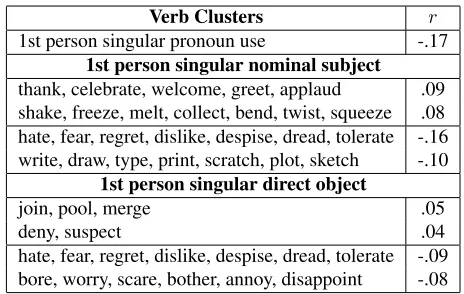
Verb Clusters r
1st person singular pronoun use -.17 1st person singular nominal subject
thank, celebrate, welcome, greet, applaud .09 shake, freeze, melt, collect, bend, twist, squeeze .08 hate, fear, regret, dislike, despise, dread, tolerate -.16 write, draw, type, print, scratch, plot, sketch -.10
1st person singular direct object
join, pool, merge .05
deny, suspect .04
[image:3.612.72.303.57.193.2]hate, fear, regret, dislike, despise, dread, tolerate -.09 bore, worry, scare, bother, annoy, disappoint -.08
Table 2:Linear regression coefficient of age and 1st per-son pronoun use in different verb clusters.
over the probability of mentioning a first person sin-gular pronoun in a given context.
(a) The overall usage first person singular pro-noun:
P(1p) =P(P N = 1p)
(b)The probability of using first person singular pronoun in thensubj, and thedobjpositions:
P(1p|r) =P(P N = 1p|rel=r)
whererel∈ {nsubj, dobj}.
(c) The probability of using first person singular pronoun in the nsubj, and the dobj positions of a given verb category:
P(1p|r, c) =P(P N = 1p|rel=r, vcat=c)
whererel∈ {nsubj, dobj}andvcatis the set of all verb categories being considered.
4 Evaluation
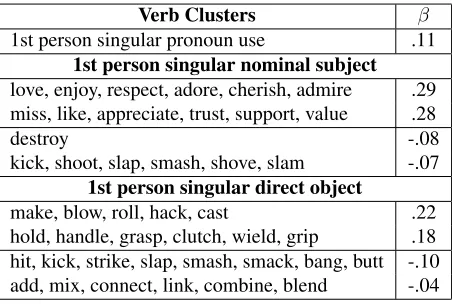
Verb Clusters β
1st person singular pronoun use .11
1st person singular nominal subject
love, enjoy, respect, adore, cherish, admire .29 miss, like, appreciate, trust, support, value .28
destroy -.08
kick, shoot, slap, smash, shove, slam -.07
1st person singular direct object
[image:4.612.73.299.56.208.2]make, blow, roll, hack, cast .22 hold, handle, grasp, clutch, wield, grip .18 hit, kick, strike, slap, smash, smack, bang, butt -.10 add, mix, connect, link, combine, blend -.04 Table 3: Logistic regression coefficient between gender and 1st person singular pronoun use in different verb clusters (positive is female).
Replication. We use standardized linear and lo-gistic regression to correlate gender, age, and de-pression with P(1p) (first-person singular pronoun
use). We control for age in the case of gender, gen-der in the case of age, and both gengen-der and age in the case of depression by including them as co-variates in the regression and reporting the unique coefficient for the variable in question. Logistic re-gression is used for gender, since it is binary, while linear regression is used for the continuous age and depression variables. Confirming past results, we found significant relationships between first-person pronoun usage and gender (β = .11, p < .001), age (r = −0.17, p < .001), and depression score
(r =−0.06,p < .01).
Syntactic Context. Taking dependency relation-ships into account (P(1p|r)), we observed shifts
in the magnitude of correlations. Specifically, we found significant negative correlations between age and using 1st-person singular pronoun in the subject (r = −0.12, p < .001), and the object positions
(r =−0.17,p < .001). For gender we found a
sig-nificant positive correlation between being female and the probability of using 1st-person singular pro-noun (r = 0.11,p < .001), and 1st-person singular
pronoun in subject position (r = 0.16, p < .001).
For depression a significant positive correlation be-tween withP(1p) (r = 0.06, p < .05), and using
1st-person singular pronoun in the subject position (r = 0.07,p < .05).
Syntactic and Semantic Context. Table 1 reports the area under the ROC curve (AUC) for gen-der prediction and the Mean Square Error (MSE) for predicting age and depression based onP(1p), P(1p|r), andP(1p|r, c), driven from various
cate-gorization approaches. We used AUC since it can capture more differences in performance by evalu-ating the class probabilities of test instances rather than just finding whether it was right or wrong. We applied 10-fold cross-validation with a linear-SVM in the case of gender, and ridge-regression in the case of depression. The obtained results reveal a consistent pattern: in gender, age, and depression prediction all the features that take context into ac-count outperformP(1p)which is the vastly reported measure of self-reference in the literature. This sug-gests that there is more information to be gained by utilization syntactic and semantic context. In other words, we can achieve a more meaningful, deeper insight into the relationship of subject and object po-sition of the first person in different contexts, reveal-ing a more complex, and more insightful set of rela-tions.
We achieve the best performance by utilizing verb categories. We first observe that integrating sen-timent helps in nearly all verb categorization ap-proaches. Next, we see that while both CCA and Levin verb clusters yield improvement in predic-tion accuracy, our performance gains using the data-driven CCA-based verb clustering are not as large as that from Levin’s linguistically-driven classes.
While we believe our features can improve pre-diction accuracy, that is not the primary application of social science research. Rather, it is correlating the behavior of referencing the self with psycholog-ical conditions, like depression, in order to gain hu-man insights. In the case of correlating behavior with a psychological measure, Pearson coefficients above .1 are considered noteworthy and above .3 are considered approaching a “correlational upper-bound" (Meyer et al., 2001).
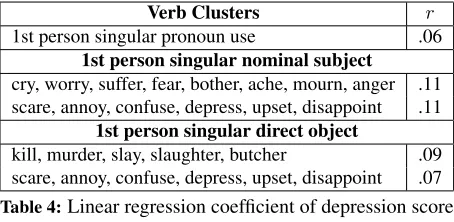
Tables 2, 3, and 4 show the most predictive fea-tures, using the best performing clustering method (i.e. Levin & Sentiment). Note that in the case of age and gender, we see that not only does the mag-nitude of the relationship change, but it’s possible that the direction can completely change.
Verb Clusters r
1st person singular pronoun use .06 1st person singular nominal subject
cry, worry, suffer, fear, bother, ache, mourn, anger .11 scare, annoy, confuse, depress, upset, disappoint .11
1st person singular direct object
[image:5.612.72.299.57.168.2]kill, murder, slay, slaughter, butcher .09 scare, annoy, confuse, depress, upset, disappoint .07
Table 4:Linear regression coefficient of depression score and 1st person singular pronoun use in different verb clusters.
use first-person singular pronouns overall, they are much more likely to use them as the subject of ag-gressive physical contact verbs like “kick", “shoot", “slap", and “smash", suggesting men are more likely to express themselves as agents of aggressive con-tact. On the other hand, women use first-person sin-gulars in the social sphere, particularly in an affilia-tive context. They assert themselves as agents of em-powering and encouraging others (e.g. “love", “en-joy", “cherish", “admire") and faith in others (e.g. “trust", “value", “support", “respect").
5 Conclusion
We have shown that the well-studied link be-tween the first-person singular pronoun and human psycho-demographics is largely dependent on its syntactic and semantic context. Many theories and conclusions are built on such relationships, but here we show these relationships depend on verbal con-text; correlations can shrink, grow, and even change directions depending on the verbs governing the pro-noun. For example, while the usage of 1st person singular pronoun decreases over age, it increases if it is used as the subject of verbs such as “thank", and “celebrate", or as the object of verbs such as “join". Similarly, while females tend to use 1st person sin-gular pronouns more than males, they use them less often as the subject of “destroy” verbs or as the ob-ject of “hit” and “kick” verbs.
By integrating syntactic dependency relationships along with semantic classes of verbs, we can cap-ture more nuanced linguistic relationships with hu-man factors. Beyond pronouns, we ultimately aim to expand the regimen of open-vocabulary tech-niques available for the analysis of psychologically-relevant outcomes.
Acknowledgments
The authors acknowledge the support from Temple-ton Religion Trust, grant TRT-0048.
References
Waleed Ammar, George Mulcaire, Yulia Tsvetkov, Guil-laume Lample, Chris Dyer, and Noah A Smith. 2016. Massively multilingual word embeddings. arXiv preprint arXiv:1602.01925.
Shlomo Argamon, Moshe Koppel, James W Pennebaker, and Jonathan Schler. 2007. Mining the blogosphere: Age, gender and the varieties of self-expression. First Monday, 12(9).
Wilma Bucci and Norbert Freedman. 1981. The lan-guage of depression. Bulletin of the Menninger Clinic, 45(4):334.
Angela L Carey, Melanie S Brucks, Albrecht CP Küfner, Nicholas S Holtzman, Mitja D Back, M Brent Don-nellan, James W Pennebaker, Matthias R Mehl, et al. 2015. Narcissism and the use of personal pronouns re-visited. Journal of personality and social psychology, 109(3):e1.
Cindy Chung and James W Pennebaker. 2007. The psy-chological functions of function words. Social com-munication, pages 343–359.
Paramveer S. Dhillon, Dean Foster, and Lyle Ungar. 2011. Multi-view learning of word embeddings via cca. In Advances in Neural Information Processing Systems (NIPS), volume 24.
Lewis R Goldberg. 1999. A broad-bandwidth, public do-main, personality inventory measuring the lower-level facets of several five-factor models. Personality psy-chology in Europe, 7(1):7–28.
Lori Kendall. 1998. Meaning and identity in â ˘AIJcy-berspaceâ ˘A˙I: The performance of gender, class, and race online.Symbolic interaction, 21(2):129–153. Michal Kosinski, David Stillwell, and Thore Graepel.
2013. Private traits and attributes are predictable from digital records of human behavior. Proceedings of the National Academy of Sciences, 110(15):5802–5805. Beth Levin. 1993.English verb classes and alternations:
A preliminary investigation. University of Chicago press.
Gregory J Meyer, Stephen E Finn, Lorraine D Eyde, Gary G Kay, Kevin L Moreland, Robert R Dies, Elena J Eisman, Tom W Kubiszyn, and Geoffrey M Reed. 2001. Psychological testing and psychological assessment: A review of evidence and issues. Ameri-can psychologist, 56(2):128.
Shigehiro Oishi, Jesse Graham, Selin Kesebir, and Iolanda Costa Galinha. 2013. Concepts of happiness across time and cultures. Personality and Social Psy-chology Bulletin, 39(5):559–577.
James W Pennebaker and Lori D Stone. 2003. Words of wisdom: language use over the life span. Journal of personality and social psychology, 85(2):291.
James W Pennebaker. 2011. The secret life of pronouns. New Scientist, 211(2828):42–45.
H Andrew Schwartz, Johannes C Eichstaedt, Margaret L Kern, Lukasz Dziurzynski, Stephanie M Ramones, Megha Agrawal, Achal Shah, Michal Kosinski, David Stillwell, Martin EP Seligman, et al. 2013. Per-sonality, gender, and age in the language of social media: The open-vocabulary approach. PloS one, 8(9):e73791.
H Andrew Schwartz, Johannes Eichstaedt, Margaret L Kern, Gregory Park, Maarten Sap, David Stillwell, Michal Kosinski, and Lyle Ungar. 2014. Towards as-sessing changes in degree of depression through
face-book. In Proceedings of the Workshop on Compu-tational Linguistics and Clinical Psychology: From Linguistic Signal to Clinical Reality, pages 118–125. Citeseer.
Richard Socher, John Bauer, Christopher D Manning, and Andrew Y Ng. 2013. Parsing with compositional vec-tor grammars. InACL (1), pages 455–465.
Jean M Twenge, W Keith Campbell, and Brittany Gen-tile. 2012. Male and female pronoun use in us books reflects womenâ ˘A ´Zs status, 1900–2008. Sex roles, 67(9-10):488–493.
Walter Weintraub. 1981. Verbal behavior: Adaptation and psychopathology. Springer Publishing Company. Johannes Zimmermann, Markus Wolf, Astrid Bock,