Semi-Supervised Representation Learning for
Cross-Lingual Text Classification
Min Xiao and Yuhong Guo
Department of Computer and Information Sciences Temple University
Philadelphia, PA 19122, USA
{minxiao,yuhong}@temple.edu
Abstract
Cross-lingual adaptation aims to learn a pre-diction model in a label-scarce target lan-guage by exploiting labeled data from a label-rich source language. An effective cross-lingual adaptation system can substantially re-duce the manual annotation effort required in many natural language processing tasks. In this paper, we propose a new cross-lingual adaptation approach for document classifica-tion based on learning cross-lingual discrim-inative distributed representations of words. Specifically, we propose to maximize the log-likelihood of the documents from both lan-guage domains under a cross-lingual log-bilinear document model, while minimizing the prediction log-losses of labeled docu-ments. We conduct extensive experiments on cross-lingual sentiment classification tasks of Amazon product reviews. Our experimental results demonstrate the efficacy of the pro-posed cross-lingual adaptation approach.
1 Introduction
With the rapid development of linguistic resources in different languages, developing cross-lingual nat-ural language processing (NLP) systems becomes increasingly important (Bel et al., 2003; Shanahan et al., 2004). Recently, cross-lingual adaptation methods have been studied to exploit labeled infor-mation from an existing source language domain where labeled training data is abundant for use in a target language domain where annotated training data is scarce (Prettenhofer and Stein, 2010). Pre-vious work has shown that cross-lingual adaptation
can greatly reduce labeling effort for a variety of cross language NLP tasks such as document catego-rization (Bel et al., 2003; Amini et al., 2009), genre classification (Petrenz and Webber, 2012), and sen-timent classification (Shanahan et al., 2004; Wei and Pal, 2010; Prettenhofer and Stein, 2010).
The fundamental challenge of cross-lingual adap-tation stems from a lack of overlap between the fea-ture space of the source language data and that of the target language data. To address this challenge, previous work in the literature mainly relies on au-tomatic machine translation tools. They first trans-late all the text data from one language domain into the other and then apply techniques such as domain adaptation (Wan et al., 2011; Rigutini and Maggini, 2005; Ling et al., 2008) and multi-view learning (Amini et al., 2009; Guo and Xiao, 2012b; Wan, 2009) to achieve cross-lingual adaptation. However, machine translation tools may not be freely available for all languages. Moreover, translating all the text data in one language into the other language is too time-consuming in reality. As an economic alter-native solution, cross-lingual representation learn-ing has recently been used in the literature to learn language-independent representations of the data for cross language text classification (Prettenhofer and Stein, 2010; Petrenz and Webber, 2012).
In this paper, we propose to tackle cross language text classification by inducing cross-lingual predic-tive data representations with both labeled and un-labeled documents from the two language domains. Specifically, we propose a cross-lingual log-bilinear document model to learn distributed representations of words, which can capture both the semantic
ilarities of words across languages and the predic-tive information with respect to the target classifi-cation task. We conduct the representation learn-ing by maximizlearn-ing the log-likelihood of all docu-ments from both language domains under the cross-lingual log-bilinear document model and minimiz-ing the prediction log-losses of labeled documents. We formulate the learning problem as a joint non-convex minimization problem and solve it using a local optimization algorithm. To evaluate the effec-tiveness of the proposed approach, we conduct ex-periments on the task of cross language sentiment classification of Amazon product reviews. The em-pirical results show the proposed approach is very effective for cross-lingual document classification, and outperforms other comparison methods.
2 Related Work
Much work in the literature proposes to construct cross-lingual representations by using aligned paral-lel data. Basically, they first employ machine trans-lation tools to translate documents from one lan-guage domain to the other one and then induce low dimensional latent representations as interlingual representations (Littman et al., 1998; Vinokourov et al., 2002; Platt et al., 2010; Pan et al., 2011; Guo and Xiao, 2012a). Littman et al. (1998) proposed a cross-language latent semantic indexing method to induce interlingual representations by perform-ing latent semantic indexperform-ing over a dual-language document-term matrix, where each dual-language document contains its original words and the corre-sponding translation text. Vinokourov et al. (2002) proposed a cross-lingual kernel canonical corre-lation analysis method, which learns two projec-tions (one for each language) by conducting kernel canonical correlation analysis over a paired bilin-gual corpus and then uses the two projections to project documents from language-specific feature spaces to the shared multilingual semantic feature space. Platt et al. (2010) employed oriented prin-cipal component analysis (Diamantaras and Kung, 1996) over concatenated parallel documents, which learns a multilingual projection by simultaneously minimizing the projected distance between paral-lel documents and maximizing the projected covari-ance of documents across different languages. Pan
et al. (2011) proposed a bi-view non-negative matrix tri-factorization method for cross-lingual sentiment classification on the parallel training and test data. Guo and Xiao (2012a) developed a transductive subspace representation learning method for cross-lingual text classification based on non-negative ma-trix factorization. Some other works exploited par-allel data by using multilingual topic models to ex-tract cross-language latent topics as interlingual rep-resentations (Mimno et al., 2009; Ni et al., 2011; Platt et al., 2010; Smet et al., 2011) and using neu-ral probabilistic language modes to learn word em-beddings as cross-lingual distributed representations (Klementiev et al., 2012). Most of them were de-veloped by applying the latent Dirichlet allocation (LDA) model (Blei et al., 2003) in a multilingual set-ting, including the polylingual topic model (Mimno et al., 2009), the bilingual LDA model (Smet et al., 2011), and the multilingual LDA model (Ni et al., 2011). Platt et al. (2010) extended the probabilis-tic latent semanprobabilis-tic analysis (PLSA) model (Hof-mann, 1999) and presented two variants of multilin-gual topic models: the joint PLSA model and the coupled PLSA model. Recently, Klementiev et al. (2012) extended the neural probabilistic language model (Bengio et al., 2000) to induce cross-lingual word distributed representations on a set of word-level aligned parallel sentences. The applicability of these approaches however is limited by the avail-ability of parallel corpus. Translating the whole set of documents to produce parallel corpus is too time-consuming, expensive and even practically impossi-ble for some language pairs. We thus do not evaluate those approaches in our empirical study.
language features, which have the highest mutual in-formation with respect to the class labels in the la-beled documents from the source language domain, to translate them into the target language domain, and then used these pivot pairs to induce cross-lingual representations by modeling the correlations between pivot features and non-pivot features. Our proposed approach shares a similarity with the CL-SCL method in (Prettenhofer and Stein, 2010) on only requiring a small amount of word translations. But our approach performs representation learning in a semi-supervised manner by directly incorporat-ing discriminative information with respect to the target prediction task, while CL-SCL only exploits labels when selecting pivot features and the struc-tural correspondence learning process is conducted in a fully unsupervised fashion.
Some other bilingual resources, such as multilin-gual WordNet (Fellbaum, 1998) and universal part-of-speech (POS) tags (Petrov et al., 2012), have also been exploited in the literature for interlingual learn-ing. Gliozzo (2006) proposed to use MultiWordNet to map words from different languages to a common synset-id as language-sharing terms. A similar work was proposed in A.R. et al. (2012), which trans-formed words from different languages to WordNet synset identifiers as interlingual sense-based rep-resentations. However, multilingual WordNet re-sources are not always available for different lan-guage pairs. Recently, Petrenz and Webber (2012) used language-specific POS taggers to tag each word and then mapped those language-specific POS tags to twelve universal POS tags as interlingual features for cross language fine-grained genre classification. This approach requires a POS tagger for each lan-guage and it may be adversely affected by the POS tagging accuracy.
3 Semi-Supervised Representation
Learning for Cross-Lingual Text Classification
In this section, we introduce a semi-supervised cross-lingual representation learning method and then use it for cross language text classification.
Assume we haveℓslabeled andusunlabeled
doc-uments in the source language domainS andℓt
la-beled andutunlabeled documents in the target
lan-guage domainT. We assume all the documents are independent and identically distributed in each lan-guage domain, and each documentxi is represented
as a bag of words,xi = {wi1, wi2, . . . , wiNi}. We use(xℓ
i, yi)to denote thei-th labeled document and
its label, and consider exploiting the labeled docu-ments in the source domainSfor learning classifiers in the target domainT.
To build connections between the two language domains, we first construct a set of critical bilingual word pairsM ={(wsi, wtj)}m
i=1, wherewisis a
crit-ical word in the source language domain, wt j is its
translation in the target language domain, andmis the number of word pairs. Here being critical means the word should be discriminative for the prediction task and occur frequently in both language domains. Following the work (Prettenhofer and Stein, 2010), we select bilingual word pairs in a heuristic way. First we select a subset of words from the source lan-guage domain, which have the highest mutual infor-mation with the class labels in labeled source docu-ments. The mutual information is computed based on the empirical distributions of words and labels in the labeled source documents. Then we translate the selected words into the target language using a translation tool to produce word pairs. Finally we produce theMset by eliminating any candidate pair (ws, wt), if eitherwsoccurs less than a predefined threshold valueφin all source language documents orwtoccurs less thanφin all target language docu-ments. Given the constructed bilingual word pair set M, the words appearing in the source language doc-uments but not inM can be put together to form a source specific vocabulary setVs ={ws1, . . . , wsvs}.
Similarly, the words appearing in the target language documents but not inM can be put together to form a target specific vocabulary setVt={wt1, . . . , wtvt}.
An overall cross-lingual vocabulary set can then be constructed asV =Vs∪Vt∪M, which has a total
ofv =vs+vt+mentries. This cross-lingual
vo-cabulary set covers all words appearing in both do-mains, while mapping each bilingual pair inM into the same entry.
embed-ding matrixR ∈ Rv×k. Similar to the log-bilinear language model (Mnih and Hinton, 2007) and the log-bilinear document model (Maas et al., 2011), our proposed model learns a dense feature vector for each word to capture semantic similarities between the vocabulary entries. But unlike the previous two models which only work with a monolingual lan-guage, our model also captures semantic similarities across different languages. Moreover, we explicitly incorporate the label information into our proposed approach, rendering the induced word embeddings more discriminative to the target prediction task.
3.1 Cross-Lingual Word Embeddings
As mentioned above, we assume a unified embed-ding matrix R which contains the distributed vec-tor representations of words in the two language domains. However, even in a unified representa-tion space, the distriburepresenta-tion of words in the two do-mains will be different. To capture the distribution divergence of the two domains and facilitate cross-lingual learning, we split the word embedding ma-trix into three parts: source language specific part Rs ∈ Rv×ks, common part Rc ∈ Rv×kc and
tar-get language specific part Rt ∈ Rv×kt, such that
k=ks+kc+kt. Intuitively, we assume that source
language words contain no target language specific representations and target language words contain no source language specific representations. Thus for words in the two language domains, we retrieve their distributed vector representations from the em-bedding matrixRusing two mapping functions,ΦS
and ΦT, one for each language domain. The two
mapping functions are defined as
ΦS(w) =[Rs(w), Rc(w),0t]T (1)
ΦT(w) =[0s, Rc(w), Rt(w)]T (2)
where 0t is a kt-dimensional row vector of zeros, 0s is aks-dimensional row vector of zeros,Rs(w)
denotes the row vector ofRs matrix corresponding
to the wordw,Rc(w)denotes the row vector ofRc
matrix corresponding to the wordw, andRt(w)
de-notes the row vector ofRtmatrix corresponding to
the wordw. It is easy to see that each pair of words inM will share the same vector fromRc. To encode
more information into the common part of represen-tation for better knowledge transfer from the source
language domain to the target language domain, we assumekc ≥ksandkc ≥kt. The form of three part
feature representations has been exploited in previ-ous work of domain adaptation with heterogeneprevi-ous feature spaces (Duan et al., 2012). However, their approach simply duplicates the original features as language-specific representations, while we will au-tomatically learn those three part latent representa-tions in our approach.
3.2 Semi-Supervised Cross-Lingual Representation Learning
Given the word representation scheme above, we conduct cross-lingual representation learning by si-multaneously maximizing the log-likelihood of all documents and the conditional likelihood of labeled documents from the two language domains
max
θ
X
L∈{S,T }
X
xi∈L
Ni
X
j=1
logPL(wij|θ)+
α X
L∈{S,T }
X
xℓi∈L
logPL(yi|xℓi, θ) (3)
where θ denotes the model parameters and α is a trade-off parameter. The first part of the objective function captures the likelihood of the documents being generated with the learned representationR. PL(wij|θ) is the probability of wordwij appearing
in the documentxifrom the language domainL, and
is defined as
PL(wij|θ) =
exp (−EL(wij, θ))
P
w′∈V exp (−EL(w′, θ))
(4)
The termEL(wij, θ) is a log-bilinear energy
func-tion, defined as
EL(wij, θ) =−dTi ΦL(wij)−bwij (5)
wherediis ak-dimensional weight vector for
docu-mentxiandbw
ij is the bias for wordwij. Below we will usebto denote av-dimensional vector contain-ing all words’ biases.
compute the conditional probability of the class la-bel given the document with the induced word rep-resentations, such that
PL(yi|xℓi, θ) =
1
1 + exp −yi wTΨL(xℓi) +q
(6)
wherew, qare model parameters of the logistic
re-gression model,ΨL(xi)is thek-dimensional vector
representation of the document xi in the language
domainL. We computeΨL(xi) by taking average
over all words in the documentxisuch as
ΨL(xi) =
1
Ni
Ni
X
j=1
ΦL(wij) (7)
By summing over all descriptions above, we can see that the proposed semi-supervised representa-tion learning has a set of model parameters, θ = {R,{di},b,w, q}. In order to avoid overfitting, we
add regularization terms for the parametersR,{di}
andw, which leads to the final optimization problem
below
max
θ
X
L∈{S,T }
X
xi∈L
Ni
X
j=1
logPL(wij|θ)−γkdik 2 2
+α X
L∈{S,T }
X
xℓi∈L
logPL(yi|xℓi, θ)
−βkRk2F −ηkwk22 (8)
whereβ, γ, ηare trade-off parameters,k · kF denote
the Frobenius norm andk · k2denote the
Euclidean-norm. This objective function is not jointly convex in all model parameters. We develop a gradient-based iterative optimization procedure to seek a lo-cal optimal solution. We first randomly initialize the model parameters{di}, R,wand setbandqto
ze-ros. Then we iteratively make gradient-based up-dates over the model parameters until reach a local optimal solution.
3.3 Cross-Lingual Document Classification
After solving (8), we obtain a word embedding ma-trixR. The distributed vector representation of any given document can then be computed using Eq. (7) based on Eq. (1) or Eq. (2). Under the distributed
vector representations of the documents in both lan-guage domains, we perform cross-lingual document classification by training a supervised classification model using labeled data from both language do-mains and then applying it to classify test documents in the target language domain .
4 Experiments
We empirically evaluate the proposed approach us-ing the cross language sentiment classification tasks of Amazon product reviews in four languages. In this section, we report our experimental results.
4.1 Dataset
We used the multilingual sentiment classification dataset1 provided by Prettenhofer and Stein (2010), which contains Amazon product reviews in four dif-ferent languages, English (E), French (F), German (G) and Japanese (J). The English product reviews were sampled from previous cross-domain senti-ment classification datasets (Blitzer et al., 2007), while the other three language product reviews were crawled from Amazon by the authors in November 2009. In the dataset, each language contains three categories of product reviews, Books (B), DVD (D) and Music (M). Each language-category pair con-tains a balanced training set and test set, each of which consists of 1000 positive reviews and 1000 negative reviews. Each review is represented as a unigram bag-of-word feature vector with term-frequency values. Following the work (Prettenhofer and Stein, 2010), we used the original English re-views as the source language while treating the other three languages as target languages. Thus, we con-struct nine cross language sentiment classification tasks (GB, GD, GM, FB, FD, FM, JB, JD, JM), one for each target language-category pair. For example, the task GB means that the target language is
Ger-man and the training and test data are samples from Books reviews.
4.2 Approaches
We compare our proposed semi-supervised cross-lingual representation learning (CL-RL) approach to the following approaches for cross-lingual doc-ument classification.
1
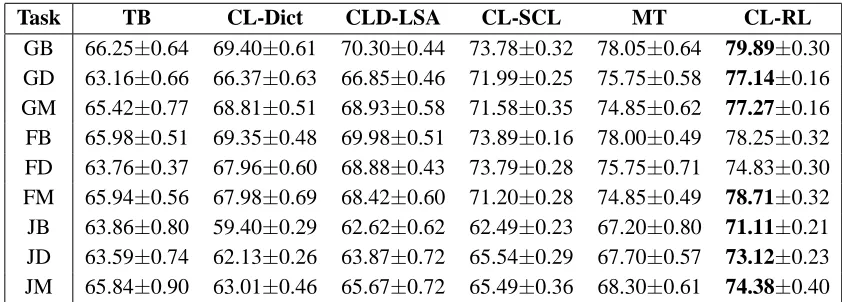
Table 1: Average classification accuracies and standard deviations for the 9 cross-lingual sentiment classification tasks. The bold format indicates that the difference between the results of CL-RL and MT is significant withp <0.05under a McNemar paired test for labeling disagreements.
Task TB CL-Dict CLD-LSA CL-SCL MT CL-RL
GB 66.25±0.64 69.40±0.61 70.30±0.44 73.78±0.32 78.05±0.64 79.89±0.30 GD 63.16±0.66 66.37±0.63 66.85±0.46 71.99±0.25 75.75±0.58 77.14±0.16 GM 65.42±0.77 68.81±0.51 68.93±0.58 71.58±0.35 74.85±0.62 77.27±0.16 FB 65.98±0.51 69.35±0.48 69.98±0.51 73.89±0.16 78.00±0.49 78.25±0.32 FD 63.76±0.37 67.96±0.60 68.88±0.43 73.79±0.28 75.75±0.71 74.83±0.30 FM 65.94±0.56 67.98±0.69 68.42±0.60 71.20±0.28 74.85±0.49 78.71±0.32 JB 63.86±0.80 59.40±0.29 62.62±0.62 62.49±0.23 67.20±0.80 71.11±0.21 JD 63.59±0.74 62.13±0.26 63.87±0.72 65.54±0.29 67.70±0.57 73.12±0.23 JM 65.84±0.90 63.01±0.46 65.67±0.72 65.49±0.36 68.30±0.61 74.38±0.40
• TB: This is a target baseline method, which
trains a supervised monolingual classifier on the labeled training data from the target lan-guage domain without representation learning.
• CL-Dict: This is a simple baseline
compar-ison method, which uses the bilingual word pairs directly to align features from different language domains into a unified feature dictio-nary and then trains a supervised classifier on this aligned feature space with labeled training data from both language domains.
• CLD-LSA: This is the cross-lingual
represen-tation learning method developed in (Gliozzo, 2006), which first translates each document from one language into the other language via a bilingual dictionary to produce augmenting features, and then performs latent semantic analysis (LSA) over the augmented bilingual document-term matrix.
• CL-SCL: This is the cross language structural
correspondence learning method developed in (Prettenhofer and Stein, 2010).
• MT: This is a machine translation based
com-parison method, which first uses an existing machine translation tool (google translation) to translate the target language documents into the source language and then trains a monolingual classifier with labeled training data from both domains in the source language.
In all experiments, we used a linear support vec-tor machine (SVM) for sentiment classification. For implementation, we used the liblinear package (Fan et al., 2008) with all of its default parameters. For the CL-SCL method, we used the same parame-ter setting as suggested in the paper (Prettenhofer and Stein, 2010): the number of pivot features is set as 450, the threshold value for selecting pivot features is 30, and the reduced dimensionality af-ter singular value decomposition is 100. For the
CLD-LSA method, we set the dimensionality of
la-tent representation as 1000. Similarly, for our pro-posed approach, we built the cross-lingual
vocabu-lary M by setting m = 450 and φ = 30. For
our representation learning, we set α = 1, β =
γ = η = 1e−4
, and set ks, kc, kt to be 25, 50,
25, respectively. The values of α, β, γ and η are selected using the first cross language classifica-tion task GB. We selected the α value from the set{0.01,0.1,1,10,100}and selectedβ, γ, ηvalues from the set{1e−5,1e−4,1e−3,1e−2,1e−5}by re-peating the experiment three times with random data partitions and choosing the parameter values that led to the best average classification accuracy.
4.3 Classification Accuracy
100 200 300 400 500 65 70 75 80 GB
#Labeled target instances
Accuracy TB CL−Dict CLD−LSA CL−SCL MT CL−RL
100 200 300 400 500
60 65 70 75
GD
#Labeled target instances
Accuracy TB CL−Dict CLD−LSA CL−SCL MT CL−RL
100 200 300 400 500
65 70 75
GM
#Labeled target instances
Accuracy TB CL−Dict CLD−LSA CL−SCL MT CL−RL
100 200 300 400 500
65 70 75 80
FB
#Labeled target instances
Accuracy TB CL−Dict CLD−LSA CL−SCL MT CL−RL
100 200 300 400 500
60 65 70 75 80 FD
#Labeled target instances
Accuracy TB CL−Dict CLD−LSA CL−SCL MT CL−RL
100 200 300 400 500
65 70 75 80
FM
#Labeled target instances
Accuracy TB CL−Dict CLD−LSA CL−SCL MT CL−RL
100 200 300 400 500
55 60 65 70 75 JB
#Labeled target instances
Accuracy TB CL−Dict CLD−LSA CL−SCL MT CL−RL
100 200 300 400 500
60 65 70 75
JD
#Labeled target instances
Accuracy TB CL−Dict CLD−LSA CL−SCL MT CL−RL
100 200 300 400 500
60 65 70 75
JM
#Labeled target instances
[image:7.612.89.525.55.481.2]Accuracy TB CL−Dict CLD−LSA CL−SCL MT CL−RL
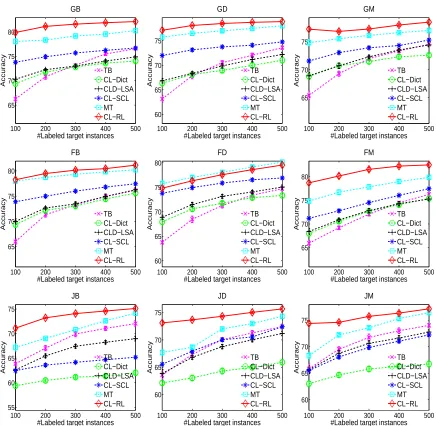
Figure 1: Average classification accuracies and standard deviations for 10 runs with respect to different numbers of labeled training documents in the target language domain.
For target language domain, we used the test set as test data while randomly selecting 100 documents from the training set as labeled data and treating the rest as unlabeled data. Thus, for each task, we have 2000 labeled documents and 2000 unlabeled docu-ments from the source language domain, and 100 labeled and 1900 unlabeled documents from the tar-get language domain for training. We have 2000 test documents from the target language domain as test-ing data. In each experiment, a classifier is produced by each approach with the training data and tested on the testing data. We repeated each experiment
10 times with different random selections of 100 la-beled training documents from the target language domain. The average classification accuracies and standard deviations are reported in Table 1.
lan-100 200 300 400 65
70 75 80
German
#Dimension
Accuracy
Books DVD Music
100 200 300 400
65 70 75 80
French
#Dimension
Accuracy
Books DVD Music
100 200 300 400
60 65 70 75 80
Japanese
#Dimension
Accuracy
[image:8.612.92.525.60.194.2]Books DVD Music
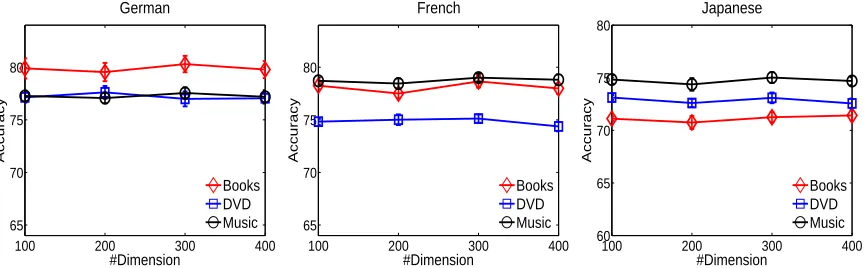
Figure 2: Average classification accuracy and standard deviation results for the proposed approach over 10 runs with respect to different dimensionality for the induced cross-lingual representations.
guage domain. By exploiting the large amount of labeled training data from the source language do-main, even the simple cross-lingual adaptation ap-proach, CL-Dict, produces effective improvements over TB. However, its performance is not consis-tent across the nine tasks. It has inferior perfor-mance than TB on the three tasks of adapting En-glish to the Japanese language domain. This sug-gests the simple bilingual word-pair based feature space unification method is far from ideal for pro-viding effective cross-lingual representations, espe-cially when two languages (English, Japanese) are very different. With a better designed representa-tion learning, CLD-LSA outperforms CL-Dict on all the nine tasks, but the improvements are very small on some tasks (e.g., GM). CL-SCL not only out-performs CL-Dict on all tasks, but also out-performs much better than CLD-LSA on most tasks. Its per-formance nevertheless is inferior to the method of
MT. Though MT can greatly increase the test
accu-racies comparing to the other four methods, TB,
CL-Dict, CLD-LSA, and CL-SCL, the benefit is obtained
at the cost of whole document translations. In con-trast, our proposed approach does not require whole document translations, but relies on the same sim-ple word-pair translations used in CL-Dict. It how-ever consistently and significantly outperforms TB,
CL-Dict, CLD-LSA, and CL-SCL on all tasks, and
outperforms MT on eight out of the nine tasks.
We also conduct significance tests for our pro-posed approach and MT using a McNemar paired test for labeling disagreements (Gillick and Cox, 1989). The results in bold format indicate that they
are significant with p < 0.05. All these results demonstrate the efficacy of our cross-lingual repre-sentation learning method.
4.4 Classification Accuracy vs the Number of Labeled Target Documents
Next, we investigated the performance of the six ap-proaches by varying the number of labeled train-ing documents from the target language domain. We maintained the same experimental setting as be-fore, but investigated a range of different values, ℓt={100,200,300,400,500}, as the number of
la-beled training documents from the target language domain. In each experiment, for a given value ℓt,
we randomly selectedℓt documents from the
train-ing set of the target language domain as labeled data and used the rest as unlabeled data. We still per-formed prediction on the same 2000 test documents in the target language domain. We repeated each experiment 10 times based on different random se-lections of the labeled training data from the target language domain. The average classification accura-cies and standard deviations across differentℓt
val-ues for all comparison methods on all the nine tasks are plotted in Figure 1.
We can see when the number of labeled target documents is small, TB performs poorly, especially for the first six tasks (GB, GD, GM, FB, FD, FM). By increasing the size of labeled target training data,
TB can greatly increase its prediction accuracies and
TB when the labeled training data in the target
lan-guage domain is very limited and is poor than TB when the labeled target data reaches 300 for the six tasks using German and French as target languages. Moreover, when adapting a system from English to a much more different target language (Japanese),
CL-Dict produces much lower accuracies for all the
three tasks comparing with TB. These results show that CL-Dict has very limited capacity on transfer-ring labeled information from a related source lan-guage domain. Similar performance is observed for
CLD-LSA. With a more sophisticated representation
learning, the CL-SCL method consistently outforms CL-Dict. However, it produces inferior per-formance than CLD-LSA on the tasks of JB and JM. By using more translation resources, the MT method outperforms TB, CL-Dict, CLD-LSA, CL-SCL in all the nine tasks across almost all scenarios. Our pro-posed method CL-RL significantly outperforms all the other five comparison methods across all experi-ments except on the task of FD, where MT produces similar performance. Moreover, it is especially im-portant to notice that CL-RL achieves high test ac-curacies even when the number of labeled target in-stances is small. This is important for transferring knowledge from a source language to reduce the la-beling effort in the target language.
4.5 Sensitivity Analysis
We also investigated the sensitivity of the proposed approach over the dimensionality of the induced cross-lingual representations. We used the same ex-perimental setting as before, and conducted experi-ments with a set of different dimensionality values, k = {100,200,300,400}. For each value k, we set ks = 0.25k, kc = 0.5k, kt = 0.25k. We
re-peated each experiment for 10 times based on dif-ferent random selections of labeled target training data and plotted the average prediction accuracies and standard deviations in Figure 2 for all the nine cross-lingual sentiment classification tasks. We can see the proposed approach produces stable accuracy results across the range of differentk values. This suggests the proposed approach is not very sensitive to the dimensionality of the cross-lingual embedding features within the considered range of values, and with a small dimensionality of 100, the induced rep-resentation can already perform very well.
4.6 Cross-Lingual Word Representations
Finally, we used the first task GB, which adapts the
Books reviews from English to German, to gain
in-tuitive understandings over the learned cross-lingual word representations. Given an English word as seed word, we find its five closest neighboring En-glish words and German words according to the Eu-clidean distances calculated in the induced cross-lingual representation space. We present a few sults in Table 2. From Table 2, we can see that the re-trieved words in both language domains are seman-tically close to the seed words, which indicates that our proposed method can capture semantic similar-ities of words not only in a monolingual setting but also in a multilingual setting.
5 Conclusion
In this paper, we proposed a semi-supervised cross-lingual representation learning approach to address cross-lingual text classification. The distributed word representation induced by the proposed ap-proach can capture semantic similarities of words across languages while maintaining predictive infor-mation with respect to the target classification tasks. To evaluate the proposed approach, we conducted experiments on nine cross language sentiment clas-sification tasks constructed from the Amazon prod-uct reviews in four languages, comparing to a num-ber of comparison methods. The empirical results showed that the proposed approach can produce effective cross-lingual adaptation performance and significantly outperform other comparison methods.
References
M. Amini, N. Usunier, and C. Goutte. Learning from multiple partially observed views - an application to multilingual text categorization. In Advances in
Neural Information Processing Systems (NIPS),
2009.
B. A.R., A. Joshi, and P. Bhattacharyya. Cross-lingual sentiment analysis for indian languages using linked wordnets. In Proceedings of the
International Conference on Computational Lin-guistics (COLING), 2012.
Table 2: Examples of source seed words together with five closest English words and five closest German words estimated using the Euclidean distance in the cross-lingual representation space on the task GB.
books absolutely love
English German English German English German
books buch absolutely absolut love liebe
book b¨ucher definitely absolute loved lieben
text text completely definitiv like wie
page blatt certainly komplett fond wieder
words w¨orter totally sicher feel f¨uhlen
expensive good not
English German English German English German
expensive teuer good gut not nicht
expense h¨oher better besser no nie
overpriced h¨ochsten well nett cannot nein
costly hoch nice großartig non keine
price preis great gr¨oßten never keines
text categorization. In Proceedings of European
Conference on Digital Libraries (ECDL), 2003.
Y. Bengio, R. Ducharme, and P. Vincent. A neu-ral probabilistic language model. In Advances in
Neural Information Processing Systems (NIPS),
2000.
D. Blei, A. Ng, and M. Jordan. Latent dirichlet al-location. Journal of Machine Learning Research
(JMLR), 3:993–1022, 2003.
J. Blitzer, M. Dredze, and F. Pereira. Biographies, bollywood, boomboxes and blenders: Domain adaptation for sentiment classification. In
Pro-ceedings of the Annual Meeting of the Asso. for Computational Linguistics (ACL), 2007.
K. Diamantaras and S. Kung. Principal component
neural networks: theory and applications.
Wiley-Interscience, 1996.
L. Duan, D. Xu, and I. Tsang. Learning with aug-mented features for heterogeneous domain adap-tation. In Proceedings of the International
Con-ference on Machine Learning (ICML), 2012.
R. Fan, K. Chang, C. Hsieh, X. Wang, and C. Lin. LIBLINEAR: A library for large linear classifi-cation. Journal of Machine Learning Research
(JMLR), 9:1871–1874, 2008.
C. Fellbaum, editor. WordNet: an electronic lexical
database. MIT Press, 1998.
L. Gillick and S. Cox. Some statistical issues in the comparison of speech recognition algo-rithms. In Proceedings of the International
Con-ference on Acoustics, Speech, and Signal Process-ing (ICASSP), 1989.
A. Gliozzo. Exploiting comparable corpora and bilingual dictionaries for cross-language text cat-egorization. In Proceedings of the International
Conference on Computational Linguistics and the Annual Meeting of the Association for Computa-tional Linguistics (ICCL-ACL), 2006.
Y. Guo and M. Xiao. Transductive representation learning for cross-lingual text classification. In
Proceedings of the IEEE International Confer-ence on Data Mining (ICDM), 2012a.
Y. Guo and M. Xiao. Cross language text clas-sification via subspace co-regularized multi-view learning. In Proceedings of the International
Con-ference on Machine Learning (ICML), 2012b.
T. Hofmann. Probabilistic latent semantic analysis. In Proceedings of Uncertainty in Artificial
Intelli-gence (UAI), 1999.
In Proceedings of the International Conference on
Computational Linguistics (COLING), 2012.
X. Ling, G. Xue, W. Dai, Y. Jiang, Q. Yang, and Y. Yu. Can chinese web pages be classified with english data source? In Proceedings of the
Inter-national Conference on World Wide Web (WWW),
2008.
M. Littman, S. Dumais, and T. Landauer. Automatic
Cross-Language Information Retrieval using La-tent Semantic Indexing, chapter 5, pages 51–62.
Kluwer Academic Publishers, 1998.
A. Maas, R. Daly, P. Pham, D. Huang, A. Ng, and C. Potts. Learning word vectors for sentiment analysis. In Proceedings of the Annual Meeting
of the Association for Computational Linguistics: Human Language Technologies (ACL), 2011.
D. Mimno, H. Wallach, J. Naradowsky, D. Smith, and A. McCallum. Polylingual topic models. In
Proceedings of the 2009 Conference on Empirical Methods in Natural Language Processing: Vol-ume 2 - VolVol-ume 2, 2009.
A. Mnih and G. Hinton. Three new graphical mod-els for statistical language modelling. In
Proceed-ings of the International Conference on Machine Learning (ICML), 2007.
X. Ni, J. Sun, J. Hu, and Z. Chen. Cross lingual text classification by mining multilingual topics from wikipedia. In Proceedings of the ACM
In-ternational Conference on Web Search and Data Mining (WSDM), 2011.
J. Pan, G. Xue, Y. Yu, and Y. Wang. Cross-lingual sentiment classification via bi-view non-negative matrix tri-factorization. In Proceedings of the
Pacific-Asia conference on Advances in knowl-edge discovery and data mining (PAKDD), 2011.
P. Petrenz and B. Webber. Label propagation for fine-grained cross-lingual genre classification. In
Proceedings of the NIPS xLiTe workshop, 2012.
S. Petrov, D. Das, and R. McDonald. A universal part-of-speech tagset. In Proceedings of the
Inter-national Conference on Language Resources and Evaluation (LREC), 2012.
J. Platt, K. Toutanova, and W. Yih. Translingual doc-ument representations from discriminative projec-tions. In Proceedings of the Conference on
Em-pirical Methods in Natural Language Processing (EMNLP), 2010.
P. Prettenhofer and B. Stein. Cross-language text classification using structural correspondence learning. In Proceedings of the Annual Meeting
of the Association for Computational Linguistics (ACL), 2010.
L. Rigutini and M. Maggini. An em based train-ing algorithm for cross-language text categoriza-tion. In Proceedings of the Web Intelligence
Con-ference, 2005.
J. Shanahan, G. Grefenstette, Y. Qu, and D. Evans. Mining multilingual opinions through classifica-tion and translaclassifica-tion. In Proceedings of AAAI
Spring Symposium on Exploring Attitude and Af-fect in Text, 2004.
W. Smet, J. Tang, and M. Moens. Knowledge trans-fer across multilingual corpora via latent topics. In Proceedings of the Pacific-Asia conference on
Advances in knowledge discovery and data min-ing (PAKDD), 2011.
A. Vinokourov, J. Shawe-taylor, and N. Cristian-ini. Inferring a semantic representation of text via cross-language correlation analysis. In
Ad-vances in Neural Information Processing Systems (NIPS), 2002.
C. Wan, R. Pan, and J. Li. Bi-weighting domain adaptation for cross-language text classification. In Proceedings of the International Joint
Confer-ence on Artificial IntelligConfer-ence (IJCAI), 2011.
X. Wan. Co-training for cross-lingual sentiment classification. In Proceedings of the Annual
Meet-ing of the Association for Computational LMeet-inguis- Linguis-tics (ACL), 2009.
B. Wei and C. Pal. Cross lingual adaptation: An experiment on sentiment classifications. In