Proceedings of the 2019 Conference on Empirical Methods in Natural Language Processing 1436
Korean Morphological Analysis with
Tied Sequence-to-Sequence Multi-Task Model
Hyun-Je Song
Dept. of Information Technology Chonbuk National University
Jeonju, 54896, Korea
Seong-Bae Park
Dept. of Computer Science and Engineering Kyung Hee University
Yongin, 17104, Korea
Abstract
Korean morphological analysis has been con-sidered as a sequence of morpheme pro-cessing and POS tagging. Thus, a pipeline model of the tasks has been adopted widely by previous studies. However, the model has a problem that it cannot utilize interactions among the tasks. This paper formulates Ko-rean morphological analysis as a combination of the tasks and presents a tied sequence-to-sequence multi-task model for training the two tasks simultaneously without any explicit reg-ularization. The experiments prove the pro-posed model achieves the state-of-the-art per-formance.
1 Introduction
Korean is an agglutinative language (Song,2006). Thus, it is a fundamental step for understanding a sentence to analyze the grammatical structure of
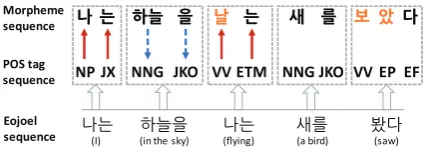
eojeols, where an eojeol is a linguistic unit seg-mented by a white space. An eojeol is composed of one or more morphemes. As a result, one eojeol can be analyzed into several morpheme combina-tions depending on a context, which yields dif-ferent part-of-speech (POS) tags of the morpheme combinations. In addition, some morphemes have a different surface form from their base form when they are derived from an eojeol. Therefore, the goal of Korean morphological analyzer is not only to decompose and recover morphemes from eoje-ols precisely (morpheme processing), but also to assign POS tags to the decomposed and/or recov-ered morphemes accurately according to a context (POS tagging).
Traditional approaches to Korean morphologi-cal analysis have adopted a pipeline model of mor-pheme processing and POS tagging (Lee and Rim,
2009;Na,2015;Choi et al.,2016;Matteson et al.,
2018; Song and Park, 2018). That is, they first
աח
ա ח ೞט ਸ
NNG JKO
NP JX VV ETM
զ ח ࢜ ܳ ࠁ ও
NNG JKO VV EP EF
Eojoel sequence POS tag sequence Morpheme sequence
(I) (in the sky) (flying) (a bird) (saw)
[image:1.595.310.522.224.300.2]ೞטਸ աח ࢜ܳ ࠌ
Figure 1: Korean morphological analysis of a sentence “나는 하늘을 나는 새를 봤다” of which meaning is “I saw a bird flying in the sky”. Correct morpheme analysis helps predicting POS tags (blue dotted arrows) while POS tagging affects morpheme analysis (red ar-rows). Orange morphemes in the morpheme sequence are recovered morphemes. Best viewed in color.
decompose and recover morphemes from eoje-ols or assign so-called POSMORPH tags (Heigold et al.,2016), and then an actual POS tag sequence is determined or resolved from the POSMORPH tags using a sequential labeling algorithm. How-ever, this pipeline model suffers from two kinds of weaknesses. One weakness is that the errors from morpheme processing are apt to be propagated to POS tagging, and the other is that it is difficult to model mutual interactions between morpheme processing and POS tagging under the pipeline model.
be analyzed in two ways. However, if morpheme processing obtains some information from POS tagging, it can decompose ambiguous eojeols cor-rectly. That is, the first ‘나는’ is decomposed into ‘나(I)’ and ‘는(topical postposition)’, while the sec-ond ‘나는’ is into ‘날(fly)’ and ‘는(verbal ending)’. Therefore, morpheme processing and POS tagging should be trained simultaneously.
This paper proposes a model to train morpheme processing and POS tagging simultaneously in Korean morphological analysis. The proposed model regards morpheme processing and POS tagging as individual tasks. Then, the two tasks are jointly trained under a sequence-to-sequence multi-task framework (Luong et al.,2016; Anas-tasopoulos and Chiang, 2018). The main charac-teristic of the proposed model is that there is a single decoder for both generating a morpheme sequence and assigning POS tags to the gener-ated morphemes. As a result, the decoder shares general representations of both tasks and forces a one-to-one mapping between morphemes and POS tags without additional regularization. Mor-pheme processing is accomplished by a pointer-generator network (See et al., 2017), while POS tagging is done by a CRF network (Huang et al.,
2015;Lample et al., 2016) utilizing the informa-tion from morpheme processing. Our experimen-tal results show that the proposed model outper-forms existing Korean morphological analyzers with its state-of-the-art performance.
2 Korean Morphological Analysis
2.1 Morpheme Processing and POS Tagging
Given an input sequencex = (w1, ..., wn)where wi is thei-th eojeol, Korean morphological anal-ysis aims to produce an output sequence y = (hm1, t1i, ...,hmk, tki)wheremj is thej-th mor-pheme andtj is its POS tag. Korean morphologi-cal analysis is different from existing NLP tasks such as English POS tagging (Toutanova et al.,
2003; Manning, 2011), and joint word segmen-tation and POS tagging for Chinese (Zhang and Clark,2008;Shao et al.,2017;Chen et al.,2017). In English POS tagging, a word and its tag have a one-to-one mapping so that the length of an input sequence is equal to that of an output sequence. On the other hand, they are usually different in Korean, because an eojeol consists of several mor-phemes. That is,n < kin general. The key distin-guishing factor between Chinese and Korean
mor-phological analysis is that lemmatization that re-covers a base form for every morpheme as well as morpheme segmentation is a must in Korean mor-phological analysis, while Chinese mormor-phological analysis requires only word segmentation. That is, in Korean,Ln
i=1wi 6=
Lk
i=1miin general, where
L
is a concatenate operator. According to Figure
1, the eojeol sequence ‘나는하늘을나는새를봤
다’ is different from its morpheme sequence ‘나는 하늘을날는새를보았다’ where underline marks
indicate the difference.1
Given an annotated corpus D = (hxi,yii)Ni=1 whereN is the number of sentences, Korean mor-phological analyzer is obtained by maximizing the conditional probability p(y|x). The conditional probability can be calculated as
p(y|x)≈p(t|m,x)
| {z }
POS tagging
p(m|x),
| {z } Morpheme processing
(1)
where m = (m1, . . . , mk) is a morpheme se-quence, and t = (t1, . . . , tk) is a tag sequence. Equation (1) implies thatp(y|x)can be further de-composed into two another conditional probabili-ties. One conditional probability, p(m|x), gener-ates a morpheme sequence mfrom the input se-quence x, and the other p(t|m,x) assigns POS tags considering the morpheme sequence m and the input sequence x. Therefore, p(m|x) corre-sponds to morpheme processing, whilep(t|m,x) is POS tagging.
2.2 Linguistic Unit in Morphological Analysis
Eojeol is the unit of spacing in Korean sentences. However, it is inappropriate to use eojeols di-rectly in sequence-to-sequence models, because the number of eojeols is extremely huge due to the agglutinative characteristics of Korean. For in-stance, there exist 624,655 kinds of eojeols in the corpus used in the experiments. This large eojeol size causes a complexity problem in morphologi-cal analysis.
According to Korean orthography, an eojeol is a sequence ofsyllables. For instance, an eojeol ‘하 늘을’ is a sequence of three syllables ‘하’, ‘늘’, and ‘을’. A morpheme in Korean is also a se-quence of syllables like an eojeol. The number of distinguished syllables in the corpus above is just
1We skip morpheme segmentation symbols in the
s:(s
1,...,slen(x)) s’:(s’1,...,s’L)
t:(t’
1,...,t’L)
c
z t
Encoder Pointer-generator
network
A en!on
CRF network
Decoder c
t
z s’
[image:3.595.72.288.61.245.2]h
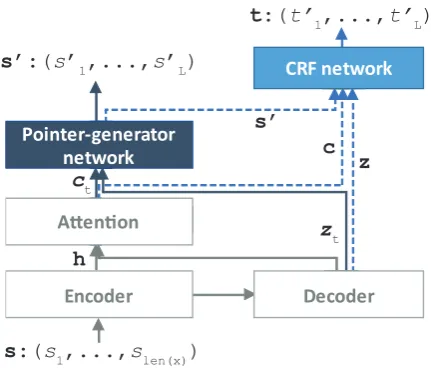
Figure 2: The proposed model for Korean morpho-logical analysis based on a Tied sequence-to-sequence multi-task model. Since syllable is adopted as a unit for the proposed model, the input for the encoder is a syllable sequences. For clarity’s sake, there are some dependencies not shown.
5,245 which is much smaller than that of eojeols. Therefore, this paper adopts syllable as a unit for sequence-to-sequence models for Korean morpho-logical analysis.
3 Tied Sequence-to-Sequence Multi-Task Model
The proposed model is based on the sequence-to-sequence model with attention (Bahdanau et al.,
2015) and extends the model for multi-task learn-ing similarly to the work of Anastasopoulos and Chiang (2018). The proposed model con-sists of four parts: a recurrent encoder, a recur-rent decoder, attention, and task-dependent net-works. Figure 2 shows an overall structure of the proposed model. The encoder encodes an in-put sequencex into a sequence of hidden states. Since syllable is adopted as the unit for the model, the encoder (bidirectional LSTM) actu-ally transforms an input syllable sequence s = (s1, . . . , slen(x)) into a sequence of encoder hid-den states h1, . . . ,hlen(x), where len(·) is the number of syllables including white spaces. The attention transforms the encoder hidden states h
into a sequence of context vectorscthrough atten-tion weights. The context vectors capture relevant source-side information for both morpheme pro-cessing and POS tagging.
Unlike other multi-task models, there is only one decoder for the two tasks of morpheme
pro-cessing and POS tagging in the proposed model. Note that a morpheme and its POS tag should have a one-to-one mapping relation. Since the two tasks are forced to share the same decoder states, a one-to-one mapping between a morpheme and its POS tag is guaranteed without any explicit regulariza-tion or task-specific token. In detail, the decoder (unidirectional LSTM) first computes a sequence of decoder hidden states z. At every time t, the decoder hidden stateztis calculated from the em-bedding of the previous syllables0t−1, the decoder state zt−1, and the context vector ct. Then, two task-dependent networks solve their own task us-ing the samez.
In morpheme processing represented by solid arrows in Figure 2, a syllable s0t is produced at every time t. Most syllables are directly copied from the input syllables while some syllables are newly generated from a vocabulary to recover the base form of a morpheme. To do this, we adopt the pointer-generator network (See et al., 2017) which allows both copying syllables via pointing and generating syllables from a fixed vocabulary. The advantage of this approach is that we can han-dle non-Korean characters such ashanja(Chinese character) and special symbols with ease.
In POS tagging represented by dotted arrows in Figure 2, it is possible to generate a POS tag at every time t by paying attention to the encoder syllable states as done in morpheme processing. However, this approach does not reflect the global dependency among adjacent tags. To solve this problem, this paper adopts a CRF network (Huang et al.,2015;Lample et al.,2016) over the pointer-generator network. When the morpheme sequence generated at the morpheme processing is given, the CRF network predicts POS tags for the mor-pheme sequence by considering the global depen-dency among tags (Lafferty et al.,2001). Further-more, this paper uses skip-connections (He et al.,
Methods
F1-score Acc (%)
Model Morpheme processing POS tagging Type
Single-Task Pointer-Generator 97.36 95.57
Multi-Task
Generator Generator Non-cascade 97.10 95.09
Generator CRF Cascade 97.25 95.30
Generator CRF Tied 97.31 95.49
Pointer-Generator Generator Non-cascade 97.30 95.45
Pointer-Generator CRF Cascade 97.40 95.61
Pointer-Generator CRF Tied 97.43 95.68
Pipeline
Na(2015) (CRF→CRF→Post-processing) 97.21 95.22
Song and Park(2018) (Generator→CRF) 97.27 95.29
[image:4.595.76.520.60.230.2]khaiii (CNN→Post-processing) 94.88 91.86
Table 1: Performances of Korean morphological analyzers
Information Training Development Test Sentences 197,508 5,000 50,631
Eojeols 2,674,571 97,292 694,524 Morphemes 5,952,985 203,244 1,542,483 Avg. eojeols 13.54 19.46 13.72
[image:4.595.74.291.277.347.2]No. of POS tags 42
Table 2: Simple statistics on the data set used.
Note that syllable is the unit for the model and one POS tag spans several syllables of a mor-pheme. Thus, to identify morpheme boundaries, morpheme processing of the proposed model gen-erates a special symbol of morpheme ending for every explicit morpheme boundary instead of adopting the IOB tagging scheme. Such an ap-proach reduces the number of POS tags and is helpful in segmenting eojeols into morphemes precisely.
The proposed model is trained to maximize the weighted sum of conditional log-likelihood of each task where the weights are set to be equal.
4 Experiments
4.1 Experimental Settings
The same data set with the work ofNa (2015) is used for the experiments. This data set is derived from Sejong corpus.2 Each eojeol in the Sejong corpus is annotated with pairs of a morpheme and its POS tag. The simple statistics on the data set used in the experiments is given in Table2.
We set the syllable embedding size and the hid-den size to 100. The number of LSTM layers is set to three and the batch size is 128. We use the
2Available athttps://ithub.korean.go.kr
gradient normalization with a threshold of five. Three baselines are adopted to show the su-periority of the proposed model. The first base-line is the model of Na(2015). This model con-sists of three sub-models (CRF segmentation, CRF tagging, and post-processing) and executes these three models in consecutive order. The second is the model ofSong and Park(2018) which consists of two sub-models (generator and CRF tagger). The last is khaiii, a publicly-available CNN based morphological analyzer.3 This analyzer assigns a POSMORPH tag for every syllable using a CNN classifier and then resolves the tag through post-processing. These baselines are all pipeline mod-els. We also compare the proposed model with a single task non-pipeline model which generates a single sequence of morphemes and POS tags using the pointer-generator network.
The F1-measure at the morpheme level and the accuracy at the eojeol level are used as evaluation metrics, and all performances are micro-averaged.
4.2 Experimental Results
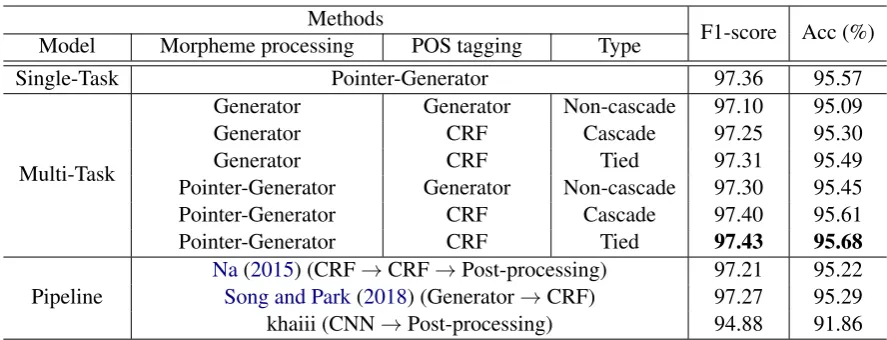
Table 1 shows the performances of the proposed model and the baselines. It also contains the results of the ablation study on the proposed model by changing the network of sub-tasks or the structure of multi-task models. ‘Non-cascade’ is similar to the standard multi-task model (Dong et al.,2015) in which each task just shares a decoder and there is no direct connection between tasks. According to Figure2, there are no dotted arrows (markeds0
andc) from the Pointer-generator network and the CRF network in ‘Non-cascade’ model. ‘Cascade’
Type Percentage Morpheme segmentation 5.8%
POS tagging 39.3%
[image:5.595.90.274.62.121.2]Morpheme recovery 54.9%
Table 3: The ratio of different error types.
is a multi-task model where the POS tagging net-work has a connection from the morpheme pro-cessing network but no skip connection from the decoder. In Figure2, ‘Cascade’ model has no dot-ted arrow (markedz) from the decoder to the CRF network. ‘Tied’ is the proposed model that consid-ers both connections.
According to the table, all multi-task mod-els that adopt Pointer-Generator and/or CRF out-perform the baseline Generator-Generator, which proves their adoption is effective in improving the performance of morphological analysis. It is also noticed from the table that ‘Cascade’ multi-task model achieves better performance than ‘Non-cascade’ model, which implies that the unimpeded information from morpheme processing to POS tagging helps predict accurate POS tags. The pro-posed ‘Tied’ multi-task model yields higher per-formances than ‘Cascade’ model. When training the ‘Tied’ multi-task model, the feedbacks from POS tagging network influence decoder states di-rectly. As a result, the ‘Tied’ model is able to learn better representation for both morpheme process-ing and POS taggprocess-ing. All these results indicate that ‘Tied’ multi-task model with Pointer-Generator network and CRF is the best choice for Korean morphological analysis.
Compared to the pipeline models which showed the state-of-the-art performance previously, even simple multi-task models report a similar perfor-mance, which means that morphological analysis can be improved by training morpheme processing and POS tagging jointly. Even if the single-task non-pipeline model achieves a reasonable perfor-mance, its performance is not as high as that of the proposed model. This is because the single-task model does not consider the global tag depen-dency explicitly. To sum up, Korean morphologi-cal analysis should be solved by training the two tasks jointly with appropriate networks.
4.3 Error Analysis
Even if the proposed method achieves over 97.4% F1-score at the morpheme level, we believe that
there still exists some room to improve the per-formance of Korean morphological analysis. To do this, we analyzed the errors by the proposed method.
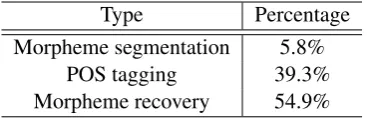
Table3shows error types and their percentages. Morpheme segmentation is when all results are correct except some morphemes that are decom-posed wrongly. This type happens mostly in Ko-rean compound nouns where KoKo-rean compound nouns can be written as one or more eojeols. If a compound noun represented as one eojeol is given, the proposed method sometimes decomposes the compound noun into a series of nouns. 5.8% er-rors belong to this type. POS tagging error type is when morphemes are correctly recovered and seg-mented but their POS tags are predicted wrongly. Its percentage is 39.3%. In this type, 37% errors occur between noun and proper noun. The remain-ing but majority errors are related to morpheme recovery. That is, these errors occur when the pro-posed method fails in recovering morphemes from eojeols accurately. Its percentage is 54.9%. There-fore, it is inferred from the error analysis that de-veloping a more accurate morpheme processing model is required to improve the performance of the proposed Korean morphological analyzer.
5 Conclusion
This paper has formulated Korean morphologi-cal analysis as a combination of morpheme pro-cessing and POS tagging. Thus, the two tasks are trained simultaneously through the tied sequence-to-sequence multi-task model with the pointer-generator network and the CRF network. Ac-cording to the experiment results, the jointly trained morphological analyzer achieves higher performances than the legacy analyzers which are pipeline models of morpheme processing and POS tagging.4
Acknowledgments
We would like to thank the anonymous review-ers for their helpful comments on our work. This work was supported by Institute of Information & Communications Technology Planning & Evalua-tion (IITP) grant funded by the Korea government (MSIT) (No. 2017-0-01772).
4Our code is available at https://github.com/
References
Antonios Anastasopoulos and David Chiang. 2018. Tied multitask learning for neural speech translation. InProceedings of the 2018 Conference of the North American Chapter of the Association for Computa-tional Linguistics: Human Language Technologies, pages 82–91.
Dzmitry Bahdanau, Kyunghyun Cho, and Yoshua Ben-gio. 2015. Neural machine translation by jointly learning to align and translate. In Proceedings of the 3rd International Conference on Learning Rep-resentations.
Xinchi Chen, Xipeng Qiu, and Xuanjing Huang. 2017. A feature-enriched neural model for joint Chinese word segmentation and part-of-speech tagging. In Proceedings of the 26th International Joint Confer-ence on Artificial IntelligConfer-ence, pages 3960–3966.
Jihun Choi, Jonghem Youn, and Sang-goo Lee. 2016. A grapheme-level approach for constructing a Korean morphological analyzer without linguistic knowledge. In2016 IEEE International Conference on Big Data (Big Data), pages 3872–3879.
Daxiang Dong, Hua Wu, Wei He, Dianhai Yu, and Haifeng Wang. 2015. Multi-task learning for mul-tiple language translation. In Proceedings of the 53rd Annual Meeting of the Association for Compu-tational Linguistics and the 7th International Joint Conference on Natural Language Processing, pages 1723–1732.
Kaiming He, Xiangyu Zhang, Shaoqing Ren, and Jian Sun. 2016. Deep residual learning for image recog-nition. In Proceedings of the IEEE Conference on Computer Vision and Pattern Recognition, pages 770–778.
Georg Heigold, Guenter Neumann, and Josef van Genabith. 2016. Neural morphological tagging from characters for morphologically rich languages. CoRR, abs/1606.06640.
Zhiheng Huang, Wei Xu, and Kai Yu. 2015. Bidi-rectional LSTM-CRF models for sequence tagging. arXiv preprint arXiv:1508.01991.
John D. Lafferty, Andrew McCallum, and Fernando C. N. Pereira. 2001. Conditional random fields: Probabilistic models for segmenting and labeling se-quence data. In Proceedings of the 18th Interna-tional Conference on Machine Learning, pages 282– 289.
Guillaume Lample, Miguel Ballesteros, Sandeep Sub-ramanian, Kazuya Kawakami, and Chris Dyer. 2016. Neural architectures for named entity recognition. InProceedings of the 2016 Conference of the North American Chapter of the Association for Computa-tional Linguistics: Human Language Technologies, pages 260–270.
Do-Gil Lee and Hae-Chang Rim. 2009. Probabilistic modeling of Korean morphology. IEEE Transac-tions on Audio, Speech, and Language Processing, 17(5):945–955.
Minh-Thang Luong, Quoc V. Le, Ilya Sutskever, Oriol Vinyals, and Lukasz Kaiser. 2016. Multi-task se-quence to sese-quence learning. InProceedings of the 4th International Conference on Learning Represen-tations.
Christopher D. Manning. 2011. Part-of-speech tagging from 97% to 100%: Is it time for some linguistics? InProceedings of the 12th International Conference on Computational Linguistics and Intelligent Text Processing, pages 171–189.
Andrew Matteson, Chanhee Lee, Youngbum Kim, and Heuiseok Lim. 2018. Rich character-level informa-tion for Korean morphological analysis and part-of-speech tagging. In Proceedings of the 27th Inter-national Conference on Computational Linguistics, pages 2482–2492.
Seung-Hoon Na. 2015. Conditional random fields for Korean morpheme segmentation and POS tagging. ACM Transactions on Asian and Low-Resource Lan-guage Information Processing, 14(3):10:1–10:16.
Abigail See, Peter J. Liu, and Christopher D. Manning. 2017. Get to the point: Summarization with pointer-generator networks. InProceedings of the 55th An-nual Meeting of the AssociationS for Computational Linguistics, pages 1073–1083.
Yan Shao, Christian Hardmeier, J¨org Tiedemann, and Joakim Nivre. 2017. Character-based joint segmen-tation and POS tagging for Chinese using bidirec-tional RNN-CRF. InProceedings of the Eighth In-ternational Joint Conference on Natural Language Processing, pages 173–183.
Hyun-Je Song and Seong-Bae Park. 2018. Korean part-of-speech tagging based on morpheme generation. TR-0002-2018, Kyung Hee University, Technical re-port.
Jae Jung Song. 2006.The Korean language: Structure, use and context. Routledge.
Kristina Toutanova, Dan Klein, Christopher D. Man-ning, and Yoram Singer. 2003. Feature-rich part-of-speech tagging with a cyclic dependency network. InProceedings of the 2003 Conference of the North American Chapter of the Association for Compu-tational Linguistics: Human Language Technology, pages 173–180.