495
Evaluating Style Transfer for Text
Remi Mir1, Bjarke Felbo2, Nick Obradovich2, Iyad Rahwan2 1Department of EECS, Massachusetts Institute of Technology
2Media Lab, Massachusetts Institute of Technology
{rmir, bfelbo, nobradov, irahwan}@mit.edu
Abstract
Research in the area of style transfer for text is currently bottlenecked by a lack of stan-dard evaluation practices. This paper aims to alleviate this issue by experimentally iden-tifying best practices with a Yelp sentiment dataset. We specify three aspects of interest (style transfer intensity, content preservation, and naturalness) and show how to obtain more reliable measures of them from human eval-uation than in previous work. We propose a set of metrics for automated evaluation and demonstrate that they are more strongly corre-lated and in agreement with human judgment: direction-corrected Earth Mover’s Distance, Word Mover’s Distance on style-masked texts, and adversarial classification for the respective aspects. We also show that the three examined models exhibit tradeoffs between aspects of in-terest, demonstrating the importance of evalu-ating style transfer models at specific points of their tradeoff plots. We release software with our evaluation metrics to facilitate research.
1 Introduction
Style transfer in text is the task of changing an attribute (style) of an input, while retaining non-attribute related content (referred to simply as con-tentfor brevity in this paper).1 For instance, pre-vious work has modified text to make it more pos-itive (Shen et al.,2017), romantic (Li et al.,2018), or politically slanted (Prabhumoye et al.,2018).
Some style transfer models enable modifica-tions by manipulating latent representamodifica-tions of the text (Shen et al.,2017;Zhao et al.,2018;Fu et al., 2018), while others identify and replace style-related words directly (Li et al.,2018). Regardless of approach, they are hard to compare as there is
1
This definition of style transfer makes a simplifying as-sumption that “style” words can be distinguished from “con-tent” words, or words carrying relatively less or no stylistic weight, such as “caf`e” in “What a nice caf`e.” The definition is motivated by penalizing unnecessary changes to content words, e.g. “What a nice caf`e” to “This is an awful caf`e.”
currently neither a standard set of evaluation prac-tices, nor a clear definition of which exact aspects to evaluate. In Section2, we define three key as-pects to consider. In Section3, we summarize is-sues with previously used metrics. Many rely on human ratings, which can be expensive and time-consuming to obtain.
To address these issues, in Section 4, we con-sider how to obtain more reliable measures of human judgment for aspects of interest, and au-tomated methods more strongly correlated with human judgment than previously used methods. Lastly, in Section 5, we show that the three ex-amined models exhibit aspect tradeoffs, highlight-ing the importance of evaluathighlight-ing style transfer models at specific points of their tradeoff plots. We release software with our evaluation met-rics at https://github.com/passeul/ style-transfer-model-evaluation.
2 Aspects of Evaluation
We consider three aspects of interest on which to evaluate output textx0 of a style transfer model, potentially with respect to input textx:
1. style transfer intensityST I(SC(x), SC(x0))
quantifies the difference in style, where SC(·)maps an input to a style distribution
2. content preservation CP(x, x0) quantifies the similarity in content between the input and the output
3. naturalnessN T(x0)quantifies the degree to which the output appears as if it could have been written by humans
Style Transfer Content Preservation Naturalness HRC(x0) HRD(x0) SC(x0) HRC(x,x0) HRR(x,{x0}) BLEU(x,x0) HRC(x0) PPL(x0)
CAAE x x x xF
ARAE x x x x x xF
[image:2.595.72.527.61.128.2]DAR x x x x xG
Table 1: Summary of past evaluation techniques. HRC is human rating on a continuous scale (e.g. 1 to 5). HRD is on discrete options (e.g. positive/negative). HRR is human ranking (most to least similar) of outputs, with respect to given inputx.{x0}is the set ofx0from models trained on different parameters. SC is a style classifier. PPL is perplexity. Superscripts denote that evaluation is done for fluency (F) or grammar (G), which we consider subsets of naturalness. Readers can see the original papers for details on methods falling under these techniques.
If it preserves content well, but sequentially re-peats words such as “the”, the output is unnatu-ral. Conversely, a model that overemphasizes text reconstruction would yield high content preserva-tion and possibly high naturalness, but little to no style transfer. All three aspects are thus critical to analyze in a system of style transfer evaluation.
3 Related Work
We review previously used approaches for eval-uating the outputs of style transfer models. Due to the high costs related to obtaining human eval-uations, we focus on three models: the cross-aligned autoencoder (CAAE), adversarially reg-ularized autoencoder (ARAE), and delete-and-retrieve (DAR) models (Shen et al., 2017; Zhao et al., 2018; Li et al., 2018). Table 1 illustrates the spread of evaluation practices in these papers using our notation from Section 2, showing that they all rely on a different combination of human and automated evaluation. For human evaluation, the papers use different instruction sets and scales, making it difficult to compare scores. Below we describe the automated metrics used for each as-pect. Some rely on training external models on the corpus of input texts,X, and/or the corpus of output texts, X0. We encourage readers seeking details on how to compute the metrics to reference the algorithms in the original papers.
Style Transfer Previous work has trained clas-sifiers on X and corresponding style labels, and measured the number of outputs classified as hav-ing a target style (Shen et al., 2017;Zhao et al., 2018; Li et al., 2018). Results from this target style scoring approach may not be directly com-parable across papers due to different classifiers used in evaluations.
Content Preservation To evaluate content preservation betweenxandx0, previous work has
used BLEU (Zhao et al., 2018; Li et al., 2018), an n-gram based metric originally designed to evaluate machine translation models (Papineni et al., 2002). BLEU does not take into account the aim of style transfer models, which is to alter style by necessarily changing words. Intended differences betweenxandx0 are thus penalized.
Naturalness Past evaluations of naturalness have relied largely on human ratings on a vari-ety of scales under different names: grammatical-ity, fluency/readabilgrammatical-ity, and naturalness itself (Ta-ble 1). An issue with measuring grammaticality is that text with proper syntax can still be seman-tically nonsensical, e.g. “Colorless green ideas sleep furiously” (Chomsky, 1957). Furthermore, input texts may not demonstrate perfect grammat-icality or readability, despite being written by hu-mans and thus being natural by definition (Sec-tion2). This undermines the effectiveness of mea-sures for such specific qualities of output texts.
Zhao et al. (2018) used perplexity to evaluate fluency, which, like grammaticality, we consider a subset of naturalness itself. Low perplexity signi-fies less uncertainty over which words can be used to continue a sequence, quantifying the ability of a language model to predict gold or reference texts (Brown et al.,1992;Young et al.,2006). However, style transfer outputs are not necessarily gold stan-dard, and the correlation between perplexity and human judgments of those outputs is unknown in the style transfer setting.
4 Methods
Negative Sentiment Positive Sentiment ruined mouthwatering
worst delightfully failure wonderfully lackluster marvelous
[image:3.595.99.265.62.124.2]horrible refreshing
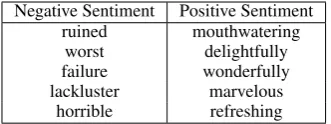
Table 2: Sample of words in a sentiment style lexicon.
4.1 Construction of Style Lexicon
Because the process of style transfer may result in the substitution or removal of more stylisti-cally weighted words, it is ideal to have a lexicon of style-related words to reference. Words in x and/orx0that also appear in the lexicon can be ig-nored in evaluations of content preservation.
While building a new style lexicon or an exten-sion of existing ones like WordNet-Affect ( Strap-parava and Valitutti, 2004) may be feasible with binary sentiment as the style, it may not be scal-able to manually do so for various other types of styles. Static lexica also might not take context into account. This is an issue for text with words or phrases that are ambiguous in terms of stylistic weight, e.g. “dog” in “That is a man with a dog” vs. “That man is a dog.”
It is more appropriate to automate the construc-tion of a style lexicon per dataset of interest. While multiple options may exist for doing so, we em-phasize the simplicity and replicability of train-ing a logistic regression classifier on X and cor-responding style labels. We populate the lexicon with features having the highest absolute weights, as those have the most impact on the outcome of the style labels. (Table2shows sample words in the lexicon constructed for the dataset used in our experiments.) While sentiment datasets have been widely used in the literature (Shen et al., 2017; Zhao et al., 2018; Li et al.,2018), a lexicon can be constructed for other datasets in the same man-ner, as long as the dataset has style labels.
Given existing NLP techniques, it may not be possible to correctly identify all style-related words in a text. Consequently, there is a tradeoff between identifying more style-related words and incorrectly marking some other (content) words as style-related. We opt for higher precision and lower recall to minimize the risk of removing con-tent words, which are essential to evaluations of content preservation. This issue is not critical be-cause researchers can compare their style transfer methods using our lexicon.
4.2 Human Evaluation
As seen in Table1, past evaluations of both style transfer and naturalness consider only output text x0. Existing work from other fields have, how-ever, shown that asking human raters to evaluate two relative comparisons provides more accurate scores than asking them to provide a numerical score for a single observation (Stewart et al.,2005; Bijmolt and Wedel, 1995). With this knowledge, we construct more reliable ways of obtaining hu-man evaluations viarelative scoringinstead of ab-solute scoring.
Style Transfer Intensity Past evaluations have raters mark the degree to whichx0 exhibits a tar-get style (Li et al., 2018). We instead ask raters to score the difference in style betweenxandx0, on a scale of 1 (identical styles) to 5 (completely different styles). This approach can also used for non-binary cases. Consider text modeled as a dis-tribution over multiple emotions (e.g. happy, sad, scared, etc.), where each emotion can be thought of as a style. One task could be to make a scared text more happy. Presented withx andx0, raters would still rate the degree to which they differ in style.
Content Preservation We consider the diffi-culty of asking raters to ignore style-related words as done in (Shen et al., 2017). Because not all raters may identify the same words as stylistic, their evaluations may vary substantially from one another. To account for this, we ask raters to eval-uate content preservation on the same texts, but where we have masked style words using our style lexicon. Under this new “masking” approach, raters have a simpler task, as they are no longer re-sponsible for taking style into account when they rate the similarity of two texts on a scale of 1 to 5.
Naturalness We ask raters to determine whether x or x0 (they are not told which is which) is more natural. Anx0 marked as more natural indi-cates some success on the part of the style transfer model, as it is able to fool the rater. This is in con-trast to previous work, where raters score the natu-ralness ofx0 on a continuous scale without taking xinto account at all, even though xserves as the basis for comparison of what is considered natural.
4.3 Automated Evaluation
No modification
Input: the girls up frontincompetent. Output: the girls up front areamazing. Style removal
Input: the girls up front . Output: the girls up front are . Style masking
[image:4.595.91.270.59.153.2]Input: the girls up fronthcustomstylei. Output: the girls up front arehcustomstylei.
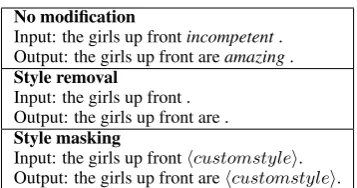
Table 3: Text under different settings of style-based modification, as used in evaluations of content preser-vation. The sample output is from ARAE (λ= 1).
Style Transfer Intensity Rather than count how many output texts achieve a target style, we can capture more nuanced differences between the style distributions ofxandx0, using Earth Mover’s Distance (Rubner et al., 1998;Pele and Werman, 2009). EM D(SC(x), SC(x0))is the minimum “cost” to turn one distribution into the other, or how “intense” the transfer is. Distributions can have any number of values (styles), so EMD han-dles binary and non-binary datasets.
Note that even if argmax(SC(x0))is not the target style class,EM Dstill acknowledges move-ment towards the target style with respect to SC(x). However, we penalize (negate) the score ifSC(x0)displays a relative change of style in the wrong direction, away from the target style.
Depending on x, not a lot of rewriting may be necessary to achieve a different style. This is not an issue, asST Irelies on a style classifier to quan-tify not the difference between the content ofxand x0, but their style distributions. For the style classi-fier, we experiment with textcnn (Kim,2014;Lee, 2018) and fastText (Joulin et al.,2017).
Content Preservation We first subject texts to different settings of modification: style removal and style masking. This is to address undesired pe-nalization of metrics on texts expected to demon-strate changes after style transfer (Section3). For style removal, we remove style words fromxand x0 using the style lexicon. For masking, we re-place those words with a hcustomstylei place-holder. Table3exemplifies these modifications.
For measuring the degree of content preserva-tion, in addition to the widely used BLEU, we consider METEOR and embedding-based metrics. METEOR is an n-gram based metric like BLEU, but handles sentence-level scoring more robustly, allowing it to be both a sentence-level and corpus-level metric (Banerjee and Lavie,2005).
For the embedding-based metrics, word em-beddings can be obtained with methods like Word2Vec (Mikolov et al., 2013) or GloVe ( Pen-nington et al.,2014). Sentence-level embeddings can be comprised of the most extreme values of word embeddings per dimension (vector extrema) (Forgues et al., 2014), or word embedding aver-ages (Sharma et al., 2017). Word Mover’s Dis-tance (WMD), based on EM D, calculates the minimum “distance” between word embeddings of x and of x0, where smaller distances signify higher similarity (Kusner et al., 2015). Greedy matching greedily matches words in x and x0 based on their embeddings, calculates their simi-larity (e.g. cosine simisimi-larity), and averages all the similarities. It repeats the process in the reverse di-rection and takes the average of those two scores (Rus and Lintean,2012).
We evaluate with all these metrics to identify the one most strongly correlated with human judg-ment of content preservation.
Naturalness For a baseline understanding of what is considered “natural,” any method used for automated evaluation of naturalness requires the human-sourced input texts. We train unigram and neural logistic regression classifiers (Bowman et al., 2016) on samples of X and X0 for each transfer model. Via adversarial evaluation, these classifiers must distinguish human-generated in-puts from machine-generated outin-puts. The more natural an output is, the likelier it is to fool a clas-sifier (Jurafsky and Martin, 2018). We calculate agreement between each type of human evaluation (Section4.2) and each classifierAC. Agreement is the ratio of instances where humans andACrate a text as more natural than the other.
We also train LSTM language models ( Hochre-iter and Schmidhuber, 1997) on X and compute sentence-level perplexities for each text in X0 in order to determine the relative effectiveness of ad-versarial classification as a metric.
5 Experiments and Results
Due to high costs of human evaluation, we focus on CAAE, ARAE, and DAR models with transfer tasks based on samples from the Yelp binary senti-ment dataset (Shen et al.,2017).2 Below we detail
2Like most literature, including the papers on CAAE,
Input wouldn’t recommenduntil management works on friendliness and communication with residents . ARAE (λ= 1) highlyrecommendthis place while living in tempe and management .
CAAE (ρ= 0.5) would highlyrecommendmanagement on duty and staff on business .
[image:5.595.337.497.157.223.2]DAR (γ= 500) until management works on friendliness and is agreatplace for communication with residents .
Table 4: Sample outputs of a negative to positive sentiment style transfer task. Italicized words are style-related, according to a style lexicon. They can be masked or removed in evaluations of content preservation (Section4.3).
the range of parameters each model is trained on in order to compare evaluation practices and generate aspect tradeoff plots. Each of three Amazon Turk raters evaluated 244 texts per aspect, per model. Of those texts, half are originally of positive senti-ment transferred to negative, and vice versa.
For brevity, we reference average scores (cor-relation, kappa, and agreement, each of which is described below) from across all models in our analysis of results. For detailed scores per model, please refer to the corresponding tables.
5.1 Style Transfer Models
For each style transfer model, we choose a wide range of training parameters to allow for variation of content preservation, and indirectly, of style transfer intensity, inX. We show sample outputs from the models for a given input text in Table4.
CAAE uses autoencoders (Vincent et al.,2008) that are cross-aligned, assuming that texts already share a latent content distribution (Shen et al., 2017). It uses latent states of the RNN and mul-tiple discriminators to align distributions of texts in X0 exhibiting one style with distributions of texts inXexhibiting another. Adversarial compo-nents help separate style information from the la-tent space where inputs are represented. We train CAAE on various values (0.01, 0.1, 0.5, 1, 5) ofρ, a weight on the adversarial loss.
CAAE is a baseline for other style transfer mod-els, such as ARAE, which trains a separate de-coder per style class (Zhao et al.,2018). We train ARAE on various values (1, 5, 10) ofλ, which is also a weight on adversarial loss.
The third model that we evaluate, which also uses CAAE as a baseline, avoids adversarial meth-ods in an approach called Delete-and-Retrieve (DAR) (Li et al.,2018). It identifies and removes style words from texts, searches for related words pertaining to a new target style, and combines the de-stylized text with the search results using a neu-ral model. We train DAR onγ = 15, whereγ is a threshold parameter for the maximum number of style words that can be removed from texts, with
Model Text Modification Setting Unmasked Style Masked
CAAE 0.158 0.289
ARAE 0.201 0.321
DAR 0.161 0.281
[image:5.595.338.494.267.334.2]Average 0.173 0.297
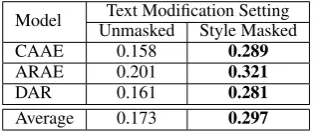
Table 5: Fleiss’ kappas for human judgments of content preservation of unmasked and style-masked texts.
Model Absolute Relative τ= 3 τ = 2
CAAE 0.193 0.321 0.579 ARAE 0.215 0.415 0.741 DAR 0.103 0.201 0.259 Average 0.170 0.312 0.526
Table 6: Fleiss’ kappas for human judgments of abso-lute naturalness and relative naturalness of texts.
respect to the size of the corpus vocabulary. For this single training value, we experiment with a range ofγvalues (0.1, 1, 15, 500) during test time because, by design, the model does not need to be retrained (Li et al.,2018).
5.2 Human Evaluation
We use Fleiss’ kappa κ of inter-rater reliability (see formula inL. Fleiss and Cohen,1973) to iden-tify the more effective human scoring task for dif-ferent aspects of interest. The kappa metric is of-ten levied in a relative fashion, as there are no uni-versally accepted thresholds for agreements that are slight, fair, moderate, etc. For comprehen-sive experimentation, we compare kappas over the outputs of each style transfer model. The kappa score for ratings of content preservation based on style-masked texts is0.297. Given the kappa score of 0.173 for unmasked texts, style masking is a more reliable approach towards human evaluation for content preservation (Table5).
Model fastText textcnn
Target Style Scores Earth Mover’s Distance Target Style Scores Earth Mover’s Distance CAAE 0.566±0.038 0.573±0.038 0.587±0.037 0.589±0.037
ARAE 0.513±0.053 0.516±0.053 0.515±0.053 0.519±0.053
DAR 0.470±0.049 0.539±0.045 0.508±0.047 0.566±0.043
Average 0.516±0.047 0.543±0.045 0.537±0.046 0.558±0.044
Table 7: Correlations of automated style transfer intensity metrics with human scores.
Model BLEU METEOR Embed Average Greedy Match Vector Extrema WMD CAAE 0.458±0.044 0.498±0.042 0.370±0.048 0.489±0.043 0.496±0.042 0.496±0.042 ARAE 0.337±0.064 0.387±0.062 0.313±0.065 0.419±0.060 0.423±0.060 0.445±0.058
DAR 0.440±0.051 0.455±0.050 0.379±0.054 0.472±0.049 0.472±0.049 0.484±0.048
[image:6.595.73.522.61.138.2]Average 0.412±0.053 0.447±0.051 0.354±0.056 0.460±0.051 0.464±0.050 0.475±0.049
Table 8: Absolute correlations of content preservation metrics with human scores on texts with style removal.
Model BLEU METEOR Embed Average Greedy Match Vector Extrema WMD CAAE 0.488±0.043 0.517±0.041 0.356±0.049 0.490±0.043 0.496±0.042 0.517±0.041
ARAE 0.356±0.063 0.374±0.062 0.302±0.066 0.405±0.061 0.422±0.060 0.457±0.057
DAR 0.444±0.050 0.454±0.050 0.370±0.054 0.450±0.050 0.473±0.049 0.475±0.049
[image:6.595.71.526.171.236.2]Average 0.429±0.052 0.448±0.051 0.343±0.056 0.448±0.051 0.464±0.050 0.483±0.049
Table 9: Absolute correlations of content preservation metrics with human scores on texts with style masking.
different numbers of categories (2 vs 5), we can compare them by using a threshold τ to bin the absolute score for each text into a “natural” group (x0is considered to be more natural thanx) or “un-natural” one (vice versa), like in relative scoring. For example, τ = 2 places texts with absolute scores greater than or equal to 2 into the natural group. Judgments for relative tasks yield greater inter-rater reliability than those of absolute tasks across multiple thresholds (τ ∈ {2,3}). This sug-gests that the relative scoring paradigm is prefer-able in human evaluations of naturalness.
5.3 Automated Evaluation
Per aspect of interest, we compute Pearson cor-relations between scores from the existing metric and human judgments. (As there were three raters for any given scoring task, we take the average of their scores.) We do the same for our proposed metrics to identify which metric is more reliable for automated evaluation of a given aspect.
For style transfer intensity, across both the fastText and textcnn classifiers, our proposed direction-corrected Earth Mover’s Distance metric has higher correlation with human scores than the past approach of target style scoring (Table7).
For content preservation, METEOR, shown to have higher correlation with human judgments
Model Unigram Adv. Clf. Neural Adv. Clf. Absolute Relative Absolute Relative CAAE 56.07 64.51 57.38 67.87
ARAE 49.45 66.67 50.68 67.90
DAR 65.16 65.57 61.07 62.30
Average 56.89 65.58 56.38 66.02
Table 10: Percent agreement between adversarial clas-sifiers and human scores on the naturalness of texts.
than BLEU for machine translation (Banerjee and Lavie,2005), shows the same relationship for style transfer. However, across various text modifica-tion settings, WMD generally shows the strongest correlation with human scores (Tables 8 and 9). Because WMD is lower when texts are more sim-ilar, it is anti-correlated with human scores. We take absolute correlations to facilitate comparison with other content preservation metrics. With re-spect to text modification, style masking may be more suitable as it, on average for WMD, exhibits a higher correlation with human judgments.
[image:6.595.73.525.268.335.2]0 1 1
0 1
1
0 1
1
[image:7.595.196.404.64.140.2](a) (b) (c)
Figure 1: Extreme tradeoff plots, with style transfer intensity on the x-axis and content preservation on the y-axis.
(a) Content vs. Style Tradeoffs (b) Naturalness vs. Style Tradeoffs
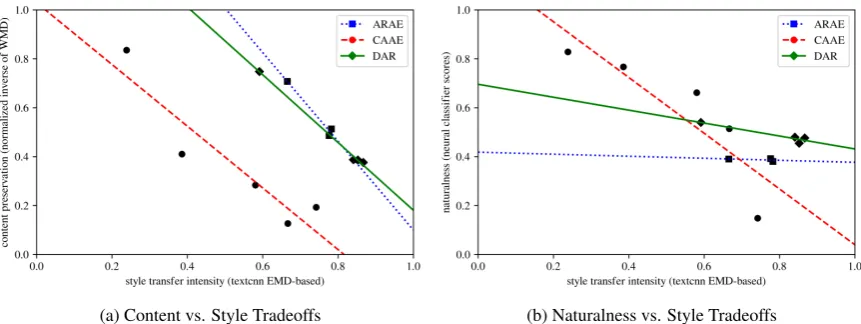
Figure 2: Tradeoffs between aspects of evaluation, using metrics most strongly correlated with human scores.
not an appropriate metric. It exhibits no significant correlation with human scores (α = 0.05). These results suggest that adversarial classifiers can be useful for automating measurement of naturalness.
5.4 Aspect Tradeoffs
Previous work has compared models with respect to a single aspect of interest at a time, but has only, to a limited degree, considered how relationships between multiple aspects influence these compar-isons. In particular, concurrent work by (Li et al., 2018) examines tradeoff plots, but focuses primar-ily on variants of its own model, while including only a single point on the plots of style transfer models from other papers. For a comprehensive comparison, it is ideal to have plots for all models. It is helpful to first understand the tradeoff space. For example, we define extreme cases for style transfer intensity and content preserva-tion, where we assume measurement of the lat-ter ignores stylistic content. Consider two classes of suboptimal models. One class produces out-puts with a wide range of style transfer intensity, but poor content preservation (Figure 1a). The other class of models produces outputs with low style transfer intensity, but a wide range of content preservation (Figure1b).
This is in contrast to a model that yields a wide
range of style transfer intensity and consistently high content preservation (Figure 1c). If we take that to be an ideal model for a sentiment dataset, we can interpret models with better performance to be the ones whose tradeoff plots are closer to that of the ideal model and farther from those of the suboptimal ones. The plot for an ideal model will likely vary by dataset, especially because the tradeoff between content preservation and style transfer intensity depends on the level of distinc-tion between style words and content words of the dataset.
With this interpretation of the tradeoff space, we construct a plot for each style transfer model (Figure2), where each point represents a different hyperparameter setting for training (Section5.1). We collect scores based on the automated metrics most strongly correlated with human judgment: direction-corrected EMD for style transfer inten-sity, WMD for content preservation, and percent of output texts marked by an adversarial classifier as more natural than input texts. Because WMD scores are lower when texts are more similar, we instead take the normalized inverses of the scores to represent the degree of content preservation.
[image:7.595.83.514.178.340.2]might conclude that ARAE and DAR perform sub-stantially differently, especially if hyperparame-ters are chosen such that ARAE achieves the left-most point on its plot and DAR achieves the right-most point on its plot. With the plots, at least for the set of hyperparameters considered, it is evident that they perform comparably (Figure2a) and do not exhibit the same level of decrease in natural-ness as CAAE (Figure2b).
6 Discussion
Previous work on style transfer models used a va-riety of evaluation methods (Table 1), making it difficult to meaningfully compare results across papers. Moreover, it is not clear from existing re-search how exactly to define particular aspects of interest, or which methods (whether human or au-tomated) are most suitable for evaluating and com-paring different style transfer models.
To address these issues, we specified key as-pects of interest (style transfer intensity, content preservation, and naturalness) and showed how to obtain more reliable measures of them from human evaluation than in previous work. Our proposed automated metrics (direction-corrected EMD, WMD on style-masked texts, and adversar-ial classification) exhibited stronger correlations with human scores than existing automated met-rics on a binary sentiment dataset. While human evaluation may still be useful in future research, automation facilitates evaluation when it is infea-sible to collect human scores due to prohibitive cost or limited time.
6.1 Human Evaluation
For style transfer intensity, the relative scoring task (rating the degree of stylistic difference be-tweenxandx0) did not have greater rater reliabil-ity than the previously used task of rating output texts on an absolute scale. This is likely due to task complexity or rater uncertainty, which moti-vates the need for further exploration of task de-sign for this particular aspect of interest.
For content preservation, our form of human evaluation operates on texts whose style words are masked out, unlike the previous approach (no masking). Our approach addresses the uninten-tional variable of rater-dependent style identifica-tion that could lead to noisy, less reliable ratings.
Identification and masking of words was made possible with a style lexicon. We automatically
constructed the lexicon in a way that can be done for any style dataset, as long as style labels are available (Section4.1). We acknowledge a trade-off between filling the lexicon with more style words and being conservative in order to avoid capturing content words. We justify taking a more conservative approach as content words are natu-rally critical to evaluations of content preservation. For naturalness, we introduced a paradigm of relative scoring that uses both the output and input texts. This achieved a higher inter-rater reliability than did absolute scoring, the previous approach.
6.2 Automated Evaluation
For style transfer intensity, we proposed using a metric with EMD as the basis to acknowledge the spectrum of styles that can appear in outputs and to handle both binary and non-binary datasets. The metric also accounts for direction by penalizing scores in the cases where the style distribution of the output text explicitly moves away from the tar-get style. Previous work used external classifiers, whose style distributions forxandx0can be used to calculate direction-corrected EMD, making it a simple addition to the evaluation workflow.
For content preservation, WMD (based on EMD) works in a similar fashion, but with word embeddings of x and ofx0. BLEU, used widely in previous work, may yield weaker correlations with human judgment in comparison as it was de-signed to have multiple reference texts per candi-date text (Papineni et al.,2002). Several reference texts, which are more common in machine trans-lation tasks, increase the chance ofn-gram (such asn≥3) overlap with the candidate. In the style transfer setting, however, the only reference text forx0isx. Having a single reference text reduces the likelihood of overlap and the overall effective-ness of BLEU.
which are, by definition, natural.
Finally, with aspect tradeoff plots constructed using scores from the automated metrics, we can directly compare models with respect to multi-ple aspects simultaneously. Points of intersection, or near intersection, for different models signify that they, at the hyperparameters that yielded those points, can achieve similar results for various as-pects. These parameters can be useful for un-derstanding the impact of decisions made during model design and optimization phases.
6.3 Future Research
As we confirmed, sentence-level perplexity of out-putx0is not meaningful by itself for the automated evaluation of naturalness. The idea of using bothx andx0, akin to how we train automated classifiers of naturalness (Section 4.3), can be extended to construct a perplexity-based metric that also takes into account the perplexity of inputx.
Another avenue for future work could be evalu-ating on datasets with a different style or number of style classes. It is worth studying the distinc-tion between style words and content words in the vocabulary of each such dataset. Given the defini-tion of style transfer and its simplifying assump-tion in Secassump-tion1, it would be reasonable to expect naturally low content preservation scores for any given style transfer model operating on datasets with less distinction, such as those of formality. This is not so much an issue as it is a dataset-specific trend that can be visualized in correspond-ing tradeoff plots, which would provide a holis-tic evaluation of model performance. In any case, results from inter-rater reliability and correlation testing on these additional datasets would over-all enable more consistent evaluation practices and further progress in style transfer research.
Acknowledgments
We would like to thank Juncen Li, Tianxiao Shen, and Junbo (Jake) Zhao for guidance in the use of their respective style transfer models. These mod-els serve as markers of major progress in the area of style transfer research, without which this work would not have been possible.
References
Satanjeev Banerjee and Alon Lavie. 2005. Meteor: An automatic metric for mt evaluation with im-proved correlation with human judgments. In
Pro-ceedings of the ACL Workshop on Intrinsic and Ex-trinsic Evaluation Measures for Machine
Transla-tion and/or SummarizaTransla-tion, pages 65–72.
Associa-tion for ComputaAssocia-tional Linguistics.
Tammo Bijmolt and Michel Wedel. 1995. The effects of alternative methods of collecting similarity data for multidimensional scaling.International Journal
of Research in Marketing, 12(4):363–371.
Samuel R. Bowman, Luke Vilnis, Oriol Vinyals, An-drew Dai, Rafal Jozefowicz, and Samy Bengio. 2016. Generating sentences from a continuous space. InProceedings of the 20th SIGNLL
Confer-ence on Computational Natural Language Learning,
pages 10–21. Association for Computational Lin-guistics.
Peter F. Brown, Vincent J. Della Pietra, Robert L. Mer-cer, Stephen A. Della Pietra, and Jennifer C. Lai. 1992.An estimate of an upper bound for the entropy of english.Computational Linguistics, 18(1).
Noam Chomsky. 1957. Syntactic Structures. Mouton and Co., The Hague.
Gabriel Forgues, Joelle Pineau, Jean-Marie Larchevˆeque, and R´eal Tremblay. 2014. Boot-strapping dialog systems with word embeddings.
Zhenxin Fu, Xiaoye Tan, Nanyun Peng, Dongyan Zhao, and Rui Yan. 2018. Style transfer in text: Exploration and evaluation. InThirty-Second AAAI
Conference on Artificial Intelligence.
Sepp Hochreiter and J¨urgen Schmidhuber. 1997. Long short-term memory. Neural computation, 9(8):1735–1780.
Armand Joulin, Edouard Grave, Piotr Bojanowski, and Tomas Mikolov. 2017. Bag of tricks for efficient text classification. InProceedings of the 15th Con-ference of the European Chapter of the Association for Computational Linguistics: Volume 2, Short Pa-pers, pages 427–431. Association for Computational Linguistics.
Dan Jurafsky and James H Martin. 2018. Speech and
Language Processing, volume 3.
Yoon Kim. 2014. Convolutional neural networks for sentence classification. In Proceedings of the 2014 Conference on Empirical Methods in Natural
Lan-guage Processing (EMNLP), pages 1746–1751.
As-sociation for Computational Linguistics.
Matt J. Kusner, Yu Sun, Nicholas I. Kolkin, and Kil-ian Q. Weinberger. 2015.From word embeddings to document distances. InProceedings of the 32nd In-ternational Conference on InIn-ternational Conference
on Machine Learning - Volume 37, pages 957–966.
Joseph L. Fleiss and Jacob Cohen. 1973. The equiv-alence of weighted kappa and the intraclass corre-lation coefficient as measures of reliability.
Edu-cational and Psychological Measurement, 33:613–
Dongjun Lee. 2018. text-cnn. https://github.
com/DongjunLee/text-cnn-tensorflow.
Juncen Li, Robin Jia, He He, and Percy Liang. 2018. Delete, retrieve, generate: a simple approach to sen-timent and style transfer. In Proceedings of the 2018 Conference of the North American Chapter of the Association for Computational Linguistics: Hu-man Language Technologies, Volume 1 (Long
Pa-pers), pages 1865–1874. Association for
Computa-tional Linguistics.
Tomas Mikolov, Ilya Sutskever, Kai Chen, Greg Cor-rado, and Jeffrey Dean. 2013. Distributed represen-tations of words and phrases and their composition-ality. InProceedings of the 26th International Conference on Neural Information Processing Systems
-Volume 2, NIPS’13, pages 3111–3119, USA.
Kishore Papineni, Salim Roukos, Todd Ward, and Wei-Jing Zhu. 2002. Bleu: A method for automatic eval-uation of machine translation. InProceedings of the 40th Annual Meeting on Association for
Computa-tional Linguistics, pages 311–318. Association for
Computational Linguistics.
Ofir Pele and Michael Werman. 2009. Fast and robust earth mover’s distances. pages 460–467. IEEE.
Jeffrey Pennington, Richard Socher, and Christopher Manning. 2014. Glove: Global vectors for word representation. In Proceedings of the 2014 Con-ference on Empirical Methods in Natural Language
Processing (EMNLP), pages 1532–1543.
Associa-tion for ComputaAssocia-tional Linguistics.
Shrimai Prabhumoye, Yulia Tsvetkov, Ruslan Salakhutdinov, and Alan W Black. 2018. Style transfer through back-translation. InProceedings of the 56th Annual Meeting of the Association for
Com-putational Linguistics (Volume 1: Long Papers),
pages 866–876. Association for Computational Linguistics.
Yossi Rubner, Carlo Tomasi, and Leonidas J. Guibas. 1998.A metric for distributions with applications to image databases. InSixth International Conference
on Computer Vision, pages 59–66. IEEE.
Vasile Rus and Mihai Lintean. 2012. A comparison of greedy and optimal assessment of natural language student input using word-to-word similarity metrics.
InProceedings of the Seventh Workshop on Building
Educational Applications Using NLP, pages 157–
162. Association for Computational Linguistics.
Shikhar Sharma, Layla El Asri, Hannes Schulz, and Jeremie Zumer. 2017. Relevance of unsupervised metrics in task-oriented dialogue for evaluating nat-ural language generation.CoRR, abs/1706.09799.
Tianxiao Shen, Tao Lei, Regina Barzilay, and Tommi Jaakkola. 2017. Style transfer from non-parallel text by cross-alignment. InAdvances in Neural
Informa-tion Processing Systems 30, pages 6830–6841.
Neil Stewart, Gordon DA Brown, and Nick Chater. 2005. Absolute identification by relative judgment.
Psychological review, 112(4):881–911.
Carlo Strapparava and Alessandro Valitutti. 2004. Wordnet affect: an affective extension of
word-net. In Proceedings of the Fourth International
Conference on Language Resources and Evaluation
(LREC’04). European Language Resources
Associ-ation (ELRA).
Pascal Vincent, Hugo Larochelle, Yoshua Bengio, and Pierre-Antoine Manzagol. 2008. Extracting and composing robust features with denoising autoen-coders. In Proceedings of the 25th International
Conference on Machine Learning, ICML ’08, pages
1096–1103. ACM.
Steve J. Young, D. Kershaw, J. Odell, D. Ollason, V. Valtchev, and P. Woodland. 2006. The HTK Book
Version 3.4. Cambridge University Press.
Junbo Zhao, Yoon Kim, Kelly Zhang, Alexander Rush, and Yann LeCun. 2018. Adversarially regular-ized autoencoders. In Proceedings of the 35th
In-ternational Conference on Machine Learning,
vol-ume 80 of Proceedings of Machine Learning