Are We Ready? A Case Study of
Technology-enhanced, Collaborative Language
Learning
YanJun Wang
Abstract -- Technology Enhanced Language Learning (TELL) refers to any technology used in the classroom, such as videos, audio recorders or even entire language labs. In collaborative learning, students work together as members of a learning community, engaged in activities such as working on a problem-solving task by questioning each other, and discussing and sharing information. What is the relationship between technology and collaboration, and how can technology best be integrated into collaborative language learning? This paper examines the notion of collaborative learning. A case study was conducted to examine how the use of technology-enhanced, collaborative language learning could enable students to work collaboratively in a university context. Participants, constituting a range of students in a variety of majors at the University of Tasmania, were invited to complete a questionnaire to present their views on this style of learning and how they perceive technology-enhanced language learning.
Key words: collaborative learning, technology-enhanced language learning
I. INTRODUCTION
The advent of innovative information and communication technologies has induced certain changes in the present educational system. These interactive technologies have affected the very nature of teaching and learning. From an educational perspective, the Internet has the potential to change radically the way that learners assimilate information. Students who learn via the Internet have to develop cognitive abilities which enable them to research, to identify, to analyze and to synthesize new information in order to construct their knowledge base. The interactive media of the Internet, such as e-mail and hypertext navigation, can give the learner the chance to participate actively in the learning process and to communicate easily with other learners. Therefore, the role of computers in language instruction has now become an important issue confronting large numbers of language teachers throughout the world.
Additionally, there has been a significant expansion in the distance education technologies with the potential to improve the quality of teaching and learning. Furthermore, the new computer-based technologies provide opportunities for enhancing the quality of teaching and learning. Language is associated closely with economic modernization and technological development. Technological advances may have an impact on language teaching.
Ms. Yanjun Wang is with the School of Asian Languages and Studies, University of Tasmania, Launceston, Locked Bag 1340, Tasmania, 7250, Australia (phone: +61 3 6324 3046; fax: +61 3 6324 3652; e-mail: [email protected]).
In a review of existing evidence of technology's impact on learning, Marshall (2002) found strong evidence that educational technology "complements what a great teacher does naturally," extending the teacher’s reach and broadening the students' experience beyond the classroom. "With ever-expanding content and technology choices, from video to multimedia to the Internet," Marshall suggests "there's an unprecedented need to understand the recipe for success, which involves the learner, the teacher, the content, and the environment in which technology is used." The teachers are expected to be competent in utilizing the technology for their own productivity and also to improve their students’ learning outcomes. In addition, computer hardware and software are developing fast and this requires teachers to adapt quickly to the changes. Ongoing and quality professional development is seen as necessary to help teachers cope with the pace and nature of current change [13], [2].
II. BACKGROUND
In the 1980s, the application of technology in language classrooms included the use of film, radio, television, language labs with audio and videotapes, computers, and interactive video [1]. Computer technology became more accessible to both individuals and schools. Today, the use of multimedia, the Internet (especially the World Wide Web), and various forms of distance learning are widespread. Interest in using computers as tools to support language learning is growing, both from the perspective of a language educator and that of a language learner.
A. Why technology?
Technology stimulates learning motivation through collaborative learning and it also improves learning efficiency by integrating classroom learning. Classroom research suggests that students do not get much speaking time during regular classroom interactions. Technology can provide a way to give speaking practice, and an improvement is suggested over the traditional use of audio recordings. Audio Portfolios is a web-based tool that collects and manages students' audio recordings in an online environment.
technology is used essentially to increase students’ basic skills and knowledge - and students can also learn "with" computers—where technology is used as a tool that can be applied to a variety of goals in the learning process and can serve as a resource to help develop critical thinking, creativity and research skills [8].
B. Why collaborative learning?
According to [3], the concept of collaborative learning, the grouping and pairing of students for the purpose of achieving an academic goal, has been researched widely and advocated throughout the professional literature. The term “collaborative learning” refers to an instruction method in which students at various performance levels work together in small groups toward a common goal. The students are responsible for one another's learning as well as their own. Thus, the success of one student helps other students to be successful.
Some supporters of collaborative learning [3], [5], [7] argue that it enhances both social and cognitive skills. For example, according to [5], there is strong evidence that cooperative teams achieve at higher levels of thought and retain information longer than students who work quietly as individuals. The shared learning gives students an opportunity to engage in discussion, take responsibility for their own learning, and thus become critical thinkers [11]. In collaborative learning classrooms where students are engaged in a thinking curriculum, each student is a member of the learning community, and no student is deprived of the opportunity for making contributions and appreciating the contributions of others. Of course, collaborative learning does not always work. There are many factors to take into consideration and it is important to examine those conditions under which collaborative learning is found to be either efficient or not [7], [9], [10].Collaborative learning appears to be crucial to the effectiveness of online learning environments.
It should be noted that collaborative learning is not confined to an educational institution. It can apply to different working environments. The advances in technology and changes in the organizational infrastructure put an increased emphasis on teamwork within the workforce. Workers need to be able to think creatively, solve problems, and make decisions as a team. Teamwork is a common feature of current institutions. Therefore, the development and enhancement of critical-thinking skills through collaborative learning is one of the primary goals of technology education.
III. A CASE STUDY
A case study was conducted to investigate students’ perspectives on the technology-enhanced, collaborative learning in language study.
A. Aim and Methodology
The aim of my study was to explore some technological aspects of language education, to consider these aspects in terms of language studies and to enable students to develop their individual abilities to improve this style of learning.
This ability helps students to learn another language effectively.
A questionnaire was the tool used in this study. It was designed to collect two broad types of information:
Background information from each respondent about their personal and demographic characteristics. Information relating to respondents’ knowledge and experiences of technology-enhanced, collaborative language learning.
B. Data Analysis and Results
Data gathering involved the distribution of 45 questionnaires. Demographic information was obtained from the questionnaire, which was completed by 45 respondents. The data collected from the questionnaire in this study were entered into the SPSS (Sphinx Survey or Ethnography) for analysis, focusing on any relationship between independent variables such as male/female, and dependent variables such as views and attitudes on technology-enhanced, collaborative language learning in a university context. The items in the questionnaire provided an opportunity to gather information on the various participants’ perceptions of technology-enhanced, collaborative language learning. The data provided information on two major aspects:
Participants’ demographic background
Attitudes and experience towards technology-enhanced, collaborative language learning
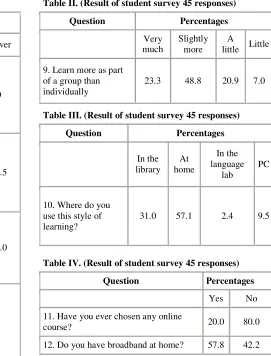
As mentioned above, a total of 45 students participated in this study. A fifteen-item questionnaire was developed to collect descriptive data about the participants. Results of the questionnaire revealed that the majority of all respondents were aged between 19-30 years (80%), and female students (60%) were 20% more than male (40%). All of them were doing undergraduate study, more than half were first year students (51.2%) and the second largest group was the second-year group (30.2%). The educational specialization of these students was mainly Arts (52.3%), and the second major area of study was “others”, such as commerce and education (25.0% of each). Also, 15.9% of the participants were undertaking the study for combined degrees, such as computing/arts, arts/law.
Table I. (Result of student survey 45 responses)
Question Percentages
Always FrequentlySometimes Rarely Never
1. Use technology and/or collaboration in your learning
24.4 37.8 31.1 6.7 0
2. Use language lab to improve your learning
2.3 9.3 20.9 14.0 53.5
3. Use online dictionaries to help with your learning
11.1 20.0 24.4 24.4 20.0
4. Use any other online tools (e.g. generic software or task-based web activities) to enhance your learning
6.7 26.7 22.2 26.7 17.8
5. Use audio-visual aid /materials
9.1 15.9 45.5 18.2 11.4
6. Encounter technical difficulties
2.3 6.8 29.5 52.3 9.1
7.Use WebCT
or email 18.2 34.1 20.5 15.9 11.4
8. Participate in a study group or group work
4.4 22.2 31.1 20.0 22.2
Table II. (Result of student survey 45 responses)
Question Percentages
Very
much Slightly more little Little A
9. Learn more as part of a group than
individually 23.3 48.8 20.9 7.0
Table III. (Result of student survey 45 responses)
Question Percentages
In the
library home At
In the language
lab PC
10. Where do you use this style of
learning? 31.0 57.1 2.4 9.5
Table IV. (Result of student survey 45 responses)
Question Percentages
Yes No
11. Have you ever chosen any online
course? 20.0 80.0
12. Do you have broadband at home? 57.8 42.2
*Notes: Questions are abbreviated from those actually given in the survey.
From the above, it is clearly seen that the technology-enhanced, collaborative learning method was generally well received by the students, with a clear majority seeing social, learning and skill development advantages. Some student groups were more positive than others. For example, female students tended to be more positive than males, especially in agreeing that the method enhanced communication skills, encouraged them and promoted understanding.
However, the collaborative learning did not always work in an efficient manner. Some students complained of technical difficulties which greatly hampered communication. These technical difficulties created a high level of frustration amongst the learners. Lack of computer literacy may place novice computer users at a disadvantage. These students had little or no knowledge of the word processing software, the Internet and its communication tools. Since communication was problematic, the collaborative process was not able to function at an optimal level.
IV. WHAT DO THE DATA TELL US?
[image:3.612.272.543.50.406.2] [image:3.612.67.299.70.735.2]mixed results. Respondents had divergent views on this matter. Students made common remarks about the effectiveness of the Video conferencing such as:
Remark 1
Video-link can prove to have difficulties with gaining a clear understanding of lessons.
Remark 2
Slight time lag makes it difficult for oral tasks; also lack of transmission of body language makes it hard to
communicate. Remark3
Video linkups make it hard to interact with other students, but the new technology is a big improvement.
Moreover, there were also some negative findings with regard to the use of technological approaches in the language learning process. For instance,
Remark 1
Online dictionaries and translations are not usually very reliable.
Remark 2
Malfunctions occur too often, much time accumulated by spending time trying to fix technological issues, maybe because of the complexity in operating the software, software should be made easier to operate.
Remark 3
Different computers run and display files in different ways. A program that runs correctly on a home computer may malfunction on a school computer.
Second, considering the experience of working in a group or with the help of technology, and the resultant academic and social benefits, the responses indicated that a clear majority of students saw social, learning and skill development benefits in this style of learning. This is because of the flexibility: learners can choose to make their own learning paths, choose when and where to learn, and even with whom they wish to learn no matter where they are in the world. As a result, the majority of them were in favor of working in a group or with the help of technology, primarily because they enjoyed the process of working with partners and sharing their learning experiences with their peers. The majority of these students revealed that they would have liked more contact with other students. Here are some of the remarks:
Remark 1
Bonding makes it more enjoyable and encourages participation and attendance.
Remark 2
Getting a real understanding of other people’s point of view and working with groups reflects the real workplace where working in groups is highly important.
Remark 3
Working in a group helps me remember rather than monologuing at home. Working together in class, I think, makes people more comfortable and therefore more confident.
Remark 4
Technology takes away embarrassment and groups instill confidence.
Remark 5
Working in a group makes it less likely to make mistakes, gain understanding of different points of view; whereas technology is more essential than beneficial to learning.
However, interestingly there was one participant holding a completely opposite opinion, “I don’t benefit from group work as we will end up with talking.” As [10] point out, the perspectives, experiences, and backgrounds of all students are important for enriching learning in the classroom. As learning beyond the classroom increasingly requires understanding diverse perspectives, it is essential to provide students with opportunities to do this in multiple contexts in schools. The fact is that not everyone makes an equal amount of contribution [9], [11], [12]. A critical characteristic of collaborative classrooms is that students are not segregated according to supposed ability, achievement, interests, or any other characteristic. Segregation seriously weakens collaboration and impoverishes the classroom by depriving all students of opportunities to learn from and with each other. Contribution to collaborative learning should be meaningful and purposeful.
Last, concerning any changes about their behavior or approach in future technology-enhanced, collaborative learning situations, and some students expected to engage in and have greater access to technology-enhanced, collaborative learning. One statement was that technology is helpful for multimedia (especially audio) and drill (character recognition) at higher levels of language study, whereas “blogs” and extended writing pieces can be helpful too. In the current context of teaching and learning in a tertiary discourse, a lecture in its traditional sense does not necessarily meet the demands of learners as a lecture can only function in a very limited context. However, the Internet provides an educational discourse in which learners can interact widely with other members of a learning community, and at the same time as learners are in control of their own learning. Their interaction for learning can be immediate, prompt, widely shared and resource-supported and this may not be possible in a traditional mode of teaching in which teachers and students are constrained heavily by the physical conditions of a classroom.
In summary, since the data pool was fairly limited, the results of this study pertain only to certain undergraduate courses at the University of Tasmania. Some further studies need to be done in this field to explore a very effective way to attract and take learners to new language learning environments.
V. CONCLUSION
old and obsolete. It should be noted that if we try to integrate technology into our teaching as presented in this article, staff development and teacher training will need to be continuous and ongoing. [4] reinforce this point in their claim that traditional staff development models of workshops and conference presentations will not meet the need for continuous ongoing technology. Current and future educators will need to be exposed and trained to use the new technologies available so that they can utilize the technology to deliver a more effective and valuable learning experience to meet the learners’ needs.
In a transmission model of learning, knowledge is given from teachers to learners and collaborative learning does not play an important role. Currently there has been a shift from teaching to learning, from transmitting to interacting. Teachers and learners are members of a learning community in which collaboration is one of the key learning experiences.
Future developments in networked communication, multimedia, and artificial intelligence will likely converge, creating a potentially more central role for the computer as a tool for authentic language exploration and use in the second language classroom. As our focus of attention gradually shifts from the computer itself to the natural integration of computers into the language learning process, we will know that we can make technology and the Internet a more rewarding partner in the language teaching and learning process.
REFERENCE
[1] C. J. Bonk and D. J. Cunningham, “Searching for learner-centered, constructivist and sociocultural components of collaborative educational learning tools,” in C. J. Bonk, and K. King, Ed.
Electronic collaborators: Learner-centered technologies for literacy, apprenticeship, and discourse. Mahwah, NJ: Lawrence Erlbaum Associates, 1998.
[2] D. C. Caverly and L. MacDonald, “Techtalk: Keeping up with technology,” Journal of Developmental Education, 28(2), 2004, pp.38-39.
[3] A. A. Gokhale, “Collaborative learning enhances critical thinking,”
Journal of Technology Education, 7, 1995, pp. 89-93. [4] C. E. Hopey and L. Ginsburg, “Distance learning and new
technologies: You can’t predict the future but you can plan for it,”
Adult Learning, 8(1), 1996, pp.22-23.
[5] R. T. Johnson and D. W. Johnson, “Action research: Cooperative learning in the science classroom,” Science and Children, 24, 1986, pp. 31-32.
[6] J. M. Marshall, Learning with technology: evidence that technology can, and does, support learning. San Diego, CA: Cable in the Classroom, 2002.
[7] W. Rau and B. S. Heyl, “Humanizing the college classroom: Collaborative learning and social organization among students,”
Teaching Sociology, 18, 1990, pp. 141-155.
[8] T. C. Reeves, “The impact of media and technology in schools.” A research report prepared for the Bertelsmann Foundation, 1998. [9] R. E. Slavin, “Research on cooperative learning: an international
perspective,” Scandinavian Journal of Educational Research, 33, 1989, pp. 231-243.
[10] M. B. Tinzmann, B.F. Jones, T.F. Fennimore, J. Bakker, C. Fine, and J. Pierce, What is the collaborative classroom? Oak Brook, NY, 1990.
[11] S. Totten, T. Sills, A. Digby, and P. Russ, Cooperative learning: a guide to research. Garland, New York, 1991.
[12] N. Webb, Student interaction and learning in small groups: a research summary. Learning to cooperate, cooperating to learn. Garland, New York, 1985.
[13] A. A. Zucker. (2001, May 5). The growing need for professional development. [Online]. Available: