Hierarchical Recurrent Neural Network for Document Modeling
Rui Lin†∗, Shujie Liu‡, Muyun Yang†, Mu Li‡, Ming Zhou‡, Sheng Li† †Harbin Institute of Technology
{linrui,ymy}@mtlab.hit.edu.cn [email protected] ‡Microsoft Research
{shujliu,muli,mingzhou}@microsoft.com
Abstract
This paper proposes a novel hierarchical recurrent neural network language model (HRNNLM) for document modeling. Af-ter establishing a RNN to capture the co-herence between sentences in a documen-t, HRNNLM integrates it as the sentence history information into the word level RNN to predict the word sequence with cross-sentence contextual information. A two-step training approach is designed, in which sentence-level and word-level lan-guage models are approximated for the convergence in a pipeline style. Examined by the standard sentence reordering sce-nario, HRNNLM is proved for its better accuracy in modeling the sentence coher-ence. And at the word level, experimen-tal results also indicate a significant low-er model plow-erplexity, followed by a practi-cal better translation result when applied to a Chinese-English document translation reranking task.
1 Introduction
Deep Neural Network (DNN), a neural network with multiple layers, has been proven powerful in many different domains, such as visual recogni-tion (Kavukcuoglu et al., 2010) and speech recog-nition (Dahl et al., 2012), ever since Hinton et al. (2006) formulated an efficient training method for it.
In addition to the applications mentioned above, many neural network based methods have also been applied to natural language processing (NLP) tasks with great success. For example, Collobert et al. (2011) propose a generalized DNN framework for a variety of fundamental NLP tasks, including part-of-speech tagging (postag), chunking, named
∗Contribution during internship at Microsoft Research.
entity recognition (NER), and semantic role label-ing.
DNN is successfully introduced to do word-level language modeling, aka., to predict the next word given the history words. Bengio et al. (2003) propose a feedforward neural network to train a word-level language model with a limited n-gram history. To leverage as much history as possible, Mikolov et al. (2010) apply recurrent neural net-work to word-level language modeling. The mod-el absorbs one word each time, keeps the informa-tion in a history vector, and predicts the next word with all the word history in the vector.
Word-level language model can only learn the relationship between words in one sentence. For sentences in one document which talks about one or several specific topics, the words in the next sentence are chosen partially in accordance with the previous sentences. To model this kind of co-herence of sentences, Le and Mikolov (2014) ex-tend word embedding learning network (Mikolov et al., 2013) to learn the paragraph embedding as a fixed-length vector representation for paragraph or sentence. Li and Hovy (2014) propose a neu-ral network coherence model which employs dis-tributed sentence representation and then predict the probability of whether a sequence of sentences is coherent or not.
In contrast to the methods mentioned above which learn the word relationship in or between the sentences separately, we propose a hierar-chical recurrent neural network language model (HRNNLM) to capture the word sequence across the sentence boundaries at the document level. HRNNLM is essentially a combination of a word-level language model and a sentence-word-level lan-guage model, both of which are recurrent neu-ral networks. The word-level recurrent neuneu-ral network follows (Mikolov et al., 2010). The sentence-level language model is another recur-rent neural network that takes sentence
tation as input, and predicts the words in the next sentence. Similar to (Mikolov et al., 2010), the hidden layer in the sentence-level recurrent neural network contains the sentence history information. The hidden layer containing the history informa-tion of previous sentences is then linked as an in-put to the word-level recurrent neural network to predict the next word together with the word-level history vector. This allows the language model to predict the next word probability distribution be-yond the words in the current sentence.
We propose a two-step training approach to op-timize the parameters of HRNNLM. In the first step, we train the sentence-level language model-s independently . And then, we connect the hid-den layer of the sentence-level language model to the input of word-level RNNLM and train the two models jointly until converged. At sentence level, we evaluate our model with a sentence ordering task and the result shows our method can outper-form a maximum entropy based and another state-of-the-art solution. At word level, we compare our method with the conventional recurrent neural net-work based language model, finding the perplexity is reduced significantly. We also apply our method to rank machine translation output and conduct ex-periments on a Chinese-English document transla-tion task, yielding a better translatransla-tion results com-pared with a state-of-the-art baseline system.
The rest of this paper is organized as follows: Section 2 introduces work related to applying neu-ral network to document modeling and SMT. Sec-tion 3 introduces the general framework for doc-ument modeling. Our sentence-level language model and its training is described in Section 4, and the overall HRNNLM and its training is pre-sented in Section 5. Section 6 presents our exper-iments and their results. Finally, we conclude in Section 7.
2 Related work
In this section, we introduce previous efforts on applying neural network to model words coher-ence across sentcoher-ence boundaries as well as works on improving machine translation performance at discourse level.
Mikolov and Zweig (2012) propose a RNN-LDA model to implement a context dependent lan-guage model. They augment the contextual infor-mation into the conventional RNNLM via a real-valued input vector, which is the probability
distri-bution computed by LDA topics for using a block of preceding text. They train a Latent Dirichlet Al-location (LDA) model using documents consisting of about 10 sentences long text from Penn Tree-bank (PTB) training data. Their approach outper-forms RNNLM in perplexity on PTB data with a limited context history over topics instead of com-plete information of preceding sentences.
Le and Mikolov (2014) extend the ous Bag-of-Words Model (CBOW) and Continu-ous Skip-gram Model (Skip-gram) (Mikolov et al., 2013) by introducing a paragraph vector. In their method, the paragraph vector is learnt in a simi-lar way of word vector model, and there will be N ×P parameters, if there areN paragraphs and each paragraph is mapped toP dimensions. Dif-ferent from them, the sentence vectors of our mod-el are learnt with nearly unlimited sentence his-tory based on a RNN framework, in which, bag of words in the sentence are used as input. The sentence vector is no longer related with the tence id, but only based on the words in the setence. And our sentence vector also integrates n-early all the history information of previous sen-tences, while their model cannot.
Li and Hovy (2014) implement a neural net-work model to predict discourse coherence qual-ity in essays. In their work, recurrent (Sutskever et al., 2011) and recursive (Socher et al., 2013) neural networks are both examined to learn dis-tributed sentence representation given pre-trained word embedding. The distributed sentence repre-sentation is assigned to capture both syntactic and semantic information. With a slide window of the distributed sentence representation, a neural net-work classifier is trained to evaluate the coherence of the text. Successful as it is in scoring the co-herence for a given sequence of sentences, this method is attempted to discriminate the different word order within a sentence.
information, neglecting the coherence information between sentences.
Following the thread modeling the word se-quence relationship within and across sentences, we propose a hierarchical recurrent neural net-work language model consist of a sentence-level language model and a word-level language model. This overall network is trained to capture the co-herence between sentences and predict words se-quence with preceding sentence contexts.
For statistical machine translation (SMT) in which we checked out model as a scenario, DNN has also been revealed for certain good results in several components. Yang et al. (2013) adapt and extend the CD-DNN-HMM (Dahl et al., 2012) model to the HMM-based word alignment model. In their method, they use bilingual word embed-ding to capture the lexical translation information and modeling the context with surrounding word-s. Liu et al. (2014) propose a recursive recurrent neural network (R2NN) for end-to-end decoding
to help improve translation quality. And Cho et al. (2014) propose a RNN Encoder-Decoder which is a joint recurrent neural network model at the sentence level as conventional SMT decoder does. However, at the discourse level, there is little port on applying DNN to boost the translation re-sult of a document.
3 Document Language Modeling
Statistical language model assigns a probability to a natural language sequence. Conventional lan-guage models only focus on the word sequence within a sentence. For sentences in one documen-t documen-talking aboudocumen-t one or several specific documen-topics, documen-the adjacent sentences should be in a coherent order. Therefore, the words in the next sentence are also dependent on the preceding sentences. To mod-el the coherence of sentences in the documentD, which contains N sentences S1, S2, S3, ..., SN,
we need to maximize the objective as follow:
p(D) =p(S1, S2, ..., SN)
=p(S1)·p(S2|S1)·p(S3|S1, S2)
...p(SN|S1, S2, ..., SN−1)
(1)
For the sentenceSkcontaining wordsw1,w2,w3,
...,wT,p(Sk|S1, S2, ..., Sk−1)is defined as:
p(Sk|S1, S2, ..., Sk−1)
=p(w1, w2, ..., wT|S1, ..., Sk−1)
=p(w1|S1, ..., Sk−1)·p(w2|w1, S1, ..., Sk−1)
...p(wT|w1, w2, ..., wT−1, S1, ..., Sk−1)
(2) As a special case of approximation to this, clas-sical n-gram language model keep only sever-al words as history, discarding any information across the sentence boundaries. Recurrent neural network language model (Mikolov et al., 2010) us-es a hidden layer which employs a real-valued vec-tor recurrently as network’s input to keep as many history as possible. This makes RNNLM be able to extend for capturing history beyond a sentence. To prevent the potential exponential decay of the history, the history length in RNN can not be too long. Here we approximate the history information of previous sentences, p(Sk|S1, S2, ..., Sk−1), by the following:
p(Sk|S1, S2, ..., Sk−1) =
p(BoWSk|BoWS1, ..., BoWSk−1)·p(Sk|BoWSk) (3) where BoWSk denotes the bag of words for the sentence Sk. The document is thus generated in
two steps.
• Given the previous sentences BoWS1 , ...,
BoWSk−1 (treating them as bag of words here),
first generate the words which will show in the next sentence without considering their order withp(BoWSk|BoWS1, ..., BoWSk−1)
• Generate the words one by one with p(Sk|BoWSk).
The first phase actually completes sentence-level language modeling, and the second addresses the word-level language modeling. Because recurrent neural network has a natural advantage in process-ing sequential data, we investigate how to model the whole process under a unified framework of recurrent neural network.
4 Sentence-level Language Model
for word ordering. It overcomes the limitations of classical language model in capturing only a fixed-length history, yielding a significant performance improvements in terms of perplexity reduction and speech recognition accuracy. Here we adept this framework for a RNN based sentence-level lan-guage modeling, i.e. RNNSLM.
4.1 Model
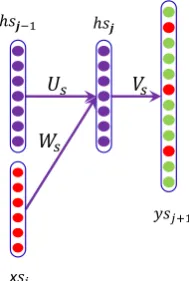
A conventional language model reads a word each time, keeps several words as history and then pre-dict the probability distribution of the next word. Similar to this, our sentence-level language model reads a sentence which is a bag of words repre-sentation. And then it stores the sentence history which captures coherence of sentences in a real-valued history vector. With the history vector, our model can predict which words are most likely to appear in the next sentence. All these will be mod-eled by a recurrent neural network.
ℎ"#$%
x"&
[image:4.595.135.230.348.489.2]'"&(% ℎ"#
Figure 1: Recurrent Neural Network for Sentence-level Language Modeling
As shown in Figure 1, similar to the convention-al recurrent neurconvention-al network, for the sentencej, our network has two input layersxsj andhsj−1. xsj
is the current sentence representation, and hsj−1
is the history information vector before sentence j. The model has a hidden layerhsj, which will
combine the history information ofhsj−1and the
current sentence input xsj, and an output layer
ysj+1, which generates the probabilities of the
words in the sentencej+ 1. The layers are com-puted as follows:
hsj =f(Us·hsj−1+Ws·xsj) (4)
ysj+1=g(Vs·hsj) (5)
where Ws, Us and Vs denote the weight matrix.
f(z)is aHT anhfunction:
f(zj) =
−1 zj <−1
z −1< zj <1 1 zj >1
(6)
andg(z)is a softmax function:
g(zj) = e zj
∑
kezk (7)
The output layerysj+1is a1×V vector that
repre-sents probability distribution of words in the next sentence given the current sentence xsj and
pre-vious historyhsj−1, whereV denotes vocabulary
size.
To emphasize coherence between the adjacen-t senadjacen-tences, we furadjacen-ther add some bigram-like bag of words feature to the output layer. As mentioned in (Mikolov, 2012), this is kind of maximum en-tropy feature which can be derived by a two-layer neural network. Some experiments show that per-plexity significantly decreases after adding these features. Following (Mikolov, 2012), where, the maximum entropy bigram features are added to our RNNSLM by a direct connection between the feature input array and output layerysj+1.
Fol-lowing (Mahoney, 2000), we map bigram maxi-mum entropy features to a fixed-length array to re-duce the memory complexity of direct connections with feature hashing. Then the output layer can be computed as follow:
ysj+1(t) =g(Vs(t)·hsj+ ∑
w∈xsj
Dhash(w,t))
(8)
where(t)denotes the t-th row of a vector or a ma-trix.Ddenotes that the hash array contains feature weights andhash(wi, wj)denotes the hash
func-tion for mapping bigram features to a fixed-length array. For a output ysj+1, multiple connections
may be activated according to the words in sen-tencexsj.
4.2 Training
The training objective of our RNNSLM is to find the best parameters for predicting the words of next sentence. Formally, given the next sentence Sk containing words w1, w2, w3, ..., wT. The
2013) can be denoted by:
log(p(BoWSk|BoWS1, ..., BoWSk−1))
= T1 ∑T t=1
logp(wt|BoWS1, ..., BoWSk−1)
(9)
For weight matrix Ws, Us, Vs and hash feature
weightD, the parameter are trained similar to the conventional recurrent neural network. The learn-ing rateα is set to 0.1 at the start of the training as suggested in (Mikolov et al., 2010). After each epoch, it can be determined by the training loss of network. If the loss decreases significantly, train-ing continues with the same learntrain-ing rate. Other-wise, if the loss increases, the training will be ex-ecuted with a new learning rateα/2. The training process will be terminated after about 30 epochs.
4.3 Initialization
All elements in weight matrixWsandUsare
ini-tialized by randomly sampling from a uniform dis-tribution [− 1
K1,
1
K1], where K1 is the size of the
input layer. Elements in weight matrixVsare
ini-tialized by randomly sampling from a uniform dis-tribution[− 1
K2,
1
K2], whereK2denotes the size of
the hidden layer. The hash feature weight arrayD is initialized as 0.
For the initialization of hs0, it can be set to a
vector of the same values, which is 0.1.
5 Hierarchical Recurrent Neural Network
In the previous section, we propose a RNNSLM which models the coherence between sentences but ignores the word sequence within a sentence. Ideally, a perfect document model should not only capture the information between sentences but al-so the information with sentence. So we propose a hierarchical recurrent neural network language model (HRNNLM) to fulfill this issue.
5.1 Model
A hierarchical recurrent neural network consists of two independent recurrent neural network. For a conventional word-level language model, it pre-dict the next word only using the word history within the sentence. To capture the longer his-tory, we integrate the sentence history into the word-level language model from sentence-level language model, which forms a hierarchical recur-rent neural network.
!"
!"#$
%(!"&$)
'!"
!"&*
'!"&$
!+
%(!"&,) '!+
%(!")
-.#$ -.
'-. %(-/&$)
-.&*
Sentence j Sentence j+1
[image:5.595.318.514.64.275.2]Document J
Figure 2: Hierarchical recurrent neural network
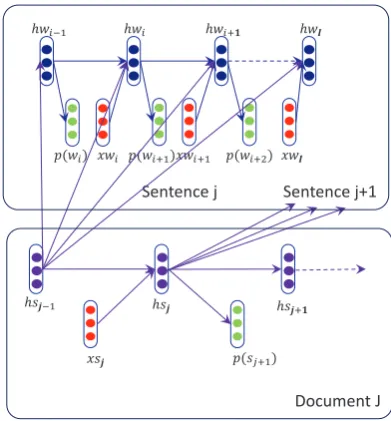
As illustrated Figure 2, the upper part is the un-folded illustration of conventional recurrent neural network based language model. It takes one word wi each time with the previous history
informa-tionhwi−1together and predicts the probability of
the next wordp(wi+1)with the information
kep-t in kep-the hiskep-tory veckep-torhwi. The lower part is our
RNNSLM, which takes the bag of words represen-tation of a sentencexsj each time with the history
information of previous sentenceshsj−1 together
and predicts the bag of words in the next sentence p(sj+1)with the information kept inhsj.
We integrate these two recurrent neural net-works together by adding connections between the sentence-level history vectorhsj−1and word level
history vectorhwi. So while predicting the
nex-t word wi+1 of the current sentence, our model
will consider the current wordwi, history of
previ-ous sentenceshsj−1and history of previous words
hwi−1. The new word-level history vectorhwiis
computed as:
hwi =f(Uw·hwi−1+Ww·xwi+Usw·hsj−1)
(10) wheref(z)is aHT anhfunction. For HRNNLM, we also add a bigram hash feature, similar as we do for RNNSLM.
5.2 Training
of training phase, the sentence history is unstable since the parameters of sentence-level language model are kept updating. Consequently, the train-ing of HRNNLM will be also unstable and hard to converge with unstable sentence history.
In this paper, we approximate the whole training of HRNNLM by a two-step training method. We first train a RNNSLM until it converges. Then we connect the hidden layer of RNNSLM to the hid-den layer of RNNWLM. To increase the training speed, all the parameters of RNNSLM are fixed while training HRNNLM. We only update the ran-dom initialized parameters in HRNNLM, though ideally the gradient of the sentence history vector could change and the RNNSLM could be updated again. The learning rateαis set to 0.1 and the up-dating of learning rate is the same as suggested in Section 4.2. All the parameters can be initialize as suggested in Section 4.3.
6 Experiments
We evaluate the sentence-level performance of HRNNLM by the common coherence evaluation of sentence ordering task, its word-level perfor-mance by perplexity measure. We also apply our HRNNLM to SMT reranking task in an open Chinese-English translation dataset. The trans-lation performance index is the IBM version of BLEU-4 (Papineni et al., 2002).
6.1 Sentence Ordering
We follow (Barzilay and Lapata, 2008) to evaluate our sentence-level language model via a sentence ordering task with test set 2010 (tst2010), 2011 (tst2011) and 2012 (tst2012) from IWSLT 2014, totaling 37 English documents. 20 random permu-tations of sentences for each document are gener-ated. Each permutation and its original document are combined as an article pair. Our goal is to find the original one among all the article pairs.
The training data for sentence-level language model is the 1,414 English documents from the parallel corpus also provided by the IWSLT 2014 spoken language translation task. 90% of the doc-uments are for training and the rest are reserved for validation. The size of the hidden layer is set to 30 and hash array size is107.
We define the log probability of a given docu-ment as its coherence score. The docudocu-ment with the higher score is regarded as the original docu-ment.
We provide two baselines for sentence order-ing. One is the state-of-the-art recursive neural network based method proposed by (Li and Hov-y, 2014). We implement their model trained and tested with our data. The other is a maximum en-tropy classifier trained with bag of words features of adjacent sentences which can generate a coher-ent probability of adjaccoher-ent scoher-entences. The docu-ment with the higher sum of log probability for each adjacency sentences is regarded as the origi-nal document. Table 1 shows the accuracy of our system and baseline.
Setting Accuracy
Recursive 91.39% ME system 91.89% Our system 95.68%
Table 1: Accuracy of the sentence ordering task for each system
From Table 1 we can see that the maximum entropy model and the recursive neural network model has almost the same performance. Com-pared with the baseline systems, the proposed HRNNLM achieves significant improvement with nearly 4.3% improvement in term of accuracy. The experimental result shows that the HRNNLM can model document coherence and capture cross-sentence information.
6.2 Word-level Model Perplexity
We compare the word level performance of HRNNLM with the most popular RNNLM in terms of model perplexity. For a fair compari-son, we follow (Mikolov et al., 2010) and train the model also on 90% of the 1.414 English docu-ments form IWSLT 2014, totaling about 3M word-s. Then we train our model with the same hidden layer size and hash array size as the baseline sys-tem. The perplexity of these two models is eval-uated on held-out documents, about 370K words. The results are shown in Table 2.
Setting Perplexity
RNNLM-30 183
HRNNLM-30 174
Table 2: Perplexity of the different language mod-el
sentences, the model perplexity decreased signif-icantly. Empirically, this confirms the hypothesis that the words selection for the next sentence is dependent on its preceding sentences in the same document.
6.3 Spoken Language Translation
The conventional SMT systems translate sen-tences independently, without considering the co-herence of the sentences in the same document. In order to learn translation coherence between sen-tences, we apply the HRNNLM to machine trans-lation reranking task.
6.3.1 Data Setting and Baselines
The data comes from the IWSLT 2014 spoken lan-guage translation task. The training data consists of 1,414 documents on TED talks, and contain-s 179k contain-sentence paircontain-s, about 3M Chinecontain-se wordcontain-s, and 3.3M English words. The language model for SMT is a 4-gram language model trained with the English documents in the training data. The devel-opment set is specified by IWSLT as dev2010, and the test set contains 37 documents from tst2010, tst2011 and tst2012.
The IWSLT 2014 baseline system is built upon the open-source machine translation toolkit Moses at the default configuration, proposed by (Cetto-lo et al., 2012). We also train a decoder, which is an in-house Bracketing Transduction Grammar (BTG) (Wu, 1997) in a CKY-style decoder with a lexical reordering model trained with maximum entropy (Xiong et al., 2006). The decoder uses commonly used features, such as translation prob-abilities, lexical weights, a language model, word penalty, and distortion probabilities.
6.3.2 Rerank System
Our reranking system is a linear model with sev-eral features, including the SMT system final s-cores, sentence-level language model ss-cores, and HRNNLM scores. It should be noted all these fea-tures are actually employed by the SMT model ex-cept for the HRNNLM score. Since Minimum Er-ror Rate Training (MERT) (Och, 2003) is the most general method adopted in SMT systems for tun-ing, the feature weights are fixed by MERT.
For our reranking system, to score the transla-tion of one sentence we need the translatransla-tion re-sults of all the previous sentences in the documen-t. Our SMT decoder generates 10-best results of all the sentences of the documents and the
rerank-ing system select the best translation result for the first sentence at first. With the translation of first sentence, we score all the translation candidates of the second sentence and select the best one as the result. Following this procedure, we can get the translation results for all the sentences in the doc-ument.
6.3.3 Results
The HRNNLM focus on exploiting longer context, esp. cross-sentence word dependencies. Therefor the translation data for IWSLT 2014 is organized as documents instead of sentences for our rerank system. We hope HRNNLM will enable a context-sensitive reranking process, capturing the syntac-tic and logic relationships between the sentences in the same document.
Setting tst2010 tst2011 tst2012
IWSLT 11.12 13.34
-Baseline 12.40 15.09 13.52
SMT + Rerank 12.55 15.23 13.70
Table 3: BLEU scores of SMT systems. The I-WSLT is a public baseline which issued by the or-ganizer of IWSLT 2014, as described in (Cettolo et al., 2012).
The translation performance comparison is shown in Table 3. From Table 3, we can find that the rerank system improves SMT performance consistently. For a single sentence without the context information, there are several appropriate translations and it is hard to tell which one is bet-ter. When considering the context of a document (previous sentences for our model), some transla-tion candidates may not be coherent with the oth-ers which should not be selected. Our model can generate the most coherent translation results by considering previous sentence history.
For example, we have the following two Chi-nese sentence in one document together with their correct translation:
我 拍摄 过 的 冰山,有些 冰 是 非常 年 轻- -几千 年 年龄
Some of the ice in the icebergs that I pho-tograph is very young - - a couple thou-sand years old.
有些 冰 超过 十万 年
Chinese word “ 有 些” means “some” in
En-glish. But when it is used in parallelism sentences, it means “some of” instead of “some”. The tradi-tional SMT system translates the italics part with-out considering the context. The translation result for this kind of system is:
Someice more than 100,000 years.
For our system, the HRNNLM can take previ-ous sentence as context and learn the parallelism between the two sentences. It can select the best translation “some of” for 有些, and the output of
our system is:
Some ofthe ice more than 100,000 years. We also calculate the BLEU increase ratio of our system on document level. The ratio is de-fined as 1
N#(BleuDrerank > BleuDbaseline),
where N denotes the number of documents, and
#(BleuDrerank > BleuDbaseline) denotes the
number of documents for which document level BLEU score of reranking system is higher than the baselines. The results are shown in Table 4.
tst2010 tst2011 tst2012
72.73% 71.43% 75%
Table 4: Experimental results to test BLEU in-crease ratio after reranking
From Table 4, we can find that, for all the three test data sets, our reranking system can achieve better performance for more than 70% documents.
7 Conclusion and Future Work
In this paper, we propose a hierarchical recurren-t neural nerecurren-twork language model for documenrecurren-t modeling. We first built a RNNSLM to capture the information between sentences. Then we tegrate the hidden layer of RNNSLM into the in-put layer of word-level language model to form a hierarchical recurrent neural network. This en-ables the model be able to capture both in-sentence and cross-sentence information in a unified RN-N. Compared with conventional language models, our model can perceive a longer history than other language models and captures the context patterns in the previous sentences. At sentence level, we examine our model with sentence ordering task. At word level, we test the model perplexity. We also conduct a SMT rerank experiment on IWSLT 2014 data set. All these experimental results show that our hierarchical recurrent neural network has a satisfying performance.
In the future, we will explore better sentence representation such as distributed sentence repre-sentation as input for our sentence-level language model to better model document coherence. We can even update the gradient from different RNN to get a better performance.
Acknowledgments
We are grateful to the three anonymous reviewers for their helpful comments and suggestions. We also thank Dongdong Zhang, Lei Cui for useful discussions. This paper is supported by the project of National Natural Science Foundation of China (Grant No. 61272384, 61370170 &61402134).
References
Regina Barzilay and Mirella Lapata. 2008. Modeling local coherence: An entity-based approach. Compu-tational Linguistics, 34(1):1–34.
Yoshua Bengio, R´ejean Ducharme, Pascal Vincent, and Christian Janvin. 2003. A neural probabilistic lan-guage model. The Journal of Machine Learning Re-search, 3:1137–1155.
Mauro Cettolo, Christian Girardi, and Marcello Federi-co. 2012. Wit3: Web inventory of transcribed and translated talks. In Proceedings of the 16th Con-ference of the European Association for Machine Translation (EAMT), pages 261–268, Trento, Italy, May.
Kyunghyun Cho, Bart van Merrienboer, Caglar Gul-cehre, Dzmitry Bahdanau, Fethi Bougares, Holger Schwenk, and Yoshua Bengio. 2014. Learning phrase representations using rnn encoder-decoder for statistical machine translation. pages 1724– 1734, October.
Ronan Collobert, Jason Weston, L´eon Bottou, Michael Karlen, Koray Kavukcuoglu, and Pavel Kuksa. 2011. Natural language processing (almost) from scratch. The Journal of Machine Learning Re-search, 12:2493–2537.
George E Dahl, Dong Yu, Li Deng, and Alex Acero. 2012. Context-dependent pre-trained deep neural networks for large-vocabulary speech recognition. Audio, Speech, and Language Processing, IEEE Transactions on, 20(1):30–42.
Geoffrey Hinton, Simon Osindero, and Yee-Whye Teh. 2006. A fast learning algorithm for deep belief nets. Neural computation, 18(7):1527–1554.
Koray Kavukcuoglu, Pierre Sermanet, Y-Lan Boureau, Karol Gregor, Micha¨el Mathieu, and Yann L Cun. 2010. Learning convolutional feature hierarchies for visual recognition. InAdvances in neural informa-tion processing systems, pages 1090–1098.
Quoc Le and Tomas Mikolov. 2014. Distributed repre-sentations of sentences and documents. pages 1188– 1196.
Jiwei Li and Eduard Hovy. 2014. A model of co-herence based on distributed sentence representa-tion. In Proceedings of the 2014 Conference on Empirical Methods in Natural Language Processing (EMNLP), pages 2039–2048. Association for Com-putational Linguistics.
Shujie Liu, Nan Yang, Mu Li, and Ming Zhou. 2014. A recursive recurrent neural network for statistical machine translation. InProceedings of ACL, pages 1491–1500.
Matthew V Mahoney. 2000. Fast text compression with neural networks. InFLAIRS Conference, pages 230–234.
Tomas Mikolov and Geoffrey Zweig. 2012. Context dependent recurrent neural network language model. In Spoken Language Technology Workshop, IEEE, pages 234 – 239.
Tomas Mikolov, Martin Karafi´at, Lukas Burget, Jan Cernock`y, and Sanjeev Khudanpur. 2010. Recur-rent neural network based language model. In IN-TERSPEECH 2010, 11th Annual Conference of the International Speech Communication Association, Makuhari, Chiba, Japan, September 26-30, 2010, pages 1045–1048.
Tomas Mikolov, Kai Chen, Greg Corrado, and Jeffrey Dean. 2013. Efficient estimation of word represen-tations in vector space.CoRR, abs/1301.3781. Tom´aˇs Mikolov. 2012. Statistical language models
based on neural networks. Ph.D. thesis, Ph. D. the-sis, Brno University of Technology.
Franz Josef Och. 2003. Minimum error rate training in statistical machine translation. InProceedings of the 41st Annual Meeting on Association for Compu-tational Linguistics-Volume 1, pages 160–167. As-sociation for Computational Linguistics.
Kishore Papineni, Salim Roukos, Todd Ward, and Wei-Jing Zhu. 2002. Bleu: a method for automatic e-valuation of machine translation. InProceedings of the 40th annual meeting on association for compu-tational linguistics, pages 311–318. Association for Computational Linguistics.
Richard Socher, Alex Perelygin, Jean Y Wu, Jason Chuang, Christopher D Manning, Andrew Y Ng, and Christopher Potts. 2013. Recursive deep mod-els for semantic compositionality over a sentimen-t sentimen-treebank. In Proceedings of the conference on empirical methods in natural language processing (EMNLP), volume 1631, page 1642. Citeseer.
Ilya Sutskever, James Martens, and Geoffrey E Hin-ton. 2011. Generating text with recurrent neural networks. InProceedings of the 28th International Conference on Machine Learning (ICML-11), pages 1017–1024.
Dekai Wu. 1997. Stochastic inversion transduction grammars and bilingual parsing of parallel corpora. Computational linguistics, 23(3):377–403.
Deyi Xiong, Qun Liu, and Shouxun Lin. 2006. Max-imum entropy based phrase reordering model for statistical machine translation. In Proceedings of the 21st International Conference on Computation-al Linguistics and the 44th annuComputation-al meeting of the As-sociation for Computational Linguistics, pages 521– 528. Association for Computational Linguistics. Puyang Xu and Ruhi Sarikaya. 2014. Contextual
do-main classification in spoken language understand-ing systems usunderstand-ing recurrent neural network. In A-coustics, Speech and Signal Processing (ICASSP), 2014 IEEE International Conference on, pages 136– 140. IEEE.