University of Warwick institutional repository:
http://go.warwick.ac.uk/wrap
A Thesis Submitted for the Degree of PhD at the University of Warwick
http://go.warwick.ac.uk/wrap/66719
This thesis is made available online and is protected by original copyright.
Please scroll down to view the document itself.
‘The Efficacy of
Cross-Curricularity: Can Primary
Schools Retain the Integrity of
History as Part of an Integrated or
Thematic Approach to the
Curriculum?’
By
James William Percival
A thesis submitted in partial fulfilment of the requirements for the
degree of Doctor of Education
University of Warwick, School of Education
1 | P a g e
Table of Contents
Title Page
List of Diagrams and Illustrations 3
Acknowledgements 4
Declaration 5
Abstract 6
Introduction 7
Chapter 1 – Literature Review 11
1.1 Background to the Debate 12
1.2 History and the National Curriculum 17
1.3 The Concepts and Elements of History in the
National Curriculum 22
1.4 Change and Continuity 26
1.5 Cause and Consequence 27
1.6 Significance and Counterfactuals 29
1.7 Enquiry and Primary Sources 31
1.8 Historical Interpretation 37
1.9 Chronology 40
1.10 Narrative 43
1.11 Evidence for Children’s Historical Reasoning 46
1.12 Cross-curricular and Thematic Teaching 52
1.13 Defining Cross-Curricularity 55
1.14 Examples of Cross-curricular Teaching and Learning
Incorporating History 61
1.15 Refining the Research Question 64
Chapter 2 – Methodology 67
2.1 Introduction and Research Aims 68
2.2 Underpinning Theoretical Perspectives 71
2.3 Research Strategy 75
2.4 Instrumentation 80
2.5 Analysis of Data 89
2.6 Academic Rigour 93
2.7 Ethical Considerations 97
Chapter 3 – Presentation of the Data 100
Pilot-study 101
3.1 Introduction 101
3.2 Observational Data 102
2 | P a g e
Title Page
Chapter 3 cont. - Case-Study 1 111
3.4 Introduction 111
3.5 Ofsted Reports 111
3.6 Planning and Policies 113
3.7 Observations and Field Notes 119
3.8 Exploring the Codes – Lesson Observations 127
3.9 Exploring the Codes – Interview Data 132
Case-Study 2 135
3.10 Introduction 135
3.11 Ofsted Reports 135
3.12 Planning and Policies 136
3.13 Observations 144
3.14 Field Notes 148
3.15 Exploring the Codes – Observations and Field Notes 155
3.16 Exploring the Codes – Interview Data 157
Case-Study 3 163
3.17 Introduction 163
3.18 Ofsted Reports 164
3.19 Planning and Policies 166
3.20 Field Notes and Classroom Observations 173
3.21 Exploring the Codes – Field Notes and Observational data 180
3.22 Interview Data 183
3.23 Exploring the Codes- Interview Data 186
Chapter 4 – Discussion 189
4.1 The Content, Concepts and Elements of History 190 4.2 Time-Ordered Matrix of Historical Learning 198
4.3 Three Models of Curriculum Integration 200
4.4 Model 1 – ‘Controlled Immersion’ 201
4.5 Model 2 – ‘Disciplined Thematic Integration’ 205 4.6 Model 3 – ‘Extended Thematic Integration’ 211 4.7 Deriving Categories from Second-Cycle Codes 216
4.8 Partially Ordered Meta-Matrix 218
4.9 The Role of the Creativity Debate 221
Chapter 5 – Conclusion 223
5.1 Exemplar of Effective Cross-Curricularity 230
5.2 Recommendations 233
List of Abbreviations 235
References 237
3 | P a g e
List of Diagrams and Illustrations
Diagram Page
Figure 1 – Map of History 25
Figure 2 – The Use of Evidence 35
4 | P a g e
Acknowledgements
5 | P a g e
Declaration
I declare that this thesis is my own work. Some of the ideas and themes discussed in chapter two were first explored in a research methods essay1 exploring a proposed research design, and submitted as a partial requirement of the Degree of Doctor of Education. The material was completely re-written with many additional references and theoretical perspectives.
No publications have yet been made from this research, but I have referred to a separate piece of research I published in 2013 on chronology and ICT. I can also confirm that this thesis has not been submitted for a degree at any other university.
1
6 | P a g e
Abstract
This research project investigated the claim that any return to cross-curricular teaching and
learning in primary schools should not be a return to the worst practice of topic work in the post-Plowden era. With a specific focus on history, the project’s aim was essentially explanatory to
determine if integrated and thematic approaches to the curriculum could retain subject integrity.
Beginning with the National Curriculum, a definition of the discipline of history that began with
the elements that constituted integrity was attempted. This definition included organising
concepts such as interpretation, chronology, significance, change, continuity and causality. It
also encompassed the importance of enquiry including the use of historical evidence and
experiential learning. The nature of historical understanding was also considered; this included
attributes such as historical insight and imagination. Theoretical models of thematic or
cross-curricular learning were also discussed.
The research was carried out using a multiple case-study design involving three primary
schools plus a pilot-study. The selection of schools was a form of purposive sampling enabled
through the self-identification of successful and innovative schools. Several research
instruments were used including formal observations, field notes, semi-structured interviews and
analysis of documentation. The methodology involved empirical field work and critical analysis.
The underpinning ontology and philosophy was based on critical realism, although elements of
ethnography were incorporated in the research design.
Data analysis, utilising coding techniques, indicated that integrated approaches to the
curriculum could successfully combine history with other subjects whilst retaining disciplinary
integrity. Three models were identified based around seven key categories. The most successful model, ‘controlled immersion’ supported the claim that history is particularly suited to
act as the lead subject for curriculum integration. The remaining two models, ‘extended thematic
integration’ and ‘disciplined thematic integration’ were judged to be less successful because of the tensions associated with managing an overarching theme and incorporating the concepts
and elements associated with a range of subject disciplines. Four categories associated with
weaker practice were further identified. The research also indicated that the National Curriculum
7 | P a g e
Introduction
In 2008, the Independent Review of the Primary Curriculum (DCSF: 2008), under the direction of Sir Jim Rose, published its interim report. Alongside a broad agreement that the existing National Curriculum (NC) (DfEE: 1999a) was still too prescriptive and overloaded with content, was a further recognition that the Review’s proposal, whereby English primary schools should adopt more thematic, creative and integrated approaches to teaching and learning, could equally not be a return to the ‘vagaries of old style topic and project work’ (DCSF: 2008: 17) that failed to develop children’s emerging ‘abilities and militated against extending their understanding’ because the curriculum often ‘lacked progression and was too repetitive’ (DCSF: 2008: 17).
By the time Rose’s final report was published (DCSF: 2009; Cunningham: 2012: 36-9) the integrated approach would still be recommended, based around six broad areas of learning, but significantly history and geography were now identified within the area of learning named ‘Historical, geographical and social understanding’ (DCSF: 2009: 17). The report was equally clear that its recommendations allowed for flexibility and creativity, yet respected the ‘integrity of the subjects’ while lessening the ‘rigidity of their boundaries’ (DCSF: 2009: 17).
This debate and its related concerns mirrored very closely to my own teaching experiences and acted as the genesis of the research question. As a former history coordinator in three primary schools, I had grown increasingly disillusioned with the prevailing subject-disciplinary model, and I experimented with integrated or cross-curricular2 approaches, particularly with history, whilst remaining vigilant about retaining subject integrity. However, attempts to export this model throughout the whole school were often inconsistent.
2
8 | P a g e From the initial literature review it was also clear that very little research had been carried out into the successful implementation of cross-curricular primary pedagogy in any subject. As Flick (2011: 21) argued persuasively, a research question should emerge or respond to a significant absence of data. Equally, the Historical Association’s (HA) recent survey of primary schools noted that the teaching of foundation subjects had become largely cross-curricular (HA: 2011)3.
This evidence, supported by the Office for Standards in Education’s (Ofsted) most recent publication on history, which reported that in 35 of the 83 primary schools they visited the teaching of foundation subjects had become largely cross-curricular (Ofsted: 2011: 33), indicated that many primary schools had independently started to develop cross-curricular approaches, suggesting strongly that this was a ‘pressing issue’ (Punch; 2009; 19), during a period of uncertainty (Guyver: 2011: 18-20), and therefore worthy of further research to contribute to the current state of knowledge (Punch: 2009: 50).
Whilst acknowledging the place of large-scale survey approaches that inform the majority of official reports, but which often result in a lack of detail and analysis required to shape practice, an explanatory, model-building approach based on detailed case studies of schools that identified themselves as managing to balance both cross-curricularity and rigour was preferred. It seemed important that any research should lead to findings that can act as guidance to schools who wish to adopt a more thematic approach towards curriculum management whilst maintaining rigour and high standards, and also influence my own initial teacher training and advisory work.
Thus based on the initial literature review and experiential knowledge, the research question that emerged, with a specific focus on history, was principally concerned with the challenge of balancing cross-curricularity against rigour in the primary curriculum. It was eventually finalised after several iterations in the following form:
367 from 214 KS2 respondents reported history taught as a discrete subject and only 33 from 205 in KS1
9 | P a g e ‘The efficacy of cross-curricularity: how can primary schools retain the integrity of history as part of an integrated or thematic approach to the curriculum?’
The term subject ‘integrity’ was not unique to the Rose Review; it had previously been used in several reports (DES: 1990: 174; Ofsted: 2011: 33) as a way of expressing an official concern for the importance of subject discipline. Fundamentally any attempt at either model building, or comparative analysis, must include a discussion about the nature and practice of history; in essence this is the ‘integrity’ of the subject that defenders of the NC wish to retain. Phillips (1998: 15-6) argued that the development of educational theory initially resulted in a separation between academic disciplines and school subjects, but the introduction of the NC unquestionably reunited both practice and philosophy because it reflected some of the attitudes and approaches adopted by academics, and in the case of history this was highly controversial.
I have retained a long standing interest in the philosophy of history from my undergraduate days, and I was aware that the nature and methods of history cannot be easily delineated. This is principally because professional history is a relatively new academic discipline, and also because historians have not always been very analytical or reflective about their methods (Marwick: 2001: x-xvi; Jenkins: 1991: xv-xx; Evans: 1997: 10-12), with Hobsbawm (1997: 89) going so far as to describe history as an ‘immature discipline’. Therefore although the principal focus of the literature chapter discussed the nature of history as defined by the NC, it also includes the theories and reflections of many eminent professionals and significant writers from the philosophy of history in an attempt to reinforce the credibility of the main concepts and elements of history found in the NC, and to broaden the definition where possible.
11 | P a g e
12 | P a g e
1.1 Background to the Debate about Cross-Curricularity
The concerns expressed in the Independent Review of the Primary Curriculum (DCSF: 2008) about the potential loss of subject integrity were based on detailed evidence from a variety of sources. From the philosophy of education there had been a long-standing belief in the importance of subject domains and disciplinary knowledge (Hirst: 1973; 1974a; Hirsch: 1987) that was often incorporated into arguments about the unique and important contribution each subject domain, for example history (Hirst: 1974a: 44-5; Shemilt: 1980: 26; Ashby: 2011: 137-8), could make to the whole curriculum. From an epistemological perspective, Schwab (1978: 243) argued that if an academic subject is overly simplified, with no reference to the disciplinary structures, the result is a corruption of that discipline. Similarly, Pring (1973) and Hirst (1974b)4, who both influenced Carr (2010), noted that arguments for an integrated curriculum rested on philosophical assumptions, such as the transferability of knowledge and disciplinary concepts, which had not been satisfactorily answered since the first wave of integration. Historians had been equally concerned that the rigour and detail of the NC should not be lost; and because of the general raising of standards and greater consistency of history after the introduction of the NC, the ‘danger’ of the fragmentation, disintegration and ‘erosion’ of history in any return to thematic and integrated approaches had also been noted (Cannadine et al: 2011: 216-8; Sheldon: 2011: 37; Harnett: 2000:16).
Concerns had also been expressed by educationalists: Turner-Bissett, a proponent of creative teaching, warned against the tenuous nature of some of the cross-curricular links, ‘often without due regard for the nature of each subject’ (Turner-Bissett: 2005: 16); and Counsell (2011) expressed similar concerns from the viewpoint of KS3. Supporting the aim of this research project, Hayes (2010: 385) argued recently that the new wave of cross-curricular teaching and learning should not be received uncritically
4
13 | P a g e and without scrutiny. In particular he warned against returning to the phenomenon of ‘sleepy slots late in the afternoon’ and “familiar ‘topic work’”, hence the importance of equally imaginative and flexible approaches to timetabling. Hirst (1974a: 51), Barnes (2011) and Kerry (2011a) all noted the demands on teachers’ skills, knowledge and confidence associated with outstanding cross-curricular work, and the importance of objective-led planning (Hirst: 1974b: 136-7), particularly if more experimental approaches are adopted. This point has been supported by Dobbins (2009) research into teachers’ experiences; specifically he reported that many felt there had been a lack of advice and training concerning how to plan for thematic or cross-curricular work.
The official position regarding cross-curricularity begins with Her Majesty’s Inspectorate (HMI) survey of English primary schools (DES: 1978), which was cited by Rose (2008) as evidence of the failure of many schools, post Plowden (CACE: 1967) and the ‘progressive’ education movement (Cunningham: 1988), to develop children’s academic skills, particularly its conclusions about the provision of history. The HMI report noted that history was mostly absent in infant classes, patchy in the mid-primary years, and inconsistently taught in the upper-juniors. It further noted that resources were often poor, with teachers often relying on an uncritical use of television and radio programmes, while work outcomes often included great swathes of indiscriminate copying from reference books (DES: 1978: 72-5).
At that time many English primary schools appeared to be attempting to respond to the Plowden report’s recommendations for greater use of topics, projects and enquiry-based learning when covering history (CACE: 1967: 225-30), but the detail of how to achieve this was absent in the report, and training and support from Local Education Authorities (LEAs) (Sylvester: 1994: 14) or teacher training institutions was often decentralised, idiosyncratic and inconsistent (Cunningham: 1988: 72-82).
14 | P a g e Years’ (HMI: 1985) was more of a blue-print for pedagogy that influenced the later NC, but it did note that even in the best classrooms topic based approaches were often ‘historically weak’ and ‘erratic’ and ‘generally unsatisfactory’ (HMI: 1985: 41). The 1989 report, ‘The Teaching Learning of History and Geography’ (HMI: 1989), was generally equally critical of cross-curricular, topic based work. The report noted the lack of consistent coverage, indiscriminate and highly individual topic choices, and the work outcomes that often ‘consisted of little more than copying notes and illustrations’ (HMI: 1989: 10), and it concluded that ‘these findings showed that many schools had great difficulty in making satisfactory provision for history within integrated work’ (HMI: 1989: 8). Admittedly the report also reported that poor history teaching was not confined to topic based approaches, but was linked to generic weaknesses such as leadership, planning and resources, which, it further noted, mirrored closely the findings from their survey eleven years earlier. The report concluded that only one in five history lessons were satisfactory or better (HMI: 1989: 8). Yet despite these criticisms, there was an acknowledgement that the best schools were able to make worthwhile and enriching cross-curricular links.
Rose was one of the highly influential ‘three wise men’ (Alexander et al: 1992a; 1992b) who carried out a thorough review of the primary curriculum shortly after the 1988 Education Act. In an almost verbatim echo of the 1978 report, they argued that much topic work, especially in history and geography, was ‘very undemanding’ and amounted to little more than ‘aimless and superficial copying from books’ that allowed few ‘opportunities for progression’ (Alexander et al: 1992a: 144-6), but they did at least concede that in the hands of skilled teachers children could produce work of great quality and make strong academic progress through a thematic or topic based approach (Alexander et al: 1992a: 145).
15 | P a g e noted that the domains were not ‘an invitation to low-grade topic work in which thematic serendipity counts for more than knowledge and skills’ (Alexander et al: 2010: 266). Nevertheless, the report also emphasised the importance of curriculum breadth, and it also advocated varied and active teaching approaches that would stimulate children’s creativity and imagination and build upon their existing knowledge (Alexander et al: 2010: 280-284): at the very least the report allowed the possibility of making meaningful curriculum links, and it further noted that disciplinary knowledge and thematic approaches are not mutually exclusive (Alexander et al: 2010: 245-7).
Ofsted has tended to be generally positive about the success of primary history. The report ‘History in the Balance’ (Ofsted: 2007) noted many strong features of KS1 history, echoing the strengths observed in early years’ humanities’ teaching in a much earlier survey into 5 to 9 practice (DES 1982), and the need for schools to continue to stimulate children’s interest in the history curriculum in both key stages; but the report also warned about the dangers of too much innovation, particularly when incorporating history into integrated topics, and further argued that attention must be given to the objectives and standards for each subject (Ofsted: 2007: 23).
16 | P a g e of itself undermine the integrity of the subject’ (Ofsted: 2011: 33), but the overall message was clear: the content of history in a cross-curricular model has to be carefully identified and promoted.
17 | P a g e
1.2 History and the National Curriculum
The introduction of the NC was unquestionably a response to the inconsistencies and weaknesses in teaching and learning found in most state schools, specifically curriculum coverage, subject leadership, planning and assessment practices (HMI: 1985; 1989), which resulted in the landmark 1988 Education Act (DES: 1988a; Cannadine: 2011: 204-5; Sheldon: 2011: 3-4) and the increase in educational accountability (Cunningham: 2012: 91-94).
One result of this process for history was the HMI publication, ‘History from 5 to 16’ (DES: 1988b; Sylvester: 1994: 20-2) which contained a great deal of advice that eventually found its way into the NC. The history curriculum, in common with other NC subjects, was ultimately to be determined by the History Working Group (HWG). As with other subjects the composition was a mixture of teachers, educationalists, academics and other professionals, and advised by HMI inspectors and civil servants (Slater: 1991: 12). The remit was to come up with a broadly British-based curriculum, and to identify progression in understanding and knowledge that could fit into the 10 point assessment scale devised by Paul Black (Sheldon: 2011: 6). The interim report (DES: 1989) included an outline of the suggested content, which included European and world topics alongside British history. The HWG’s final report (DES: 1990) was a landmark document that has essentially shaped the state education of history for over two decades. The final report then went off for consideration by the National Curriculum Council (NCC). At this consultative stage a number of important revisions were made (NCC: 1990a). One of the most significant was the decision to allow primary schools to teach the history study units in non-chronological order.
18 | P a g e pictures and photographs, and more detailed studies on famous people and events from the past. The POS for key stage 2 included the core units of ‘Invaders and Settlers’, ‘Life in Tudor and Stuart times’, and either ‘Victorian Britain’ or ‘Britain since 1930’. The non-British core units were the study of ‘Ancient Greece’ and ‘Exploration and Encounter 1450 – 1550’ (the Aztecs). The optional units included broad topics such as food and farming and ships and seafarers, which were designed to be predominately British; additionally, schools were given the discretion to develop their own study units which had to include local history. The ‘Supplementary study units’ adopted broad themes such as transport and domestic life - category A; category B included at least one local history study; and category C included past non-European societies, including ‘Egypt’ (DES: 1991: 11-29; NCC: 1993c).
The addition of the Political, Economic, Social and Cultural (PESC) formula (DES: 1990: 16) was a significant decision because it acknowledged that history could not be an uncritical parade of kings, queens and battles, but should incorporate a broader definition of history that more accurately represented the work that professional historians actually do (DES: 1990: 183-5). Historians such as Stone (1987), Tosh (1991) and Marwick (1981 & 2001) have considered this point in considerable detail, and unquestionably professional history has broadened its remit to include new subject areas and approaches: economic history, social and cultural histories were undoubtedly influenced by the burgeoning social sciences such as sociology and psychology (Marwick: 2001), and local history became more accepted by professionals from the 1960s onwards (Stone 1987; Tosh: 1991).
19 | P a g e As children progressed5 chronology would include explanations of historical change, principally ideas such as cause and effect, and the identification of differences between past and present times. It stated that by the end of primary school most children should have been able to understand ideas such as historical causes and consequences (DES: 1991: 3-4). AT2, ‘Interpretations of History’, was clearly harder to define and delineate; in essence children would show progress by developing their understanding that stories may be about real or fictional people (level 1) to an ‘understanding that deficiencies in evidence may lead to different interpretations of the past’ (level 4), which might include explaining why illustrations of Ancient Egypt vary so much (DES: 1991: 7). AT3, ‘The Use of Historical Sources’, clearly based on the principles of enquiry and evidence, defined progression as ‘communicating information acquired from an historical source’ (level 1) to putting together ‘information drawn from different historical sources’ (level 4), such as information from old newspapers, photographs or maps (DES: 1991: 9). Also contained in the folder was reasonably detailed supplementary guidance on how to plan and teach the new orders for history (NCC: 1991), followed by further guidance from the NCC (1993a; 1993b) for teachers who had been unable to go on training courses (Sheldon: 2011: 25-6).
Nevertheless, because rather than despite all the thought and innovation that went into constructing the NC, its implementation was far from smooth. As Sheldon noted, two issues quickly stood out: the ‘overloaded content and the problem of assessment’ (Sheldon: 2011: 18). The eventual response was the Dearing review, which set up a new History Group, which ultimately decided to trim the content, for example removing the Stuarts from the ‘Life in Tudor and Stuart times’ unit. Of greater significance assessment was reduced to a single AT, containing very broad level descriptors (DES: 1995: 73-83), alongside the abandonment of any idea that history could be tested in the primary years. It additionally promoted chronology into a more prominent position.
5
20 | P a g e The 1999 History Task Group review in preparation for the Curriculum 2000 (DfEE: 1999c), resulted in few significant changes other than the broadly welcomed addition of citizenship (Arthur: 2000: 2-5), which, although non-statutory in primary schools, was intended to be taught in combination with history (AGC: 1998: 22-3), and included a greater emphasis on general aims and values (White: 2004). The Dearing review had introduced key elements in lieu of the lost ATs, and in the Curriculum 2000 these were now defined as ‘Knowledge, skills and understanding’ to be taught and assessed as part of the study units. The list of elements included: ‘chronological understanding’; ‘historical interpretation’; ‘historical enquiry’ and ‘organisation and communication’. The final element, ‘knowledge and understanding of events, people and changes in the past’ deserves a slightly more detailed discussion because it contained, in a rather inchoate way, concepts such as change, causality and significance that are linked to historical reasoning and understanding. The Curriculum 2000 study units are also recognisably the same as the recommendations from the HWG’s final report: in key stage 2 they included a ‘local history study’, virtually identical British history units, a European study (Ancient Greece), and a world history study (virtually the same list as the 1991 document with the addition of the Aztecs) (DfEE: 1999c: 102-7).
22 | P a g e
1.3 The Concepts and Elements of History in the National Curriculum
It might therefore be thought that achieving excellence in primary history is simply a matter of transferring the elements of the NC, described above, into practice, but this would omit many important considerations. To begin with there has been a long standing debate in history education surrounding the balance between content and skills, often reflecting the distinction philosophers such as Ryle (1949) have made between procedural (knowing how) and propositional (knowing what) knowledge, or Schwab’s (1964; 1978) categorization of substantive and syntactic understanding. Few theorists accept the extreme version of the skills approach to pedagogy over the transmission of knowledge, and indeed there were many powerful criticisms of a predominately skills-based approach. Dickinson et al (1978), Rogers (1987) and Lee (1991; 1994) all argued for the importance of content, essentially as a form of reference to help children scaffold their understanding, and also the desirability of synthesising skills with knowledge. Lee (1991: 43-8) was particularly vocal against the ‘vicious relativism’ that sometimes emerged from predominately skills-based approaches.
23 | P a g e A related question is to determine the exact nature of the historical concepts covered by the NC for primary history. The most important elements such as chronology, interpretation, enquiry and evidence have already been identified in the account of the history of the NC, and each demands a separate and detailed discussion. Additionally there are also a number of more elusive concepts linked to historical understanding and explanation, and therefore essential in supporting analysis of children’s learning in history.
The earliest and arguably most influential attempt was Fines and Coltham’s (1971) HA publication which certainly stimulated and challenged teachers to think more analytically about their practice. A further delineation has been the distinction between the substantive concepts of history, linked to knowledge, such as ‘parliament’ or ‘reform’, and procedural (also described as second-order or organising) concepts, such as ‘causality’ and ‘change’. These were first identified by the Schools Council History Project (SCHP) (1975) and have been discussed in detail by Guyver (1997; 1998) and Lee and Shemilt (2004: 14). Contemporary attempts to define them have also been produced by writers such as Hoodless (2008), Levesque (2008), based on Peter Seixas’ work, and VanSledright (2009). Turner-Bissett (2001: 37) (figure 1; page 25) produced a useful, if complex, list of elements demarcated into Schwab’s schema for substantive knowledge, syntactic knowledge based on processes and skills, and finally the necessary attitudes and attributes and beliefs essential for successful learning including all of the concepts linked to the NC.
25 | P a g e
26 | P a g e
1.4 Change and Continuity
According to the Qualification and Curriculum Authority (QCA: 2007: 112) ‘Change and Continuity, as a related yet contrasting pair of concepts, should be closely linked to a ‘sense of period’, a theme identified by Turner-Bissett (2005: 20) as important in developing young children’s burgeoning understanding of the past, and linked to overarching themes including consideration of the pace of change. Despite their recent prominence, this pair of concepts has rarely been discussed by philosophers of history, and Counsell (2011) noted that there is also far less educational research about these concepts compared with other concepts. Crowther (1982) carried out research into young children’s accounts of change, and found that this concept was often misinterpreted by young children in personal terms, such as substitution, for example related to clothes and friends. He concluded, however, that by the end of primary school a more mature understanding of transference started to emerge. More optimistic evidence of primary-aged children’s ability to understand change was provided by Sampson et al (1998) as part of a research project that linked discussion and teacher exposition to key historical concepts and language.
27 | P a g e
1.5 Cause and Consequence
The QCA defined the aims of these related concepts balancing the importance of different causal elements and ‘making explanatory links between causes and effects’ (QCA: 2007: 112) based on established arguments, evidence and contrasting interpretations. These statements do not accurately reflect the controversial status of causality in the philosophy of history, and it became one of the main preoccupations of early philosophers (Clark: 1985:179). Certainly most of the attempts to identify laws of historical development in the nineteenth century, which could then be used for prediction, notably Hegel (1956), have been unsuccessful. Determinist and teleological theories of historical processes, including linear or cyclical accounts of historical progress, particularly under the umbrella term of historicism (Evans, 1997; Elton: 2002; and Oakeshott: 1983), have been almost entirely discredited.
From a liberal perspective powerful critiques against determinist accounts were provided by Berlin (1960; 1969) and Popper (1957; 1966) that emphasised human agency and free will; and while Nagel (1960) allowed the possibility of determinism, largely on the grounds of logic, his position was more motivated by a desire to prevent limits being placed on future historical developments that a belief that such laws would be identified. The elusive nature of the past, the fragmentary nature of historical evidence, the theory of contingency and free will, explain why few contemporary historians hold such ambitious aims.
28 | P a g e imprisoning those subjected to them (Braudel: 1980: 30-2; Clarke: 1985: 185); and that these structures are more readily identified by adopting the approach of the longue durée. Hobsbawm (1997: 38-41), from a Structuralist-Marxist perspective, thought that historians should aim to identify the ‘mechanisms of change’ in history, based on the identification of historical ‘transformations’ and other revolutionary episodes. Evidence of this sort can then aid the historian in assessing the ‘potentiality’ of future events based on soundly based historical judgements (Hobsbawm: 1997:209-220).
29 | P a g e
1.6 Significance and Counterfactuals
The link between ‘Significance’ and ‘Interpretation’ are outlined in the QCA document (2007: 113) in the form of changing judgements and explanations, hence the introduction of evidence-based contestability. Arguably significance is a broader concept than this and is essentially concerned with the developing ability of young people to understand what is worth knowing in history, and how this knowledge can inform and enrich historical understanding. Lee (1991) made a strong case for the place of knowledge-based substantive concepts which he argued acted as a framework for developing an understanding of significance. He associated an understanding of significance with other concepts such as coherence, dimensionality and the ability to identify connections between different historical events. He later termed this outcome ‘historical literacy’ (Lee: 2011: 64-9). Clearly significance, in this model, is not simply learning knowledge for its own sake, but the ability to synthesise content and concepts to develop understanding and to make historical connections.
30 | P a g e The role of counterfactual history in underpinning historical reasoning, including causation and significance, has been considered more favourably by academics and historians since the publication of Ferguson’s (1997) influential book. Wrenn (1998), Chapman (2003) and Woodcock (2011) have all argued, from a KS3 perspective, for the use of thought experiments and game approaches, using ideas such as ‘Buckaroo’ and ‘Diamond 9’ activities, alongside more cerebral approaches such as identifying hierarchies of possible causes, and allied to the formal logic of necessary or sufficient causes derived from philosophers such as Evans (1997: 156-8).
31 | P a g e
1.7 Enquiry and Primary Sources
Collingwood (1939; 1946), and Oakeshott6 to a lesser degree (1933; 1962; 1983), described history as a ‘special form of research or enquiry’ (Collingwood: 1946: 9) that required historians to ‘study problems not periods’ (Collingwood: 1939: 124); and similar arguments for history as a form of problem solving were also stated by Bloch (1954), Hexter (1968), and Tosh (1991). Stone (1987) further defined history as a practical and limited form of enquiry (Stone: 1987: 43), while Popper contributed the metaphor of shining a searchlight into the dark places of the past, guided by a hypothesis, and based firmly on his falsification theory of knowledge (Popper: 1966: 260-9; Stanford: 1986: 97-8). Thus there is very little disagreement that questions and hypotheses should guide historian’s work.
Historians also tend to agree that the foundations of history are firmly based on primary sources, and because of the status and importance of historical evidence this has become a bulwark against charges of relativism, thus for some professional historians rigorous forms of enquiry have become a crucially important argument for demonstrating the objective truth of historical knowledge (Elton: 1970; 2002; Bevir: 1994). Evans (2000: 240-53) further described how primary sources demand high levels of imagination from the historian in the form of conversations with the past, circumscribed by a complex set of rules that historians often adhere to implicitly (Evans: 2000: 115-6).
There is evidence that pedagogical approaches using enquiry and evidence began in the late 19th century (Levesque: 2008: 26), but contemporary accounts tend to begin with the work of the SCHP in the 1970s (Shemilt: 1980; Counsell: 2012). Children from the early 1970s onwards were introduced to the aims and methods of professional historians, principally through enquiry and exposure to primary sources, while their progress and understanding were measured against organising or secondary concepts
6
32 | P a g e such as significance, continuity and change and understanding. Dickenson et al (1978: 4-12) were also at the forefront of supporting children’s engagement with history through enquiry, and like the professionals they emphasised the importance of starting with a focused question, then interrogating the evidence as far as it will go.
Evidence of the triumph of the ‘new’ approaches to history can be seen in the way that virtually all the main primary history theorists advocated that children should engage with history through enquiry. Cooper (1995: 2000: 2012) argued strongly for the use of primary sources in the classroom, and the importance of an evidence base for children’s work. Husbands, writing principally about older pupils, favoured an active model strongly based on children learning history, not as a ‘cipher’, but as an ‘active participant in the dialogue between present and past’ (Husbands: 1996: 53), and comparable arguments were presented by Bage (2000), Banham (2000) and Hoodless (2008).
33 | P a g e a source of historical enquiry and evidence, and partly a reflection of the burgeoning rise in status of local history in universities.
Pioneering work with artefacts was carried out by Blyth (1969) and Bamford (1970: 205-14), the latter of whom developed techniques that utilized deduction and inferential reasoning, for example ‘detective work’, based on activities such as the ‘mystery wallet’. Hodgkinson (1996) encouraged children to work out whether objects were genuine or not, and to make calculations of what has changed and what might change in the future based on probability models. Wright (1996) and Turner-Bissett (2005) provided useful advice and guidance for developing children’s close observation skills and their application of prior knowledge to make more informed statements about objects, and greater skill in ordering objects by age; similarly Vass (1991) identified the importance of modelling observation, hypothesis and adapting previous knowledge, while Davis (1986) was typical of many reflective practitioners who argued that artefacts are a way of encouraging follow up questions leading to further enquiry or storytelling (Bage: 2010). Other recognised aspects of good practice include the creation of interactive class museums, often involving play areas (Blyth: 1988; Verrier: 2007), and the related use of museum support services (Harrison and Woff: 2004; Markland: 2010) both as a source of artefacts and centres of expertise.
34 | P a g e images are crucial to children’s burgeoning concepts of comparison and change. Turner-Bissett (2005: 61) made an important distinction between images both as a teaching resource as well as a source of primary evidence, and echoing West’s work she produced a list of general stages to help children decode images including scanning, observing, continuous questioning, and finally attempting to ‘enter’ into the scene.
There is still agreement that text-based historical sources pose many challenges for children, particularly below upper KS2 (Cooper: 1995: 99), and therefore written sources have understandably been less popular with teachers. Nevertheless, teachers have taken up the challenge: Fines (1968), Bamford (1970) and West (1978) were pioneers in the use of written sources of evidence, with variable results. Certainly West’s (1978) four year study with 7-11 year olds demonstrated that older primary aged children were capable of carrying out meaningful forms of deductive reasoning and questioning strategies when introduced to written forms of evidence. Low-Beer and Blyth (1990) argued that written evidence is more successfully introduced as a whole-class activity, with the teacher modelling their interpretation and decoding, rather than independent work.
Another strategy has been to use more accessible forms of evidence, and with younger children a certain amount of creativity can be adopted in their selection. Both Cooper (1995: 104) and Low-Beer and Blyth (1990) have produced extensive lists of possible sources including street signs, advertising logos and children’s own historical documents such as birth-cards, alongside the more traditional sources such as school log books, and Parish, church and census records; other approaches have included newspapers (Adams: 1998) and political cartoons (Card: 2010) as accessible sources of historical evidence for 20th century history.
35 | P a g e they also use teacher intervention to scaffold children’s thinking. More recently Nichol (2004; 2010) has refined analytical approaches in the classroom to include techniques such as ‘codebreaker’; this approach helps children to categorise the content into categories such as form, voice and context, and it aims to skilfully link information and historical interpretation.
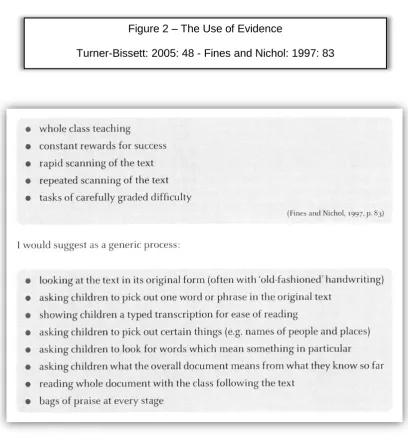
Fines and Nichol’s (1997) long term Nuffield project between 1991-9 led to successful work outcomes and useful guidance for teachers, which was further adapted by Turner-Bissett (2005: 48) (figure 2).
[image:37.595.122.531.291.740.2]
Figure 2 – The Use of Evidence
37 | P a g e
1.8 Historical Interpretation
Interpretation has been widely discussed within the philosophy of history. The early debate tended to focus on the possibility of achieving an objective historical truth (Carr: 1961; Munslow: 1997), and the ability to distinguish between the facts and the practice of history. Other considerations included the representativeness of data, with the rich and powerful nearly always predominating in any given time or society (Stone: 1987: 57-9), and the question of uneven survival, with chance and fragmentation creating unintentional biases as much as deliberate destruction (Bloch: 1954: 73-6). Carr also pointed out the cumulative nature of historical reasoning, and the importance of theory in constructing historical knowledge. Carr possibly overplayed the importance of theory and ideology in shaping historical accounts, but his advice to ‘study the historian before you begin to study the facts’ (Carr: 1961: 23) remains important advice.
Additionally there are several theoretical positions that have also questioned the reliability of historical knowledge. Structuralists (Levi-Strauss: 1962 & 1963; Boon: 1985; Lechte: 1994; Lowenthal: 1985: 214-5) have questioned the possibility of describing accurately the potentially infinite number of individual perspectives and interpretations as a unitary historical event. Postmodernists, such as White (1973; 1976; 1978) and Jenkins (1991: 13-14), have argued that historians inevitably select, shape and interpret their ideas in the form of their political and philosophical belief systems, an argument supported by Hexter’s (1971: 80) concept of the historian’s ‘second record’. The outcomes of history are then shaped by the use of literary devices including narrative and ‘emplotment’ (White: 1999: 7-10).
38 | P a g e review, thus allowing a more complete and accurate understanding of historical beliefs and interpretations.
The determination of the HWG to retain interpretation in the face of ministerial hostility (Sheldon: 2011: 10), because of their fears that history would be used as ‘propaganda’ or for the purposes of ‘social engineering’ (HWG: 1990: 11), resulted in its prominent place in the NC. However, it remains an organising concept in history that has been infrequently discussed by educationalists (Williams and Davies: 1998), and often focused on a rather sterile debate about bias (Lang: 1993). Counsell (2000) considered that the impact and presence of interpretation in the NC had been underdeveloped, while Haydn et al (2001) identified the lack of research or guidance about the place of interpretation in primary schools, and especially the development of a critical approach to the use of secondary sources of evidence.
39 | P a g e involve risk, or requires greater consideration given to challenging pupils’ preconceptions (Hallden: 1986).
40 | P a g e
1.9 Chronology
The concept of chronological understanding, although an important part of pedagogic approaches to history, has largely been ignored by professional historians. Hobsbawm argued that an understanding of time is ‘essential to the modern, historical sense of the past, since history is (concerned with) directional change’ (Hobsbawm: 1997: 29), but he has been a rare exception. Structuralists such as Levi-Strauss (1963) and Braudel (1980) have tended to place more attention on it, whilst simultaneously adding a more critical approach such as identifying differing rates and perceptions of time and change according to class and status. In particular Braudel noted the importance of the ‘histoire de la longue durée’ (Braudel: 1980: 10-13, 74; Clark: 1985: 180-184) as a brake against overly theoretical and ideological approaches; Braudel also recognised the place of fast-moving, micro-history of events and intermediate paced, cyclical forms of historical change. The relationship between them was described as hierarchical, with the structures of the longue durée defining the main channels of historical change, and the ‘foam’ of events and personalities are correspondingly the least important, if the most visible and superficially significant.
41 | P a g e Early research, Oakden and Sturt (1922), Bradley (1947)7, Jahoda (1963) and Lello (1980) reported that a full understanding of time comprised of several different concepts, some more historical than others, all of which were difficult to develop, and not easily separated from linguistic and mathematical understanding. Piaget (1946) and Hoodless (2002) considered that narrative rested on a deeply held sense of time and causality; hence there is a natural link between narrative structures and chronology. More recent research has tended to focus on the difference certain pedagogical approaches can make, notably ICT (Masterson and Rogers: 2002; Percival: 2012), and the acknowledgement of the importance of wider, out of school knowledge and context (West: 1981a; 1981b: Stow: 1999). Arguably the most influential teaching approach has been the timeline, and many writers cite West’s (1981a) work as influential in promoting the use of timelines in school, although West was keen to emphasise that in the early years to lower KS2 children should essentially carry out sequencing activities, drawing upon their wider contextual knowledge and reasoning skills, rather than becoming confused with dates and periods.
Hodkinson (2004a: 2004b: 2007) carried out extensive research that indicated that teacher intervention could accelerate children’s understanding, and his research, supported by Wood (1995), reinforced the importance of clear modelling and explanation of temporal terms and language. Many other researchers have adapted West’s picture sequencing work, including Blyth (1989), Lynn (1994), Harnett (1994) and Stow (1999), with chronology often underpinning wider research into children’s historical understanding. Levstik and Barton’s (1996) work deserves a brief discussion since their use of images from 20th century political and social history suggested that there is a reasonably accurate and widely distributed knowledge of historical imagery. The other aspect of culturally shared knowledge was Stow’s (1999) observation that children often become confused if recent images or objects are damaged or dirty, and
7
42 | P a g e the association of age with monochrome images: it seems therefore that cultural stereotypes can also cause confusion in many young children’s minds.
43 | P a g e
1.10 Narrative
Narrative approaches, recommended in early guidance for primary history (Keating and Sheldon: 2011), have also been an implicit aspect of the primary NC from the beginning. Story and narrative were recommended by HMI as ‘central’ to history teaching (DES: 1988: 19), and narrative was implied in many of the POS in the first iteration of the NC, not least linked to the previously discussed elements of interpretation and chronology alongside myths and legends (DES: 1991:13). Yet it has also remained a controversial aspect of both the philosophy and the pedagogy of history. Despite Green and Troup’s (1999: 204) claim that narrative forms have often been perceived as a defining aspect of history writing, many professionals have demonstrated a rather uneasy relationship with narrative forms, possibly fearful of postmodernist accusations that history is little more than unverifiable stories about the past (White: 1976). Yet the links between narrative forms and historical accounts are strong. As Stone (1987: 74) stated, ‘historians have always told stories’, often using elegant, literary forms that can contain high levels of analysis (Hexter: 1968: 40-1). Indeed, Hexter and Stone, along with Taylor (1983: 160) and Starkey (2005), are noteworthy examples of the few historians to make a strong case for the return of narrative approaches to history after unsuccessful flirtations with social science methodology (Stone: 1987: 74-96; Phillips: 1984). However it was Bruner (1996) who presented the strongest case for the importance of narrative as part of his constructivist model of learning. Narrative forms, he argued, offered an alternative to the logico-mathematical form of reasoning by offering a ‘test of truth’ based on verisimilitude, internal cohesion and plausibility (Bruner: 1996: 90-2). Considering the case of history, Bruner further argued that history offered a ‘narrative construal of reality’ that imposed coherence on the past through a ‘culturally shared’ from of knowledge (Bruner: 1996: 143-147).
44 | P a g e many adherents of this approach including Fines (1975), Rogers (1977) and Little (1983). Echoing the changing attitude towards narrative held by some professional historians, there has been a similar re-evaluation and rehabilitation of narrative as a model of historical understanding within education, including a claim that narrative is arguably one of the main organising concepts of history (Gjedde: 2010; Levstik and Barton: 2011; Lang: 2003; Counsell: 2012). A further claim is that historical accounts can be both chronological and narrative in form, which also allow children to see the ‘big picture’ of history that allows both the development of an overview combined with depth and understanding (Hake and Haydn: 1995; Riley: 1997; Barnes: 2002). Bage has also been a powerful advocate, and he argued that children have a ‘natural narrative competence’ (Bage: 1999: 23), and that part of a teacher’s approach should be based on these ancient and fundaments models of learning; particularly potent is the drive to find out ‘what happened next’ due to the forward looking, chronological nature of narrative (Fines: 1975; Hake and Haydn: 1995). Furthermore, by using story as a pedagogic approach, Farmer and Cooper (1998) argued that children will develop an increased sense of the teacher’s authority, although this requires skill and preparation on behalf of teachers. Cooper (2007: 62) has argued a further point that narrative is ‘crucial’ for stimulating children’s imagination, creating a sense of history and evocation to help them fill in the gaps of the past, and engaging their interest in the subject.
45 | P a g e latter arguing that it was a method ‘par excellence’ for attempting to understand history from the ‘inside’, firmly based on the available evidence thus retaining accuracy and criticality. There have been many drama techniques utilized in history lessons including ‘freeze-frame’, ‘teacher-in-role’ and ‘conscience alley’ alongside the more typical full re-enactments (Vass: 2005; Turner-Bissett: 2005),
Fines (1980: 3-5) used the technique of a fictional ‘half story’ to stimulate discussion and dramatic solutions, and this introduces the role of fiction into the debate. Understandably distrusted in some quarters, Vass (1992) was an early proponent of adapting a more relaxed approach to the use of story based on the argument that fiction can still provide children with genuine historical insight and understanding. This theme has been adapted by Hicks and Martin (1997) for context setting; while Little (1983; 2007), Cox and Hughes (1998) and Aiken (1985) have stressed the role of fiction in creating the imagery and mental pictures that could help to create an ‘imaginative grasp of the past’ (Aiken: 1985: 81).
46 | P a g e
1.11 Evidence for Children’s Historical Reasoning
The nature of historical reasoning has to be considered because it underpins the research question and helps to identify further aspects of good practice in primary history, not least the development of children’s imagery of the past, and their use of imagination to support historical reasoning: two aspects of good practice that have arguably been under-emphasised.
Early research into children’s historical reasoning and understanding tended to be based on Piagetian levels, and his ontogenetic stage theory of intellectual development (Piaget: 1954; 1955), and the equilibrium theory of assimilation and accommodation (Piaget: 1954: 350-7; Gruber and Voneche: 1977: 694). These were investigated by Hallam (1969; 1970; 1972; 1975), Steele (1976) and De Silva (1972) with consistently pessimistic and widely quoted results. Generic challenges to Piagetian levels have been made over many years, particularly the work of Donaldson (1978) and Harris (2000; 2004; Spivey and Geng: 2001), who both argued that the greater use of play and imagination allowed young children to attain higher levels of cognitive ability than Piaget allowed. In history, West (1986: 17-8), produced evidence from a large scale four year study of 7 to 11 year olds that suggested that children were capable of highly plausible historical reasoning; Dickinson and Lee (1984) also argued that stage levels significantly underestimated children’s ability to reason about the past. Similarly Cooper (1983) and Booth (1980; 1983; 1987; 1994) produced convincing research evidence to counter the pessimism of Piagetian stage theory, while Booth (1983), influenced by Fischer’s (1971: xv-xvi) model of adductive reasoning, further argued that upper juniors and adolescents were capable of genuine historical thinking if the subject was adapted to include discussion and explanations of how historians construct arguments.
47 | P a g e from the 1990s (Lee et al 1996a; Lee et al; 1996b; Lee et al; 1997)8. There have arguably been two main outcomes of recent empirical research: firstly the production of a number of schemas that track children’s understanding from early childhood to adolescence, and secondly the many research projects that reported the wide span of historical understanding and ability in any average classroom. Early findings for substantial range and overlap included McNaughton (1966), Thornton and Vukelich (1988) and Knight (1989a), whilst the CHATA project (Lee and Shemilt: 2004) reported a seven year differential in any average classroom. If accepted, the teaching implications of these consistent findings are significant, and for primary teachers a class of older juniors may include some who are operating at secondary levels of understanding, emphasising the importance of both differentiation and appropriate challenge.
In terms of models of development, the schemas that emerged from the CHATA project require discussion. The aim of the CHATA project was to explore concepts of evidence and explanation in children’s reasoning between the ages of 7 and 14 (Lee et al: 1996a). The impact of teaching on the acceleration of learning was also explored, and its conclusion, thus countering Hallam’s research, was that teaching could make a difference, particularly linked to more explicit teaching and explanation of historical concepts such as causation and change (Lee et al: 1996b).
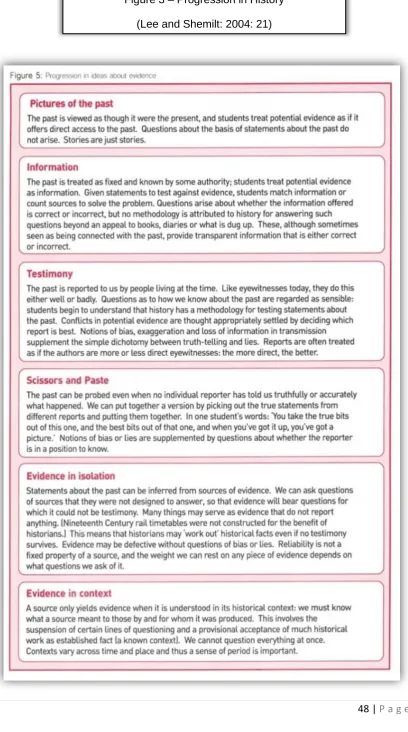
The most complete model of progression (Figure 3; Lee and Shemilt: 2004, overleaf), the six stages from ‘pictures of the past’, or copy theory of history, to ‘evidence in context’, produced by the CHATA team, clearly built upon earlier work by Lee (1978), Shemilt (1987) and Ashby and Lee (1987), and this can be used as an alternative way of assessing children’s level of historical understanding, particularly the first three stages in the primary school.
8
48 | P a g e Figure 3 – Progression in History
49 | P a g e However, it is the theories of social constructivism where greatest optimism for children’s engagement in history can be found. Constructivism may admittedly be described as a ‘heterogeneous body of theoretical approaches across different disciplines’ (Vianna and Stetsenko: 2006: 81), but all approaches have a core belief in the active construction of children’s understanding rather than the passive transmission of fixed knowledge into children’s deficient minds (Piaget: 1935 & 65: 712-6). Additionally, there have been two very important constructivist pedagogical models to aid educators; firstly Bruner’s’ concept of the ‘spiral curriculum’ (Bruner: 1960: 52-4), in which he argued that the ‘essential disciplinary concepts’ should retain their integrity, and should be introduced in honest and accessible ways to children of all ages, and Vygotsky’s ‘Zone of Proximal Development’ (ZDP) (Vygotsky: 1978: 84-91) which argued that a skilled teacher can bridge the gap between a child’s potentiality and the actual level of development. The emphasis was strongly based around the mediating role of language and active learning methods; and linked to the latter model is Bruner and Wood’s Vygotskian influenced concept of ‘scaffolding’ (Wood et al: 1976), an approach that involves the modelling and demonstration of ideas, and a close working relationship between teacher and learner.
50 | P a g e exposition and discussion, particularly the words that overlap with common meanings (Sampson et al: 1998).
Bruner, unlike Piaget, also allowed for the role of intuition as a valuable intellectual tool (Bruner: 1960: 64-7), and in the case of history, where the past cannot be directly experienced this would seem to allow for more speculative forms of reasoning including the importance of imagination and imagery (Egan: 1992; 1997). Both Oakeshott and Collingwood used the language of mental imagery, particularly visualisations in the case of Collingwood, as part of the description of historical imagination. Given that history is about real people and events in real locations, but separated by the unbridgeable gap of time, it might be supposed that most of historical reasoning is indeed visual in form, but it would be a mistake as Piaget (1963: 659-60) and White (1990) have convincingly argued to reduce imagery solely to visualisation. Rather surprisingly few historians seem to have considered the nature of historical imagination. Stanford (1986: 84-7) discussed the role of ‘mental pictures’ and the historian’s ‘picture of the past’, as well as being ‘eavesdroppers’ into past conversations, and Bloch (1954: 49-71) obliquely mentioned the role of mental imagery, but these have been notable exceptions. Nevertheless, there are good prima facie reasons for thinking that historical imagery is predominately visual in form.
52 | P a g e
1.12 Cross-Curricular and Thematic Approaches
The introduction of the NC may often be associated with the end of uncritical ‘topic’ approaches in primary classrooms, as described by HMI in 1978, but it is arguably more accurate to describe the process as a ‘bipolar’ contrast (Tyler: 1992: 563) between the demands of ten subject domains and a ministerial desire to introduce a number of cross-curricular themes and dimensions. In fact the 1988 Education Reform Act (DES: 1988) made provision for a ‘broad and balanced’ curriculum (Boyle and Bragg: 2006: 570) including eight cross-curricular themes, as the guidance (NCC: 1990b) made clear; and it should also be noted that the HWG’s final report (1990: 181-184) included guidance for linking history with all other curriculum subjects. Reviews from the time of introduction, for example Nixon (1991) and Tyler (1992), suggested that curriculum overcrowding, overload, and a corresponding lack of coherence, resulted in a loss of cross-curricularity almost from the start in secondary schools.
Crawford (2000), writing from a later perspective, argued that the issue had been fudged due to civil-service interference and hostility to thematic teaching, therefore the separate subject model soon became established in English primary schools, although allowance should be made for Farmery’s (2011) claim that that many primary schools, even certain teachers within schools, never entirely abandoned the principles of Plowden. Despite later attempts at guidance (SCAA: 1995), initiatives were quickly quashed by the newly elected Labour government in 1997; the White Paper on education ‘Excellence in Schools’ (DES: 1997) demonstrated a clear commitment to high standards, and further established the primacy of literacy and mathematics, culminating in the Literacy and Numeracy Strategies (DfEE: 1998; 1999a).
53 | P a g e argued that, important those these initiatives were, they were fatally compromised by an ‘irresolvable contradiction’ between the Labour Party’s philosophical support for progressive teaching practices and its determination to appease middle England. What can be stated with security is that the importance of league tables and the national obsession with Key Stage 2 test results necessarily compromised any attempts to free the primary curriculum from a subject domain model.
The QCA also reported on maintaining ‘Breadth and Balance’ (QCA: 1998) before beginning to support the ‘Excellence and Enjoyment’ agenda with materials and guidance for planning and timetabling the primary curriculum (QCA: 2002), which included advice concerning the judicious combinations of subjects (no more than two or three) and backed by detailed planning; by 2004 it had developed materials for promoting greater subject flexibility (QCA: 2004; Redmond: 2004). In 2008 the QCA introduced the idea of the curriculum ‘Big Picture’ (QCA: 2008: Bartlett et al 2008; Waters: 2008) and the metaphor of the curriculum tree to represent the relationship between skills (the roots), subject domains (branches), and knowledge (individual leaves). It was clear that, pace ‘Excellence and Enjoyment’, any curriculum flexibility would be defined by a skills based approach and attention to detail. More recently, for example the QCDA report (2010) ‘Your Curriculum Journey’, there has been greater support for thematic approaches, alongside individual and subject based teaching and learning.
54 | P a g e later report into ’20 Outstanding Primary Schools’ (Ofsted: 2009) was more accepting of thematic teaching and an enriched curriculum, and by the following year this had translated into a more wholehearted support of curriculum flexibility (Ofsted: 2010) that was partially based on their evidence drawn from 22 primary schools in challenging areas that were judged to be good to outstanding. Crucially, part of the success of these schools was identified as being linked to ‘good examples of creative styles’ embedded ‘through cross-curricular approaches’ (Ofsted: 2010: 4). The report concluded that there was no necessary conflict between the content of the NC and thematic approaches, and that in the best examples the ‘distinctiveness of individual subjects was not diminished’ (Ofsted: 2010: 11); the report also identified inspired leadership, strong planning, and thorough assessment that ensured children’s progress, as essential for success. Their case-study examples, however, offered little in the way of detail as the how these schools had actually managed the curriculum so well. Some common themes that did emerge from the wider literature included a consistent emphasis on the importance of school leadership (Ofsted: 2002; 2009), detailed and careful planning (Sexton: 1990; Laurie: 2011), team approaches to planning and teaching (Harrod and Kerry: 2011), and thorough assessment and record keeping (Ofsted: 2009; 2010).