warwick.ac.uk/lib-publications
A Thesis Submitted for the Degree of PhD at the University of Warwick Permanent WRAP URL:
http://wrap.warwick.ac.uk/99424/
Copyright and reuse:
This thesis is made available online and is protected by original copyright. Please scroll down to view the document itself.
Please refer to the repository record for this item for information to help you to cite it. Our policy information is available from the repository home page.
Single Nanoparticle Electrochemistry
By
Minkyung Kang
Thesis
Submitted to the University of Warwick
for the degree of
Doctor of Philosophy
Supervisor: Prof Patrick R. Unwin
Department of Chemistry
Contents
List of Figures ... i
List of Tables ... xiv
Abbreviation ... xv
Acknowledgements ... xvii
General Declaration ... xviii
Abstract ... xxii
Chapter 1. Introduction ... 1
Reactions at Electrodes ... 1
Kinetics of Electrode Reactions: Current-Potential Relationship ... 3
Mass-transport ... 6
Electrochemical Techniques for Single NP Detection: Static Measurements ... 8
Ultramicroelectrodes... 9
Single Nanoparticle Electrochemical Impact Experiments Using UMEs ... 12
Micro-Droplet Electrochemical Cell ... 19
SNEI Experiments Using the Micro-Droplet Electrochemical Cell Method ... 21
Electrochemical Techniques for Single NP Detection: Dynamic measurements .... 23
Scanning Electrochemical Microscopy ... 24
SECM Hybrid Techniques ... 26
Scanning Ion Conductance Microscopy ... 31
Scanning Electrochemical Cell Microscopy ... 33
Super-Resolution Optical Imaging Techniques. ... 35
Aims of the Thesis ... 36
References... 38
Chapter 2. Experimental Methods ... 49
Chemicals ... 49
SEPM Operating System ... 52
References... 55
Chapter 3. Time-Resolved Detection and Analysis of Single Nanoparticle Electrocatalytic Impacts ... 57
Abstract ... 57
Introduction ... 57
Materials and Methods ... 59
Chemicals ... 59
Electrochemical Landing Experiment ... 60
Preparation and Characterization of Ruthenium Oxide Nanoparticles (RuOx NPs) ... 61
Three-Dimensional (3D) Random Walk Simulations ... 62
Results and Discussion ... 64
Conclusions... 73
References... 74
Chapter 4. Impact and Oxidation of Single Silver Nanoparticles at Electrode Surfaces: One Shot versus Multiple Events ... 77
Abstract ... 77
Introduction ... 78
Materials and Methods ... 81
Chemicals ... 81
Electrochemical Dissolution of Individual Ag NPs: Experimental Setup ... 83
Ag NP Characterization: TEM and DLS ... 84
Results and Discussion ... 88
Influence of the Experimental setup, Instrumentation and Acquisition Parameters on the Background Current (noise) Level ... 88
AgNP Stripping Using SECCM ... 90
Electrochemical Dissolution Mechanisms of Individual NPs ... 107
Special Case: Periodic Current Transients ... 110
References... 114
Chapter 5. Simultaneous Topography and Reaction Flux Mapping At and Around Electrocatalytic Nanoparticles ... 118
Abstract ... 118
Introduction ... 119
Materials and Methods ... 121
Chemicals ... 121
Nanopipette and Sample Preparation ... 121
Scanning Ion Conductance Microscopy (SICM) ... 122
FEM Simulations... 122
Results and Discussion ... 126
Electrochemical SICM Operating Principles ... 126
Electrochemical Mapping on UMEs ... 130
Tip Distance Effects in Reaction Mapping. ... 135
Single NP Mapping ... 137
Conclusions... 148
References... 149
Chapter 6. Quantitative Visualization of Molecular Delivery and Uptake at Living Cells with Self-Referencing Scanning Ion Conductance Microscopy (SICM) – Scanning Electrochemical Microscopy (SECM) 154 Abstract ... 154
Introduction ... 155
Materials and Methods ... 157
Chemicals ... 157
Substrate Preparation ... 157
Probe Fabrication ... 157
Instrumentation ... 158
Simultaneous Topography and Uptake Mapping ... 159
Results and Discussion ... 165
Operational Principle... 165
FEM Simulations... 168
Validation of SICM-SECM for Uptake Mapping ... 171
Differentiation of Subcellular Uptake Heterogeneities ... 174
Conclusions... 176
References... 177
List of Figures
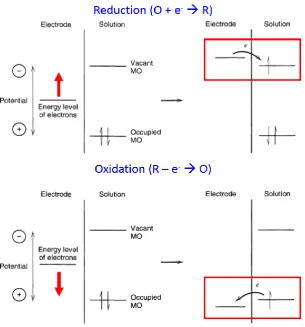
Figure 1.1 Illustration of a reduction (top) and oxidation (bottom) process, occuring between two different redox molecules in solution and an electrode. The oxidised and
reduced forms of each molecule are represented as “O” and “R”, respectively. The
highest occupied molecular orbital (HOMO) of the molecule is denoted “Occupied
MO” and lowest unoccupied molecular orbital (LUMO) is denoted “Vacant MO”.
Figure 1.1 was adapted from Bard and Faulkner (2001).1 ... 2
Figure 1.2 Pathway of a general electrode reaction. It needs to be noted that there are redox species limited by mass transfer [e.g., Hexaammineruthenium (III/II)] rather
than other processes described in Figure 1.2. Figure 1.2 was adapted from Bard and
Faulkner (2001).1... 3
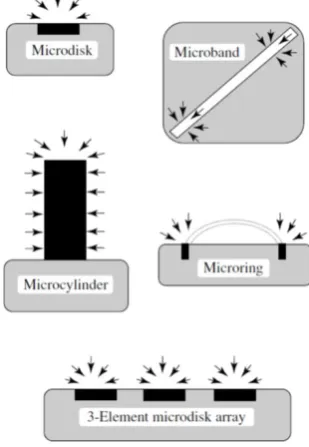
Figure 1.3 Most commonly utilised microelectrode geometries and their associated diffusion field. Figure 1.3 was adapted from Bard et al. (2003).8 ... 9
Figure 1.4 Schematic representation of the diffusion profiles on a disk-UME at (A) short (linear diffusion profile) and (B) long (radial diffusion profile) timescales. Figure
1.4 was adapted from Bard et al. (2003).8... 11
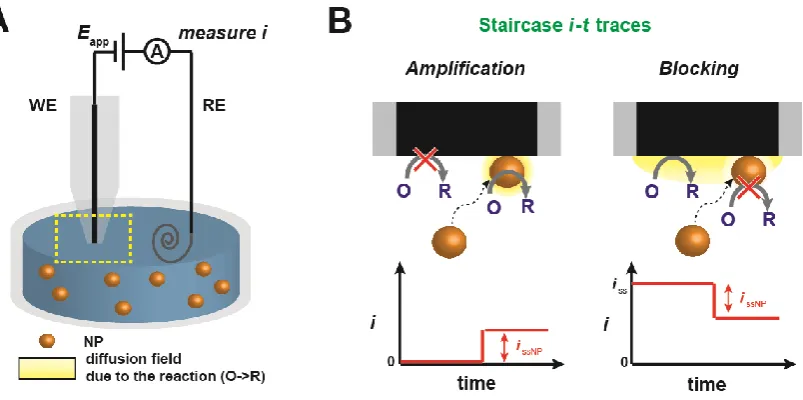
Figure 1.5 (A) Schematic of a SNEI experiment setup using a UME as the WE. (B) Schematics and typical i-t transient arising from NPs after a “sticking” impact (i.e., “staircase” response), resulting in either amplification (left) or blocking (right) of the
reaction of interest on the collector electrode surface. ... 13
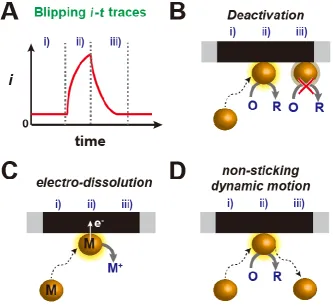
Figure 1.6 (A) Schematic of a typical i-t transient for a “blipping” response during a SNEI experiment. Three possible processes giving rise to the response are illustrated:
(B) deactivation; (C) electrodissolution; and (D) non-sticking dynamic motion. ... 16
Figure 1.7 (A) A schematic of the early stage of micro-droplet electrochemical cell setup with optical and contact force monitoring. (B) Optical image of a glass capillary
with an applied silicone gasket. Figure 1.7 was adapted from Lohrengel et al. (2001).67
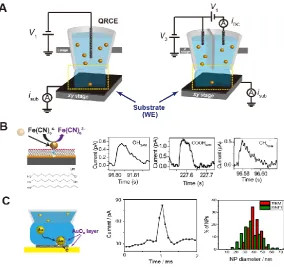
Figure 1.8 (A) Schematics of the micro-droplet electrochemical cell setup for SNEI experiments using a single channelled probe (left)24,51 and a double channelled probe
(right).44,76,77 Confined droplet contact on the substrate is achieved through monitoring
signals (i.e., currents) induced by the circuit completion (isub) and the deformation of
the droplet (iDC). More operation details are provided in Section 1.3.4. (B) Principle
of a single Au NP electrochemical impact on SAM-modified Au electrodes and typical
i-t responses with, −OH, −COOH, and −CH3 terminated SAMs. (B) was adapted from
Chen et al. (2015).77 (C) Illustration of an AuO
x layer formation on an Au NP through
electron tunnelling between the Au NP and passivated Au electrode surface, with a
typical i-t response of the process followed by comparisons of size analysis between
TEM analysis and SNEI. (C) is adapted from Bentley et al. (2016).24 ... 22
Figure 1.9 it as a function of tip–substrate separation, L (dt-s normalised with rtip)
where the substrate is (A) a conductor (“positive feedback”) and (B) an insulator
(“negative feedback”), with illustrations of the diffusion profile at the tip in each case,
in bulk (hemispherical), on a conductor (feedback) and on an insulator (hindered).
Figure 1.9 was adapted from Bard et al. (2012).82 ... 25
Figure 1.10 Approach curves as a function of k0 for electron transfer (redox) reaction at the substrate. From top to bottom, k0 (cm s-1) is (a) 1, (b) 0.5, (c) 0.1, (d) 0.025, (e) 0.015, (f) 0.01, (g) 0.005, (h) 0.002, and (i) 0.0001. Curve (a) is identical to that for
mass transfer controlled (electrochemically reversible) reaction and curve (i) for an
insulating substrate in Figure 1.9. Figure 1.10 was adapted from Bard et al. (2012).82
... 25
Figure 1.11 (A) Schematic showing the basic principles of AFM operation and (B) force-ds-t relationships at approach and retract of the AFM tip. (C) Optical and
scanning electron microscopic (SEM) images of manually fabricated Pt wire
SECM-AFM probe. (C) was adapted from Macpherson et al. (2000).97 (D) Principle of the
SECM-AFM technique for the interrogation of PEGylated ferrocene (PEG =
polyethyleneglycol) anchored on individual gold NPs (left). Simultaneously obtained
topography and tip current images (right). Cross sections of the topography and tip
current images (dotted white lines) are respectively plotted in red and blue.
in the plots) are plotted as black traces. (D) was adapted from Huang et al. (2013).106
... 28
Figure 1.12 (A) Basic principle of SICM operation, where a potential bias between two QRCEs and the induced ionic current is noted as ΔV and iion, respectively. (B) iion
-ds-t relationship during approach of a SICM probe to a surface. The magnitudes of iion
begins to decrease where ds-t is similar to the diameter of the probe (dtip). ... 29
Figure 1.13 (A) Schematic illustration of double-channelled SECM-SICM probe fabrication (top) with optical (bottom left) and SEM (bottom right) images of the
probes. (A) was adapted from Takahashi et al. (2011).119 (B) Schematic showing the
basic principles of SECM-SICM operation. (C) (i) A SEM image of spherical Pt NPs
electrochemically decorated on a GC surface and (ii) corresponding topography and
ORR reactivity maps of the surface, simultaneously obtained by the SECM-SICM
technique. (C) was adapted from O’Connell et al. (2014).121 ... 30
Figure 1.14 (A) Basic operating principle for electrochemical reaction mapping with SICM. (B) Cyclic voltammograms acquired from the substrate (Pt UME, red) and
concurrently monitored current at the SICM probe (blue) which is positioned at the
central part of the substrate electrode during the potential sweep. (C) Topography (left)
and reactivity (middle, HER; right, hydrazine oxidation) maps obtained from dynamic
reaction imaging with SICM. Figure 1.14 was adapted from Momotenko et al. (2016).116 ... 32
Figure 1.15 (A) Schematic of the SECCM setup, with a TEM image of a double-chanelled quartz nanopipette (dtip ≈ 100 nm) inset. (B) Approach curves of an SECCM
probe with idc and iac as a function as z extension towards the substrate. Shown above
the plots are illustrations delineating three regions; in air, where no contact has been
made with the substrate; jump-to-contact (dashed line); and contact. Figure 1.15 was
adapted from Mirkin and Amemiya (2015).139 ... 35
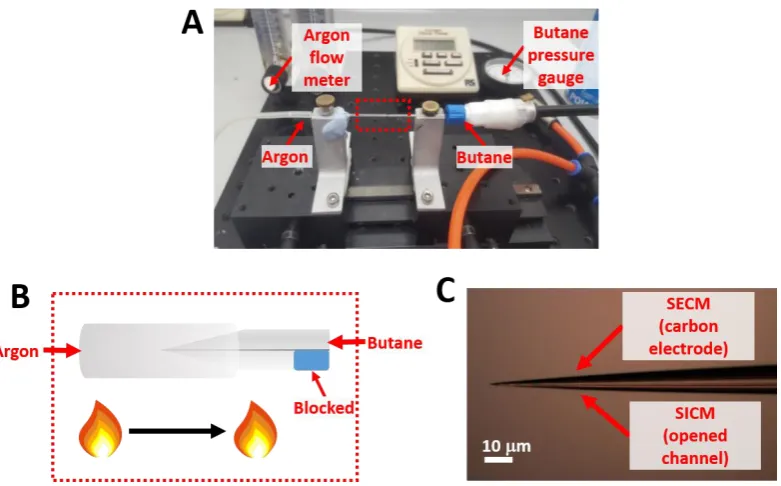
Figure 2.1 (A) A photograph and (B) schematic depicting the experimental set up for the butane pyrolysis process during fabrication of double-channelled SECM-SICM
Figure 2.2 Electron microscopy images of the nanopipette probes used for high-resolution electrochemical imaging. (A) SEM image of a double-channelled theta
nanopipette. (B) TEM image of a single-channelled nanopipette. Figure 2.2 was
adapted from Kang et al. (2016).6 ... 52
Figure 2.3 Photograph of nanopipette probes mounted on a brass holder for TEM characterization. ... 52
Figure 2.4 Schematic of a typical SEPM set up, for use with the WEC-SPM software. (A) Illustrates the positioning system and (B) shows the general control of the SEPM
system. Figure 2.4 was adapted from the WEC-SPM Control Software User Guide
(2017).8 ... 53
Figure 3.1 RuOx NP landing experiments in an ultramicro-electrochemical cell,
showing the cell setup (top), with a typical theta pipet for meniscus contact and NP
delivery to a working electrode (HOPG) substrate. There is no oxidation of H2O2 at
the HOPG electrode surface, i.e., no surface current (isurf), as shown on the bottom left,
unless a NP impacts with the surface and sets off the electrocatalytic oxidation of
H2O2 at the NP (bottom right). ... 59
Figure 3.2 Cyclic voltammograms, with and without H2O2 present, on HOPG in 0.1
M phosphate buffer (pH 7.4) at a scan rate of 0.1 V s-1. ... 61
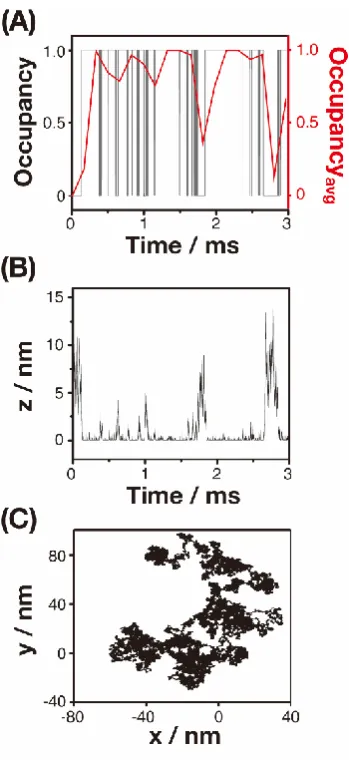
Figure 3.3 (A) Comparisons of the occupancy (black) and the average occupancy of the NP considering the experimental conditions (red). (B) The height (z) of the NP
above the collector electrode during the interaction of a NP with the collector electrode
and (C) lateral trajectory of the NP. ... 64
Figure 3.4 (A) FE-SEM and (B) TEM images of RuOx NPs synthesized with sodium citrate. (C) Size distribution from the analysis of TEM images (red) and from DLS
(green), in terms of the particle radius, rNP. ... 66
Figure 3.5 SEM images of RuOx NPs synthesized without sodium citrate. ... 66
Figure 3.6 Current responses of RuOx NP impacts at HOPG in the presence of 0.5
synthesized (A) without or (B) with a sodium citrate capping step. Note the difference
in the current scales. ... 67
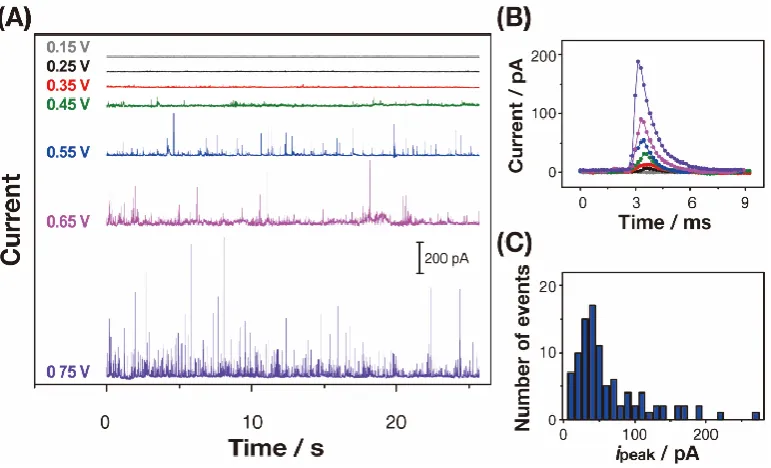
Figure 3.7 (A) Current (isurf) responses for 0.5 mM H2O2 oxidation with 15 pM
RuOxNPs in 0.1 M phosphate buffer solution (pH 7.4) at different Eapp at the HOPG
collector electrode (0.15 V, 0.25 V, 0.35 V, 0.45 V, 0.55 V, 0.65 and 0.75 V vs
Ag/AgCl QRCE). (B) Example current responses of individual impacts of RuOxNPs
at the different Eapp with the color matched with part A; the bigger the current
magnitude the higher the Eapp. (C) Distribution of peak currents, ipeak, from collision
experiments at 0.55 V. ... 68
Figure 3.8 Comparison of current responses in RuOx NP landings with 0.5 mM H2O2
and without 0.5 mM H2O2 at 0.55 V. ... 68
Figure 3.9 Plot of average ipeak against different Eapp from Figure 3.7. ... 69
Figure 3.10 Histograms of the rise time from (A) 200 simulations and (B) 16 experimental transients. Experimental i–t traces (blue lines) are presented in parts C
and D. These are the average (one standard deviation) of (C) 10 individual transients
that had a rise time of 330 μs and (D) 5 individual traces that had a rise time of 500 μs. Shown alongside are simulated occupancy traces (black lines), which displayed a
similar rise time for comparison. ... 70
Figure 3.11 Typical multiple RuOx NP impact events at a collector electrode potential of 0.55 V. ... 73
Figure 4.1 Schematic of the set up for SECCM NP impact experiments. ... 83
Figure 4.2 Representative TEM images of Ag NPs with nominal diameters of (a) 10 nm, (b) 20 nm, (c) 40 nm, (d) 60 nm and (e) 100 nm (abbreviated as Ag10NPs,
Ag20NPs, Ag40NPs, Ag60NPs and Ag100NPs, respectively). ... 86
Figure 4.3 Linear sweep voltammogram (LSV) (100 mV s-1) for the reduction of 2
mM Ru(NH3)63+ in 0.1 M KNO3 solution by the meniscus contact on GC using a glass
pipette (diameter of 8 m) and SEM image of the footprint after the meniscus contact
Note that the LSV is not fully at steady-state due to the scan speed used and the fact
that SECCM diffusion is from a conical segment rather than fully hemispherical. .. 87
Figure 4.4 Representative I-t transients obtained during the polarization at E= +0.6 V vs Ag/AgCl of a (a) Au UME, (b) CF-UME and (c) GC electrode in SECCM setup, with different amplification time constants. d) Peak to peak background current vs amplification time constant for different electrode materials and setups. ... 89
Figure 4.5 Representative current transients obtained by applying E = +0.6 V vs Ag/AgCl to a GC electrode with a solution containing Ag NPs with nominal diameter
of (a) 10 nm and (b,c) 20 nm. The numbers i-v refer to different cases discussed in the
text. ... 91
Figure 4.6 Representative current transients obtained by applying E = +0.6 V vs Ag/AgCl to a GC electrode with a solution containing Ag NPs with nominal diameter
of (a, b) 40 nm and (c, d) 60 nm. The numbers i-v refer to different cases discussed in
the text. ... 92
Figure 4.7 Representative current transients obtained by applying E = +0.6 V vs Ag/AgCl to a (a, b) GC and a (c, d) Au electrode with a solution containing Ag NPs
with nominal diameter of 100 nm. The numbers i-v refer to different cases discussed
in the text. ... 94
Figure 4.8 (a) Log-log plot of the charge histograms for single events recorded during the stripping of Ag NPs with nominal diameter of 10, 20, 40, 60 and 100 nm on GC
and 100 nm Ag NPs on Au electrodes. Histograms of the (b) equivalent NP diameter
(assuming dissolution of whole NP), (c) event duration and (d) maximum current. . 96
Figure 4.9 Log-log plot of the event duration histograms for single events recorded during the stripping of Ag NPs with nominal diameter of 10, 20, 40, 60 and 100 nm
on GC and Au electrodes. ... 98
Figure 4.10 Log-log plot of the maximum current histograms for single events recorded during the stripping of Ag NPs with nominal diameter of 10, 20, 40, 60 and
Figure 4.11 (a) LSV (50 mV s-1) for Ag (UME of diameter = 125 m)
electrodissolution in presence (black) and absence (red) of 1 mM trisodium citrate in
25 mM NaNO3. (b) Current-time curves at different applied potentials (Eapp vs.
Ag/AgCl) where the steady-state currents are corresponding to 0.6 (black), 1.3 (blue),
and 1.9 (red) mM of Ag+ concentrations on the Ag UME surface. Citrate inhibits Ag
electrodissolution (probably by surface adsorption) but there is no evidence of surface
passivation due to Ag3Cit precipitation... 101
Figure 4.12 Log-log plot of the time elapsed between consecutive events recorded during the stripping of Ag NPs with nominal diameter of 10, 20, 40, 60 and 100 nm
on GC and Au electrodes. The blue dashed line represents the estimated average time
between two events if each NP was fully stripped in one single event. ... 104
Figure 4.13 Representative current transients obtained with (a) τC = 100 s and (b) τC
= 5 ms, by applying E=+0.6 V vs Ag/AgCl to a GC electrode with a solution
containing Ag NPs with nominal diameter of (left) 40 nm and (middle) 100 nm, and
to a Au electrode with a solution containing Ag NPs with nominal diameter of 100 nm
(right). Histograms of (c) equivalent NP diameter (assuming complete dissolution of
NPs) and (d) event duration, both for τC = 5 ms. ... 106
Figure 4.14 Schematic of different processes of electrochemical dissolution of Ag NPs with nominal diameters of (a) 10, (b) 20, 40 and (c) 60, 100 nm... 108
Figure 4.15 Representative periodic I-t transients obtained by applying E=+0.6 V vs Ag/AgCl to a GC with a solution containing Ag NPs with nominal diameter of (a,b)
40 nm and (c,d) 60 nm, and to Au with a solution containing Ag NPs with nominal
diameter of (e,f) 100 nm... 111
Figure 4.16 Periodic I-t patterns (from Figure 4.15) and Schematic representation of the electrochemical dissolution mechanism of Ag NPs on a (a) GC and on (b) Au
substrate... 112
Figure 5.1 (A) A 2D Schematic representation of the FEM simulation domain with boundary descriptions shown in Table 5.1. All other boundaries not explicitly labeled
were set as no flux boundaries. (B) Simulated I-V curved with varying surface charge
for reaction mapping experiments, with the nanopipette positioned in bulk solution.
Note that the geometry of the nanopipettes were consistent according to the TEM
characterization of multiple nanopipettes, and the average current magnitude at Vtip of
+0.15 V yielded 188 pA with a standard deviation of 7 pA (N = 4). (C) Simulated
SICM approach curve (tip-substrate separation versus normalized Itip) with the
solution conditions as in the experiments. ... 124
Figure 5.2 Transmission electron microscopy (TEM) image of a representative nanopipette with a tip diameter of approximately 30 nm. ... 125
Figure 5.3 (A) Schematic of the experimental setup used for simultaneous topographical/electrochemical mapping of a substrate electrode using SICM. (B)
Shown at the top are schematics of the main features of the imaging procedure during
the hop motion of the probe (numbered 1 to 4) at each pixel. A trace of z-position and
Vsub during each step is shown at the bottom. The overall procedure can be summarized
as follows: (1) approach towards the substrate surface under DC ionic current feedback
to reach the set point distance; (2) small retract (“small lift-up”); (3) waiting time of
20 ms followed by potential step by jumping Vsub from Vsub1 to Vsub2; and (4) full retract
before the hop procedure is repeated at the next pixel, typically 20 nm lateral
displacement from the previous one. The tip current, measured throughout, was
analyzed as discussed in the text. ... 127
Figure 5.4 (A) Plots of z-position (black trace) and substrate electrode potential (Vsub)
(blue trace) vs. time, showing the protocol utilized during each hop (pixel-level
measurement) of a typical imaging experiment. (B) The corresponding tip current (Itip)
vs time plot, recorded simultaneously with (A). ... 128
Figure 5.5 LSVs (potential sweep at Vsub) obtained at two individual Au UMEs
(diameter ≈ 10 m) in a solution containing 3 mM NaBH4 and 30 mM NaOH with
scan rate of 0.2 V s-1. The substrate current (I
sub) and tip current (Itip) were concurrently
measured at fixed tip bias potentials (Vtip) of (A) +0.15 V and (B) -0.35 V. The SICM
probe was positioned at the center of the Au UME at a vertical distance of 26 nm (vide
infra) during the measurements. For normalization, the magnitude of Itip without the
substrate reaction was (A) 180 pA and (B) -850 pA. (C) Schematics (not to scale)
nanopipette at positive (left) and negative (right) tip biases during BH4- oxidation.
... 132
Figure 5.6 FEM simulations of normalized Itip at different fixed biased potential at the
tip (Vtip) with an increase in k at the substrate, showing higher sensitivity of Itip to the
reaction at positive Vtip in correspondence with the experimental results in Figure 2A
and B of the main manuscript. ... 133
Figure 5.7 FEM simulation results of OH- concentrations near the end of the
nanopipette and above a reactive substrate at biased potential at the tip (Vtip) of + 0.15
V (A and B) and -0.35 V (C and D) with ‘slow’ and ‘fast’ substrate reaction, defined
by k = 70 cm4 mol-1 s-1 and k = 1.2106 cm4 mol-1 s-1 respectively. Corresponding total
ionic concentrations shown in E-H. ... 134
Figure 5.8 (i) SICM topography and (ii) electrochemical activity maps of an Au UME (diameter ≈ 10 m), obtained simultaneously, in a solution containing 3 mM NaBH4
and 30 mM NaOH, recorded with Vsub2 = 0.9 V, Vtip = +0.15 V and ds-t values of (A)
11 nm, (B) 26 nm and (C) 106 nm. There is no interpolation of the data and each of
the images contains 1681 pixels. ... 136
Figure 5.9 (i) SICM topography and (ii) electrochemical activity maps of a segment of an Au UME (diameter ≈ 10 m) sealed in glass, obtained in a solution containing
3 mM NaBH4 and 30 mM NaOH, recorded with dt-s = 26 nm, Vtip = +0.15 V and Vsub2
values of (A) 0.3 V and (B) 0.6 V. There is no interpolation of the data and the images
contain 1681 pixels. ... 137
Figure 5.10 (A) Cyclic voltammograms (CVs) obtained at Au (diameter ≈ 10 m, red
trace) and CF (diameter ≈ 7 m, black trace) UMEs in an aqueous solution containing
3 mM NaBH4 and 30 mM NaOH with a scan rate of 0.2 V s-1. (B) SICM topography
map and (C) corresponding electrochemical activity image, obtained at the CF UME
in the solution defined above with dt-s = 26 nm, Vtip = + 0.15 V and Vsub2 = 0.9 V,
showing the inactive carbon surface for BH4- electro-oxidation. The topography map
of the UME shows that the CF (red) extends from the end of the glass support (blue),
arising from the polishing process during UME fabrication/conditioning. There is no
Figure 5.11 (A) SEM images of Au nanostructures on a CF UME: (i) an electron micrograph of the CF UME with deposited Au nanostructures and (ii) magnified view
of the red box in (i), indicating the area imaged with SICM. (B) (i) SICM topography
map and (ii) corresponding electrochemical activity image of Au nanostructures at
Vsub2 = 0.65 V. (iii) is a replotted electrochemical image of selected area in Figure
5.11B (ii); with the scale bar indicating 100 nm. (C) is identical to (B), except the data
were obtained at a Vsub2 of 0.9 V. Data were obtained in a solution containing 3 mM
NaBH4 and 30 mM NaOH at Vtip of +0.15 V, recorded with a ds-t value of 26 nm (when
the nanopipette is positioned above the top of the particle). There is no interpolation
of the data and the full SICM images each contain 3111 pixels in total. Note that the
SICM image shows the CF to protrude from the glass surround (raised areas in the left
of the topographical images). ... 140
Figure 5.12 (A) SEM images of AuNPs on a CF UME: (i) a full picture of the CF UME with AuNPs and (ii) a magnified view of the red box in (i), indicating the area
scanned with SICM. (B) Annotation of individual NPs from the SEM map and (C) corresponding topographical SICM data (pixel density: 2600 pixels m-2) in a solution
containing 3 mM NaBH4 and 30 mM NaOH at a Vtip of +0.15 V. There is no
interpolation of the data and the SICM image contains 3136 pixels. ... 141
Figure 5.13 (A) SEM images of AuNPs on a CF UME, shown in the main manuscript, Figure 5. (B) A representative TEM image of the cross-section of a single AuNP. The
TEM samples were prepared using FIB-SEM from the sample shown in (A). ... 142
Figure 5.14 (i) SICM topography maps and (ii) simultaneously recorded activity images of AuNPs on a CF UME (diameter = 7 m) (pixel density: 2600 pixels m-2),
obtained in a solution containing 3 mM NaBH4 and 30 mM NaOH, at Vsub2 values of
(A) 0.65 V, (B) 0.75 V, (C) 0.9 V and (D) 0.95 V. During mapping, Vtip and ds-t were
fixed at +0.15 V and 26 nm, respectively. There is no interpolation of the data and the
images contain 3136 pixels. ... 143
Figure 5.15 CVs obtained at (A) a CF UME (diameter ≈ 7 m) and (B) a CF UME with electro-deposited AuNPs (Figure 5.12A) in a solution containing 3 mM NaBH4
and 30 mM NaOH with a scan rate of 0.1 V s-1. The CVs were obtained before the
avoid surface oxidation/reduction of Au, which would modify the surface of the
AuNPs.59 ... 144
Figure 5.16 (A) Array of NPs on surface separated by distance Sep. (B) Effect of separation distance on predicted normalized current above the central particle. (C) OH-
concentration along the bottom plane of the simulation domain showing little overlap
between the particles when separated by 1 m. (D) OH- concentration along the bottom
plane of the simulation domain showing a strong overlap between the particles when
separated by 0.17 m. The value of k was 2.4104 cm4 mol-1 s-1 in each simulation. ... 145
Figure 5.17 FEM simulations of an isolated NP with BH4- oxidation at two different
heterogeneous rate constant (k) (i.e. 3.4103 cm4 mol-1 s-1 (low) and 1.2106 cm4 mol -1 s-1 (high)). Total ion concentration profiles (A and B) showing how the ion
concentration around a NP (and at the end of the tip) changes with the reaction rate.
(C and D) predicted tip current profiles around the NP showing the same ring effect
observed experimentally at low k, in particular. (E and F) show simulated tip current
versus radial direction profiles with the nanopipette tracing the NP or substrate at a distance corresponding the approach current threshold and the small lift up (i.e. 26 nm
when over the particle centre) at low and high k, respectively. (C-F) highlight the ‘ring
effect’ in the activity around the NP, notably at low k... 147
Figure 6.1 Fabrication of dual-barrel nanoprobes for use in SICM-SECM. (a) Carbon was deposited in one barrel of the probe via the pyrolysis of butane (SECM) while the
other was kept open (SICM). Inset transmission electron microscopy (TEM) images
show an example of both complete (left) and incomplete (right) carbon deposition.
Scale bar in both micrographs is 500 nm. (b) The probe diameter was regulated using
focused ion beam (FIB) milling. Inset TEM images show a probe with scale bars of 5
μm (left) and 500 nm (right) after FIB milling. ... 158
Figure 6.2 Schematic (not to scale) of a 2D slice from the 3D FEM simulation of a dual-channel nanopipette above a surface of variable uptake rate constant, k. Boundary
Figure 6.3 Difference in the simulated SICM current at a probe-substrate separation distance (d, see above) of 120 nm over substrates of differing uptake rates when
compared to the SICM current at 120 nm over a surface with an uptake rate constant
of 0 cm s-1. ... 163
Figure 6.4 Comparison between approach curves in both the SICM and SECM channels from FEM simulations and from a typical experimental approach. In both
figures the zero point is that taken from the simulations where the probe-substrate
separation is known precisely. The experimental approach curves have been shifted
by 120 nm from the point of closest approach. ... 164
Figure 6.5 SICM-SECM experimental setup for the investigation of cellular uptake. (a) The current flowing between two Ag/AgCl QRCEs, one in bulk and one in the
open channel of the probe, with an applied bias, V1, used for topographical feedback
in an SICM configuration. The carbon electrode used to measure the local
concentration of the species is at a bias V2 - V1. (b) Schematic showing the
diffusion-migration of [Ru(NH3)6]3+ from the SICM barrel into the near cell region. The current
due to the reduction of [Ru(NH3)6]3+ at the SECM channel is monitored on approach
of the probe to the surface and compared to the steady-state bulk current response to
quantify uptake rates. It should be noted that transport via an ion channel is just one
of many possible membrane transport mechanisms and is depicted herein for
illustrative purposes. ... 167
Figure 6.6 Finite element method (FEM) modeling of the SICM-SECM uptake system. (a) Simulated SICM approach curve (current vs. distance) to a surface of zero
uptake with a probe of the same geometry as used experimentally, with
electrochemistry switched on at the SECM channel. The current data are plotted as the
percentage drop in ionic current from the bulk value (~850 pA). The experimental
threshold (red line in (a)) was used to determine a working distance at which
steady-state simulations (b) were carried out to calibrate the normalized SECM current as a
function of the uptake rate constant at the surface. The normalized SECM current is
the value at d = 120 nm divided by that with the probe in bulk solution (~10 pA). (c)
and (d) show the concentration of [Ru(NH3)6]3+ at steady state with initial
Figure 6.7 SICM-SECM topographical and [Ru(NH3)6]3+ uptake mapping of a Zea
mays root hair cell on a glass substrate. (a) Optical image of the scanned root hair cell (A) on a glass support with the end of the probe also visible (B); scan area denoted by
the dashed rectangle. (b) Substrate topography extracted from the z-position at the
point of closest approach. (c) Normalized SECM current map showing the difference
in uptake between glass substrate (zero uptake) and the root hair cell. ‘Normalized
current’ is the ratio of the [Ru(NH3)6]3+ steady-state limiting reduction current at the
point of closest approach to the reduction current in bulk. Individual experimental
approach curves from the scan in (c) are shown in (d), at the four positions numbered.
SICM (e) and SECM (f) currents across the entirety of the scan (400 separate approach
curves) demonstrate minor current drift for SICM, but some effect for SECM, making
the self-referencing approach essential. The red line in (f) shows the trend in bulk
SECM current, ignoring the approaches to either the cell or the glass. ... 173
Figure 6.8 SICM-SECM topographical and [Ru(NH3)6]3+ uptake mapping of two
regions of a single Zea mays root hair cell. (a) Optical image of the scanned root hair cell; scan area denoted by the dashed rectangle. (b) Substrate topography extracted
from the z-position at the point of closest approach from the SICM channel. (c)
Normalized SECM current map showing a clear difference in uptake between the root
hair cell body (higher current, lower uptake) and the root hair cell tip (lower current,
higher uptake). ‘Normalized current’ is the ratio of the [Ru(NH3)6]3+ reduction current
at the point of closest approach to the same reduction current in bulk. (d) Histograms
of the normalized SECM current across the two different regions of the root hair cell,
‘tip’ and ‘body’ (see (b)). ... 175
Figure 6.9 Raw data normalized current image of the root hair cell scan presented in
List of Tables
Table 2.1 Capillary materials, dimensions, suppliers and the pulling parameters of the pipettes utilised in each chapter. ... 49
Table 2.2 The BNC channels from the breakout box (AO = Analog Output, AI = Analog Input). ... 55
Table 3.1 -potential measurements of RuOx NPs with or without the sodium citrate
capping step. ... 66
Table 4.1 Summary of Conditions for previous studies of Ag NP electro-oxidation. ... 81
Table 4.2 Average diameters (nm) of Ag NPs as determined from TEM and DLS (in absence and presences of 25 mM NaNO3). ... 86
Table 4.3 Estimated concentration, diffusion coefficient and impact frequency of distributions of Ag NPs with nominal diameters of 10, 20, 40, 60 and 100 nm. ... 87
Table 5.1 FEM boundary conditions for simulation geometry depicted in Figure 5.1. ... 125
Table 5.2 Comparison of size analysis results between SEM and SICM from Figure 5 in the main manuscript: NP numbers are annotated in Figure 5B. The particle boundary
in SICM topographical data to create Table S2 was defined as a height threshold of 10
nm above the support electrode... 142
Table 6.1 Diffusion coefficients of the species simulated. ... 161
Table 6.2 Boundary conditions for the FEM model with boundaries corresponding to Figure 6.2 below. ... 162
Table 6.3 Normalized SECM current values at the distance of closest approach from a series of approach curves to a Zea mays root hair cell at different approach rates. Each value given is the mean of three approaches and an error of one standard
Abbreviation
Abbreviation
ac Alternating current
AFM Atomic force microscopy
Cd Double layer capacitance
CE Counter electrode
CF Carbon fibre
Cstray Stray capacitance
CV Cyclic voltammogram
dc Direct current
EOF Electroosmotic flow
ET Electron transfer
FEM Finite element method
FE-SEM Field emission-scanning electron microscopy
FIB Focused ion beam
FPGA Field-programmable gate array
GC Glassy carbon
HER Hydrogen evolution reaction
HOPG Highly oriented pyrolytic graphite
LSV Linear sweep voltammogram
MSE Mercury sulfate electrode
NP Nanoparticle
ORR Oxygen reduction reaction
Pd-H2 Palladium wire saturated with hydrogen
PZC Potential of zero charge
QRCE Quasi-reference counter electrode
RAM Random assembly microelectrode
RE Reference electrode
RuOx Ruthenium oxide
SAM Self-assembled monolayer
SCE Standard calomel electrode
SECM Scanning electrochemical microscopy
SEPM Scanning electrochemical probe microscopy
SERS Surface-enhanced Raman scattering
SICM Scanning ion conductance microscopy
SNEI Single nanoparticle electrochemical impact
SWCNT Single-wall carbon nanotube
TEM Transmission electron microscopy
UME Ultramicroelectrode
Acknowledgements
Firstly, I would like to thank my supervisor Prof Patrick R. Unwin for all of
his support, encouragement and enthusiasm throughout my PhD. He has given me so
many opportunities to develop my scientific skills and knowledge here in Warwick
Electrochemistry and Interfaces Group and his advice on research and general life
have brought me here to finalise my PhD.
I have truly enjoyed working with the state-of-art electrochemical
instrumentation and with the amazing people in the group. I would like to thank all of
you who has been in the group (including visitors) throughout my PhD. I sincerely
appreciate your expertise and kindness, which has been incredibly helpful for me.
Special thanks to “Team Cell” including Binoy (previous member), David and
Ashley for being fantastic to work with and, more importantly, great friends to throw
banter at each other. I also would like to acknowledge Faduma, Maria, Emma and Sze
who has been through the same years with me in this group and provided “supportive”
talks during coffee breaks. Special thanks to Faduma, for introducing me to a great
“field” of dank memes. Among the amazing master students who have worked with
me in the group, I would like to give special thanks to Erin, who taught me how
incredible it is to work with someone so positive and energetic. Also, thanks to all the
lads in the group who had a few “Dangerous Wednesday” sessions alongside me and
endured drunk MK.
I appreciate support from my parents from South Korea and my lovely sister,
Minjung, who visited me in England and spent great time with me here. Finally, a
huge thank you to Cameron, who has been the best supporter during my PhD at work
and in life and put up with my everyday craziness.
Finally, I acknowledge the University of Warwick Chancellor's International
General Declaration
The work presented in this thesis is entirely original and my own work, except where
acknowledged in the list below. I confirm that this thesis has not been submitted for a
degree at another University. Material from this thesis has been published, as noted
below.
The material in Chapter 3 was published as:
Time-Resolved Detection and Analysis of Single Nanoparticle Electrocatalytic Impacts
Minkyung Kang, David Perry, Yang-Rae. Kim, Alex W. Colburn, Robert A. Lazenby, Patrick R. Unwin
J. Am. Chem. Soc. 2015, 137 (34), 10902–10905. 3D random walk simulation in the material was performed by Dr. David Perry
The material in Chapter 4 was published as:
Electrochemical Dissolution via Silver Single Silver Nanoparticle Impacts: Morphological Analysis of the Dynamic Response
Jon Ustarroz†, Minkyung Kang†, Erin Bullions, Patrick R. Unwin
Chem. Sci. 2017, 8, 1841–1853. (†equally contributed) The data analysis and presentation in the material were performed with Dr. Jon Ustarroz.
The material in Chapter 5 was published as:
Simultaneous Topography and Reaction Flux Mapping At and Around Electrocatalytic Nanoparticles
ACS Nano 2017, 11 (9), 9525-9535. Finite element method (FEM) simulations in the material were performed by Dr. David Perry and characterization of nanoparticles with
transmission electron microscopy (TEM) was performed by Dr. Geoff West.
The material in Chapter 6 was submitted as:
Quantitative Visualization of Molecular Delivery and Uptake at Living Cells with Self-Referencing Scanning Ion Conductance Microscopy-Scanning Electrochemical Microscopy
Ashley Page, Minkyung Kang, Alexander Armitstead, David Perry, Patrick R. Unwin Anal. Chem. 2017, 89, 3021−3028. The material in this paper also provided the basis
of a chapter in Ashley Page’s thesis (Warwick, expected in 2017) who jointly
performed the experiments and fully performed FEM simulations. The substrate
samples (e.g., corn roots) were prepared by both Ashley Page and Mr. Alexander
Armitstead.
Additionally, during my PhD I have contributed to the following papers whose results
are not presented in this thesis:
Electrochemical maps and movies of the hydrogen evolution reaction on natural crystals of molybdenite (MoS2): basal vs. edge plane activity
Cameron L. Bentley, Minkyung Kang, Faduma M. Maddar, Fengwang Li, Marc Walker, Jie Zhangb Patrick R. Unwin
Chem. Sci. 2017, 8, 6583-6593.
Time-Resolved Detection of Surface Oxide Formation at Individual Gold Nanoparticles: Role in Electrocatalysis and New Approach for Sizing by Electrochemical Impacts
J. Am. Chem. Soc. 2016, 138 (39), 12755–12758.
Characterization of Nanopipettes
David Perry, Dmitry Momotenko, Robert A Lazenby, Minkyung Kang, Patrick R. Unwin
Anal. Chem. 2016, 88 (10), 5523–5530.
Simultaneous Interfacial Reactivity and Topography Mapping with Scanning Ion Conductance Microscopy
Dmitry Momotenko, Kim McKelvey, Minkyung Kang, Gabriel N. Meloni, Patrick R .Unwin
Anal. Chem. 2016, 88 (5), 2838–2846.
High-Speed Electrochemical Imaging
Dmitry Momotenko, Joshua C. Byers, Kim McKelvey, Minkyung Kang, Patrick R. Unwin
ACS nano 2015, 9 (9), 8942–8952
And two review articles, which discusses much of the work published in this thesis
and the above-mentioned studies:
Scanning Electrochemical Cell Microscopy: New Perspectives on Electrode Processes in Action
Frontiers in Nanoscale Electrochemical Imaging: Faster, Multifunctional, and Ultrasensitive
Minkyung Kang,† Dmitry Momotenko,† Ashley Page,† David Perry,† Patrick R. Unwin,
Abstract
This thesis presents various pipette-based techniques for resolving the electrochemical
activities of single nanoentities (e.g., nanoparticles, NPs) in time and/or space. In
particular, the work provides a framework for understanding the (electro)chemistry of
single NPs and the development of tools to resolve them temporally and/or spatially.
Through the use of the state-of-the-art instrumentation developed by the Warwick
Electrochemistry & Interfaces Group (WEIG), electrochemical measurements with a
“static” probe (i.e., micro-droplet electrochemical cell) have revealed detailed
(temporally-resolved) information on the dynamics of the interaction of colloidal NPs
(in solution) with electrode surfaces. Through careful data analysis, and supported by
simulations, it has been demonstrated how current-time traces provide information on
the physical dynamics of individual NPs on an electrode surface. This regime has been
further applied to understand the electrodissolution of individual NPs and has revealed
the complexity of the process, through carefully designed experiments and thorough
quantitative analysis of large data sets. In addition, through the use of the
aforementioned instrumentation, new scanning electrochemical probe microscopy
(SEPM) regimes have been developed with a “dynamic” probe, providing spatial
resolution. A greatly simplified nanoprobe configuration (i.e., a single channelled
probe) has been proposed for simultaneous topography and electrochemical flux
mapping at the nanoscale, implemented with a new scanning protocol in scanning ion
conductance microscopy (SICM). This was directly applied in tandem with FEM
simulations to observe and explain heterogeneities in the ion flux at and around
individual catalytic NPs adhered to an inert conductive surface during catalytic
turnover conditions with electrochemical activity information on surface
heterogeneities at the nanoscale. Finally, to highlight the generalities of the
approaches, a new configuration of scanning electrochemical microscopy (SECM)
combined with SICM with a double-channelled nanoprobe has been introduced,
demonstrating the simultaneous visualisation of topography and uptake rate on a
biological entity (cell), which is quantified by finite element method (FEM)
simulations. In this configuration the probe is multifunctional, delivering analytes to
the cell surface, providing probe positional information and detecting changes in the
Chapter 1.
Introduction
Reactions at Electrodes
Electrochemistry is the branch of chemistry concerning the diverse processes
that involve the passage of charge (e.g., electrons and/or ions) across the interface
between two phases. Electron transfer between a conducting electrode and a redox
active species dissolved in an electrolyte solution is the most commonly encountered
electrochemical process and is most relevant to the discussion of the work carried out
in this thesis. In this case, applying a potential at the electrode changes the energy level
of electrons within the metal (and more importantly, at the electrode surface), resulting
in the gain/loss of electrons from/to electrochemically active molecules (oxidised and
reduced forms are denoted O and R, respectively) in solution, shown schematically in
Figure 1.1. Increasing the energy level of the electrons at the electrode, which can be
achieved by externally applying more negative potentials, facilitates electron transfer
from the electrode to redox species in solution and this is referred to as a reduction
process (Figure 1.1, top). On the other hand, decreasing the energy level of the
electrons at the electrode, achieved by applying more positive potentials, enables
electron transfer from the redox species in solution to the electrode, referred as an
oxidation process (Figure 1.1, bottom).
In both oxidation and reduction processes, the electron flow through an
external circuit is measured as current (see below), which can reveal a wealth of
information on the nature of the solution and the electrode, as well as the reaction that
is occurring at the electrode/electrolyte interface. The net rate of an electrode reaction as a surface flux across the interface, (mol m-2 s-1), is followed by:
𝜐 = 𝑖
𝑛𝐹𝐴 eq (1.1)
where i is the current (C s-1), n is the stoichiometric number of electrons involved in
the charge transfer, F is Faraday’s constant (96485 C mol-1) and A is the area of the
electrode (m2).1 Therefore, as alluded to above, the current flow during
Figure 1.1 Illustration of a reduction (top) and oxidation (bottom) process, occuring between two different redox molecules in solution and an electrode. The oxidised and
reduced forms of each molecule are represented as “O” and “R”, respectively. The highest occupied molecular orbital (HOMO) of the molecule is denoted “Occupied MO” and lowest unoccupied molecular orbital (LUMO) is denoted “Vacant MO”.
Figure 1.1 was adapted from Bard and Faulkner (2001).1
The pathway of a general electrode reaction is illustrated in Figure 1.2. From this
figure, it is clear that the factors that influence the rate of the reaction across the
electrode/electrolyte interface are as follows:
Electron transfer across at the electrode surface; Reactions preceding/proceeding the electron transfer; Mass-transport to/from the interface;
Other surface reactions, including adsorption, desorption, or crystallization (e.g.,
As previously outlined, in this thesis, the aim is to elucidate the reaction and
mass-transport mechanisms associated with electrochemical reaction at NPs using
spatially/temporally sensitive static/dynamic electrochemical probing methods. To
this end, the fundamentals of the kinetics of heterogeneous electron transfer and
mass-transport are outlined in brief below.
Figure 1.2 Pathway of a general electrode reaction. It needs to be noted that there are redox species limited by mass transfer [e.g., Hexaammineruthenium (III/II)] rather
than other processes described in Figure 1.2. Figure 1.2 was adapted from Bard and
Faulkner (2001).1
Kinetics
of
Electrode
Reactions:
Current-Potential
Relationship
The classical Butler-Volmer formalism of electrode kinetics is considered
herein, which can empirically predict the kinetics of a heterogeneous electron-transfer
reaction which is controlled purely by the interfacial potential difference. The general
redox reaction can be given by:
O + n𝑒−𝑘⇌f
𝑘b
R eq (1.2)
where O is the oxidised form, R is the reduced form and kf and kb are heterogeneous
(oxidation), b, reaction pathways, respectively. Reactions of the type shown in eq (1.2)
proceed at rates which are proportional to concentrations of O and R at the electrode surface, with the net reaction rate, net, given by:
𝜐net = 𝜐f− 𝜐b= 𝑘f𝐶O(0, 𝑡) − 𝑘b𝐶R(0, 𝑡) eq (1.3)
where Cj(x,t) is the concentration of species j at distance x from the electrode surface
(x = 0, at surface; x = ∞, in bulk) at time t. Combining eq (1.3) with eq (1.1) the overall
(net) current, inet, is:
𝑖𝑛𝑒𝑡 = 𝑖f− 𝑖b= 𝑛𝐹𝐴[𝑘f𝐶O(0, 𝑡) − 𝑘b𝐶R(0, 𝑡)] eq (1.4)
If the simplest possible reaction process at the electrode (one step and one
electron) is considered:
O + 𝑒−𝑘⇌f
𝑘bR eq (1.5)
and it is assumed that kf and kb have an Arrhenius form1, they can be expressed as:
𝑘f= 𝑘0𝑒−𝛼𝑓(𝐸−𝐸0ˊ)
eq (1.6)
𝑘b = 𝑘0𝑒(1−𝛼)𝑓(𝐸−𝐸0ˊ) eq (1.7)
where k0 is the standard heterogeneous rate constant, α is the charge-transfer coefficient, E0’ is the formal potential (incorporation of the standard potential and fraction of activity coefficients of the components) and f is defined by F/RT, where
R is the gas constant and T is temperature. Accordingly, the heterogeneous rate constants, kf and kb, are exponentially related to the interfacial potential difference (or
more specifically, E ‒ E0’) at the electrode. Substituting eq (1.6) and eq (1.7) into eq
(1.4) gives the complete current-potential characteristic:
𝑖𝑛𝑒𝑡 = 𝐹𝐴𝑘0[𝐶
O(0, 𝑡)𝑒−𝛼ƒ(𝐸−𝐸 0ˊ)
− 𝐶R(0, 𝑡)𝑒(1−𝛼)ƒ(𝐸−𝐸0ˊ)
] eq (1.8)
Although not covered here, analogous i-E relationships can be derived for more complicated cases which include electrical double-layer effects and multistep reaction
For the heterogeneous electron-transfer reactions shown in eq (1.2) and eq
(1.5), when there is no net current flowing through the external circuit (i.e., inet is zero
and the system is at equilibrium), the electrode potential is characterised by the Nernst
equation:
𝐸 = 𝐸0ˊ+𝑅𝑇
𝑛𝐹ln (
𝐶𝑂(∞, 𝑡) 𝐶𝑅(∞, 𝑡))
eq (1.9)
The Nernst equation is a thermodynamic expression which links the electrode
potential to fraction of the bulk concentrations of O and R (more specifically activity,
the product of activity coefficients and concentrations of the redox components)
regardless of the kinetics at the electrode. On the other hand, k0 is a kinetic parameter,
physically interpreted as a measure of the kinetic facility of a redox process, and is
numerically equal to kf and kb when E = E0’. If k0 is large, and the system is able to
achieve equilibrium on the experimental timescale, the process is termed
‘electrochemically reversible’. If the reaction shown in eq (1.5) is assumed to be
electrochemically reversible (i.e., k0 is large), the current-potential relationship eq (1.8)
reduces to:
𝐸 = 𝐸0ˊ+𝑅𝑇
𝐹 ln (
𝐶𝑂(0, 𝑡)
𝐶𝑅(0, 𝑡))
eq (1.10)
In other words, at the electrochemically reversible limit, the surface concentrations of
O and R are directly related to electrode potential simply with an equation of the Nernst form, regardless of the current flow in the system. When k0 is small, as is the case when the reaction involves significant molecular rearrangement upon electron transfer
and/or multistep mechanisms, the system will be sluggish to reach to equilibrium,
which is referred to as electrochemically quasireversible or irreversible, depending on
magnitude of k0.
Most electrochemical processes in practice are rather more complicated than
that presented in eq (1.5), including several elementary reactions which may or may
not be heterogeneous electron transfer steps (e.g., see Figure 1.2). The most sluggish
step of the overall reaction mechanism is recognised as the rate-determining step
(RDS). In theory, if the RDS is a heterogeneous electron transfer reaction, a
to understand the kinetics of the reaction. When the reaction requires a more complex
knowledge of the reactions preceding the RDS, in modern electrochemistry,
computational simulation can be employed in order to establish the complete theory
that applies for a given reaction mechanism.
Mass-transport
In Section 1.1.1, it was assumed that mass-transport is not limiting the overall
reaction rate at the electrode. In practice, however, mass-transport often becomes
limiting on the experimental timescale (e.g., see Figure 1.2). Mass-transport of a
species to an electrode surface is described by the Nernst-Planck equation:
𝐽j = −𝐷j∇𝐶j−
𝑧j𝐹
𝑅𝑇𝐷j𝐶j∇𝜙 + 𝐶j𝑣L
eq (1.11)
where Jj is the flux density (mol cm-2 s-1), Dj is the diffusion coefficient, zj is the charge
valence of species j, ϕ is electrostatic potential and vL is the linear velocity of solution
flow. ∇ is a Laplacian operator, the form of which is related to the electrode geometry.1
When mass-transport to the electrode surface occurs in one dimension (i.e., linear type
to a planar electrode), eq (1.11) becomes:
𝐽j(𝑥, 𝑡) = −𝐷j
𝜕𝐶j(𝑥, 𝑡)
𝜕𝑥 −
𝑧j𝐹
𝑅𝑇𝐷j𝐶j
𝜕𝜙(𝑥, 𝑡)
𝜕𝑥 + 𝐶j𝑣L(𝑥, 𝑡)
eq (1.12)
where 𝜕𝐶𝑖𝜕𝑥(𝑥,𝑡) and 𝜕𝜙(𝑥,𝑡)𝜕𝑥 are concentration and potential gradients species j at distance
x from the electrode surface at time t, respectively. The first, second and third terms represent the contributions of diffusion, migration and convection to total flux,
respectively.
Diffusion is the movement of a species down a concentration gradient, which,
in the current context, is generally induced by an electrode reaction (e.g., the
production or depletion of the electroactive species at the electrode surface). Fick's
laws, which are differential equations describing the flux of a substance and its
concentration as functions of time and position (e.g., see the first term of eq (1.11) and
eq (1.12)), can be solved to yield concentration profiles of a redox species. Migration
is the movement of charged species (including supporting electrolytes and redox
application of a potential at the electrode. As it is described in the second term of eq
(1.11), in a fixed electric field, flux due to migration is affected by mobility (=𝑧𝑅𝑇j𝐹𝐷j)
and concentration of the species. Finally, convection in an electrochemical system can
be due to thermal gradients and density variation (natural convection) or the
application of an external mechanical force (forced convection).
In electrochemistry, the total flux is measured as a current (i.e.,eq (1.1)), and
as a result it is difficult to treat an electrochemical system quantitatively in practice
when all three modes of mass-transport are in effect. For this reason, electrochemical
experiments in practice are often designed to make the contribution of one or more of
the processes to the total flux negligible.1,5 For example, electrochemical experiments
are often carried out in the presence of large concentrations of supporting electrolyte,
suppressing the migrational component of mass-transport. High concentrations of
supporting electrolyte improve conductivity of the solution (i.e., reduce Ohmic effect
caused by resistance in the solution) as well as form only thin double layer so that all
potential drops between electrode and plane of electron transfer where electron
transfer takes places. In addition, natural convection can be simply avoided by
maintaining steady temperature and preventing any mechanical perturbation in the
electrochemical cell, such as stirring or vibration. Unless otherwise stated, the results
discussed herein have been carried out under conditions where mass-transport is
governed predominantly by diffusion.
The diffusion coefficient or diffusivity, Dj (m2 s-1) of a species is the
proportionality constant between diffusional flux and the concentration gradient of the
species in the vicinity of the electrode surface (i.e., see the first term of eq (1.12)). The
diffusivity of a solute in a continuum of solvent (i.e., a solution) is given by the
Stokes-Einstein equation:
𝐷𝑗 = 𝑘B𝑇 6π𝜂𝑟j
eq (1.13)
where kB is the Boltzmann constant, η is a viscosity of the solution and ri is the radius
(assumed as sphere) of the solute. Treatment of diffusion in this fashion is suitable for
most applications in general macro/micro-scale electrochemistry, where the electrode
The use of nanostructured electrode materials has become increasingly
prevalent, particularly in materials science, where the mean-free path of species
(related to the size of the diffusing molecule) and a unit of the nanostructure in
question (e.g., the size of a single nanopore or nanochannel) are comparable, and thus
effective diffusion on the length scale of the unit dimension needs to be considered.
Nanoporous structures are a representative example for this case, where Knudsen
diffusion is suggested.6,7 For instance, once a molecule enters a nanopore, it is
confined within the nanostructure and therefore maintains a close distance to the inner
wall of the pore (i.e., the electrode surface, in the context of an electrocatalyst, vide infra). Consequently, there is a higher probability for the molecule to interact with the electrode surface inside the nanoporous structure compared to a macroscopic surface.
As a result, a diffusing molecule tends to travel between the walls within a
nanostructured material, and thus the true concentration gradient is less than the
concentration gradient predicted from the first term of eq (1.12).7
Electrochemical Techniques for Single NP Detection:
Static Measurements
The electrochemical signals arising from a single NP, for example i-t transients, are
very small (e.g., << 1 nA), and therefore cannot be probed by conventional
macroscopic electrochemical techniques. Recent developments in the electrochemical
detection of single NPs, which are broadly classified as static or dynamic
measurements depending on whether the electrochemical probe is stationary or mobile
during the measurement, respectively, are considered and discussed herein. In the
static measurements considered below, the electrochemical probe is stationary
throughout the electrochemical measurement and only a small area of electrode
(typically nm2 to m2) is exposed, resulting in increased detection sensitivity, as well
as low background noise and current. Systems which utilize an ultramicroelectrode or
a micro-droplet electrochemical cell for such measurements are described below,
which have been used extensively in recent years to study the electrochemical
response of single NPs in solution as they make contact or “impact” with the surface
Ultramicroelectrodes
Ultramicroelectrodes (UMEs), typically defined as any electrode with a critical
dimension in the tens of µm range, have been widely utilised since the 1980s in a range
of applications.8 As shown in Figure 1.3, there are five main UME configurations,
however of these, the microdisk is the most popular due to relatively simple fabrication
processes compared to other geometries. The beneficial traits of UMEs which result
from their characteristic dimensions are highlighted below.
Figure 1.3 Most commonly utilised microelectrode geometries and their associated diffusion field. Figure 1.3 was adapted from Bard et al. (2003).8
Firstly, the effect of uncompensated resistance or Ohmic drop is often
negligible when employing UMEs. In a general electrochemical cell, a potential is
applied to the working electrode (WE) with a respect to reference electrode (RE) and
the current flowing between the WE and a counter electrode (CE) is concurrently
measured. The effective potential at the WE (Eeff) can be expressed as:
𝐸eff = 𝐸app− 𝑖𝑅sol eq (1.14)
where Eapp is a potential applied at the WE with respect to the RE, and iRsol is the
Ohmic term arising from current (i) flow through the finite resistance of the solution.1
[image:37.595.238.393.246.470.2]
of-magnitude smaller at a UME (µm) compared to a macroelectrode (mm), meaning
the influence of the iRsol term is diminished with decreasing electrode size. In other
words, when using a UME, Eeff ≈ Eapp, even in relatively resistive systems. This is
beneficial, as it allows the experimental setup to be simplified to a two electrode
system [where the RE also serves as a CE, in the form of a quasi-reference counter
electrode (QRCE)], as well as expanding the possibility of studying to highly resistive
systems, such as organic solutions.10,11
Secondly, for a solution-based faradaic process (i.e., the electrochemical
reaction of a dissolved redox species), the predominant mass-transport regime
(diffusion profile) is time-dependent at an UME, as shown schematically in Figure 1.4.
At short timescales, where the diffusion layer is smaller than the radius of the UME,
mass-transport is governed by linear diffusion and therefore the faradaic current shows
a similar time dependence as a planar macroelectrode (i.e., i ∝ t-1/2).1 At long timescales, however, where the diffusion layer is comparable to the radius of the UME,
the faradaic current becomes time-independent (i.e., steady state), with a radial
diffusion profile near the UME surface. As a result, the current-time relationship for a
UME with spherical geometry (rs, radius of the spherical UME), the simplest case, is
given by:1
𝑖(𝑡) =𝑛𝐹𝐴𝐷𝑂
1/2𝐶 𝑂
𝜋1/2𝑡1/2 +
𝑛𝐹𝐴𝐷𝑂𝐶𝑂 𝑟𝑠
eq (1.15)
where the first and second term arise from planar and radial diffusion, respectively.
Evidently from eq (1.15), it is clear that the (faradaic) current densities achievable at
UMEs are much higher than planar electrodes, borne out of the much higher
mass-transport rates at the former class of electrode. At a disk-UME, the current-time
expression is more complicated as the surface is not homogeneously accessible,
however, it still possesses planar and radial components, as is the case in eq (1.15).
When mass-transport to a disk-UME is governed solely by radial diffusion, the
steady-state current (iss) can simply expressed by:12
𝑖𝑠𝑠 = 4𝑛𝐹𝐷𝑂𝐶𝑂𝑟𝑑𝑖𝑠𝑘 eq (1.16)
when the ratio of adisk to rdisk (RG) (Figure 1.4B) is larger than 10.1 As RG affects the
diffusion profile at the UME and iss can be accordingly modified to:13
which highlights the importance of the entire UME architecture.
Figure 1.4 Schematic representation of the diffusion profiles on a disk-UME at (A) short (linear diffusion profile) and (B) long (radial diffusion profile) timescales. Figure
1.4 was adapted from Bard et al. (2003).8
Finally, non-faradaic processes are also affected by the small dimensions of
UMEs. Non-faradaic (charging) current is proportional to the double layer capacitance
(Cd), which for disk-shaped electrode, is given by:8
𝐶𝑑 = 𝜋𝑟𝑑𝑖𝑠𝑘2 𝐶𝑠 eq (1.18)
where rdisk is radius of the disk electrode and Cs is specific double-layer capacitance
of the electrode. As alluded to above, the faradaic current density achieved at a UME
is much higher than at planar electrodes, meaning the faradaic to non-faradaic current
ratio is greatly enhanced, and thus UMEs are a great tool for analytical studies
requiring high sensitivity, with diminished background (double-layer) charging
current.8
The RC time constant is another important consideration, which is usually
given by product of Rsol and Cd, meaning it is proportional to rdisk (see below).
Electrochemical signals, which are meaningful to be analysed, are only to be extracted
at the time scale of five to ten times higher that of the RC time constant.1 It also needs
to be highlighted that a small RC time constant allows higher temporal resolution to
be achieved at UMEs compared to conventional macroelectrodes, enabling high-speed
transient measurements. Nevertheless, although Cd is minimal, stray capacitance