MJLTM Vol. 1, Issue 2, October 2011
Modern Journal of Language Teaching Methods
(MJLTM)
www.mjltm.jahanelm.ac.ir
This e-book is in copyright.
No reproduction may take place without
the express written permission of the
Modern Journal of Language Teaching Methods (MJLTM)
No Unauthorized Copying
All rights reserved. No part of this book may be reproduced, stored in a
retrieval system or transmitted in any form or by any means Electronic,
mechanical, photocopying or otherwise, without the prior written
permission of the Modern Journal of Language Teaching Method.
Director:
Mohammad Shahbazi Rad
Editors – in – Chief:
Hamed Ghaemi
Hossein Khodabakhshzade
hISSN: 2251-6204
MJLTM Vol. 1, Issue 2, October 2011
Director
Mohammad Shahbazi Rad, Dean of Jahan Elm Institute of Higher Education, Mashhad, Iran.
PhD candidate in English language and Literature, Yerevan State University, Armenia.
Editors-in-chief
Hamed Ghaemi, Islamic Azad University, Gonabad Branch, Iran PhD candidate in TEFL, University of Tehran, Iran.
Hossein Khodabakhshzadeh, Islamic Azad University, Torbat-e-Heydareih Branch, Iran. PhD candidate in TEFL, Ferdowsi University of Mashhad, Iran.
Managing Editor
Aqil Izady Sadr, Jahan Elm Institute of Higher Education, Mashhad, Iran.
Editorial Board
Abednia Arman, PhD in TEFL, Allameh Tabataba‘i University, Tehran, Iran
Eghtesadi Ahmad Reza, PhD in TEFL, Tarbiat Modares University, Tehran, Iran
Elahi Shirvan Majid, PhD Candidate in TEFL, Ferdowsi University of Mashhad, Iran
Grim Frédérique M. A., Associate Professor of French, Colorado State University, USA
Kargozari Hamid Reza, PhD Candidate in TEFL, Payame Noor University of Tehran, Iran
Kaviani Amir, Assistant Professor at Zayed University, UAE
Kirkpatrick Robert, Assistant Professor of Applied Linguistics, Shinawatra International University, Thailand
Rezaei Saeed, PhD Candidate in TEFL, Sharif University of Technology, Tehran, Iran
Shahbazirad Mohammad, PhD candidate in English language and Literature, Yerevan State University, Armenia
Weir Goerge R. S., PhD in Philosophy of Psychology, University of Strathclyde, Glasgow, UK
Zegarac Vladimir, PhD, University of Bedfordshire, UK
MJLTM Vol. 1, Issue 2, October 2011
Table of Contents
1. Does the vehicle of presentation affect the listening comprehension of
EFL learners? A case of Iranian learners………..………4
Mohammad Makki
2. Communication apprehension among international undergraduates the
impact on their communicative skills………18
Manjet Kaur Mehar Singh, Anne Rowena David and Julie Chuah Suan Choo
3. Is Rasch model without drawback? A reanalysis of Rasch model
limitations………..……….31
Hamed Ghaemi
4. On the effects of two models of cooperative learning on EFL reading
comprehension and vocabulary learning………..………39
Abbas Ali Zarei, Jaafar Keshavarz,
5. Mutual intelligibility or native-like proficiency? Iranian teachers‘
attitudes toward implementing a l2 pronunciation of English……..………55
Rezvan khazaee
6. The effect of academic study on grammar attitude, grammar motivation,
and perception of grammar relevance………...66
Hadi farjami,
7. Evaluating the effectiveness of explicit and e-learning instruction on the
development of critical thinking ability of Iranian students and teachers...82
Mansoor Fahim, Houman Bijani
8. The effect of EFL teachers‘ locus of control on EFL learners‘ reading
achievement……….………..97
Behzad Ghonsooly, Yasser Rezvani
9. The Effect Of Metadiscourse On EFL Learners‘ Reading
Comprehension……….………..112
Mohammad Reza Hashemi, Hossein KhodabakhShzadeh, Majid Elahi Shirvan
MJLTM Vol. 1, Issue 2, October 2011
DOES THE VEHICLE OF PRESENTATION AFFECT
THE LISTENING COMPREHENSION OF EFL
LEARNERS? A CASE OF IRANIAN LEARNERS
Mohammad Makki
Department of foreign languages and linguistics,
Faculty of literature and humanities
Shiraz University
ABSTRACT
The aim of the present study was to investigate the effect of the vehicle of presentation (live human input versus canned input such as tape recording) on the listening comprehension of Iranian language learners. To achieve this end, ninety-two learners of intermediate proficiency levels in an established language institute in Shiraz, Iran were randomly chosen to take part in the study. They were the students of four intact classes. The researcher read the passage for the learners of the first two classes (n = 48) himself while he played a native speaker‘s recorded voice for the other two classes (n = 44). Then, they were administered a listening test. The results of the test showed no significant difference between the two groups. Moreover, the analysis of results revealed the students‘ overall weakness in listening comprehension. The interview of students, elicited after the study, proved that they did not have listening practice at all. Their listening activities are just restricted to the class time and no more.
KEYWORDS
Listening, comprehension, live human input, canned input, activities
1. Introduction
For many years, listening skills were neglected in language teaching. Teaching methods emphasized productive skills, and the relationship between receptive and productive skills was poorly understood. The first major approach which assigned a prominent role to the comprehension was James Asher‘s (1977) Total Physical Response. Similarly, the Natural Approach (see Krashen & Terrell, 1983) recommended a ―silent period‖ during which students listen to a large amount of comprehensible input. These approaches were the result of a number of studies that showed the importance of input in second language acquisition.
MJLTM Vol. 1, Issue 2, October 2011 Further pedagogical research refined the process of listening more. Rubin (1994) identified text, interlocutor, task, listener, and process characteristics as different contextual characteristics, which affect the speed and efficiency of processing aural language. For example, the listeners‘ proficiency, memory, attention, affect, age, gender, background schemata, and even disabilities in L1 are all among the factors affecting the process of listening (ibid.).
The process of listening is very complex and eluding. To date, researchers have identified three major processes: 1- bottom-up 2- top-down 3- interactive (see Brown, 2001; Nunan, 2002; Rost, 2001)
Another issue of concern to the experts in the field is how to teach listening. The teachers in the classroom usually test listening rather than teach it (Field, 2002). So, testing listening is much easier than teaching it. However, teaching listening is of no concern to us in this paper. For more information in this regard, interested readers can consult Nunan (2002); Field (2002); Lam (2002) to name just a few.
The issue of listening comprehension is more challenging to non-native learners. Non-native listeners recognize only part of what they hear (Field‘s research suggests a much smaller percentage than what we imagine), and have to make guesses that link pieces of texts together (Field, 2002). The input, which the listener receives, is one of the main components of Bachman‘s (1990) test method framework. This input can have different facets such as the format of the input and the nature of the language. The former, according to Bachman, consists of the channel of presentation (aural and visual), the mode of presentation (receptive), the form of presentation (language, non-language, both), the vehicle of presentation (live, canned, both), the language of presentation (native, target, both), the identification of problem (specific, general), and the degree of speededness.
The latter contains length, propositional content, organizational structure, and pragmatic characteristics. Each of these parts has some sub-parts, which are delineated in Bachman (1990). The vehicle of presentation as one of the formats of input is going to be investigated in this research. The researcher examines whether ‗live‘ human input like a teacher or the researcher himself and ‗canned‘ human input, as in a tape recording or computer recording have any impact on the performance of students in a listening comprehension test. Whether canned or live, successful listening comprehension as a receptive skill demands high working memory and attention on the part of the learners. Live and canned input data of this research study differ in some respects. For example, rate of delivery of input was different in the two vehicles. In fact, every language learner initially thinks that native speakers speak too fast. However, Richards (1983) points out that the number and length of pauses used by a speaker is more crucial to comprehension than sheer speed. In addition to the rate of delivery, reduced forms evident in the canned form might pose significant difficulty for classroom learners, who may have been exposed to full forms of the English language (Brown, 2001: 253).
MJLTM Vol. 1, Issue 2, October 2011 1.1. Significance of the Study
The results of the research can be useful for any language teacher in the field. They can
decide whether in the 21st century listening comprehension as one of the major skills is
paid homage or not. Moreover, they can decide whether non-native EFL teachers in countries like Iran can substitute their voice in the classroom for a native speaker‘s voice, which is usually provided by tapes or computer systems as in recorded voices. It can also have consequences for future listening activities in the classrooms; that is, how to provide incentives for language learners to listen to their cassettes, CDs or everything possible while they are being provided with native like input.
Before exploring the issue in this study, it is worth mentioning some works done with regard to listening comprehension and testing listening comprehension in the field.
1.2. Objectives of the Study
This study examines the effect of the vehicle of presentation (―live‖ and ―canned‖) on the EFL learners‘ listening comprehension. To achieve this end, four classes of EFL learners of intermediate level in an established English language institute took a listening test. They were all studying at the same level. Two classes listened to the researcher reading the material for them while the other two groups listened to the taped passage via a computer. The researcher wanted to find out if there is any difference in the performance of the two groups. That is, does the vehicle of presentation affect the EFL learners‘ listening performance?
2. Literature Review
Shohamy and Inbar (1991) investigated the effect of both texts and question types on participants‘ scores on listening comprehension tests. The researchers gave participants three text types, a news broadcast, a lecture, and a consultative dialogue varying in the degree of oral features they contained, to 150 EFL learners in their last year of secondary school. Test takers listened to two different versions about the two topics and answered identical questions to enable comparison of performance on the different text types. The results of the study indicated that different types of texts located at different points resulted in different test scores, so that the more ―listenable‖ texts were easier.
In another study, Buck (1991) argued how listening tests work through the verbal report methodology. Six participants were asked to provide the researcher with their introspection on four main areas: 1- the influence of the short-answer test method on the measurement of listening comprehension 2- whether test items can measure higher level cognitive processes 3- whether test items can measure how well listeners monitor the appropriacy of their interpretation 4- how question preview influences comprehension and test performance. The analysis of reports indicated a serious dilemma for language testers in that listening comprehension involves far more than the application of linguistic knowledge to produce a propositional representation of a text; rather it is an inferential process in which listeners attempt to construct an interpretation, which was meaningful based on their own assessment of the situation, knowledge, and experience.
MJLTM Vol. 1, Issue 2, October 2011 Chiang and Dunkel (1992) in their study investigated the listening comprehension of 388 high-intermediate listening proficiency (HILP) and low-intermediate listening proficiency (LILP) Chinese students of English as a foreign language. The students listened to a lecture in four formats, i.e. familiar-unmodified, familiar-modified, unfamiliar-unmodified, and unfamiliar-modified. After the lecture, the EFL subjects took a multiple-choice exam testing recognition of information presented in the lecture and general knowledge of familiar and unfamiliar topics. A significant interaction between speech modification (redundant vs. non-redundant speech) and listening proficiency (HILP vs. LILP) indicated that the HILP students benefited from speech modification, but the LILP students did not. A significant interaction between prior knowledge (familiar vs. unfamiliar topic) and test type (passage-independent vs. passage-dependent) was also found. For both the HILP and LILP participants, prior knowledge had a significant impact on subject‘s memory for information contained in the passage-independent test items on the comprehension test. The EFL subjects who listened to the familiar-topic lecture had higher passage-independent than passage-dependent scores.
Sherman (1997) inspected the effect of question preview in listening comprehension tests. In Sherman‘s study, 78 subjects took listening tests in four different versions, one with questions before, one with questions after, one with questions between the two hearings, and one with no questions. All participants also completed questionnaires designed to elicit reactions to each version and a week later, wrote a free recall of what they had heard. The results obtained from the recall were inconclusive, but in the tests the version with questions between the two hearings produced significantly more correct answers. The questionnaires supported that the aforementioned version facilitated comprehension the most, but also showed a strong affective attachment to previewed questions. It was concluded that previewed questions seemed more helpful than they really were.
Brindley (1998) in his review of research on assessment of L2 listening abilities looks at some testing issues and challenges (assessing higher-level skills, confounding of skills, assessing listening in oral interaction, authenticity), discusses assessment methods and techniques (test administration, item formats), and considers potential applications of new computers and video technology.
Major, Fitzmaurice, Bunta, and Balasubramanian (2002) in another study described the extent to which native English speaking and ESL listeners performed better on a test when the speaker shared their native language. Four groups of 100 listeners, whose native languages were Chinese, Japanese, Spanish, and standard American English, heard lectures presented in English by speakers with different native languages and answered questions based on the lectures. The results indicated that both native and non-native listeners scored lower significantly when they listened to non-native speakers of English; native speakers of Spanish got significantly higher scores when listening to Spanish-accented speech and native speakers of Chinese scored significantly lower when they were listening to speakers who shared their native language.
Derwing and Munro (2001) assessed the appropriateness of the speech rate of narratives read by native English speakers and Mandarian learners of English. The narratives were
MJLTM Vol. 1, Issue 2, October 2011 played to listeners at their unmodified rates and at three computer-manipulated rates: all passages were adjusted to the Mean Mandarian rate, the Mean English rate, and a reduced rate, 10 percent slower than the Mean Mandarian rate. Generally speaking, the modifications did not result in improvements in the ratings. However, the listeners assigned better ratings to fast (compared with natural rate) productions from the slowest Mandarian speakers. The results reflected a difference in processing costs for familiar and unfamiliar accents. The findings of the study suggested a reproof for L2 learners to slow down is unlikely to be a broadly beneficial strategy.
Major, Fitzmaurice, Bunta, and Balasubramanian (2005) inspected whether listeners experience more difficulty with regional, ethnic, and international dialects of English than with standard American English. The results of the study demonstrated that the speaker dialect had a significant effect on both English as a second language (ESL) listeners (n = 158) and native English speaking listeners (n = 58). ESL listeners scored lower on the listening tests hearing ethnic and international dialects of English compared to standard American English; however, there were no significant differences between the scores of those hearing regional dialect and those hearing standard American English. The results of the study suggested that regional dialects be considered in listening comprehension tests such as the Test of English as a Foreign Language.
Elkhafaifi (2008) evaluated the effect of pre-listening activities and repeated listening exposure for listening comprehension scores of Arabic students. Participants completed a pre-listening activity (vocabulary preview, question preview, or a distracter activity), listened to an Arabic listening passage and took a listening comprehension test. Participants listened to the passage again and repeated the test. Students who completed one of the pre-listening activities scored higher than those who completed the distracter activity; students who received the question preview did better than those who received the vocabulary preview. The participants‘ scores improved after the second exposure to the listening passage. The findings of the study proposed that while certain pre-listening activities have a positive impact on students‘ scores in listening comprehension tests, repeated exposure to the passage is a better predictor of improved performance.
In Iran Sadighi and Zare (2006) explored the effect of background knowledge on listening comprehension. The participants of the study were the members of two TOEFL preparation classes. The experimental group received some treatment in the form of topic familiarity and their background knowledge was activated. When the treatment finished, a 50-item TOEFL test of listening comprehension was administered for both classes and control groups. The results proved that the students who had background knowledge performed better on the test.
So far the only study which has some similarities with that of us is Major, Fitzmaurice, Bunta, and Balasubramanian (2002). Moreover, no such study has been conducted in the context of Iran in general and in private language institutes in particular. As mentioned earlier, the ―vehicle of presentation‖ (live, canned) is considered one of the sub-components of ―format‖ in the ―facets of the input‖ in Bachman‘s framework. His
MJLTM Vol. 1, Issue 2, October 2011 framework consists of five major categories: 1- the testing environment; 2- the test rubric; 3- the nature of the input the test taker receives; 4- the nature of the expected response to that input; 5- the relationship between input and response. The third major category had two components; i.e., the format and the nature of language. One of the sub-components of the format of the input is the vehicle of presentation. By this term, he refers to aural channel of input in which data can be presented via ―live‖ human input or ―canned‖ human input as in a tape recording or the like.
According to Bachman (1990) himself, this framework of test method facets is ―a guide for empirical research that I hope will lead to better understanding of the extent to which these facets affect performance on language tests‖ (p. 117).
2.1. English Language Institutes in Iran
Farzin-nia (1964, cited in Razmjoo & Riazi, 2006) mentioned that the first formal English language insitute was established in Iran in 1925 and was named The Iranian-American society. After the islamic revolution, the name of this instiute changed to Iran Language Institute (ILI) and together with the name, the objectives, curricula, and management underwent some changes. Gradually, due to the limitations of English language teaching in Iranian schools such as limited facilities and outdated textooks, different institutes under different titles were established over the country. In the recent years, English language institutes are mushrooming in different cities of Iran including Shiraz. ―Today, there are more than 80 institutes for males and females in the four educational districts of Shiraz city alone. These institutes offer different courses for different age groups‖ (Razmjoo & Riazi, 2006: 344). Razmjoo & Riazi also believe that learners‘ main objective for attending the institutes is improving their command of English proficiency. The main focus in these institutes are on oral skills, namely, listening and speaking. Learners listen to large amounts of English material every session of the class. All the dialogues, readings, pronunciation tips and the like are supposed to be played on a tape or any other similar facility.
Children are sent to these institutes by their parents to learn English as soon as they are six years old (Vaezi, 2008). All of the institutes are required to get a certificate or permission from the ministry of education in order to be able to offer educational service. Moreover, their tuition fees should be approved by the ministry of education. Interestingly, part of the tuition fees should go to this ministry.
In another study, Talebinezhad & SadeghiBeniss (2005) delineated the delicate differences between the English taught in the universities and the one taught in private institutes in Iran. They believe that learners, personally motivated, attend private instiutes to learn the language; so they spend time and money to have those classes. They continue that based on the researches done at MA and PhD levels between 2000 and 2004 in three universities in Iran, about 91% of the participants belonged to universities, while only 9% of the studies counted private institute learners as the participants of their study. Rostamlu (2003) added that learners especially at intermediate and advanced levels in private institutes are highly
MJLTM Vol. 1, Issue 2, October 2011 motivated. He believes that high motivation and seriousness of such participants give the project a considerable advantage.
3. Method
3.1. Participants
Ninety-two Iranian EFL learners took part in the study. Forty-eight learners listened to a live passage read by the researcher and forty-four learners listened to the canned passage played on the computer. The participants were all male young adolescents and their ages ranged from 13 to 16. They were students of four intact classes in the same level of proficiency, namely, intermediate. The proficiency level of the learners was determined in accordance with the hierarchy chart of the English institute. According to that chart,
elementary learners study different books based on their age; books such as Let’s Go
(Nakata, Frazier, Hoskins, and Graham, 2006), True Colors (Maurer & Schooenberg, 1999),
Connect (Richards, Barbisan, and Sandy, 2004) and Top Notch (Saslow&Ascher, 2006).
Intermediate learners studied Top Notch and Take Off (Abbs, Freebairn, Mariani, and
Chapman, 2006) books while advanced learners studied both Summit (related to Top Notch)
and Gold (Acklam& Burgess, 2001) books. During some informal interviews, they all expressed that they expected the teacher to focus on oral skills first. They desired to improve their speaking and listening first. They were told about the experiment prior to the listening test in order to ensure their full cooperation.
3.2. Instrument
The instrument used to gather the data for this study was a listening test. In fact, it was a listening passage geared to the proficiency level of the participants. To ensure such
correspondence, a listening passage from the book Take Off 3 was chosen. All the learners
had covered that listening passage some months before. The time interval was enough in order to minimize the practice effect.
The true-false items together with the fill in-the-blanks and short answer questions that follow the listening comprised the items of the listening test. With regard to short answer questions and fill-in-the-blanks, acceptable-words method was applied and the researcher was not looking for just one correct response. If the learners showed that they understood the listening, they were given a score. For example, regarding one of the questions which was ―Mandy Whiteman has a ……….‖ all the responses including 1- pet 2- tarantula 3- strange pet were considered correct. The listening passage together with the following questions or the questions on which the learners were tested is shown in Appendix 1. For
further information regarding the listening, interested readers can consult Take Off 3(p. 22).
3.3. Procedures
The researcher randomly chose four classes of the same level. He attended each class and explained in Persian what the students were expected to do. He attended the first class and distributed the test among all the students and then asked them to have a look at the questions before he started reading the material. Furthermore, he told them that they were going to answer the first six questions as true, false, or I don‘t know. Then, he explained the other six short answer questions and told them to answer the questions based on the
MJLTM Vol. 1, Issue 2, October 2011 listening passage. He also delineated that he was not looking for a single correct answer, but every question can have different correct responses. He also told students that spelling does not matter for the researcher. Moreover, in order to lessen test anxiety, they were not required to write their names. The researcher ensured the students that this test would not affect their final scores. Having explained all these issues in Persian, he started to read the passage for the class. When the reading finished, they were given some time to answer the questions. Besides, there was no time constraint for them. However, the researcher answered no question while the students were answering the items. He read the passage once and did not repeat any word while reading. The researcher followed the same procedures for the second class while the vehicle of presentation changed for the third and the fourth class. All the procedures such as the explanations of teachers and the like were the same and in Persian. However, when it came to the passage, this time he turned on the computer and played the passage for them, which was recorded on the system. He had checked the quality of the instruments (computers and speakers) beforehand, and they all had high quality. Then, all the learners listened to the native speaker‘s canned voice, the computer, in this case. During the playing of the passage, students occasionally asked questions about ―what he said‖, but the researcher did not answer them and asked them by gesture to be quite and listen to the rest of the passage. When the passage finished, they were asked to answer the questions on the listening passage. Not to mention, they were not pressed for time. In order to bar students from cheating, the questions were designed in four different formats. By different formats, I mean the order of the questions was different for two students sitting next to or behind each other. The students were informed about this tactic of the researcher before the distribution of the papers. When the learners answered the items, the researcher collected the papers and took them home to correct them. As mentioned before, more than one answer might have been correct for a single question. However, all the responses were assessed in accordance with the passage and not in a vacuum. If the answers were correct based on the passage, they would get a score. Finally, after the calculation of the scores from four classes, the researcher entered all the data into the SPSS. He inserted the students‘ scores, for whom the researcher himself read the material, into one column and all the learners‘ scores, for whom the computer file was
played, into another column, and then ran t-test to see if there was any difference between
these two groups.
4. Results and Discussions
Throughout the study one t-test was administered. We wanted to see if the results of the t
-test showed significantly different performance in one vehicle of presentation rather than the other.
MJLTM Vol. 1, Issue 2, October 2011
Table 1: The t-test for the performance of the two groups
Groups Mean SD N df Sig. (2 tailed)
Group 1 5.75 3.42 44
.91
Group 2 5.81 2.23 48
Total 92 73.01
P> .05
As the above results in Table 1 indicate, the significance value obtained is much larger than the critical value (p < .05). So, it shows no significant difference between the two groups taking the test. Furthermore, it can be seen that the mean or the average of group two, who listened to the researcher, was a little larger than that of group one, who listened to the canned listening passage. However, this very small difference is not significant at all. Moreover, standard deviation of the first group is larger than that of the second group. It means that the variance, distance from the mean, of scores in the first group, who listened to the canned passage by the native speaker, was larger. Their scores were more distributed.
As mentioned in the previous sections, the purpose of the current study was the analysis of the difference between two groups of learners who listened to a single passage, once read live by the researcher in the classroom and once played via a computer in a canned format. The recorded voice on the computer belonged to a native speaker. Comparing the
two mean scores using t test, the research question was answered. The two groups did not
score significantly different on the listening test. Hence, it can be concluded that the vehicle of presentation, whether be live or canned, does not affect students‘ performance significantly. It is somehow in contrast with a previous study (Major, Fitzmaurice, Bunta, and Balasubramanian (2002) which proved that listening to a native speaker makes listeners perform better on a test. In our case, the canned version of the listening in the computer was produced by a native speaker and in a normal rate. Speech rate was not found to be a significant element in comprehension in previous studies such as Derwing and Munro (2001).
Now, we had better deal with some questions which were among the most error-provoking aspects in the test. Some of the answers were the results of the students‘ general world knowledge or their cursory attention to the listening passage. For example there was a question which asked about the life span of female tarantulas. It was a fill-in-the-blanks question. ―Female tarantulas live ……. The answer is ―about twenty-five years‖, but many students named a region they heard in the passage, which was totally unrelated
MJLTM Vol. 1, Issue 2, October 2011 to the question, or they said ―jungles‖, which can be a general term where might be the residence of any animal in the world.
Moreover, it can be added that students had more problems with inference type questions because the rate of correct answers in this type of questions was very low. Nevertheless, their performance with more direct questions was different. They performed better on questions the answers of which were provided directly in the passage. This performance held true with both true-false items and short answer items; however, the students outperformed on this type of questions. Also, almost no student left true false items unanswered, but it was not the case with short answer questions.
As mentioned before, the language required for answering short answer questions was kept in minimum, and there was no complex language needed to achieve that end. But in spite of this consideration, many students left short-answer and fill-in-the-blanks questions unanswered. In addition, another look at the students‘ scores proves that they did not perform very well in either vehicles of presentation; neither student who listened to the researcher nor students who listened to the canned passage performed satisfactorily on the test. So, the results of the test somehow imply that Iranian students are not good at listening comprehension at all. Their performance was very weak in a listening passage which was familiar to them and was also covered before in previous terms. They should have obtained better scores because of familiarity with the topic (see Chiang and Dunkel 1992). It might have different reasons. The most prominent one, which was revealed during a follow up interview with the students, was their lack of exposure to the foreign language. They do not have enough listening practice at home or other places. According to the students themselves, they do not listen to their books‘ CDs at home. Moreover, most of them confessed that they had not bought the CD at all. In fact, they did not pay any attention to the listening skill at all. They do not consider it as something compulsory in their course of learning. What mattered more to them was the ability to speak English. Another reason can be found in their lack of attention during a listening activity in the classroom. Whenever students are asked to listen to something in the classroom, they do not devote all their attention to the listening task. The problem is aggravated in the case of authentic listening tasks. As it is accepted, there are very few pure listening opportunities in the real world without the interference of some noise. So, it is recommended that teachers and material developers incorporate listening activities in which there is some degree of white noise. When we listen to something or someone in the real world, there are some other voices and sounds in the background. However, in the listening passage, which was played and read for the students, there was not such an inconvenience for the listeners. But again the results showed students‘ weakness in the listening comprehension skill.
CONCLUSION
To recapitulate, the aim of this paper was to examine the effect of the vehicle of presentation (live vs. canned such as a tape) on the listening comprehension of the young adolescent learners. In this study, the researcher focused on language learners in language institutes. To achieve the purpose of the study, the researcher chose two groups of language learners at the same level of proficiency. He read a passage for one group himself
MJLTM Vol. 1, Issue 2, October 2011 while he exposed the other group to the canned version of the passage recorded on a
computer. The computer version was the Take Off CD accompanied by the books. Then, he
administered the same listening test to both groups. The results of the test proved no significant difference between the two groups of learners. This lack of difference suggests that the vehicle of presentation is not a determinant factor in students‘ listening comprehension. Moreover, the students‘ poor performance on the test stemmed from their lack of exposure to the listening practices revealed by students in the interview, which followed the test. In addition, the same interview indicated that students do not respect listening comprehension as a major skill in foreign language learning.
It should be also pointed out that this study has its own limitations. First and foremost, the researcher collected his sample of students from one language institute, namely, Navid English Institute. He might have fallen into the pitfall of biased sampling. In order to avoid it, he would have had better choose different learners from different institutes. Moreover, the test requires student to write some words. So, the skill of writing is at work to some extent. Although the researcher claims that it has been kept to the minimum, it cannot be concluded firmly whether the students‘ inability to answer the short-answer and fill-in-the-blanks questions was due to their listening or their writing incompetency. So, it is better to design a test which has no writing at all and only tests the candidates‘ listening comprehension. Last but not least, the students‘ proficiency level should have been verified by a standard proficiency test like Oxford Placement Test (Allen, 1992). Although students are all at the same level, it cannot be concluded firmly whether they are all really at the same proficiency level. Another suggestion for further research is to conduct the experiment with the same students. It would be better to read the passage for them once, and then after some weeks play them the same passage by a computer or a tape recorder. Also, the same test is administered twice to the students. The results of the test in the two administrations can be a reliable yardstick in determining the effect of the vehicle of presentation on students‘ listening comprehension.
References
Abbs, B., Freebairn, I., Mariani, L., & Chapman, J. (2006). Take off. New York: Longman.
Acklam, R., & Burgess, S. (2001). Advanced Gold Coursebook. New York: Longman.
Allen, D. (1992). Oxford placement test. Oxford University Press.
Asher, J. (1977). Learning Another Language Through Actions: The Complete Teacher's Guidbook.
Los Gatos, CA: Sky Oak Productions.
Bachman, L. (1990). Fundamental Considerations in Language Testing. New York: Oxford
University Press.
Brindley, G. (1998). Assessing listening abilities. Annual Review of Applied Linguistics, 18, 171-191.
MJLTM Vol. 1, Issue 2, October 2011
Brown, D. H. (2001). Teaching by Principles: An Interactive Approach to Language Pedagogy
(2nd ed.). New York: Longman.
Buck, G. (1991). The test of listening comprehension: an introspective study. Language
Testing, 8, 67-91.
Chiang, C., & Dunkel. (1992). The effect of speech modification, prior knowledge, and
listening proficiency on EFL lecture learning. TESOL Quarterly, 26, 345-374.
Derwing, T., & Munro, M. J. (2001). What speaking rates do non-native listeners prefer?
Applied Linguistics, 22, 324-337.
Elkhafaifi, H. (2008). The Effect of Prelistening Activities on Listening Comprehension in
Arabic Learners. Foreign Language Annals, 38, 505 - 513.
Field, J. (2002). The Changing Face of Listening. In J. C. Richards, & W. Renandya,
Methodology in Language Teaching: An Anthology of Current Practice (pp. 242-247). Cambridge: Cambridge University Press.
Krashen, S. D., & Terrell, T. D. (1983). The Natural Approach: Language Acquisition in the Classroom. Oxford: Pergamon Press.
Lam, W. Y. (2002). Raising Students' Awareness of the Features of Real-World Listening
Input. In J. C. Richards, & W. Renandya, Methodology in Practice: An Anthology of Current
Practice (pp. 248-253). Cambridge: Cambridge University Press.
Major, R. C., Fitzmaurice, S. F., Bunta, F., & Balasubramanian, C. (2002). The Effects of
Nonnative Accents on Listening Comprehension: Implications for ESL Assessment. TESOL
Quarterly, 36, 173-190.
Major, R. C., Fitzmaurice, S. M., Bunta, F., & Balasubramanian, C. (2005). Testing the Effects of Regional, Ethnic, and International Dialects of English on Listening
Comprehension. Language Learning, 55, 37-69.
Maurer, J., & Schooenberg, I. E. (1999). True Colors. New York: Longman.
Nakata, F., Frazier, K., Hoskins, B., & Graham, C. (2006). Let's go. New York: Oxford University Press.
Nunan, D. (2002). Listening in Language Learning. In J. C. Richards, & W. Renandya,
Methodology in Language Teaching: An Anthology of Current Practice (pp. 238-241). Cambridge: Cambridge University Press.
MJLTM Vol. 1, Issue 2, October 2011 Razmjoo, A., & Riazi, A. (2006). Do high schools or private institutes practice communicative language teaching? A case study of Shiraz teachers in high schools and institutes. The Reading Matrix, 6 (3), 340-363.
Richards, J. C. (1983). Listening comprehension: Approach, design, procedure. TESOL
Quarterly, 17, 219-239.
Richards, J. C., Barbisan, C., & Sandy, C. (2004). Connect. Cambridge: Cambridge
University Press.
Rost, M. (2001). Listening. In R. Carter, & D. Nunan, The Cambridge Guide to Teaching English to Speakers of Other Languages (pp. 7-13). Cambridge: Cambridge University Press.
Rubin, J. (1994). A review of second language listening comrehension research. Modern
Language Journal, 78, 199-221.
Sadighi, F., & Zare, S. (2006). Is Listening Comprehension Influenced by the Background
Knowledge of the Learners? A Case Study of Iranian EFL learners. The Linguistics Journal, 1
(3), retrieved from:
http://www.linguistics-journal.com/November_2006_fs&sz.php.
Saslow, J., & Ascher, A. (2006c). Summit 2A. New York: Longman.
Saslow, J., & Ascher, A. (2006b). Top Notch: 2A. New York: Longman.
Saslow, J., & Ascher, A. (2006a). Top Notch: Fundamentals A. New York: Longman.
Sherman, J. (1997). The effect of question preview in listening comprehension tests.
Language Testing, 14, 185-213.
Shohamy, E., & Inbar, O. (1991). Validation of listening comprehension tests: the effect of text and question type. Language Testing, 8, 23-40.
Talebinezhad, M. R., & Sadeghi Beniss, A. R. (2005). Non-academic L2 Users: A Neglected Research Pool in ELT in Iran. Linguistik online, 25 (4).
Vaezi, Z. (2008). Language Learning Motivation among Iranian Undergraduate Students. (54-61, Ed.) World Applied Sciences Journal, 5 (1).
Appendix
Name: Listening Test
Answer (T) for ―True,‖ (F) for ―False,‖ or (?) for ―I don‘t know.‖
1- Tammy lives in an aquarium. 2- Tammy eats cheese.
MJLTM Vol. 1, Issue 2, October 2011 3- Mandy wants to get another spider.
4- Tammy is going to get much bigger. 5- Tammy can do tricks.
6- Tammy‘s poison is very strong.
Complete the sentences.
1- Mandy Whiteman has a ---
2- Keeping a tarantula as quite expensive at first because ---
3- Tammy eats---
4- She is still young so ---
5- A bite from an adult tarantula can be--- but ---
6- Female tarantulas live ---
MJLTM Vol. 1, Issue 2, October 2011
COMMUNICATION APPREHENSION AMONG
INTERNATIONAL UNDERGRADUATES: THE
IMPACT ON THEIR COMMUNICATIVE SKILLS
Manjet Kaur Mehar Singh, Anne Rowena David & Julie Chuah Suan Choo
Universiti Sains Malaysia
Malaysia
ABSTRACT
Communication apprehension is a common phenomenon in ESL classes globally. This form of anxiety affects students‘ oral communication. The obstacles present in a student hinder successful language learning and communication among students. Effective communication is compulsory in a language classroom in order to perform better in classroom based language activities. This quantitative study highlights the importance of oral communication in an English language classroom and communication apprehension faced by international undergraduate students. For the purpose of this study, Mccroskey‘s (1970) personal report of communication apprehension scale (PRCA) will be utilized to identify oral communication apprehension faced by this group of students. The results will be able to provide insights to language educators on the issue of communication apprehension among international undergraduate students and measures that can be taken to overcome the hurdles.
KEY WORDS
Communication apprehension, international undergraduate students, English language classroom
MJLTM Vol. 1, Issue 2, October 2011
1. Introduction
McCroskey (1977) as cited in Holbrook (1987) defines communication apprehension (CA) as ―an individual level of fear or anxiety associated with either real or anticipated communication with another person or persons.‖ The causes of CA may be triggered by situational settings (for example, public speaking) and the individual‘s personality traits (shyness, quietness and reticence). Students when requested to communicate orally at any level (primary, secondary or higher education) will definitely at one point of time in their life experience apprehension. A certain degree of CA is inevitable although it varies from person to person. CA plays an important role in English as a foreign language (EFL) learning as it can have positive or negative effects. In the context of English language classroom, CA is more prevalent as international undergraduate students have to demonstrate their proficiency in reading, writing, speaking and listening. With English being a second or foreign language for these students, it is bound to present hindrance or obstacles.
2. Problem statement
One of the main purposes of any English proficiency course is to enable its learners to master the basic skills in the language, namely reading, writing, listening or speaking. Weakness or poor mastery in any one of these skills may serve as a problem to the overall English language proficiency. Oral communication or the speaking skill is an important skill to hone in order to achieve a good grade in the context of this study. Inability to well communicate orally may lead to apprehension towards oral communication activities in class, especially when students are required to express their opinions in public speaking and group discussion tasks during their English lessons. Communication apprehension is evident in this situation and it might affect their grades as the speaking component is part of the coursework assessment. Moreover, the international undergraduates in this study have to deal with learning English in an EFL setting and most of them have insufficient background knowledge and contact with English language in their native country. This may indirectly contribute to the variety CA levels experienced by international undergraduates.
3. Purpose of study
This study aims to identify oral communication apprehension encountered by international undergraduates in English language classrooms in a local Malaysian university. This study employs McCroskey‘s (1970) Personal Report of Communication Apprehension (PRCA-24) adapted scale to identify oral communication apprehension faced by this group of students. It is crucial and timely to investigate whether learning English in an intercultural setting affects learners‘ CA. This paper will discuss the degree of the presence of CA in an intercultural milieu. The outcomes of this research will be able
MJLTM Vol. 1, Issue 2, October 2011 to offer pertinent and valuable information and perceptions to ESL and EFL instructors on the issue of communication apprehension among international undergraduates and appropriate actions that can be implemented to reduce the occurrence of CA in the language classrooms.
4. Background
The current study is conducted in a language school in one of the public institutions of higher learning in Malaysia. Undergraduates from schools or faculties of various disciplines in this particular university are required sign up for language proficiency courses and pass with a minimum grade C (40 marks) in order to proceed to the next level and also meet the university‘s graduation requirement. The respondents in this study were enrolled in a 14 week Academic English proficiency course, which is a compulsory course. The students registered in this course consist of both local and international students who possess different levels of English proficiency. This course offers a variety of listening, reading, writing and speaking based activities, which target to improve students‘ overall English language proficiency. It is also structured in such a way that students are required to participate in class discussions, speak clearly and voluntarily, discuss and share ideas openly. The graded coursework assessments consist of oral group presentation, listening test and writing test. Students are tested on essay writing and reading comprehension during the final examination at the end of the course.
5. Literature review
Communication apprehension is a fear which to some extent surpasses the fear of heights, financial problems and even to the extreme of death. According to communication experts ―…2 out of every 10 individuals experience some form of communication anxiety …‖ (Watson, & Bossley 1995, p.111). These individuals experience a fear of some things they encounter daily, and whether it is in a formal or informal situation, CA is experienced by everyone. Four different types of CA exist: trait like, generalized-context, personal–group, and situational. Trait like can be described as ―…a relatively enduring, personality-type orientation toward a given mode of communication across a wide variety of contexts‖ (McCroskey, 1984, as cited in Everett, 1999, p.42). Secondly, generalized-context is similar to trait like; however, it may occur in one situation and not in another. Personal-group CA repeatedly occurs when an individual interacts with a certain person or group. Lastly, situational CA depends on a situation where one can be with the same individual or group, but the situation itself causes the apprehension (McCroskey, 1984, as cited in Everett, 1999).
A simple definition of CA is anxiety or fear of communicating in different situations. According to Berger, McCroskey & Baldwin (1984) it is ―the way a person feels about
MJLTM Vol. 1, Issue 2, October 2011
communication, not how they communicate‖. The fear or anxiety could be due to any of
the following reasons: lack of proficiency in the target language, lack of practice, insecurity or any pre-programmed thought pattern. Even those who have high level of proficiency in a language can experience CA. Some people may be good at communicating through writing but they may have problems speaking in front of an audience. Some may be good at interpersonal communication, but may not feel comfortable making presentations and vice versa. According to Scovel (1991), anxiety is defined as a state of uneasiness and apprehension or fear caused by the anticipation of something threatening. Horwitz et al. (1986) argued that communication apprehension is a type of shyness characterized by fear or anxiety about communication with people. According to this definition, there are many forms of CA and that fear of oral communication is not limited to a certain age or level of study. It is linked to interaction among people in different settings.
Thaher (2005) classified the factors that lead to CA inside an English language classroom, especially EFL classroom into three categories: (1) psychological factors, which include emotion, self-esteem, anxiety, attitude, fear and motivation; (2) instructional factors, which include goals, teacher, method, text, time, intensity and means of evaluation, and (3) sociocultural factors, which include acculturation, social distance, second versus foreign language learning and culturally accepted thought.
With regards to prior studies, Price (1991) investigated the causes of anxiety in foreign language classrooms. He argued that for EFL learners, speaking English in the classroom is the main cause of anxiety. On the other hand, according to Tunaboylu (1993), students‘ tendency to be silent listeners rather than active speakers in oral English classes is caused by many reasons. The most prominent of these reasons is psychological pressure of making mistakes in the presence of their classmates. The next would be poor count of vocabulary. So, CA is attributed to students‘ fear of poor communication and negative evaluation.
As for gender based CA, Johnson and Faunce (1973) indicated that females expressed greater anxiety about speaking in front of the class. However, Mukattash (1980) found in his study that the level of females‘ attitude and motivation toward English was significantly higher than those of males. Frantz, Marlow & Wathen (2005) found that there was significant statistical difference in the level of communication apprehension experienced by males and females. As for Aly and Islam (2005) gender, job status, grade point average and years of experience have an effect on CA. Women were found to experience a higher level of CA than men. On the other hand, Borzi and Mills (2001) found the male accounting majors have a higher level of CA than female accounting majors.
MJLTM Vol. 1, Issue 2, October 2011 Fear of speaking English in class may occur in a person‘s native language or in a foreign language. McCroskey et al. (1999) examined levels of CA among Japanese students in native and second language (English). The results indicated that Japanese students have high CA in both languages. Lucas (1984) indicated that …‖if international students are apprehensive about speaking their own languages, their fear of communicating in English must be tenfold‖.
In a cross-cultural study, a comparison was made among Chinese and American mainstream students‘ levels of communication apprehension. Zhang, Butler and Pryor (1996) found that as expected, Chinese students reported a significantly higher mean score for CA when compared to students from the United States. On the other hand, their findings contradict earlier findings by Klopf (1984), which found that Chinese students‘ reported levels of communication apprehension did not differ significantly from those of mainstream students in the United States. As an East Asian country, China would be expected to be higher on the communication scale because of its orientation toward collectivism and high power distance, i.e. acceptance of status differences as a social given (Hofstede, 1980). In addition to that, Klopf (1984) did not translate the scale used to measure communication apprehension, whereas, Zhang, Butler and Pryor (1996) translated the PRCA scale developed by McCroskey (1982).
Larsen-Freeman and Long (1991) found that communicative language situation can be influenced by evaluation that leads to uncertainty and anxiety. In the context of oral communication skills, which are essential in all study areas, CA has negative effects on classroom participation and academic success since teachers reward students who take part in classroom participation and demonstrate academic success with good marks (Thaher, 2005). Liu and Littlewood‘s (1997) two large scale surveys at the University of
Hong Kong indicate liking for communicative work at school and a preference for university classes in which students do most of the talking.
Izzo (1981) indicated that learners are influenced by the setting in which they learn a language and by the teacher who teaches them. These situational variables influence their feelings and attitudes toward the foreign language and the extent to which they become proficient in it. She also indicated that time is an important factor in determining foreign language proficiency and achievement.
Aspects of individual‘s culture will drastically influence overall communicative English proficiency of many English learners. If they do not have freedom in the classroom because of the effect of their culture, they will be shy, quiet and reluctant to react positively in the class. As argued by Littlewood (1984) when we try to adopt new speech patterns, we are to some extent giving up markers of our identity in order to adopt those
MJLTM Vol. 1, Issue 2, October 2011 of another cultural group and accepting another culture‘s ways of perceiving the world. If the students are in acceptance of this process, it can enrich the learning experience; if not, it can be a source of resentment and insecurity.
6. Methodology
This quantitative study attempts to describe communication apprehension among international undergraduates enrolled in an English language course at the School of Languages, Literacies and Translation, Universiti Sains Malaysia. For the purpose of this study, an adapted version of McCroskey‘s (1970) Personal Report of Communication Apprehension (PRCA-24) was utilized to measure communication apprehension among the respondents.
6.1 Instrument
McCroskey‘s version of the PRCA-24 consists of a questionnaire which encompasses twenty-four statements regarding the respondents‘ feelings about communicating with their peers in the following four communicative tasks: group discussions, meetings, interpersonal conversations, and public speaking. The questionnaire is used to gauge the respondents‘ communication apprehension in the above stated areas. The instrument was adapted for the purpose of this study and only a total of 18 statements pertaining to the three communicative areas (group discussion, interpersonal communication and public speaking) are included in the questionnaire. The instrument was administered at the tenth week of the course.
There are two parts to the questionnaire. The first part comprises demographic details. The respondents are required to provide personal background information such as gender, age, country of origin, nationality, highest English language qualification and so on. The second section comprises 18 statements from the PRCA-24 and based on the Likert scale from ―Strongly Agree = 5; Agree = 4; Neutral = 3; Disagree = 2; to Strongly Disagree = 1‖. The respondents are required to respond to the statements by writing down the corresponding number of the option that they felt the most suitable to express their opinions with regards to the communication tasks. In the original version of the PRCA, the overall scores vary from 24 to 120. On the other hand, in this study, the overall scores range from 18-90, with a low of 6 and a high of 30 for each communicative area. Any score above 18 in each sub-area shows some degree of apprehension. So a CA score of 54 indicates that a student has recorded CA in two or all three sub-areas.
6.2 Respondents
32 international undergraduates from various disciplines of study in Universiti Sains Malaysia were involved in this study. These respondents were randomly selected and are
MJLTM Vol. 1, Issue 2, October 2011 between 19-24 years of age. Their country of origin is as follows: China (26), Thailand (2), Indonesia (1) and Saudi Arabia (3). From the overall total of 32 respondents, 22 of them are in their second year, and the remaining 10 are in their first year of studies.
Table 1. Number of Male and Female Participants Gender Frequency Percentage (%)
Male 18 56.25%
Female 14 43.75%
Total 32 100.00%
All the respondents in this study have had some prior experience with English either in their native country or after coming to Malaysia. 17 of these international undergraduates have completed the in-house Intensive English Programme, which is a non-graduating intensive English course offered by the School of Languages, Literacies and Translation, Universiti Sains Malaysia. 10 of them have IELTS qualification with scores ranging from 5.0 to 5.5.
7. Findings and Discussion
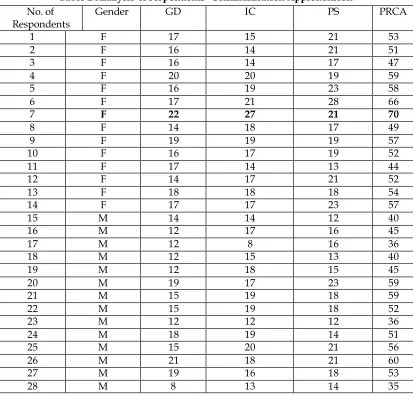
Table 2 illustrates the overall communication apprehension scores of the 32 respondents who completed the questionnaire. Analysis of the data shows that 12 (37.5%) of the total respondents in this study displayed CA scores of 54 and above in two or all three communicative areas. The highest score attained was 70 and the lowest was 18.
It is found that a total of 7 (50%) of the female respondents recorded an overall score of 54 and above, thus indicating CA in two or all three communicative areas. Conversely, only 5 (27.8%) of the male respondents achieved an overall score of 54 and above in those same areas. Hence, the frequency of female respondents who achieved high overall CA scores is more than their male counterparts. The findings of this study match other similar research by Frantz, Marlow & Wathen (2005). In their study, it was discovered that both male and female respondents experienced considerably different levels of communication apprehension. It is also established by Johnson and Faunce, (1973) that females expressed higher levels of apprehension when speaking in front of an audience.
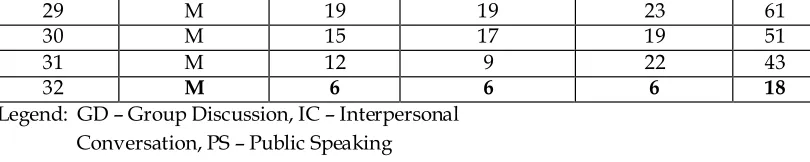
The data indicates that respondent number 7 (refer to Table 2), a female student from Indonesia, recorded the highest overall communication apprehension score, which is 70. It is evident that she has high communication apprehension level and this is further strengthened by the high scores she achieved in all three areas of communication: group discussion, interpersonal conversation and public speaking. This is attributed by the fact that this respondent did not receive any prior instruction in English in her native country. The respondent‘s only exposure to English in Malaysia is through the six months of language classes under the Intensive English Programme before registering for the degree
MJLTM Vol. 1, Issue 2, October 2011 programme. Poor command of the English language and a basic level of vocabulary may have contributed to her anxiety and meagre communication skills. Izzo (1981) emphasized that foreign language proficiency and communication achievement are greatly influenced by the time factor or length of exposure in the target language. The anxiety of speaking in a foreign language may also contribute towards making mistakes during oral communication as stressed in Price (1991) and Tunaboylu (1993). In contrast, the person with the lowest CA score is respondent number 32 (refer to Table 2). This male respondent from China obtained an overall CA score of 18 and does not display CA in any of the three communicative areas. Prior to coming to study in Malaysia, he studied English in his country for 5 years and he has an IELTS score of 5.5.
Table 2 Analysis of respondents’ Communication Apprehension
No. of Respondents
Gender GD IC PS PRCA
1 F 17 15 21 53
2 F 16 14 21 51
3 F 16 14 17 47
4 F 20 20 19 59
5 F 16 19 23 58
6 F 17 21 28 66
7 F 22 27 21 70
8 F 14 18 17 49
9 F 19 19 19 57
10 F 16 17 19 52
11 F 17 14 13 44
12 F 14 17 21 52
13 F 18 18 18 54
14 F 17 17 23 57
15 M 14 14 12 40
16 M 12 17 16 45
17 M 12 8 16 36
18 M 12 15 13 40
19 M 12 18 15 45
20 M 19 17 23 59
21 M 15 19 18 59
22 M 15 19 18 52
23 M 12 12 12 36
24 M 18 19 14 51
25 M 15 20 21 56
26 M 21 18 21 60
27 M 19 16 18 53
28 M 8 13 14 35
MJLTM Vol. 1, Issue 2, October 2011
29 M 19 19 23 61
30 M 15 17 19 51
31 M 12 9 22 43
32 M 6 6 6 18
Legend: GD – Group Discussion, IC – Interpersonal Conversation, PS – Public Speaking
The analysis of the respondents‘ Communication Apprehension based on the three main communicative areas is shown in Table 3. CA was recorded high in public speaking. Almost 62.5% respondents experienced CA in this area with 28 being the highest score out of the total 30. From this number, 11 were female respondents. Therefore, 11 (78.6%) out of 14 female respondents or displayed high CA for public speaking. This phenomenon is clearly stated by Aly and Islam (2005), who found that women experienced higher levels of CA than their male counterparts. McCroskey et al. (1999) pointed out that the above occurrence is further aggravated because most students are afraid to speak in public especially in front of the class. They become very nervous and anxious, thus affecting their oral presentation. On the other hand, the CA score for the section on interpersonal conversation was 46.9% or 15 respondents who achieved high CA. The rate of CA in conversations is smaller because of its informal, casual and stress-free nature as compared to the demanding skills of public speaking. The lowest percentage of CA was documented in the area of Group Discussions with only 9 (28.1%) respondents who experienced high CA when involved in group discussions. This may be attributed by the larger number of participants engaged in group discussions. Moreover, students with higher CA are usually overwhelmed by those who exhibit lower CA in the group from the perspective of frequency of talk time. This indirectly discourages students with higher CA from attempting to communicate in the group.
Table 3 The Analysis of respondents’ CA in three main communicative areas.
Communicative areas
Percentage of Communication Apprehension (%)
Group Discussion 28.1%
Interpersonal Conversation
46.9%
Public speaking 62.5%
MJLTM Vol. 1, Issue 2, October 2011
8. Recommendations
It is a challenge to totally eradicate the occurrence of CA in the language classroom. However, practical proactive activities can be implemented to reduce the detrimental effects of CA.
A less threatening language classroom environment should be formed for the students in order to ease their anxiety towards oral communication activities. A variety of classroom activities such as individual oral presentation, oral pair work, oral group discussion, should be adopted to inspire students to be more involved and active in class. This would indirectly make them less anxious in articulating their viewpoints. Delucchi (2006) mentions that irrespective of the students‘ differences in their language proficiencies and personalities, they are somehow able to function more effectively in groups because they can exchange more opinions and ideas. This is because they will feel less anxious than when they work alone. Krashen (1988) has suggested that learning English in a less apprehensive environment can produce effective learning.
In the milieu of similar research conducted, a study by N. Osman, S. Nayan & et al (2010) established that students‘ spoken skills developed because of collaborative learning activities. It was found that students were more excited, conversed more with each other and involved in group discussion effectively. This clearly shows that CA can be lowered via collaborative learning activities. These shared learning activities are able to motivate students to produce more ideas, and students are less anxious to express themselves in the class. Indirectly, it is able to increase their confidence level in oral communication.
P‘Rayan & Shetty (2008) proposed a few learner centred activities whereby the students can be encouraged to conduct self-reflection, group sharing and one to one sessions with their language instructor. For the group sharing activity, students are allocated groups and they share their communication anxiety or other issues pertaining to presenting in front of an audience and how they tried to overcome these challenges. Guidelines on how to monitor the group discussion can be provided for the students, in order to facilitate and ensure a smooth flowing discussion takes place. The teacher who plays the role of facilitator and also counsellor can invite students to slot in one to one sessions with the teacher so that they can help evaluate the student‘s ability to communicate effectively in different situations. Alternatively, students could be placed into groups based on their high CA scores in group discussion, interpersonal and public speaking. This learner centred guidance as proposed by P‘Rayan & Shetty (2008) enables students, who have achieved high scores in specific areas, have the opportunity to actively improve on their weaknesses.
MJLTM Vol. 1, Issue 2, October 2011 Finally, as teaching international students in an intercultural setting is an arduous task, teachers should be equipped with multicultural awareness, and they should be more knowledgeable on the educational, cultural and social issues affecting the learning processes of students who come from various parts of the world. With this background knowledge, teachers should be prepared to play a more effective and resourceful role in handling the diverse of learning styles of the students.
CONCLUSION
This study was conducted to investigate CA of international undergraduates in English language classrooms. The results of the study highlight the presence of CA among international undergraduates. It is the hope of the researchers, that the findings will inspire language teachers to measure their students‘ CA and employ the students‘ personal report of CA to assist them to overcome CA. Language teachers should persist to create a favourable environment that can help lessen CA for the students to warrant positive learning experiences.
References
Aly,I., & Islam, M. (1995). Factors affecting oral communication apprehension among
business students: An empirical study. The Journal of Ameri