Language Learning Histories and Learner Variables in an
MA TEFL Programme: A Well-being Perspective
Zainab Abolfazli Khonbi
PhD Candidate, Urmia University
Karim Sadeghi
1Associate Professor, Urmia University
Abstract
Highlighting the complex and dynamic nature of learning English as a Foreign Language (EFL) from the perspective of the well-being theory and following an intact group design, this study analyzed Iranian MA TEFL students' (N = 37) language learning histories with regard to their language learning strategy use, multiple intelligences, language learning aptitude, and resiliency. T-test revealed a few significant differences in the 24 components of well-being (VIA Institute of Character, 2014) in students' language learning histories between males and females. Qualitative analysis of ten students' coping strategies in negative circumstances showed that their language learning experiences included positive/negative emotions, meaningful engagement, relationships, and accomplishments albeit with some differences. Hierarchical multiple regression analysis revealed that learner variables play significant roles in shaping students' well-being. Detailed results along with discussions and implications for theory and practice are presented in the study.
Keywords: Complex Dynamic Systems, Language Learning History, Learner Variables, Well-being Theory
Received on 1 June, 2016 Accepted on December 14, 2016
1. Introduction
With regard to the importance of psychology in education and particularly the inclusion of different learner variables in a context of a complex dynamic system, Erikson (1950) proposed a theory of psychological development that he called 'humanism'. Humanistic psychology centers on individual's growth
Language Learning Histories …
and authenticity and offers theoretical roots for positive psychology (Linley, Joseph, Maltby, Harrington, & Wood, 2011). The theory has recently been used in the field of second/foreign language (S/FL) teaching and learning as a theoretical framework with some adaptations of the standard theory of well-being which fully captures the idea of complex dynamic systems (e.g., Oxford & Cuéllar, 2014). Dörnyei (2009) states that in any complex dynamic system, like language learning, "high-level mental attributes and functions are determined by a complex set of interconnected components that continuously evolve over time" (pp. 195-196) in an organic, holistic, nonlinear, interactive fashion (Mercer, 2011). The well-being theory uses the acronym PERMA to denote "positive emotion, engagement, meaning, positive relationships, and accomplishment" (Seligman, 2011, p. 12). PERMA includes 24 character strengths divided into six virtues by VIA Institute of Character (2014), namely, wisdom and knowledge (including creativity, curiosity, critical thinking, love of learning, and perspective), courage (including bravery, perseverance, authenticity, and zest), humanity (including love, kindness, and social intelligence), justice (including teamwork, fairness, and leadership), temperance (including forgiveness, humility, prudence, and self-regulation), and transcendence (including appreciation of beauty and excellence, gratitude, hope, humor, and spirituality). However, Oxford (2014) believed that PERMA elements are not independently definable and measureable and that they do not pay due attention to the influence of negative emotions, so she revised it and mapped the character strengths into four umbrella terms: positive and negative emotions, meaningful engagement, relationships, and accomplishment.
well-being. Within a cognitive information processing paradigm, LLA has been defined by Robinson (2005) as strengths that every learner might have in their cognitive abilities. These strengths are required for information processing both during second language learning process and for performance, in different contexts and at various stages. LLSs as defined by Oxford (1990) are "specific actions taken by the learner to make learning easier, faster, more enjoyable, more self-directed, more effective, and more transferable to new situations" (p. 8). Resiliency consists of "patterns of positive adaptation during or following significant adversity or risk" (Masten, Cutuli, Herbers, & Reed, 2011, p. 18). Finally, intelligence is not a single entity in itself but consists of various elements such as verbal comprehension, perceptual organization, working memory, and processing speed, among others (e.g., Fleetham, 2014). Intelligence was operationalized in the present research in the form of multiple intelligences (MI) defined as the innate ability of human beings to think, identify, analyze, and work out problems for specific purposes, under their own management and direction, in particular social-historical and physical contexts (Chongde & Tsingan, 2003). The present study was an attempt to identify the connections between these learner variables in light of the well-being theory. In so doing, this research was set to analyze Master of Arts (MA) in Teaching English as Foreign Language (TEFL) students' Language Learning Histories (LLHs); then investigated their LLA, LLS use, MI, and resiliency. This theory has not been investigated in the field of L2/FL teaching adequately so far (Oxford, 2014).
2. Literature Review
about one's choices; Self-regulation: Regulating what one feels and does; f) Transcendence [Strengths that forge connections to the larger universe and provide meaning]: Appreciation of beauty and excellence: Noticing and appreciating beauty and excellence and/or skilled performance in various domains of life, from nature to art, to mathematics to science to everyday experience: Gratitude: Being aware of and thankful for the good things that happen; Hope (Optimism); Expecting the best in the future and working to achieve it; Humor: Liking to laugh and tease; Spirituality: Having coherent beliefs about the higher purpose and meaning of universe.
Recently, following VIA Institute of Characters' (2014) framework of well-being, Oxford (2014) proposes a framework of well-being that includes four elements which she claims can be used to understand the well-being EFL students experience in their language learning histories. As she defines these four categories they include: a. positive/negative emotions (emotional responses): joy, interest, love, contentment, pride, happiness, gratitude, pleasure, eagerness, effort, feelings of success or failure, anticipatory tension, anxiety, sadness, self-retribution, disappointment, fatigue, and boredom; b. meaningful engagement (motivation, meaning, and commitment): intrinsic motivation, flow, self-determination, and investment; c. relationships: healthy interpersonal relationships; and d. accomplishments (achievements and strategies): the development of general proficiency in the L2, achievement in a particular curriculum or course, effective use of the language, self-regulated behavior, any other achievement related to L2 learning, the accomplishments are aided by the use of L2 learning strategies.
the inappropriate testing methods used to place students. Still one other main factor in every body's life is intelligence whose new theories view it as a synthesis of various elements (e.g., Gardner, 1999). Language learners also differ in their MI which greatly influences their learning success. With regard to learners' histories, when learners have to deal with especially negative experiences, the amount of resiliency each student may show really determines whether the student will cope with a bad event successfully or will let the traumatic consequences remain with him/her all through the life, especially as Oxford (2014) claims, occasionally a negative emotion serves as a helpful wake-up call to change something, particularly in resilient learners.
In an article which compared the language learning experiences of two extreme cases of English as a second language learners, Oxford (2014) found that under the adapted framework of well-being theory, the strategies and learners’ negative or positive responses to numerous difficulties and their consequences on their learning success can be accurately understood. She found that one of her participants was highly strategic and had a very positive language learning experience while the other was a less strategic learner and had long lasting response to a single traumatic situation. Only recently is positive psychology overtly being used as a theoretical framework particularly with some adaptations of the standard theory of well-being (e.g., Oxford & Cuéllar, 2014). In their study, Oxford and Cuéllar (2014) using the principles of positive psychology and narrative research, analyzed the language learning experiences of five language learners of Chinese. They applied Seligman's (2011) PERMA model and found language learning to be a major journey in self-discovery and tied richly to positive emotions, engagement, relationships, meaning, and accomplishment.
example, Wentzel (2007) explored students' cognitive representations of what they are trying to achieve. Her work showed how students' academic accomplishments are influenced by the integrated contribution of multiple social and academic goals, and in particular how the pursuit of nonacademic forms of competence such as social competence interacts positively with the development of academic competence. Her work also drew attention to the important role of social and emotional well-being in motivating learning, and stimulated research interest in exploring various social and academic goals in educational settings (e.g. Horst, Finney, & Barron, 2006). On the role of resiliency, some studies have shown that even children with disorders can achieve greater well-being and success if they are resilient (Kumar, Steer, & Gulab, 2010). In a context of secondary school in China where the well-being of students was found to be generally low as a result of academic pressure, Zhang (2016) studied implementing well-being oriented education which was aimed at relieving the academic pressure on students and to better support their learning and development. The researcher found that after three years of adopting positive expectation of student development through student-centered approach in curriculum adaptation, pedagogical design, staff development, and resource management, the students’ learning and well-being generally improved; however, the researcher elaborated that positive education practices expand beyond direct teaching of well-being skills.
have to deal with a range of language problems, cultural differences, personal issues, so on. Positive psychology, therefore, might provide some useful tools for professors and other responsible individuals to better understand learning needs of all students. Following the principles of well-being theory, the study was designed to find answers to the following questions:
1. What components of well-being theory appear in male versus female MA TEFL students' LLHs?
2. What are male versus female MA TEFL students' coping strategies in negative circumstances in their LLHs?
3. What role do learner variables of LLS use, MI, LLA, and resiliency play in shaping male versus female MA TEFL students' well-being? 3. Method
3.1 Participants
For the first and the third research questions, 37 MA TEFL students were selected through intact group sampling. They were within the age range of 22 to 27 and studied at Kashan (N = 10; 3 males, 7 females), Tabriz (N = 12; 3 males, 9 females), and Urmia (N = 15; 7 males, 8 females) universities (in Iran). However, in order to answer the second research question, only ten students' negative circumstances and coping strategies in their LLHs were analyzed for space considerations.
3.2 Instruments
The instruments that were used in this study included the following:
that makes sense, so a story is life that makes sense" (p. 15, authors' insertion).
b) A test of LLA (adapted Modern Language Aptitude Test, Carrol & Sapon, 1983) consisting of five parts, namely, number learning, phonetic script, spelling clues, words in sentences, and paired associates that were representative of a number of constructs underlying LLA. Carrol (1965) identified four key constructs in the LLA test, namely phonemic coding ability, grammatical sensitivity, inductive language-learning ability, and rote-learning ability.
c) An MI test (McKenzie, 1999) that included 90 items measuring nine types of intelligence, namely, natural, musical, logical-mathematical, existential, interpersonal, bodily-kinesthetic, verbal-linguistic, intrapersonal, and visual-spatial intelligences. Ten items were used to measure each type of intelligence.
d) An LLS use test including 50 Likert-scale items and some open-ended questions (Strategy Inventory for Language Learning, Oxford, 1990). It measured both direct and indirect strategies. The direct LLSs included memory strategies, compensation strategies, and cognitive strategies. The indirect strategies included metacognitive strategies, social strategies, and affective strategies.
e) A tailor-made resiliency test to measure preparation through hardiness, navigating successfully, bouncing back and recovery, and the extent of being body wise, managing energy, and building optimism (Citrin, 2012).
the best fit was accomplished and for reliability insurance, the data were coded several times with some intervals between the coding sessions (i.e., intrarater reliability).
3.3 Procedure
The study was of both qualitative (descriptive) and quantitative (inferential) nature. The students were requested to write as much as they wished about their language learning experiences including anything about actions, events, positive/negative emotions, struggles, and achievements as well as institutions that fostered or hindered their second language learning, and teachers, family members or others who influenced them. Generally speaking, they voluntarily wrote about what they thought the important aspects of their language learning experiences were. They also wrote about their strategies in coping with difficult and problematic circumstances, and were allowed to pinpoint any questions or concerns they had about their own second language learning and any lessons they personally learnt or answers they found to these questions. Then they were invited to take part in a resiliency survey and were given LLA, MI and LLS use questionnaires.
15-minute break, the LLA test was taken following detailed instructions in the manual. The test took nearly 30 minutes. The resiliency test was distributed after a few days and students were requested to read the instructions first and then to think about the statements in the test and indicate whether they agreed or disagreed with them. The task took approximately 20 minutes.
3.4 Data Analysis
First, following a grounded theory approach (Corbin & Strauss, 2007) and VIA Institute of Character's (2014) theory of well-being, the researchers identified as many detailed well-being elements as possible in MA TEFL students' LLHs. Also, after finding negative circumstances in students' LLHs and their coping strategies, comparisons were made among the emerging themes against the dimensions of Oxford's (2014) framework of well-being theory and attempts were made to find any close fit. A t-test was used to compare the two genders in terms of the components of well-being (in LLHs). Finally, a hierarchical multiple-regression analysis was conducted to find the power of independent variables (LLS use, MI, LLA, and resiliency in addition to gender) on students' well-being.
4. Results
4.1 Research Question 1: What components of well-being theory appear in male versus female MA TEFL students' LLHs?
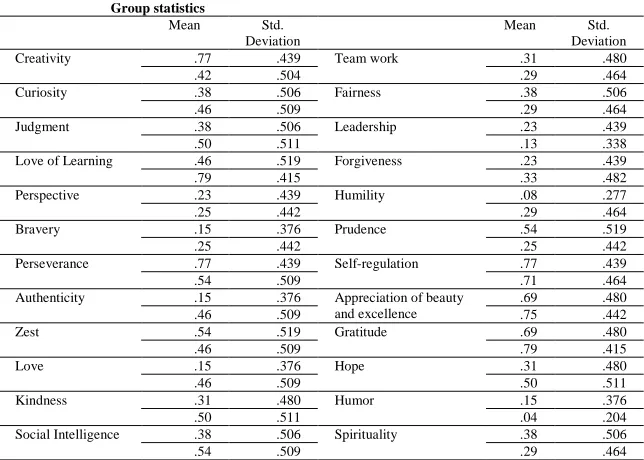
leadership, forgiveness, humility, humor, and spirituality. The first row in the second, third, fifth, and sixth columns presents data for males (N = 13) and the second one indicates data for females (N = 24). A score of one was given if an element was evident in student’s history and zero if none was evident, with the mean being .5.
Table 1
Group Statistics for The 24 Elements of Well-Being Across Gender Group statistics
Mean Std.
Deviation
Mean Std.
Deviation
Creativity .77 .439 Team work .31 .480
.42 .504 .29 .464
Curiosity .38 .506 Fairness .38 .506
.46 .509 .29 .464
Judgment .38 .506 Leadership .23 .439
.50 .511 .13 .338
Love of Learning .46 .519 Forgiveness .23 .439
.79 .415 .33 .482
Perspective .23 .439 Humility .08 .277
.25 .442 .29 .464
Bravery .15 .376 Prudence .54 .519
.25 .442 .25 .442
Perseverance .77 .439 Self-regulation .77 .439
.54 .509 .71 .464
Authenticity .15 .376 Appreciation of beauty
and excellence
.69 .480
.46 .509 .75 .442
Zest .54 .519 Gratitude .69 .480
.46 .509 .79 .415
Love .15 .376 Hope .31 .480
.46 .509 .50 .511
Kindness .31 .480 Humor .15 .376
.50 .511 .04 .204
Social Intelligence .38 .506 Spirituality .38 .506
.54 .509 .29 .464
Table 2
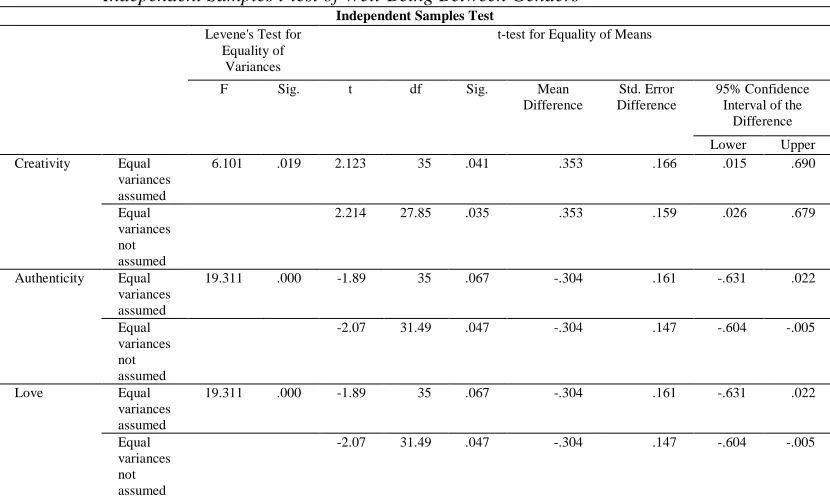
Independent Samples t-test of Well-Being Between Genders
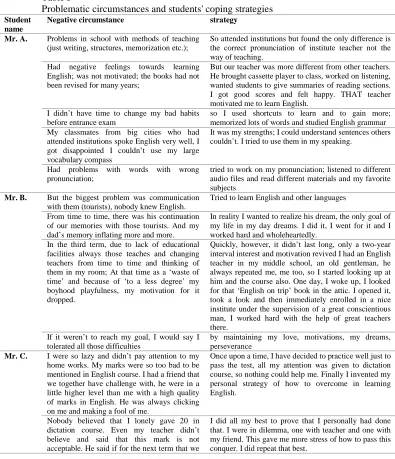
4.2 Research Question 2: What are male versus female MA TEFL students' coping strategies in negative circumstances in their LLHs? A snapshot of participants' coping strategies in negative circumstances is presented below, and for space considerations the whole histories are not provided. The statements are direct quotes taken from students' writings in their LLHs. In Table 3, the first column shows student’s codes, the second column indicates what the student believed was a problematic circumstance in the way of their language learning. The next column reveals student’s strategies in coping with the situation; and finally, the last column is the category of well-being which the researchers believed the student’s coping strategy belonged to.
Independent Samples Test
Levene's Test for Equality of
Variances
t-test for Equality of Means
F Sig. t df Sig. Mean
Difference
Std. Error Difference
95% Confidence Interval of the
Difference
Lower Upper
Creativity Equal
variances assumed
6.101 .019 2.123 35 .041 .353 .166 .015 .690
Equal variances not assumed
2.214 27.85 .035 .353 .159 .026 .679
Authenticity Equal
variances assumed
19.311 .000 -1.89 35 .067 -.304 .161 -.631 .022
Equal variances not assumed
-2.07 31.49 .047 -.304 .147 -.604 -.005
Love Equal
variances assumed
19.311 .000 -1.89 35 .067 -.304 .161 -.631 .022
Equal variances not assumed
Table 3
Problematic circumstances and students' coping strategies Student
name
Negative circumstance strategy
Mr. A. Problems in school with methods of teaching (just writing, structures, memorization etc.);
So attended institutions but found the only difference is the correct pronunciation of institute teacher not the way of teaching.
Had negative feelings towards learning English; was not motivated; the books had not been revised for many years;
But our teacher was more different from other teachers. He brought cassette player to class, worked on listening, wanted students to give summaries of reading sections. I got good scores and felt happy. THAT teacher motivated me to learn English.
I didn’t have time to change my bad habits before entrance exam
so I used shortcuts to learn and to gain more; memorized lots of words and studied English grammar My classmates from big cities who had
attended institutions spoke English very well, I got disappointed I couldn’t use my large vocabulary compass
It was my strengths; I could understand sentences others couldn’t. I tried to use them in my speaking.
Had problems with words with wrong pronunciation;
tried to work on my pronunciation; listened to different audio files and read different materials and my favorite subjects
Mr. B. But the biggest problem was communication with them (tourists), nobody knew English.
Tried to learn English and other languages
From time to time, there was his continuation of our memories with those tourists. And my dad’s memory inflating more and more.
In reality I wanted to realize his dream, the only goal of my life in my day dreams. I did it, I went for it and I worked hard and wholeheartedly.
In the third term, due to lack of educational facilities always those teaches and changing teachers from time to time and thinking of them in my room; At that time as a ‘waste of time’ and because of ‘to a less degree’ my boyhood playfulness, my motivation for it dropped.
Quickly, however, it didn’t last long, only a two-year interval interest and motivation revived I had an English teacher in my middle school, an old gentleman, he always repeated me, me too, so I started looking up at him and the course also. One day, I woke up, I looked for that ‘English on trip’ book in the attic. I opened it, took a look and then immediately enrolled in a nice institute under the supervision of a great conscientious man, I worked hard with the help of great teachers there.
If it weren’t to reach my goal, I would say I tolerated all those difficulties
by maintaining my love, motivations, my dreams, perseverance
Mr. C. I were so lazy and didn’t pay attention to my home works. My marks were so too bad to be mentioned in English course. I had a friend that we together have challenge with, he were in a little higher level than me with a high quality of marks in English. He was always clicking on me and making a fool of me.
Once upon a time, I have decided to practice well just to pass the test, all my attention was given to dictation course, so nothing could help me. Finally I invented my personal strategy of how to overcome in learning English.
Nobody believed that I lonely gave 20 in dictation course. Even my teacher didn’t believe and said that this mark is not acceptable. He said if for the next term that we
have dictation course I repeat this mark again; it will be counted on my list marks. If I cannot repeat that I will face a lot of tortures. This made my attitude a little weaken to English. Ms. D. It was really important for me to improve my
listening comprehension Had problems with listening.
I was stressful about listening comprehension task in class but I liked reading and writing tasks.
I started doing different tasks, sometimes it was stressful but I pushed myself to do it and now I think it worked/ works.
By asking my friend’s strategies;
I usually talk with my friends who were my classmates in language school. It was full of funny learning events. about strange or different language structures
and vocabulary
I tried to create different stories and even funny theories to persuade myself
About difficult and problematic circumstances in general
And emotionally I used to repeat positive points and statements about my learning and my future and I used to think that after hard days of studying there would be good days of success.
Ms. E. But the condition was not very suitable (for studying) because God gave me a baby
But when my boy was 4 years old, I decided to go to university;
I have studied for THE conquer about 4 months then I was accepted in university of X.
Ms. F. In that class I was not so friendly with the students and that was a problem.
What helped me the most in language learning was reading short stories and input from teachers and professors at university in BA and M.A. My accent and my speaking was OK up to
starting my job as a teacher.
After that because I had to teach English to elementary learners and exposed with them and I had to spend much time preparing myself for their classes and speaking simplified, my English got worst, my accent disappeared, my speaking got worst, most of the words I knew I forgot because I didn’t use them.
But now I have intermediate classes and I have to speak more and use more complicated structures and I attend university classes which is a great input for me, my English improved a little bit
In a short period, I watched BBC world news which was great but after a while I didn’t have enough time to do that because of my university courses and institute classes
No speaking opportunity; I just used English classes and university classes Ms. G. At that time I hated too much homework or not
having much time to play with my friends. At the first session of my English class I was frightened, because my classmates were 15, 16 years old and I was only 7.
My dictation was very bad, At the end of the term, my father encouraged me to listen to the course tapes more than 10 times, it was right and my score was 100 and that was an unforgettable experience for me.
Generally speaking And about my behavior and personality, I became more tolerant of unknown things in every area and even I can say it increases my emotions toward literature and poetry
Sometimes I cannot really make others understand my aim and intention
I use English words and sometimes it is the same about Persian.
Ms. H. So I did so, and I went to these classes without even knowing what was its use but
I learnt English as a process of time passing
In the time when my university admission exam arrived, I just wanted to study for the medicine but I got known that I have no interest to study that course
But my brother came to me and said that you can be more successful if you continue in your own course and continue your English courses in a higher level of academic
At first I got somehow disappointed why to choose these courses that has lots of volunteers
but later, I got used to these situation and I soon find myself and my talents to overcome those obstacles, Ms. I. When I was at high school I didn’t like my
English teacher, so I hated English She didn’t encourage me to study more On that time we just remembered a list of words and conversations and repeated them It was meaningless to me and I was wondering about its use and benefit
At the age of 18 I got married and stopped my studies
As I was a good student, my family stated that you are clever why you stopped your studies especially my mother.
My emotions become passionate when she persisted me I decided to attend university entrance exam,
I accepted and started to learn English. But I was working and studying at the same
time
I wasn’t interested in English enough.
Also I didn’t make much effort to learn English. It was for the sake of grade
As a result, it took a long time for me to become graduate
After two years I became familiar with Mr. X who was the dean of an institute
I liked his way of speaking English. He spoke like native English and very fluent
I decided to become similar to him
It was an arduous task.
I encountered countless difficulties in studying English by myself
But I was constantly and strongly encouraged by my mother
Ms. J. There were also some negative points in my language learning experience like I remember my English teacher in junior high school (guidance school) who had terrible pronunciation (I can dare to say that some of the students’ pronunciations were much better than her).
The only way to teach English was by memorizing vocabularies and grammar rules and translating to Farsi and (you know better like GTM).
Despite this funny (to me it was funny but to other students it was OK) method, I tried to have my own way: I used to make sentences with the new vocabularies and grammatical points and use them in writing and speaking (I gave myself a topic and then started to use as many new words and grammars as possible)
We had a video player but the American actors talked so fast that I couldn’t follow them
But at least I could check my listening and pronunciation with simple words. I could watch some English cartoons
I felt really happy because they spoke slower and used simple words that I could understand almost many of them
1.Problems with teacher: Teaching methods (course content)/; Teacher's terrible pronunciation/Teacher's threat; did not know the use and benefit of this way of learning English; Did not know the use of English classes etc.: Meaningful engagement/ Accomplishment 2. Problems with the educational system: Books were not revised for
many years; Lack of educational facilities: (Relying on teachers' creative teaching techniques)/Meaningful engagement
3. Problems in learning: Difficulty with listening; Strange or difficult language components; No speaking opportunity; Bad dictation; Couldn't follow native speakers' speaking speed; did not try much; didn’t pay attention to home works/ bad marks; learnt it as a process of passing time, so on: Accomplishment/ Meaningful engagement/ positive emotions
4. Problems with peers: Comparing themselves with more capable peers; Had challenge with a friend; Being smaller than classmates frightened her etc.: Meaningful engagement
5. Problems with social-communication skills: Difficulties in communicating in English; No friendly relationship; Difficulties in conveying messages to others, so on.: Positive emotions/ Accomplishment
6. Negative emotions: Hated too much home work; Negative feelings towards learning/ no motivation/ no time to change bad habits; His father’s negative reminders; Negative change in attitude towards English etc.: Positive emotions/ Meaningful engagement
7. Difficult circumstances in general: positive emotions
The four elements of Oxford's (2014) framework derived from students' histories included the following items:
1. Positive emotions: Motivation from teacher/ knowledge of one's strength; Tried to learn English and other languages/ got help under the supervision of a great conscientious man/ maintaining love, motivation, dreams, and perseverance; decided to practice well; input from teachers helped her; father's encouragements; got more feedback from teachers; became passionate/Mr. X's way of speaking; felt happy etc.
more proficient; Tried to have her own way of learning (used to make sentences with new words and grammatical points in writing and speaking/ checked her listening and pronunciation with simple words etc.
3. Meaningful engagement: Attending institutions/using alternate ways of learning like shortcuts; wanted to realize his father's dreams/ worked hard; invented a personal strategy; became more motivated etc.
4. Relationships: Asking friends' strategies etc.
As the data in Table 3 showed, in the first place, all the students had experienced negative circumstances in their LLHs so far which may be quite understandable as the result of the first question showed they had scores below mean on some elements of well-being. These negative conditions would be more severe for some and less severe for others. In coping with these difficult circumstances, the students used a variety of strategies, all of which were explainable by Oxford's framework of well-being. It is also clear that most of the time, students used more than one strategy in dealing with a problem. The participating students mainly used accomplishment, meaningful engagement, and positive emotions in dealing with negative circumstances in their LLHs while relationships had a small chance of being applied.
4.3 Research Question 3: Do learner variables of LLS use, LLA,
MI, and resiliency play any significant role in shaping male
versus female MA TEFL students' well-being?
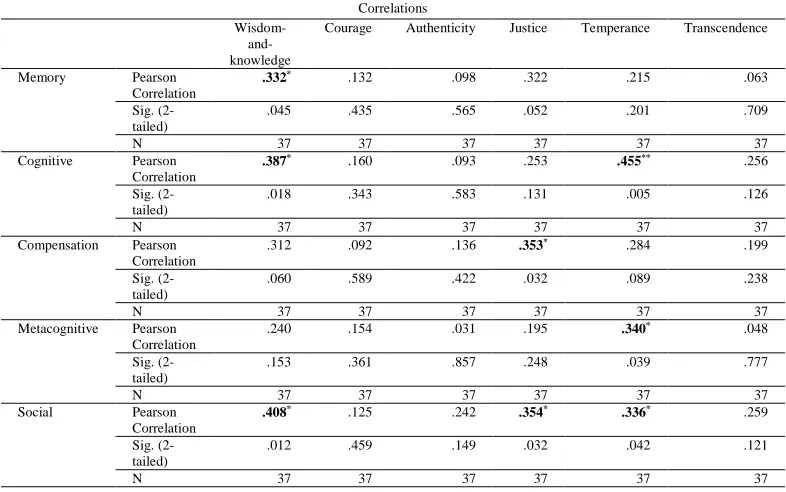
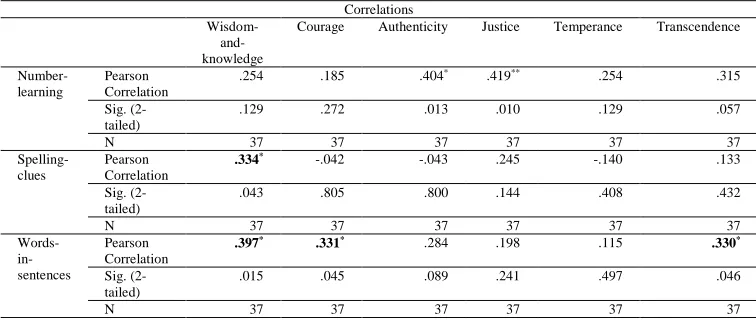
Before running the regression analysis, a series of Pearson Product-moment correlations were carried out to check for the potential associations among the six virtues of well-being and the parts of LLS, MI, LLA, and resiliency, whose results are presented in Tables 4, 5, 6, and 7, respectively. As the tables show, some cases of significant correlations were found among virtues and parts of LLS, MI, and LLA, and all virtues were found to be correlated with resiliency. For space considerations, the tables include statistics on elements with significant correlations only.
Table 4
Correlations Among Virtues and LLS Categories
Correlations
Wisdom- and-knowledge
Courage Authenticity Justice Temperance Transcendence
Memory Pearson
Correlation
.332* .132 .098 .322 .215 .063
Sig. (2-tailed)
.045 .435 .565 .052 .201 .709
N 37 37 37 37 37 37
Cognitive Pearson
Correlation
.387* .160 .093 .253 .455** .256
Sig. (2-tailed)
.018 .343 .583 .131 .005 .126
N 37 37 37 37 37 37
Compensation Pearson
Correlation
.312 .092 .136 .353* .284 .199
Sig. (2-tailed)
.060 .589 .422 .032 .089 .238
N 37 37 37 37 37 37
Metacognitive Pearson
Correlation
.240 .154 .031 .195 .340* .048
Sig. (2-tailed)
.153 .361 .857 .248 .039 .777
N 37 37 37 37 37 37
Social Pearson
Correlation
.408* .125 .242 .354* .336* .259
Sig. (2-tailed)
.012 .459 .149 .032 .042 .121
Table 5
Correlations among virtues and MI types Correlations
Wisdom- and-knowledge
Courage Authenticity Justice Temperance Transcendence
Logical-mathematical
Pearson Correlation
.107 .236 .250 .100 .374* .193
Sig. (2-tailed)
.530 .160 .136 .555 .023 .252
N 37 37 37 37 37 37
Existential Pearson
Correlation
.222 .298 .310 .162 .381* .238
Sig. (2-tailed)
.187 .073 .062 .337 .020 .156
N 37 37 37 37 37 37
Interpersonal Pearson Correlation
.156 .180 .328* .312 .255 .173
Sig. (2-tailed)
.356 .285 .047 .060 .128 .306
N 37 37 37 37 37 37
Bodily-kinesthetic
Pearson Correlation
.362* .295 .207 .249 .326* .243
Sig. (2-tailed)
.027 .077 .218 .138 .049 .148
N 37 37 37 37 37 37
Verbal-linguistic
Pearson Correlation
.335* .152 .225 .316 .305 .265
Sig. (2-tailed)
.043 .370 .180 .057 .067 .113
N 37 37 37 37 37 37
Intra-personal
Pearson Correlation
.292 .009 .278 .293 .442** .180
Sig. (2-tailed)
.080 .957 .095 .078 .006 .286
N 37 37 37 37 37 37
Visual-spatial
Pearson Correlation
.425** .227 .433** .225 .469** .309
Sig. (2-tailed)
.009 .177 .007 .180 .003 .063
Table 6
Correlations Among Virtues and LLA Parts
Correlations
Wisdom- and-knowledge
Courage Authenticity Justice Temperance Transcendence
Number-learning
Pearson Correlation
.254 .185 .404* .419** .254 .315
Sig. (2-tailed)
.129 .272 .013 .010 .129 .057
N 37 37 37 37 37 37
Spelling-clues
Pearson Correlation
.334* -.042 -.043 .245 -.140 .133
Sig. (2-tailed)
.043 .805 .800 .144 .408 .432
N 37 37 37 37 37 37
Words- in-sentences
Pearson Correlation
.397* .331* .284 .198 .115 .330*
Sig. (2-tailed)
.015 .045 .089 .241 .497 .046
N 37 37 37 37 37 37
Table 7
Correlations Between Virtues and Resiliency
Wisdom- and-knowledge
Courage Authenticity Justice Temperance Transcendence
Resiliency Pearson
Correlation
.517** .381* .388* .361* .508** .341*
Sig. (2-tailed)
.001 .020 .018 .028 .001 .039
N 37 37 37 37 37 37
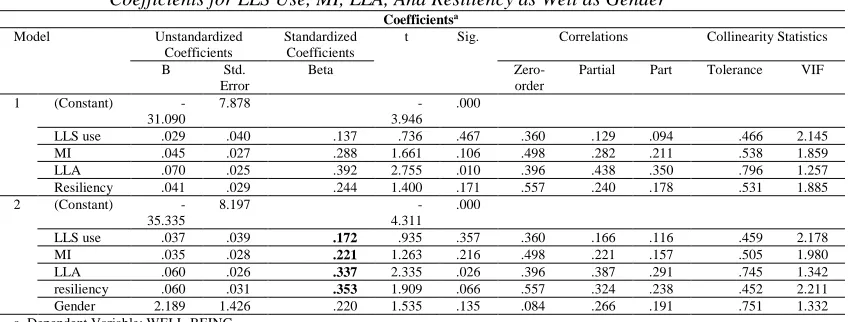
As for the third research question, hierarchical multiple regression was carried out to assess the power of four control measures (i.e., the tests of LLS use, MI, LLA, and resiliency to affect students’ well-being) after controlling for the influence of students' gender. Preliminary analyses showed no violation of assumptions of normality, linearity, multicollinearity, and homoscendasticity.
after controlling for gender, R square change = .03, F change (1, 31) = .2.35, P>.05. In the final model, only the four control measures were statistically significant, with resiliency (beta = 35, P > .05), language learning aptitude (beta = .33, P < .05), multiple intelligences (beta = .22, P > .05), and language learning strategy use (beta = .17, P > .05), recording the highest to the lowest beta values, respectively. The following three tables are the results of this stage of analysis.
Table 4
Model Summary for the Two Models of LLS Use, MI, LLA, And Resiliency as Well as Gender and Well-being
Model Summaryc
Model R R
Square
Adjusted R Square
Std. Error of the Estimate
Change Statistics R
Square Change
F Change
df1 df2 Sig. F
Change
1 .696a .484 .419 3.664 .484 7.498 4 32 .000
2 .721b .520 .443 3.588 .036 2.356 1 31 .135
a. Predictors: (Constant), Resiliency, LLA, MI, LLS use b. Predictors: (Constant), Resiliency, LLA, MI, LLS use, Gender c. Dependent Variable: WELL-BEING
Table 9
ANOVA Results for the two Models of LLS Use, MI, LLA, and Resiliency, as Well as Gender, and Well-being
ANOVAa
Model Sum of Squares df Mean Square F Sig.
1 Regression 402.518 4 100.630 7.498 .000b
Residual 429.482 32 13.421
Total 832.000 36
2 Regression 432.859 5 86.572 6.724 .000c
Residual 399.141 31 12.876
Total 832.000 36
a. Dependent Variable: WELL-BEING
Table 10
Coefficients for LLS Use, MI, LLA, And Resiliency as Well as Gender Coefficientsa
Model Unstandardized
Coefficients
Standardized Coefficients
t Sig. Correlations Collinearity Statistics
B Std.
Error
Beta
Zero-order
Partial Part Tolerance VIF
1 (Constant)
-31.090
7.878
-3.946 .000
LLS use .029 .040 .137 .736 .467 .360 .129 .094 .466 2.145
MI .045 .027 .288 1.661 .106 .498 .282 .211 .538 1.859
LLA .070 .025 .392 2.755 .010 .396 .438 .350 .796 1.257
Resiliency .041 .029 .244 1.400 .171 .557 .240 .178 .531 1.885
2 (Constant)
-35.335
8.197
-4.311 .000
LLS use .037 .039 .172 .935 .357 .360 .166 .116 .459 2.178
MI .035 .028 .221 1.263 .216 .498 .221 .157 .505 1.980
LLA .060 .026 .337 2.335 .026 .396 .387 .291 .745 1.342
resiliency .060 .031 .353 1.909 .066 .557 .324 .238 .452 2.211
Gender 2.189 1.426 .220 1.535 .135 .084 .266 .191 .751 1.332
a. Dependent Variable: WELL-BEING
5. Discussion
that these four learner variables, but not gender, could contribute to MA TEFL students' well-being.
As far as this study focused on students' LLHs rather than their life histories, it can be said that the low well-being may be due to some academic pressure. University, the curriculum, or at least some courses might be threatening to students' well-being. A large number of studies which looked at language difficulties and cultural challenges faced by the students highlight a number of issues such as second or foreign language problems (e.g., Park & Son, 2011), different learning styles (Biggs, 2003) and socio-cultural problems and adjustments (Purdie, O'Donoghue, & Rosa, 1998) to be sources of reduced well-being. In a study on Chinese students’ well-being, Zhang (2016) also found students suffer from low general well-being. Further, the study found males to be more capable of creativity perhaps since naturally, males from childhood are more interested in manipulating objects and using more of their left brain capacities than females, so this strength may have a place devoted to the left hemisphere of the brain. Additionally, the last part of the analysis showed males were higher users of cognitive strategies and resiliency so it may happen cognitive strategies have something to do with creativity or that cognitive LLS use, resiliency, and creativity might be in some ways interrelated.
more positive emotions and again in a chain-like model, these three elements were practiced rather than using healthy relationships with others. Furthermore, the participating students in general might have valued more self-managed strategies for improvement rather than relying on relationships or asking help from others. Intrinsically-motivated learners are well-directed and tend to work hard and make effort to improve themselves with the help of their own interior reasons: they have self-knowledge and awareness, enjoy energy, vitality, and activity, and have active life with meaningful work (e.g., Keyes, 2007). This may also be related to external factors like environment, educational context, even the contribution of religious matters, so on. As Larsen-Freeman and Cameron (2008) claim, in any complex dynamic system, just like language learning, context is not separate from other elements but part of the system and its complexity. Dewaele and MacIntyre (2014) resonate a similar claim that cultural background affects scores on enjoyment and anxiety measures of students. In line with Dörnyei's (2009) and Merce's (2011) claim about the complex dynamic nature of the entire language learning process or any kind of learning for that matter, the results of the study clearly confirm the idea of complex dynamic systems, since learner variables are quite complex systems which are shaped by the influence of many underlying variables interacting with each other in complex ways that are dynamic with their influences, relationships, and interactions within and among themselves changing over time (e.g., Ellis & Larsen-Freeman, 2009).
Oxford (2014) and Truebridge (2014) agree with saying that particularly in resilient learners occasionally a negative emotion serves as a wake-up call. Oxford’s classification worked well in distinguishing coping strategies in negative circumstances, yet in most of the cases, students applied more than one strategy to cope with the problematic circumstances, an issue which cannot be explained by Oxford's framework. The research also found a few new categories not included in Oxford’s classification, like, (students D's third problem) hope or positive indoctrinate, or feeling of hatred (like G's and I’s first problems), or tolerance (G's fourth problem), or even getting used to something (H's third problem's coping strategy), and finally, feelings of hardship (I's last problem). Likewise, Oxford et al. (2015) found factors like hope, bilingual identity, and hardiness in six Costa Rican university language students’ histories which are not stated in Oxford's (2014) framework. Researchers in this study also found it difficult to separate feelings of failure (negative emotions) from problems with development (accomplishment). These are one issue in a sense, but Oxford has included them in separate categories (G's and I's third problems and J's last problem whose positive experience is concerned, in which case, we might say these are examples of feelings of success, but real academic achievements can be called accomplishments). The study also found Oxford's framework did not describe what should be said when students used two categories of one element for coping with problematic situations (e.g., once effort and feelings of success, and once gratitude both in dealing with one problem as is the case for F's second problem, or another case would be G's third problem and so on).
interrelated themes in their participants' histories, this study found meaningful engagement, accomplishment, positive emotions, but to a lesser degree relationships to exist in students' language learning experiences especially because they used them as coping strategies in difficult circumstances.
and motivation, c) perseverance, including resilience and hope, d) agency and autonomy, e) time, f) habits of mind, g) intelligences, h) character strengths, and i) self-factors, especially, self-efficacy. Also resiliency as defined bouncing back and recovery or preparation through hardiness (e.g. Citrin, 2012), would more be related to students' coping strategies in negative circumstances rather than their general well-being. Kumar et al. (2010) found a relationship between resiliency and well-being even if their participants were children with disorders; and other studies conducted on well-being, identity and self-esteem (Ushioda, 2009), well-being and locus of control (White, 1959), well-being and anxiety (Marcos-Llinas & Juan Garau, 2009), well-being and motivation (Csíkszentmihályi, 2013), well-being and social relationships (MacIntyre & Mercer, 2014) have found relationships between their variables of study. Similarly, Neethu and Snathosh (2014) in a comparison of spiritual well-being between teachers who implement multiple intelligences in their classrooms and those who do not found teachers who adopt MI rank higher both in their job satisfaction and their spiritual well-being and indeed there is a positive relationship between these two elements. Positive relationships were also found between critical thinking ability and spiritual intelligence and indeed the former is found to predict the latter between Iranian EFL teachers (Azizi & Azizi, 2015).
examined. Experimental designs could be developed where one group would receive well-being-based instruction and the other a placebo and then comparisons could be made. Future researchers may conduct experiments on the effect of learner variables such as language and cultural background, prior knowledge, LLS, MI, LLA, resiliency, rate of learning or instructional time, and attitudes towards their technical field on their coping strategies in negative circumstances. Insightful results may be revealed through distributing ready-made well-being questionnaires or measures and then investigate the impact of learner variables on students' well-being. Observation-based longitudinal studies on students' histories may produce more reliable results than following self-report procedures. Program evaluations can also be carried out in terms of the 24 character strengths comprising well-being to see whether they are encouraged in the field or not while the results of this study found variables which could influence learning and indeed considered in most of TEFL programs have the power to contribute to well-being.
raising issues concerning programming for students with special needs, multicultural education, and second language learning. To put it in a nutshell, the results of this research are applicable in managing language learning/teaching programs, wherein the well-being of students would be considered in all aspects of teaching and assessment and wherein teaching would not follow the one-size-fits-all metaphor. In establishing visions and setting directions from the first step of developing such a program (i.e., needs analysis) to syllabus design to administration to time tabling to classroom practice to student involvement to grading to assessment of students' learning and to the evaluation of the program, the well-being principles should all be taken into account. The analyses of students' language learning histories could also provide insights for facilitating decisions regarding programme development, implementation, and evaluation. For example, all-round assessment techniques can be provided instead of merely judging a student’s performance based on academic achievement (Sha, 2005). The society and government can also be educated about how the universities can implement well-being-based instructions and more support can be sought from them. It is believed that if psychology in the form of a relaxing and positive university environment for students is considered in all areas of education including TEFL, curriculum developers will be able to provide more beneficial programs to students which will best help them achieve their full potentials and which will improve teachers' well-being as well.
6. Conclusion
however, differences were found. Problematic circumstances had also been observed in students' histories where students' coping strategies proved efficient. Learner variables of LLS use, MI, LLA, and resiliency were found of significance in shaping students' well-being. Just like the idea of spider's web proposed by Morris (2011), this study found multiple variables interacting at different layers in the learning history of a student and that life cannot be divided neatly into categories is the claim which well explains the results of the study. As to the importance of well-being and learner variables in students' histories, it is recommended that in order to provide really effective instruction it may be appropriate to mobilize a school-based team where some specialists, including professors, technology experts, programme developers, administrators among others would have advanced training in how to use recent trends in technology, psychology, and education to design, administer, and apply relevant educational curriculum and how to help professors, parents, and others validly interpret the results of such programmes.
References
Azizi, M., & Azizi, A. (2015). Exploring the relationship between EFL teachers' critical thinking and their spiritual intelligence. International Journal of Language Learning and Applied Linguistics World, 9(2), 119-130.
Biggs, J. (2003). Teaching international students. In J. Biggs (Ed.), Teaching for quality learning at university (pp. 121–140). Buckingham, England: Open University Press.
Carrol, J. (1965). The prediction of success in foreign language training. In R. Glaser (ed.), Training, research, and education. New York: Wiley. Carrol, J. B., & Sapon, S. M. (1983). Language learning aptitude test
(MLAT): Manual. New York: The Psychological Corporation Harcourt Brace Jovanovich, Inc.
Chongde, L., & Tsingan, L. (2003). Multiple intelligence and the structure of thinking. Theory and Psychology,13(6), 829-845.
Citrin, R. (2012). The resilience advantage questionnaire. Citrin Consulting, Retrieved from http://citrinconsulting.com/Downloads/The-Resilience-Advantage-Questionnaire.pdf
Corbin, J., & Strauss, A. (2007). Basics of qualitative research (3rd ed.).
Thousand Oaks, CA: Sage.
Dewaele, J-M. & MacIntyre, P. (2014). The two faces of Janus? Anxiety and enjoyment in the foreign language classroom. Studies in Second Language Learning and Teaching, 4(2), 237-274.
Diener, E. (2011). Positive psychology: past, present, and future. In S. J. Lopez, & C. R. Snyder (Eds.), The Oxford handbook of positive psychology (pp. 7-11). New York: Oxford University Press.
Dörnyei, Z. (2005). The psychology of the language learner: Individual differences in second language acquisition. Mahwah, NJ: Erlbaum. Dörnyei, Z. (2009). The psychology of second language acquisition. Oxford:
Oxford University Press.
Elias, M., & Haynes, N. (2008). Social competence, social support, and academic achievement in minority, low-income, urban elementary school children. School Psychology Quarterly, 23, 474-495.
Ellis, N. C., & Larsen-Freeman, D. (2009). Language as a complex adaptive system. UK: Wiley-Blackwell.
Ellis, R. (1997). Second language acquisition. Oxford: Oxford University Press.
Erikson, E. H. (1950). Childhood and society. New York: Norton.
Fleetham, M. (2014). Pocket PAL: Multiple intelligences. United Kingdom: Bloomsbury Education.
Gao, Z. (2009). Exploring students' pressures in the new basic education curriculum reform. The Science Education Article Collects, 5, 51.
Gardner, H. (1999). Intelligence reframed: Multiple intelligences for the 21st
century. New York: Basic Books.
Griffin, J. (1986). Well-being: Its meaning, measurement and moral significance. New York: Oxford University Press.
Keyes, C. (2007). Promoting and protecting mental health as flourishing: A complementary strategy for improving national mental health. American Psychologist, 62(2), 95-108.
Kumar, G., Steer, R. A., & Gulab, N. A. (2010). Profiles of personal R in child and adolescent psychiatric inpatients. Journal of Psycho-educational Assessment, 28, 315–325.
Linley, P. A., Joseph, S., Maltby, J., Harrington, S., & Wood, A. M. (2011). Positive psychology applications. In S. J. Lopez, & C. R. Snyder (Eds.), The Oxford handbook of positive psychology (pp. 35-47). New York: Oxford University Press.
Lovat, T., Toomey, R., & Clement, N. (2010). International research handbook on values education and student well-being. New York. Springer.
MacIntyre, P., & Mercer, S. (2014). Introducing positive psychology to SLA. Studies in Second Language Learning and Teaching, 4(2), 153-172. McKenzie, W. (1999). Multiple intelligence inventory. Surfaquarium
Consulting. Retrieved from http://surfaquarium.com/MI/inventory.htm. Marcos-Llinas, M., & Juan Garau, M. (2009). Effects of language anxiety on
three proficiency-level courses of Spanish as a foreign language. Foreign Language Annals, 42(1), 94-111.
Martel, Y. (2011). Beatrice and Virgil: A novel. New York: Spiegel & Grau. Masten, A. S., Cutuli, J. J., Herbers, J. E., & Reed, M.G. J. (2011). Resiliency
in development. In S. J. Lopez, & C. R. Snyder (Eds.), The Oxford handbook of positive psychology (pp. 117-131). New York: Oxford University Press.
Mercer, S. (2011). The self as a complex dynamic system. Studies in Second Language Learning and Teaching, 1(1), 57 - 82.
Morris, I. (2011). Teaching happiness and well-Being in schools: Learning to ride elephants. New York: Continuum International Publishing Group. Neethu, S., & Santhosh, K. R. (2014). Spiritual well-being and job
satisfaction in teachers who adopt multiple intelligence methods in their inclusive classrooms. Periyar University Journal of Psychology, 2(1&2), 68-73.
Oxford, R. L. (1990). Language learning strategies: What every teacher should know. New York: Newbury House/Harper & Row.
Oxford, R. L. (2014). What we can learn about strategies, language learning, and life from two extreme cases: The role of well-being theory. Studies in Second Language Learning and Teaching. 4(4). 593-615.
Oxford, R. L. (2013). Understanding language learner narratives. In J. Arnold & T. Murphey (Eds.), Meaningful action: Earl Stevick's influence on language teaching (pp. 95-110). Cambridge: Cambridge University Press. Oxford, R. L., & Cuéllar, L. (2014). Positive psychology in cross-cultural narratives: Mexican students discover themselves while learning Chinese. Studies in Second Language Learning and Teaching, 4, 173-203.
Psychology Perspectives on Foreign Language Learning and Teaching (pp. 21-37). New York: Springer.
Oxford, R. L., Acuna, G. P., Hernandez, & Smith, A. L. (2015). A language is a mentality: A narrative, positive psychological view of six learners’ development of bilingualism. System, 55, 100-110.
Park, S.-S., & Son, J.-B. (2011). Language difficulties and cultural challenges of international students in an Australian university preparation program. In A. Dashwood & J.-B. Son (Eds.), Language, culture and social connectedness (pp. 35–55). Newcastle upon Tyne, England: Cambridge Scholars Publishing.
Parfit, D. (1984). ‘What makes a person’s life go best?’ in reasons and persons. New York: Oxford University Press.
Purdie, N., O’Donoghue, T. A., & Rosa, C. S. (1998). Goals and coping behaviours: The development of a model for international students. Queensland Journal of Educational Research, 14(2), 29–56.
Qian, Y. (2012). On the lack of happiness in education: Reading "Classics of Chinese education: Guided Readings". Examinations Weekly, 59, 166– 167 (in Chinese).
Robinson, P. (2005). Aptitude and second language acquisition. Annual Review of Applied Linguistics, 25, 46-73.
Seligman, M. E. P. (2011). Flourish: A visionary new understanding of happiness and well-being. New York: Atria/Simon & Schuster.
Sha, H. (2005). Education: For the happiness of human being. Beijing: Education & Science Press (in Chinese).
Truebridge, S. (2014). Resilience begins with beliefs: Building on student strengths for success in school. New York: Teachers College Press. Ushioda, E. (2009). A person-in-context relational view of emergent
motivation and identity. In Z. Dörnyei& E. Ushioda (Eds.), Motivation, language identity, and the L2 self (pp. 215-228). Bristol: Multilingual Matters.
VIA Institute of Character. (2014). VIA classification of character strengths. Retrieved from http://www.viacharacter.org/www/Character-Strengths/VIAClassification
Wentzel, K.R. (2007). Peer relationships, motivation, and academic performance at school. In Elliot, A. J. and Dweck, C.S. (Eds.), Handbook of Competence and Motivation (pp. 279-96). New York/London: The Guilford Press.