Relationship between the Level of Physical Activity and
Nutritional Status with Fatigue in Elderly Residents of
Rest Homes in Tehran
Bakhtyar Tartibian1Core Research Head of Health Physiology and Physical Activity, Associate Professor of Exercise Physiology, Faculty of Physical Education and Sport Sciences,
Allameh Tabataba'i University, Tehran, Iran
Mehdi Kushkestani* Shiva Ebrahimpour Nosrani
Mohsen Parvani
M.Sc. Student of Exercise Physiology, Faculty of Physical Education and Sport Sciences, Allameh Tabataba'i University, Tehran, Iran
Received: January 29, 2020; Accepted: March 01,2020
doi:10.22054/nass.2020.10761 Abstract
Purpose: Aging is a complex process of physiological and social changes that leads to disease, disability, and the lower experience of happiness. On the other hand, fatigue is one of the most important indicators of aging syndrome. This study aimed to investigate the relationship between the level of physical activity and fatigue in elderly residents of rest homes in Tehran. Method: This was a descriptive correlational study in which 20 rest homes located in Tehran province constituted the study population. By visiting rest homes, the eligible subjects were chosen. Physical activity was measured by the Physical Activity Scale for the Elderly (PASE). The FACIT Fatigue Scale is a short, 13-item, easy to administer tool that measures an individual’s level of fatigue during their usual daily activities over the past week. Nutritional status was evaluated by mini nutritional assessment (MNA). Results: The results of statistical analysis indicated a significant and positive correlation between PASE and FACIT scores (r=0.48, p<0.01) while, there was a significant negative correlation between FACIT score and age (r=-0.23, p<0.01). Also, there was a significant positive correlation between MNA and FACIT (r=0.40, p<0.01). In addition, a significant positive correlation was found between MNA and PASE score (r=0.31, p<0.01). Conclusions: The findings of this study indicate that holding sports classes under the supervision of exercise physiologists is an essential matter to increase health and prevent age-related complications in elderly residents of Tehran rest homes.
Keywords:Geriatric syndrome, Exercise, Tehran, Health, Aging
1 * Author’s e-mail: [email protected] (Corresponding Author);
INTRODUCTION
Aging is a complex process of physiological and social changes that
leads to disease, disability, the lower experience of happiness (Khazaee‐
Pool, Sadeghi, Majlessi & Rahimi Foroushani, 2015), a gradual decrease in functional ability, individual changes, and mortality (Sadrollahi, Hosseinian, Alavi, Khalili & Esalatmanesh, 2016). In recent years, social and economic changes, as well as the development of various sciences have greatly reduced the age-related deaths which is the most important cause of an increase in the elderly population worldwide (Oh, Kim, Martins & Kim, 2006). Iran is one of the developing countries that its elderly population has been increasing rapidly due to the significant decline in fertility and higher life expectancy (Noroozian, 2012). In addition, it is expected that the population of people aged 65 and older will increase from 5.7% in 2011 to 9.7% in 2030 and 25.2% in 2060 (Noroozian, 2012). On the other hand, the “geriatric syndrome" phrase is used to diagnose the clinical conditions of the elderly, which shows independent signs of diseases. The most common conditions experienced by the elderly are fatigue, frailty, falls, delirium, urinary incontinence, and syncope, which are classified as subsets of the aging syndrome. Studies have shown that different individuals display different kinds of symptoms (Inouye, Studenski, Tinetti & Kuchel, 2007).
Also, it is considered as one of the predicting factors for movement disorders (Avlund, Damsgaard, Sakari-Rantala, Laukkanen & Schroll, 2002) and mortality (Avlund, Schultz-Larsen & Davidsen, 1998) in the elderly. In addition, it has been reported that fatigue is a hallmark of various diseases, such as cancer and MS, meanwhile, it accounts for secondary agents in many other diseases. As a result, elderly people with chronic diseases have a greater risk of experiencing fatigue (Egerton, Chastin, Stensvold & Helbostad, 2016). In the other word, malnutrition, which is characterized by an imbalance in energy consumption, causes changes in shape, body composition, as well as a decline in physical and mental performance (Al-Rasheed et al., 2018).
Studies have shown that malnutrition affects about 24 percent of the home-dwelling elderly and 51 percent of the elderly in the rehabilitation centers (Alzahrani & Alamri, 2017). Another term, malnutrition in turn reduces body mass and increases fat mass (Al-Rasheed et al., 2018). Nutritional status also is closely associated with physical efficiency with aging (Alipanah et al., 2009). The benefits of physical activity and exercise in improving physical function, quality of life and prevention of various diseases have been established in many studies (Kushkestani, Parvani, Ebrahimpour Nosrani & Bathaeezadeh, 2020). According to world health organization reports, exercise is a safe and cost-effective solution to prevent loss of functional capacity in the elderly (Tartibian, Kushkestani & Ebrahimpour Nosrani, 2019; WHO, 2007). Also, recently the important role of exercise in the prevention, control and treatment of frailty, chronic diseases, and age-related negative changes have been shown in numerous studies (Cvecka et al., 2015). Furthermore, the effects of exercise in the elderly include the increase of independency, self-care, self-esteem, quality of life, life expectancy and reduction of mortality.
with fatigue levels in the elderly residents of the rest homes. Therefore, the purpose of this study was to better understand the relationship between fatigue and physical activity levels in elderly living in rest homes. Meanwhile, the ultimate purpose of this study was to use the results for holding sports classes and providing an appropriate diet to prevent and control the aging complications such as fatigue among the elderly living in the rest homes of Tehran.
METHOD
Subjects
This was a descriptive correlational study conducted from October to December in 2018 at 10 rest homes located in Tehran province. The sample size using the Cochran formula was set to 131 with confidence level of 95%, p = 0.05. However, 121 individuals qualified following inclusion and exclusion criteria. By visiting rest homes, the eligible subjects were chosen. The inclusion criteria were: age above 65 years and live in rest home for more than 3 months. The exclusion criteria included: suffering dementia and Alzheimer; having severe hearing, speech and vision deficit; BMI lower than 17 kg/m2, unable to interview and infection diseases. Consent forms were taken, then the subjects were interviewed to collect the data.
Anthropometric measurement
The height of subjects was measured to the nearest 0.1 cm by wall-sticker tape meter while subjects were standing as straight as possible with their back against the wall and with shoes removed. Subjects’ weight was measured by OMRON digital scanner with 0.01 g sensitivity and light clothing and no shoes. BMI was calculated as weight (kg)/height squared
(m2). Waist and hip circumferences were measured to the nearest
millimeter using a tape meter. Waist-hip ratio (WHR) was calculated as waist circumference (cm) at the narrowest point divided by hip circumference (cm) at the maximum point.
Physical activity
household activities (e.g. housework, gardening), and 1 item assesses paid or volunteer employment. It uses frequency, duration, and intensity level of activity over the previous week to assign a score, ranging from 0 to 793, with higher scores indicating greater physical activity. The Persian version of PASE was found to have high internal validity (Cronbach’s alpha 0.97).
Fatigue
The FACIT Fatigue Scale is a short, 13-item, easy to administer tool that measures an individual’s level of fatigue during their usual daily activities over the past week. The level of fatigue is measured on a four-point Likert scale (4 = not at all fatigued to 0 = very much fatigued) with higher scores indicating less fatigue. The Persian version of FACIT Fatigue Scale was found to have high internal validity (Cronbach’s alpha = 0.891) (Ghaneh Ezzabadi, Maghsoudi & Beigomi, 2015).
Malnutrition
The risk of malnutrition in elderly people was measured by Mini Nutritional Assessment (MNA); a reliable screening test which consists of 18 items divided into 6 screening questions and 12 assessment questions. In current study, screening questions were used to distinguish subjects who are malnourished (<7 points) or at the risk of malnutrition (8-11 points) or well nourished (>12 points). MNA has been translated and validated in Persian and is being used in several countries (Ghazi et al., 2015).
Statistical analysis
The collected data were analyzed in SPSS 21 at the significant level of P<0.05. We used Kolmogorov-Smirnov test, for normality of data distribution. Descriptive analysis for socio-demographic variables was
performed using frequencies (n), percentage (%) and meanSd.
activity groups. Also, Bonferroni test was performed to determine differences between physical activity groups.
RESULTS
The characteristics of the elderly are summarized in Table 1. The mean
age of subjects was 72.3010 and had a mean BMI of 26.926.58, which
is considered overweight. As presented in table 2, weight (P<0.05), height (P<0.05), education (P<0.05), MNA (P<0.01) and PASE (p<0.01) scores in the low level of fatigue (LLF) group were significantly more than the high level of fatigue (HLF) group whilst, age (P<0.05) was significantly lower in the LLF group.
The results of Pearson correlation coefficientindicated a significant
and positive correlation between FACIT with MNA (r=0.406, p<0.01) and PASE (r=0.481, p<0.01) scores. Also, there was a significant and positive correlation between weight and FACIT (r=0.279, p<0.01) score while a negative significant correlation was found between age and FACIT score (r=-0.233, P<0.01). In addition, there was a significant and positive correlation between PASE and MNA score(r=0.310, p<0.01). However, there was a negative correlation between age and PASE score (r=-0.256, p<0.01).
In addition, there was a significant positive correlation between MNA score and BMI. The results of the correlation between age, BMI, PASE, MNA and FACIT score are presented in Table 3. We used hierarchical regression analysis to control the intervening variables, such as age and education. Table 4 showed that about 17% of the alterations
in FACIT scores (∆R2=0.177, p <.001) results from PASE scores. The
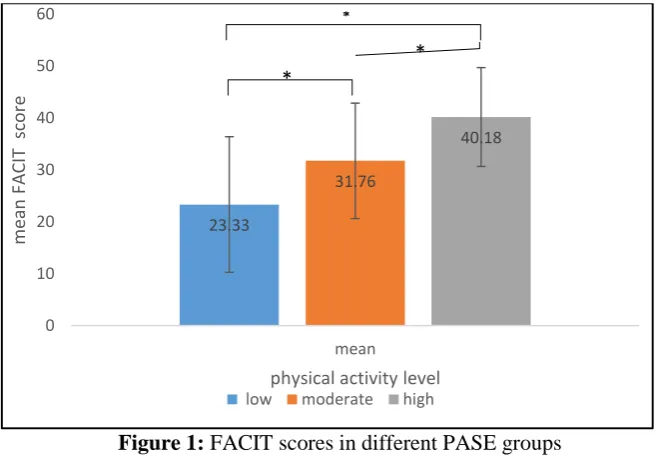
elderlies were divided into low (N=39), moderate (N=42) and high (N=40) PASE score groups to compare FACIT scores precisely. The results of ANCOVA test showed that there was a significant difference in FACIT score between the three physical activity levels (F=15.811, p<0.01).
Table 1: Basic characteristics of subjects
Variables Mean±SD Edu. level N (%)
Age (yrs) 72.3010.23
Height (cm) 155.5310.78
Weight (kg) 63.0114.21
BMI (kg/m2) 26.926.58
WHR 0.900.07
HR (bpm) 76.9916.37
SBP (mmHg) 134.4124.37
DBP (mmHg) 82.7514.60
Education
Not literate 30 (24.79%)
Primary school 31 (25.61%)
Middle school/
diploma 42 (34.71%)
Bachelor 13 (10.74%)
Master/PhD 5 (4.13%)
BMI: Body mass index, WHR: Waist-hip ratio, SBP: Systolic blood pressure, DBP: Diastolic blood pressure, HR: Heart rate
Table 2: Characteristics differences between low and high level of fatigue groups
variables
Fatigue ≥ 30 (LLF group)
N (73)
Fatigue < 30 (HLF group)
N (48)
P
Age (years) 72.36 76.15 0.022*
Weight (kg) 64.79 58.79 0.017*
Height (cm) 157.16 151.46 0.003*
WHR (cm) 0.899 0.904 0.713
BMI (kg/m2) 27.53 25.97 0.198
MNA 73 48 0.000**
PASE 51.10 18.17 0.000**
Table 3: The correlation between different variables of the subjects
Age Weight BMI MNA PASE FACIT Education
Age P 0.007** 0.059 0.280 0.003** 0.010** 0.049*
R 1 -0.243 -0.172 -0.099 -0.256 -0.233 -0.179
weight P 0.001** 0.001** 0.114 0.002** 0.420
R 1 0.586 0.368 0.145 0.279 0.074
BMI P 0.001** 0.393 0.336 0.014*
R 1 0.358 0.078 0.088 -0.223
MNA P 0.001** 0.001** 0.518
R 1 0.310 0.406 0.059
PASE P 0.001** 0.002**
R 1 0.481 0.284
FACIT P 0.001**
R 1 0.370
Education P 1
R
* Correlation is significant at the 0.005 level (2-tailed). ** Correlation is significant at the 0.001 level (2-tailed).
Table 4: Hierarchical Regression for variables predicting prolonged fatigue
Model R R2 Adjusted R2 ∆R2 ∆F sig
1 0.406a 0.165 0.151 0.111 15.687 0.001**
2 0.585b 0.343 0.326 0.177 31.584 0.001** a predictors (constant), age, education
Figure 1: FACIT scores in different PASE groups
DISCUSSION
In the present study, there was a negative and significant correlation between age and FACIT score (fatigue) in elderly living in rest homes. In fact, with an increase in age, the level of fatigue increases too. Also, in the HLF group the mean age was significantly higher than the LLF group. Our findings are consistent with Åkerstedt, Discacciati, Miley-Åkerstedt & Westerlund (2018). It has been well established that the negative changes such as the decrease of physical and mental function (Fried et al., 2001), disability, fatigue, and many other symptoms tend to increase with age which is known as a geriatric syndrome (Inouye, Studenski, Tinetti & Kuchel, 2007). However, the cause of many of these symptoms is still unknown. It has also been well demonstrated that elderly resident of nursing homes are more likely to develop physical and mental dysfunction and fatigue due to less mobility than elderly living homes (Soyuer & Şenol, 2011; Engberg, Segerstedt, Waller, Wennberg & Eliasson, 2017).
In the present study, a positive and strong correlation was found between the PASE (level of physical activity) and FACIT score in elderly living in rest homes. In addition, in the HLF group, the mean PASE score was significantly higher than the LLF group. Our findings are in line
23.33
31.76
40.18
0 10 20 30 40 50 60
mean
m
ean
FAC
IT
sc
o
re
physical activity level
low moderate high
*
with the Soyuer and Şenol in 2011, and Egerton, Chastin, Stensvold and Helbostad in 2016. Regarding the lifestyle of the elderly who live in the rest home, it can be argued that the decline in physical function and serious disability is due to the lower levels of physical activity which is one of the most important signs of fatigue in these individuals. Also, it has been observed that the elderly residents of rest homes have lower physical activity levels than other elderly people. In addition, most of them would prefer to do their daily tasks the same as walking, family gathering and shopping rather than do the exercise (Stewart et al., 2001). Goggin & Marrow (2001) reported that 89 percent of Americans ages 65 and older are aware of exercise benefits however, 69 percent of them do not have enough participation in physical activities. In the present study, a positive and strong correlation was found between MNA (malnutrition status) with and FACIT score in elderly living in rest homes (P<0.000). In addition, in the HLF group, the mean MNA score was significantly lower than the LLF group (P<0.000). In a simple term, malnutrition is associated with a poor diet or deficiency of micronutrient which results in reduced levels of physical activity and more fatigue. Thus,
physiologically, undernutrition causes depletion of body fat stores,
muscle deterioration, and symptoms such as fatigue or tiredness
(Furman, 2006). Many factors including malnutrition play an important
the home. It seems, aging and malnutrition are associated with a decrease in the health and physical function of the elderly, which gradually leads to an increase in dependency in daily tasks, decreased quality of life, and ultimately a decline in physical activity levels (Papparotto, Bidoli & Palese, 2013).
CONCLUSIONS
The findings of this study indicate that holding sports classes under the supervision of exercise physiologists is an essential matter to increase health and prevent the age-related complications in elderly residents of Tehran rest homes.
REFERENCES
Åkerstedt, T., Discacciati, A., Miley-Åkerstedt, A., & Westerlund, H. (2018). Aging and the change in fatigue and sleep–a longitudinal study across 8 years in three age groups. Frontiers in psychology, 9, 234, 1-8. 10.3389/fpsyg.2018.00234
Alipanah, N., Varadhan, R., Sun, K., Ferrucci, L., Fried, L. P., & Semba, R. D. (2009). Low serum carotenoids are associated with a decline in walking speed in older women. JNHA-The Journal of Nutrition, Health and Aging,
13(3), 170-175. doi.org/10.1007/s12603-009-0053-6
Al-Rasheed, R., Alrasheedi, R., Johani, R., Alrashidi, H., Almaimany, B., Alshalawi, B., ... & Alqadheb, A. (2018). Malnutrition in elderly and its relation to depression. Int. J. Community Med. Public Health, 5(6), 2156-2160. 10.18203/2394-6040.ijcmph20181974
Alzahrani, S. H., & Alamri, S. H. (2017). Prevalence of malnutrition and associated factors among hospitalized elderly patients in King Abdulaziz University Hospital, Jeddah, Saudi Arabia. BMC geriatrics, 17, 136, 1-7. 10.1186/s12877-017-0527-z
Avlund, K., Damsgaard, M. T., Sakari-Rantala, R., Laukkanen, P., & Schroll, M. (2002). Tiredness in daily activities among nondisabled old people as determinant of onset of disability. Journal of clinical epidemiology,
55(10), 965-973. 10.1016/S0895-4356(02)00463-8
Avlund, K., Schultz-Larsen, K., & Davidsen, M. (1998). Tiredness in daily activities at age 70 as a predictor of mortality during the next 10 years.
Journal of clinical epidemiology, 51(4), 323-333. 10.1016/S0895-4356(97)00296-5
Cvecka, J., Tirpakova, V., Sedliak, M., Kern, H., Mayr, W., & Hamar, D. (2015). Physical activity in elderly. European journal of translational myology, 25(4), 249-252. 10.4081/ejtm.2015.5280
Egerton, T., Chastin, S. F., Stensvold, D., & Helbostad, J. L. (2016). Fatigue may contribute to reduced physical activity among older people: an observational study. Journals of Gerontology Series A: Biomedical Sciences and Medical Sciences, 71(5), 670-676. 10.1093/gerona/glv150 Engberg, I., Segerstedt, J., Waller, G., Wennberg, P., & Eliasson, M. (2017).
Fatigue in the general population-associations to age, sex, socioeconomic status, physical activity, sitting time and self-rated health: the northern Sweden MONICA study 2014. BMC public health, 17(1), 654, 1-9. 10.1186/s12889-017-4623-y
Fried, L. P., Ferrucci, L., Darer, J., Williamson, J. D., & Anderson, G. (2004). Untangling the concepts of disability, frailty, and comorbidity: implications for improved targeting and care. The Journals of Gerontology Series A: Biological Sciences and Medical Sciences, 59(3), M255-M263. 10.1093/gerona/59.3.M255
Fried, L. P., Tangen, C. M., Walston, J., Newman, A. B., Hirsch, C., Gottdiener, J., ... & McBurnie, M. A. (2001). Frailty in older adults: evidence for a phenotype. The Journals of Gerontology Series A: Biological Sciences and Medical Sciences, 56(3), M146-M157. 10.1093/gerona/56.3.M146 Furman, E. F. (2006). Undernutrition in older adults across the continuum of
care: nutritional assessment, barriers, and interventions. Journal of gerontological nursing, 32(1), 22-27. 10.3928/0098-9134-20060101-11 Ghaneh Ezzabadi, S., Maghsoudi, Z., & Beigomi, A. (2015). Validity and
Reliability of the Functional Assessment of Chronic Illness Treatment (FACIT) Fatigue Scale in a Persian-Speaking Aging Population. Elderly Health Journal, 1(1), 32-35. Retrieved from https://www.sid.ir/en/journal/ViewPaper.aspx?ID=490825.
Ghazi, L., Fereshtehnejad, S. M., Abbasi Fard, S., Sadeghi, M., Shahidi, G. A., & Lökk, J. (2015). Mini Nutritional Assessment (MNA) is rather a reliable and valid instrument to assess nutritional status in Iranian healthy adults and elderly with a chronic disease. Ecology of food and nutrition, 54(4), 342-357. 10.1080/03670244.2014.994743
Inouye, S. K., Studenski, S., Tinetti, M. E., & Kuchel, G. A. (2007). Geriatric Syndromes: Clinical, Research, and Policy Implications of a Core Geriatric Concept: (See Editorial Comments by Dr. William Hazzard on pp 794–796). Journal of the American Geriatrics Society, 55(5), 780-791. 10.1111/j.1532-5415.2007.01156.x
Khazaee‐Pool, M., Sadeghi, R., Majlessi, F., & Rahimi Foroushani, A. (2015). Effects of physical exercise programme on happiness among older people.
Journal of psychiatric and mental health nursing, 22(1), 47-57. 10.1111/jpm.12168
Kushkestani, M., Parvani, M., Ebrahimpour Nosrani, S., Bathaeezadeh Y. (2020). The relationship between drug use, sleep quality and quality of life in dormitory students at Allameh Tabataba’i University, Iran. Population Medicine. 2(2), 1-7. doi:10.18332/popmed/115799
Noroozian, M. (2012). The elderly population in Iran: an ever growing concern in the health system. Iranian journal of psychiatry and behavioral sciences, 6(2), 1-6.
Oh, J., Kim, H. S., Martins, D., & Kim, H. (2006). A study of elder abuse in Korea. International journal of nursing studies, 43(2), 203-214. 10.1016/j.ijnurstu.2005.03.005
Papparotto, C., Bidoli, E., & Palese, A. (2013). Risk factors associated with malnutrition in older adults living in Italian nursing homes: a cross-sectional study. Research in gerontological nursing, 6(3), 187-197. 10.3928/19404921-20130528-01
Rolland, Y., Van Kan, G. A., Benetos, A., Blain, H., Bonnefoy, M., Chassagne, P., ... & Piette, F. (2008). Frailty, osteoporosis and hip fracture: causes, consequences and therapeutic perspectives. The Journal of Nutrition Health and Aging, 12(5), a319-a330. 10.1007/BF02982665
Sadrollahi, A., Hosseinian, M., Alavi, N. M., Khalili, Z., & Esalatmanesh, S. (2016). Physical activity patterns in the elderly kashan population. Iranian Red Crescent Medical Journal, 18(6). e25008.
Soyuer, F., & Şenol, V. (2011). Fatigue and physical activity levels of 65 and over older people living in rest home. International Journal of Gerontology, 5(1), 13-16. 10.1016/j.ijge.2011.01.003
Tartibian, B., Kushkestani, M., & Ebrahimpour Nosrani, S. (2019). The Effect of 12-Week Endurance Training on Lipid Profiles and Fat Percentage of Overweight Girls. New Approaches in Sport Sciences, 1(1), 189-200. doi:10.22054/nass.2019.10134
Valentini, A., Federici, M., Cianfarani, M. A., Tarantino, U., & Bertoli, A. (2018). Frailty and nutritional status in older people: the Mini Nutritional Assessment as a screening tool for the identification of frail subjects.
Clinical interventions in aging, 13, 1631, 1237-1244. 10.2147/CIA.S164174
Washburn, R. A., Smith, K. W., Jette, A. M., & Janney, C. A. (1993). The Physical Activity Scale for the Elderly (PASE): development and evaluation. Journal of clinical epidemiology, 46(2), 153-162. 10.1016/0895-4356(93)90053-4
Washburn, R. A., Smith, K. W., Jette, A. M., & Janney, C. A. (1993). The Physical Activity Scale for the Elderly (PASE): development and evaluation. Journal of clinical epidemiology, 46(2), 153-162. 10.1016/0895-4356(93)90053-4
Wick, J., & LaFleur, J. (2007). Fatigue: implications for the elderly. The Consultant Pharmacist®, 22(7), 566-578. 10.4140/TCP.n.2007.566 World Health Organization. (2007). A guide for population-based approaches