The Relationship of Consumers Perceived Hedonic Value and Behavior
Asta Kazakeviciute, Jurate Banyte
Kaunas University of Technology
K. Donelaicio st. 73, LT-44029, Kaunas, Lithuania
e-mail: [email protected], [email protected]
http://dx.doi.org/10.5755/j01.ee.23.5.1975
Hedonism and its impact on consumers’ behavior had become an important object of various scientific researches during the past 50 years in marketing literature. It should be noted that current level of theoretical and empirical researches on phenomenon of hedonism in the theory of consumer behavior notes that hedonism as the expression of value has not been sufficiently analyzed. Theoretical and empirical studies have demonstrated the lack of complex models integrating the relations of factors affecting hedonic value and consumers’ behavior, behavioral outcomes.
The scientific problem of this article is formulated with the help of the following questions: what factors determine consumers’ perceived hedonic value and how, according to it, consumers’ behavior varies?
The objective of the article: to prepare a conceptual model of the relationship of consumers’ perceived hedonic value and behavior that reveals main factors of the hedonic value and their affected direct and mediatory relations between hedonic value and consumer behavior.
The performed analysis of scientific literature revealed the importance of cognition of the hedonic value and value factors. In this article three potential value factors were identified – social, emotional and epistemic. It was realized that each of value factors could influence consumer behavior and behavioral intentions. Therefore, having analyzed scientific literature, the authors of the article prepared a conceptual model of relationship of consumers’ perceived hedonic value and behavior. In the conceptual model, direct and indirect relations among value factors (social, emotional and epistemic), hedonic value, consumers’ perceived satisfaction and future behavioral intentions are analyzed. Considering theoretical findings, there are recommendations for future researches and empirical testing of conceptual model proposed.
Keywords: consumer behavior, shopping, hedonism, consumers’ perceived value, hedonic value.
Introduction
The buying process has become a crucial part of the consumers’ life that changes concerning the constant changes of the environment. This aspect of the consumer behavior is very relevant for representatives of the retail sector: the buying process or participation in this process is not initiated because of the main function – satisfaction of material needs - but because hedonic aspect of the buying process is becoming more and more important.
Growing competitiveness forces retailers to estimate current marketing strategies and means of their implementation; and ability to identify specific features of buying process and consumer behavior more often is considered as the tool to gain competitive advantages in retail market. Concerning this reason, lately in the discussions of researches and practicians predominant attitude that not only utilitarian but also hedonic aspect of consumer behavior significantly influences buying process becomes the focus of attention of competitive participants of the retail market and the relevant object of the consumer behavior researches. The current level of researches of the hedonism phenomenon in the theory of consumer behavior (Hirschman & Holbrook, 1982; Batra & Ahtola, 1990; Fan & Xiao, 1998; Stoel et al., 2004; Guido, 2006; Wesley et al.,
2006; Kang & Park-Poaps, 2009; Watchravesringkan et al.,
2009) reveals that hedonism as the expression of perceived
consumer behavior is one of the least researched areas of hedonic consumer behavior.
During performed theoretical analysis four areas of consumer behavior researches which observe the phenomenon of hedonism were identified:
• Hedonic and utilitarian shopping motives; • Typology of hedonists and utilitarians;
• Impact of emotions, senses and fantasies on buying process;
• Expression of hedonic and utilitarian features in different categories of products.
Despite the fact that all four areas are closely interrelated and there are a lot of studies, it is clear that so far hedonic consumer’s decision-making style and hedonism as the form of consumers’ perceived value are not sufficiently researched. According to (Babin et al.,
1994; Wertenbroch & Dhara, 2000), hedonism as a form of consumers’ perceived value should reveal consumers’ perceived value that would not be based on achieving objectives and explain the poorly analyzed area of consumer behavior.
consumers’ perceived hedonic value and how do these factors affect variation of the consumer behavior?
The object of the article – the expression of consumers’ perceived hedonic value in behavior.
The objective of the article - to prepare a conceptual model of the relationship of consumers’ perceived hedonic value and behavior that reveals main factors of the hedonic value and their affected direct and mediatory relations between hedonic value and consumer behavior.
The article was prepared by using systematic and comparative analysis of scientific literature.
The construct of hedonism in the context of researches of consumers perceived value The concept of hedonism
In the consumer behavior researches that are dedicated for analysis of buying phenomenon two directions exist. The representatives of the first one propose a theory that buying is motivated by personal factors, meanwhile other researches focus attention to more holistic, hedonic and utilitarian shopping motives (Guido, 2006).
It is pointed out that utilitarian and hedonic aspects of shopping have huge impact on buying process in the recent researches. Utilitarian aspect of buying process is related to demand to purchase particular product and / or service and hedonic aspect includes various different shopping motives that are related to seeking of pleasure (Kang & Park-Poaps, 2010).
Hedonic and utilitarian aspects of consumer behavior are defined variously in scientific literature. The objective of hedonic shopping process is related to achieved satisfaction and pleasure, e.g. stimulation of joy, entertainment, fantasies and senses but not a purchase of particular product and / or service. This means that hedonic shopping aspect usually is displayed through joy which is felt by using purchased product or through pleasure and new experiences gained while shopping (Wertenbroch & Dhar, 2000; Arnold & Reynolds, 2003; Kim, 2006; Cardoso & Pinto, 2010; Ballantine et al., 2010). The “success” of buying process is measured by subjective emotional and aesthetical approach.
The revealed results of scientific researches of hedonism have cleared out that shoppers mostly could be divided into two types – hedonists and utilitarians. Considering to these shoppers cardinally different approach to buying process, it is assumed that hedonists and utilitarians understand differently a perceived shopping value – as a result hedonic and utilitarian values are identified.
The concept of consumers’ perceived hedonic value
Consumers’ perceived value is considered as one of the main aspects of retail differentiation because it defines believes and wants of consumers, their expectations after shopping and during consumption of purchased products. The creation and conveyance of value to consumer is becoming a part of marketing strategy in retail market companies (Rintamaki et al., 2006; Turel et al., 2010). Depending on the situation, first of all, the importance of knowledge of perceived value is emphasized – researchers
are encouraged to analyze possible beginnings of the value and its conceptualization.
The definition of value is multiple - different researchers interpret it variously. In scientific literature it is agreed that the conceptualization of value could vary dependably on the context of the performed research (Babin et al., 1994). Rintamaki et al., (2006) support this opinion and claim that the variety of perceived value definitions should not surprise because all marketing researches propose their results after performed researches and analysis in different environments. According to Babin
et al., (1994), in Zeithaml, (1988) identified four possible definitions of the value concept:
• Value is price. This definition simply equates value with price. Interestingly, early philosophers (prior to the sixteenth century) also viewed value and price isomorphically.
• Value is what I get for what I give. Value plays a key role in the exchange process by representing the trade-off between costs and benefits.
• Value is ratio of quality and price. This definition is more specific.Value generally takes the role of important intervening variable caused directly by consumer perceptions of quality, sacrifice, and product's intrinsic and extrinsic attributes and resulting in product choice.
• Value – all quantitative, qualitative, subjective, objective factors that create and / or determine buying experience. This definition recognizes explicitly value's subjective nature. Value is provided by the whole shopping experience, not simply by product acquisition.
According to Rintamaki et al., (2006) and Chen, Hu (2010) this conceptualization of value is the most universe and widely used in scientific literature, the definition of the value is changing alongside changing consumers‘ behavior and environment. This consideration explains the variety of suggested value definitions in the scientific literature.
Analyzing different concepts of customer’s perceived value it is noticeable that despite the wide variety of possible definitions of value (for example, functional value, symbolic value, and emotional value) all of them could be divided to one of two universal value concepts (Chen & Hu, 2010). The origin of motives of the buying process initiation has a huge impact on consumers’ perceived value that could be functional (utilitarian) or nonfunctional (hedonic).
Summing up arguments of researches of consumer behavior, critical approach to consumers’ perceived value concept’s interpretation is identified. Chen & Hu, (2010) noticed that perceived value could not be analyzed as complex despite the fact that all value definitions are universally accepted in science literature. Hirschman and Holbrook (1982) also agree that each conceptualization of value is right and relevant in the specific context but unambiguously objective approach that concentrates attention to functional features of product, price and direct benefits could be too limited.
researches. Therefore, it is important to estimate subjective value of buying process – consumers’ perceived value should be estimated not only by functional perspective (utilitarian) but also closely related to hedonic aspect of buying process.
The performed analysis of the conceptualizations of hedonic and utilitarian values in scientific literature (Holbrook & Hirschman, 1982; Overby & Lee, 2006; Seo & Lee, 2008; Carpenter & Moore, 2009; Kim & Han, 2011) revealed that:
• Consumers’ perceived hedonic value is more subjective and personal than utilitarian and usually is obtained by entertainments, playfulness but not by implementation of tasks;
• The whole of experienced arousal, perceived freedom, experiences gained (social, cognitive, and emotional) could be identified as the consumers’ perceived hedonic value.
• Hedonic value could be achieved without purchasing particular product or even only initiating buying process.
Theoretical analysis of factors that affect consumers perceived hedonic value and their expression in consumer behavior
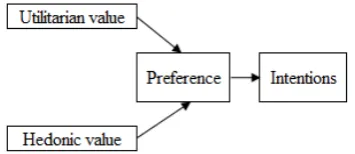
Ryu et al., (2010) state that majority of researches have found out the close relation of consumers’ perceived hedonic and utilitarian values and important consumption variables, for example, consumers’ behavioral intentions, satisfaction and directly influenced preferences and results (Overby & Lee, 2006), therefore, determine which retailer will be chosen the first (Figure 1).
Figure 1. The relation of consumers’ perceived value, preferences and future intentions (Overby & Lee, 2006)
Relations shown in Figure 1 reveal the influence of consumers’ preferences of particular retailer or service provider on consumers’ future intentions (intentions to repeat purchase or to recommend retailer to other people). Lee et al., (2009) also identified significant relations of hedonic value and satisfaction that affect consumers’ future intentions.
The research by Lee et al., (2009) also found out that compulsive buying behavior, seeking of variety and sensitivity for price has significant impact on hedonic value meanwhile utilitarian value is influenced only by consumers’ seeking of variety. It is important to note that these results were revealed during research that was performed in the context of online auctions.
Also Ryu et al., (2010) researched the relations of consumers’ perceived hedonic and utilitarian values and
future intentions. The results of this research are shown in Figure 2.
Figure 2. The relation of consumers’ perceived value, customer satisfaction and behavioral intentions (Ryu et al., 2010)
Ryu et al., (2010) claim that both the consumers’ perceived utilitarian and the hedonic values significantly influence consumers’ satisfaction and future intentions. Satisfaction plays an important role in formation or change of future intentions. Also, it is known that hedonic and utilitarian values directly and indirectly influence on future intentions but the impact on consumers’ satisfaction is stronger on hedonic value. Virvilaite & Saladiene (2012) notice that some consumers have stronger expressed hedonic value and therefore expectations of shopping and behavior could vary.
These arguments confirm the single-mindedness of further theoretical studies of the hedonic value’s influence on consumers’ behavior.
On the grounds of analysis of previous researches it is approval of approach that hedonic value reflects consumers’ perceived psychological value of buying process and purchased product, could be characterized by positive influence on willingness to recommend and higher loyalty (Carpenter & Moore, 2009). Moreover, hedonic value could be created by consumers’ social, emotional and epistemic experiences that were identified during Sheth et al., (1991), Rintamaki et al., (2006) researches.
Consumers’ epistemic experience is the most difficultly identifiable value factor that is analyzed and estimated as consumers’ perceived aesthetical value in this article. Consumers’ perceived aesthetical value is identified as attribute of retail environment, product or buying process that creates epistemic experience in this context.
Usually the expression of one of the experiences (hedonic value factors) and its influence on consumers’ behavior are stronger in hedonist’s behavior.
Social value factor in hedonist’s behavior
One of the most important hedonic value factors is a social value factor. According to Rintamaki et al., (2006), in 1972 during the research (qualitative analysis of respondent’s buying experiences) Tauber found out that main shopping motives are personal motives (social).
to boost self-esteem and status (Seo & Lee, 2008; Rintamaki et al., 2006).
Social value factor is thorough revealed in hedonic dimensions of buying process identified by Arnold and Reynolds (2003):
• Value shopping; • Social shopping; • Role shopping.
Value shopping refers to shopping for sales, looking for discounts and hunting for bargains. Shopping is considered as a challenge or a game.
Value shopping is grounded in assertion theories which view the human as a competitive achiever, seeking success and admiration, and striving to develop his potentials in order to enhance his self-esteem.
Social shopping refers to the enjoyment of shopping with friends and family, socializing while shopping, and bonding with others while shopping. In this case, shopping is a way to spend time with friends and/or family members, enjoy socializing with others while shopping. Social shopping is grounded in theories of human motivation which focus on people being altruistic, cohesive, and seeking acceptance and affection in interpersonal relationships.
Role shopping reflects the enjoyment that shoppers derive from shopping for others, the influence that this activity has on the shoppers’ feelings and moods, and the excitement and intrinsic joy felt by shoppers when finding the perfect gift for others. In this case shoppers seek ego enhancement to their self-concepts through the addition of satisfying roles and “acting out” the role’s responsibilities.
In summary, such consumer initiates buying process not because of necessity of particular product or service but because of communication and degree of socialization, short-term boost of ego and self-esteem that are experienced during the shopping.
Aesthetical value factor in hedonist’s behavior
The category of aesthetics is wider than definition of the beauty because beauty is only one form of aesthetics expressions. Andrijauskas (2006) identifies three object groups of aesthetically meaningful things:
• Natural objects of the nature that exists independable on human;
• Utilitarian things that are created to fulfill needs of the human;
• Specially created things (usually art) that has aesthetical value.
Hedonist’s perceived aesthetical value could be clearly identified in the last mentioned group of aesthetical objects: buying luxury goods, art pieces, usually products that have both utilitarian and hedonic features. Example for such products could be a car that is economical, spacious (utilitarian features) and sporting, has a popular brand, great design, is fast (hedonic features). Arnold, Reynolds (2003) notices that aesthetical value could be created to have the use of design of shopping place, it’s environment because for some of the costumers physical elements of the environment of the shopping place is very important. Scientific researches (Stoel et al., 2004; Jackson et al.,
2011) confirm the importance of the atmospheric elements
of the shopping place for consumers’ emotions and behavior. Virvilaite & Dailydiene, (2012) also emphasize the importance of atmospheric elements to consumers’ perceived image of the shopping place.
Ballantine et al., (2010) revealed two categories of factors that appeared to influence buyer’s hedonic experience in shopping place:
• Attractive factors – those factors that attracts attention, excites and delights customers (for example, lightning, sound, space, colors, layout, design features);
• Facilitating factors – those factors that are necessary in order to facilitate product engagement (for example, comfort features, crowding, lightning, product display features, and employees).
Some of these features could be categorized to both categories, e.g. lightening. Lightening not only is element of the design but also improves visibility of products for customers.
Therefore, the more consumers are involved in buying process, the more important atmospheric factors for them are. It is known that a consumer for whom aesthetical value of product is very important has characteristics of the bigger wastefulness and necessity to belong to specific social group.
Emotional value factor in hedonist’s behavior
Various consumption variables have an impact on consumers’ perceived emotional value. Perceived human or spatial crowding, consumers’ satisfaction is considered as the most important factors in formation of consumers’ emotions.
Eroglu et al., (2005), Vaske & Shelby, (2008), Yuksel, (2009), Jones et al., (2010), Byun & Mann, (2011) declare that one of the main factors of consumers’ social environment is perceived retail crowding. Perceived retail crowding could be described as a feeling caused by the environment when a consumer is isolated at some level and his possibility to move is limited. It is a psychological state resulting from the situation when the user's need for space exceeds the supply and could be determined, for example, by high human density in a store or bad configuration of merchandise, shelves, and so on.
With regard to this perceived retail crowding consists of two dimensions: spatial crowding and human crowding:
• Spatial crowding refers to feelings of restricted physical body movement due to high spatial density (Li et al., 2009), for example, the amount of merchandise and aisles or their configuration within a store could enhance perceived spatial crowding;
• Human crowding concerns the number of other people and the extent of social interaction among them in a store.
Emotions significantly influence satisfaction and buying behavior that are formed by perceived retail crowding; they play an important role of a mediator in the relationship between retail crowding and consumers’ satisfaction and could be either negative or positive.
of tension, confusion, and undesirable outcomes for retailers such as the minimization of time spent in a store, buying less, changes of shopping plans, or even postponing shopping for next time.
Despite that Li et al., (2009) and Byun & Mann, (2011) state that perceived human crowding also could impact consumers’ emotions positively: due to associations a retail environment where there usually are many buyers and crowds could be considered as a popular store or a store with a good reputation.
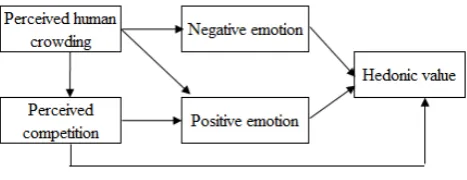
The Byun & Mann, (2011) prepared model of the relations of perceived human crowding and competition, emotions and hedonic value is shown in Figure 3.
Figure 3. The relations of perceived human crowding and competition, emotions and hedonic value (Byun & Mann, 2011)
As it is shown in Figure 3, perceived human crowding could cause both negative and positive emotions.
Consumer experiences negative emotions when actual number of other shoppers is bigger than it was expected –if human crowding is equal or lower than it was expected – human crowding could not to cause negative emotions. According to Eroglu et al., (2005), perceived spatial and human crowding could be understood differently, depending on individual (e.g. tolerance for crowding) and situational variables (e.g. shopping motives, time pressure). It is also noticed that crowding expectations are strongly influenced by the type of the store (e. g., a department store, a specialized store, a discount store) and the concept of the retailer (e. g., high-end designer stores, low-priced fast fashion stores) (Byun & Mann, 2011; Kazakeviciute & Banyte, 2012).
In discount stores, fast fashion stores, etc. a high number of consumers is expected, therefore consumers will be psychologically prepared for crowding, and crowding will not cause negative emotions. Usually some sense of competition that is felt among consumers could evoke positive emotions and increase hedonic shopping value in discount and other similar stores. It is also known that other customers affect the emotional state and behavior – if a consumer buys a product while feeling competition, then appreciable pleasure, arousal, and satisfaction are higher.
Moreover, according to Byun, Mann (2011), a strong relation exists between consumers’ emotions experienced during buying process and hedonic value. Negative emotions decrease consumers’ perceived hedonic value because a consumer experiencing negative emotions is not willing to explore retail environment, browse for new stimulus and spent time in retail environment. Positive emotions affects consumers’ behavior contrary – consumer is willing to spent more time in retail environment, explore
it and new products, shopping becomes an entertainment – in this case, perceived hedonic value is increasing.
Eroglu et al., (2005) and Jones et al., (2010) also analyzed the impact of emotions to consumers’ perceived hedonic and utilitarian value. These authors found out that despite indirect effect of retail crowding on consumers’ perceived hedonic value, consumers’ perceived utilitarian value is not affected.
Moreover, Jones et al., (2010), used 27 emotions that are significant in the context of retail market, grouped them and identified that all emotions have significant influence on consumers’ perceived hedonic value (given positive emotions value is increasing, given negative emotions – value is decreasing) but consumers’ satisfaction is influenced only by such emotions as anger, disgust, irritation, discontent. Eroglu et al., (2005) noticed that shoppers who spent less than 60 minutes in the store were more influenced by human crowding and their perceived hedonic value decreased. And contrary, shoppers who spent more than 60 minutes in the store became habituated to the situation and no longer noticed the high human crowding.
The performed analysis of emotional value factor in consumers’ hedonist’s behavior supports conclusions that emotional value factor could be stimulated by consumers’ engagement in shopping seeking for some kind of stimulation, adventures, experiences that are surrounded by different signs, sounds and scents. It is also characterized by the need to relax from stress, get rid of a bad mood, and forget existing problems. Some shoppers engage in buying process and enjoy browsing and collecting of new information without intentions to purchase particular product. For those consumers searching for information is a great way to spend leisure time. In summary, it is concluded that the buyer for whom an emotional value is important, feels the need to stimulate the senses and express themselves through play and creativity during the shopping or reduce stress, restore inner balance. The shopping could be perceived as a great environment for achieving satisfaction.
Considering identified consumers’ perceived hedonic value factors and specific consumers’ behavior inherent for them, the conceptual model of the relation of perceived hedonic value and behavior is prepared.
Conceptual model of the relation of consumers’ perceived hedonic value and behavior
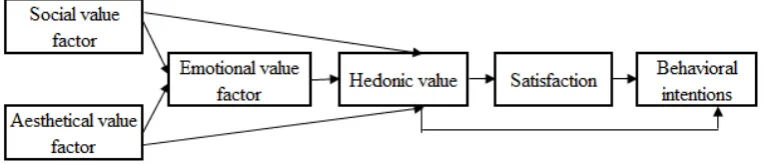
Summing up the results of scientific studies and insights the conceptual model of relations of consumers’ perceived hedonic value and behavior (Figure 4) is prepared. Logic of the model is closest to Ryu et al.,
Given the fact that often expression of one of the value factors in hedonist’s behavior is stronger and they determine specific behavior, the conceptual model illustrates the influence of each factor and the strength of direct relation with the consumers’ perceived hedonic value.
Social value factor evidences in hedonist’s behavior by increased need to socialize, communicate and increase the status and self-esteem in front of other people. It can be revealed by such elements as the value seeking (sensitivity to price, limit of the price, extravagance) (Lee et al., 2009), seeking for social experience, which could be defined as the level of contact with other buyers (the need to communicate and socialize) (Arnold & Reynolds, 2003; Seo & Lee, 2008; Rintamaki et al., 2006) and role playing (buyers desire to increase the status and self-esteem levels during the shopping) (Lee et al., 2009).
Aesthetical value factor includes aspects of facilitating (layout of products, employees, comfortability,
human crowding) and attractiveness (lighting, music, color and design) - their impact and importance for hedonic value was identified by Ballantine et al., (2010). According to the insights of (Arnold & Reynolds, 2003 and Ballantine, et al., 2010), this value factor should be analyzed using retail environment’s interior and exterior, layout of products, appearance of personnel. The dominance of aesthetical value factor can lead to higher customer extravagance, the need to belong to a specific social group.
It is assumed that the most comprehensively scientific literature describes the emotional value factor which can have a direct impact on customer’s perceived hedonic value (Byun & Mann, 2011) and play a significant role of the mediator (Byun & Mann, 2011; Jones et al., 2010). This value factor should be revealed by the perceived retail crowding (perceived spatial and human crowding) and the perceived competition.
Figure 4. Conceptual model
In the scientific literature there is consensus on the effects of the emotions caused by crowding on customer’s satisfaction (Machleit et al., 2000; Eroglu et al., 2005; Li
et al., 2009; Byun & Mann, 2011). The direct and significant emotions impact on consumers’ perceived hedonic value was proved by (Byun & Mann, 2011; Jones
et al., 2010; Eroglu et al., 2005) studies and the impact of perceived competition – by the studies of Byun & Mann, (2011).
Given the revealed importance of the role of emotions for creation of consumers’ perceived hedonic value, the conceptual model includes possible indirect (mediatory) relation of social and aesthetical value factors and hedonic value. In this relation emotional value factor plays a role of mediator.
Prepared conceptual model illustrates the relations among consumers’ perceived hedonic value, satisfaction and future intentions that were analyzed in the studies of (Ryu et al., 2010; Overby & Lee, 2006; Jones et al., 2010).
Directions for future study
To sum up previous researches of consumers’ perceived hedonic value, it can be stated that in the conceptual model the aesthetic, emotional and social factors are related to the consumers’ perceived hedonic value, which affects customer’s satisfaction and behavioral intentions. Although in the theory of consumer behavior the phenomenon of hedonism was analyzed since the end of the 20th century but comprehensive studies that analyze the correlation between the constructs of the conceptual model - social, emotional, aesthetic value factors,
consumers perceived hedonic value, satisfaction and behavioral intentions - have not been carried out yet.
In this context, for future studies it is appropriate to initiate researches for verification of the conceptual model of relation between consumers’ perceived hedonic value and behavior. This type of research could be carried out by analyzing relations between the luxury goods and art consumers’ perceived hedonic value and behavior. It would also be useful to carry out a comparative study analyzing the customer’s perceived hedonic value and behavior at different sectors of the retail market.
During verification of the conceptual model of relation of consumers’ perceived hedonic value and behavior it would be appropriate to carry out studies to analyze the relations between the value factors (emotional, aesthetic, social) and hedonic values as well the hedonic values and behavioral intentions and to compare obtained data considering different demographic characteristics (sex, age, residence, income level) of the respondents. It is also would be very useful to examine the model’s relevance interviewing only hedonist consumers. To implement such a study identification of hedonic customer is necessary through integrating a special scale into the research instrument, or by a separate questionnaire and then re-contacting potential respondents - hedonic consumers.
Conclusions
1.The scientific analysis of the literature revealed conceptual essence of the hedonism which bases the categorization of shopping motives and buying process to two categories – hedonic and utilitarian. This typology is supported by majority of the researchers. Summarizing the results of the analysis of hedonism concept the essential difference between hedonic and utilitarian shopping processes was revealed - different consumers have specific objectives for shopping.
2.Summarizing the results of performed theoretical analysis of consumers’ perceived value, the approach claiming that the hedonic value reflects consumer’s perceived psychological value of shopping and purchased product was reasoned. Also, consumers’ perceived hedonic value has a positive effect on consumer willingness to share verbal recommendations, increased loyalty. It was identified that the hedonic value could be created by the consumers’ social, emotional and epistemic experiences (value factors), and epistemic experience is analyzed as a consumers’ perceived aesthetic value in this article.
3.Identified value factors are considered as factors that stimulate specific behavior of the consumer and create
consumers’ perceived hedonic value. Scientific literature revealed that for those consumers, who are involved in buying process and have a dominating aesthetical value factor, the atmospheric factors are very important – they have characteristics of the bigger wastefulness and necessity to belong to specific social group. The buyers, for whom an emotional value is important, feel the need to stimulate the senses and express themselves through play and creativity during the shopping or reduce stress, restore inner balance. In this case the shopping could be perceived as a great environment for achieving satisfaction. Consumers who experience dominating social value factor initiate buying process not because of necessity of particular product or service but because of communication and degree of socialization, short-term boost of ego and self-esteem that could be experienced during the shopping.
4.Considering the lack of complex models the conceptual model of consumers’ perceived hedonic value and behavior to answer the problemical questions was prepared. This model integrates social, emotional and aesthetical value factors, hedonic value, consumers’ satisfaction and future intentions.
References
Andrijauskas, A. (2006). Estetikos ir meno filosofijos teritorijų kaita. Vilnius
Arnold, M. J., & Reynolds, K. E. (2003). Hedonic Shopping Motivations. Journal of Retailing, 79, 77 – 95. http://dx.doi.org/10.1016/S0022-4359(03)00007-1
Babin, B. J., Darden, W. R. & Griffin, M. (1994). Work and/or fun: Measuring Hedonic and Utilitarian Shopping Value.
The Journal of Consumer Research, 20(4), 644-656. http://dx.doi.org/10.1086/209376
Ballantine, P. W., Jack, R., & Parsons, A. G. (2010). Atmospheric Cues and Their effect on the Hedonic Retail Experience. International Journal of Retail & Distribution Management, 38(8), 641-653. http://dx.doi.org/10.1108/09590551011057453
Batra, R., & Ahtola, O. T. (1990). Mea Suring the Hedonic and Utilitarian Sources of Consumer Attitudes. Marketing Letters, 2(2), 159-170. http://dx.doi.org/10.1007/BF00436035
Byun, S. E., & Mann, M. (2011). The Influence of Others: the Impact of Perceived Human Crowding on Perceived Competition, Emotions, and Hedonic Shopping Value. Clothing & Textiles Research Journal, 29(4), 284-297. http://dx.doi.org/10.1177/0887302X11422820
Cardoso, P. R., & Pinto, S. C. (2010). Hedonic and Utilitarian Shopping Motivations Among Portuguese Young Adult Consumers. International Journal of Retail & Distribution Management. 38(7), 538-558. http://dx.doi.org/10.1108/09590551011052124
Carpenter, J. M. (2008). Consumer Shopping Value, Satisfaction and Loyalty in Discount Retailing. Journal of Retailing and Consumer Services, 15, 358-363. http://dx.doi.org/10.1016/j.jretconser.2007.08.003
Chen, P. T., & Hu, H. H. (2010). The Effect of Relational Benefits on Perceived value in Relation to Customer Loyalty: an Empirical Study in the Australian Coffee Outlets Industry. International Journal of Hospitality Management, 29, 405-412. http://dx.doi.org/10.1016/j.ijhm.2009.09.006
Davis, L., & Hodges, N. (2012). Consumer shopping value: An investigation of Shopping Trip Value, in-Store Shopping Value and Retail Format. Journal of Retailing and Consumer Services, 19, 229-239. http://dx.doi.org/10.1016/j.jretconser.2012.01.004
Dhar, R., & Wertenbroch, K. (2000). Consumer Choice between Hedonic and Utilitarian Goods. The Journal of Marketing Research, 37(1), 60-71. http://dx.doi.org/10.1509/jmkr.37.1.60.18718
Eroglu, S. A., Machleit, K., & Barr, T. F. (2005). Perceived Retail Crowding and Shopping Satisfaction: the Role of Shopping Values. Journal of Business Research, 58, 1146-1153. http://dx.doi.org/10.1016/j.jbusres.2004.01.005 Fan, J. X., & Xiao, J. J. (1998). Consumer Decision-Making Styles of Young-Adult Chinese. The Journal of Consumer
Affairs, 32(2), 275-294. http://dx.doi.org/10.1111/j.1745-6606.1998.tb00410.x
Holbrook, M. B., & Hirschman, E. C. (1982). The experiential aspects of consumption: consumer fantasies, feelings, and fun. The Journal of Consumer Research, 9(2), 132-140. http://dx.doi.org/10.1086/208906
Jackson, V., Stoel, L., & Brantley, A. (2011). Mall Atributes and Shopping Value: Differences by Gender and Generational Cohort. Journal of Retailing and Consumer Services, 18, 1-9. http://dx.doi.org/10.1016/j.jretconser.2010.08.002
Kang, J., & Park-Poaps, H. (2010). Hedonic and Utilitarian Shopping Motivations of Hashion Leadership. Journal of Fashion Marketing and Management, 14(2), 312 – 328. http://dx.doi.org/10.1108/13612021011046138
Kazakeviciute, A., & Banyte, J. (2012). The Relationship between Retail Crowding and Consumers‘ Satisfaction.
Economics and Management, 17(2), 658-664.
Kim, H. S. (2006). Using Hedonic and Utilitarian Shopping Motivations to Profile Inner City Consumers. Journal of Shopping Center Research, 13(1), 57 – 79.
Lee, M. Y., Kim, Y. K., & Fairhurst, A. (2009). Shopping Value in Online Auctions: their Antecedents and Outcomes.
Journal of Retailing and Consumer Services, 16, 75-82. http://dx.doi.org/10.1016/j.jretconser.2008.11.003
Li, J. T., Kim, J. O., & Lee, S. Y. (2009). An Empirical Examination of Perceived Retail Crowding, Emotions and Retail Outcomes. The Service Industries Journal, 29(5), 635-652. http://dx.doi.org/10.1080/02642060902720121
Machleit, K. A., Eroglu, S. A., & Mantel, S. P. (2000). Perceived Retail Crowding and Shopping Satisfaction: What
Modifies this Relationship? Journal of Consumer Psychology, 9(1), 29-42.
http://dx.doi.org/10.1207/s15327663jcp0901_3
Overby, J. W., & Lee, E. J. (2006). The Effects of Utilitarian and Hedonic Online Shopping Value on Consumer
Preference and Intensions. Journal of Business Research, 59, 1160-1166.
http://dx.doi.org/10.1016/j.jbusres.2006.03.008
Rintamaki, T., Kanto, A., Kuusela, H., & Spence, M. T. (2006). Decomposing the Value of Department Store Shopping Into Utilitarian, Hedonic and Social Dimensions. International Journal of Retail & Distribution Management, 34(1), 6-24. http://dx.doi.org/10.1108/09590550610642792
Ryu, K., Han, H., & Jang, S. (2010). Relationship Among Hedonic and Utilitarian Values, Satisfaction and Behavioral Intentions in the Fast-Casual Restaurant Industry. International Journal of Contemporary Hospitality Management, 22(3), 416-432. http://dx.doi.org/10.1108/09596111011035981
Seo, S., & Lee, Y. (2008). Shopping Values of Clothing Retailers Perceived by Consumers of Different Social Classes.
Journal of Retailing and Consumer Services, 15, 491-499. http://dx.doi.org/10.1016/j.jretconser.2008.02.001
Sheth, J. N., Newman, B. I., & Gross, B. L. (1991). Why We Buy What we Buy: a Theory of Consumption Values.
Journal of Business Research, 22, 159-170. http://dx.doi.org/10.1016/0148-2963(91)90050-8
Stoel, L., Wickliffe, V., & Lee, K. H. (2004). Attribute Beliefs and Spending as Antescedents to Shopping Value. Journal of Business Research, 57, 1067-1073. http://dx.doi.org/10.1016/S0148-2963(03)00016-X
Turel, O., Serenko, A., & Bontis, N. (2010). User Aceptance of Hedonic Digital Artifacts: A Theory of Consumption Values perspective. Information & Management, 47, 53-59. http://dx.doi.org/10.1016/j.im.2009.10.002
Virvilaite, R., & Dailydiene, M. (2012). Strengthening of a Private Brand: the Aspect of a Store’s Image. Inzinerine Ekonomika-Engineering Economics, 23(1), 90-98.
Virvilaite, R., & Saladiene, V. (2012). Models Investigation of Factors Affecting Consumer Impulsive Purchase Behavior in Retail Environment. Economics and Management, 17(2), 670-676.
Watchravesringkan, K., Nelson Hodges, N., & Kim, Y. H. (2010). Exploring Consumers’ Adoption of Highly Technological Fashion Products. Journal of Fashion Marketing and Management, 14(2), 263-281. http://dx.doi.org/10.1108/13612021011046101
Asta Kazakevičiūtė, Jūratė Banytė
Pirkėjų suvokiamos hedonistinės vertės ir elgsenos sąsajos
Santrauka
Pirkimo procesas yra svarbi vartotojo gyvenimo dalis, kuri kinta veikiama nuolatinių aplinkos pokyčių. Pastaruoju metu žmonių pirkimas arba įsitraukimas į pirkimo procesą yra inicijuojamas ne tik dėl pagrindinės funkcijos, t.y. materialaus poreikio tenkinimo. Vis svarbesniu tampa hedonistinis pirkimo aspektas, kuris, dėl nuolat didėjančios konkurencijos mažmeninės prekybos rinkoje, yra itin aktualus siekiant įgyti konkurencinį pranašumą. Dėl šios priežasties, mokslininkų diskusija, jog pirkimo procesui reikšmingą poveikį turi ne tik utilitarinis, bet ir hedonistinis pirkėjų elgsenos aspektas, vis dažniau patraukia mažmeninės prekybos rinkos dalyvių dėmesį. Remiantis hedonizmo fenomeno vartotojų elgsenos teorijoje ištyrimo lygiu (Hirschman, Holbrook, 1982; Batra, Ahtola, 1990; Fan, Xiao, 1998; Stoel, Wickliffe, Lee, 2004; Guido, 2006; Wesley, LeHew, Woodside, 2006; Kang, Park-Poaps, 2009; Watchravesringkan, Hodges, Kim, 2009) galima teigti, jog hedonizmas yra mažiausiai tirta hedonistinės pirkėjų elgsenos sritis.
Darbo objektas – pirkėjų suvokiamos hedonistinės vertės raiška elgsenoje.
Darbo tikslas – parengti konceptualų pirkėjų suvokiamos hedonistinės vertės ir elgsenos sąsajų modelį, atskleidžiantį pirkėjų suvokiamą hedonistinę
vertę lemiančius veiksnius ir poveikio sąlygotus tiesioginius bei mediacinius hedonistinės vertės ir pirkėjų elgsenos ryšius.
Tyrimo metodai – lyginamoji bei sisteminė mokslinės literatūros analizė.
Mokslinėse studijose atskleidžiama, jog egzistuoja dvi, pirkimo fenomeną aiškinančios kryptys: vartotoją skatina pirkti asmeniniai veiksniai; pirkimą skatina hedonistiniai ir utilitariniai motyvai (Guido, 2006). Pastarojo meto tyrėjai pabrėžia, jog pirkimo procesui stiprų poveikį turi utilitarinis ir hedonistinis pirkimo aspektai. Utilitariniam ir hedonistiniam pirkimo aspektui būdingas tikslo siekimas, tačiau jis vertinamas iš skirtingų perspektyvų.
Hedonistiniame pirkimo procese tikslas siejamas su malonumo siekimu. Hedonistinis vartojimo aspektas dažniausiai pasireiškia per džiaugsmą, kurį vartotojas gauna naudodamas įsigytą prekę, arba per malonumą ir naujas patirtis, kurios sužadinamos pirkimo proceso metu. (Wertenbroch, Dhar, 2000; Arnold, Reynolds, 2003; Kim, 2006; Cardoso, Pinto, 2010; Ballantine, Jack, Parsons, 2010;). Pirkimo proceso „sėkmė“ vertinama subjektyviu emociniu bei estetiniu požiūriu.
Vienas pagrindinių mažmeninės prekybos diferenciacijos aspektų – tai pirkėjo suvokiama vertė. Remiantis atlikta, mokslinėje literatūroje pateikiamų hedonistinės ir utilitarinės vertės sampratų, analize (Holbrook ir Hirschman, 1982; Overby, Lee, 2006; Seo, Lee, 2008; Carpenter, Moore, 2009; Kim, Han, 2011) galima teigti, jog:
• Pirkėjų suvokiama hedonistinė vertė yra subjektyvesnė ir asmeniškesnė nei utilitarinė. Dažniausiai gaunama pasitelkiant pramogas bei žaismingumą, o ne užduoties įgyvendinimą;
• Patiriamo susijaudinimo, suvokiamos laisvės, fantazijų įgyvendinimo bei įgyjamų patirčių (socialinių, pažintinių, emocinių) visuma gali būti identifikuojama kaip pirkėjo suvokiama gaunama hedonistinė vertė.
• Hedonistinė vertė gali būti gaunama net pirkėjui neįsigyjant konkrečios prekės, o tiesiog inicijuojant pirkimo procesą.
Remiantis atliktų studijų analize, straipsnyje pritariama požiūriui, kad hedonistinė vertė atspindi pirkėjo suvokiamą psichologinę pirkimo proceso ir įsigytos prekės vertę, pasižymi teigiama įtaka pirkėjų norui dalytis žodinėmis rekomendacijomis, lojalumo didėjimu (Carpenter, Moore, 2009). Taip pat vadovaujamasi nuostata, kad hedonistinė vertė kuriama pasitelkiant pirkėjo socialinę, emocinę bei episteminę patirtis, kurios buvo identifikuotos Sheth ir kt., (1991), Rintamaki ir kt., (2006) atliktų tyrimų metu. Episteminė pirkėjo patirtis – sudėtingiausiai identifikuojamas vertės veiksnys, kuris šiame straipsnyje vertinamas ir analizuojamas kaip pirkėjo suvokiama estetinė vertė. Pirkėjo suvokiama estetinė vertė šiame kontekste identifikuojama kaip prekybos vietos, prekės, pirkimo proceso aplinkos atributas, kuriantis episteminę pirkėjo patirtį. Akcentuotina, jog dažnai pirkėjo hedonisto elgsenoje, vienos iš patirčių (hedonistinės vertės veiksnių) raiška, būna stipresnė ir daroma įtaka pirkėjo elgsenai didesnė.
Apibendrinant atliktų mokslinių studijų rezultatus bei įžvalgas, sudarytas konceptualus pirkėjų suvokiamos hedonistinės vertės ir elgsenos sąsajų modelis. Esminė modelio sudarymo logika artimiausia Ryu ir kt., (2010) teorinėms nuostatoms, kurios argumentuoja hedonistinės vertės, pirkėjų pasitenkinimo ir elgsenos ketinimų ryšį. Remiantis šia logika, konceptualiame modelyje integruojami mokslinės literatūros analizės metu identifikuoti pirkėjų suvokiamą hedonistinę vertę lemiantys socialinės, emocinės bei estetinės vertės veiksniai (Rintamaki ir kt., 2006) ir hedonistinės vertės, pirkėjų pasitenkinimo bei elgsenos ketinimų konstruktai.
Atsižvelgiant į tai, jog dažnai, vieno iš vertės veiksnių raiška, pirkėjų hedonistų elgsenoje būna stipresnė ir lemia specifinę elgseną, konceptualiame modelyje siūloma tirti kiekvieno veiksnio daromą įtaką bei tiesioginio ryšio su pirkėjo suvokiama hedonistine verte stiprumą.
Mokslinės literatūros analizės metu išsiaiškinta, kad socialinės vertės veiksnys pirkėjo hedonisto elgsenoje pasireiškia per didesnį poreikį socializuotis, bendrauti, didinti statusą ir savigarbą kitų žmonių akivaizdoje, todėl jis gali būti atskleidžiamas pasitelkiant tokius elementus kaip vertės siekimas (pirkėjų jautrumas kainai, išlaidumas, kainos riba) (Lee ir kt., 2009), socialinės patirties siekimas, t.y. kontakto su kitais pirkėjais lygis (poreikis bendrauti ir socializuotis) (Arnold, Reynolds, 2003; Seo, Lee, 2008; Rintamaki ir kt., 2006) bei įsijautimas į vaidmenį (pirkėjų siekis didinti statusą, savigarbos lygį pirkimo proceso metu) (Lee ir kt., 2009). Estetinės vertės veiksnys apima lengvinančius (prekių išdėstymas, darbuotojai, patogumas, žmonių gausa) ir patrauklumo (apšvietimas, muzika, spalvos, dizainas) aspektus, kurių poveikį ir svarbą hedonistinei vertei nustatė Ballantine ir kt., (2010). Remiantis Arnold, Reynolds (2003) ir Ballantine ir kt., (2010) įžvalgomis, šis vertės veiksnys turėtų būti analizuojamas pasitelkiant prekybos vietos interjero bei eksterjero, prekių ir jų išdėstymo, personalo išvaizdos elementus. Estetinės vertės veiksnio dominavimas gali lemti didesnį pirkėjų išlaidumą, poreikį priklausyti specifinei socialinei grupei.
Rengiant konceptualų pirkėjų suvokiamos hedonistinės vertės ir elgsenos sąsajų modelį daroma prielaida, jog, išsamiausiai mokslinėje literatūroje aprašomas emocinės vertės veiksnys, gali daryti tiesioginę įtaką pirkėjų suvokiamai hedonistinei vertei (Byun, Mann, 2011) bei atlikti reikšmingą mediatoriaus vaidmenį (Byun Mann, 2011; Jones ir kt., 2010). Šis vertės veiksnys turėtų būti atskleidžiamas per suvokiamos spūsties masto (suvokiamo erdvės „perkrovimo“ ir žmonių spūsties masto) bei suvokiamos konkurencijos elementus, nes mokslinėje literatūroje sutariama dėl spūsties sukeliamų emocijų poveikio pirkėjų pasitenkinimui (Machleit ir kt., 2000; Eroglu ir kt., 2005; Li ir kt., 2009; Byun, Mann, 2011), o tiesioginę reikšmingą emocijų daromą įtaką pirkėjo suvokiamai hedonistinei vertei įrodė Byun, Mann (2011), Jones ir kt., (2010), Eroglu ir kt., (2005) atlikti tyrimai, suvokiamos konkurencijos – Byun, Mann (2011). Atsižvelgiant į atskleistą emocijų vaidmens svarbą, kuriant pirkėjų suvokiamą hedonistinę vertę, konceptualiame modelyje įvertinamas ir galimas netiesioginis ryšys tarp socialinės ir estetinės vertės veiksnių ir hedonistinės vertės, emocinės vertės veiksniui atliekant mediatoriaus vaidmenį.
Apibendrinant anksčiau atliktus pirkėjų suvokiamos hedonistinės vertės tyrimus, galima tvirtinti, kad konceptualiame modelyje pateikiami estetinės, emocinės bei socialinės vertės veiksniai yra susiję su pirkėjų suvokiama hedonistine verte, kuri lemia pirkėjų pasitenkinimą bei elgsenos ketinimus. Nors hedonizmo fenomenas vartotojų elgsenos teorijoje analizuojamas jau nuo 20 amžiaus pabaigos, tačiau iki šiol nėra atliktų kompleksinių tyrimų, kuriuose būtų analizuojamos sąsajos tarp visų konceptualaus modelio konstruktų: socialinės, emocinės, estetinės vertės veiksnių, pirkėjų suvokiamos hedonistinės vertės, pirkėjų pasitenkinimo ir elgsenos ketinimų.
Atsižvelgiant į tai, tikslinga ateityje atlikti tyrimus, kuriais būtų patikrintas konceptualaus modelio tinkamumas pirkėjų suvokiamos hedonistinės vertės ir elgsenos sąsajoms tirti.
Raktažodžiai: vartotojų elgsena, pirkimo procesas, hedonizmas, pirkėjų suvokiama vertė, hedonistinė vertė.