365
Agriculture and Biosciences
www.ijagbio.com P-ISSN: 2305-6622 E-ISSN: 2306-3599 [email protected]RESEARCH ARTICLE
An Efficient Methodology to Identify Technological Needs and Problems of Poultry Farmers
Mathialagan1 P and VE Sabarathinam2
1Department of Veterinary and Animal Husbandry Extension and Entrepreneurship, Madras Veterinary College, Chennai, India; 2National Academy for Agricultural Research Management, Hyderabad, India
ARTICLE INFO ABSTRACT
Received: Revised: Accepted:
July 10, 2013 August 12, 2013 December 12, 2013
Poultry farming is playing an important role in boosting economy of India. Tamil Nadu state ranked second in commercial egg production in India. Hence it is essential to determine the needs and problems of poultry farmers of India to improvise the egg production. There is no methodology to scientifically estimate the needs and problems of poultry farmers in developing countries. Keeping this point in mind, a methodology has been developed by empirical research. This methodology include 11 steps that includes activity listing, inventory preparation, finding out the degree to which the available technologies meet the technological needs, estimating awareness and adoption, extent of participation in each activity, listing of technological needs/problems, ranking of problems and technological needs, Rank Based Estimation, estimation of loss due to the problem / needs, magnitude value estimation, and classifying the technological need into research need and extension need. This would result in identifying research needs and extension problems in poultry farming which would boost poultry production. This study would pave way for estimating the technological needs of farmers in different parts of the country. When such estimated needs are discussed with concerned authorities, this might help to pave an efficient way to develop viable technologies and implement extension programmes.
Key words: Awareness Extension needs Poultry farmers Technological needs
*Corresponding Address: P Mathialagan
Cite This Article as: Mathialagan P and VE Sabarathinam, 2013. An efficient methodology to identify technological needs and problems of poultry farmers. Inter J Agri Biosci, 2(6): 365-370. www.ijagbio.com
INTRODUCTION
Identification of technological needs and problems of farmers is the first step either in developing sophistica- tions in commercial poultry industry or in developing extension programmes in poultry farming. No systematic methodology is available especially for poultry farming except a Ph.D thesis carried out by Mathialagan (1998) throughout the world especially for poultry farmers. Hence, an attempt was made to develop a methodology to identify technological needs and problems of poultry farmers.
Research institutes and universities should design and implement policies and programmes aimed at encouraging and motivating researchers in using Participatory Poultry production Research (Apantaku, 2006). The level of farmers' involvement in agricultural problems identifica- tion and prioritization was low, farmers were very willing to be involved in their agricultural problem identification and prioritization (Apantaku, 2003)
Non involvement of farmers in problem identification resulted in inapplicability of most of the research findings (Getahun et al., 1977). Researchers aimed at farmers
problems has used top down approaches (Crawford and Barclay, 1982). Most of the research, extension programmes if examined carefully, will be found not usually relevant to farmers needs (Cerena et al., 1985).
Existing programmes not delivering results should be restructured (Anonymous, 2011).
First, a thorough literature search was made to identify a methodology to find out technological needs and problems of poultry Farmers. No method is available for poultry farmers except a single method developed by Sabarathnam (1988) which is based on Rank Based Quotient for crop production.
MATERIALS AND METHODS
In this study, technological needs were estimated in the following manner: Farmers, extension personnel and technology developers were taken as respondents for this study and they were asked to indicate individually the difficulties faced by the poultry farmer in using the available technology. This is referred as technological need or problem. The technological needs could be estimated by adopting the following steps:
Step 1: Activity listing
In order to identify the genuine respondents for the study, we had to list the various activities related to poultry farming by using observation technique in the actual layer poultry farms of Namakkal district (Fig.1). In this way, 130 activities were identified. For example, the activities related to input purchase is presented in Table 1.
Table 1: Input purchase activities of poultry farming S. No Activities
1. Decision regarding type of poultry strain
2 Purchase of chicks
3 Purchase of brooder
4 Purchase of feeders and waterers 5 Purchase of electric bulbs
6 Purchase of medicines
7 Purchase of litter materials
Step 2: Inventory preparation
An inventory for available technologies on poultry farming was developed keeping the poultry technology inventory developed by Mathialagan (2010) as a base by going through various literature, discussion with poultry scientists and extension officials and interacting with the poultry farmers engaged in poultry farming and on the spot observation made by the researcher. This resulted in identification of 129 technologies. The inventory regarding
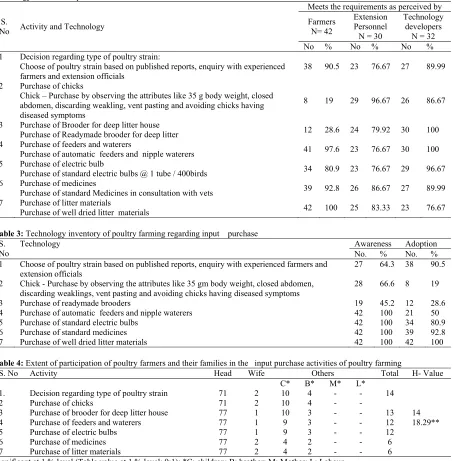
input purchase of poultry farming is shown in the table 2. Step 3: Finding out the degree to which the available technologies meet the technological needs to carry out the different activities identified by the poultry farmer. Finding out the degree to which the available technologies meet the technological needs to carry out the different activities identified by the poultry farmer indicates the farm activities and the technological availabilities as per the perception of the technology users (poultry farmers), technology developers (scientists) and Extension personnel as indicated in column 3 of table 2. For example as for the purchase of chicks, only 19 per cent of the farmers perceived that the technology available meets their requirement. This indicates that there is technological need.
Step 4: Estimating awareness and adoption
The extent of awareness of the technologies and also the rate of adoption were worked out. When there is significant variation between awareness (obtained by word of mouth) and adoption with regard to a specific technology, it could be inferred that the technology does not meet the requirement and it indicates the technological problem / need. Here again the example regarding input purchase in poultry farming is shown in table3.
For instance, purchase of chicks in this case, awareness is 67 per cent whereas adoption is only 19 per cent. This indicates that there is a technological need. Step 5: Extent of participation in each activity
The information regarding extent of participations of the farmer and family members was collected through interview and observation. The family members who were intensively involved in the specific activity were alone selected as respondent for listing out the need / problem for the specific activity concerned and is shown in table 4. Step 6: Listing of technological needs / problems
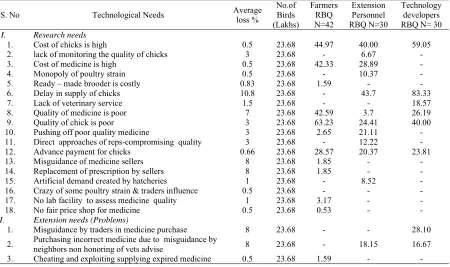
The activities and the concerned available technologies were tabulated. The farmers were asked to list the needs / problems for the activities and asked them to rank. An example with regard to activity regarding input purchase is shown in the table-5.
Step 7: Ranking of problems / technological needs The farmers were asked to rank the different problems based on importance, urgency and magnitude by requesting them to place pellets (dried dropping) of goat or sheep against each problem. The ranking of the farmers’ perception was done on the floor (Fig.1). Even seeds of Neem, Castor and Tamarind were used as suggested by Venkataramaya (1990). Based on the number of pellets / seeds found, each problem was ranked as first second, third etc as shown in the table-6. For the Extension personnel and Technology developers ranking was done on papers.
Step 8: Rank Based Quotient (RBQ) estimation
RBQ was estimated using the RBQ formula developed by Sabarathnam and Vennila (1996). An example is shown below:
∑ (Fi) (n+1-i)
i=1
RBQ = --- ×100 Nn
Fi = Frequency of farmers for the ith rank of the
technological need N = Number of farmers
N = Number of ranks Σ = it directs to sum the multiplication factor
i = 1; F = 42; N = 5 Problem A First rank = 4 So, Fi (n+1-i) = 4 (5 + (1 - 1))
= 4 X 5 = 20
∑ (Fi) (n+1-i)
i=1
RBQ = --- ×100 Nn
20
= --- × 100 = 9.5 42 × 5
Table 2: Technology inventory of poultry farming regarding input purchase and perception regarding the degree to which the technology meets the requirement
S.
No Activity and Technology
Meets the requirements as perceived by Farmers
N= 42
Extension Personnel N = 30
Technology developers
N = 32
No % No % No %
1 Decision regarding type of poultry strain:
Choose of poultry strain based on published reports, enquiry with experienced farmers and extension officials
38 90.5 23 76.67 27 89.99
2 Purchase of chicks
Chick – Purchase by observing the attributes like 35 g body weight, closed abdomen, discarding weakling, vent pasting and avoiding chicks having diseased symptoms
8 19 29 96.67 26 86.67
3 Purchase of Brooder for deep litter house
Purchase of Readymade brooder for deep litter 12 28.6 24 79.92 30 100
4 Purchase of feeders and waterers
Purchase of automatic feeders and nipple waterers 41 97.6 23 76.67 30 100
5 Purchase of electric bulb
Purchase of standard electric bulbs @ 1 tube / 400birds 34 80.9 23 76.67 29 96.67
6 Purchase of medicines
Purchase of standard Medicines in consultation with vets 39 92.8 26 86.67 27 89.99
7 Purchase of litter materials
Purchase of well dried litter materials 42 100 25 83.33 23 76.67
Table 3: Technology inventory of poultry farming regarding input purchase S.
No
Technology Awareness Adoption
No. % No. %
1 Choose of poultry strain based on published reports, enquiry with experienced farmers and extension officials
27 64.3 38 90.5
2 Chick - Purchase by observing the attributes like 35 gm body weight, closed abdomen, discarding weaklings, vent pasting and avoiding chicks having diseased symptoms
28 66.6 8 19
3 Purchase of readymade brooders 19 45.2 12 28.6
4 Purchase of automatic feeders and nipple waterers 42 100 21 50
5 Purchase of standard electric bulbs 42 100 34 80.9
6 Purchase of standard medicines 42 100 39 92.8
7 Purchase of well dried litter materials 42 100 42 100
Table 4: Extent of participation of poultry farmers and their families in the input purchase activities of poultry farming
S. No Activity Head Wife Others Total H- Value
C* B* M* L*
14 18.29**
1. Decision regarding type of poultry strain 71 2 10 4 - - 14
2 Purchase of chicks 71 2 10 4 - -
3 Purchase of brooder for deep litter house 77 1 10 3 - - 13
4 Purchase of feeders and waterers 77 1 9 3 - - 12
5 Purchase of electric bulbs 77 1 9 3 - - 12
6 Purchase of medicines 77 2 4 2 - - 6
7 Purchase of litter materials 77 2 4 2 - - 6
Significant at 1 % level (Table value at 1 % level: 9:1): *C: children; B: brother; M: Mother; L: Labour
In the same way the RBQ was calculated for the other two categories of respondents’ viz., technology developers
and extension personal and shown in Table-1.
For example, item 5 of table7, (Ready- made brooder is costly was felt by farmers, but not by Extension personnel and Technology Developers)
Step 9: Estimation of loss due to the problem / needs The respondents, who were asked to list the technological needs / problems, were also asked to indicate the loss met by them due to the problem in terms of percentage. Then the Average Extent of Damage (AEOD) was calculated for the specific problem by adding the percentage damage listed by the different farmers and dividing it by the number of farmers who reported the damage.
For example in one case 6 farmers reported damage as below: 60%, 70%, 40%, 80% and 65%.
Then the AEOD = 60+70+40+45+80+65 = 360/6 = 60% 6
For instance, if the number of eggs has gone down from 100 to 80, then the percentage of loss is equal to 20%.
100 - 80 = 20% 20
= — X 100 = 20% 100
Step 10: Magnitude value estimation
Table 5: List of different technological needs and problems identified regarding input purchase
S. No Technological Needs / problems
I Research needs
1. Cost of chicks is high
2. lack of monitoring The quality of chicks 3. Cost of medicine is high
4. Monopoly of poultry strain S. No Technological Needs / problems
5. Ready – made brooder is costly 6. Delay in supply of chicks 7. Lack of veterinary service 8. Quality of medicine is poor 9. Quality of chicks is spoor 10. Pushing off poor quality medicine
11. Direct approaches of reps-compromising quality 12. Advance payment for chicks
13. Misguidance of medicine sellers 14. Replacement of prescription by sellers 15. Artificial demand created by hatcheries 16. Crazy of some poultry strain & traders influence 17. No lab facility to assess medicine quality 18. No fair price shop for medicine
II Extension needs (Problems)
1. Misguidance by traders in medicine purchase 2. Purchasing incorrect medicine, misguidance by
Neighbours,non-honouring of vets advice
3. Cheating and exploiting by supplying expired medicine
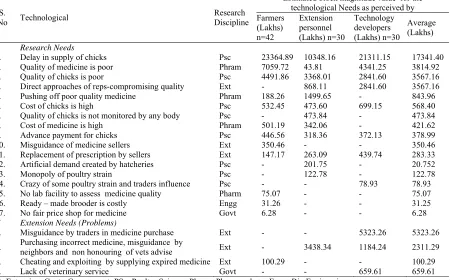
with regard to technology needs, there is a need to develop the technology for each category separately. Most of the technological needs to be developed, as per study were from the following disciplines viz., Pathology,
Microbiology, Poultry Science, Parasitology, Pharma- cology and Extension Education. The magnitude value was calculated by using the formula and tabulated in the Table 8:
MV = RBQ X AEOD or AYLP X NB affected. Where,
MV = Magnitude Value
RBQ = Rank Based Quotient AEOD = Average Extent of Damage AYLP = Average Yield Loss Percentage NB affected = Number of birds affected An example of the magnitude value table is given in table 8.
Table 6: Preferential ranking of the identified problems of the farmers
S. No. of
Respondents Problems / Difficulties rank
A B C D E
1 1 (16) 2 (10) 5 (2) 3 (7) 4 (6)
2 1 (20) 1 (25) 5 (4) 4 (10) 3 (15)
3 1 (30) 2 (20) 5 (7) 3 (18) 4 (15)
4 1 (24) 2 (15) 0 (0) 3 (10) 4 (6)
.. ... ... ... ... ...
.. ... ... ... ... ...
N 1 (29) 2 (20) 4 (10) 3 (15) 0 (0)
(Figures in the bracket indicate the number of pellets used)
Step 11: Classifying the technological need into research need and extension need
A need is considered as a research need when there is no technology as perceived by the respondent. A need is considered as an extension need when the technology is available, but it is not known by the poultry farmer. The technological needs identified were classified as Research needs and Extension needs as shown in table 8. The research needs were to be sent for conducting research by concerned scientist. The extension needs were to be sent to concerned development department to formulate suitable development programme.
Table 7: RBQ and Average loss for different technological needs and problems as per different categories of respondents regarding input purchase
S. No Technological Needs Average loss %
No.of Birds (Lakhs)
Farmers RBQ N=42
Extension Personnel RBQ N=30
Technology developers RBQ N= 30
I. Research needs
1. Cost of chicks is high 0.5 23.68 44.97 40.00 59.05
2. lack of monitoring the quality of chicks 3 23.68 - 6.67 -
3. Cost of medicine is high 0.5 23.68 42.33 28.89 -
4. Monopoly of poultry strain 0.5 23.68 - 10.37 -
5. Ready – made brooder is costly 0.83 23.68 1.59 - -
6. Delay in supply of chicks 10.8 23.68 - 43.7 83.33
7. Lack of veterinary service 1.5 23.68 - - 18.57
8. Quality of medicine is poor 7 23.68 42.59 3.7 26.19
9. Quality of chick is poor 3 23.68 63.23 24.41 40.00
10. Pushing off poor quality medicine 3 23.68 2.65 21.11 -
11. Direct approaches of reps-compromising quality 3 23.68 - 12.22 -
12. Advance payment for chicks 0.66 23.68 28.57 20.37 23.81
13. Misguidance of medicine sellers 8 23.68 1.85 - -
14. Replacement of prescription by sellers 8 23.68 1.85 - -
15. Artificial demand created by hatcheries 1 23.68 - 8.52 -
16. Crazy of some poultry strain & traders influence 0.5 23.68 - - -
17. No lab facility to assess medicine quality 1 23.68 3.17 - -
18. No fair price shop for medicine 0.5 23.68 0.53 - -
II. Extension needs (Problems)
1. Misguidance by traders in medicine purchase 8 23.68 - - 28.10
2. Purchasing incorrect medicine due to misguidance by neighbors non honoring of vets advise 8 23.68 - 18.15 16.67
Table 8: Technological needs and problems of poultry farmers based on magnitude values regarding input purchase
S.
No Technological
Research Discipline
Estimated block magnitude value for the technological Needs as perceived by Farmers
(Lakhs) n=42
Extension personnel (Lakhs) n=30
Technology developers (Lakhs) n=30
Average (Lakhs)
I Research Needs
1. Delay in supply of chicks Psc 23364.89 10348.16 21311.15 17341.40
2. Quality of medicine is poor Phram 7059.72 43.81 4341.25 3814.92
3. Quality of chicks is poor Psc 4491.86 3368.01 2841.60 3567.16
4. Direct approaches of reps-compromising quality Ext - 868.11 2841.60 3567.16
5. Pushing off poor quality medicine Phram 188.26 1499.65 - 843.96
6. Cost of chicks is high Psc 532.45 473.60 699.15 568.40
7. Quality of chicks is not monitored by any body Psc - 473.84 - 473.84
8. Cost of medicine is high Phram 501.19 342.06 - 421.62
9. Advance payment for chicks Psc 446.56 318.36 372.13 378.99
10. Misguidance of medicine sellers Ext 350.46 - - 350.46
11. Replacement of prescription by sellers Ext 147.17 263.09 439.74 283.33
12. Artificial demand created by hatcheries Psc - 201.75 - 20.752
13. Monopoly of poultry strain Psc - 122.78 - 122.78
14. Crazy of some poultry strain and traders influence Psc - - 78.93 78.93
15. No lab facility to assess medicine quality Pharm 75.07 - - 75.07
16. Ready – made brooder is costly Engg 31.26 - - 31.25
17. No fair price shop for medicine Govt 6.28 - - 6.28
II Extension Needs (Problems)
1. Misguidance by traders in medicine purchase Ext - - 5323.26 5323.26
2. Purchasing incorrect medicine, misguidance by neighbors and non honouring of vets advise Ext - 3438.34 1184.24 2311.29
3. Cheating and exploiting by supplying expired medicine Ext 100.29 - - 100.29
4. Lack of veterinary service Govt - - 659.61 659.61
Ext: Extension, Govt.: Government, PSc: Poultry Science, Pharm: Pharmacology, Engg: Bio Engineering
Fig. 1: Study Area
Conclusion
The detailed methodology to estimate the technological needs/problems of poultry farmers consisting of 11 steps has been identified. So, H0 is
rejected and H1 is accepted. This would pave way for
estimating the technological needs of farmers in different parts of the country. When such needs are estimated and sent to the concerned scientist and to the development departments, to develop viable technologies and implemental extension programmes would emerge, which in turn boost the poultry farming.
Recommendations
This study recommends that effort must be made to draw similar methodology for different branches (Dairy, Sheep and goat) of veterinary sciences by conducting specific studies.
REFERENCES
Agble WK, ENW Oppang and and DK Oparesem, 1977. Agricultural systems in Ghana, Proceedings of the workshop on Agricultural research Administration, Nairobi, Kenya, 27-33, June. Association for the advancement of Agricultural sciences in Africa (AAASA) and international Development Research Centre (IDRC), pp: 10-14.
Apantaku SO, A Oloruntoba and EO Fakoya 2003. Farmers' involvement in agricultural problems identification and prioritization in Ogun State, Nigeria. South African J Agri Ext, 32: 45-59.
Apantaku SO, 2006. Analysis of participation of farmers in participatory poultry production research in Lagos State, Nigeria. Livestock Res Rural Dev, 18, Article #94.Retrieved April 6, 2013, from http://www.lrrd. org/ lrrd18/7/apan18094.htm
Anonymous, 2011. 12th Plan to target 9 to 9.5% Growth .
The Hindu, April 22, 2011, P.12 (http://www. thehindu.com/news/national/article1715866.ece) Cerena MM, JK Coulter and FA Russell, 1985. Research-
Extension-Farmer, A two way continuum for Agriculture Development, World bank, Washington, DC, p: 49.
Crawford, R Paul and AH Barclay Jr, 1982. AID experiment in Agriculture research: A review of Project evaluation office of Evaluation Bureau for program and policy co-ordination. Agency for International Development, Washington, DC, 20523, USA, pp: 37-245.
Agricultural Research Administration, Nairobi, Kenya, 27-30, June 1977, pp: 48.
Mathialagan P, 1998. Technological needs of poultry farmers unpublished PhD thesis, Tamil Nadu Veterinary and Animal Science University, Chennai, India.
Mathialagan P, 2010. Poultry Technology Inventory, Madras Veterinary College, Chennai, India.
Sabarathnam VE, 1988. Manual on field experience training for ARS Scientists, National Academy and Agricultural Research Management, Hyderabad.
Ve Sabarathnam and S Vennila, 1996. Estimation of Technological Needs and Identification of Problems of Farmers for Formulation of Research and Extension Programmes in Agricultural Entomology. Experimental Agriculture, 32: pp: 87-90 doi:10.1017/ S0014479700025898