ECONOMICS OF ENGINEERING DECISIONS
Optimization of the Ratio of the Bank Payment Cards Price and Quality
Stanislava Stunguriene
International Business School at Vilnius University Sauletekio al. 22, LT-10225, Vilnius, Lithuania e-mail: [email protected]
The present paper expands the price and quality ratio concept in respect of the consumer and producer expectation gap having generalized the findings and conclusions of the research conducted during past years. It has been noticed that when placing a new product on the market, most often the expectation gap is specifically wide and tends to considerably decrease in the course of time.
For the purpose of the present research paper the author has chosen an unconventional product - the bank payment cards whose quality is defined in terms of the number of the elements embedded in the card, and the quality level of each element has been scored in points. From the consumer‘s point of view the price of a card corresponds to its quality although this assumption has not been confirmed by any actual data available. The sharp increase in the number and volumes of payment operations using payment cards is a direct representation of the need by the customers to use payment cards on a wider scale. In Lithuania this increase in the demand for payment cards is growing, so research in the area of price and quality of the payment card is topical.
A number of empirical surveys have shown that the quality of the product may be efficiently enhanced without increasing its price, and, by applying optimization methods, even reducing its price. The increase or decrease in the price shall be interpreted as the product quality enhancement costs. The model developed to determine the product price-quality ratio is illustrated on the basis of the MasterCard payment card while identifying the specific limits of the costs incurred in relation to quality enhancement. The present paper is dedicated to the survey of the cards that after having attained their highest quality point acquires the same quality, as no further enhancement of the quality is possible in respect of such cards. The highest quality in respect of each individual card is related to different costs. Following a logical path of thinking, the price and quality ratio could be computed by working out an optimization problem, since, as a rule, it is the costs, rather than the quality that have to be limited. Most elements of the payment cards are not assigned the highest score which implies that any enhancement of their quality will require additional expenses the amount whereof shall be proportional to the quality sought. This, however, does not mean that quality costs in all cases. For instance, MasterCard issued by the bank in Lithuania currently costs LTL 25, and according to the calculations related to the highest quality of the card, it would cost LTL 24.75. This allows an assumption that without reducing the price of the card, the card may be considerably improved, since
its initial quality was 0.90 points, and would result at 1.80 points when based on the calculations related to the highest quality. This is a double quality for a price LTL 0.25 less. This can be explained with reference to a high initial price of the Visa GOLD card, which only provides additional evidence that no significant investment is required in order to attain the highest quality. This conclusion, however, is valid only for the cards with high initial price, or the cards that contain just few elements requiring improvement. Any further increase in the costs is considered inexpedient in view of the absence of any quality enhancement reserve.
This article consists of five parts, starting with the introduction where the novelty, the problem of the research, the purpose of the research and the research methods are described.
Keywords: product price, quality costs, payment cards, optimization, limits of the optimal ratio.
Introduction
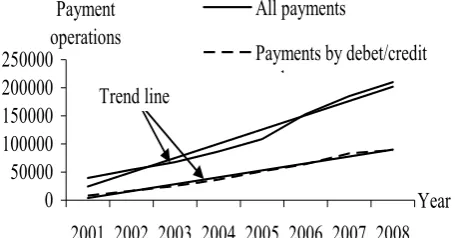
It is quite reasonable to assume that the overall downturn of the global economy will eventually cause certain shifts in the perception of material and immaterial values with a more significant focus being placed upon the product quality. A number of research papers have highlighted the need to seek, in the market environment in which the right of choice has been entirely vested with the consumer, balance between the price and the quality of a product. In our view, however, the structure and the scope of the costs incurred for the purpose of quality enhancement is a subject deserving an even more thorough examination. The scope of the survey has been limited to the payment cards operated in the Lithuanian banking system. The survey has been perceived by the author as relevant in view of the growing share and volumes of payment card operations within the overall payment volumes (Figure 1).
necessary to assess the production cost of every single element and identify the optimal price-quality ratio.
0 50000 100000 150000 200000 250000
2001 2002 2003 2004 2005 2006 2007 2008 Year Payment
operations
All payments
Payments by debet/credit d
Trend line
Figure 1. Payment operations (thousand) volumes in Lithuania: development trends
The inceptive stage of the survey raises the hypothesis on the possibility of existence of the quality enhancement limit the specific value whereof is determined by means of the mathematical programming methods having regard to the characteristics of the costs incurred. Following a thorough overview and the generalization of the services provided by the banks the assessment of the quality of each individual card is based on a selection of 12 elements:
E
1− chip,
E
2− currency,E
3 −credit,E
4 −additional cards,5
E
− validity abroad,E
6 −internet payments,E
7 − cash withdrawal limits,E
8 −insurance,E
9 − discounts,E
10 −security program,
E
11 − special purpose,E
12 − ATMs. The quality of cards is assessed on the basis of the number of the elements integrated within the card, therefore the enhancement of the quality is associated with the increase in the number of the elements concerned. However, it has been assumed necessary to identify the ideal ratio between the increase in the number of the elements and the related increase in costs and provide evidence that any further increase in the costs is inefficient in view of only marginal resulting improvement in the quality.In the service sector it is customary to assess quality on the basis of a consumer response to a product supplied and the quality improvement is associated with the improvement in the quality taking into account the related costs incurred (Resende and Henrique, 2009; Virvilaite and Saladiene, 2009).
The aim of the articleis the examination of the ratio between the production costs and quality of a range of payment cards as the bank product.
The main tasks of the article are to analyze the aspects of the evaluation quality of the products, to define the product price and quality expectation gap and model of increasing quality of payment cards.
The object of the article is evaluation costs for increasing quality of new products.
Research novelty. The author offers an unconventional approach towards the product quality as the quality is assessed not from the point of view of the consumer satisfaction but rather in terms of the interest of the service
provider (a specific bank) to provide a payment card with a larger number of elements.
Method of work: Scientific literature analysis, based on comparative and summarization method, computer calculations with special program for optimal decisions.
Product price and quality expectation gap
Within the environment of economic activity production costs shall be assessed reasonably having regard to consumer expectations. The costs incurred shall be calculated by applying the relevant accounting methods. However, the identification and the recording of consumer expectation may be defined as a complex issue in view of the differences in the perception of the product value: a consumer in all cases expects to acquire a high-value product, though not infrequently the customer assesses the value of the item by his intuition, on the basis of a criterion of own choice. Objectively, the assessment of a product quality is built up in the market environment, taking into account certain demand factors such as (i) the need to acquire the product, (ii) price, (iii) physical and aesthetical qualities of the product.
When placing on the market any new product companies seek to inform the market about the quality of the product concerned. The methods used in the advertising to describe the quality of the product most often do not reflect the actual quality of the product (Nelson, 1974). Furthermore, an increase in advertising expenses naturally leads to higher sale costs without, however, any resulting improvement in the perception of the product quality (Clark, et al., 2009; Ruzevicius, 2009). Wassouf Fadi (2008) has suggested that price and advertising may be perceived as the product quality indicator. For instance, the advertising employed by companies manufacturing medicines in all cases seek to convey the message of the high quality of their produce (Hellstrom and Rudholm, 2008; Banyte and Salickaite, 2008). Under competitive conditions prices tend to decrease, therefore manufacturers endeavor to cut down the production cost to ensure that the profit generated does not approach an alarmingly low level. Some authors in research papers have suggested that the product profitability of higher quality products should be higher and assumed that consumers have developed a good perception of the product quality and are able to relate the quality of the product with its price (Moorthy and Srinivasan, 1995). However, a research of the advertising and product pricing strategies employed by companies has highlighted a problem of uncertainty about the quality, essentially meaning that the price of a high quality product and that of a low quality product may be identical. In this case the consumer is deprived of his ability to assess the quality on the basis of the product price (Hao Zhao, 2000; Allen, 1984). The perception of the product quality and price ratio is adjusted for the product acquisition costs incurred by the consumers (Tyagi, 2004; Dovaliene and Virvilaite, 2008). Where the acquisition costs related to higher quality goods are higher consumers are free to opt for less expensive goods.
enhance the quality of the product in order to maintain the high price of the product. The new price of the product is meant to maximize the demand for the product concerned. A low price is naturally substantially attractive to consumers, however, it is necessary to assess the expected profits taking into account the price sensitivity of potential consumers (Bils, 2009; Harmon et al., 2007).
The issues related to the pricing by monopolies are largely determined by a number of factors such as: (i) production cost, (ii) buyer feedback, (iii) sellers' intent to cut down the price by offering discounts (Bose et al., 2008). Since monopolies in the market face no competition, there is a possibility for a monopoly to sell its products at higher prices. Subject to the product purpose and the specification of its production (e.g., energy generation) the pricing policy pursued by monopolies may be restricted by the State that establishes the authorized production cost, depreciation rates and profit margins (Sedlacek and Valouch, 2009), or the paying ability of consumers. The expectation gap between the producer and the customer may significantly decrease where the price limitation mechanisms are applied. The consumer’s ability to pay is one of the most important factors that are in one way or another taken into consideration by monopolies and non-monopolistic firms. Furthermore, consumers are in all cases willing to pay the price below cost where the surplus supply of products is observable in the market (Anderson and Dana, 2009; Jovarauskiene and Pilinkiene, 2009). Where the consumers’ ability to pay is low the product price needs to be lowered for two reasons: (i) to promote the sale of the products to make them better known in the market, (ii) the producer is in all cases trying to generate income throughout the entire period of the placement of the product, and cannot await the ideally beneficial conditions. The consumer should also avoid fostering expectations for price reduction with a sole purpose to promote the buy-up of the products. The expectations of a firm and those on the consumer side are very different and their absolute compatibility is feasible only on theory level. As a result, the actual price of a product evolves within the expectation gap with an evident contradiction on its extremes – a company will in all cases seek to increase the price and a consumer will be always expecting to obtain a lower price (Figure 2).
High price Low price
t1 t0
The interest of a firm
The interest of a consumer
Time Expectation gap
The price that satisfies both sides
Figure 2. Producer and consumer expectation gap
Relatively, the price that satisfies both sides is established only after some time gap at the moment
t
1. The time difference between the establishment of the actual price and the placement of the product to consumersΔ
t
shall be computed according to the formula:Δ
t
=
t
1−
t
0 (t
1- the actual price establishment moment,t
0- the moment of the placement of the product to consumers).In all cases a company presents to consumers its products of identical quality, which may be, however, differently perceived by different consumers (Sibly, 2009).
A number of authors have noted a specific group of consumers that assess the quality of the product only on the basis of its price (Amstrong and Chen, 2009). The moral context of the price development is also an issue worth considering, specifically in cases where ecological issues are addressed (Freitas & Wagner, 2009; Chung-Chiang Chen, 2009). Any significantly lower prices may cause doubts on the part of the buyers as to the usefulness of the product and the moral environment related to the manufacturing of the product. Firms being honest in their operations seek to adjust the price of the product in relation to its quality. In the opinion of Bils (2009), more than a half of the price of any new high quality product is related to the quality of the product.
The most recent research has shown that the manufacturer, based on the form of the marginal income function (concave or convex) chooses the level of the product quality (Xu Xiaowei, 2009). However, account should be taken of the way in which the balance between the manufacturer’s and the seller’s strategies is achieved in respect of the quantity of the product, the quality of each product and the price set by the manufacturer, the price set by the seller and the product purchased in each market segment (Villas-Boas, 1998).
The payment card is a very specific product, therefore we proceed following an assumption that the price and the quality of the product is assessed by the manufacturer. The price shall be established in proportion to the card production cost, and the quality – on the basis of the number of elements embedded in the card. The consumer chooses a specific payment card considering the number of the elements and the price of the card, where the number of the elements is a determining factor rendering the price the factor of greater importance to the manufacturer than to the consumer.
Optimization of the card parameters
operations, while in 2008, the figure was 42 percent. For the purpose of the price-quality dependence the authors of the present paper have chosen payment cards issued by two Lithuanian banks, the sample composed of 6 payment cards of each bank. In respect of each card the 12 elements distinguished served as the basis for the assessment of the quality of each payment card.
Each level of the utilization of an element is assigned a specific score as follows: 0 – not used or the element does not exist; 1 – the card does have the element, but the element capacities are limited (utilization at approx. 30%); 2 – well utilized element (approx. 80%); 3 – best used element (any better possibilities currently not available, even where 100 % not attained). Where an element can embed only two possibilities, i.e.,, "present" or “none”, then the score assigned may be only 3 or 0.
Most elements of the payment cards are not assigned the highest score which implies that any enhancement of their quality will require additional expenses the amount whereof shall be proportional to the quality sought: improvement from 0 to 1 score – 2 conditional cost units, from 1 to 2 scores - 6 conditional cost units. The evaluation of the quality of the payment card is then replaced by a fraction: 1 score is equated to the value 0.1; 2 scores shall be equated to 0.2; and 3 scores are equated to 0.3. Given the element quality (
g
) limits0
≤
g
i≤
1
, and assuming the form of the analytical dependence on cost (c) as gi = f(ci), the following result is obtained:) exp(
1 i
i c
g = − (1)
Since (1) expresses a non-linear regression equation, its coefficients may be established by using the indirect regression equation and a selected methodology for the calculation of the same aspect (Kurickij 1997; Sakalauskas and Zavadskas, 2009). Therefore, having performed the modifications of the equation
)
exp(
1−gi = ci and Ln(1−gi)=ci
The regression equation acquires the following expression:
) exp(
1 i i
i b mc
g = − − (2).
Based on the data of scoring of the quality of the bank card elements, the MASTERCARD of the first bank is assigned the following regression equations:
) 0412 . 0 1095 . 0 exp( 1 i i c
g = − − − (for elements
9 6 5 3
2
,
E
,
E
,
E
,
E
E
), ) 0489 . 0 0491025 . 0 exp( 1 7 7 cg = − − −
) 0594 . 0 0068764 . 0 exp( 1 11 11 c
g = − −
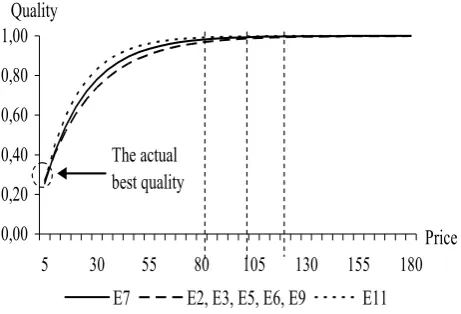
The maximum value computed on the basis of the regression equation is 1, however, in the actual situation the highest quality scored at 3, is expressed in figures at 0.3. Therefore, the actual best quality zone must be close to the value 0.3 (Figure 3).
The examination of the actual best quality zone showed that the price for the attainment of the highest quality of the cards ranges from 5.8 to 6.2 units. Any further increase in the costs is considered inexpedient in view of the absence of any quality enhancement reserve.
0,00 0,20 0,40 0,60 0,80 1,00
5 30 55 80 105 130 155 180
Price Quality
E7 E2, E3, E5, E6, E9 E11 The actual
best quality
Figure 3. Dependences of the quality of elements and the price of payment cards in Lithuania banks
Following a logical path of thinking, the price and quality ratio could be computed by working out an optimization problem, since, as a rule, it is the costs, rather than the quality that have to be limited.
Optimization of the payment card price and quality ratio
Since the card contains the elements the quality whereof needs to be improved, the optimal price and quality ratio may be found by working out a non-linear programming problem:
(
)
⎪ ⎪ ⎪ ⎪ ⎩ ⎪⎪ ⎪ ⎪ ⎨ ⎧ ≤ ≤ ≤ − − = + + + + + + = + + + + + + = → = ii i c
c uzd i i i D C d C C mc b P P P P P P P P P C C C C C C C C P F exp 1 max 7 3 5 4 3 2 1 7 6 5 4 3 2 1
For the problem to have an answer, the
C
limitation from above is sufficient. The results of the multiple solutions of the problem are summarized in Figure 4.2 2,05 2,1 2,15
Price limitation
Quality
Quality 2,04 2,05 2,07 2,09 2,09 2,1 2,1 2,1 2,1 2,1 40 40,5 41 41,5 42 42,1 42,2 42,5 43 44
The highest quality (2,1) of the elements of a payment card could be achieved at the established price of LTL 42,2. The initial price for the MasterCard card is LTL 40. This means, that the quality of the card might be enhanced to its highest level at the expense of increasing its price by LTL 2.2.
The findings of the survey allowed a conclusion that the most substantial change in the price may result in respect of UB MCV (MasterCard Virtuali) card. However, the virtual card is intended for internet settlements only therefore the application of requirements inherent to other types of card is not entirely correct, as the purpose of this card is different from that of other cards. To the largest extent the quality enhancements could be effected in respect of the Visa GOLD card issued by the second bank: the card needs to be chip card with extended possibilities to be used in foreign States, also the card needs to be expanded in terms of holding other currencies (not only EUR, LTL and USD). Furthermore, it has been established that payment cards issued by the second bank are equipped with a better security programme. The initial quality of the cards issued by the second bank was higher by 0.5 points. Also, the survey allowed the conclusion that the cards of the highest quality issued by the first bank are MC Virtuali and MC Lizingo card which both are specialized cards, and the Bank would find it very inexpedient to further modify the cards with a sole purpose to make them identical to other cards. The two cards have established their markets
and no modification of the customer approach is actually required.
The thorough analysis of the findings of the card quality optimization process yielded the conclusion that in view of increasing of the number of the elements to be improved, the Lagrange Multiplier in the sensitivity report is equally increasing, although the price in relation to the efforts to achieve the highest quality is not increasing, and in some instances is even lower than the existing price. The calculations presented in this paper have not distinguished the calculations of failure cost by assuming that the success and failure costs in this case collectively represent the quality costs.
Conclusions
1. Most elements of the payment cards are not assigned the highest score which implies that any enhancement of their quality will require additional expenses. 2. Following a logical path of thinking, the price and
quality ratio could be computed by working out an optimization problem, since, as a rule, it is the costs, rather than the quality that have to be limited.
3. The calculations presented in the present paper have not distinguished the calculations of failure cost by assuming that the success and failure costs in this case collectively represent the quality costs.
References
Allen, F. (1984). Reputation and Product Quality. RAND Journal of Economics. Autumn ‘84, 15(3), 311-327.
Amstrong, M. & Chen Y. (2009). Inattentive Consumers and Product Quality. Journal of the European Economic Association, 7(2-3), 411-422.
Anderson, E. T. & Dana, J. D., Jr. (2009). When Is Price Discrimination Profitable? Management Science. (55)6, 980-989 Banyte, J., & Salickaite, R. (2008). Successful Diffusion and Adoption of Innovation as a Means to Increase
Competitiveness of Enterprises. Inzinerine Ekonomika-Engineering Economics(1), 48-56.
Bils, M. (2009). Do Higher Prices For New Goods Reflect Quality Growth or Inflation?. Quarterly Journal of Economics. 124(2), 637-675.
Bose, S., Orosel, G., Ottaviani, M., & Vesterlund, L. (2008). Monopoly Pricing in the Binary Herding Model. Economic Theory37(2), 203-241.
Chung-Chiang, Chen. (2009). Price Competition and Clean Production in the Presence of Environmental Concerns.
Transformations in Business & Economics. International Journal of Scholarly Papers, 2(17), 100-115.
Clark, C., Doraszelski, U., & Draganska, M. (2009). The effect of advertising on brand awareness and perceived quality: An empirical investigation using panel data. QME-Quantitative Marketing and Economics, 7(2), 207-236.
Dovaliene, A., & Virvilaite, R. (2008). Customer Value and Its Contribution to the Longevity of Relationship with service Provider: the Case of Theatre Industry. Inzinerine Ekonomika-Engineering Economics(1), 66-73.
Freitas, L., & Wagner, J., (2009). The uncertain Moral Context of Price Changes. Ecological Economics. 68(4), 1100-1105. Hao, Zhao. (2000). Raising Awarenrss and Signaling Quality to uniformed Consumers: A Price-Advertising Model.
Marketing Science, Fall 2000, 19(4), 390-396.
Harmon, R. R.; Unni, R. & Anderson, T. R. (2007). Price sensitivity measurement and new product pricing: A cognitive response approach. PICMET '07: Portland International Center for Management of Engineering and Technology, Vol. 1-6, Proceedings-Management of Converging Technologies, 1691-1967.
Hellstrom, J. & Rudholm, N. (2008). Advertising as a signaling device: Simulated maximum likelihood estimation of a multiple random effects count data model. Economics Letters, 101(3), 227-229.
Holmes, G. (1997). Credit World, Nov/Dec97, 86(2), 21 -25.
Jovarauskiene, D., & Pilinkiene, V. (2009). E-Business or E-Technology? Inzinerine Ekonomika-Engineering Economics
(1), 83-89.
Moorthy, S. & Srinivasan, K. (1995). Signaling Quality with a Money-Back Guarantee: the Role of Transaction Costs.
Marketing Science, 14(4), 442-167.
Nelson, Ph. (1974). Advertising as information. Journal Political Economics, 91, 729-754.
Ostaseviciute, R. & Sliburyte, L. (2008). The study of Quality Certification System of Lithuania. Inzinerine Ekonomika-Engineering Economics (1), 91-103.
Report Notes Jump in Payment Card Fraud Last Year (2009). CardLine, 2/13/2009, 9(7).
Resende, M. & Tupper, H. C. (2009). Service quality in Brazilian mobile telephony: an efficiency frontier analysis.
Applied Economics, 41(18), 2299-2307.
Ruzevicius, J. (2008). The study of Quality Certification System of Lithuania. Inzinerine Ekonomika-Engineering Economics (2), 78-84.
Sakalauskas, L. & Zavadskas, E. K. (2009). Optimization and Intelligent Decisions. Baltic Journal on Sustainability,
15(2), 189-196.
Sedlacek, J. & Valouch, P. (2009). Fair Value in the Price Regulation of Natural Monopoly. E & M Economie a Management. 12(2), 6-14.
Sibly, H. (2009). The Determinants of the Quantity-Quality Balance in Monopoly. Australian Economic Papers, 48(1), 65-79.
Tyagi, Rajeev, K. (2004). Technological Advances, Transaction Costs, and Consumer Welfare. Marketing Science, Summer2004, 23(3), 335-344
Vanagas, P., & Vilkas, M. (2008). Development of Total Quality Management in Kaunas university of Technology.
Inzinerine Ekonomika-Engineering Economics(4), 67-75.
Villas-Boas, JM. (1998). Product line design for a distribution channel. Marketing Science, 17(2), 156-169.
Virvilaite, R., Saladiene, V., & Skindaras, D. (2009). The relationship between Price and Loyalty in Services Industry.
Inzinerine Ekonomika-Engineering Economics(3), 96-104.
Wassouf, F. (2008). The Influence of Product Price and Advertisement on Customer's Perception of Product. Proceedings of the 5th International Conference on Conference on Innovation Ų Management., I & II, 1061-1065.
Xu, Xiaowei. (2009). Optimal Price and Product Quality Decisions in a Distribution Channel. Management Science, 55(8), 1347-1352.
Zukauskas, E., & Neverauskas, B. (2008). Conceptional Model of Commercial Bank Management. Inzinerine Ekonomika-Engineering Economics(5), 41-47.
Stanislava Stungurienė
Banko mokėjimo kortelių kainos ir kokybės santykio optimizavimas
Santrauka
Šiame straipsnyje, apibendrinus pastarųjų metų mokslinių darbų rezultatus, praplečiama kainos ir kokybės santykio samprata lūkesčio plyšio tarp vartotojų ir gamintojų požiūriu. Pastebėta, kad išleidžiant į rinką naują produktą dažniausiai lūkesčių plyšys būna labai platus, o po tam tikro laiko gerokai sumažėja. Tyrimo objektu pasirinktas netradicinis produktas – banko mokėjimo kortelės, kurių kokybė pagrįsta elementų kiekiu ir kiekvieno elemento kokybės lygis įvertintas balais. Vartotojo požiūriu mokėjimo kortelės kaina adekvati kokybei, tačiau realūs duomenys to nepatvirtino. Empiriškai ištirta, kad šio produkto kokybę galima pagerinti nedidinant kainos, o pritaikius optimizavimo metodus - netgi sumažinus kainą. Kainos padidėjimas arba sumažėjimas sąlygiškai interpretuojamas kaip sąnaudos produkto kokybei gerinti. Parengtas modelis produkto kainos ir kokybės santykiui nustatyti iliustruojamas MasterCard kortelės pavyzdžiu, nurodant konkrečias patiriamų sąnaudų kokybei gerinti ribas.
Tyrimo tikslas – vertinti sąnaudas naujo produkto kokybei gerinti.
Tyrimo objektas – Lietuvos bankų mokėjimo kortelių kokybė.
Tradiciškai analizuojant tai, kaddaugėja mokėjimų negrynaisiais pinigais operacijų naudojant debeto ir kredito korteles, pagrindinis dėmesys sutelkiamas į mokėjimų aplinkos įvairovę (Holmse, 1997). Mokėjimo kortelių kokybė vertinama pagal turimų elementų (galimų transakcijų) skaičių: kuo daugiau elementų, tuo kokybė geresnė. Kadangi mokėjimo kortelės elementų didinimas siejamas su kortelės kaina, kuri dažniausiai atitinka gamybos kaštus, būtina įvertinti kiekvieno elemento savikainą ir rasti optimalų kainos ir kokybės santykį.
Pradiniame tyrimo etape iškeliama hipotezė, kad turi egzistuoti kokybės gerinimo riba, kurios konkreti reikšmė randama taikant matematinio programavimo metodus, atsižvelgiant į patiriamų sąnaudų ypatumus.
Pagal elementų skaičių vertinama kortelės kokybė, todėl kokybės gerinimas siejamas su elementų didinimu. Tačiau būtina rasti optimalų elementų ir sąnaudų didinimo santykį ir įrodyti, kad tolesnis sąnaudų didinimas nėra efektyvus dėl mažo kokybės gerėjimo.
Monopolinių kainų nustatymo problemos sąlygojamos tokių veiksnių: 1) gamybos savikainos; 2) pirkėjų atsiliepimų; 3) pardavėjų polinkio mažinti kainą darant nuolaidas (Bose et al., 2008). Kadangi monopolija rinkoje nepatiria konkurencijos, susidaro galimybė produkciją parduoti aukštesne kaina. Jeigu monopolija vienašališkai nustatytų labai didelę kainą, susidarytų didelis lūkesčių plyšys, kurio vienoje pusėje būtų pati monopolija, kitoje – vartotojas. Priklausomai nuo produktų paskirties ir jų gamybos specifikos (pvz. energijos gamyba), monopolijos kainas riboja valstybė, nustatydama leidžiamą savikainą, nusidėvėjimo ir pelno normas (Sedlacek and Valouch, 2009), arba vartotojų mokumas. Taikant kainų ribojimo mechanizmus, lūkesčių plyšys tarp gamintojo ir vartotojo gali gerokai sumažėti. Vartotojų mokumas yra vienas iš svarbiausių veiksnių, į kuriuos vienaip ar kitaip reaguoja monopolijos ir nemonopolinės firmos. Be to, vartotojai visada linkę mokėti netgi mažiau savikainos, jeigu pastebimas produktų perteklius (Anderson ir Dana 2009). Jei vartotojų mokumas žemas, produkto kaina turi būti mažinama dėl dviejų priežasčių: 1) turi būti perkami produktai, kad jie taptų plačiau žinomi; 2) gamintojas stengiasi gauti pajamas per visą gaminio pateikimo vartotojui laiką ir negali laukti idealiai palankių sąlygų.
Kainos ir kokybės priklausomybėms tirti pasirinktos dviejų bankų mokėjimo kortelės. Iš kiekvieno banko pasirinkta po 6 mokėjimo korteles. Kiekvienoje kortelėje išskirta 12 elementų, pagal kuriuos turi būti įvertinta kortelės kokybė
Mokėjimo kortelės kokybės įvertinimas balais keičiamas trupmenine išraiška: 1 balas prilyginamas 0,1 reikšmei; 2 balai – 0,2 reikšmei; 3 balai – 0,3 reikšmei. Nustačius elemento kokybės (g) ribas 0≤ ≤1
i
g ir priėmus analitinės priklausomybės nuo sąnaudų (
c
) formą ( )i i f c
g = , užrašoma:
) exp( 1 i
i c
g = − . (1)
Kadangi (1) išreiškia netiesinę regresijos lygtį, jos koeficientai gali būti surandami taikant nurodytą netiesinės regresijos lygtį ir jos apskaičiavimo pasirinktą metodiką (Kurickij, 1997). Taigi atlikus lygties pakeitimus
)
exp(
1−gi= ci ir Ln(1−gi)=ci
regresijos lygties forma įgyja tokią išraišką:
) exp( 1 i i
i b mc
g = − − . (2)
Realios geriausios kokybės srities tyrimas parodė, kad kortelių elementų aukščiausios kokybės pasiekimo kaina svyruoja nuo 5,8 iki 6,2 vieneto. Kadangi kortelėje yra tokių elementų, kurių kokybę reikia gerinti, optimalus kainos ir kokybės santykis gali būti randamas sprendžiant netiesinio programavimo uždavinį, apribojant C iš viršaus.
Tyrimo rezultatai parodė, kad didžiausią kainos pokytį gali turėti UB MCV (virtualioji MasterCard) kortelė. Bet virtuali kortelė yra skirta tik atsiskaityti internete, todėl jai taikyti kitų kortelių reikalavimus yra šiek tiek klaidinga, nes jos paskirtis yra ne tokia pati kaip ir kitų kortelių. Didžiausią
kokybės gerinimo procesą atitiktų „Snoro“ VisaGOLD kortelė, nes joje galima išskirti greičiausiai tvarkomus elementus: kortelė turi būti lustinė, praplėstas galiojimas užsienyje, taip pat suteikta galimybė turėti kitas valiutas (ne tik EUR, LTL ir USD). Be to, nustatyta, kad „Snoro“ banko kortelės turi geresnę kokybės gerinimo programą, kadangi pradinė „Snoro“ banko kortelių kokybė buvo didesnė 0,5 balo. Taip pat daroma išvada, kad Ūkio banko didžiausią kokybę turinčios kortelės yra virtualioji MC ir lizingo MC, kurios abi yra specializuotos ir keisti jų parametrus tik tam, kad būtų tokios pat kaip ir kitos kortelės, bankui nepasimoka. Šios kortelės turi savo rinką ir keisti jų požiūrįį klientą neverta.
Išsamiai analizuojant kortelių kokybės optimizavimo rezultatus pastebėta, kad didėjant tobulinamų elementų kiekiui Lagranžo daugiklis jautrumo argumentų pokyčių ataskaitoje taip pat didėja, nors kaina siekiant aukščiausios kokybės nedidėja, o būna netgi mažesnė už esamą. Tokiu atveju gerinti kortelių kokybę bankui nieko nekainuoja. Šiuose skaičiavimuose neišskiriami nesėkmės sąnaudų skaičiavimai priimant teiginį, kad sėkmės ir nesėkmės sąnaudos čia sudaro kokybės sąnaudas.
Tyrimo rezultatų išvados.
1. Priimant sprendimus įmonėje, orientuojamasi į tris pagrindinius veiklos rodiklius: kokybę, sąnaudas, produktyvumą. Visi trys rodikliai yra svarbūs gamintojui, tačiau vartotojui pasirenkant prekę svarbiausias yra kokybės rodiklis. Pirkėjui svarbi kaina, bet kaina ir sąnaudos nėra tas pats. Sąnaudoms įtakos turi vidiniai veiksniai, o kainai – išoriniai. Kokybės rodiklis yra labai svarbus visiems: ir gamintojui, ir ypač vartotojui. Apskaitydama ir analizuodama kokybės sąnaudas įmonė ne tik patenkina klientų poreikius bei lūkesčius (dėl produkcijos kokybės), bet kartu ir atitinka savus interesus (mažinti produkcijos sąnaudas palaikant gerą kokybę arba ją gerinant).
2. Tyrimas parodė, kad jei kortelės elementai pasiekia 0.3 balų kokybę, kortelės kokybė yra aukščiausia. Kad ir kiek didinamos sąnaudos, kokybė
negerėja, kaina kyla, o vartotojai nebeužsakinėja tokių kortelių. Šiame darbe nagrinėjamosios kortelės, pasiekusios savo aukščiausios kokybės tašką,
įgyja tą patį kokybės kiekį, kadangi daugiau jau gerinti jų nebeįmanoma. Tačiau kiekvienai atskirai aukščiausia kokybė kainuoja skirtingai. Pvz., „Snoro“ banko MasterCard kortelė šiuo metu kainuoja 25 Lt, pritaikius aukščiausios kokybės skaičiavimus ji kainuoja 24,75 Lt. Tai leidžia manyti, kad nesumažinant kortelės kainos ją galima gerokai pagerinti, kadangi jos pradinė kokybė buvo 0,90 balo, o pagal aukščiausios kokybės skaičiavimus yra 1,80 balo. Tai dvigubai didesnė kokybėuž 0,25 Lt mažesnę kainą. Tai paaiškinama Visa GOLD kortelės didele pradine kaina, kuri tik įrodo teiginį, kad norint pasiekti aukščiausią kokybę nereikia daug investuoti. Tačiau tai galioja tik toms kortelėms, kurių pradinė kaina yra didelė arba yra nedaug tobulinamų elementų.
3. Lietuvos bankai nenaudoja mokėjimo kortelių sąnaudų apskaitos, nors bankai ir labai atsargūs savo įvaizdžio, t. y. ir kokybės,atžvilgiu. Kokybės sąnaudų apskaita menkai tyrinėtina sritis, todėl moksliškai nepagrįstos rekomendacijos tokiam jautriam produktui kaip kortelės gali sukelti priešingą
reakciją.
Raktažodžiai: produkto kaina, kokybės sąnaudos, mokėjimo kortelės, optimizavimas, optimalaus santykio ribos.