EFFECTS OF INTERVENTION PROGRAMS ON CHANGES
IN RESTING ENERGY EXPENDITURE
Iva Řehová, Pavel Stejskal, Radim Šlachta, Aleš Jakubec, Olga Bartáková,
Hana Cipryanová, Michal Botek, Lukáš Cipryan
Faculty of Physical Culture, Palacký University, Olomouc, Czech Republic
Submitted in September, 2007
The aim of the study was to assess the eff ects of two types of weight reducing programs on changes in resting energy expenditure (REE) in overweight middle aged women. We recruited 28 overweight or obese premenopausal women at the age of 40–50 years via poster advertisements, of which 6 of the women were withdrawn early. Participants were divided into 2 groups – D and DC. Women assigned to group D (n = 10) had only a diet regime prescribed, whereas group DC (n = 12) followed a combined diet and exercise intervention. The diet was identical for both groups and the daily energy restriction for each participant was approximately 2000 kJ. Group DC combined resistance training and aerobic exercise. Both programs ran for 6 weeks. At the beginning and end of the intervention REE values (measured by indirect calorimetry), REE/kg and selected anthropometric parameters: body weight, stature, BMI, waist, hips and thigh girth, and body fat percentage were monitored.
In the combined intervention program the REE decrease was smaller than in the group with only an energy re-stricted diet. However, the REE and REE/kg changes detected at the end of the monitored period were not statistically signifi cant, and there was no signifi cant statistical diff erence between the applied intervention programs. Apart from the thigh circumference, the two intervention programs did not show diff erent eff ects of any statistical signifi cance on the change of monitored anthropometric indices. However, for all the parameters monitored (REE as well as the an-thropometric ones) we can see that energy restricted diet combined with exercise is more eff ective than diet alone.
To aff ect the REE more markedly, prescription of physical exercise of longer duration, and of greater intensity and frequency would be necessary.
Keywords: Obesity, resting energy expenditure, exercise, weight reduction.
INTRODUCTION
The occurrence of obesity in developed countries has recently reached epidemic dimensions. This is also the reason for the growing number of research work and studies focusing on fi nding the most convenient obesity therapy. In most cases programs focusing on weight reduction include dieting and training regime intervention, as these are the most eff ective tools for weight management. Therefore, with respect to the long term eff ectiveness of weight loss programmes, the loss of fat mass while maintaining fat free mass and resting energy expenditure seems desirable.
Resting energy expenditure (REE) represents 60– 70% of one’s total daily expenditure and thus plays a substantial role in body weight modulation (Poehl-man, 1989). Results of research dealing with changes in REE during the keeping of a reducing diet is not clear. Luscombe et al. (2002), Stiegler and Cunliff e (2006) or Wadden et al. (1996) have shown that a reducing diet re-sults in REE decrease; others, however, do not confi rm this (Brehm et al., 2005; Rumpler et al., 1991).
A uniform opinion of researchers prevails concern-ing the eff ects of increased physical activity on increas-ing the restincreas-ing energy expenditure (Gilliat-Wimberly et al., 2001; Goran et al., 1994; Poehlman, Melby, & Goran, 1991; Stiegler & Cunliff e, 2006). According to Poehlman, Melby and Goran (1991) exercise may infl u-ence REE in two ways: 1) a prolonged increase in post exercise metabolic rate from an acute exercise challenge; and 2) a chronic increase in resting metabolic rate as-sociated with exercise training. At the same time, how-ever, the authors say that an exercise prescription for the general population that consists of exercise of low (less than 50% VO2max) or moderate (50–75% VO2max) intensity does not appear to produce a prolonged eleva-tion of post exercise metabolic rate that would infl uence REE. Van Zant (1992) has shown that the REE value increases only via endurance exercise at > 70% VO2max increases REE. However, such a level of strain intensity cannot be applied to untrained obese individuals.
low for eff ective adjustment of REE reduced by the diet restriction. This REE decrease is often the main cause of weight gain after the reducing program is ended.
This study aims to assess the eff ects of an energy restricted diet and of an energy restricted diet combined with physical activity on REE changes in a group of overweight or obese middle aged women. This research sets to determine such a program that would result in weight loss, but not in REE decrease. In the study we have used exercise at 50–60% of maximum heart rate reserve and a diet with slight reduction of energy in-take (by 2000 kJ per day), which should signifi cantly decrease REE.
METHODS
The research was carried out on women recruited via poster advertisements. There were several criteria for subject inclusion: BMI > 25 kg/m2, an age of 40–50 years and regular menstruation. Exclusion criteria were: thyroid disease, diabetes mellitus, hypertension or hy-perlipidemia, the fact of having undergone surgical or medication obesity therapy, drug addicts and alcoholics, and also weight loss of > 3 kg during the last 3 months. All subjects were non smokers and before the study was started had not exercised regularly.
The study was approved by an ethics committee and each subject was informed of the entire course of the ex-amination verbally and in writing, and by her signature confi rmed her voluntary participation in the study.
There were 28 asymptomatic obese or overweight women at the age of 40–50 years who were included in the study. Six of them were withdrawn early; the fi nal group thus consisted of 22 women of a mean BMI value of 29.2 ± 4.3 kg/m2 and aged 45.8 ± 7.4 years.
The women were randomized into subgroups D (n = 10) and DE (n = 12). Women assigned to group D had only diet program prescribed, whereas group DE followed a combined diet and training intervention pro-gram. Both programs ran for 6 weeks.
At the beginning and after the 6 week intervention REE values and anthropometric parameters were taken. The subjects were tested always after fasting for at least 12 hours in the physiology lab of the Faculty of Physical Culture in Olomouc.
Diet intervention
At the beginning of the program each woman com-pleted a questionnaire analysing her eating habits and appetite preferences. Based on the results of the anthro-pometric values and eating habits questionnaire, a de-tailed eating plan was drawn up for the subjects. Daily energy restriction for each subject was approximately 2000 kJ. Basic nutrients in the food were represented
in accordance with standard recommendation – fats 20–30%, saccharides 55–60% and proteins 15% of the total energy intake. The diet was divided into fi ve meals during the day (three main meals and two snacks), and their energy value was determined following a model, in that the breakfast represented 30% of daily energy in-take, lunch 30%, dinner 20% and morning and afternoon snacks 10% each. The individual portions were com-posed so that their energy density reached at most 500 kJ/100g of food. To achieve an optimum liquid intake it was recommended to drink 2.5–3.0 l of unsweetened liquids per day. The prescribed reducing diet was identi-cal for both groups.
Exercise intervention
A combination of resistance training practised by a method of very slow repeating (Westcott et al., 2001) and aerobic exercise was designed for women assigned to group DE. The subjects had an individual program de-signed for each training unit, changing according to the principles of gradually increasing exercise of intensity and durance. After a short warm up and stretching, the resistance training program involving all major muscle groups (muscles of the chest, shoulder, abdomen and limbs) followed; the positive (concentric) stage lasting 5 seconds and the negative (eccentric) stage 7 seconds and was repeated in one sequence 5 to 7 times. During the fi rst two weeks of the program 1–2 sets per exer-cise were applied (depending on the subject’s abilities), and from the third week on 2 sequences were always used. In the fi rst week of training the following aerobic part on a bicycle ergometer or stair stepper had a 60% intensity of maximum pulse reserve and lasted 20 min-utes; every week one minute was added. A telemetric heart rate monitor (Polar) was available to all subjects to accurately determine exercise intensity. Training with a fi tness specialist was scheduled twice a week in about 90 minute lessons.
Resting energy expenditure
Anthropometric measuring
The following parameters were statistically evaluated: weight, waist, hips and thigh circumference, and body fat percentage. BMI was calculated by dividing weight (kg) by square of height (m2). The body weight and stat-ure were measstat-ured by a medical digital scale with preci-sion to 0.1 kg and 0.1 cm. The waist circumference was measured with a metal tape measure with precision to 0.1 cm in the midpoint between the lower part of the rib cage and the illiac crest in the horizontal plane; hip cir-cumference was measured at the widest part of the hip region in the horizontal plane. The body fat percentage was determined with callipers by measuring performed on 10 skin folds following Pařízková (1973).
Statistical data processing
For each monitored quantity, basic statistical quanti-ties were calculated (the arithmetic mean and standard deviation). Due to the character of data measured we applied non parametric tests. The signifi cance of the changes of the monitored parameters at the end of the intervention program was tested by a sign test and the diff erence between groups D and DE was verifi ed by the Mann-Whitney U test. The α signifi cance level was set to 0.05. The statistical processing of results was carried out by computer software Statistica 6.
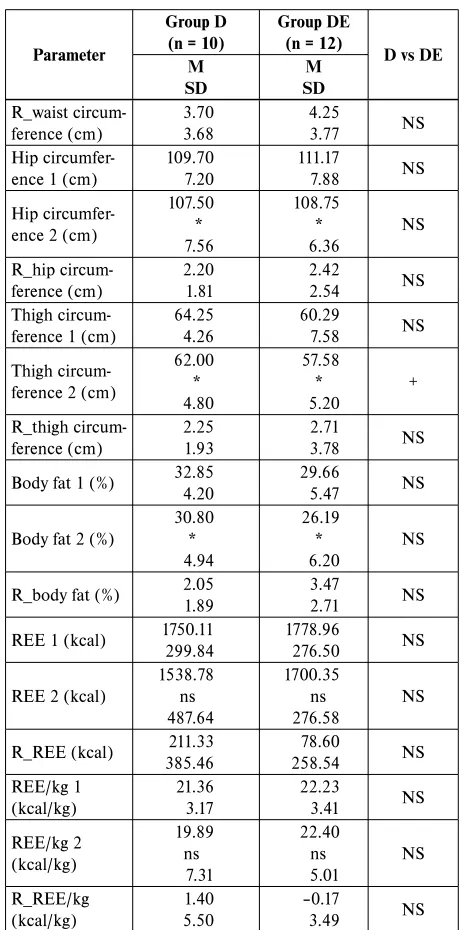
TABLE 1
Changes of the measured data after a 10 week weight reduction programme
Parameter
Group D (n = 10)
Group DE (n = 12)
D vs DE M
SD
M SD
Age (years) 48.70
3.80
43.83
8.82 NS
Stature (cm) 167.60
5.04
167.25
6.27 NS
Weight 1 (kg) 81.34
12.54
81.25
14.14 NS
Weight 2 (kg)
78.72 * 14.06 77.84 * 13.62 NS
R_weight (kg) 2.62
2.99
3.41
2.41 NS
BMI 1 (kg/m2) 28.88 3.58
29.07
5.01 NS
BMI 2 (kg/m2)
27.93 * 4.16 27.80 * 4.90 NS
R_BMI (kg/m2) 0.95
1.08
1.20
0.85 NS
Waist circumfer-ence 1 (cm)
99.30 9.03
91.83
11.08 NS
Waist circumfer-ence 2 (cm)
95.60 * 9.98 87.58 * 9.85 NS Parameter Group D (n = 10)
Group DE (n = 12)
D vs DE M SD M SD R_waist circum-ference (cm) 3.70 3.68 4.25 3.77 NS Hip circumfer-ence 1 (cm)
109.70 7.20
111.17
7.88 NS
Hip circumfer-ence 2 (cm)
107.50 * 7.56 108.75 * 6.36 NS R_hip circum-ference (cm) 2.20 1.81 2.42 2.54 NS Thigh circum-ference 1 (cm)
64.25 4.26
60.29
7.58 NS
Thigh circum-ference 2 (cm)
62.00 * 4.80 57.58 * 5.20 + R_thigh circum-ference (cm) 2.25 1.93 2.71 3.78 NS
Body fat 1 (%) 32.85
4.20
29.66
5.47 NS
Body fat 2 (%)
30.80 * 4.94 26.19 * 6.20 NS
R_body fat (%) 2.05
1.89
3.47
2.71 NS
REE 1 (kcal) 1750.11
299.84
1778.96
276.50 NS
REE 2 (kcal)
1538.78 ns 487.64 1700.35 ns 276.58 NS
R_REE (kcal) 211.33
385.46 78.60 258.54 NS REE/kg 1 (kcal/kg) 21.36 3.17 22.23 3.41 NS REE/kg 2 (kcal/kg) 19.89 ns 7.31 22.40 ns 5.01 NS R_REE/kg (kcal/kg) 1.40 5.50 –0.17 3.49 NS Legend
D – group with diet restriction
DE – group with combined diet and exercise intervention M – arithmetic mean
SD – standard deviation
R_... – diff erence in measured parameters Statistically signifi cant diff erence: a sign test
* p < 0.05 changes from baseline ns – no signifi cant from baseline Mann-Whitney U test
+ p < 0.05 D vs DE NS – no signifi cant D vs DC
RESULTS
At the end of the monitored period REE decreased by 12.1% vs. 4.4% as compared to the initial values (D vs. DE). REE/kg in group D decreased by 7% and in group DE increased by 0.8% as compared to the initial values. The changes in REE and REE/kg were not statistically signifi cant and there were also no diff erences between groups D and DE. At the beginning of the intervention there were no statistically signifi cant diff erences in the monitored anthropometric parameters between groups D and DE. At the end of the six week intervention, weight decreased by 2.62 ± 2.99 kg vs. 3.41 ± 2.41 kg, BMI by 0.95 ± 1.08 kg/m2 vs. 1.20 ± 0.85 kg/m2, waist circumference by 3.70 ± 3.68 cm vs. 4.25 ± 3.77 cm, hip circumference by 2.20 ± 1.81 cm vs. 2.42 ± 2.54 cm, thigh circumference by 2.25 ± 1.93 cm vs. 2.71 ± 3.78 cm and body fat by 2.05 ± 1.89% vs. 3.47 ± 2.71% (D vs. DE). The weight change oscillated around the generally recommended value of 0.5 kg/week, on average it was 0.4 kg/week in group D and 0.6 kg/week in group DE. In both groups a statistically signifi cant decrease in all anthropometric values occurred. In two women (each in a diff erent group) weight, body fat as well as other anthropometric parameters increased. In an interview it was elicited that the woman from group D adhered to the prescribed diet program rather loosely, and the subject from group DE, although attending the train-ing regularly, often contravened the diettrain-ing regime. The only statistically signifi cant diff erence in the monitored anthropometric parameters between group D and group DE was the thigh circumference shortage.
DISCUSSION
This study has confi rmed that when energy intake decreases, so does the energy expenditure. This is a very important fact that needs to be taken into account in obesity therapies. In a recent study Brehm et al. (2005) describe a 7% REE decrease and 1% REE/kg decrease in 50 obese women undergoing a two month reducing diet. The women had a prescribed daily restriction of 3500 kJ and decreased their weight by 5.8 kg. Similar-ly Miles et al. (1993) have found a REE decrease in obese women by 8.8% while their weight was reduced by 7.3 kg. In this study we applied less strict dietary restrictions (2000 kJ/day), with weight in group D de-creasing on average by 2.62 kg. We could therefore also assume a more moderate REE decrease, as the diet in-duced REE decrease depends on the amount of weight loss (Froidevaux et al., 1993). In fact, however, the REE values in group D decreased by 12% and REE/kg by 7%. Detected values showing signifi cant REE decrease can be explained by the short duration of the intervention, since during the fi rst weeks of the reducing regime the REE decrease is probably more marked and only later
subsides. A continuation of the above study by Brehm et al. (2005) might suggest so, as after the next two months of the reducing diet the REE values decreased only by 6% as compared to the initial values and REE/kg values even increased by 5%. For this reason a study that is to be a continuation of the present one will prolong the intervention to 6 months.
REE and REE/kg values in group D obtained during the initial measuring were highly diff use as compared to group DE (great SD). In single subjects a great vari-ability of reaction to the intervention programs used was detected. Causes can be seen in individually diff er-ing reactions to the trainer-ing stimulation conditioned by genetic dispositions (Joosen et al., 2005). In addition, the amount of habitual physical exercise not monitored within the study also diff ered.
The REE increase caused by regular exercise has been described in a number of works (Gilliat-Wimberly et al., 2001; Goran et al., 1994; Poehlman, Melby, & Goran, 1991; Stiegler & Cunliff e, 2006; and others). Nevertheless, the sole increase of physical activity for weight reduction in obese women without also modify-ing their diet is not too happy a solution, since women, more so than men, tend to increase their energy intake in proportion to the increased energy expenditure (West-erterp et al., 1992).
For REE maintenance the regular exercise model applied combining slow resistance training and endur-ance training with the intensity of 60–70% of maximum heart rate reserve was suffi cient. This result does not correspond to the outcomes of Van Zant’s (1992) or Poehlman, Melby and Goran’s (1991) works, who state that in this respect eff ective exercise must have higher intensity. It should be realised that obese untrained sub-jects would not be even able to perform regular exercise under higher intensity. Higher exercise frequency and longer duration of the intervention program could aff ect the metabolism more signifi cantly, as suggested by the fi rst results of a new continuation study with the inter-vention period prolonged to six months.
CONCLUSION
in all the monitored anthropometric parameters. For all monitored parameters (REE and anthropometric) a reducing diet combined with exercise tends to be more eff ective than dieting alone.
The often described “yo-yo” eff ect is linked to the REE decrease as a result of the reducing diet carried over even after the energy restrictions are ended. If maintain-ing or even increasmaintain-ing REE is successful, the reduced weight is also easier to maintain. In this experiment the selected exercise program succeeded in maintaining or even slightly increasing the REE reduced by the diet. In the case of the REE/kg value it is apparent that the diet intervention used decreases its value, whereas the combined intervention slightly increases it.
To aff ect the REE more markedly, prescription of physical exercise of longer duration, and of greater in-tensity and frequency would be necessary.
The presented results suggest that to reduce weight in obese women, it is more eff ective to apply a complex program comprising dieting restrictions and higher physical activity.
Acknowledgments
This study was carried out within the research project granted by the Ministry of Education, Youth and Sports “Physical activity and inactivity of inhabit-ants of the Czech Republic, no: 6198959221”.
REFERENCES
Brehm, B. J., Spang, S. E., Lattin, B. L., Seeley, R. J., Daniels, S. R., & D’Alessio, D. A. (2005). The role of energy expenditure in the diff erential weight loss in obese women on low fat and low carbohydrate diets. The Journal of Clinical Endocrinology & Me-tabolism, 3(90), 1475–1482.
Froidevaux, F., Schutz, Y., Ghristin, L., & Jéquier, E. (1993). Energy expenditure in obese women before and during weight loss, after refeeding, and in the weight relapse period. American Journal of Clinical Nutrition, 57, 35–42.
Gilliat-Wimberly, M., Manore, M. M., Wolf, K., Stan, P. D., & Carrollm S. S. (2001). Eff ects of habitual physical activity on the resting metabolic rates and body compositions of women aged 35 to 50 years. Journal of the American Dietetic Association, 10(101), 1181–1188.
Goran, M. I., Calles-Escandon, J., Poehlman, E. T., O’Connell, M., & Danforth, E. (1994). Eff ects of increased energy intake and/or physical activity on energy expenditure in young healthy men. Journal of Applied Physiology, 77, 366–372.
Hainer, V. et al. (2004). Základy klinické obezitologie. Praha: Grada.
Joosen, A. M., Gielen, M., Vlietinck, R., & Westerterp, K. R. (2005). Genetic analysis of physical activity in twins. American Journal of Clinical Nutrition, 82, 1253–1259.
Luscombe, N. D., Clinton, P. M., Noakes, M., Parker, B., & Wittert, G. (2002). Eff ects of energy restricted diets containing increased protein on weight loss, resting energy expenditure, and the thermic eff ect of feeding in type 2 diabetes. Diabetes Care, 25, 652–657.
Miles, C. W., Wong, N. P., Rumpler, W. V., & Conway, J. (1993). Eff ect of circadian variation in energy ex-penditure, within subject variation and weight reduc-tion on the thermic eff ect of food. European Journal of Clinical Nutrition, 4, 274–284.
Pařízková, J. (1973). Složení těla a lipidový metabolismus za různého pohybového režimu. Praha: Avicenum. Poehlman, E. T. (1989). A review: Exercise and its infl
u-ence on resting energy metabolism in man. Medicine and Science in Sports and Exercise, 1(5), 515–525. Poehlman, E. T., Melby, C. L., & Goran, M. I. (1991).
The impact of exercise and diet restriction on daily energy expenditure. Sports Medicine, 11, 78–101. Rumpler, W. V., Seale, J. L., Miles, C. W., & Bodwell,
C. E. (1991). Energy intake restriction and diet com-position eff ects on energy expenditure in men. Ameri-can Journal of Clinical Nutrition, 53, 430–436. Stiegler, P., & Cunliff e, A. (2006). The role of diet and
exercise for the maintenance of fat free mass and resting metabolic rate during weight loss. Sports Medicine, 3, 239–262.
Van Zant, R. S. (1992). Infl uence of diet and exercise on energy expenditure. International Journal of Sport Nutrition, 2, 1–19.
Wadden, T. A., Foster, G. D., Stunkard, A. J., & Donikl, A. M. (1996). Eff ects of weight cycling on the resting energy expenditure and body composition of obese women. The International Journal of Eating Disor-ders, 1, 5–8.
Weir, J. B. V. D. (1949). New methods for calculating metabolic rate with special reference to protein me-tabolism. Journal of Physiology, 109, 1–9.
Westcott, W. L., Winett, R. A., Anderson, E. S., Wo-jcik, J. R., Loud, R. L. R.,Cleggett, E., & Glover, S. (2001). Eff ects of regular and slow speed resistance training on muscle strength. Journal of Sports Medi-cine and Physical Fitness,41, 154–158.
VLIV INTERVENČNÍCH PROGRAMŮ NA ZMĚNY KLIDOVÉHO ENERGETICKÉHO VÝDEJE
(Souhrn anglického textu)
Cílem naší studie bylo posoudit vliv dvou typů re-dukčních programů na změny klidového energetického výdeje (REE) u skupiny žen středního věku s nadměr-nou hmotností. Intervenčních programů se zúčastnilo 28 asymptomatických žen ve věku 40–50 let s nadváhou či obezitou, 6 žen studii nedokončilo. Soubor byl rozdě-len na 2 skupiny – D a DE. Ženy zařazené do skupiny D (n = 10) měly předepsanou pouze dietní intervenci a ve skupině DE (n = 12) kombinovaný program dietní a po-hybové intervence. Dietní program byl v obou skupinách stejný a denní energetická restrikce činila pro každého jedince přibližně 2000 kJ. Ve skupině s pohybovou in-tervencí byla zvolená kombinace silového a aerobního tréninku. Oba programy trvaly 6 týdnů. Na počátku a konci intervence jsme sledovali hodnoty REE (nepří-mou kalorimetrií), REE/kg a vybrané antropometrické parametry: tělesnou hmotnost, výšku, BMI, obvod pasu, boků a stehna a procento tělesného tuku.
Ve skupině s kombinovaným intervenčním progra-mem byl pokles REE menší než ve skupině s pouhou dietní restrikcí. Změny REE a REE/kg na konci sle-dovaného období však nebyly statisticky významné a nebyl zjištěn statisticky významný rozdíl ani mezi po-užitými intervenčními programy. Rozdílné intervenční programy rovněž neměly, kromě obvodu stehna, statis-ticky významně rozdílný vliv na změnu sledovaných antropometrických ukazatelů. Ve všech sledovaných parametrech (REE i antropometrických) můžeme však pozorovat tendenci efektivnějšího působení kombinace redukční diety a cvičení než samotné diety.
Pro výraznější ovlivnění REE by bylo patrně zapotře-bí použití předpisu pohybové aktivity s delším trváním, vyšší intenzitou a frekvencí cvičení.
Klíčová slova: obezita, klidový energetický výdej, cvičení, redukce hmotnosti.
Contact
Mgr. Iva Řehová