Vol.9 (2019) No. 6
ISSN: 2088-5334
An Efficient Phase-Based Binarization Method for Degraded
Historical Documents
Alaa Sulaiman
#, Khairuddin Omar
#, Mohammad F. Nasrudin
##
Pattern Recognition Research Group, Centre for Artificial Intelligence Technology, Faculty of Information Science and Technology, Universiti Kebangsaan Malaysia (UKM), 43600, Bangi, Selangor, Malaysia
E-mail: [email protected], [email protected], [email protected]
Abstract— Document image binarization is the first essential step in digitalizing images and is considered an essential technique in both document image analysis applications and optical character recognition operations, the binarization process is used to obtain a binary image from the original image, binary image is the proper presentation for image segmentation, recognition, and restoration as underlined by several studies which assure that the next step of document image analysis applications depends on the binarization result. However, old and historical document images mainly suffering from several types of degradations, such as bleeding through the blur, uneven illumination and other types of degradations which makes the binarization process a difficult task. Therefore, extracting of foreground from a degraded background relies on the degradation, furthermore it also depends on the type of used paper and document age. Developed binarization methods are necessary to decrease the impact of the degradation in document background. To resolve this difficulty, this paper proposes an effective, enhanced binarization technique for degraded and historical document images. The proposed method is based on enhancing an existing binarization method by modifying parameters and adding a post-processing stage, thus improving the resulting binary images. This proposed technique is also robust, as there is no need for parameter tuning. After using document image binarization Contest (DIBCO) datasets to evaluate this proposed technique, our findings show that the proposed method efficiency is promising, producing better results than those obtained by some of the winners in the DIBCO.
Keywords— document image binarization; document image binarization contest (DIBCO); HOWE binarization.
I. INTRODUCTION
Document image binarization (DIB) is considered a critical stage in segmenting texts from highly degraded document images, also binarization coming as the first step in most of document image analysis and recognition [1]. The purpose of this technique is to segment anticipated objects, such as texts, from the background and remove noises that exist in images. Document image binarization is of paramount importance because the performance of other steps in analysis and vision applications depends on its results and efficiencies [1], such as optical character recognition, image enhancement, text detection and writer identification [2].
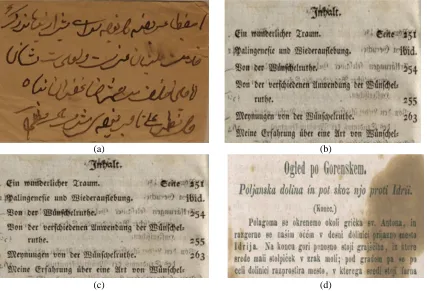
As illustrated in Fig.1, document images typically suffer from various degradations over time, and it is not uncommon for severely degraded documents to depict abnormal properties concerning stroke brightness, stroke width, stroke connection, and background of the document [3]. Common types of degradation include contrast variation, uneven
Illumination, blurring, faded ink or faint characters, bleeding of ink, smears, and thin or weak texts [4]. These degradations make the document image binarization a daunting task. Nevertheless, various methods for DIBs have been developed to address the challenges in binarization. The methods of image binarization are typically categorized into local and global thresholding methods [5]. The global thresholding method uses a single thresholding amount, and it ensures that the foreground and the background images are well-segmented.
Furthermore, the Niblack method [7], which is one of the older local binarization methods, can produce reasonable results by segmenting the text in the image from the background correctly. This method, nonetheless, produces extensive noise around the text, and the tuning of the parameter needs to be made manually. Hence, apart from the fact that the results of binarization depend on the window size used, the parameters need to change for certain kinds of degradations [5].
Another thresholding method is Sauvola’s binarization method, a technique that has solved the noise problem around text [8]. However, this method is not foolproof. It is sensitive when there is a contrast variation between the background and the foreground images. In addition to the fact that its results depend on window size, Sauvola’s binarization method is also similar to most local methods
which need to tune the parameters and the window’s size manually, depending on the images. Although no binarization methods are yet to be effective for different types of document degradations, the binarization of heavily degraded document images remains under research [9].
Some researchers have proposed binarization methods that are dependent on many stages [10]. They use a pre-processing stage before binarization; these methods utilize some filters to eliminate noises in the images before the binarization step. At a later stage, a newly proposed binarization method is applied to specific existing binarization methods, to extract the foreground from the noisy background. Furthermore, the quality of the resulting binary image is improved by employing some post-processing methods [11].
(a) (b)
(c) (d)
Fig 1. Image A is from PHIBD 2012, images a – d is from different DIBCO datasets These approaches yield more improved results than those
using simple thresholding methods [5], [12]. This was confirmed by the 2014 and 2016 DIBCO winners, whose methods consisted of numerous stages. In addition to these research efforts, by introducing challenging benchmarking datasets for evaluating the recent advancement in DIB, contests such as the Competition of Handwritten Document Image Binarization (H-DIBCO) and the Competition of Document Image Binarization (DIBCO) have been held since 2009 to address this ongoing problem [13]. However, competition results thus far indicate that more research efforts are needed to improve binarized image quality [6].
II. MATERIALS AND METHODS
Howe’s binarization method comprises three salient stages that define its distinct purposes and functions [14].
correcting labeling discontinuities. Owing to their significant results, Howe provides an automatic algorithm that tunes the two parameters [15]. He also argues that tuning the value of c minimizes the energy function for a sequence of a varied c value and compares two sequential images based on the measure of their instability. The measure above represents a normalized change between two sequential images. The final result is chosen by selecting the image whose instability value is the lowest. Another crucially tuned parameter, according to [14], is the thi. Howe contends that picking between two high threshold values, τ1 and τ2, is enough to
provide sufficient energy to speed up the process of tuning the parameter. However, it is worth noting that tuning thi requires adjusting c, as described above for τ1 and τ2 and their average value τ0.
The process results in the following binarized images: B0, B1, and B2. The previously described variability measure is used on B0 and B1, and B0 and B2 to compare their high threshold with its mean. The value of thi is chosen from the highest threshold, whose instability value is the lowest. The above automatic algorithm tuning procedure produces excellent results for the binarization, however, Howe’s binarization method, in some cases, fails to detect the edges of the text if the image is degraded with too much ink bleeding [16].
A. Proposed Binarization Method
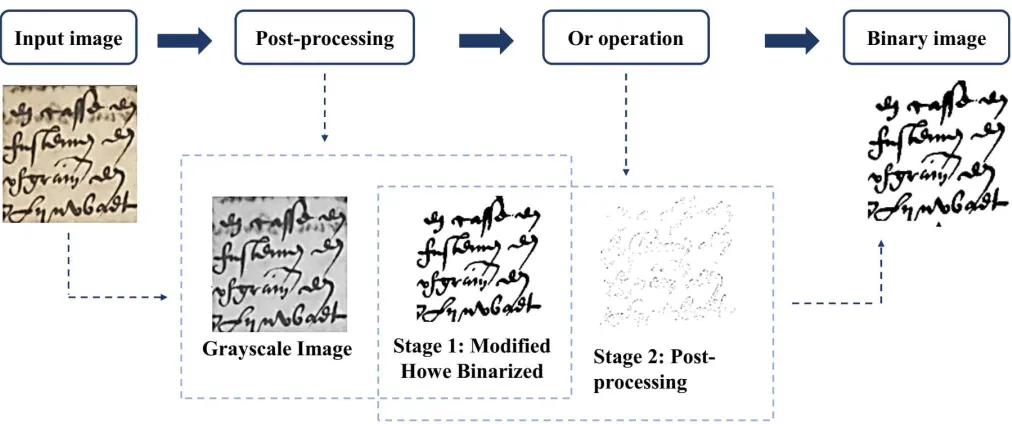
The proposed binarization method consists of two main stages. Fig. 2 presents the proposed method framework.
Fig. 2 The framework of the proposed method
A. Stage 1: Modified Howe Binarization
The proposed binarization method uses modified parameters of Howe’s binarization method [13], which tuned the c value and calculated the binarization using two thi values τ1, τ2 and their mean value τ0 = (τ1 + τ2)/2. The proposed method modified thi value from the original Howe method. thi, from the original Howe method, had values [0.25 0.5]. From experiments with the proposed post-processing method, our technique produced the best results with the values of thi equal to [0.20 0.6] moreover we experimentally found that Howe method with sigma equals 0.62 instead of 0.6 in original Howe method gives better results, where these parameters tuned using DIBCO 2016 dataset [11].
B. Stage2: Post-Processing Step
Howe’s binarization method fails in some cases to detect the edges of the text if the image degrades with too much bleeding [16]. The purpose of the post-processing stage is to identify the needed pixels around the text stroke edges, to include it with the binarized image, to reduce any loss of pixels around the text edges, and to refine the pixel position around the edges, based on their grayscale image from the original image which must be binarized This step follows the
methods proposed by B. Su, et al. [17]. The modification in the proposed binarization method is to involve the binary image calculated in the previous step, which modified Howe’s binarized image for E, rather than the image with the high contrast used in the original method. The grayscale image must be included for post-processing. Thus, the input grayscale image is used for I in (1). The post-processing generates hollow characters; hence, the OR operation is applied between the resultant binary image from the post-processing step and the first binary image from Howe’s modified method in Step (A).
R (x, y) =
⎩ ⎨
⎧ 1 ≥
( , ) ≤ + 2
0 "#ℎ%&'()%
(1)
*
+∑539:;<=>((-,.,/)012345)×(701(.,/)))8
?
(2)
Where Estd in equation two represents the image’s intensity standard deviation, Emean in equation three denotes the mean, which involves the modification of Howe’s binary image and the grayscale image within the region window. Also, we must note that the size of the window used is 3 x 3. The symbol I denote the input greyscale image and (x, y) represents the location of the pixel for the image under study. E denotes the binary result image from Step (A) above. The number of ones in the image is within the local neighboring window represented by Ne. Therefore, if Ne is higher than Nmin and I (i, j) is less than Emean +E (std)/2, R (i, j) is set to 1; or, R (i, j) is set to 0. Based on the experiment, the size of the dimension of the window is set to 3x3, as was done in the reference paper, and the minimum amount of foreground image pixels Nmin is set to 4 within the region window [16].
B. Setup of the Experiment
The proposed method was evaluated using all versions of the DIBCO dataset from 2009 to 2017, with all 103 images. The proposed method was also assessed using the PHIBC 2012 [13], which includes images written in Persian. The images from the above datasets include different kinds of degradations, such as smearing, bleeding through contrast variation, uneven illumination, faint ink, and thin pen strokes. Those degradations make the binarization process challenging. The datasets include handwritten and printed documents.
Furthermore, the proposed method compares the first three winners in each version of the DIBCO dataset. In addition, the results are compared with some standard binarization techniques, such as Otsu’s [24], Savoula’s [8], and Howe’s [14] binarization methods. The measures used for evaluation were revamped from DIBCO’s report [5], and they include the F-Measure (FM), Pseudo-F-Measure (P-FM), Distance Reciprocal Metric (DRD), and Peak Signal to Noise Ratio (PSNR).
CD% )E&% =
?×F G HH×IJ G KF G HHLIJ G K (4)M&%N()(" =
OILPIOI (5)Q%N RR =
OILPBOI (6)TP represents True Positive, FN stands for False Negative, and FP denotes the False Positive values.
The phenomenon is represented by [5], whereby it applies to all the PPs (Pseudo Precision) and RPs (Pseudo-Recall). RPs together with PPs utilize distance weights concerning the issue characters of the Ground Truth (GT) contour. Regarding PRs, GT foreground weights are normalized based on the width of the local stroke. The weights are well-defined between the region [0,1]. The weights for PPs are fixed in a
region that allows it to expand to the GT background, the width of the closest GT stroke part.
MS Q = 10R"T (UV1G8 ) (7)
WS =
∑^_\]∑Z[\](-(X,Y)0-(X,Y))8UB (8) The term PSNR is used to indicate the distance or closeness of one image to another. It should be noted that the value of PSNR is directly proportional to the similarity of the image. In other words, when the value of PSNR is high, the similarity of the images increases and vice versa. The distance reciprocal metric (DRD) measures the possible visual distortions that are visible in binary documented images. It uses the (9) to measure the distortion.
`Q` =∑cb\]aFab
BdeB (9)
The NUBN represents the total number of the 8x8 non-uniform blocks present in the GT image. The DRDk represents the deformity of the flipped kth pixel. Its weighted sum is equal to the ground truth image of 5x5 block, but it differs from the flipped kth pixel at (x, y) as shown in (10).
`Qfg= ∑?*0?∑p*0?? hijg((, k) − mg( , n × oBU((, k) (10)
III.RESULTS AND DISCUSSION
The experimental results are presented in Table 1. The proposed method is compared with some well-known binarization methods in the 2009-2016 competition datasets [5] and [18-23]. Table 2 illustrates the evaluation results on the most recent DIBCO 2017 datasets. A comparison is drawn between the top three ranked methods from the competition and some well-known methods. Table 3 presents the evaluation results on the PHIBC 2012 datasets [13] which include 15 images written in Persian and Arabic. These images are riddled with several types of degradation, including smear, bleed-through, uneven illumination, and other forms of degradation.
TABLEI
COMPARISON OF FM,P-FM,PSNR, AND DRD MEASURES.
Dataset Methods Measures
FM P-FM PSNR DRD
DIBCO 2009
1st 88.65 -- 19.42 --
2nd 86.02 -- 18.57 --
3rd 86.16 -- 19.42 --
Otsu 78.72 -- 15.34 --
Sauvola 85.41 -- 16.39 --
Proposed 94.12* 94.70* 20.09* 1.95
H-DIBCO 2010
1st 91.5 93.58 19.78 --
2nd 89.7 95.15 19.15 --
3rd 91.78 94.43 19.67 --
Otsu 85.24 -- 17.51 --
Sauvola 75.3 -- 15.96 --
Proposed 93.47* 94.59* 20.71* 1.79
DIBCO 2011
1st 92.38* -- 19.93* 2.36*
2nd 88.74 -- 18.76 4.01
3rd 87.18 -- 17.76 4.14
Otsu 82.22 -- 15.77 8.72
Sauvola 82.54 -- 15.78 8.09
Proposed 91.13 92.02 19.16 4.25
H-DIBCO 2012
1st 89.47 90.18 21.80* 3.44
2nd 92.85 93.34 20.57 2.66
3rd 91.54 93.30 20.14 3.05
Otsu 80.18 82.68 15.03 26.46
Sauvola 82.89 87.95 16.71 6.60
Proposed 93.24* 93.49* 21.29 2.29*
DIBCO 2013
1st 92.12 94.19* 20.68 3.01*
2nd 92.70* 93.13 21.29* 3.18
3rd 91.81 92.67 20.68 4.02
Otsu 83.94 86.52 16.63 7.58
Sauvola 85.02 89.77 16.94 7.58
Proposed 89.69 89.66 20.44 3.59
H-DIBCO 2014
1st 96.88* 97.65* 22.66* 0.90*
2nd 96.63 97.46 22.40 1.00
3rd 93.35 96.05 19.45 2.19
Otsu 91.78 95.74 18.72 2.65
Sauvola 86.83 91.8 17.63 4.90
Proposed 96.36 96.81 21.95 1.07
H-DIBCO 2016
1st 87.61 91.28 18.11 5.21
2nd 88.72 91.84* 18.45* 3.86*
3rd 88.47 91.71 18.29 3.93
Otsu 86.61 88.67 17.8 5.56
Sauvola 82.52 86.85 16.42 7.49
Howe 87.48 92.28 18.05 5.35
Proposed 87.91* 91.17 18.05 4.42
Table II depicts the FM, P-FM, PSNR, and DRD values of the first three winners in DIBCO 2017 dataset, Otsu’s, Sauvola’s, Howe’s methods, and the proposed method. In comparison to other methods, the proposed method produced the highest results in terms of FM and PSNR. However, the DRD value of the proposed method is relatively low compared to Sauvola’s and Otsu’s method.
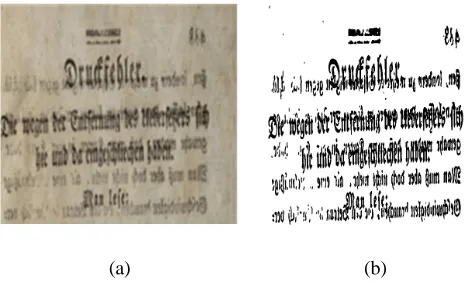
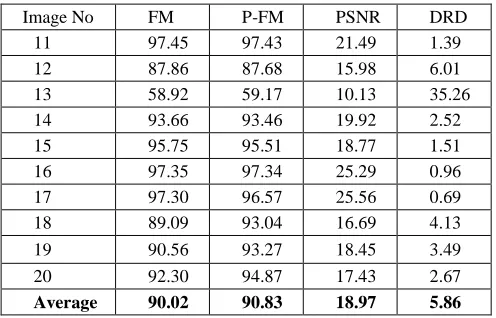
By examining the two tables, we are able to see that the results of the proposed method for FM is higher than 87.4 % for all images, except image number 13, where the FM result was 58.92 % for that image, which shown in Figure 3, is very low compared with all 19 document images in the dataset. Since the image contains several types of degradations at the same time, in addition to blurring, the proposed method fails to get high results like other images. Hence, this image result affects the average FM value of machine-printed document results which is 90.02 %, whereas it is 92.46 % for handwritten document images. Figure 3 below shows the
image number 13 from DIBCO 2017, and the binarization result image in (b) using the proposed method.
(a) (b)
TABLEII
EVALUATION RESULTS FOR THE 2017DIBCO DATASETS.
Method FM P-FM PSNR DRD
1st 91.04 92.86* 18.28 3.40*
2nd 89.67 91.03 17.58 4.35
3rd 89.42 91.52 17.61 3.56
Otsu 77.73 77.89 13.85 15.54
Sauvola 77.11 84.1 14.25 8.85
Howe 90.10 91.48 18.52 5.13
Proposed 91.24* 92.38 18.75* 4.31
Table III presents the detailed evaluation results for handwriting documents from the 2017 DIBCO dataset, and Table IV shows the detailed evaluation results for machine-printed documents from the 2017 DIBCO dataset.
TABLEIII
DETAILED EVALUATION RESULTS FOR HANDWRITING DOCUMENTS FROM
2017DIBCO DATASETS.
Image No FM P-FM PSNR DRD
1 94.91 93.84 20.19 1.52
2 89.29 91.62 16.59 4.35
3 93.30 95.07 19.91 2.14
4 87.42 88.55 17.90 5.57
5 92.11 94.18 22.33 2.46
6 94.52 96.63 16.12 2.04
7 93.58 95.12 15.62 2.71
8 91.44 96.25 18.90 2.70
9 90.90 90.85 16.94 3.11
10 97.09 97.06 20.72 1.03
Average 92.46 93.92 18.52 2.76
TABLEIV
DETAILED EVALUATION RESULTS FOR MACHINE-PRINTED DOCUMENTS FROM 2017DIBCO DATASETS.
Image No FM P-FM PSNR DRD
11 97.45 97.43 21.49 1.39
12 87.86 87.68 15.98 6.01
13 58.92 59.17 10.13 35.26
14 93.66 93.46 19.92 2.52
15 95.75 95.51 18.77 1.51
16 97.35 97.34 25.29 0.96
17 97.30 96.57 25.56 0.69
18 89.09 93.04 16.69 4.13
19 90.56 93.27 18.45 3.49
20 92.30 94.87 17.43 2.67
Average 90.02 90.83 18.97 5.86
Table V evaluates the average performance of the proposed method for all the 103 images from DIBCO 2009-2017. On average, the proposed method reaches 91.24 % F-Measure and 20.47% PSNR for all examined images in from all DIBCO versions. The evaluation measures are taken from the DIBCO results [5], [11], and [19]-[23]. Figure 4 presents the average F-Measure to the left and PSNR to the right for Otsu and Sauvola’s methods compared with the proposed method for all images from the 2009-2017 DIBCO datasets.
TABLEV
COMPARING THE AVERAGE OF FM AND PSNR.
Method FM Average PSNR
Otsu 83.30 16.33
Sauvola 82.20 16.26
Proposed 92.14* 20.47*
70.00 80.00 90.00 100.00
Otsu Sauvola Proposed
F-Measure
Fig 4. Average FM and PSNR comparison of Otsu and Sauvola’s method and the proposed method
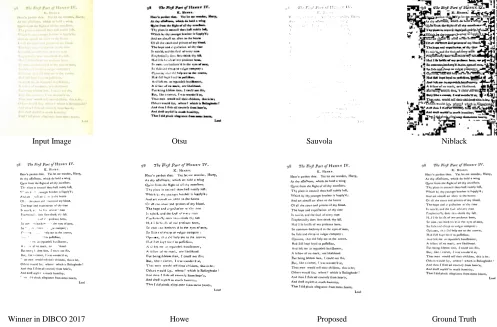
Furthermore, as illustrated in Table VI, which shows the result of PHIBC 2012 dataset [13], which evaluate the performance of the binarization methods when applied on Iranian historical degraded documents which are written in Arabic letters, we observed that the proposed result had the best result in terms of F-Measure and P-FM. Additionally, Figure 5 highlights the document binarization results for sample test images from the DIBCO 2017 dataset and compares the results obtained from the algorithm of the competition winner with some of the well-known methods Figure 5 shows a printed degraded document image from the DIBCO 2017 dataset. In Otsu’s binarization result, the image is bleeding and the text is difficult-to-read.
Similarly, Sauvola’s method fails because the input image is very low in contrast. Both Niblack and Nick methods fail to show a good binary result image. As for the Howe method, many pixels are lost around text stroke edges. The resultant image from the winner of the DIBCO 2017 dataset also has many faded texts as shown in Figure 5. Nevertheless, the proposed method preserves most of the text strokes, and it is the closest image to the ground truth image.
TABLEVI
EVALUATION OF THE PROPOSED METHOD ON PHIBC2012[12].
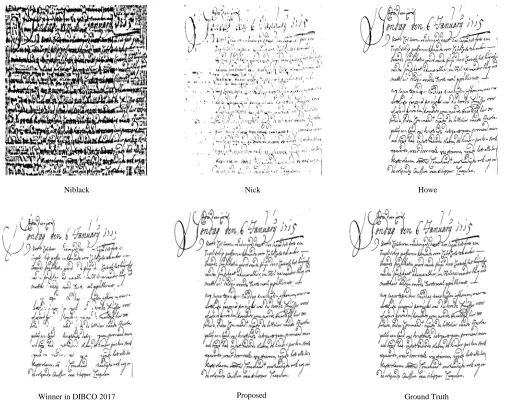
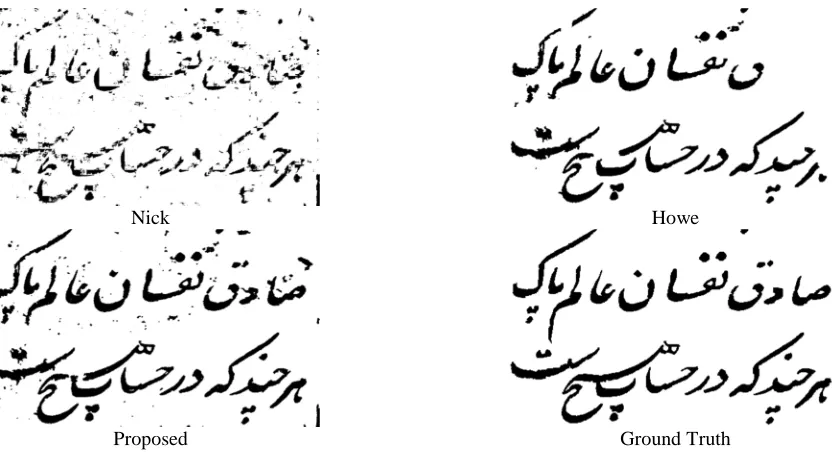
Figure 6 depicts a handwritten degraded document image from the DIBCO 2017 dataset. The image is very degraded, with low image contrast and much bleeding throughout, the resultant images show again that the proposed method is more effective than other methods. Figure 7 illustrates the binarization results for a document image from the PHIBC 2012 dataset. A few noises remain in Otsu’s binarization result. Sauvola’s method was also met with failure because of a lot of contrast variation between the text and the degraded.
0 10 20 30
Otsu Sauvola Proposed
PSNR
Method Measurements
FM Pseudo-FM PSNR DRD
1st 88.50 92.25 18.28 5.57
2nd 86.79 86.29 17.64 6.08
3rd 87.30 89.50 17.95 5.87
Otsu 77.75 79.98 15.42 31.1
Howe 89.58 91.88 18.53* 4.11*
Fig . 5 Binarization results of the printed sample image from the DIBCO 2017 datasets.
Input Image
Otsu
Sauvola
Input Image Otsu Sauvola Niblack
Niblack
Nick
Howe
Winner in DIBCO 2017 Proposed Ground Truth
Fig. 6 Binarization results of the handwritten sample image from the DIBCO 2017 datasets.
Input Image Otsu
Fig 7. Binarization results of a sample image from the PHIBC 2012 dataset.
IV.CONCLUSION
This paper proposes an improved document images binarization method which is effective for common types of image degradation, including uneven illumination, contrast variation, ink-bleed, smears, faded ink or faint characters, blurring, and thin or weak text. The proposed technique is modest and robust. Besides the fact that it does not require any parameter tuning, this proposed method consists of two steps. The first step is by using an existing binarization method and by modifying some parameters. The second step is by adding an efficient post-processing method that refines the pixels around the edges and enhances the performance of the binarization method. Based on the experimental results, these two steps have provided a high accuracy when applied to highly degraded historical documents. The results from experiments also indicate that the proposed methods outperform several well-known established binarization methods in terms of the F-Measure, P-FM, PSNR, and DRD.
ACKNOWLEDGMENT
University Grants PP-FTSM-2019 funded this research
REFERENCES
[1] Sulaiman, A., Omar, K. and Nasrudin, M.F., 2019. Degraded Historical Document Binarization: A Review on Issues, Challenges, Techniques, and Future Directions. Journal of Imaging, 5(4), p.48. [2] Susan, Seba, and KM Rachna Devi. "Text area segmentation from
document images by novel adaptive thresholding and template matching using texture cues." Pattern Analysis and Applications (2019): 1-13.
[3] H.S. Baird, “The state of the art of document image degradation modeling,” In Proc. 4 IAPR Int. Workshop Doc. Anal. Syst. 2000, pp. 1–16.
[4] A. Sulaiman et al., “A database for degraded Arabic historical manuscripts,” in ICEEI 2017 6th Int. Conf., pp. 1-6, 2017.
[5] K. Ntirogiannis et al., “ICFHR2014 competition on handwritten document image binarization (H-DIBCO 2014),” ICFHR, pp. 809– 813, 2014.
[6] T. Kalaiselvi, “A comparative study on thresholding techniques for gray image binarization,” IJARCS, vol. 8, no. 7, pp. 1168–1172, 2017. [7] W. Niblack, An Introduction to Digital Image Processing, Strandberg
Publishing Company, 1985.
[8] J. Sauvola and M. Pietikäinen, “Adaptive document image binarization,” Pattern Recognition, vol. 33, no. 2, pp. 225–236, 2000. [9] L. P. Saxena, “Niblack’s binarization method and its modifications to
real-time applications: a review,” ArtificialIntell.Review,2017. [10] Yahya, Sitti Rachmawati, et al. "Image enhancement background for
high damage Malay manuscripts using adaptive Threshold Binarization." International Journal on Advanced Science,
Engineering and Information Technology 8.4-2 (2018): 1552-1564.
[11] I. Pratikakis et al., “ICFHR 2016 handwritten document image binarization contest,” Proc. ICFHR, 2016, pp. 619–623.
[12] I. Pratikakis et al., “ICDAR2017 competition on document image binarization,” 2017 14th IAPR ICDAR, 2017, pp.1395–1403. [13] S.M. Ayatollahi and H. Ziaei Nafchi, “Persian heritage image
binarization competition (PHIBC 2012),” in 1st Iranian Conf. Pattern Recognit. Image Anal. PRIA, 2013.
[14] N. R. Howe, “Document binarization with automatic parameter tuning,” Proc. Int. Conf. Doc. Anal. Recog., vol. 16, no. 3, pp. 247– 258, 2013.
[15] N. R. Howe, “A Laplacian energy for document binarization,” Proc.
ICDAR, pp. 6–10, 2011.
[16] C. Tensmeyer and T. Martinez, “Document image binarization with fully convolutional neural networks,” 2017.
[17] B. Su et al., “Binarization of historical document images using the local maximum and minimum,” Proc. 9th IAPR Int. Workshop on
Doc. Anal. Syst., 2010, pp. 159-166.
[18] J. Burie, et al., “ICFHR 2016 competition on the analysis of handwritten text in images of Balinese palm leaf manuscripts,” Proc.
of Int. Conf. Frontiers Handwriting Recog.ICFHR,2016, pp.0–5,
[19] B. Gatos et al., “DIBCO 2009: document image binarization contest,”
Int. J. Doc. Anal. Recog, vol. 14., no. 1, pp. 35–44, 2011.
[20] I. Pratikakis et al., “H-DIBCO 2010 - handwritten document image binarization competition,” Proc. 12th ICFHR,2010, pp.727–732. [21] I. Pratikakis et al., “ICDAR 2011 document image binarization
contest,” ICDAR, 2010, pp. 727–732,
[22] I. Pratikakis et al., “ICFHR 2012 competition on handwritten document image binarization,” ICFHR, pp. 12, 18–20, 2012. [23] I. Pratikakis et al., “ICDAR 2013 document image binarization
contest (DIBCO 2013),” Proc. ICDAR, 2013, pp.1471–1476. [24] N. Otsu, “A threshold selection method from gray-level
histograms”,IEEE Trans. Sys., Man., Cyber, vol. 9, Pp. 62–66, 1979.
Nick Howe