R E S E A R C H
Open Access
A coalitional graph game framework for
network coding-aided D2D communication
Yulei Zhao
1, Yong Li
1*, Zhiguo Ding
2,3, Ning Ge
1and H. Vincent Poor
2Abstract
The application of device-to-device (D2D) communication in cellular networks can significantly improve the efficiency of spectrum utilization, which benefits local area cooperative services. On the other hand, network coding can realize more efficient cooperation among cellular users. Thus, it is natural to combine network coding with D2D communication in order to further increase the system sum rate. In this paper, a coalitional graph game framework is proposed to jointly accomplish resource allocation and relay selection, two challenging problems in network coding-aided D2D communication networks. It is shown that this framework can model D2D communication combined with various network coding schemes. Based on the coalitional graph game framework, a distributed algorithm with low computational complexity is proposed to solve the formulated problem for physical layer network coding-aided D2D communication. Finally, the performance of the proposed transmission scheme is evaluated through extensive simulations.
Keywords: Device-to-device communication, Network coding, Coalitional graph game, Resource allocation, Relay selection
1 Introduction
Wireless access and mobile Internet are gaining popular-ity globally. For example, Cisco estimates that mobile data traffic will grow at an annual rate of 57 % from 2015 and reach over 24.3 exabytes per month in 2019 [1]. Over two thirds of this traffic will be related to local area video con-tent service. To meet this ever-increasing demand for local area services, device-to-device (D2D) communication has been proposed as a key component for next-generation cellular networks [2], where user equipments (UEs) send data to nearby devices over direct links, instead of through base stations (BSs) [3]. Such direct D2D transmission enables proximate cellular users to share content directly, which reduces power consumption and improves trans-mission rates [4]. Meanwhile, when D2D pairs reuse the bandwidth resources being used by regular cellular users, the spectrum efficiency can be further improved.
On the other hand, network coding allows interme-diate nodes to process their received data more spec-trally efficiently, which increases the capacity of wireless
*Correspondence: [email protected]
1Department of Electronic Engineering, Tsinghua University, Shuangqing Road, Beijing, China
Full list of author information is available at the end of the article
networks [5]. In the context of D2D communication, the application of network coding is particularly important since it enables users to cooperate more effectively and hence enhances the performance of local content sharing [6–10]. Osseiran et al. [6] combined network coding with cooperative transmissions to decrease the frame error rate, while Fitzek et al. [7] used network coding to achieve efficient cooperation for mobile clouds. The application of various network coding schemes to D2D communication scenarios has been investigated in [8] and [9]. Pyattaev et al. [10] used random linear network coding (RLNC) to significantly improve the degrees of content availability for cellular users and speed up content downloading.
These existing studies provided important insights for combining network coding with D2D communication net-works. However, two challenging problems in network coding-aided D2D communication systems, resource allocation and relay selection, have not yet been jointly investigated. The motivation for carrying out resource allocation is that D2D pairs and relays may occupy the same spectrum as regular cellular user and therefore introduce co-channel interference into the system. Exist-ing studies in this area have mainly focused on the prob-lems of resource allocation for direct D2D communication
[11–14]. For example, Xu et al. [12] proposed a reverse iterative combinatorial auction-based approach to allo-cate resources between cellular and D2D UEs. Li et al. [13] considered large-scale networks and proposed a coalitional formation game-based scheme to allocate the uplink resources among multiple D2D and cellular users. While the application of network coding to D2D com-munication can enhance the system throughput, this application makes the resource allocation problem more challenging since the use of network coding introduces relays into the D2D communication systems.
Meanwhile, relay selection becomes significantly com-plicated for the D2D scenario with multiple users and relays [15–18]. Kadloor et al. [15] formulated a convex optimization problem for relay selection and designed a heuristic algorithm to achieve close-to-optimal relay selection. Pham et al. [16] formulated relay assignment as a mixed-integer linear programming problem by max-imizing the minimum capacity. Joint relay selection and subcarrier assignment were considered in OFDMA D2D communication in [17]. Lu et al. [18] utilized a layered coalitional game to select the relays and allocate spectral resources. Relay selection for two-way relaying transmis-sions was analyzed in [19] and [20], but these existing works did not consider co-channel interference which is severe in spectrum-sharing schemes. Our previous work [21] only evaluated the performance of intra-session net-work coding with a limited number of D2D pairs. In conclusion, joint spectral resource allocation and relay selection for network coding-aided D2D communication is still an open problem and needs to be investigated under large-scale network scenarios.
Coalitional graph games have many important appli-cations for distributed resource allocation problems in wireless communication networks [22]. Myerson [23] was the first to define the coalitional graph game model, where each player maximizes its individual utility based on a graph model for a network. In graph-based communica-tion networks, this model can be used to solve certain problems through distributed problem [24–26]. Saad et al. [24] used the network formation game model to construct a tree uplink structure, which can be used to maximize the packet success rate. Wang et al. [26] proposed a model for the popular content distribution among onboard units (OBUs) in vehicular ad hoc networks by applying the coalitional graph game formalism.
In this paper, we propose a coalitional graph game framework for modelling the problem of joint spectrum allocation and relay selection in network coding-aided D2D communication networks. Suppose that D2D com-munication shares uplink spectral resources instead of downlink ones, where the BS does not cause strong inter-ference for D2D transmissions in the cell [13, 14]. In such a system, in order to maximize system transmission rates,
multiple D2D pairs may use the spectrum occupied by regular cellular users. Different D2D pairs are assisted by a single relay by using orthogonal channel resources, such as different frequency channels. The resource allocation of cellular users has a significant impact on the potential gains of relay-aided D2D transmissions, and relay selec-tion has an important influence on the resource allocaselec-tion scheme. Therefore, we need to use game theory to model the interactions between the two problems, resource allo-cation and relay selection. In this paper, we first use an interference graph to depict the interference relationships among communication links. Then, we establish a coali-tional graph game framework to model joint resource allocation and relay selection in network coding-aided D2D communication networks, by using the interference graph. Finally, we use physical layer network coding-aided D2D communication as a case study to demonstrate the applications of our proposed framework. Our contribu-tions are summarized as follows.
• We propose a coalitional graph game framework, which solves the problem of joint resource allocation and relay selection in network coding-aided D2D communication networks. The proposed framework is able to provide significant flexibility for modeling the application of different network coding schemes to D2D networks.
• We focus on the application of physical layer network coding (PNC) to D2D communication, which requires only two time slots. The achievable rate of different transmission modes is developed in the presence of the interference between relays and D2D pairs. We formulate the problem of joint relay selection and resource allocation in PNC D2D networks as an optimization problem, which is shown to be NP hard. To solve the formulated problem, we use the coalitional graph game framework, in which the utility of each coalition is defined as the maximum achievable sum rate of each coalition with different resource allocation policies. • We carry out extensive simulations which show that
our proposed PNC scheme provides the maximum sum-rate. Furthermore, it is shown that the
performance of our proposed solution is close to that of the optimal solution. The overall transmission rate of the network can be improved up to 50 % without increasing the computational complexity, compared with the existing schemes.
on the coalitional graph game framework is also proposed. Performance evaluations are given in Section 4, and finally Section 5 concludes this paper.
2 Coalition graph game framework
2.1 System model
Consider a set of D2D pairs sharing the resources of cellular users. The direct links from the sources to the destinations are ignored for two-way transmissions due to the half duplexing constraint at the nodes. The relays assist D2D pairs and cellular users to speed up their data transmissions with the implementation of network cod-ing. Network coding includes two coding strategies: intra-session network coding and inter-intra-session network coding [8]. Intra-session network coding encodes the packets within a single flow, while inter-session network coding encodes the packets from different data flows. Intra-session network coding increases the content availability and link reliability with low signaling, while inter-session network coding can improve the spectral efficiency. The network coding-aided D2D communication schemes can be summarized as follows:
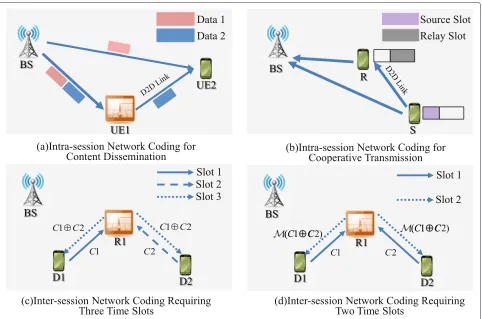
• Intra-session network coding for content dissemination. This technique speeds up content downloading and sharing among cellular users. As depicted in Fig. 1a, both cellular users UE1 and UE2 request the same content from the service provider. UE1 obtains two packetsData1andData2, while UE2 only getsData1from the BS. Then, UE2 can retrieveData2from UE1 through D2D link. In particular,Data1andData2are the coded packets instead of original packets. Intra-session network coding can significantly increase the content availability for cellular users. Based on RLNC, it has been shown that each connected cellular user can obtain the required packets with a probability close to one [10].
• Intra-session network coding for cooperative transmission. This technique uses the rateless feature of network coding to improve the achievable rate. Specifically RLNC, an algebraic coding scheme, can be adopted to realize reliable cooperative
transmissions [27]. LetPK×Ldenote the transmitting packet matrix andGN×K denote the random coefficient matrix. The encoding process of RLNC can be written asCN×L=GN×K×PK×L, where CN×Lis the encoded packet matrix. Note thatK denotes the block size of the original information packets,N represents the number of coded packets, andL is the number of bytes in each packet. As depicted in Fig. 1b, for uplink transmissions,S first transmits the coded packets to the BS in the time slot allocated to the source, where the relayR can
overhear the signals. WhenR has an adequate number of coded packets, it recodes its received packets without decoding them and transmits the re-encoded packets to the BS. At the same time,S stops sending the coded packets. The fraction of the time slots allocated to the source and the relay is determined by their channel state information [21]. • Inter-session network coding requiring three time
slots. As described in Fig. 1c, three time slots will be required for this case. In time slot 1, the cellular user D1sends its dataC1to the cellular userD2, andD2 sends its dataC2toD1in time slot 2. Due to the broadcast nature of the wireless medium, the relay can hear bothC1andC2. Next, the relay generates the encoded dataC1⊕C2and broadcasts it to the cellular usersD1andD2simultaneously. Finally, the cellular userD1recoversC2andD2recoversC1, as they already know their own data,C1andC2, respectively.
• Inter-session network coding requiring two time slots. As described in Fig. 1d, two time slots are required for this case. In time slot 1,D1andD2 transmit their data to the relay simultaneously. The relay will use advanced decoding strategies, such as denoise-and-forward (DNF) [28], to manipulate its received mixture. Then, the relay broadcasts the unique mapping dataM(C1,C2)toD1andD2at the same time. Again asD1andD2know their own data, they can remove the self-interference and then recover the packets of their partners.
In order to maximize the overall achievable transmis-sion rates, we need to consider the signal-to-interference-plus-noise ratio (SINR) in each time slot. The SINR of any terminaljreceiving the signal from terminalican be expressed as follows:
γj=
Piρi−,jα|h0|2 Pint,j+N0
, (1)
Fig. 1Different network coding-aided D2D communication schemes.aintra-session network coding for content dissemination,bintra-session network coding for cooperative transmission,cinter-session network coding requiring three time slots, anddinter-session network coding requiring two time slots
2.2 Interference graph model
In this subsection, we construct the interference graph to represent the resource-sharing relations in D2D com-munication networks [29, 30]. In particular, we assume there are C cellular users grouped in a set denoted by
C = {c1,c2,· · ·,cC}. Besides the cellular users, there are D D2D pairs grouped in a set denoted by D = {d1,d2,· · ·,dD}, which share the uplink resources with
C. Each D2D pair di
d1i,d2i consists of transmitter di1 and receiverd2i. These D2D pairs can choose the spectral resources occupied by any cellular users ci,∀ci ∈ C. In network coding-aided D2D communication networks, we also consider the use ofRrelays grouped in a set denoted byR= {r1,r2,· · ·,rR}. It is assumed that each D2D link or cellular link is limited to be aided by only one relay.
We use an undirected weighted interference graph modelG=(V,E)to depict the interference due to spec-trum sharing in the system. The vertices V denote the communication links of the regular cellular users, the D2D pairs and the relays, while the edges E represent spectrum-sharing relationships among the communica-tion links. E consists of edi,cj,di ∈ D,cj ∈ C, eri,cj,ri ∈
R,cj ∈ C andedi,ri,di ∈ D,ri ∈ R. edi,cj equals to 1
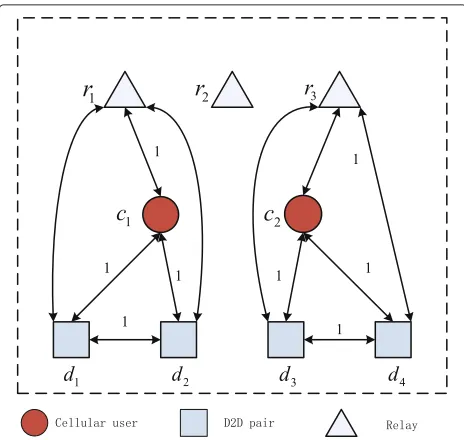
if a D2D pairdi and a cellular usercj occupy the same spectrum, i.e., co-channel interference occurs. eri,cj and edi,ri are defined similarly. The values ofedi,cj, eri,cj and edi,riare determined by resource-sharing policies used in D2D communication networks. As illustrated in Fig. 2, we construct the interference graph for the resource usage relationships. For example,c1,d1, andd2occupy the same spectral resource and the values of mutual edges equal to 1.c2, d3, and d4occupy the same spectral resource and the values of mutual edges equal to 1. The values of other edges are equal to 0, i.e., there is no interference, and hence are omitted in the interference graph for clarity. For the network coding-aided D2D communication, relaysr1 andr3occupy the same spectral resources as c1andc2, respectively, whiler2does not assist any transmissions.
2.3 Coalitional graph game framework
Fig. 2Illustration of the interference graph for network coding-aided D2D communication underlying cellular networks
transmission link to maximize the overall network rate. Therefore, the utility of each D2D user is dependent on G(V,E). From the above analysis, the coalitional graph game for network coding-aided D2D communication net-works is defined by a triple G = (N,X,U), and the formulation of this game is as follows:
• Players:N is the set of the regular cellular users, the D2D pairs, and the relays in the D2D communication network, which are the game players withN
representing the number of all game players. • Strategy:Xis the set of strategies for the regular
cellular users, D2D pairs, and relays. The strategies of the players are to make decisions on resource allocation in order to maximize each player’s utility. • Utility:U denotes the network utility of each player. In our proposed coalitional graph game model, all the players in the same coalition work cooperatively to increaseU.
2.3.1 Strategy space
Denote the strategy of each D2D user or relay n ∈ N by xn ∈ Xn, where Xn = {1, 2,. . .,C} is a set of all feasible strategies of D2D user or the relay. xn can be determined by the spectrum-sharing policies. For exam-ple, xn = j indicates that D2D pair or relay n occu-pies the same spectral resource with cellular usercj. For our formulated coalition graph game model, let x−n =
(x1,. . .,xn−1,xn+1,. . .,xN) be the set of strategies cho-sen by other D2D users or relays except playern. We also definex=(x1,x2,. . .,xN)=(xn,x−n)to denote the strat-egy vector andXis the set of all possiblex. Given the other
users’ strategies x−n, user n wants to choose a strategy xn∈Xnto maximize its network utility, i.e.,
max xn∈Xn
Un(xn,x−n),∀n∈N,
where Un(xn,x−n) can be obtained from the following definition.
2.3.2 Utility function
In the system, positive utility is defined to represent the sum rate of network coding-aided communication links, which is related to the strategies of the regular cellu-lar users, D2D users, and relays. Therefore, the utility function is an interference graph-based function, which is denoted byU(G). When relay ioccupies the spectral resource of cellular userj, it is supposed that relayihas the capability to help uplink transmissions from cellular userj to the BS or the bi-directional transmissions between D2D pairs.
In order to calculate the utility of each player, we define a set of coalitions denoted byH= {H0,H1,H2,· · ·,HC}, where Cis the total number of the coalitions Hi in the structureH,Hi∩Hj = ∅for anyi =j, and∪Ci=0|Hi| = |H|. Each coalitionHjconsists of one cellular usercjand its associated D2D pairs and one relay. All the nodes in the same coalition occupy the same spectrum. We useDcj andrcj to denote the D2D pairs in coalitionHj, respec-tively.H0represents the coalition of D2D pairs and relays, which are inactive. The utility function of each player is depending on which coalition it belongs to.
Suppose the strategy of playern∈ N isxn = cj, which indicates that playernoccupies the same spectrum with cellular usercj ∈ C. According to the above definitions, playernis in coalitionHcj. Then, the utility for playern, denoted by Un(G), is defined to be proportional to the achievable sum rate of all communication links inHcjand is given by
Un(G)=Rcj, (2)
whereRcj is the sum rate of cellular links and D2D links in the coalitionHcj. Letddenote the communication link which is chosen by relayrcjto assist, which can be the link of either the cellular user or a D2D pair.dis decided by solving the following formulated optimization problem:
d=arg max d
(Rcj), (3)
which means that relayrcj will try to maximize the sum rate of coalition Hcj. Therefore, Rcj can be derived as follows:
Rcj =Rd+log2
1+γcj
+
d∈Dcj\{d}
where Rd is determined by the specific transmission scheme of network coding-aided D2D communication.γcj andγdcan be obtained from (1). From the above analysis, the strategy vector x = (xn,x−n) determines the inter-ference graphG. Therefore,Un(xn,x−n)= Un(G), which is the general definition and can be adapted to different application scenarios.
2.3.3 Nash equilibrium
For the proposed coalitional graph game model, the num-ber of transmission links aided by each relay needs to be less than predefined M, which is determined by the available spectral resources of each relay. When the num-ber of aided links is less than M, the relay may defi-nitely select the strategy to aid the communication links in a new coalition. When the total number of links is equal to M, the relay only change the strategy when its utility is increased and other players’ utilities are not decreased. Therefore, we first define the feasible local strategy.
Definition 1.(Feasible local strategy)The feasible local strategy for a coalitional graph gameG = (N,X,U) is defined as the strategy xi∈Xi, which satisfies: (1) Ui(G) > Ui(G); (2) Uk(G) ≥ Uk(G) for k = i,k ∈ N, where G(V,E)is the current interference graph in the communi-cation domain, and G(V,E)is the changed interference graph caused by strategy xi.
The set of all feasible local strategies for player i is denoted by Si ∈ Xi, which can be obtained from Definition 1. Then, we give the definition of the local best response for player i, which aims to select the strategy xi∈Sito maximize its utility.
Definition 2.(Local best response) A feasible local strategy x∗i ∈Siis the local best response for player i∈N if Ui(x∗i,x−i)≥Ui(xi,x−i),∀xi∈Si.
Therefore, the local best response for player i is to occupy the appropriate spectral resource, if this strat-egy can maximize its utility. For joint resource allocation and relay selection, each cellular user selects its local best response in a distributed way and the coalitional graph gameG = (N,X,U)converges to the local Nash equilibrium.
Definition 3.(Coalitional graph Nash equilibrium (CGNE)) The coalitional graph game G = (N,X,U) has the Nash equilibrium if no player can increase its network utility by changing its resource-sharing strategy, i.e., x∗i = arg max
xi∈Si
Ui(xi,x−i),∀i ∈ N. Therefore, x∗ =
x∗1,x∗2,· · ·,x∗Nis the CGNE.
According to the above definition, it is important that the strategy of each player must be the local best response when the coalitional graph game achieves the CGNE.
2.4 Game theoretic solutions by using the proposed framework
The coalitional graph game framework is able to solve the problem of joint resource allocation and relay selec-tion in network coding-aided D2D communicaselec-tion net-works. As described in Fig. 1, there are four typical application scenarios for D2D communication underly-ing cellular networks. In the case of intra-session network coding for content dissemination, the network perfor-mance is determined by resource allocation among D2D links. Therefore, the strategy of each D2D link d is to occupy the appropriate spectral resource of cellular users to increase the sum rate of its coalition, which is the set of transmission links that shares the same spectrum with d. From the interference graph, we can obtain the utility functionUd. Based on the above utility value, the Nash equilibrium can be achieved through the myopic algorithm [26].
In the case of network coding-aided two-way D2D transmission, spectrum sharing of D2D users has the impact on the potential gains of the transmission links aided by relays, and relay selection in turn influences the resource allocation scheme among the D2D links. Based on the proposed framework, the strategy of each D2D link or a relay is to select a cellular user with which the spectral resource is shared. When relayroccupies the same spec-trum with cellular usercj∈Cand its associated D2D pairs
Dcj, the utility of this coalition is determined by which link is aided by the relay. We can obtain the utility from (2), and the Nash equilibrium can also be achieved by again applying the myopic algorithm.
3 Coalitional graph game framework for physical layer network coding
3.1 System overview
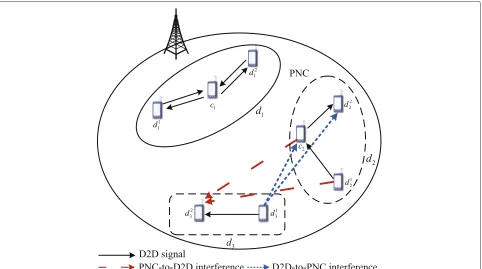
In D2D communication underlying cellular networks, co-channel interference exists between relays and D2D pairs as a result of spectrum sharing. The AF protocol may amplify this interference at the relay, which decreases the system performance. Therefore, PNC with the decode-and-forward (DF) strategy is considered in this paper. As illustrated in Fig. 3, the D2D pair d11,d21 occupies the spectral resource of c1, and the D2D pair
d12,d22 and
d13,d32occupy the same spectral resource ofc2. c1and c2act as the relay ford11,d21 andd21,d22, respectively, which communicate via PNC-aided two-way D2D trans-missions. Some D2D pairs may work under direct two-way D2D mode, i.e., their transmissions are not helped by any relays. For example,d13,d32communicate with each other through the direct transmission scheme.
In this work, we use the physical resource block (RB) in LTE as the minimum resource allocation unit, which occupies 0.5 ms in the time domain and 180 kHz in the frequency domain. D2D pairs can occupy the RBs allo-cated to an idle cellular user. In order to maximize the system performance, multiple D2D pairs can share the same idle cellular user’s spectral resource [12, 13]. How-ever, one two-way D2D communication pair is limited to be assisted by only one relay. Furthermore, the BS is in charge of resource allocation and relay selection, since it is the control center of the D2D communication network.
As an example to analyze the interference relationship, we consider the direct transmissions fromd31to d23 and the PNC-aided two-way D2D transmissions fromd12tod22, as depicted in Fig. 3. The receiverd22and its relayc2 of the PNC scheme are interfered with by the transmitterd13 ofd3. The receiver ofd23 is interfered with by the trans-mitterd12 and relayc2of the PNC scheme, asd12 andc2 transmit in the different time slots. In other words, the received signal at D2D receiverd2under the PNC scheme consists of the signals from the source node and the relay node, the interference from other D2D pairs, and addi-tive white Gaussian noise (AWGN). Similarly, the received signal at D2D receiverd3 under the direct transmission scheme consists of the signal from the source node, the interference from other D2D pairs, and AWGN. There-fore, the interference of D2D pairs needs to be suppressed to protect the transmission rate of D2D users. We define the minimum required transmission rate asRd,d∈Dfor each D2D pair, i.e., the transmission rate of any D2D pair should be larger thanRd. To simplify notation, we use 2TS and 3TS to denote the PNC-aided two-way communica-tion schemes requiring two time slots and three time slots, respectively.
3.1.1 Achievable rate of 2TS
In this section,d ∈ Ddenotes each D2D pair and c ∈
C denotes each cellular user. For brevity, we omit the
subscripts fordandc. LetR1ddenote the achievable rate of PNC-aided two-way D2D dd1,d2 communication with the idle cellular usercover two time slots, and each transmission phase has the same time duration. We adopt the two-time-slot transmission scheme of denoise-and-forward (DNF) in [28, 31] and derive the interference rela-tionships among D2D pairs. As complicated interference exists in D2D communication networks, we consider an upper bound on the achievable rate for PNC-aided two-way D2D transmissions. The upper bound onR1dis deter-mined by the weaker link and can be obtained as follows [28]:
channel capacities fromctod1andd2, respectively. The resource allocation vectorxdetermines the inter-ference relationships, which have significant impact on the achievable rate of PNC-aided two-way D2D transmis-sion using the DNF scheme [28]. For brevity, we use the binary assignment variables xc,d and yc,d to denote the resource allocation policy. xc,d = 1 indicates that D2D pair d uses the resource block of cellular user c; other-wise, xc,d = 0.yc,d = 1 indicates that idle cellular user cassists D2D paird; otherwise,yc,d = 0. The spectrum-sharing strategy xd = cmeansxc,d = 1. When xr = c, relayrwill assist the associated D2D pairs of cellular user c. Then, the value ofyc,dcan be determined by maximizing the sum rate of the associated D2D pairs ofc. Therefore, when strategy vector xof D2D pairs is determined,xc,d andyc,dcan also be obtained. For example,xd=cis equal mission model, the interference is from cellular usercand other D2D pairs that are assigned the same RB. We obtain the interference for D2D receiverdas follows:
Pint,d=Pnc,d+
d0∈D\{d,d}
xc,d0Pd0ρd−0α,d|h0|2, (7)
wherePnc,dis the interference power incurred bydfor the case of PNC-aided D2D transmissions requiring two time slots. For brevity, we define the interference from D2D pairs exceptdas follows:
Pint,dir=
d0∈D\{d,d}
xc,d0Pd0ρd−0α,d|h0|2. (8)
In the first and second cooperative phases of PNC-aided two-way D2D communication, the sum interference observed byd, respectively, can be expressed as follows:
⎧
Pint1,dindicates the interference of D2D users, whilePint2,d denotes the interference of relays and D2D users. Note that the two transmission phases of PNC-aided two-way D2D communication happen at different time slots and have the same time duration. Thus, the achievable trans-mission rate of D2D pair dcan be expressed as follows:
⎧
which denotes the ratio of the time duration for the cellu-lar userc. Combining (5) and (10), we obtain the achiev-able transmission rate of d, denoted by Rd(xc,d,yc,d), as
3.1.2 Achievable rate of 3TS
In this subsection, we derive the maximal rate of PNC-aided two-way D2D communication requiring three time slots. Specifically, the direct transmission links between D2D pair are neglected. When three time slots are used, R1dcan be obtained as follows [28]:
R1d = Id1,cId2,cmin
andfdcan be obtained as follows:
fd=
Ic,d1+Ic,d2
Id1,cId2,c+Id1,c+Id2,cminIc,d1,Ic,d2
Substituting (13) and (14) into (12), we can obtain the achievable rate Rd(xc,d,yc,d) for the three time slots scheme.
3.2 Optimization problem formulation
Based on the above analysis, we observe thatRd depends on the assignment variables of resource allocation and relay selection,xc,dandyc,d,c ∈C,d∈ D. The sum rate,
In this paper, we focus on maximizing the sum rate of D2D communication. Thus, we formulate joint resource allocation and relay selection in the PNC-aided two-way D2D communication as the following optimization problem:
The first constraint means that each D2D pair occupies only one cellular user’s resource block; the second and third constraints guarantee that each idle cellular user at most serves one D2D pair. The last constraint maintains the minimum required rate of each D2D pair. It is straight-forward to show that this formulated objective function is not a concave function of xc,d andyc,d. Thus, it is a binary integer non-linear and non-convex programming problem, which can be reduction to the 0–1 Knapsack problem, a well-known NP-hard problem [33]. Therefore, the problem formulated in (16) is NP hard. However, the coalitional graph game framework can be used to solve the above problem in a distributed manner.
3.3 Distributed algorithm based on coalitional graph game
Introducing the D2D pairs clusterG allows us to obtain the optimal resource allocation solution, and we let OP denote the optimal solution in [21]. However, it is impor-tant to point out that the cardinality of G increases exponentially with the cardinality ofD.
In this subsection, we propose a distributed cluster-forming algorithm based on the coalitional graph game framework. Especially, we introduce the QoS constraints for each cellular user.
The strategy vectorxof the cellular users partitions the cellular users into different coalitions. Consider the coali-tionsHcsharing the spectral resource with cellular user c ∈ C. Recall that the sum rate of this coalitionR(Hc)is
which represents the sum of all achievable rates of the whole coalitionHc.Rd andRd can be defined in (5) and (12), respectively. Again,Rdis the minimum rate require-ment of cellular userd.
One of the two conditions for D2D pairdto change its strategy fromctocs, i.e.,xd=cbecomesxd =cs, is given by
Ud(Gcs) >Ud(Gc), (18)
whereUd(Gc)denotes the utility of all coalitions whend shares the spectral resource withc, andUd(Gcs)denotes the utility of all coalitions whendchanges its strategy from ctocs. From the coalition game framework, we obtain that
Ud(Gcs)−Ud(Gc) =R(H
c)+R(Hcs)−R(Hc)−R(Hcs), (19)
which indicates that we only need to calculate the utili-ties ofHcandHcsinstead of all coalitions. Following those steps similar to the ones in [13], when the constraint is not satisfied, we define the acceptance probability as follows:
φc,cs =exp is the current times of switch operations. By using this acceptance probability, the second condition for a switch operation is given by
λ < φc,cs, (21)
where λ is a random number uniformly distributed in
(0, 1].
To analyze the computational complexity, we study the complexity of the distributed algorithm as a function of the number of cellular usersCand D2D pairsD. As shown in Algorithm 1, the complexity of the distributed algo-rithm is determined by the predefined maximum number of iterations, which is proportional to the number of D2D pairsD. The complexity of each switch operation isO(C) in a large-scale network and the overall complexity of Algorithm 1 isO(DC).
Algorithm 1Modified coalitional game algorithm (MCG)
1: Initialization:
Initialize the system with one feasible resource allo-cation vector xini randomly, which forms coalitions
Hini;
InitializeHcur=Hini;
2: repeat
3: Step 1: Selectdand its associated strategy
4: Selectd∈Drandomly and its coalition asHc;
5: Select another coalitionHcsrandomly;
6: Step 2: Minimum rate requirements
7: d=arg max d
(R(Hc));
8: if Rd≥Rdthen
9: Go to Step 3;
10: else
11: Return to Step 2,n=n+1;
12: end if
13: Step 3: One switch operation
14: xd=cis changed intoxd=cs;
15: ifSatisfy the condition (18) and (21)then 16: Letxd=cs,djoinHcs, and updateHcuras
17: (Hcur\ {Hc,Hcs})∪({Hc\{d},Hcs∪ {d}});
18: end if
19: untilReach the CGNE or the predefined maximum
iteration number.
20: Output the convergence partition.
3.3.1 Convergence and stability
We will analyze the properties of convergence and stability for Algorithm 1. In terms of convergence, since the num-ber of strategy vectors is finite and we aim to maximize each coalition’s utility, the switch operation will always terminate.
According to coalitional graph game theory and the concept of local Nash equilibrium for the coalitional graph game, the stability of the final strategy vectorxfindepends on whether a Nash-stable network exists.
The convergence and the stability of our proposed switching algorithm are guaranteed as follows.
Theorem 1.Starting from any initial strategy vectorxini, the proposed distributed algorithm will always converge to a Nash-stable strategy vectorxfin.
Proof. In this paper, we focus on a cooperative coalition graph game, in which all players aim to improve the sys-tem sum rate cooperatively. This can be observed from the utility of each player and the Definition 1, which guaran-tees that each feasible local strategy can increase system sum rate. Therefore, the strategy vectorx∗, which maxi-mizes the system sum rate, is the Nash equilibrium. Due to the finite resource allocation strategies, we can obtain x∗from exhaustive search.
Each switch operation in Algorithm 1 will yield a new strategy vector after adopting a new strategy and changing existing strategies, and the maximum number of strategies for each D2D user isC−1 since there are onlyC cellu-lar users in the system. Therefore, the number of strategy vectors for the given D2D users set D is finite. Thus, the sequence of random switch operations will terminate with probability 1, and the system then converges to a final strategy vectorxfinafter finitely many iterations with probability 1, which proves the convergence in probability for our proposed distributed algorithm.
Now, we prove the stability of the proposed algorithm by contradiction. Suppose the final strategy vector xfin obtained from Algorithm 1 is not Nash stable. Then, there exists a D2D user i ∈ D whose strategy is xi ∈ xfin. When D2D user i adopts the new strategy xi ∈/ xfin, U(x) > U(xfin), where x = (xi,x−i). According to Algorithm 1, D2D userican perform a switch operation fromxitoxi, which contradicts the fact thatxfinis the final strategy vector. Thus, we have proved that the final net-work strategy vectorxfinresulting from Algorithm 1 must be Nash stable.
4 Performance evaluation
We consider the performance evaluation in a scenario with a cell area of 500 × 500 m2. In the simulation, the communication channels and the main parameters of the D2D pairs are set the same as in [12]. The main simulation parameters are depicted in Table 1. In order to verify the relay performance, the idle cellular users are distributed in the center region 100 × 500 m2 uni-formly. Let DIR denote the traditional four time slots transmission scheme. We compare the optimal solution through cluster method OP with our proposed modified distributed algorithm based on the coalitional graph game framework.
In order to better evaluate the performance of PNC-aided D2D communication, we also show in the follow-ing the achievable rate of DIR requirfollow-ing four time slots. Specifically, when four time slots are used, R1d can be obtained as follows:
R1d = min
Id1,c,Id2,c,Ic,d1,Ic,d2
Table 1Main Parameters used in the system simulation
Parameter Value
The cell area for simulations 500×500 m
Maximum transmit power of D2D transmitters −10 dBm
Noise figure of D2D device 9 dBm
Sub-carrier bandwidth 15 kHz
Noise spectral density −174 dBm/Hz
Path loss exponent 3.7
and fd = 12. Substituting (22) and fd into (12), we can obtain the achievable rate Rd(xc,d,yc,d)for DIR. For brevity, we omit the expression for the achievable rate for the traditional transmission scheme.
4.1 Performance of MCG compared with OP
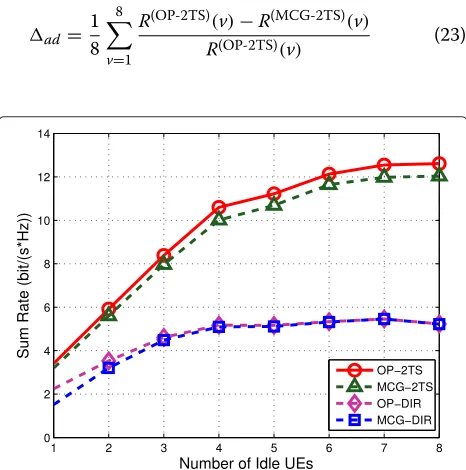
The system sum rates achieved by the proposed algorithm and the comparable schemes are shown as a function of the number of UEs and D2D pairs in Figs. 4 and 5, respectively. OP-2TS and OP-DIR denote the optimal performance of the 2TS scheme and the traditional trans-mission scheme [21]. MCG-2TS and MCG-DIR denote the performance of MCG in the 2TS case and the direct transmission case.
From Figs. 4 and 5, one can observe that OP-2TS can increase the system sum rate compared to OP-DIR by 50 %.
To verify the convergence of our proposed MCG algo-rithm, we define the average deviation between the results obtained by MCG and OP as follows:
ad=
1 8
8
v=1
R(OP-2TS)(v)−R(MCG-2TS)(v)
R(OP-2TS)(v) (23)
Fig. 4System sum rate as a function of the number of cellular users comparing with OP
Fig. 5System sum rate as a function of the number of D2D pairs comparing with OP
where R(OP-2TS) and R(MCG-2TS) denote the system sum rate obtained by the OP and MCG for the 2TS case, respectively, andvdenotes the cardinality ofDorC. In Figs. 4 and 5, the average deviation between OP-2TS and MCG-2TS is about 5 %. These observations demon-strate that the performance of the proposed MCG-2TS approaches to the optimal, regardless of the number of UEs and D2D pairs.
4.2 Performance of 2TS compared with 3TS and DIR Next, to compare the performance of 2TS and 3TS with DIR, the system sum rate is shown as a function of the number of cellular users in Fig. 6 with 8 D2D pairs, and the system sum rate is shown as a function of the number of D2D pairs in Fig. 7 with 8 cellular users. Increas-ing the number of idle UEs indicates that more spectral resources are available to D2D pairs and also there are more potential relays. But increasing the number of D2D pairs means that more interference is introduced to the network, which causes performance degradation. As can be observed from the two figures, 2TS outperforms all other schemes. In Fig. 7, when the number of D2D pairs is 8, 2TS outperforms 3TS and DIR by about 45 and 100 %, respectively. Since the 2TS mechanism uses the minimal number of time slots, it achieves the best spectral effi-ciency and therefore the largest sum rate compared with the other schemes.
4.3 Characterize the impact of relaying
Fig. 6System sum rate as a function of the number of cellular users with 8 D2D pairs
the source to the destination into 7 equal small regions, which are indexed by 1–7 from left to right as depicted in Fig. 8. The relays in the region 1 are nearest to the source users, while the relays in the region 7 are nearest to the destination users.
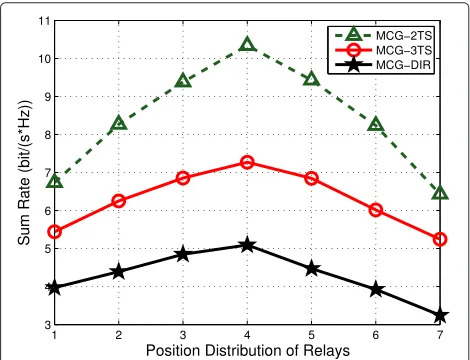
Next, to demonstrate the impact of the positions of the relays in the scenario with interference, the system sum rate is shown by varying the positions of cellular users with 4 cellular users and 8 D2D pairs in Fig. 9. One can observe that the system sum rate increases when the relays move to the region 4. The reason is that as relays move away from the source, the achievable rate of the worst link increases. We note that when the relays move towards the destination from the small region 4,
Fig. 7System sum rate as a function of the number of D2D pairs with 8 cellular users
Fig. 8A snapshot of 4 idle cellular users and 8 D2D pairs
the sum rate is determined by the transmission rate from the source to the relay. Therefore, the system sum rate decreases. As can be observed from Fig. 9, the maximal sum rate can be achieved when the relay is located in the region 4. The reason for this is that the relay is in the center between the source and the destination, which is consistent with the well-known fact that symmetric source-relay and relay-destination channel conditions are important to increase the rate for two-way relaying channels. From the above results, we also observe that the 2TS scheme performs best under both two condi-tions. Therefore, we conclude that the relay position distribution is important to the system transmission rate.
4.4 Convergence rate
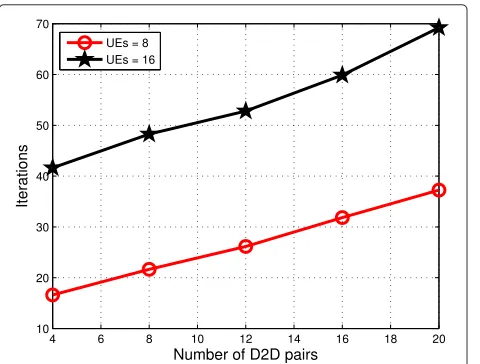
In order to show the convergence rate of our proposed algorithm, we set the number of cellular users to be 8 and 16 and vary the number of D2D pairs N from 4–20. The average number of switch operations required for Algorithm 1 to converge to the final resource alloca-tion vector xfin is shown in Fig. 10. As the number of D2D pairs increases, the average number of switch oper-ations increases. In the case of 16 cellular users, which provide 16 selections for each D2D user, the average num-ber of switch operations increases linearly in order to find the final solution by our algorithm, while exhaustive search needs 16N iterations to find the optimal solution. Therefore, compared with exhaustive search, the use of the proposed algorithm can decrease the computational complexity significantly.
5 Conclusions
We have studied the problem of joint resource allocation and relay selection for network coding-aided D2D com-munication networks. Based on the interference graph, a coalitional graph game framework was proposed to model this problem. Then, physical layer network coding-aided D2D communication was used as a case study, and the achievable rates of the two-way transmission schemes were derived in the presence of interference. The system sum rate maximization problem for the addressed net-work was shown to be NP hard, and then a coalitional graph game framework was applied to solve the prob-lem of joint resource allocation and relay selection. Then, based on this framework, a low complexity distributed algorithm was proposed, and the stability of the proposed
Fig. 10System convergence rate in terms of the average number of iterations as a function of the number of D2D pairs
algorithm was also studied. The provided extensive sim-ulations demonstrate that the proposed game theoretic algorithm can outperform existing schemes.
Competing interests
The authors declare that they have no competing interests.
Acknowledgements
This work is supported by the National Nature Science Foundation of China under grant no. 61132002, 61301080, and 61201183, the National Basic Research Program of China under grant No. 2013CB329001, and the Creative Research Group Program from NSFC (61321061).
Author details
1Department of Electronic Engineering, Tsinghua University, Shuangqing
Road, Beijing, China.2Department of Electrical Engineering, Princeton
University, Princeton, NJ, USA.3School of Computing and Communications,
Lancaster University, LA1 4WA Lancaster, UK.
Received: 18 June 2015 Accepted: 1 December 2015
References
1. Cisco Visual Networking Index: Global Mobile Data Traffic Forecast Update 2014–2019 White Paper. (2015). http://www.cisco.com/c/en/us/ solutions/collateral/service-provider/visual-networking-index-vni/white_ paper_c11-520862.html
2. L Lei, Z Zhong, C Lin, X Shen, Operator controlled device-to-device communications in LTE-advanced networks. IEEE Wireless Commun.
19(3), 96–104 (2012)
3. K Doppler, M Rinne, C Wijting, C Ribeiro, K Hugl, Device-to-device communication as an underlay to LTE-advanced networks. IEEE Commun. Mag.47(12), 42–49 (2009)
4. G Fodor, E Dahlman, G Mildh, S Parkvall, N Reider, G Miklo’s, Z Tura’nyi, Design aspects of network assisted device-to-device communications. IEEE Commun. Mag.50(3), 170–177 (2012)
5. R Ahlswede, N Cai, S-YR Li, RW Yeung, Network information flow. IEEE Trans. Inf. Theory.46(4), 1204–1216 (2000)
6. A Osseiran, K Doppler, C Ribeiro, M Xiao, M Skoglung, J Manssour, inProc.
ICT-Mobile Summit. Advances in device-to-device communications and
network coding for IMT-Advanced, (Santander, Spain, 2009), pp. 1–8. https://www.researchgate.net/publication/228375506_Advances_in_ Device-to-Device_Communications_and_Network_Coding_for_IMT-Advanced
7. FHP Fitzek, J Heide, MV Pedersen, M Katz, Implementation of network coding for social mobile clouds. IEEE Signal Proc. Mag.30(1), 159–164 (2013)
8. P Pahlevani, M Hundebøll, MV Pedersen, D Lucani, H Charaf, FHP Fitzek, H Bagheri, M Katz, Novel concepts for device-to-device communication using network coding. IEEE Commun. Mag.52(4), 32–39 (2014) 9. G Fodor, A Pradini, A Gattami, Device-to-device communications and
network coding: friends or foes?. IEEE Comsoc MMTC E-Letter.9(1), 33–35 (2014)
10. A Pyattaev, O Galinina, S Andreev, M Katz, Y Koucheryavy, Understanding practical limitations of network coding for assisted proximate
communication. IEEE J. Sel. Areas Commun.33(2), 156–170 (2015) 11. C-H Yu, K Doppler, CB Ribeiro, O Tirkkonen, Resource sharing optimization
for device-to-device communication underlaying cellular networks. IEEE Trans. Wireless Commun.10(8), 2752–2763 (2011)
12. C Xu, L Song, Z Han, Q Zhao, X Wang, X Cheng, B Jiao, Efficiency resource allocation for device-to-device underlay communication systems: a reverse iterative combinatorial auction based approach. IEEE J. Sel. Areas Commun.31(9), 348–358 (2013)
13. Y Li, D Jin, J Yuan, Z Han, Coalitional games for resource allocation in the device-to-device underlaying cellular networks. IEEE Trans. Wireless Commun.13(7), 3965–3977 (2014)
15. S Kadloor, R Adve, Relay selection and power allocation in cooperative cellular networks. IEEE Trans. Wireless Commun.9(5), 1676–1685 (2010) 16. TT Pham, HH Nguyen, HD Tuan, Relay assignment for max-min capacity in
cooperative wireless networks. IEEE Trans. Veh. Technol.61(5), 2387–2394 (2012)
17. X Zhang, X Tao, Y Li, N Ge, J Lu, inCommunications (ICC), 2014 IEEE
International Conference on. On optimal relay selection and subcarrier
assignment in OFDMA relay networks with QoS guarantees (IEEE Communication Society, Sydney, NSW, 2014), pp. 2660–2664
18. X Lu, P Wang, D Niyato, A layered coalitional game framework of wireless relay network. IEEE Trans. Veh. Technol.63(1), 472–478 (2014)
19. Y Li, RHY Louie, B Vucetic, Relay selection with network coding in two-way relay channels. IEEE Trans. Veh. Technol.59(9), 4489–4499 (2010) 20. S Atapattu, Y Jing, H Jiang, C Tellambura, Relay selection schemes and
performance analysis approximations for two-way networks. IEEE Trans. Commun.61(3), 987–998 (2013)
21. Y Zhao, Y Li, X Chen, N Ge, Joint optimization of resource allocation and relay selection for network coding aided device-to-device
communications. IEEE Commun. Lett.19(5), 807–810 (2015) 22. L Song, D Niyato, Z Han, E Hossain, Game-theoretic resource allocation
methods for device-to-device (D2D) communication. IEEE Wireless Commun.21(3), 136–144 (2014)
23. R Myerson, Graphs and cooperation in games. Math. Oper. Res.2(3), 225–229 (1977)
24. W Saad, Z Han, M Debbah, A Hjorungnes, inGlobal Telecommunications
Conference, 2008. Network formation games for distributed uplink tree
construction in IEEE 802.16J networks (IEEE Communication Society, New Orleans, LO, 2008), pp. 1–5
25. W Saad, Z Han, M Debbah, A Hjorungnes, T Basar, Coalitional game theory for communication networks: a tutorial. IEEE Signal Proc. Mag.26(5), 77–97 (2009)
26. T Wang, L Song, Z Han, Coalitional graph games for popular content distribution in cognitive radio VANETs. IEEE Trans. Veh. Technol.62(8), 4010–4019 (2013)
27. G Angelopoulos, A Paidimarri, AP Chandrakasan, M Medard, in
Communications (ICC), 2013 IEEE International Conference on. Experimental
study of the interplay of channel and network coding in low power sensor applications (IEEE Communication Society, Budapest, Hungary, 2013), pp. 5126–5130
28. P Popovski, H Yomo, inCommunications (ICC), 2007 IEEE International
Conference on. Physical network coding in two-way wirless relay channels
(IEEE Communication Society, Glasgow, Scotland, 2007), pp. 707–712 29. R Zhang, X Cheng, Q Yao, C-X Wang, Y Yang, B Jiao, Interference graph
based resource sharing schemes for vehicular networks. IEEE Trans. Veh. Technol.62(8), 4028–4039 (2013)
30. R Zhang, X Cheng, Y Yang, B Jiao, Interference graph based reource allocation (InGRA) for D2D communications underlaying cellular networks. IEEE Trans. Veh. Technol.64(8), 3844–3850 (2015) 31. RHY Louie, Y Li, B Vucetic, Practical physical layer network coding for
two-way relay channels: performance analysis and comparison. IEEE Trans. Wireless Commun.9(2), 764–777 (2010)
32. Z Zhao, M Peng, Z Ding, W Wang, HH Chen, Denoise-and-forward network coding for two-way relay MIMO systems. IEEE Trans. Veh. Technol.63(2), 775–788 (2013)
33. LA Wolsey,Integer Programming. (Wiley-Interscience, Hoboken, 1998)
Submit your manuscript to a
journal and benefi t from:
7Convenient online submission 7Rigorous peer review
7Immediate publication on acceptance 7Open access: articles freely available online 7High visibility within the fi eld
7Retaining the copyright to your article