ISSN 0975-928X
Research Article
Combining ability analysis for grain yield and its contributing traits in
maize (
Zea mays
L.) over environments
Baudh Bharti
1*, R.B. Dubey1, Arun Kumar2, H.N. Bind3 and B.S. Jat11
Department of Plant Breeding & Genetics, Maharana Pratap University of Agriculture and Technology, Udaipur-313001(Rajasthan), India
2
Department of Genetics & Plant Breeding, Govind Ballabh Pant University of Agriculture & Technology, Pantnagar-263145, Uttarakhand,
3
Department of Genetics and Plant Breeding Sardar Vallabhbhai Patel University of Agriculture &Technology, Meerut. 250 110 (U.P.),India
* E-mail: [email protected]
(Received: 11 Mar 2017; Revised: 11 Dec 2017; Accepted: 25 Dec 2017)
Abstract
Combining ability analysis for grain yield and its contributing traits in maize was performed with 15 inbred line and 3 tester parents and the resulting 45 hybrids using line x tester cross analysis in three environments during kharif and rabi 2014.The results of combining ability analysis over the environments revealed significant mean squares due to general and specific combining ability indicating that both additive and non-additive gene actions were important in the inheritance of characters studied. The parents L2 (EIQ -132), L4(EIQ-134), L5(EIQ-135), L6(EIQ-136), L8(EIQ-138), and L14(EIQ-144) and L15 (EIQ-145) were good general combiners for grain yield and majority of traits over the environments. Hence, these parents can be used in crossing and further exploited for improvement of traits in the population. Six inbred lines viz., L1(EIQ-131), L2(EIQ -132), L3(EIQ-133), L6(EIQ-136), L8(EIQ-138) and L14(EIQ-144) were identified good general combiner for maturity related traits. Whereas the crossesL7 x T2 (EIQ-137 x EIQ-102),L13 x T3 (EIQ-143 x EIQ-103), L10 x T1 (EIQ-140 x EIQ-101), L1 x
T1(EIQ-131 x EIQ-101) andL11 x T3 (EIQ-141 x EIQ-103) were identified as potential ones for yield and yield components
based on high sca effects along with high per se performance. These hybrids may be exploited for commercial cultivation by testing them over locations and years for their yield stability
.
Key words
Maize, combining ability, grain yield ,line x tester
Introduction
Maize (Zea mays L.) is the third largest grain crop in India, after rice and wheat. It is grown during rainy (kharif), winter (rabi) and spring seasons, but major production is in the rainy season (Yadav et al. 2016). Protein of maize is deficient in two essential amino acids, lysine and tryptophan (Bhatia and Rabson 1987). In non-QPM, the endosperm contains a high amount of zein which is completely devoid of lysine and tryptophan. The poor nutritional value of normal maize grain has been well known for a long time (Osborne and Mendel 1914). Maize has protein content with protein quality limited by deficiencies of two essential amino acid like lysine and tryptophan and has excess of luecine and isoleucine, leading to a poor growth in children and pellagra in adults (Mertz et al., 1964).
Line x tester method has been used in various studies Singh et al. (2013), Jahan et al. (2014), Rastgari et al. (2014) and Kumar et al. (2015) to determine general combining ability (gca) and specific combining ability (sca) of the lines under study. Line x tester analysis is also helpful in estimating genetic variance components and types of gene effects (Singh and Chaudhary, 1985). Venkatesh et al. (2001) using line x tester method found significant differences between lines, testers
and line x tester combinations indicating the contribution of both additive and non- additive (dominance)gene actions in controlling grain yield. The nature of gene action would help in predicting the effectiveness of selection in population. A distinct type of gene action, its magnitude and constitution of genetic architecture are of fundamental importance to plant breeder. The objectives of present study were to estimate gca, sca and gene effects for grain yield and yield contributing traits in maize using hybrids over environments produced by the line x tester mating design.
Materials and methods
The experimental material was generated by making crosses between 15 inbred lines and 3 testers in line x tester mating design. Fifteen parental inbred lines were crossed with three testers during rabi 2013 to generate the experimental hybrids for this study. The experimental material, thus, consisting of 45 F1s (single crosses), 15 inbred lines, 3 testers and 4 checks (HQPM-1, HQPM-5, Pratap QPM-1 and Vivek QPM-9 Table -5) were evaluated during kharif and rabi 2014 in three environments. Three environments were two locations and two seasons viz. E1 (timely sowing,
ISSN 0975-928X
2014 at ARSS, Vallabh Nagar, MPUAT, Udaipur) and E3 (timely sowing, rabi 2014 at Instructional farm Rajasthan college of Agriculture, Udaipur). The experimental material was planted under each environment in randomized bock design with three replications in a single row plot of four meter length, maintaining crop geometry of 60 x 25 cm. All the recommended agronomy inputs and practices were applied to the crop during the season, to raise the successful crop. NPK fertilizer were applied at the rate of 120:60:00 kg/ha. The total amount of phosphatic fertilizer and half of the nitrogenous fertilizer were applied as basal dose and rest of the nitrogenous fertilizer were given in two equal doses, one at knee-high stage and another at flowering stage of the crop. The border rows were also planted to neutralize the border effect.
Thirteen quantitative observations were recorded on ten randomly selected competitive plants for each treatment in each replication for plant type traits viz. plant height (cm), ear height (cm) for yield and yield contributing traits viz., ear length (cm), ear girth (cm), number of grain rows per ear, 100-grain weight (g), grain yield per plant (g), shelling percentage (%) and harvest index (%). The observations for maturity related traits viz. days to 50 per cent tasseling, days to 50 per cent silking, anthesis-silking interval and days to 75 per cent brown husk were recorded on plot basis. The mean values were used for statistical analysis. The observations taken for hybrids and parents were subjected to L x T analysis and combining ability effects of different crosses were worked out. The combining ability variance analysis was based on the method developed by Kempthorne (1957).
Results and discussion
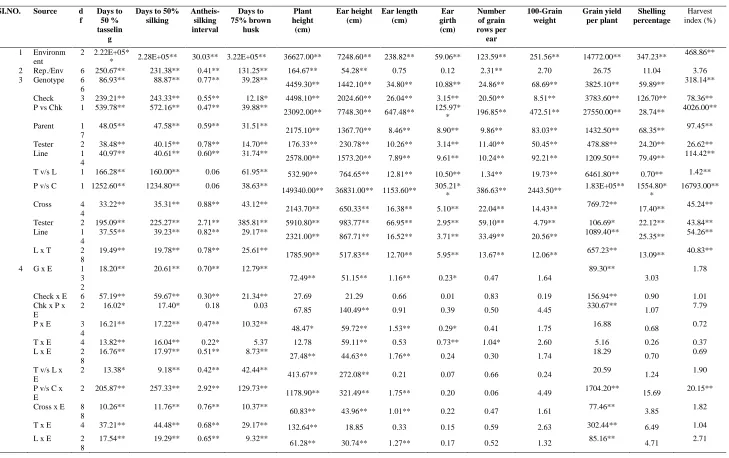
The pooled analysis of variance for combining ability over three environments revealed that the
environments, genotypes, parents and crosses
exhibited highly significant differences among themselves for all the characters studied (Table -1). The parents vs crosses which indicates average heterosis, was also significant for all traits except for anthesis-silking interval, thus considerable amount of average heterosis was reflected in hybrids. This indicates the presence of non-additive gene action (Bello and Olaoye, 2009).
The interaction of genotypes, parents, crosses, and parents vs crosses with environments were significant for all the characters except number of grain rows per ear,100-grain weight and shelling percentage. While the genotypes x environments for harvest index, parents x environments, for grain yield per plant and harvest index, crosses x environments for ear girth, harvest index and parents v/s crosses x environments for ear girth.
Mean squares due to lines, testers and lines x testers were significant for all the characters suggesting significant role of additive and non -additive gene actions like -additive x -additive, additive x dominance, epistasis and other interaction effects in the expression of these characters. Interaction of lines with environments was significant for all the characters except ear girth, number of grain rows per ear,100- grain weight, shelling percentage and harvest index. Further, testers x environments interaction was significant for all the characters except ear height, ear length, ear girth, number of grain rows per ear,100- grain weight, shelling percentage and harvest index. The interaction of lines x testers x environments were significant for all the characters except days to per cent tasseling, number of grain rows per ear, 100- grain weight, shelling percentage and harvest index. This indicated that estimates of gca and sca effects were highly influenced by environments for large numbers of characters studied. Similar findings reported by Rashmi et al. (2013).
Selection of parents with good general combining ability is a prime requisite for any successful breeding programme especially for heterosis breeding. The general combining ability effects of parents (lines and testers) over the environments are presented in Table 2. The estimates of gca
effects revealed that the good general combiner for yield and majority of yield contributing characters
viz., harvest index, ear girth, 100- grain weight, ear length, number of grain rows per ear and shelling percentage were inbred lines L2 (EIQ -132), L4 (EIQ-134), L5 (EIQ-135), L6(EIQ-136), L8 (EIQ-138), and L14(EIQ-144). Six inbred lines viz., L1(EIQ-131), L2(EIQ -132), L3(EIQ-133), L6 (EIQ-136), L8 (EIQ-138) and L14(EIQ-144) were identified good general combiner for maturity related traits. These inbred lines possessed favourable genetic architecture for imparting earliness to their progenies. (Jahan et al., 2014) also observed similar phenomenon in their study. For plant type traits two inbred lines L7(EIQ-137) and L9 (EIQ-139) were identified good general combiner. Similar finding was reported by (Singh
et al. 2013) for earliness, dwarfness and yield. In general, inbred lines L2 (EIQ -132), L4(EIQ-134), L5(EIQ-135), L6(EIQ-136), L8(EIQ-138), and L14(EIQ-144) and L15 (EIQ-145) have been good general combiner for yield and majority of the characters. This finding is in close agreement with previous reports (Rastgari et al., 2014, Kumar et al., 2015) for yield and most of yield contributing traits.
ISSN 0975-928X
good general combiner for ear height and plant height respectively. Tester T3 (EIQ-103) had good general combiner for ear length, ear girth, number of grain rows per ear and harvest index. None of testers exhibited good general combiner for grain yield per plant. The general combining effects observed is due to additive gene effects and additive x additive gene effects (Griffing, 1956).
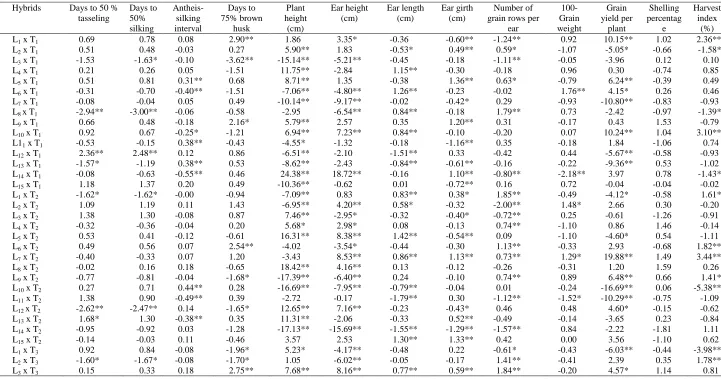
The estimates of sca effects for yield and yield contributing traits on pooled basis are presented in Table 3. Out of 45 crosses only 11 crosses viz., L1 x T1 (EIQ-131 x EIQ-101) , L5 x T1((EIQ-135 x , EIQ-101), L6 x T1 (EIQ-136 x EIQ-101), L10 x T1 (EIQ-140 x EIQ-101), L7 x T2 (137 x EIQ-102), L9 x T2 (EIQ-139 x EIQ-102), L12 x T2 (EIQ-142 x EIQ-102) , L3 x T3 (EIQ-133 xEIQ-103) , L10 x T3 (EIQ-140 x EIQ-103) , L11 x T3 (EIQ-141 x EIQ-103) and L13 x T3 (EIQ-143 x EIQ-103) exhibited significantly positive sca for yield per plant. These results are in conformity with findings of Kumar et al. (2015). Significant yield performance in specific crosses was due to the combinations on the basis of their per se
performance and sca effects. (Ahmad et al., 2014). None of the hybrid exhibited positive significant
sca effects for shelling percentage.
Five promising crosses with desirable sca effects for various traits viz., days to 50 per cent tasseling, days to 50 per cent silking, anthesis-silking interval, days to 75 per cent brown husk, plant height (cm), ear height (cm), ear length (cm), ear girth (cm), number of grain rows per ear, 100-grain weight (g), grain yield per plant (g), shelling percentage (%) and harvest index (%) along with mean performance and gca effects of parents involved in the crosses on pooled basis are listed in Table 4.The crosses, L7 x T2 (137 x EIQ-102), L13 x T3 (EIQ-143 x EIQ-103), L10 x T1 (EIQ-140 x EIQ-101), L1 x T1 (EIQ-131 x EIQ-101) and L11 x T3 (EIQ-141 x EIQ-103) expressed high
significant sca effects as well as high per se performance for grain yield per plant and other traits. It was also observed that the desirable cross combinations included high x high, high x medium, high x low, medium x high, medium x medium, medium x low, low x high and low x medium and low x low type of general combiners (Table 4). The desirable performance of cross combinations like medium x medium, low x low, medium x low and low x medium general combiners may be ascribed to complementary (dominance x dominance) gene effects.
Crosess, L8 x T1(EIQ-138 x EIQ-101), for days to
50% tasseling and days to 50% silking, L3 x T1
(EIQ-133 x EIQ-101) for days to 50% silking, L6 x T1 (EIQ-136 x EIQ-101), for anthesis – silking
interval, L9 x T2 (EIQ-139 x EIQ-102), for plant
height, L7 x T1 (EIQ-137 x EIQ-101) for ear height, L11 x T3 (EIQ-141 x EIQ-103), L12 x T3 (EIQ-142 x EIQ-103) and L14 x T3 (EIQ-144 x EIQ-103) for
ear length, L14 x T3 (EIQ-144 x EIQ-103) and L3 x
T3 (EIQ-133 x EIQ-103) for number of grain rows
per ear had high sca performance and high mean values in desirable direction. These desirable cross combinations involved high x high type of general combiners (Rastgari et al., 2014 and Aly, 2013) were reported about interaction between positive and positive alleles in crosses involving high x high combiners which can be fixed in subsequent generations if no repulsion phase linkages are involved. However, those crosses which involved one good combiner and the other medium or poor combiner could produce desirable transgressive segregates if additive genetic system was operating in good combining parent and epistatic effects also act in same direction (additive x dominance). The crosses ,L12 x T2 (EIQ-142 x EIQ-102), L2 x T3 (EIQ -132 x EIQ-103) and L13 x T1(EIQ-143 x EIQ-101), showed such combination of gca effects for days to 50% tasseling, L12 x T2, (EIQ-142 x EIQ-102), L2 x T3 (EIQ -132 x EIQ-103) and L1 x T2 (EIQ-131 x EIQ-102) for days to 50 % silking, L14 x T1 (EIQ-144 x EIQ-101) and L6 x T1 (EIQ-136 x EIQ-101) for anthesis – silking interval, L1 x T3 (EIQ-131 x EIQ-103), L2 x T3 (EIQ -132 x EIQ-103) , L7 x T3(EIQ-137 x EIQ-103) and L9 x T2 (EIQ-139 x EIQ-102) for days to 75% brown husk. Similarly other crosses were showed such combination of gca effects L14 x T2 (EIQ-144 x EIQ-102) and L10 x T2 (EIQ-140 x EIQ-102) for plant height, L9 x T1 (EIQ-139 x EIQ-101), L7 x T2 (EIQ-137 x EIQ-102) and L14 x T1 (EIQ-144 x EIQ-101) for ear girth, L14 x T3(144 x EIQ-103), L8 x T1 (EIQ-138 x EIQ-101) and L2 x T3 (EIQ -132 x EIQ-103) for number of grain rows per ear, L6 x T1 (EIQ-136 x EIQ-101), and L14 x T3
(EIQ-144 x EIQ-103) for 100-grain weight and L10 x T3 (EIQ-140 x EIQ-103)and L13 x T3 (EIQ-143 x EIQ-103)for harvest index. None of the crosses exhibited such types of combination for gca effect for grain yield and shelling percentage. The preponderance of non-addtive gene action for yield contributing traits in most crosses also suggested heterosis breeding as a profitable proposition. The desirable traits can be improved by developing F1 hybrids from the parents of good general combiners. These results were in agreement with the earlier findings of Jahan et al. (2014). For improvement of yield and other desirable traits, a breeding programme which can exploit both the significance of additive and non-additive type of gene action would be useful.
ISSN 0975-928X
ascribed to complementary (dominance x dominance) gene effects.
The cross L1 xT1 (EIQ-131 x EIQ-101) observed such combination of gca effects for days to 50% tasseling, L11 x T2(EIQ-141 x EIQ-102), L13 x T2 EIQ-143 x EIQ-102), and L15 x T3 (EIQ-145 x EIQ-103) for anthesis to silking interval, L3 x T1 (EIQ-133 x EIQ-101) for days to 75% brown husk, L5 x T3 (EIQ-135 x EIQ-103) and L4 x T3 (EIQ-134 x EIQ-103) for plant height, L14 x T2 (EIQ-144 x EIQ-102) and L5 x T3 (135 x EIQ-103) for ear height, L5 x T2 (EIQ-135 x EIQ-102) and L15 x T2 (EIQ-145 x EIQ-102) for ear length, L5 x T1 (EIQ-135 x EIQ-101) and L15 x T2 (EIQ-145 x EIQ-102) for ear girth, L1 x T2 (EIQ-131 x EIQ-102) for number of grain rows per ear and L5 x T3(EIQ-135 x EIQ-103) , L11 x T3 (EIQ-141 x EIQ-103), and L2 x T2 (EIQ-132 x EIQ-102) for 100- grain weight.
The crosses L7 x T2 (EIQ-137 x EIQ-102) , L13 x T3(EIQ-143 x EIQ-103), L10 x T1(140 x EIQ-101), L1 x T1 (EIQ-131 x EIQ-101) and L11 x T3
(EIQ-141 x EIQ-103) exhibited such combination of gca effects for grain yield per plant, L11 x T3(EIQ-141 x EIQ-103), L8 x T2 (138 x EIQ-102), L9 x T1(EIQ-139 x EIQ-101), L7 x T2 EIQ-137 x EIQ-102) and L15 x T3 (EIQ-145 x EIQ-103) for shelling percentage and crosses L7 x T2 (EIQ-137 x EIQ-102) , L10 x T1 EIQ-140 x EIQ-101) and L1 x T1 (EIQ-131 x EIQ-101) for harvest index. Involvement of both combiners with low gca has been attributed to over dominance and epistasis interaction, which has been suggested by Malik et al. (2004).
Conculsion
Considering the overall performances, the parents
L2 (EIQ -132), L4(EIQ-134), L5(EIQ-135), L6 (EIQ-136), L8(EIQ-138), and L14(EIQ-144) and L15 (EIQ-145) were the good general combiners and genetically worthy parents, as they contributed favourable genes for grain yield and its components. Hence, these high yielding parents with good attributes for different yield components may be crossed to pool the genes in desirable direction to improve the yield potential. Whereas the crossesL7 x T2 (EIQ-137 x EIQ-102),L13 x T3
(EIQ-143 x EIQ-103), L10 x T1 (140 x EIQ-101), L1 x T1(EIQ-131 x EIQ-101) and L11 x T3
(EIQ-141 x EIQ-103) were identified as most promising crosses for yield based on sca effects, better per se also, could be exploited profitably for yield in maize.
Acknowldgement
This research work was supported by All India Co-ordinated Maize Improvement Project, MPUAT,
Udaipur. The authors thank to principal investigator All India Co-ordinated Maize Improvement Project, MPUAT, Udaipur for provide experimental material, valuable help and support. The authors also thank to UGC for provide Rajiv Gandhi National Fellowship (RGNF) during research work for financial support.
References
Ahmad, M, Zaffar G, Dar ZA, Razvi SM, Saleem N and Habib M 2014. Combining ability studies for forage quality traits and forage yield in diallel crosses of oats (Avena sativa L.). Electronic Journal of Plant Breeding, 5(2) :165-172.
Aly, R.S. H. 2013. Relationship between combining ability of grain yield and yield components for some newly yellow maize inbred lines via line x tester analysis. Alex. J. Agric. Res., 58 : 115-124.
Bello, O. B and Olaoye, G. 2009. Combining abilityfor
maize grain yield and
otheragronomiccharacters in a typical southern guineasavanna ecology of Nigeria. Afr. J. Biotechnol. 8 : (25)18-22.
Bhatia, C.R. and Rabson, R. 1987. Relationship of grain yield and nutritional quality. Agronomy Monograph No. 28. ASA, CSSA, and SSSA, Madison, WI, USA, pp. 11–43.
Jahan, N., Uddin, M. S., Islam, M. R., Hasna, S. and Saifullah, A. R. M. 2014. Evaluation of inbred line through line x tester method. J. Environ. Sci. & Natural Resources, 7(2): 79-84. Kempthorne O. 1957. An introduction to genetical
statistics. John Willey and Sons Inc, New York, pp. 323-331.
Kumar, B., Razdan, A.K. and Pandey,S.K. 2015. Combining ability analysis for grain yield and component traits in yellow maize single crosses. Bioinfolet, 12 (1 A): 14 – 18.
Malik, S. I., Malik, H. N., Minhas, N. M. and Munir,M. 2004. General and specific combiningability studies in maize. Int. J. Agric. Biol. 6: (8)56-59.
Mertz, E.T., Lynn, S.B. and Nelson, O. E. (1964). Mutant gene that changes protein composition and increases lysine content of maize endosperm. Science, p.p. 279-280.
Osborne, T.B. and L.B. Mendel, (1914). Nutritive properties of proteins of the maize kernel. Journal of Biological Chemistry,18 (1): 1-16. Rashmi, K., Haider, Z.A., Chakraborty , M. and Sahay,
S. 2013. Analyses of combining ability and heterosis in yellow maize inbreds over environments. Prog. Agric.,13(1) : 93–101. Rastgari, M., Ahmadi, H. and Zebarjadi, A. R. 2014.
Combining ability analysis and gene effects in maize (Zea mays L.) using line x tester crosses. Res. on Crops,15(3): 621‐625.
ISSN 0975-928X
Singh, R.K. and Choudhary, B.D. 1985. Biometrical Methods in Quantitative Genetic Analysis. Kalyani Publishers, New Delhi, India.
Venkates S, Singh NN and Gupta NP 2001. Early generation identification and utilization of potential inbred lines in modified single cross hybrids of maize (Zea mays L.). Indian Journal of Genetics, 61(3): 213-217.
ISSN 0975-928X
Table - 1 Pooled analysis of variance for combining ability for grain yield and its contributing traits in maize
SI.NO. Source d f
Days to 50 % tasselin
g
Days to 50% silking
Antheis- silking interval
Days to 75% brown
husk
Plant height (cm)
Ear height (cm)
Ear length (cm)
Ear girth (cm)
Number of grain rows per
ear
100-Grain weight
Grain yield per plant
Shelling percentage
Harvest index (%)
1 Environm ent
2 2.22E+05*
* 2.28E+05** 30.03** 3.22E+05** 36627.00** 7248.60** 238.82** 59.06** 123.59** 251.56** 14772.00** 347.23**
468.86**
2 Rep./Env 6 250.67** 231.38** 0.41** 131.25** 164.67** 54.28** 0.75 0.12 2.31** 2.70 26.75 11.04 3.76
3 Genotype 6 6
86.93** 88.87** 0.77** 39.28**
4459.30** 1442.10** 34.80** 10.88** 24.86** 68.69** 3825.10** 59.89** 318.14** Check 3 239.21** 243.33** 0.55** 12.18* 4498.10** 2024.60** 26.04** 3.15** 20.50** 8.51** 3783.60** 126.70** 78.36** P vs Chk 1 539.78** 572.16** 0.47** 39.88**
23092.00** 7748.30** 647.48** 125.97*
* 196.85** 472.51** 27550.00** 28.74**
4026.00**
Parent 1
7
48.05** 47.58** 0.59** 31.51**
2175.10** 1367.70** 8.46** 8.90** 9.86** 83.03** 1432.50** 68.35** 97.45** Tester 2 38.48** 40.15** 0.78** 14.70** 176.33** 230.78** 10.26** 3.14** 11.40** 50.45** 478.88** 24.20** 26.62**
Line 1
4
40.97** 40.61** 0.60** 31.74**
2578.00** 1573.20** 7.89** 9.61** 10.24** 92.21** 1209.50** 79.49** 114.42** T v/s L 1 166.28** 160.00** 0.06 61.95** 532.90** 764.65** 12.81** 10.50** 1.34** 19.73** 6461.80** 0.70** 1.42** P v/s C 1 1252.60** 1234.80** 0.06 38.63**
149340.00** 36831.00** 1153.60** 305.21*
* 386.63** 2443.50**
1.83E+05** 1554.80* *
16793.00**
Cross 4
4
33.22** 35.31** 0.88** 43.12**
2143.70** 650.33** 16.38** 5.10** 22.04** 14.43** 769.72** 17.40** 45.24** Tester 2 195.09** 225.27** 2.71** 385.81** 5910.80** 983.77** 66.95** 2.95** 59.10** 4.79** 106.69* 22.12** 43.84**
Line 1
4
37.55** 39.23** 0.82** 29.17**
2321.00** 867.71** 16.52** 3.71** 33.49** 20.56** 1089.40** 25.35** 54.26**
L x T 2
8
19.49** 19.78** 0.78** 25.61** 1785.90** 517.83** 12.70** 5.95** 13.67** 12.06** 657.23** 13.09** 40.83**
4 G x E 1
3 2
18.20** 20.61** 0.70** 12.79**
72.49** 51.15** 1.16** 0.23* 0.47 1.64
89.30**
3.03
1.78
Check x E 6 57.19** 59.67** 0.30** 21.34** 27.69 21.29 0.66 0.01 0.83 0.19 156.94** 0.90 1.01
Chk x P x E
2 16.02* 17.40* 0.18 0.03
67.85 140.49** 0.91 0.39 0.50 4.45 330.67** 1.07 7.79
P x E 3
4
16.21** 17.22** 0.47** 10.32**
48.47* 59.72** 1.53** 0.29* 0.41 1.75 16.88 0.68 0.72
T x E 4 13.82** 16.04** 0.22* 5.37 12.78 59.11** 0.53 0.73** 1.04* 2.60 5.16 0.26 0.37
L x E 2
8
16.76** 17.97** 0.51** 8.73**
27.48** 44.63** 1.76** 0.24 0.30 1.74 18.29 0.70 0.69
T v/s L x E
2 13.38* 9.18** 0.42** 42.44**
413.67** 272.08** 0.21 0.07 0.66 0.24 20.59 1.24 1.90
P v/s C x E
2 205.87** 257.33** 2.92** 129.73** 1178.90** 321.49** 1.75** 0.20 0.06 4.49 1704.20** 15.69 20.15** Cross x E 8
8
10.26** 11.76** 0.76** 10.37**
60.83** 43.96** 1.01** 0.22 0.47 1.61 77.46** 3.85 1.82
T x E 4 37.21** 44.48** 0.68** 29.17** 132.64** 18.85 0.33 0.15 0.59 2.63 302.44** 6.49 1.04
L x E 2
8
17.54** 19.29** 0.65** 9.32**
ISSN 0975-928X
*, ** Significance at 5% and 1% levels of probability respectively
Table -2 Estimate of general combining ability effects (gca) of parents for grain yield and its contributing traits in maize on pooled basis L x T x E 5
6
4.70 5.66* 0.82** 9.55**
55.47** 52.37** 0.92** 0.25* 0.44 1.69 57.54** 3.22 1.43
5 Pooled Error
3 9 6
3.86 3.96 0.08 4.39
30.85 14.06 0.37 0.18 0.43 2.62
27.59
7.10
2.78
Parents Lines
Days to 50 % tasseling
Days to 50% silking
Antheis- silking interval
Days to 75% brown husk
Plant height (cm)
Ear height (cm)
Ear length (cm)
Ear girth (cm)
Number of grain rows per ear
100-Grain weight
Grain yield per
plant
Shelling percentage
Harvest index (%)
L1 -0.31 -0.44 -0.13* -1.03* 2.61* 0.02 -0.08 -0.32** 0.24 -1.35** -12.20** -0.38 -3.02**
L2 -1.57** -1.81** -0.24** -1.62** -6.87** -1.24 -0.88** 0.08 -0.40** 0.37 6.91** 0.37 1.28**
L3 -0.64 -0.81* -0.17** 0.94* 4.83** 3.68** -0.61** -0.44** 1.39** -0.76* -0.33 -1.16* -0.96**
L4 -0.72 -0.59 0.13* -0.62 5.28** -0.02 0.04 0.51** -0.08 0.75* 3.78** 0.51 -0.20
L5 0.65 0.64 -0.02 0.42 0.76 1.02 -0.74** -0.45** -0.89** -0.03 3.71** -0.06 0.81*
L6 -1.20** -1.40** -0.20** -0.06 4.98** -2.83** -1.06** 0.09 -1.31** 1.54** 6.25** -1.08* 0.90**
L7 -0.09 0.04 0.13* -0.84* -16.28** -9.69** -1.14** 0.29** -0.06 -0.15 -2.85** 0.41 0.03
L8 -2.12** -2.10** 0.02 -1.10** -6.91** -0.98 0.56** -0.51** 1.86** 0.42 3.37** -0.46 0.49
L9 1.62** 1.53** -0.09 0.71 -12.76** -6.54** -0.23 0.42** -0.88** -1.26** -9.97** 0.46 -2.10**
L10 -0.20 -0.10 0.09 -0.03 -0.35 -6.32** 1.27** -0.34** -0.41** 0.70* -2.15* -1.82** -0.98**
L11 1.80** 1.82** 0.02 1.20** -13.65** 0.24 0.63** 0.43** 1.44** -0.96** -1.72 -0.00 1.06**
L12 1.02** 1.08** 0.06 0.90* 7.20** -3.20** 1.00** -0.12 0.56** -0.31 1.89 2.12** 0.55
L13 0.62 0.75 0.13* 2.12** 9.54** 11.68** 0.25* -0.06 -1.82** -0.56 -8.75** -0.05 -0.68*
L14 1.47** 1.30** -0.17** -0.92* 14.98** 7.76** 1.00** 0.55** 1.30** 1.19** 9.34** 1.29* 2.73**
L15 -0.35 0.08 0.43** -0.06 6.61** 6.42** 0.00 -0.14 -0.95** 0.41 2.72** -0.14 0.08
SE (gi) 0.39 0.40 0.06 0.42 1.10 0.75 0.12 0.08 0.13 0.32 1.04 0.53 0.33
Testers
T1 -0.51** -0.67** -0.16** -0.27 3.21** -2.35** -0.32** 0.05 -0.53** 0.22 0.76 0.42 -0.09
T2 -0.86** -0.82** 0.04 -1.54** -7.61** -0.60 -0.49** -0.17** -0.21** -0.13 -0.98 -0.39 -0.52**
ISSN 0975-928X
*, ** Significance at 5% and 1% levels of probabilityrespectively
Table -3 Estimate of specific combining ability effects (sca) of crosses for grain yield and its contributing traits in maize on pooled basis
SE (gj) 0.20 0.20 0.03 0.21 0.55 0.37 0.06 0.04 0.07 0.16 0.52 0.26 0.17
Hybrids Days to 50 % tasseling
Days to 50% silking
Antheis- silking interval
Days to 75% brown
husk
Plant height
(cm)
Ear height (cm)
Ear length (cm)
Ear girth (cm)
Number of grain rows per
ear
100-Grain weight
Grain yield per
plant
Shelling percentag
e
Harvest index
(%)
L1 x T1 0.69 0.78 0.08 2.90** 1.86 3.35* -0.36 -0.60** -1.24** 0.92 10.15** 1.02 2.36**
L2 x T1 0.51 0.48 -0.03 0.27 5.90** 1.83 -0.53* 0.49** 0.59* -1.07 -5.05* -0.66 -1.58*
L3 x T1 -1.53 -1.63* -0.10 -3.62** -15.14** -5.21** -0.45 -0.18 -1.11** -0.05 -3.96 0.12 0.10
L4 x T1 0.21 0.26 0.05 -1.51 11.75** -2.84 1.15** -0.30 -0.18 0.96 0.30 -0.74 0.85
L5 x T1 0.51 0.81 0.31** 0.68 8.71** 1.35 -0.38 1.36** 0.63* -0.79 6.24** -0.39 0.49
L6 x T1 -0.31 -0.70 -0.40** -1.51 -7.06** -4.80** 1.26** -0.23 -0.02 1.76** 4.15* 0.26 0.46
L7 x T1 -0.08 -0.04 0.05 0.49 -10.14** -9.17** -0.02 -0.42* 0.29 -0.93 -10.80** -0.83 -0.93
L8 x T1 -2.94** -3.00** -0.06 -0.58 -2.95 -6.54** 0.84** -0.18 1.79** 0.73 -2.42 -0.97 -1.39*
L9 x T1 0.66 0.48 -0.18 2.16* 5.79** 2.57 0.35 1.20** 0.31 -0.17 0.43 1.53 -0.79
L10 x T1 0.92 0.67 -0.25* -1.21 6.94** 7.23** 0.84** -0.10 -0.20 0.07 10.24** 1.04 3.10**
L11 x T1 -0.53 -0.15 0.38** -0.43 -4.55* -1.32 -0.18 -1.16** 0.35 -0.18 1.84 -1.06 0.74
L12 x T1 2.36** 2.48** 0.12 0.86 -6.51** -2.10 -1.51** 0.33 -0.42 0.44 -5.67** -0.58 -0.93
L13 x T1 -1.57* -1.19 0.38** 0.53 -8.62** -2.43 -0.84** -0.61** -0.16 -0.22 -9.36** 0.53 -1.02
L14 x T1 -0.08 -0.63 -0.55** 0.46 24.38** 18.72** -0.16 1.10** -0.80** -2.18** 3.97 0.78 -1.43*
L15 x T1 1.18 1.37 0.20 0.49 -10.36** -0.62 0.01 -0.72** 0.16 0.72 -0.04 -0.04 -0.02
L1 x T2 -1.62* -1.62* -0.00 -0.94 -7.09** 0.83 0.83** 0.38* 1.85** -0.49 -4.12* -0.58 1.61*
L2 x T2 1.09 1.19 0.11 1.43 -6.95** 4.20** 0.58* -0.32 -2.00** 1.48* 2.66 0.30 -0.20
L3 x T2 1.38 1.30 -0.08 0.87 7.46** -2.95* -0.32 -0.40* -0.72** 0.25 -0.61 -1.26 -0.91
L4 x T2 -0.32 -0.36 -0.04 0.20 5.68* 2.98* 0.08 -0.13 0.74** -1.10 0.86 1.46 -0.14
L5 x T2 0.53 0.41 -0.12 -0.61 16.31** 8.38** 1.42** -0.54** 0.09 -1.10 -4.60* 0.54 -1.11
L6 x T2 0.49 0.56 0.07 2.54** -4.02 -3.54* -0.44 -0.30 1.13** -0.33 2.93 -0.68 1.82**
L7 x T2 -0.40 -0.33 0.07 1.20 -3.43 8.53** 0.86** 1.13** 0.73** 1.29* 19.88** 1.49 3.44**
L8 x T2 -0.02 0.16 0.18 -0.65 18.42** 4.16** 0.13 -0.12 -0.26 -0.31 1.20 1.59 0.26
L9 x T2 -0.77 -0.81 -0.04 -1.68* -17.39** -6.40** 0.24 -0.10 0.74** 0.89 6.48** 0.66 1.41*
L10 x T2 0.27 0.71 0.44** 0.28 -16.69** -7.95** -0.79** -0.04 0.01 -0.24 -16.69** 0.06 -5.38**
L11 x T2 1.38 0.90 -0.49** 0.39 -2.72 -0.17 -1.79** 0.30 -1.12** -1.52* -10.29** -0.75 -1.09
L12 x T2 -2.62** -2.47** 0.14 -1.65* 12.65** 7.16** -0.23 -0.43* 0.46 0.48 4.60* -0.15 -0.62
L13 x T2 1.68* 1.30 -0.38** 0.35 11.31** -2.06 -0.33 0.52** -0.49 -0.14 -3.65 0.23 -0.84
L14 x T2 -0.95 -0.92 0.03 -1.28 -17.13** -15.69** -1.55** -1.29** -1.57** 0.84 -2.22 -1.81 1.11
L15 x T2 -0.14 -0.03 0.11 -0.46 3.57 2.53 1.30** 1.33** 0.42 0.00 3.56 -1.10 0.62
L1 x T3 0.92 0.84 -0.08 -1.96* 5.23* -4.17** -0.48 0.22 -0.61* -0.43 -6.03** -0.44 -3.98**
L2 x T3 -1.60* -1.67* -0.08 -1.70* 1.05 -6.02** -0.05 -0.17 1.41** -0.41 2.39 0.35 1.78**
ISSN 0975-928X
*, ** Significance at 5% and 1% levels of probability respectively
Table -4 Top five promising crosses of maize for grain yield and its component traits on pooled basis
L4 x T3 0.11 0.10 -0.00 1.30 -17.43** -0.14 -1.23** 0.43* -0.56* 0.14 -1.16 -0.72 -0.71
L5 x T3 -1.04 -1.23 -0.19 -0.07 -25.03** -9.73** -1.03** -0.83** -0.72** 1.89** -1.65 -0.14 0.61
L6 x T3 -0.19 0.14 0.33** -1.03 11.08** 8.35** -0.82** 0.53** -1.11** -1.43* -7.07** 0.42 -2.29**
L7 x T3 0.48 0.36 -0.12 -1.70* 13.57** 0.64 -0.84** -0.71** -1.02** -0.36 -9.08** -0.66 -2.51**
L8 x T3 2.96** 2.84** -0.12 1.23 -15.47** 2.38 -0.97** 0.29 -1.53** -0.42 1.22 -0.62 1.14
L9 x T3 0.11 0.33 0.22 -0.48 11.60** 3.83* -0.59* -1.10** -1.05** -0.72 -6.90** -2.19* -0.62
L10 x T3 -1.19 -1.38 -0.19 0.93 9.75** 0.72 -0.05 0.15 0.19 0.17 6.46** -1.09 2.29**
L11 x T3 -0.85 -0.75 0.11 0.04 7.27** 1.49 1.98** 0.86** 0.77** 1.70** 8.44** 1.81 0.35
L12 x T3 0.26 -0.01 -0.26* 0.78 -6.14** -5.06** 1.74** 0.10 -0.04 -0.91 1.07 0.73 1.55*
L13 x T3 -0.11 -0.12 -0.00 -0.88 -2.69 4.49** 1.17** 0.09 0.65* 0.36 13.01** -0.76 1.86**
L14 x T3 1.03 1.55 0.51** 0.82 -7.25** -3.02* 1.71** 0.19 2.37** 1.34* -1.75 1.03 0.32
L15 x T3 -1.04 -1.34 -0.30** -0.03 6.79** -1.91 -1.31** -0.61** -0.58* -0.72 -3.53 1.14 -0.60
SE (Sij) 0.78 0.79 0.12 0.83 2.21 1.49 0.24 0.17 0.26 0.64 2.09 1.06 0.66
Characters
Crosses SCA effects CV(%) Per se performance of crosses GCA effects GCA status of parent
Female parent Male parent
Days to 50 % tasseling L8 x T1 L12 x T2 L1 x T2 L2 x T3 L13 x T1
-2.94** -2.62** -1.62* -1.60* -1.57*
2.75 64.44
67.56 67.22 68.22 68.56 -2.12** 1.02** -0.31 -1.57** 0.62 -0.51** -0.86** 0.86** 1.37** -0.51**
H x H L x H M x L H x L M x H Days to 50 % silking L8 x T1
L12 x T2 L2 x T3 L3 x T1 L1 x T2
-3.00** -2.47** -1.67* -1.63* -1.62*
2.70 66.67
70.22 70.44 69.30 69.56 -2.10** 1.08** -1.81** -0.81* -0.44 -0.67** -0.82** 1.49** -0.67** -0.82**
H x H L x H H x L H x H M x H Antheis- silking interval L14 x T1
L11 x T2 L6 x T1 L13 x T2 L15 x T3
-0.55** -0.49** -0.40** -0.38** -0.30**
12.00 1.56
2.00 1.67 2.22 2.67 1.30** 0.02 -0.20** 0.13* 0.43** -0.16** 0.04 -0.16** 0.04 0.12**
L x H M x M
H x H L x M L x L Days to 75 % brown husk L3 x T1
L1 x T3 L2 x T3 L7 x T3 L9 x T2
-3.62** -1.96* -1.70* -1.70* -1.68*
1.95 104.56 106.33 106.00 106.78 105.00 0.94* -1.03* -1.62** -0.84* 0.71 -0.27 1.81** 1.81** 1.81** -1.54**
ISSN 0975-928X
Plant height (cm) L5 x T3
L4 x T3 L9 x T2 L14 x T2 L10 x T2
-25.03** -17.43** -17.39** -17.13** -16.69**
3.57 145.78 157.89 129.89 155.89 141.00 0.76 5.28** -12.76** 14.98** -0.35 4.40** 4.40** -7.61** -7.61** -7.61**
M x L L x L H x H L x H M x H
Ear height (cm) L14 x T2
L5 x T3 L7 x T1 L10 x T2 L8 x T1
-15.69** -9.73** -9.17** -7.95** -6.54**
5.23 68.00
70.78 55.33 61.67 66.67 7.76** 1.02 -9.69** -6.32** -0.98 -0.60 2.95** -2.35** -0.60 -2.35**
L x M M x L H x H H x M M x H
Ear length (cm) L11 x T3
L12 x T3 L14 x T3 L5 x T2 L15 x T2
1.98** 1.74** 1.71** 1.42** 1.30**
4.12 18.90
19.04 19.01 15.68 16.31 0.63** 1.00** 1.00** -0.74** 0.00 0.81** 0.81** 0.81** -0.49** -0.49**
H x H H x H H x H L x L M x L
Ear girth (cm) L5 x T1
L15 x T2 L9 x T1 L7 x T2 L14 x T1
1.36** 1.33** 1.20** 1.13** 1.10**
3.22 14.54
14.60 15.25 14.83 15.27 -0.45** -0.14 0.42** 0.29** 0.55** 0.05 -0.17** 0.05 -0.17** 0.05
L x M M x L H x M H x L H x M Number of grain rows per ear L14 x T3
L1 x T2 L3 x T3 L8 x T1 L2 x T3
2.37** 1.85** 1.84** 1.79** 1.41**
4.85 18.44
15.91 18.00 17.16 15.78 1.30** 0.24 1.39** 1.86** -0.40** 0.74** -0.21** 0.74** -0.53** 0.74**
H x H M x L H x H H x L L x H 100-grain weight (g) L5 x T3
L6 x T1 L11 x T3 L2 x T2 L14 x T3
1.89** 1.76** 1.70** 1.48* 1.34*
6.00 30.00
31.73 28.87 29.93 30.67 -0.03 1.54** -0.96** 0.37 1.19** -0.08 0.22 -0.08 -0.13 -0.08
M x M H x M L x M M x M
H x L Grain yield per plant (g) L7 x T2
L13 x T3 L10 x T1 L1 x T1 L11 x T3
19.88** 13.01** 10.24** 10.15** 8.44**
7.04 101.86 90.29 94.64 84.51 92.76 -2.85** -8.75** -2.15* -12.20** -1.72 -0.98 0.22 0.76 0.76 0.22
L x M L x M L x M L x M L x L Shelling percentage L11 x T3
L8 x T2 L9 x T1 L7 x T2 L15 x T3
1.81 1.59 1.53 1.49 1.14
3.44 80.26
79.23 80.89 79.99 79.46 -0.00 -0.46 0.46 0.41 -0.14 -0.03 -0.39 0.42 -0.39 -0.03
M x M M x M M x M M x M M x M
Harvest index (%) L7 x T2
L10 x T1 L1 x T1 L10 x T3 L13 x T3
3.44** 3.10** 2.36** 2.29** 1.86**
4.68 41.77
40.85 38.08 40.74 40.62 0.03 -0.98** -3.02** -0.98** -0.68* -0.52** -0.09 -0.09 0.61** 0.61**
ISSN 0975-928X
*, ** Significance at 5% and 1% levels of probability respectively,
H = Desirable significant (+ or – ) gca effects , M = Desirable non- significant (+ or -) gca effects and L= Undesirable significant ( + or –) gca effects
Table 5 Details of Inbred lines used as Parents
SI.NO. Symbol/Name Pedigree Origin
1 L1 (EIQ-131) NP-06-07R-58-3-2-1-2-1 AICRP on maize, Udaipur 2 L2 (EIQ -132) NP-06-07R-74-2-1-6-1-1-1 AICRP on maize, Udaipur 3 L3 (EIQ-133) NP-06-07R-58-3-2-1-9-1 AICRP on maize, Udaipur
4 L4 (EIQ-134) NP-06-07R-16-13 AICRP on maize, Udaipur
5 L5 (EIQ-135) NP-06-07R-77-11-1-2-2-2 AICRP on maize, Udaipur 6 L6 (EIQ-136) NP-06-07R-77-2-1-1-2-1 AICRP on maize, Udaipur 7 L7 (EIQ-137) NP-06-07R-77-89-12-1-1 AICRP on maize, Udaipur 8 L8 (EIQ-138) NP-06-07R-80-16-1-1-2-1 AICRP on maize, Udaipur 9 L9 (EIQ-139) NP-06-07R-76-8-3-1-3-1 AICRP on maize, Udaipur 10 L10 (EIQ-140) NP-06-07R-76-8-3-4-2 AICRP on maize, Udaipur 11 L11 (EIQ-141) NP-06-07R-76-8-3-1-5 AICRP on maize, Udaipur 12 L12 (EIQ-142) NP-06-07R-80-12-1-1 AICRP on maize, Udaipur 13 L13 (EIQ-143) NP-06-07R-80-5-1-2-1-2-1 AICRP on maize, Udaipur
14 L14 (EIQ-144) H06-R-6136-64-1-2-1-1 CIMMYT
15 L15 (EIQ-145) H06-R-64-1-4-1-2-1 CIMMYT
16 T1 (EIQ-101) NP-77-1 AICRP on maize, Udaipur
17 T2 (EIQ-102) NP-76-11-3 AICRP on maize, Udaipur
18 T3 (EIQ-103) H06R-68-1- 16 CIMMYT
19 HQPM-1 HKI193-1 x HKI163 CCS, HAU
20 HQPM-5 HKI163 x HKI 161 CCS, HAU
21 Pratap-QPM-1 DMRQPM-106 x HKI-193-1 AICRP on maize, Udaipur
ISSN 0975-928X
Where, AICRP - All India Coordinated Research Project