Performance Analysis of AODV and DSR
Routing Protocol for Wireless Adhoc Network
Margam K. Suthar
Post Graduate Research Centre for Mobile Computing and Wireless Technologies, Gujarat Technological University, Visat-Gandhinagar Highway, Chandkheda, Ahmedabad-382424, Gujarat, India
Email: [email protected]
Dhaval R. Sathawara
Department of Electronic and Communication Engineering, U.V. Patel Collage of Engineering, Ganpat University Kherva (Mehsana), India
Email: [email protected]
Abstract—These Recent years have witnessed an extreme growth in research and development in the field of Wireless Networks. The special focus has been on Ad-hoc Networks especially Mobile Adhoc Network. Mobile Ad-hoc Network is a collection of wireless mobile hosts forming a temporary network without the aid of any centralized infrastructure. Mobile ad-hoc networks are organizing and self-configuring multi hop wireless networks where, the structure of the network changes dynamically. This is mainly due to the mobility of the nodes. The MANET architecture suffers from a highly unstable topology as the links between the nodes break frequently due to movement of the user. So routing protocol selection are key strategies behind the design of any wireless network. This paper focuses on the performance analysis of AODV and DSR routing protocols using network simulator NS-2 with User Defined Protocol (UDP) traffic. These protocols are analyzed against several performance metrics, Throughput, Packet Delivery Ratio, End to End Delay and node mobility speed are kept varying during simulation.
Index Terms—AODV (ad-hoc on-demand distance vector),
AWK (Aho Weinberger Kernighan), ACK
(acknowledgement), DSDV (destination sequence distance vector)
I. INTRODUCTION
The wireless networks are classified as infrastructure or infrastructure less. In infrastructure wireless networks, the mobile node can move while communicating, the base stations are fixed and as the node goes out of the range of a base station, it gets into the range of another base station. In Infrastructure less or Ad Hoc wireless network, the mobile node can move while communicating, there are no fixed base stations and all the nodes in the network act as routers. The mobile nodes in the Ad Hoc network dynamically establish routing among themselves to form their own network “on the fly”. [1] A Mobile Ad Hoc Network is a collection of wireless mobile nodes forming a temporary network without any fixed infrastructure
Manuscript received October 30, 2016; revised April 24, 2017.
the source host must be relayed by several intermediate hosts before reaching the destination host. Thus, each mobile host in a MANET must function as a router to discover and maintain routes to other nodes in the network [4]. Ad-hoc networks have several advantages compared to traditional cellular systems. These advantages include on demand setup, fault tolerance, and unconstrained connectivity. Mobile Ad-hoc Networks offer unique benefits and flexibility for a variety of situations and applications. Because of these features, the ad-hoc networks are used where wired network and mobile access is either unproductive or not feasible. In emergency search-and-rescue or military maneuverers, a temporary communication network also needs to be deployed immediately. In the above situations, a mobile ad-hoc network (MANET) can be a better choice [4].
Qutaiba, Bousheri, et al. [5] concentrate on DSDV, DSR and AODV routing protocols that are simulated using different scenarios in terms of different Traffic types, CBR, VBR and then combining both classes in one scenario to scrutinize the impact of this combination. Routing protocols are analyzed against several performance metrics, Average throughput, Normalized routing load, packet delivery fraction, Average energy consumption and total dropped packets. From these studies, DSR proved to be reliable choice for different traffic classes when throughput metric is our concern. Better simulation results for packet delivery fraction and total dropped packets metrics are demonstrated through both DSR and AODV either for network size or nodes movement variations. When combined traffic file is simulated while varying nodes mobility, AODV and DSR maintained a high PDF almost 100% most of the times due to their on-demand nature and their fast recovery when the nodes move at moderate and high speeds. [5]
II. CLASSIFICATION OF DIFFERENT ROUTING
PROTOCOLS FOR AD HOC NETWORK
Routing protocols for ad hoc wireless networks can be classified into several types based on different criteria. Some of the classifications, their properties, and the basis of classifications are discussed below. [6] The classification is not mutually exclusive and some protocols fall in more than once class. The deviation from the traditional routing metrics and path-finding process that are employed in wired networks makes it worth further exploration in this direction. The routing protocols for ad hoc wireless can be broadly classified into four categories based on:
Routing information update mechanism Use of temporal information for routing Routing topology
Utilization of specific resources
A. Based on the Routing Information Update Mechanism
Ad hoc wireless network routing protocol can be classified into two major categories based on the routing information update mechanism. They are:
1) Proactive or driven routing protocols: In table-driven routing protocols, every node maintains the network topology information in the form of routing tables by periodically exchanging routing information. Routing information is generally flooded in the whole network. Whenever a node requires a path to a destination, it runs an appropriate path-finding algorithm on the topology information it maintains.
2) Reactive or on-demand routing protocols: Protocols that fall under this category do not maintain the network topology information. They obtain the necessary path when it is required, by using a connection establishment process. Hence these protocols do not exchange routing information periodically.
B. Based on the Use of Temporal Information for Routing
This classification of routing protocol is based on the use of temporal information used for routing. Since ad hoc wireless networks are highly dynamic and path breaks are much more frequent than in wired networks, the use of temporal information regarding the lifetime of the wireless links and the lifetime of the paths selected assumes significance. The protocols that fall under this category can be further classified into two types:
1) Routing protocols using past temporal information: These routing protocols use information about the past status of the links or the status of links at the time of routing to make routing decisions. For example, the routing metric based on the availability of wireless links (which is the current/present information here) along with a shortest path-finding algorithm, provides a path that may be efficient and stable at the time of path-finding. The topological change may immediately break the path, making the path undergo a resource-wise expensive path reconfiguration process [6].
2) Routing protocol that uses future temporal information: Protocols belonging to this category use information about the expected future status of the wireless links to make approximate routing decisions. Apart from the lifetime of wireless links, the future status information also includes information regarding the lifetime of the node (which is based on the remaining battery charge and discharge rate of the non-replenish able resources), prediction of location, and prediction of link availability [6].
C. Based on the Routing Topology
Routing topology being used in the Internet is hierarchical in order to reduce the state information maintained at the core routers. Ad hoc wireless networks, due to their relatively smaller number of nodes, can make use of either a flat topology or a hierarchical topology for routing.
2) Hierarchical topology routing protocols: Protocols belonging to this category make use of logical hierarchy in the network and an associated addressing scheme. The hierarchy could be based on geographical information or it could be based on hop distance.
D. Based on the Utilization of Specific Resources 1) Power-Aware routing: This category of routing protocol aims at minimizing the consumption of a very important resource in the ad hoc wireless networks: the battery power. The routing decisions are based on minimizing the power consumption either locally or globally in the network.
2) Geographical information assisted routing: Protocol belonging to this category improve the performance of routing and reduce the control overhead by effectively utilizing the geographical information available.
III. AD HOC ON-DEMAND DISTANCE VECTOR (AODV)
The Ad Hoc On-Demand Distance Vector (AODV) routing protocol is intended for use by mobile nodes in an ad hoc network. It offers quick adaptation to dynamic link conditions, low processing and memory overhead, low network utilization, and determines unicast routes to destinations within the ad hoc network. It uses destination sequence numbers to ensure loop freedom at all times (even in the face of anomalous delivery of routing control messages), avoiding problems (such as “counting to infinity”) associated with classical distance vector protocols [2].
One distinguishing feature of AODV is its use of a destination sequence number for each route entry. The destination sequence number is created by the destination to be included along with any route information it sends to requesting nodes. Using destination sequence numbers ensures loop freedom and is simple to program. Given the choice between two routes to a destination, a requesting node is required to select the one with the greatest sequence number [7].
Route Requests (RREQs), Route Replies (RREPs), and Route Errors (RERRs) are the message types defined by AODV. These message types are received via UDP, and normal IP header processing applies. So, for instance, the requesting node is expected to use its IP address as the Originator IP address for the messages. For broadcast messages, the IP limited broadcast address (255.255.255.255) is used. This means that such messages are not blindly forwarded. However, AODV operation does require certain messages (e.g., RREQ) to be disseminated widely, perhaps throughout the ad hoc network. The range of dissemination of such RREQs is indicated by the TTL in the IP header. Fragmentation is typically not required [8].
An ad hoc network is an instantly deployable wireless network that does not require the services of any networking infrastructure such as base stations or routers. A key feature of these networks is their ease of deployment that makes it ideally suitable for battlefield, search and rescue and disaster relief operations. A Mobile Ad hoc Network (MANET) is a set of wireless mobile
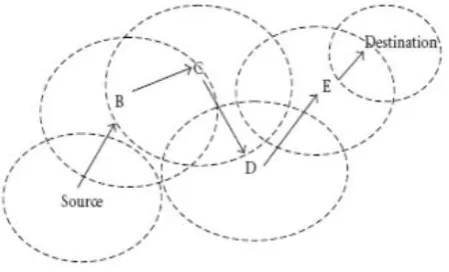
nodes forming a dynamic autonomous network. Nodes communicate with each other without the intervention of centralized access points or base stations. In such a network, each node acts both as a router and as a host. Due to the limited transmission range of wireless network interfaces, multiple hops are needed to exchange data between nodes in the network. Fig. 1 shows an example of an ad hoc network, where there are numerous combinations of transmission areas for different nodes. From the source node to the destination node, there can be different paths of connection at a given point of time. But each node usually has a limited area of transmission as shown in Fig. 1 by the oval circle around each node. A source can only transmit data to node B but B can transmit data either to C or D. It is a challenging task to choose a really good route to establish the connection between a source and a destination so that they can roam around and transmit robust communication [9].
Figure 1. Mobile ad-hoc network
Advantages and Drawbacks of AODV: AODV protocol has certain advantages:
It is used to find latest route to destination. Its connection setup delay is less.
It favours the least congested route instead of shortest route.
It supports unicast and multicast packet transmissions.
AODV protocol has also certain drawbacks [10]: The intermediate nodes can lead to inconsistent
route if the source sequence number is very old and the intermediate node have a higher but not the latest destination sequence number, thereby having stale entries.
Multiple route reply packets in response to a single route request packet can lead to heavy control overhead.
Periodic beaconing leads to unnecessary bandwidth consumption.
IV. DYNAMIC SOURCE ROUTING PROTOCOL
administration. [11] The protocol is composed of the two main mechanisms of “Route Discovery” and “Route Maintenance”, which work together to allow nodes to discover and maintain routes to arbitrary destinations in the ad hoc network. All aspects of the protocol operate entirely on demand, allowing the routing packet overhead of DSR to scale automatically to only what is needed to react to changes in the routes currently in use. The protocol allows multiple routes to any destination and allows each sender to select and control the routes used in routing its packets, for example, for use in load balancing or for increased robustness. Other advantages of the DSR protocol include easily guaranteed loop- free routing, operation in networks containing unidirectional links, use of only “soft state” in routing, and very rapid recovery when routes in the network change. [12] The DSR protocol is designed mainly for mobile ad hoc networks of up to about two hundred nodes and is designed to work well even with very high rates of mobility. This document specifies the operation of the DSR protocol for routing unicast IPv4 packets [13].
Advantages and Drawbacks of DSR [14]: DSR protocol has certain advantages:
It use reactive approach which eliminates the need of periodically flood the network with table update message, which required in a table driven approach.
The routes are maintained only between nodes that need to communicate.
The intermediate nodes utilize the route cache information efficiently to reduce the control overhead.
DSR protocol has also certain drawbacks:
The route maintenance mechanism does not locally repair a broken link.
Stale cache information could also result in inconsistencies during the route reconstruction phase.
The connection setup delay is higher than table driven protocol.
It performs well in static and low mobility environment, the performance degrades rapidly with increasing mobility.
Routing overhead in involved due to the source routing mechanism employed in DSR, this routing overhead is directly proportional to the path length.
V. COMPARISSION OF AODV AND DSRROUTING
PROTOCOL FOT AD-HOC WIRELESS NETWORK
Simulation Scenario: We have used network simulator ns -2 for our experiments based on simulation. This section describes simulations for AODV and DSR routing protocol for ad hoc wireless network. For all simulations, we are considering parameter mentioned as below:
Routing Protocols: AODV and DSR, Simulation Time (sec.): 200sec., No. of Nodes: 10, 20, 30, 40, Area (m2): 400*400, Traffic Type: UDP, Packet size (byte): 512.
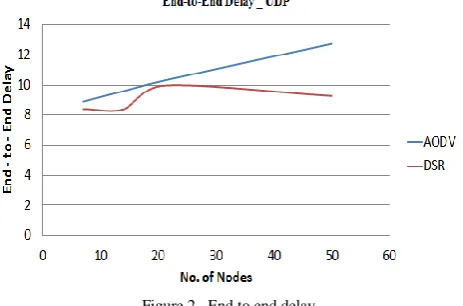
End-to-End Delay: Time taken for the packets to reach the destination.
Figure 2. End to end delay
Fig. 2 shows the simulation results of end-to-end delay with varying number of nodes for UDP traffic. From the results we see that as number of nodes is increase, the end-to-end delay is increase. AODV protocol gives higher delay than DSR in UDP traffic.
TABLEI. END-TO-ENDDELAY_UDP
No. of Nodes AODV DSR
10 32.4 32.61
20 58.3 58.92
30 58.34 58.83
40 58.16 59.09
From Table I, the simulation results shows that the performance of both reactive protocols (AODV and DSR).DSR is batter compare to AODV at higher node End to End Delay.
Good-Put: Measures the transfer of usable data over a given period of time;
Fig. 3 shows the simulation results of Good-Put with varying number of nodes for UDP traffic. From the results we see that as number of nodes is increase DSR will deliver higher number of packet compare to AODV in UDP traffic. The simulation results data are shown in Table II.
TABLEII. GOOD-PUT_UDP
No. of Nodes AODV DSR
10 0.9943 0.9987
20 0.995 1
30 0.9961 0.9989
40 0.9964 0.9993
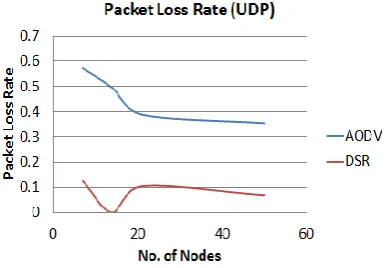
Packet Loss Rate: Fig. 4 shows the simulation results of packet loss rate with varying number of nodes for UDP traffic. From the results we see that packet loss rate is higher in AODV than DSR in UDP traffic. The simulation results data are shown in Table III.
Figure 4. Simulation results
TABLEIII. PACKET LOSS RATE
No. of Nodes AODV DSR
10 32.4 32.61
20 58.3 58.92
30 58.34 58.83
40 58.16 59.09
VI. CONCLUSION
We have compared two On-demand Routing Protocols, Ad Hoc On-Demand Distance Vector Routing (AODV) and Dynamic Source Routing (DSR). We use NS-2 as a simulation platform.
We have done simulation for scenario in which number of nodes, node speed and pause time are kept varying during simulation. As the traffic protocols, we have used User Datagram Protocol (UDP) traffic. We analyse both protocols in terms of End-to-End Delay, Good-Put and Packet Loss Rate.
AODV and DSR both protocol use on-demand approach for finding routing path but different routing mechanism. The AODV routing protocol selects least congested path to transmit the data packets from source to destination, while DSR selects shortest path to transmit data packets from source to destination. From the simulation results we conclude that DSR will give better performance with UDP traffic compare to AODV.
REFERENCES
[1] S. K. Bisoy and S. K. Mohapatra, “Simulation analysis of active queue management for internet congestion control,” in Proc.
International Conference on Computing, Communication and
Sensor Network, 2012.
[2] E. Alessio, M. Garetto, R. L. Cigno, M. Meo, and M. A. Marsan, “Analytical estimation of completion times of mixed new reno and tahoe TCP connections over single and multiple bottleneck networks,” Dipartimento di Elettronica - Politecnico di Torino, IEEE, 2001.
[3] Q. Razouqi, A. Boushehri, M. Galallah, and L. Alsaleh, “Extensive simulation performance analysis for DSDV, DSR, AODV MANET routing protocols,” in Proc. International Conference on Advanced Information Networking and Application
Workshops, 2013.
[4] S. Taneja, A. Kush, and A. Makkar, “Experimental analysis of DSR, AODV using speed and pause time,” International Journal of Innovation, Management and Technology, vol. 1, no. 5, pp. 453-458, Dec. 2010.
[5] TCP Extension Selective Acknowledgement (Sack) RFC 2018 Duplicate Sack (D-Sack) RFC 2883, Pallavi Mahajan CIS 856 Computer and Information Sciences University of Delaware, 2009. [6] C. E. Perkins, E. M. Royer, S. R. Das, and M. K. Marina,
“Performance comparison of two on-demand routing protocols for ad hoc networks,” IEEE Personal Communications, vol. 8, no. 1, pp. 16-28, 2001.
[7] R. Jain, N. B. Hairnar, and L. Shrivastava, “Comparative study of three mobile ad-hoc network routing protocols under different traffic source,” in
Communication and Network Technologies, 2011.
[8] I. Vijaya and A. K. Rath, “Simulation and performance evaluation of AODV, DSDV and DSR in TCP and UDP environment,” in
Proc. 3rd International Conference on Electronics Computer
Technology (ICECT), 2011, pp. 42-47.
[9] A. Tuteja, R. Gujral, and S. Thalia, “Comparative performance analysis of DSDV, AODV and DSR routing protocols in MANET using NS2,” in Proc. International Conference on Advances in
Computer Engineering, 2010, pp. 330-333.
[10] A. K. Sharma and N. Bhatia, “Behavioral study of MANET routing protocols by using NS-2,” International Journal of
Computational Engineering and Management, vol. 12, pp.
100-104, Apr. 2011.
[11] D. Bisen, P. Suman, S. Sharma, and R. Shukla. Effect of pause time on DSR, AODV and DYMO routing protocols in MANET.
International Journal of IT and Knowledge Management.[Online].
3(1). Available:
http://www.csjournals.com/IJITKM/Special1/8.%20Effect%20of %20Pause%20Time.pdf
[12] K. Fall and K. Varadhan. (2009). The ns manual (formerly ns notes and documentation). [Online]. Available: http://www. isi. edu/nsnam/ns/doc/ns_doc. pdf
[13] Maynooth Maynooth, Co. Kildare, Ireland, Department Of Computer Science Technical Report Series, NUIMCS-TR-2004-05.
[14] J. Koo, S. Ahn, and J. Chung, “A comparative study of queue, delay, and loss characteristics of aqm schemes in qos-enabled networks,” Computing and Informatics, vol. 23, no. 4, pp. 317-335, 2012.
Margam K. Suthar was born in Visnagar,
Gujarat in 1988. He received the B.E. degree in Electronic and Communication Engineering from Hemchandracharya North Gujarat University, Patan, in 2010, M.Tech degree in Electronic and Communication at Ganpat University, Kherva-382711. Dist. Mehsana, Gujarat, India in 2012.
He has two year of teaching experience in the field of Electronic and Communication. He is currently an Assistant Professor, Post-graduate Research Center for Mobile Computing & Wireless Technologies at Gujarat Technological University (GTU), Visat - Gandhinagar Highway Chandkheda, Ahmedabad – 382424 – Gujarat, India. He has authored and published / presented six publications in reputed International Journals and Conferences.
His research interests include Mobile Computing, Wireless Technologies, ad-hoc Network, and Congestion Control and improve TCP/IP protocol for High Speed Network & Wireless Network.
Dhaval R. Sathawara was born in Visnagar, Gujarat in 1988. He received the B.E. degree in Electronic and Communication Engineering from Dharmsinh Desai University, Nadiad in 2010, M.Tech degree in Electronic and Communication at at Ganpat University, Kherva - 382711.Dist.Mehsana, Gujarat, India in 2012. He has two year of teaching experience in the field of Electronic and Communication. He is currently an ASSISTANT PROFESSOR, at Ganpat University, Kherva-382711. Dist. Mehsana, Gujarat, India.