ISSN 2319-7625 (Online)
(An International Research Journal), www.chemistry-journal.org
Metallo – Bioactive Pyridopyrazolopyrimidine Complexes
as a new Class for Anticancer Therapy
M. I. Ayad1, W. A. Ragab2, Islam El-Garawani3, Mohammed H. H. Abu-Setta*1
and Noor Smah. S. Shams El-Dein1
1Department of Chemistry, Faculty of Science,
Menoufia University, Shebin El -Kom, EGYPT. 2 Food Technology Research Institute,
Agriculture Research Center, Giza, EGYPT. 3Zoology Department, Faculty of Science,
Menoufia University, Shebin El-Kom, Menoufia, EGYPT.
(Received on: February 5, 2020)
ABSTRACT
The synthesis of bioactive pyridopyrazolopyrimidine ligands denoted I, II and III were described. The chelation abilities of the ligand towards Co(II), Cu(II( salts have been studied and give the following formula: [Cu(H2L1)(HL1)(CH3COO)
(H2O)].3H2O, (Ib), [Cu(HL1)2(H2O)2].1.5H2O, (Ic), [Co(H2L1)2Cl(OH)].H2O, (Id),
[Cu(H2L2)(OH)(H2O)].Cl.0.5H2O, (IIa), [Cu(HL3)Cl(H2O)2].H2O, (IIIa). These
investigated in depth towards other cancer cell lines to assess their possible integration as chemotherapeutics.
Keywords: Complexes, Synthesis, pyridopyrazolopyrimidines, Cytotoxicity.
1. INTRODUCTION
Pyrazolopyrimidines are found to possess a wide important pharmacophore and adjective structure in medicinal chemistry due to their biological importance. Functionalized pyrazolopyrimidines are known to exhibit several pharmacological activities such as CNS depressant1, antihypertensive2, adenosine receptors3, tuberculostatic4, antibacterial and antifungal5. Some of the pyrazolopyrimidine derivatives are known to inhibit enzymes such as xanthine oxidase6,7. The pyrazolo[1,5-a]pyrimidines frame work, are attractive compounds for drug discovery since many of them have been shown to exhibit excellent biological activities8. In addition, the pyrimidines and pyrazoles have received much attention over their years because of their interesting pharmacological properties9,10. Pyrazolo[3,4-b]pryridines have received considerable attention as a result of their biological activity. It has been shown that many of pyrazolopyridines especially pyrazolo[3,4-b]pryridines have antibacterial11 and antiviral effects12. Some of the derivatives act as anti-metabolites and those are effective in the control of cancer13. Pyrazolopyridines were found to be among many systems which affects on the central nervous systems. Various pyrazolo[3,4-b]pryridines have been found to exhibit pharmacological properties. Some of the derivatives of pyrazolo[3,4-b]pryridines have been tested for anti-inflammatory14 action, while others have been demonstrated to be good anxiolytic15. To enhance the activity of pyrazolopyridines and pyrazolopyrimidines, several approaches to construct another ring over those ring systems described in the literature are available on preparation of pyridopyrazolopyrimidines which left much scope for further study. Moreover, pyridopyrazolopyrimidines revealed antiproliferative activity and are used as potent kinase inhibitors16-19. This study aims to reprepare and characterize pyridopyrazolopyrimidin derivatives as ligands, then prepare and characterize the anticancer synthetic pyridopyrazolopyrimidines complexes and study their biological activities as anticancer agents for leukemia treatment. Among the entire diseases, cancer ranks high as a major killer worldwide.
2. EXPERIMENTAL
2.1. Materials and methods
electronic spectra were measured in Nujol mulls using a Perkin Elmer Lambda 4B spectrophotometer. Molar conductance measurements were made in a solution of 10-3 M DMSO using a type CD6 N Tacussel conductivity meter. The thermal analysis (TGA&DTG) was carried out by using a Shimadzu DAT/TG-50 thermal analyzer with a heating rate of 10°C/min under air atmosphere with a flowing rate of 20 mL/min from the room temperature up to 800°C using platinum crucibles. Magnetic susceptibilities were measured at room temperature by a modified Gouy method using a Johnson Matthey magnetic susceptibility balance. The effective magnetic moments were calculated from the equation µeff = 2.84 (XMcorrt T) 1/2. Melting points were measured by using Stuart melting point apparatus.
2.2 Preparation of PyridoPyrazolopyrimidines ligands (I, II and III):
PyridoPyrazolopyrimidines ligands (I, II and III) were prepared as reported.17
Structural assignment by infrared (IR) spectroscopy showed the characteristic absorption bands at 3405-3293cm-1, 3404-3276cm-1 and at 3430-3290 cm-1 due to (OH) and (NH) groups of the free ligands ( I, II and III) respectively. The proposed structure for ligands ( I, II and III))) is shown in (Scheme 1).
Scheme 1: Preparation of PyridoPyrazolopyrimidine derivatives, where, (2a-c ) are the Free ligands (I, II
and III) respectively.
2.3 Preparation of the metal complexes ligands (I, II and III)
All complexes were prepared in (1M:1L) by adding equimolar amounts of a hot ethanolic solution (15 mL) of appropriate metal salt to an ethanolic solution (25 mL) of ligands
(I, II and III). The reaction mixture was stirred for one hour at 50°C and then cooled. The precipitated complexes were filtered off, washed several times with ethanol and finally dried under vacuum over anhydrous calcium chloride giving a metal-ligand mole ratio of 1:2 for (Ib, Ic, Id( and 1:1 for (IIa, IIIa).
3. CHEMISTRY
C32H46N8O10Cu ,FW= (766.318): C, 50.15; H, 6.05; N, 14.63, Cu, 8.29; Found(%) C, 50.19; H, 4.73; N, 15.22, Cu, 8.61. IR (cm-1),3422(m) υ(OH) phenolic υ(OH) of H
2O20, the bands characteristic to υ(NH) and υ(C=O) were absent21, 1461(m) υ (N=C−O), 1382(w) υ(C-O) amide22, 1272(sh) Phenolic υ(C−OH), 1027(m) 1027(m) (N−N) of pyrazole23, 599w υ(MــــO), 531(vw) υ(M←O), 457(vw) (M←N)24-26, 1598(s) and 1421(m)cm-1 due to ν
assy.(OAc–) and νsym..(OAc–) respectively. The separation ∆ν=177cm-1 suggests the unidantate coordination of .(OAc–) ion in complex (Ib)27. UV-Vis: (192-250, 296−308), (515), (792) due to (𝜋 − 𝜋*)32, 2A
1g(D) ⟶2B1g(D), (d−d transition of an octahedral geometry)33 respectively ,
2.04(BM)34 and mass loss Calcd.(%): (2.35), (4.70), (2.35), (30.46), (41.92), (18.22); Found (%): (2.35), (4.68), (2.35), (30.55), (41.16), (18.91) at TG range (0C): (27−127), (127−282), (282−394), (394−491), (491−899), (At 899) due to loss of hydrated (H2O), lattice (2H2O), coordinated (H2O), partial ligand pyrolysis, complete ligand pyrolysis and (CuO + C residue) respectively.
Complex (Ic), [Cu(HL1)
2(H2O)2].1.5H2O Yield: 84%; m.p > 300oC; color: pale green; molar conductivity (Λm): (11.60) ohm-1cm2mol-1. Anal.Calcd.(%) for C30H41N8O7.5Cu ,FW= (697.240): C, 51.68; H, 5.93; N, 16.07, Cu, 9.11; Found(%) C, 52.68; H, 4.96; N, 17.03, Cu, 9.03. IR (cm-1), 3442(m) υ(OH) phenolic υ(OH) of H
2O20, the bands characteristic to υ(NH) and υ(C=O) were absent21, 1428(sh) υ(N=C−O) , 1395(m) υ(C-O) amide22, 1219(m) Phenolic υ(C−OH), 1027(m) (N−N) of pyrazole23, 601w υ(M−O),445(vw) (M←N) 24-26. UV-Vis: (192−250), (344−350), (448−515), (706) due to ( 𝜋 − 𝜋*)32, (2eg(D) ⟶2B
1g(D)), (𝑛 − 𝜋*),
(d−d transition of an octahedral geometry)33 respectively; 1.91(BM)34 and mass loss Calcd.(%): (3.87), (2.58), (40.00), (36.11), (17.44) ; Found (%): (3.52), (2.70), (39.60), (36.90), (17.28) at TG rang(0C): (28−100), (100−209), (209−453), (453−669), (669−899) due to loss of hydrated 1.5(H2O), coordinated (H2O), [[coordinated (H2O) & partial ligand pyrolysis ]],complete ligand pyrolysis and (CuO + C residue) respectively.
Complex (Id), [Co(H2L1)2Cl(OH)].H2O Yield: 81%; m.p > 300oC; color: light green; molar conductivity (Λm): (19.00)ohm-1cm2mol-1.Anal.Calcd.(%) for C30H39N8O6CoCl ,FW= (702.070): C, 51.27; H, 5.60; N, 15.96; Co, 8.39; Found(%) C, 52.70; H, 5.46; N, 16.16, Cu, 8.49. IR (cm-1), 3419(m) υ(OH) of H
2O/EtOH20, 3205(m) (NH) amide , 1635(sh) (C=O) amide28-30, 1239(sh) (C−OH), 980(w) (N−N) of pyrazole as ligand(I), 532(vvw) (M←O), 454(vw) (M←N)24-26. UV-Vis: (436−486), (574−670) due to (4T
1g(F) ⟶4T2g(p)), 4T
1g⟶4A2g(octahedral geometry) respectively; 4.17(BM)and mass loss Calcd.(%): ( 2.63 ),
(7.47), ( 79.23 ), ( 10.67 ); Found (%): (2.73), (7.27), (79.20), (10.80) at TGA range (0C): (23−69), (69−228), (228−479, (479−899) due to loss of hydrated (H2O), [(OH) + 0.5Cl2 gas],complete ligand pyrolysis and (CoO) respectively.
Complex (IIa), [Cu(H2L2)(OH)(H2O)].Cl.0.5H2O:Yield:68%; m.p > 300oC; color: yellowish brown; molar conductivity (Λm): (60.40)ohm-1cm2mol-1. Anal.Calcd.(%) for C12H16N4O4.5CuCl ,FW= (387.288): C, 37.21; H, 4.16; N, 14.47, Cu, 16.41;Found (%) C, 37.90; H, 3.71; N, 14.88; Cu, 15.87. IR (cm-1), 3430(m,br) υ(OH) of H
(N−N) of pyrazole as ligand(II), 503(w) (M←O), 444(vvw) (M←N)24-26. UV-Vis: (336), (452), (510-580) due to (𝜋 − 𝜋*), (𝑛 − 𝜋*)32, (d−d transition of square planer )35 respectively; 1.85 (BM) and mass loss Calcd.(%): (2.32), (17.68), (60.54), (19.46); Found (%): (2.25), (18.36), (60.52), (18.87) at TG range(0C): (29−135), (135−336), (336−649), (649−899) due to loss of hydrated 0.5(H2O), [coordinated 2(H2O) + 0.5Cl2 gas], complete ligand pyrolysis and (Cu + C residue)respectively.
Complex (IIIa), [Cu(HL3)Cl(H
2O)2].H2O: Yield: 65%; m.p > 300oC; color: light brown; molar conductivity (Λm): (35.20)ohm-1cm2mol-1.Anal.Calcd.(%) for C17H19N4O5CuCl, FW= (458.362): C, 44.54; H, 4.18; N, 12.23, Cu, 13.86; Found(%) C, 44.05; H, 3.07p; N, 12.29 ; Cu,14.17. IR (cm-1), 3506(sh) due to inter or intramolecular hydrogen bonding between (H2O) molecules,3429(m) υ(OH) phenolic υ(OH) of H2O20, 3190(sh) (NH) amide [Upon comlexation, the band of (NH) exhibits downshift by about 100cm-1in complex (IIIa) may be due to [[hydrogen bonding between (NH) amide proton and (C=O) amide oxygen]], 1648(sh) (C=O) amide as its ligand (III)31, 1272(w) (C−OH), 1023(w) (N−N) of pyrazole23, 603(w) υ(M−O), 427(vw) (M←N) 24-26. UV-Vis: (420-515), (660-680) due to (𝜋 − 𝜋*, 𝑛 − 𝜋*)32, (d-d transition of square pyramidal)36 respectively; 1.78(BM)and mass loss Calcd.(%): (3.93), (7.86), (7.73), (61.80), (18.67); Found (%): (3.64), (7.20), (8.18), (61.91), ( 19.07 ) at TGA range (0C ): (25−173), (173−260), (260−283),( 283−490), (490−899 ) due to loss of hydrated (H2O), coordinated 2(H2O) , (Partial dissociation of ligand due to loss of 0.5 mole of Cl2 gas ], complete ligand pyrolysis, (CuO + C residue)respectively. The elemental analysis, IR, lectronic spectra, and magnetic moment measurements, as well as thermal analyses are compatible with the suggested structure (Fig. 2).
(Ib) (Ic)
(Id) (IIa)
(IIIa)
Figure2. Structural representation of the complexes
4. ANTICANCER ACTIVITY
Materials and methods
Peripheral blood leucocytes' isolation and incubation:
until a white pellet appeared37. Isolated human normal leucocytes and myeloid leukemia cells were preceded for short-term culture in serum free RPMI-1640 medium supplemented with 1% (100U/ml penicillin and 100 μg/ml streptomycin) for three hours of tested extracts incubation at 37oC and humidified 5% CO
2 atmosphere38.
Assessment of cytotoxicity in NPBL and AML cells
After the various treatments incubation for 3h, determination of cytotoxicity was done by the charged cationic trypan blue dye (0.4%, Lonza) uptake method following incubation for 5 minutes at 37 °C for control and treated groups of both normal and AML cells.
5. RESULTS
Cytotoxicity in NPBL and AML cells
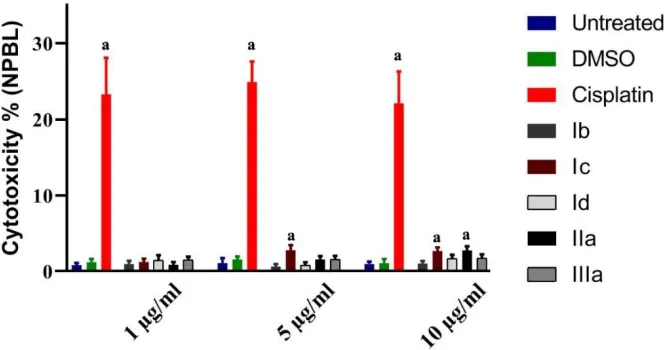
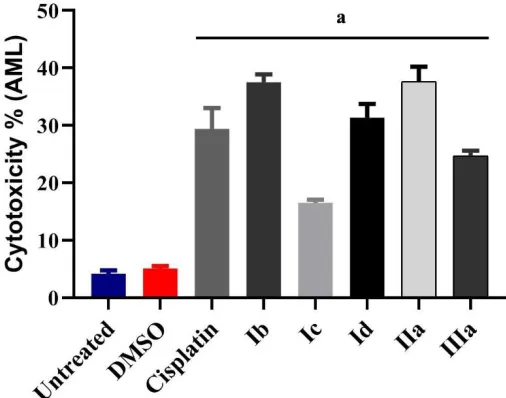
After the various treatments and incubations for 1h, determination of cytotoxicity was done by the charged cationic trypan blue dye uptake method. Results revealed significant cytotoxicity towards AML cells while cytotoxicity towards NPBL were not observed (Figure 3 and 4).
Cytotoxicity of (1,5,10) µg/ml for complexes (Ib, Ic, Id, IIa and IIIa) on normal blood cells after direct exposure for one hour of incubation:
Cytotoxicity of (10µg/ml) for complexes (Ib-Ic,Id, IIa and IIIa) on leukemia blood cells (AML) after direct exposure for one hour:
Figure ( 4 ) Cytotoxicity of complexes (Ib-Id, IIa and IIIa) on AML after direct exposure for one hour of incubation using trypan blue staining method. Data represent the average of three independent experiments, (n=3). Bars: standard deviation and a: significant with respect to the control (P 0.05). Cisplatin (3 µg/mL).
6. DISCUSSION
The cytotoxicity of the copper complexes (Ib, IIa) and cobalt complex (Id) are more active than standard drug used. This can be explained as Cu (II) ion binds to DNA. It seems that, changing the anion, molar ratio and the nature of the metal ion has effect on the biological behavior, due to alter binding ability of DNA binding, so testing of different complexes is very interesting from this point of view. Chemotherapeutic activity of the complexes may be attributed to the central metal atom which was explained by Tweedy's chelation theory39.40. Also, the positive charge of the metal increases the acidity of coordinated ligand that bears protons, leading to stronger hydrogen bonds which enhance the biological activity41, 42. Moreover, Gaetke and Chow had reported that, metal has been suggested to facilitate oxidated tissue injury through a free-radical mediated pathway analogous to the Fenton reaction42. By applying the ESR-trapping technique, evidence for metal - mediated hydroxyl radical formation
in vivo has been obtained. ROS are produced through a Fenton-type reaction as follows:
LM(II) + H2O2 → LM(I) + .OOH + H+ LM(I) + H2O2 → LM(II) + .OH + OH
-Where L, organic ligand
significant and well-characterized of the OH reactions is hydrogen atom abstraction from the C4 on the deoxyribose unit to yield sugar radicals with subsequent β-elimination. By this mechanism strand break occurs as well as the release of the free bases. Another form of attack on the DNA bases is by solvated electrons, probably via a similar reaction to those discussed below for the direct effects of radiation on DNA44. pyridopyrazolopyrimidines revealed antiproliferative activity and are used as potent kinase inhibitors16-19. The tested complexes were found to be less toxic than the free ligands. This indicates enhancing of antitumor activity upon coordination.
CONCLUSION
Novel bioactive pyridopyrazolopyrimidine metal complexes have been synthesized and characterized using chemical and physicochemical analysis. These structures have been synthesized and characterized by elemental analyses, (spectral method UV–Vis., IR), magnetic susceptibility, conductance and thermogravimetric analysis. TGA were performed. Molar conductance in DMF arrangement demonstrates that, all complexes are non-electrolytes except the complex (IIa) is electrolyte. All these parameters described above, confirmed the proposed structures of these metal complexes. These complexes of these ligands have much potential as anticancer agents. Chelates behave as a neutral bidentate ligand bonded to the metal ions through either the nitrogen atom of pyrazole ring and hydroxyl oxygen atom attached to pyrimidine ring or the nitrogen atom of amide group of pyrimidine ring and carbonyl oxygen atom of amide group of pyrimidine ring in protonated or deprotonated form..
The safety and tolerance assessment of these complexes were done on normal peripheral blood leucocytes isolated from eight healthy non-smoker volunteers. Besides, the anticancer properties were evaluated on acute myeloid leukemia (AML) blasts of eight patients that were recently diagnosed for AML and received no chemotherapeutics until the samples were taken. The tested complexes should be investigated in depth towards other cancer cell lines to assess their possible integration as chemotherapeutics. These compounds are promising candidates as anticancer agents because of their high cytotoxic activities.
REFERENCES
1. (a) Julino, M.; Stevens, F. G. M. Antitumour polycyclic acridines. Part 5.1 Synthesis of 7Hpyrido[4,3,2-kl] acridines with exploitable functionality in the pyridine ring. J. Chem. Soc. Perkin Trans. 1, 1677-1684 (1998); (b) Abdou, I. M.; Saleh, A. M.; Zohdi, H. F. Synthesis and antitumor activity of 5-trifluoromethyl-2,4dihydropyrazol-3-one nucleosides. Molecules, 9, 109-116 (2004).
2. El-Feky, S. A.; Abd el-Samii, Z. K. Synthesis and antihypertensive activity of novel 1-(4benzyl-1-phthalazinyl)-pyrazolo[3,4-d]. pyrimidines. Pharmazie, 51, 540-543 (1996). 3. (a) Davies, L. P.; Brown, D. J.; Chow, S. C.; Johnston, G. A. Pyrazolo[3,4-d] pyrimidines,
4. Ghorab, M. M.; Ismail, Z. H.; Abdel-Gawad, S. M.; Abdel Aziem, A. Antimicrobial activity of amino acid, imidazole, and sulfonamide derivatives of pyrazolo[3,4-d]pyrimidine. Heteroatom Chem., 15, 57-62 (2004).
5. Holla, B. S.; Mahalinga, M.; Karthikeyan, M. S.; Akberali, P. M.; Shetty, N. S. Synthesis of some novel pyrazolo[3,4-d]pyrimidine derivatives as potential antimicrobial agents.
Bioorg. Med. Chem.,14, 2040-2047 (2006).
6. Gupta, S.; Rodrigues, L. M.; Esteves, A. P.; Oliveira-Campos, A. M.; Nascimento, M. S.; Nazareth, N.; Cidade, H.; Neves, M. P.; Fernandes, E.; Pinto, M.; Cerqueira, N. M.; Bras, N. Synthesis of N-aryl-5-amino-4-cyanopyrazole derivatives as potent xanthine oxidase inhibitors. Eur. J. Med. Chem., 43, 771-780 (2008).
7. Tamta, H.; Thilagavathi, R.; Chakraborti, A. K.; Mukhopahyay, A. K. 6-(N-benzoylamino) purine as a novel and potent inhibitor of xanthine oxidase: inhibition mechanism and molecular modeling studies. J. Enzyme Inhib. Med. Chem., 20, 317-324 (2005).
8. Bouabdallah, I.; M'Barek, L. A.; Zyad, A.; Ramdani, A.; Zidane, I.; Melhaoui, A. Anticancer effect of three pyrazole derivatives. Nat. Prod. Res., 20, 1024-1030 (2006). 9. Coimbra, C.; Boris-Moller, F.; Drake, M.; Wieloch, T. Diminished neuronal damage in
the rat brain by late treatment with the antipyretic drug dipyrone or cooling following cerebral ischemia. Acta Neuropathol., 92, 447-453 (1996).
10. (a) Shaaban, M. R.; Saleh, T. S.; Mayhoub, A. S.; Mansour, A.; Farag, A. M. Synthesis and analgesic/anti-inflammatory evaluation of fused heterocyclic ring systems incorporating phenylsulfonyl moiety. Bioorg. Med. Chem., 16, 6344-6352; (2008). (b) Shaaban, M. R.; Saleh, T. S.; Mayhoub, A. S.; Farag, A. M. Single step synthesis of new fused pyrimidine derivatives and their evaluation as potent Aurora-A kinase inhibitors. Eur. J. Med. Chem., 46, 36903695 (2011).
11. El-Kateb, Ahmed A., et al. "Microwave-assisted synthesis of novel pyrazole, pyrimidine and pyrazolo [1, 5-a] pyrimidines containing aryl sulfone moiety." Life Sci J 9 (2012): 711-718.Goda , F. E. ; Abedl-Aziz , A. A. M. ; Attef , O. A. Synthesis and antiproliferative activity in vitro of new 3-substituted aminopyrazolo[3,4-b]pyridines. Bioorg. Med. Chem., 12, 1845 – 1852 (2004).
12. Goda , F. E. ; Abedl-Aziz , A. A. M. ; Attef , O. A. Synthesis and antiproliferative activity in vitro of new 3-substituted aminopyrazolo[3,4-b]pyridines. Bioorg. Med. Chem., 12, 1845 – 1852 (2004).
13. Attaby , F. A. ; Elghandour , A. H. H. ; Ali , M. A. ; Ibrahim , Y. M. Synthesis, reactions, and antiviral activity of 1-(1H-pyrazolo[3,4-b]pyridin-5-yl)ethanone and pyrido[2′,3′:3,4] pyrazolo[5,1-c][1,2,4]triazine derivatives. Phosphorus, Sulfur Silicon Relat.Elem. 2006,181,1087-1102. [3] Attaby , F. A. ; Elghandour , A. H. H. ; Ali , M. A. ; Ibrahim , Y. M. Synthesis, characterization, and antiviral activities of pyridopyrazolotriazines. Phosphorus,
Sulfur Silicon Relat. Elem., 182 ,133 – 149 (2007). 14. De Mello , H. ; Echevarria , A. ; Bernardino , A. M. ; Canto-Cavalheiro , M. ; Leon , L.
15. Alberti , M. J. ; Auten , E. P. ; Lackey , K. E. ; McDonald , O. B. ; Wood , E. R. ; Preugschat, F. ;Cutler , G. J. ; Kane-Carson , L. ; Liu , W. ; Jung , D. K. Discovery and in vitro evaluation of potent kinase inhibitors: Pyrido[1′,2′ :1,5]pyrazolo[3,4-d]pyrimidines. Bioorg. Med. Chem. Lett. , 15, 3778–3781 (2005).
16. Mohamed , A. M. G. ; Azza , M. ; Mohamed , A. A. E. Pyrazlo[3,4-b]pyridine in heterocyclic synthesis: Synthesis of new pyrazolo[3,4-b]pyridines, imidazo[1′,2′:1,5] pyrazolo[3,4-b]pyridines, and pyrido[2′,3′:3,4]pyrazolo[1,5-a]pyrimidines. Can. J. Chem., 85 , 592 – 599 (2007).
17. El-Essawy, F. A. Synth. Commun., 40, 877-887 (2010).
18. Hojo, M., Masuda, R., Kokuryo, Y., Shioda, H., & Matsuo, S. Electrophilic Substitutions of Olefinic Hydrogens II. Acylation of Vinyl Ethers and N-Vinyl Amides. Chemistry Letters, 5(5), 499-502. (1976)
19. Hojo, M., Masuda, R., & Okada, E. (1990). A convenient synthetic route to functionalized 5-trifluoroacetyl-6-trifluoromethyl-3, 4-dihydro-2H-pyrans: hetero-diels-alder reaction of
β, β-Bis (trifluoroacetyl) vinyl ethers with electron-rich alkenes. Synthesis, (04), 347-350 (1990).
20. Salman S. Asmaa, Org. Chem. Int.,2013, 1 (2013).
21. Synthesis and characterization of transition metal complexes of N 0-[(1,5-dimethyl-3-oxo-2-phenyl-2,3-dihydro-1H-pyrazol-4-yl) methylene]thiophene-2-carbohydrazide
22. M. F. R. Fouda Æ M. M. Abd-Elzaher Æ M. M. E. Shakdofa Æ F. A. El Saied Æ M. I. Ayad Æ A. S. El Tabl. Transition Met Chem, 33:219–228 (2008).
23. Sengupta SK, Pandey OP, Rai A, Sinha A. Spectrochim Acta Part A 65:139 (2006). 24. Maurya MR, Khurana S, Schulzke C, Rehder D. Eur JInorg Chem 779 (2001).
25. Abd El-Wahab ZH, Mashaly MM, Salman AA, El-Shetary BA, Faheim AA. Spectrochim Acta Part A 60:2861 (2004).
26. Sallam SA, Orabi AS, El-Shetary BA, Lentz A. Transit Met Chem 27:447 (2002). 27. Tossidis A, Bolos CA. Inorg Chim Acta 112:93 (1986) .
28. .Ispir E., Serin S., J. Therm. Anal. Calorim. 94, 281 (2008).
29. Gup R, Kirkan B. Spectrochim Acta Part A 62:1188 (2005).
30. Synthesis, Complexation and Characterization of 1-Phenyl-3-Methyl-4- (p-nitrobenzoyl) Pyrazolone-5(HNPz) and its complexes of Barium(II), Strontium(II) and Zinc(II) Nneka D. Ekekwe1, *, Amaka J. Arinze2, Lebe A. Nnanna3, Chibueze F. Ukpabi1, Akuagwu Agwu1 , Martins O. C. Ogwuegbu2 American Journal of Chemistry, 2(2): 52-56 (2012). 31. Ogwuegbu, M.O.C and Maseka, K.K. Studies on the Coordination Complexes of Ca(II),
Cd(II) and Tn(IV) with p-Nitrobenzoyl-oxo-pyrazole, Bull. Chem. Soc. Ethiop., 12(1), 27-33 (1998).
32. Y.J. Seok, K.S. yang, S.T. Kim, W.K. Huh, S.O. Kang, J. Carbo hydrate chemistry
15.1085 (1996).
33. A.D. Harrish, B.Josses, R.D.Archey Inorg. Chem., 4, 147 (1965).
34. M.B.Halli, S.Ravindr, S.Malipatil, Der Pharma Chemical 0.3,146 (2011).
36. - N. Roman, C. Thangaraja, S. Johnsoraja, Central Eur. S. Chem 3, 537 (2005).
37. El-Garawani, I. M. Ameliorative effect of Cymbopogon citratus extract on cisplatin-induced genotoxicity in human leukocytes. Biol Science Appl Res, 1, 304-310 (2015). 38. Bruserud, Ø., Gjertsen, B. T., Foss, B., & Huang, T. S. New strategies in the treatment of
acute myelogenous leukemia (AML): in vitro culture of aml cells—the present use in experimental studies and the possible importance for future therapeutic approaches. Stem cells, 19(1), 1-11 (2001)..
39. 74. N. A. Illan- Cabeza, A. R. Garcia-Garcia, M. N. Moreno-carretero, J. M. Martin-Martos, M. J. J. Ramirez-exposito, Inorg. Biochem., 99, 1637 (2005).
40. 75. I. H Hall, C. C. Lee, G. Ibrahim, M. A. Khan, G.M. Bouet, Appl. Organomet. Chem., 11, 565 (1997).
41. G. Feng, J. C. Mareque-Rivas, R. T Rosales, N. H. A. Williams, J. Am. Chem. Soc., 127, 13470 (2005).
42. B. Bauer-Siebenlist, F. Meyer, E. Farkas, D. Vidovic, S. Dechert, J. Chem. Eur., 11, 349 (2005).