CUPS: Secure Opportunistic Cloud of
Things Framework based on Attribute
Based Encryption Scheme Supporting
Access Policy Update
Belguith, S, Kaaniche, N and Russello, G
http://dx.doi.org/10.1002/spy2.85
Title
CUPS: Secure Opportunistic Cloud of Things Framework based on
Attribute Based Encryption Scheme Supporting Access Policy Update
Authors
Belguith, S, Kaaniche, N and Russello, G
Type
Article
URL
This version is available at: http://usir.salford.ac.uk/id/eprint/51592/
Published Date
2019
USIR is a digital collection of the research output of the University of Salford. Where copyright
permits, full text material held in the repository is made freely available online and can be read,
downloaded and copied for noncommercial private study or research purposes. Please check the
manuscript for any further copyright restrictions.
DOI: xxx/xxxx
ARTICLE TYPE
CUPS: Secure Opportunistic Cloud of Things Framework based
on Attribute Based Encryption Scheme Supporting Access
Policy Update
Sana Belguith*
1| Nesrine Kaaniche
2| Giovanni Russello
31School of Computing, Science and Engineering, University of Salford, Manchester, UK
2Department of Computer Science, University of Sheffield, Sheffield, UK
3Cyber Security Foundry,University of Auckland, New Zealand, NZ
Correspondence
*Sana Belguith. Email: [email protected]
Summary
The ever-growing number of Internet connected devices, coupled with the new computing trends, namely within emerging opportunistic networks, engenders several security concerns. Most of the exchanged data between the Internet of Things (IoT) devices are not adequately secured due to resource constraints on IoT devices. Attribute Based Encryption is a promising cryptographic mechanism suitable for distributed environments, providing flexible access control to encrypted data contents. However, it imposes high decryption costs, and does not support access policy update, for highly dynamic environments. This paper presents CUPS, an ABE-based framework for opportunistic cloud of things applications, that securely outsources data decryption process to edge nodes in order to reduce the computation overhead on the user side. CUPS allows end-users to offload most of the decryption overhead to an edge node and verify the correctness of the received partially decrypted data from the edge node. Moreover, CUPS provides the access policy update feature with neither involving a proxy-server, nor re-encrypting the enciphered data con-tents and re-distributing the users’ secret keys. The access policy update feature in CUPS does not affect the size of the message received by the end-user which reduces the bandwidth and the storage usage. Our comprehensive theoretical analysis proves that CUPS outperforms existing schemes in terms of functionality, communication and computation overheads.
KEYWORDS:
Opportunistic computing, Cloud of things, Constant-size attribute based encryption, Decryption delegation, Verifiability, Access policy update, Confidentiality, Access control.
1
INTRODUCTION
Cloud Server
Ed
ge L
ay
er
Cl
oud L
aye
r
Edge Node Edge Node Edge Node Edge Node
Io
T L
ay
er
IoT device
IoT device IoT device
[image:3.595.197.398.53.343.2]IoT device IoT device IoT device
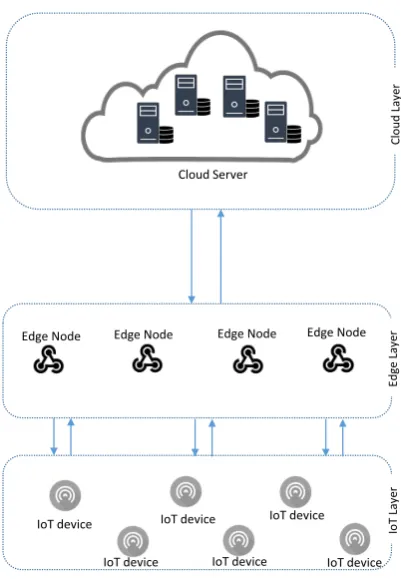
FIGURE 1 Cloud of Things Architecture
Recently, the Internet of Things (IoT) appeared and gained an expanding interest7,8. IoT has sparked a significant shift in all aspects of our lives including business, industry and society. Today’s availability of low-cost embedded sensors and actuators offer unprecedented opportunity for interconnecting smart buildings, factories, vehicles, power grids and other data infrastructures9,10,11,12.Combining IoT and opportunistic networks
has fostered a new computing paradigm referred to as Opportunistic Computing (c.f.,Figure 1 ).Exploiting devices’ contact opportunities for com-munication is only a first step. Indeed, this device-to device comcom-munication can be used to share data, utilise other devices resources and compute tasks remotely.
Hence, adopting opportunistic computing to leverage secure content dissemination is an interesting solution, for IoT application13,14. However, in the context of opportunistic networks, secure content sharing remains an issue. An increasing need to design secure and efficient data sharing protocols adapted to IoT applications has appeared. Due to their limited storage and computation capacities, IoT devices are usually assisted with cloud services to store and process generated data15,16,17, generally considered as a semi-trusted third party.
Data sharing schemes often rely on cryptographic algorithms to ensure the secrecy of shared data, between different group members. Although encryption mechanisms ensure data confidentiality against both curious cloud service providers and malicious users], the use of conventional encryption approaches is not sufficient to support the enforcement of fine-grained access control policies15,18. In fact, data confidentiality preser-vation becomes more complicated, considering flexible data sharing among highly dynamic group of users, trying to foster any opportunity to collect and/or retrieve data.
These opportunistic groups require efficient sharing of deciphering keys between different authorized users. In fact, the subscription of a new group member -based on its availability in an area-range and main interests- should not require updating the secret keys of existing users to minimise the key management complexity. Thus, the challenge lies in defining a comprehensive access control mechanism for outsourced data while both ensuring data secrecy and flexible up-datable access policies.
Proxy re-encryption techniques are introduced and used to update users in outsourced systems. These mechanisms allow a server to re-encrypt stored data without accessing their content using a re-encryption key22,23. Attribute-based Proxy Re-encryption (AB-PRE) systems have been applied for access policy update. In AB-PRE, when the data owner decides to update access policies of some ciphertexts, she uses her private key to generated a encryption key for each ciphertext to be changed from an old access policy to a new one. Afterwards, all the generated re-encryption keys are uploaded to a proxy server to update the ciphertext using the received keys. Although AB-PRE schemes allow re-re-encryption without decrypting ciphertext or accessing the plaintexts, it requires that the data owner generates valid re-encryption keys. When the number of ciphertext rises, it becomes inefficient for a data owner to generate all the re-encryption keys and upload them to the proxy. Furthermore, this may also be unfeasible for limited bandwidths. Therefore, attribute-based proxy re-encryption schemes may not be efficient when updating a huge num-ber of ciphertexts. Key Policy Attribute Based Encryption (KP-ABE) is widely applied to secure data in several distributed systems such as Publish and Subscribe systems (Pub/Sub)24,25,26, pay-TV systems27, vehicular networks28, ..., where rules on who may read a document must be specified but it is unable to specify policies on a per-message basis. Obviously, these dynamic environments usually require efficiently adding new users and/or revoking existent users. That is, KP-ABE consists in labeling user’s key by an access structure that specifies which type of ciphertext the key can decrypt, while ciphertext are labeled by a set of attributes. Thus, KP-ABE are adapted to distributed and decentralized environments. Instead, Ciphertext Policy Attribute Based Encryption (CP-ABE) schemes consists in associating an access structure to the ciphertext while assigning a set of credentials to deciphering users. CP-ABE schemes supporting policy update have been recently explored by Jiang et al.29,30.
In this paper, we introduce CUPS, a key policy attribute based encryption scheme, that supports policy update and verifiable computation offloading, to leverage an opportunistic computing solution for cloud of things. CUPS is an extension of PU-ABE, our KP-ABE scheme supporting adding and/or removing attributes from the access policy without sharing keys with the cloud server31. PU-ABE31, enables the encrypting entity to generate a ciphertext involving encrypted data together with some extra components used for supporting the access policy update feature. The ciphertext is forwarded to the cloud server that can update the access policy upon demand. Indeed, the cloud server does not need to be trusted. That is, it stores and shares ciphertexts among authorised users and also executes access policy update algorithm as requested. While executing these functionalities, the remote server is unable of decrypting any ciphertexts neither accessing any secret keys. In addition to this existent feature, this extension introduces several new functions introduced hereafter.
Contributions – CUPS presents a key policy attribute based encryption scheme which supports access policy update and verifiable decryption-outsourcing feature. This proposed scheme is suitable for bandwidth-limited applications as the size of the ciphertext received by end-users does not depend on the number of attributes involved in the access policy. In CUPS, the encrypting entity generates a ciphertext involving encrypted data together with some extra components used for supporting the access policy update feature. The ciphertext is forwarded to the cloud server that can update the access policy upon demand. Indeed, the cloud server does not need to be trusted. That is, it stores and shares ciphertexts among authorised users and also executes the access policy update algorithm as requested. While executing these functionalities, the remote server is unable of decrypting any ciphertexts neither accessing any secret keys. CUPS also supports secure delegation of the decryption algorithm to an edge node. This latter can partially decrypt the enciphered data content and forward the result to the requesting user. The user can then retrieve the plaintext by executing low cost mathematical operations. To achieve a secure delegation, CUPS allows the user to verify the accuracy of the received partially decrypted ciphertext to ensure that it has been honestly generated by the edge node. These features make CUPS is useful to be applied in dynamic environments requiring efficiently adding/removing users.
Our contributions are as follows:
1. CUPS provides a comprehensive framework for efficient and secure data sharing adapted to opportunistic cloud of things scenarios. It supports access policy update without requiring cipherext re-encryption or re-issuing users’ secret keys. CUPS does not rely on a proxy re-encryption server to execute policy update procedures. In addition, unlike most ABE techniques, the size of the ciphertext that the end-user will receive is constant and independent from the number of attributes involved in the access policy. Therefore, CUPS generates a constant-size ciphertext, w.r.t. the end-user, that reduces bandwidth utilisation and storage costs.
2. CUPS extends the PU-ABE scheme31by adding a computation offloading feature. Indeed, the IoT device can offload to the nearest edge node a part of the decryption process. This latter performs most of the decryption operations without accessing the plaintext, and returns a partially decrypted ciphertext to the intended user. In return, the user can retrieve the plaintext by executing low cost mathematical operations.
Paper Organisation –The remainder of this work is as follows: Section 2 gives an overview of the proposed framework and describes the system and security models. Section 3 reviews related work and Section 4 presents the mathematical background. In Section 5, an overview of CUPS is intro-duced and the detailed construction is presented. Section 6 presents a rigorous security discussion. Finally, a theoretical analysis of computational performances is presented in Section 7, before concluding in Section 8.
2
FRAMEWORK SPECIFICATION
In this section, we first present the network model, detailing the involved entities and their interactions in Section 2.1. Then, we detail the security requirements that the proposed system should fulfill in Section 2.2. Afterwards, we present the system and security models of the proposed CUPS framework in subsection 2.3 and subsection 2.5, respectively.
2.1
Architecture
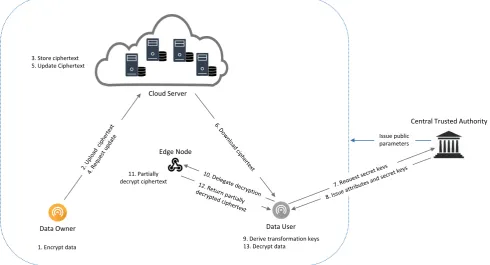
As presented in Figure 2 , CUPS framework considers a cloud service provider that stores data generated by data owners and share them among authorised users. Five different entities are defined as follows:
• The Central Trusted Authority (CTA), known by the Attribute authority, is responsible for generating the global public parameters and issuing users’ secret keys. CTA is considered as a trusted entity in our model.
• The Cloud Server (RC) is a remote cloud server who stores and shares data among authorised users. RC is also responsible of executing the update algorithm to change the access policy involved in the ciphertext, w.r.t. the data owner’s recommendations.
• Edge Node (EN) is responsible for partially decrypting a ciphertext using a transformation key received from the user. Indeed, the user derives a couple of public and private transformation keys from his secret keys. The user shares the public key with EN to allow the partial decryption of ciphertext, while keeping secret the private transformation key to be used for the final local data retrieval.
• The data owner (O) is the data producer. he defines access rights and encrypts data with respect to them before outsourcing to the cloud. In addition, the data owner generates extra ciphertext components used by the update algorithm.
• The data user (U) requests access to outsourced data. he delegates a part of the decryption process to EN. Specifically,Uis responsible for using his secret keys to derive transformation keys used by EN to partially decrypt the ciphertext. Finally,Udecrypts and verifies the partially decrypted ciphertext that is received from EN. A user may be malicious if he tries to access data without authorisation.
2.2
Security Requirements
To design an efficient attribute based encryption scheme supporting efficient access policy update and computation delegation features, the following requirements need to be achieved:
• access policy update –our CUPS scheme should ensure adding new attributes and/or removing attributes from the access policy.
• flexible access control –our proposal should ensure flexible security policies among dynamic groups of users, w.r.t. forward secrecy and backward secrecy.
– backward secrecy means that a new added user to a group is unable to decrypt information created prior to their introduction.
– forward secrecy means that a compromise of the secret key does not affect the secrecy of future encrypted data.
• low computation overhead and storage cost –the proposed algorithms should have low processing complexity and acceptable storage cost to be adapted to resource-constrained devices and distributed environments.
Central Trusted Authority Cloud Server
Edge Node
Data User Data Owner
Issue public parameters
1. Encrypt data 3. Store ciphertext 5. Update Ciphertext
9. Derive transformation keys 13. Decrypt data 11. Partially
[image:6.595.58.549.63.328.2]decrypt ciphertext
FIGURE 2CUPS Architecture
2.3
System Model
The CUPS framework is composed of four phases, i.e., SYS_INIT, STORAGE, UPDATEand RETRIEVAL, defined with respect to seven randomized algorithms detailed hereafter.
The SYS_INITphase is executed once by the CTA. It permits to generate and publish system public parameters toallinvolved entities and derives users’ private keys associated to their attributes. The SYS_INITphase is based on two algorithms, denoted bysetupandkeygen.
During the STORAGEphase, the data owner (O) defines the access policy, i.e., set of attributesS. This phase includes one randomized algorithm,
denoted byencrypt, to encipher the data content w.r.t. the access policyS, while pointing out either the content can be updated or not.
The UPDATEphase is executed by the cloud provider, upon the request of the data owner. It is based on one algorithm, denoted byupdatethat supports both the addition and removal of attributes from access policies.
During the RETRIEVALphase, the user (U) has first to request access to a particular data content, for the cloud provider. Once retrieved from RC, U runs an interactive protocol with the edge node (EN), to recover the original data content. The RETRIEVALphase relies on three different algorithms, referred to astransform,decryptoutanddecrypt. Indeed, U executes thetransformalgorithm to derive atransformationkey, relying on his
private keys that satisfy the encryption set of attributesSassociated to the requested data content. The transformation key is then sent to EN along
with the downloaded ciphertext from RC. This latter performs thedecryptoutalgorithm and generates a partially decrypted data content. Finally,
based on the partially deciphered data file, U is able to finalise the decryption process. Recall that U is able check whether the received partially deciphered content was correctly generated, thanks to the support of theverifiabilityproperty.
The proposed CUPS framework consists of seven randomized algorithms:setup,encrypt,update,keygen,transform,decryptoutanddecrypt,
defined w.r.t. the four procedures, as follows:
• SYS_INITphase:
setup(ξ)→(pp,msk)– thesetupalgorithm is performed by a central trusted authority, known by the attribute authority. It takes as input a security parameterξand outputs the public parametersppand the secret master keymsk.
• STORAGEphase:
encrypt(pp,S,M)→CT– the encryption algorithm is performed by the data owner (O). It takes as inputs the public parameterspp, the set
of the encryption attributesSand the messageM. This algorithm outputs the encrypted message, referred to asCT.
• UPDATEphase:
update(pp,CT,ind,U)→CT0– the update algorithm is executed by a cloud server. It takes as inputs the public parameterspp, a ciphertext
CT that contains the set of enciphering attributesS ={ai}i=1..msuch that|S| =m, an operation indicatorindwhereind=addorind=
revokeand a set of attributesUwithU ∩ S=∅ifind=addorU ⊂ Sifind=revoke. It outputs a new ciphertextCT0for the new encrypting set of attributesS0such asS0=S ∪ UorS0=S \ Uw.r.t.indvalue.
• RETRIEVALphase:
transform(pp,Ψ,sk)→tk– the transform algorithm is performed by U having an access policyΨand their related secret keyssk.transform takes as inputppandsk. It generates the transformation keytk = (tpk,tsk)related tosk, wheretpkandtskare the public and private transformation keys, respectively.
decryptout(pp,sk,CT0)→Y– is executed by EN . To retrieve the partially decrypted messageY, this algorithm takes as inputpp, the
trans-formation keytpk, a set of attributesΨand the updated ciphertextCT0. Note thatCT0can beCTif theupdatealgorithm has not been executed.
decrypt(Y,tsk) → M–Uexecutesdecryptto retrieveM. This algorithm takestskand the partially decrypted ciphertextYas input and outputsM.
2.4
Threat Model
In this section, we explain the considered attack model based on which we discuss the security properties of our proposed scheme.
• An honest but curious cloud server provider (RC). RC is honest as it generates accurate inputs or outputs, during the different steps of the proto-col, and performs calculations properly. However, it is curious to gain extra data from the protoproto-col, such as obtaining credentials/attributes of a data user, retrieving the plaintext, or distinguishing the data owner based on the signcrypted content. As such, we consider the honest but curious attack model against the confidentiality w.r.t adaptive replayable chosen-plaintext attacks (IND-RCPA) (c.f, 2.5.1).
• An unauthorised data user. This attacker could be a data user (or an external entity), whose attributes do not satisfy the access policy asso-ciated with the ciphertext, or could be a revoked user. We also consider a set of colluding users on the attributes, who do not satisfy the access policy associated with the ciphertext and try to merge their attributes to retrieve the plaintext, in this attack model. These unau-thorised users attempt to decrypt the content and access the plaintext. As such, we consider this attack model against the confidentiality requirements w.r.t adaptive replayable chosen-plaintext attacks (IND-RCPA) (c.f, 2.5.1).
• A lazy or malicious edge node (EN). This attacker tries to forge a non-authentic partial decrypted ciphertext, or returns an old previously computed ciphertext. A security scheme against this attacker should satisfy verifiability feature (c.f, 2.5.2).
2.5
Security Model
In this section, we explain the considered attack model based on which we discuss the security properties of our proposed scheme.
2.5.1 Confidentiality
For designing a secure policy-update attribute based encryption scheme, we consider the case of malicious adversaries with respect to the indis-tinguishability property. The indisindis-tinguishability property means that if an adversary has some information about the plaintext, he should not learn about the ciphertext. This security notion requires the computational impossibility to distinguish between two messages chosen by the adversary with a probability greater than a half.
between an adversaryAand a challengerCas follows:
INITIALISATION–Aselects a set of encryption attributesS∗(i.e;S∗corresponds to the set of attributes specified for the encryption) to be used for encrypting the challenge ciphertext, as a set of attributesS∗={a
i}i=1..mwhere|S∗|=m.AsendsS∗toC.
SETUP– the challengerCruns thesetup(ξ)algorithm, sends the public parametersppto the adversaryAand keeps secret the master keymsk. Phase 1 Queries– first,Csets an empty table T. Then,Ais able to request the following queries, for each sessioni:
• Private Key Query– the adversaryAqueries an access policyΨA,i. The challengerCanswers by running thekeygen(pp,msk,ΨA,i)
algorithm and sends the resulting secret keyskA,ito the adversaryA. Note that the access policyΨA,idoes not satisfy the encryption
attribute setS∗.
• Transformation Key Query–Aqueries the secret transformation keystkA,i, w.r.t.ΨA,i.Csearches the entry(ΨA,i,skA,i,tkA,i)in table T.
It returns the transformation key if it exists in table T, otherwiseCexecutes thetransformalgorithm to generatetkA,iand forwards them to
the adversary.
CHALLENGEPHASE– during the challenge phase,Apicks two equal length cleartextsM0∗andM1∗as well as an attribute setU∗with|U∗|=t
U∗∩ S∗ = ∅ifind=addorU∗ ⊂ S∗ifind=revoke. The challengerCchooses a random bitbfrom{0,1}withS0∗
=S∗\ U∗forind=addor
S0∗ =S∗∩ U∗forind=revokeand computes the challenge encrypted messageCT
b∗=encrypt(pp,S∗,Mb∗). It givesCTb∗to the adversary if
U=∅, otherwiseCT0∗
b =update(pp,CTb∗,ind,U∗).
QUERYPHASE2 – in this phase, the adversaryAcan query a polynomially bounded number of queries as in QUERYPHASE1, except thatAcannot
query secret keys related to an access policyΨthat satisfiesS∗.
GUESS–Atries to guess which messageMi, wherei∈ {0,1}corresponds to the enciphered dataCTb∗. Thus,Aoutputs a bitb0ofband wins
the game ifb=b0. The advantage of the adversaryAin the above game is defined as:
AdvA[ExpConf(1ξ)] =|P r[b=b0]−
1 2|
Definition 1. CUPS fulfills the confidentiality property if there is no adversary that can succeed the security gameExpconfwith non-negligible
advantage.
2.5.2 Verifiability
This scheme is said to be verifiable if there is no probabilistic polynomial time (PPT) adversary that can win theExpverifsecurity game with
non-negligible advantage. TheExpverifgame is formally defined, between an adversaryAand a challengerCas follows:
INITIALISATION–Aselects a set of encryption attributesS∗(i.e;S∗corresponds to the set of attributes specified for the encryption) to be used for encrypting the challenge ciphertext, as a set of attributesS∗={a
i}i=1..mwhere|S∗|=m.AsendsS∗toC.
SETUP– the challengerCruns thesetup(ξ)algorithm, sends the public parametersppto the adversaryAand keeps secret the master keymsk. Phase 1 Queries– first,Csets an empty table T. Then,Ais able to request the following queries, for each sessioni:
• Private Key Query– the adversaryAqueries an access policyΨA,i. The challengerCanswers by running thekeygen(pp,msk,ΨA,i)
algorithm and sends the resulting secret keyskA,ito the adversaryA. Note that the access policyΨA,idoes not satisfy the encryption
attribute setS∗.
• Transformation Key Query–Aqueries the secret transformation keystkA,i, w.r.t.ΨA,i.Csearches the entry(ΨA,i,skA,i,tkA,i)in table T.
It returns the transformation key if it exists in table T, otherwiseCexecutes thetransformalgorithm to generatetkA,iand forwards them to
the adversary.
Challenge– during the challenge phase,Achooses a challenge messageM∗and sends it to the challenger. The challenger C encryptsM∗and generates the verification keyV∗underS∗. Then, the generated ciphertextCT∗is returned to the adversary.
QUERYPHASE2 – in this phase, the adversaryAcan query a polynomially bounded number of queries as in QUERYPHASE1, except thatAcannot
query secret keys related to an access policyΨthat satisfiesS∗.
Forge – A generates a random partially decrypted ciphertext Y∗ without executing the Decrypt
out algorithm. A wins the game if
Decrypt(pp,tpk,S∗,Y∗)∈ {/ M∗,⊥}and the verification of the partially decrypted ciphertext is valid.
A’s advantage is noted as:
Definition 2. CUPS fulfills the verifiability property if there is no adversary that can succeed the security gameExpverif with non-negligible
advantage.
3
ATTRIBUTE BASED ENCRYPTION SCHEMES
Attribute-based Encryption (ABE) has been designed to ensure encrypted flexible access control for outsourced data32. Unlike traditional public key encryption schemes, ABE consists in encrypting data for many users. Therefore, decrypting entities’ private keys and encrypted data are labeled with a set of attributes or a structure over attributes. A user is able to decrypt a ciphertext if there is a match between her private key and the ciphertext33. Attribute based encryption schemes are classified into two categories, namely: Key-Policy ABE (KP-ABE) and Ciphertext-Policy ABE (CP-ABE)34. In KP-ABE, ciphertexts are labeled with a set of attributes while users’ private keys are associated with an access policy which can be any monotonic structure. The user is able to decrypt the ciphertext if her access policy is satisfied by the attributes embedded in the ciphertext. KP-ABE schemes have been widely applied to secure data in distributed systems such as Internet of Things, publish and subscribe systems, intelligent transport systems, etc.35.
3.1
Constant size KP-ABE
Although ABE schemes ensure flexible access control to encrypted data, the communication and computation overhead as well as the bandwidth consumption increase exponentially with the number of attributes required in the access policies. To save the storage cost of ciphertext and process-ing overhead of encryption, attribute based encryption schemes with constant ciphertext size have been introduced36,37,38,39. In these schemes, the size of the generated ciphertext does not depend on the number of attributes used on the threshold access policies, which presents an interesting feature mainly for resource-constrained devices. Herranz et al.36have proposed the first constant size threshold ciphertext-policy attribute based encryption scheme. Indeed, the ciphertext size is constant and does not depend on the number of attributes involved in the threshold access poli-cies. Afterwards, several CP-ABE schemes with constant cipheretxt size have been proposed37,40,41. Due to the construction of CP-ABE schemes, monotone access policies based schemes can not be extended to ensure a constant ciphertext size. For instance, these schemes consist in only using threshold or conjunctive access policies which do not provide the desired expressiveness42.
Several expressive KP-ABE schemes with constant ciphertext size have been designed38,39,43. Wang et al.39have proposed a KP-ABE scheme with constant ciphertext size. This scheme relies on a monotone access policy to express the users’ attributes.
Although, these schemes ensure reduced communication and computation costs, they still present a major limitation which is their incapacity of changing access policies of ciphertexts. In dynamic environments, users may be often added or removed, then access policies should be updated to support these changes. Recently, the first CP-ABE with policy update has been proposed by Jiang et al.29,30. The authors introduced a new variant of CP-ABE supporting access policy update that captures the functionalities of attribute addition and revocation from access policies. They provide two CP-ABE schemes supporting AND-gate access policies with constant-size ciphertexts. The first KP-ABE scheme supporting attributes addition is recently introduced by Belguith et al.44. In this scheme, the ciphertext is updated by the cloud provider to add new attributes to the encryption set of attributes. Therefore, new users can be added and are able to decrypt the ciphertext without re-encrypting the ciphertext neither re-issuing existent users secret keys. Later, the same authors have extended their scheme to support attributes’ revocation. The introduced scheme PU-ABE31 support both attributes revocation and addition. Indeed, users can be added or removed from system without relying on a proxy server neither re-issuing secret keys nor re-encryption the ciphertext.
3.2
Decryption Delegation in ABE
One key limitation of ABE schemes is the high decryption cost, which grows with the complexity of the access policies. Indeed, the decryption cost is related to the execution of several pairing functions12,45,46,41,47.
Lai et al.46proposed an outsourced ABE scheme where the user is able to verify the correctness of the partially decrypted ciphertext. This scheme encrypts two different messages, one is the original message and the other is a random message. The ciphertext involves a component ˜
Cgenerated using a combined hash functions over both messages. After receiving the partially decrypted ciphertext, the user decrypts the two messages and compare the result toC˜to verify the correctness of the decryption performed by the server.
An ABE scheme with both outsourced encryption and decryption algorithms was described by Wang et al.50. In this scheme, the data owner is assisted by a proxy server to partially encrypt the data. Then, the data owner uses the partially encrypted data to encrypt the message and generate the ciphertext to be outsourced to the cloud server. On the other side, users outsource the decryption algorithm to a semi-trusted server who partially decrypts the ciphertext. In 2017, Li et al.41proposed a CP-ABE scheme that supports the verifiable outsourced decryption feature. Beyond reducing decryption overhead, this scheme incurs low communication costs as it generates a constant-size ciphertext. Recently, PHOABE, the first multi authority CP-ABE scheme with outsourced decryption has been introduced12. In this scheme, a user may delegate the decryption algorithm to be executed by a semi-trusted server while being able to verify the correctness of the partially decrypted ciphertext.
4
MATHEMATICAL BACKGROUND
In this section, we first introduce the access structure in section 4.1. Then, in section 4.2, we present the bilinear maps. Finally, we introduce some security assumptions.
4.1
Access Policies
Access policies can be represented as a boolean functions of attributes or a Linear Secret Sharing Scheme (LSSS) matrix.
Access Structure –LetP={P1,· · ·,Pn}be a set of parties. A collectionA⊆2{P1,···,Pn}is monotone if∀B,CifB∈AandB⊆CthenC∈A.
An access structure is a collectionAof non-empty subsets of{P1,· · ·,Pn}, such asA⊆2{P1,···,Pn}\∅. Note that any access structure can be con-verted into a boolean function. Boolean functions can be defined as an access tree, where the leaves present the attributes while the intermediate and the root nodes are the logical operators AND(∧)and OR(∨).
Linear Secret Sharing Schemes (LSSS) –LetPbe a set of parties,Abel×nmatrix, andρ:{1,2,· · ·,l} → Pbe a function that maps a row to a party
for labeling. A secret sharing scheme for access structureΨover a set of partiesPis a linear secret sharing scheme (LSSS) inZpand is represented
by(A, ρ)if it consists of two efficient algorithms:
• Share((A, ρ),s): The share algorithm takes as inputs∈ Zpwhich is to be shared. It randomly choosesβ1,· · ·, βn ∈ Zp, and definesβ =
(β1=s, β2,· · ·, βk)T. It outputsM.βas the vectors oflshares. The shareλi=<Ai, βT>belongs to partyρ(i), whereAiis thei−thof A.
• Recon((A, ρ),S): The reconstruction algorithm takes as input an access setS ∈A. LetI={i|ρ(i)∈ S}. It outputs a set of constants{µi}i∈I
such thatP
i∈Iµi·λi=β1=s.
4.2
Bilinear Maps
LetG1,G2andGTbe three multiplicative groups of a finite field having the same orderp. An admissible asymmetric pairing functionˆefromG1×G2
inGThas to be bilinear, non degenerate and efficiently computable.
4.3
The General Diffie-Hellman Exponent Assumption
In our CUPS construction, we make use of the generalisation of the Diffie-Hellman exponent assumption, formally defined by Boneh et al. in51. The authors have introduced a class of assumptions that appeared with the use of pairing-based schemes namely Decisional Diffieâ ˘A¸SHellman assumption (DDH), Bilinear Diffie-Hellman (BDH), and q-Bilinear Diffie Hellman Exponent (qâ´LŠBDHE) assumptions, detailed hereafter.
LetB = (p,G1,G2,G,ˆe : G1 ×G2 → G)be a bilinear map group such thatG1 = G2 = G. Letg0 be a generator ofGand set
g = ˆe(g0,g0) ∈ G. Letsandnbe positive integers andP,Q ∈ Fp[X1,· · ·,Xn]sbe twos-tuples ofn-variate polynomials overFpwhere
stands for(h(p1(x1,· · ·,xn)),· · ·,h(ps(x1,· · ·,xn)))∈Ωsandh(Q(x1,· · ·,xn))stands for(h(q1(x1,· · ·,xn)),· · ·,h(qs(x1,· · ·,xn)))∈ Ωs. Let
f∈Fp[X1,· · ·,Xn], it is said thatfdepends on(P,Q), which we denote byf∈P,Q, when there is a linear decomposition
f= X
1≤i,j≤s
ai,j·pi·pj+
X
1≤i≤s
bi·qI, ai,j, bi∈Zp
LetP,Qbe as above andf∈Fp[X1,· · ·,Xn]. The(P,Q,f)-General Diffie- Hellman Exponent problems are defined as follows.
Definition 1:(P,Q,f)-GDHE. Given a tupleH(x1,· · ·,xn) = (g
P(x1,···,xn)
0 ,g
Q(x1,···,xn))∈
Gs1×Gs, computegf(x1,···,xn).
Definition 2:(P,Q,f)-GDDHE. GivenH(x1,· · ·,xn)∈Gs1×Gs, computegf(x1,···,xn)as above, decide whetherT=gf(x1,···,xn).
We refer to51for a proof that(P,Q,f)-GDHEand(P,Q,f)-GDDHEhave generic security whenf∈/<P,Q>.
4.4
Collision-Resistant Hash Functions
The proposed CUPS scheme relies on the use of collision-resistant hash functions, defined as follows:
Definition 3. Collision-Resistant Hash Function– A hash functionH:{0,1}n−→ {0,1}m, wheren,m∈
N, is said to be collision-resistant if it
satisfies the following two properties:
• length compressing —m>n, typicallym=n/2;
• hard to find collisions —for all non-uniform probabilistic polynomial-time (PPT) algorithmA, there exists a negligible function, such that for
alln∈N,
P r[(x0, x1)← A(1n,H) :x06=x1∧ H(x0) =H(x1)]≤(n)
5
CUPS: SECURE OPPORTUNISTIC CLOUD OF THINGS FRAMEWORK BASED ON ATTRIBUTE BASED
ENCRYPTION SCHEME
In this section, we first give an overview of our proposed constant size CUPS scheme, while presenting the main procedures (subsection 5.1). Then, we detail the scheme construction, in subsection 5.2.
5.1
Overview
CUPS presents a verifiable and outsourced KP-ABE scheme that ensures flexible access control, while supporting policy updates in opportunistic cloud of things environments. CUPS scheme relies on the constant size KP-ABE scheme proposed by Belguith et al.31, which has been extended to fulfill the decryption delegation feature.
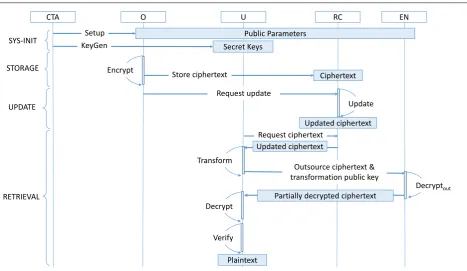
Figure 3 presents a detailed workflow of CUPS, while enhancing the different interactions between involved actors. Based on four phases, Figure 3 shows the chronological sequence of seven randomized algorithms and a set of functions. Recall that some phases such as the SYS_INIT, STORAGEand RETRIEVALare compulsory, while the UPDATEphase is considered as optional. Similarly, some functions are considered as internal features such as theverifyfunction that enables a honest user to find out whether a data content that has been decrypted with the edge node assistance is matching the ciphertext downloaded from remote server or not.
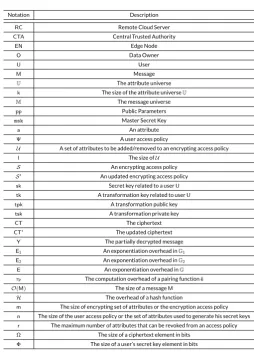
For ease of presentation, the different notations used in this paper are listed in Table 1 .
5.2
Secure Opportunistic Cloud of Things: Proposed Protocol
Our CUPS construction, supporting both attributes’ addition and revocation, is based on four phases including five algorithms defined as follows:
• SYS_INITphase:
CTA O U RC EN Public Parameters
Setup
Secret Keys KeyGen
Ciphertext
Encrypt Store ciphertext
Request ciphertext Request update
Update
Updated ciphertext
Updated ciphertext Transform
Decryptout
Partially decrypted ciphertext Decrypt
Verify
Plaintext
Outsource ciphertext & transformation public key SYS-INIT
STORAGE
UPDATE
[image:12.595.69.537.46.317.2]RETRIEVAL
FIGURE 3 Work Flow of CUPS Protocol
– setup– given the security parameterξ, the attribute authority chooses three cyclic groupsG1,G2andGTof prime orderpand defines
a bilinear pairingˆe:G1×G2 →GTand four collusion resistant hash functionsH0:{0,1}∗ →ZP,H0 :{M} → {0,1}nH0,H1 :
{M} → {0,1}∗,H
2 :{0,1}∗ → {0,1}nH2, whereMis the message universe andnH
0andnH2are the output-sizes ofH0andH2 hash functions, respectively.. It also randomly selects two generatorsg ∈G1andh∈G2as well as a secret random valueα ∈Z∗p.
In addition, the attribute authority setsv=ˆe(g,h),{hαi
}i=1···kand{ui=gα
i
}i=1···kwherek=|U|is the cardinal of the attributes
universesU. Finally, it chooses a cryptographic hash functionH:{0,1}∗⇒Z∗pand outputs the public parametersppas follows:
pp= (G1,G2,GT,v=ˆe(g,h),h,{hα
i
}i=1···k,{ui=gα
i
}i=1···k)
The master secret key is defined asmsk= (g, α).
– keygen– it computes the private key associated to an access structureΨw.r.t. anLSSSscheme(A, ρ)such thatAis the corresponding l×nmatrix. First, thekeygenalgorithm generates shares of1relying on theLSSSschema w.r.t.(A, ρ), as detailed in section 4. Namely, it chooses a column vectorβ = (β1, β2,· · ·, βn)T, whileβ1 = s = 1andβ2,· · ·, βn ∈ Zp. Then for eachi = 1tol, it calculates
λi=<Ai, βT>, and setsskas follows:
sk = {Di}li=0,{(Ki,j)nj=0} l i=0
= {g
λi
α+H(ρ(i)),(hλiαj)n
j=0} l i=0
• STORAGEphase:
– encrypt– letSbe the set of the encryption attributesS = {ai}mi=1andRa random value inGT. This algorithm, executed by the
TABLE 1The different notations used in this paper
Notation Description
RC Remote Cloud Server
CTA Central Trusted Authority
EN Edge Node
O Data Owner
U User
M Message
U The attribute universe
k The size of the attribute universeU
M The message universe
pp Public Parameters
msk Master Secret Key
a An attribute
Ψ A user access policy
U A set of attributes to be added/removed to an encrypting access policy
l The size ofU
S An encrypting access policy
S0 An updated encrypting access policy
sk Secret key related to a userU
tk A transformation key related to userU
tpk A transformation public key
tsk A transformation private key
CT The ciphertext
CT0 The updated ciphertext
Y The partially decrypted message
E1 An exponentiation overhead inG1
E2 An exponentiation overhead inG2
E An exponentiation overhead inG
τP The computation overhead of a pairing functionˆe
O(M) The size of a messageM
H The overhead of a hash function
m The size of encrypting set of attributes or the encryption access policy n The size of the user access policy or the set of attributes used to generate his secret keys
r The maximum number of attributes that can be revoked from an access policy
Ω The size of a ciphertext element in bits
Φ The size of a user’s secret key element in bits
E0=h s·Q
ai∈S(α+H(ai)) E1=Eα0,· · ·,Ek−m=Eαk−m−1
C1=u−1s=,· · ·,Cr+1=u−r+s1
C=R·ˆe(g,h)s
(ii) Afterwards, the algorithm computesR0=H0(R)and a symmetric keyK=H1(R). O encrypts the messageMusing a symmetric
encryption algorithmencKsuch thatCK=encK(K,M). The verification key is computed asV=H2(R0||CK).
• UPDATEphase:
– update– theupdatealgorithm first checks the operation indicatorind. Then, ifind=add, it proceeds as (i), otherwise ifind=revokeit executes (ii):
(i) – given a ciphertextCTencrypted w.r.t. a set of attributesSandU ={a0
1,· · ·,a0t}a new set of attributes whereU ∩ S =∅, the
server has to add elements ofUto the set of encrypting attributesSof the ciphertextCT. To do so, it proceeds as follows: LetF(x)be the polynomial inxdefined asF(x) =Q
ai∈U(x+H(ai)) =ftx
t+f
t−1xt−1+· · ·+f0
Then, the algorithm computesE0
0 =E F(α)
0 =
Qt i=0E
fi
i. The new ciphertext is then defined asCT0= (E00,C1,C)w.r.t.S0, the new set
of encrypting attributes defined asS0=S ∪ U.
(ii) – given a ciphertextCTencrypted w.r.t. a set of attributesSand a revocation attribute setU={a01,· · ·,a0t} ⊆ Swheret≤r, the
LetF(x)be the polynomial inxasF(x) = 1
Q
ai∈UH(ai) Q
ai∈U(x+H(ai)) =ftx
t+f
t−1xt−1+· · ·+f0
Then, the algorithm computesCT0as follows:
E00=E
1
Q
ai∈U H(ai)
0 =h s·Q
ai∈S\U(α+H(ai))F(α) C0
1=
Qt+1 t=1C
fi−1
i =g
−αsPt+1 i=1α
i−1f
i−1=u−sF(α)
1
C0=Cˆe(Qt i=1C
−fi
i ,h) =Rˆe(g,h) sPt
i=0fiαi =RvsF(α)
• RETRIEVALphase:
During the RETRIEVALphase, U has first to request access to a particular data content, for the cloud provider. Once retrieved from RC, U runs an interactive protocol with the edge node (EN), to recover the original data content. The RETRIEVALphase relies on the following three algorithms:
– transform–Uexecutes this algorithm to generate the transformation keys. He first picks a random valuez∈ Z∗N, then derives the
transformation public and private keystk= (tpk,tsk), wheretpkandtskare computed as follows:
tpk=sk1z = ({Di}l
i=0)
1
z,({(Ki,j)n
j=0} l i=0)
1 z
tsk=z
Therefore,tpkandtskare defined as:
tpk=sk1z =g
λi z(α+H(ρ(i))),(h
λiαj z )n
j=0} l i=0
tsk=z
Finally, U outsources the ciphertext as downloaded from RC along with the transformation public keytpkto the EN.
– decryptout– the cipherextCT0is encrypted under the set of attributesS. EN which received the transformation public keytpkfirst
setsI=i|ρ(i)∈ S0, and calculates the reconstruction of constantsµ
i∈I=Recon((A, ρ),S). The decryption key corresponding to the
LSSSscheme w.r.t.(A, ρ)is parsed astpk={(Di)
1 z,((Ki,j)n
j=0} l i=0)
1
z. Then, EN computes the polynomial on the variableαwith degree m+t−1as follows:
Pi,A(α)= λi
α(
Y
j=1,j6=i
(α+H(aj))−
Y
j=1,j6=i
H(aj))) EN calculateshPi
,A(α)
z according to the transformation public key component((Ki,j)n
j=0)
1
z. Afterwards, EN computesYiwhich can be retrieved based on two cases w.r.t. theindoperator value, such that:
* Case 1:if attributes have been added to the access policy: Yi = (ˆe(C1,h
Pi,A(α)
z )·ˆe((Di) 1 z,C2))
1
Q
j=1,j6=iH(ai))
= ˆe(g,h) sλi
z
* Case 2:if attributes have been revoked from the access policy: Yi = (ˆe(C01,h
Pi,A(α)
z )·e((Di) 1 z,E00))
1
Q
j=1,j6=iH(ai))
= ˆe(g,h) sF(α)λi
Z
Finally, EN computesY=Q
i∈IY
µi
i =ˆe(g,h)
s
zand returns it to the userU.
– decrypt– This algorithm includes two steps. The first step, denoted by (i), enables U to retrieve the plaintext, while the second step (ii) permits to verify the correctness of the partially decrypted message received from EN:
* Case 1:in the case of adding attributes to the access policy:
R = C
(Y)tsk
= R·(ˆe(g,h)
s
(ˆe(g,h)sz)z = R·(ˆe(g,h)
s
ˆ e(g,h)s
* Case 2:in the case of revoking attributes from the access policy:
R = C
0
(Y)tsk
= R·(ˆe(g,h)
sF(α) (ˆe(g,h)
sF(α)
z )z = R·(ˆe(g,h)
sF(α)
ˆ
e(g,h)sF(α)
Note that if no changes have been made to the access policy and the corresponding ciphertext, the decryption process followsCase 1.
(ii) To retrieve the messageM,Ufirst computesR0 = H(R). Then, he computesH2(R0||CK)and compares it againstV. IfV 6=
H2(M0||CK), thendecryptreturns⊥. Otherwise, he computes the symmetric keyK = H1(R), then decrypts the messageM =
decK(K,CK).
6
SECURITY ANALYSIS
The security of CUPS relies on the following Theorems.
Theorem 1. Correctness.The correctness property requires that for all security parameterξ, all attribute universe descriptionsU, all(pp,msk)∈
setup(ξ), all(S,U)⊆U(i.e;Uis the attribute universe), allsk ∈ keygen(pp,msk,Ψ), allM∈ M(i.e;Mis the message universe), allΨ∈ G(Gis
the access policy space), allCT∈encrypt(pp,S,M), and allCT0 ∈ update(pp,CT,ind,U), all transformation keystk∈ transform(pp,sk,Ψ), all partially decyrpted messagesY ∈ decryptout(pp,tpk,CT0), if the user has correctly obtained the secret keyskrelated to theΨrequired access
policyS0for deciphering the encrypted message, the
derypt(tsk,Y)outputsM.
Theorem 2. Confidentiality.The proposed CUPS scheme is indistinguishable against replayable chosen ciphertext attacks, w.r.t. theGDHE assumption.
Theorem 3. VerifiabilityIfH0andH2are collision-resistant hash functions, then the proposed CUPS scheme is verifiable against lazy and malicious
edge nodes.
Here-after, we start by proving the correctness of the proposed scheme. Afterwards, we introduce the security proofs related to security games presented in Section 2.5.
6.1
Correctness
In this subsection, we show the correctness of CUPS w.r.t. Theorem 1, while detailing the update process in subsection 6.1.1 and the decryption algorithms in subsection 6.1.2.
6.1.1 Update Correctness
A user U who possesses a set of attributes expressed with respect to an access structureΨ, satisfyingS0first setsP
i,A(α) =
λi
α(
Q
j=1,j6=i(α+
H(aj))−
Q
j=1,j6=iH(aj))). Then, U uses his secret keys to computeYiwith respect to the two following cases:
• Case 1:ifind=addandS0=S ∪ U, thenY
Yi = [ˆe(C01,h
Pi,A(α))·ˆe(D
i,E00)]
1
Q
j=1,j6=iH(aj))
= [ˆe(g−αs,hPi,A(α))·ˆe(g λi
α+H(ρ(i)),EF(α)
0 )]
1
Q
j=1,j6=iH(aj))
= [ˆe(g−αs,hPi,A(α))·ˆe(g λi
α+H(ρ(i)),hs· Q
aj∈A(α+H(aj))F(α) )]
1
Q
j=1,j6=iH(aj))
= [ˆe(g,h)−αsPi,A(α)·ˆe(g,h)sλiF(α)·Qj=1,j6=i(α+H(aj)))] 1
Q
j=1,j6=iH(aj))
= [ˆe(g,h)−sλi(Qj=1,j6=i(α+H(aj))ˆe(g,h)sλiQj=1,j6=iH(aj)·ˆe(g,h)sλiF(α)·Qj=1,j=6 i(α+H(aj))] 1
Q
j=1,j6=iH(aj)
= [ˆe(g,h)sλiQj=1,j6=iH(aj)] 1
Q
j=1,j6=iH(aj)
=ˆe(g,h)sλi Afterwards, the user U computes:
Y = Y
i∈I
Yµi
i
= Y
i∈I
ˆ
e(g,h)sλiµi = ˆe(g,h)sP
i∈Iλiµi = ˆe(g,h)s
Recall that the constantsmui∈Iare the reconstruction of theLSSSmatrixµi∈I=Recon((A, ρ),A). Therefore, the user retrievesYusing the
following equation
< λ, µ >=X
i∈I
λiµi=
X
i∈I
β1= X
i∈I
1 = 1
• Case 2:ifind=revokeandS0=S \ U,Y
iis computed as follows:
Yi = [ˆe(C01,h
Pi,A(α))·ˆe(D
i,E00)]
1
Q
j=1,j6=iH(aj))
= [ˆe(u−1sF(α),h
Pi,A(α))·ˆe(g λi
α+H(ρ(j)),hs· Q
aj∈A\U(α+H(aj))F(α))] 1
Q
j=1,j6=iH(aj))
= [ˆe(g,h)−sλiF(α)(
Q
j=1,j6=i(α+H(ai))−
Q
j=1,j6=iH(ai)))·ˆe(g,h)sλi·
Q
j=1,j6=i(α+H(aj))F(α))] 1
Q
j=1,j6=iH(aj))
= [ˆe(g,h)−sλiF(α)(
Q
j=1,j6=i(α+H(ai))·ˆe(g,h)sλiF(α)
Q
j=1,j6=iH(ai)))·ˆe(g,h)sλiF(α)·
Q
j=1,j6=i(α+H(aj)))] 1
Q
j=1,j6=iH(aj))
= ˆe(g,h)sλiF(α))
Q
j=1,j6=iH(ai) Q
j=1,j6=iH(aj)
= ˆe(g,h)sF(α)λi Afterwards, the user computes:
Y = Y
i∈I
Yµi
i
= Y
i∈I
ˆ
e(g,h)sF(α)λiµi = ˆe(g,h)sF(α)Pi∈Iλiµi = ˆe(g,h)sF(α)
Recall that the constantsmui∈Iare the reconstruction of theLSSSmatrixµi∈I=Recon((A, ρ),A). Therefore, the user retrievesYusing the
following equation
< λ, µ >=X
i∈I
λiµi=
X
i∈I
β1= X
i∈I
1 = 1
6.1.2 Decryption Correctness
We assume a data user U having an access policyΨwhich satisfies the encryption set of attributesS. In the following, we prove the
This algorithm includes two steps. The first step, denoted by (i), enables U to retrieve the plaintext, while the second step (ii) permits to verify the correctness of the partially decrypted message received from EN:
(i) Based on the partially decrypted ciphertextY, U performs only one exponentiation without calculating any pairing functions to recover the random message.Rcan be retrieved based on two cases w.r.t. theindoperator value, such that:
– Case 1:in the case of adding attributes to the access policy:
R = C
(Y)tsk
= R·(ˆe(g,h)
s
(ˆe(g,h)sz)z = R·(ˆe(g,h)
s
ˆ e(g,h)s
– Case 2:in the case of revoking attributes from the access policy:
R = C
0
(Y)tsk
= R·(ˆe(g,h)
sF(α) (ˆe(g,h)
sF(α)
z )z = R·(ˆe(g,h)
sF(α)
ˆ
e(g,h)sF(α)
Note that if no changes have been made to the access policy and the corresponding ciphertext, the decryption process followsCase 1.
(ii) To verify that the retrieved messageMis correct,Ufirst computesM0 = H(M). Then, he computesH2(M0||CK)and compares it
againstV. IfV6=H2(M0||CK), thendecryptreturns⊥. Otherwise, EN has executeddecryptcorrectly and the retrieved plaintext is verified.
Therefore, he computes the symmetric keyK=H1(R), then decrypts the messageM=decK(K,CK).
6.2
Confidentiality
In the following proof, we prove that our CUPS scheme is CPA-Secure against non-adaptive Chosen Ciphertext Attacks with respect to Theorem 4.
Theorem 4. For any adversaryA, against CPA-Secure against non-adaptive chosen ciphertext, our CUPS scheme is indistinguishable according to
Definition 2.5 with respect to the hardness of the General Diffie-Hellman Exponent (GDHE) assumption ( Definition 4.3)
Proof. To decrypt a ciphertext CT’ associated with an updated access policyS0,Amust recoverˆe(g,h)s, in case of attributes’ addition and
ˆ e(g,h)sPt
i=0fiαi, in case of attributes’ revocation, where the secret sharing keysis embedded in the ciphertext.
To prove that our scheme is secure against selective non-adaptive chosen ciphertext attacks, we first consider thatAis running theExpconf
experiment with an entityB. This latter is running theExpB. Wang et al. security game39, withC. The objective of this proof is to show that the advantage ofAto win theGS−CPA(1κ)security game is equivalent to the advantage ofExp
Bto win the Wang et al. security game39. Hereafter,A andBproceed as follows:
INITIALISATION– in this phase, the adversaryAgives the algorithmCa challenge set of attributesS∗.
SETUP– the challengerCruns thesetup(ξ)algorithm, sends the public parameterspp= (G1,G2,GT,v = ˆe(g,h),gα,h,hα,· · ·,hα
k
,{ui =
gαi
}i=1···k) toBand keeps secretmsk. Consequently,BsendspptoA.
QUERYPHASE1 –Bsets an empty tableTand queries an access policyΨA,i, for each sessioni. That is,BusesCto derive and send the queried
LSSSschema w.r.t.(A, ρ). It chooses a column vectorβ = (β1, β2,· · ·, βn)T, whileβ1 =s =1andβ2,· · ·, βn∈ Zp. Then for eachi =1tol, it
calculatesλi=<Ai, βT>, and setsskasskA,i={g
λi
α+H(ρ(i)),(hλiαj)n
j=0} l i=0.
Note that the access policyΨA,idoes not satisfy the encryption attribute setS∗. The private keysskA,i = {g
λi
α+H(ρ(i)),(hλiαj)n
j=0} l i=0are
returned toB. Subsequently,Bsets a new entry with the private key and returnsskA,i={g
λi
α+H(ρ(i)),(hλiαj)n
j=0} l i=0toA.
CHALLENGEPHASE– during the challenge phase,Apicks two equal length cleartextsM0∗andM1∗as well as an attribute setU∗with|U∗|=t U∗∩ S∗ = ∅ifind=addorU∗ ⊂ S∗ifind=revoke. Subsequently,BselectsSBsuch thatSB ⊆ S0∗, such asS
0∗
=S∗\ U∗forind=addor
S0∗=S∗∩ U∗forind=revoke.
Afterwards,Bsends the access structureSBand the two equal length messagesM0andM1, defined byAto the challengerC. The challengerC
chooses a random bitbfrom{0,1}withS0
B =SB\ U∗forind=addorS0B=SB∩ U∗forind=revokeand computes the challenge encrypted messageCTb∗=encrypt(pp,S0B,Mb∗).
E0=h s·Q
ai∈S0 B(α+H(ai)) E1=Eα0,· · ·,Ep−m=Ep−m−1
C1=u−1 s=,· · ·,Cr+1=u−r+s1
C=R·vs=R·ˆe(g,h)s
The challengerCgivesCTb∗to the adversary ifU=∅, otherwiseCT0∗b =update(pp,CTb∗,ind,U∗).
QUERYPHASE2 – in this phase, the adversaryAcan query a polynomially bounded number of queries as in QUERYPHASE1, except thatA
cannot query secret keys related to a set of attributesS∗.
Hereafter, two cases are considered w.r.t. theindoperator value, randomly selected byCin order to encrypt the challenging message such that:
• Case 1– the first case corresponds to attributes’ addition, such thatCsetsS0
B = SB∪ U∗and outputs an encrypted messageCT0b, as
defined in section 5.2. In this case, we first show that how a challenge ciphertext should be produced. In fact, given a ciphertextCTencrypted w.r.t. a set of attributesSBandU∗ = {a01,· · ·,a0t}a new set of attributes whereU ∩ S = ∅,Chas to add elements ofU∗to the set of
encrypting attributesSBof the ciphertextCT0b. To do so, it proceeds as follows:
LetF(x)be the polynomial inxdefined asF(x) =Q
ai∈U∗(x+H(a
0
i)) =ftxt+ft−1xt−1+· · ·+f0Then, the algorithm computesE0∗0 =
E∗F0(α)=
Qt i=0E
fi
i. The new ciphertext is then defined asCT
0
b = (E0∗0,C1,C)w.r.t.S0, the new set of encrypting attributes defined as
S0
B=SB∪ U∗.
• Case 2– the second case corresponds to attributes’ revocation, such thatCdefinesS0
B = SB\ U∗and outputs an encrypted mes-sageCT0
b, as detailed in section 5.2. That is, given a ciphertextCTencrypted w.r.t. a set of attributesS
0
Band a revocation attribute setU∗ = {a0
1,· · ·,a0t} ⊆ S0Bwheret ≤ r, the server updates the ciphertextCT0bas follows: LetF(x)be the polynomial inxas
F(x) = 1
Q
a0
i∈U ∗H(a
0
i) Q
a0
i∈U (x+H(a0
i)) =ftx t+f
t−1xt−1+· · ·+f0. Similarly, the new ciphertext is then defined asCT0b= (E0∗0,C0∗1,C0∗M)
w.r.t.S0, the new set of encrypting attributes defined asS0
B=SB\ U∗.
Without loss of generality, the distribution of the received challenge ciphertext does not depend on the attributes’ addition and revocation. More precisely, the distribution of the challenge enciphered message is quite similar in both cases. Thus, the resistance of CUPS scheme against CPA, follows Wang et al. construction39construction, w.r.t. toB, that is proven secure under the GDDHE assumption. Thus, the view ofBis indis-tinguishable from the view ofA, considering a randomly selected enciphered message w.r.t.S0
Breferring to the updated access policy.
As such, we prove that our CUPS construction is secure against selective non-adaptive chosen ciphertexts attacks in the standard model, under the GDDHE assumption, with respect toExpconfsecurity experiment.
6.3
Verifiability
Proof. TheExpverifsecurity games, presented in 2.5.2 captures the behaviour of lazyor a malicious edge node EN. That is, the goal of an adversaryA
is to forge a compromised partially decrypted ciphertext, that can be correctly verified by the challengerC, by runningdecryptalgorithm.
To this end, we define an adversaryArunning theExpverifsecurity game with an entityB. This entityBis also running a collusion attack against
hash functionHwith a challengerC. The aim of this proof is to demonstrate that the advantage of the adversaryAto succeed in theExpverifgame
is smaller than the advantage of the entityBto win the collusion game. In the following, we prove that CUPS is verifiable against lazy and malicious
Theorem 5. IfH2andH0are two collision-resistant hash functions, then, CUPS is verifiable against lazy EN.
Bexecutes thesetupalgorithm to generate the public parameters except the hash functionsH2andH0. Then,Bexecutes bothQueries phase 1
andQueries phase 2to issue the secret and transformation keys.
During the challenge phase,Aforwards a challenge messageM∗toB.Bchooses a random messageR∗ ∈
GTand encryptsR∗under the
challenge accessS∗. Then,BdefinesR∗
0 =H∗0(R∗)and computes a symmetric keyK∗=H∗1(R∗).Bexecures the encryption of the messageM∗
using a symmetric encryption algorithmencKsuch asCK∗=encK(K∗,M∗).Cdefines the verification keyV∗=H∗2(R0∗||C∗K).Bsends the computed
ciphertext toAas a challenge ciphertext as well as the verification keyV∗.
IfAbreaks the verifiability game,Bwill recover a messageM∈ {/ M∗,⊥}relying on the partially decryption algorithmdecrypt
out.
Notice that the decryption algorithm outputs⊥ifH∗
2(R∗0||C∗K)6=V
∗whereR∗
0 =H∗0(R∗)andR∗=decK(K,CK). In the following we consider
the two cases:
• Case 1:SinceBknows(R∗
0,C∗K), if(R0,CK)6= (R∗0,C∗K)is returned as a result, thenBobtains a collision of the hash functionH
∗
2.
• Case 2:If(R0,CK) = (R∗0,C∗K), whileR∗andRare not equal (R∗6=R). Then,Bbreaks the collision resistance condition ofH∗0asH∗0(R) =
R0=R∗0 =H∗0(R∗).
Consequently, using anabsurdumreasoning, since the hash functionsH2andH0are two collision resistant functions, CUPS is verifiable.
7
PERFORMANCES ANALYSIS
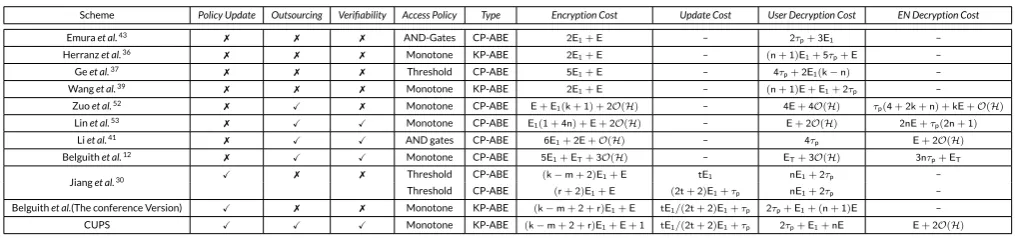
[image:19.595.44.552.415.534.2]In this section, we present the computation and the storage complexities of our proposed CUPS scheme. In our analysis, we are interested in the computations performed to execute theencrypt,updateand thedecryptalgorithms as presented in Table 2 . Furthermore, the size of the generated encrypted message, the size of the secret keys and the communications costs between the system entities are introduced in Table 3 .
TABLE 2 Features and Functionality Comparison of Attribute Based Encryption Schemes
Scheme Policy Update Outsourcing Verifiability Access Policy Type Encryption Cost Update Cost User Decryption Cost EN Decryption Cost
Emuraet al.43 7 7 7 AND-Gates CP-ABE 2E1+E – 2τp+3E1 –
Herranzet al.36 7 7 7 Monotone KP-ABE 2E1+E – (n+1)E1+5τp+E –
Geet al.37 7 7 7 Threshold CP-ABE 5E1+E – 4τp+2E1(k−n) –
Wanget al.39 7 7 7 Monotone KP-ABE 2E1+E – (n+1)E+E1+2τp –
Zuoet al.52 7 X 7 Monotone CP-ABE E+E1(k+1) +2O(H) – 4E+4O(H) τp(4+2k+n) +kE+O(H) Linet al.53 7 X X Monotone CP-ABE E1(1+4n) +E+2O(H) – E+2O(H) 2nE+τp(2n+1)
Liet al.41 7 X X AND gates CP-ABE 6E1+2E+O(H) – 4τp E+2O(H)
Belguithet al.12 7 X X Monotone CP-ABE 5E1+ET+3O(H) – ET+3O(H) 3nτp+ET
Jianget al.30 X 7 7 Threshold CP-ABE (k−m+2)E1+E tE1 nE1+2τp –
Threshold CP-ABE (r+2)E1+E (2t+2)E1+τp nE1+2τp – Belguithet al.(The conference Version) X 7 7 Monotone KP-ABE (k−m+2+r)E1+E tE1/(2t+2)E1+τp 2τp+E1+ (n+1)E –
CUPS X X X Monotone KP-ABE (k−m+2+r)E1+E+1 tE1/(2t+2)E1+τp 2τp+E1+nE E+2O(H)
7.1
Storage and Communication Complexities
Emura et al.43introduced a KP-ABE scheme requiring only 2 keys per user independent of the users’ attributes. In addition, this scheme generates a ciphertext composed only of 3 elements.
Herranz et al.36have proposed the first CP-ABE scheme generating a ciphertext whose size does not depend on the number of attributes used in the threshold access policy. In this scheme, the user needsk+nsecret keys’ wherekis the cardinal of the attributes universes andnis the number of the users’ attributes.
In37, the authors proposes a CP-ABE scheme with constant ciphertext size. However, this schemes requires the use of3k−2+nsecret keys. Similarly, the authors in39proposed a KP-ABE scheme which produces only3elements in the ciphertext. The users’ secret keys are equal tok(n+1). This size of secret keys is due to the use ofLSSSmonotone access policies which makes the scheme more expressive than the aforementioned