Solution of Multi-Objective Interval Solid
Transportation Problems using Expected Value
A.Nagarajan, K.Jeyaraman,S.Devi
Professor,Department of Mathematics, PSNA College of Engg. and Tech., Dindigul- 624 622., Tamil Nadu, India. Dean,Science and Humanities, PSNA College of Engg. and Tech., Dindigul- 624 622., Tamil Nadu, India
Assistant Professor,Department of Mathematics, PSNA College of Engg. and Tech., Dindigul- 624 622., Tamil Nadu, India
Abstract: In this paper, a solution procedure has been given for the Multi-Objective Interval Solid Transportation Problem under stochastic environment where the cost coefficients of the objective functions, source availability, destination demand and conveyance capacities have been taken as stochastic intervals. The problem has been transformed into a classical multi-objective transportation problem where the multiple objective functions are minimized by using fuzzy programming approach. Numerical examples are provided to illustrate the approach.
Keywords: Solid transportation problem; Multi-objective interval solid transportation problem; stochastic programming; Fuzzy programming
1. Introduction
As a generalization of traditional TP, the Solid Transportation Problem (STP) was stated by Shell [1] in 1955, which, he considered the three item properties in the constraint set instead of two items namely source and destination. He also suggested the situations where the STP would arise, and four cases of STP were discussed according to the data given on the item properties and developed its solution procedure. Basu et al. [2] developed an algorithm for finding the optimum solution for the solid fixed charge linear transportation problem. Although STP was forgotten for long time, because of existing advanced solution methodologies, recently it is receiving the attention of many researchers of this field. Models and algorithms have been developed by many authors [3-9].
In literature, it was found that various effective algorithms were developed for solving transportation problems with the assumption that the coefficients of the objective function, source availability, destination demand and conveyance capacities are specified in a crisp manner. However, these conditions may not be satisfied always. Since in the present situation, the unit transportation costs are rarely constant. To deal the problems with ambiguous coefficients in mathematical programming, inexact and interval programming techniques have been developed by many authors [10- 13].
The STP in uncertain environment becomes important branch of optimization and a lot of models and algorithms have been presented for different problems by different authors [14, 15, 16, 17]. A.Nagarajan and K.Jeyaraman developed many models and methods for solving multi_ objective
environment[20,26,27,28,29,30],solution procedures for solid fixed cost bi-criterion indefinite quadratic transportation problem under stochastic environment [20]. S.K.Das et al. [21], developed the theory and methodology for multi-objective transportation problem with interval cost, source and destination parameters. Expected value of fuzzy variable and fuzzy expected value models presented by Baoding Liu and Yian-Kui Liu [22].
The fuzzy set theory concept was first introduced by Zadeh [23]. Linear programming problems with several objective functions was solved by using fuzzy membership functions by Zimmerman [24] and he showed that the results obtained from fuzzy are always efficient. A special type of non-linear membership function was used for the vector maximum linear programming problem [25]. In this paper, the idea of stochastic environment has been employed for MOISTP a method has been proposed to solve the MOISTP. Using expectation of random variables, we have constructed an equivalent crisp model to the given MOISTP. To obtain the solution of this equivalent problem, we have used fuzzy programming approach. In order to illustrate the proposed method, numerical examples are provided.
numerical example is given in section 8 along with the solution to illustrate the approach.
2.Multi-objective Interval Solid
TransportationProblem (MOISTP)
The MOISTP is a generalization of the multi-objective solid transportation problem in which input data are expressed as stochastic variables as well as stochastic intervals instead of point values. These types of problems arise only when uncertainty occurs in data. The decision makers consider it as more convenient to express it as intervals which can be stated as follows.
Problem-I :
Minimize
Zp =
m i 1
n j 1
l k 1
[cLijkp , cRijkp ]xijk ,
p = 1, 2, 3,..., P (1) subject to
n j 1
l k 1
xijk = [aLi, aRi] ,
i = 1, 2, 3,…, m. (2)
m i 1
l k 1
xijk = [bLj, bRj] ,
j =1, 2, 3, ..., n. (3)
m i 1
n j 1
xijk = [eLk, eRk ],
k = 1, 2, 3, ... ,l. (4)
with
m i 1
aLi≥
n j 1
bLj,
m i 1
aRi≥
n j 1
bRj,
l k 1
eLk ≥
n j 1
bLj,
l k 1
eRk ≥
n j 1
bRj (non-balanced condition). (5)
Where [cLijkp , cRijkp ] for p = 1, 2, 3,..., P are intervals representing the uncertain cost for the transportation problem; it can represent delivery time, quantity of goods delivered, under used capacity, etc. The source
parameter lies between left limit aLi and right limit a
Ri, similarly, destination parameter lies between left
limit bLj and right limit bRj and conveyance parameter lies between left limit eLk and right limit e
Rk.
Definition 2.1 [18, 19]
Let
(., /, +, - ) be a binary operation on the set of real numbers. If A and B are closed intervals, thenA
B = { a
b: a
A, b
B } (6) defines a binary operation on the set of closedintervals. In the case of division, it is assumed that 0
B. The interval operations used in this research paper are as given below.A + B = [aL, aR] + [bL, bR ]
=[aL+bL,aR+bR], (7) A + B =
aC, aW
+
bC, bW
=
aC+bC, aW+bW
, (8) kA = k[aL, aR]= [kaL, kaR] for k ≥ 0, (9) kA = k[aL, aR]
= k[aR, kaL] for k < 0, (10) KA = k
aC,aW
=
kaC,k
aW
, (11)where ‘k’ is real number.
3. Order relation between Intervals
The order relations which represent the decision makers’ preference between interval costs are defined for the minimization problems. Let the uncertain costs from two alternatives be represented by intervals ‘A’ and ‘B’ respectively. It is assumed that the cost of each alternative is known only to lie in the corresponding interval.
Definition 3.1 The order relation ≤LR between A = [aL, aR] and B =[bL, bR ] is defined as
A ≤LRB iff a L ≤ bL and aR ≤ bR, A <LR B
iff A ≤LRB and A
B.(12) This order relation ≤LR represents the decisionmakers’ preference for the alternative with lower minimum cost and maximum cost, i.e., if A ≤LRB, then A is preferred to B.
Definition 3.2 The order relation ≤CW between A =
aC, aW
andB =
bC, bW
is defined asA ≤CWB iff aC≤ bC and aW ≤ bW A<CW B iff
A ≤CWB and A
B.(13) This order relation ≤CW represents the decisionexpected cost and less uncertainty, i.e., if A ≤CWB,
then A is preferred to B.
4. Formulation of the crisp objective function
In this section, the formulation of original interval objective function has been made as a crisp one.
Definition 4.1 xijk
0
S is an optimal solution of the problem-I iff there is no other solution xijk
Swhich satisfies Z(x) <LRZ(x 0)or Z(x) <CWZ(x 0).
Theorem 4.1 It can be proved that A ≤RC B iff A ≤LR B or A ≤CW B,A <RC B iff A <LRB or A <CW B, (14) where the order relation ≤RC is defined as
A ≤RC B iff aR ≤ bRand aC≤ bC, A <RCB iff A ≤RC B and A
B.Using the theorem 4.1, Definition 4.1 is simplified as follows.
Definition 4.2 x0
S is an optimal solution of the Problem-I iff there is no other solution x
S which satisfiesZ(x) <RC Z(x 0).The right limit
ZPR( x) of the interval objective function in problem-I is derived from the equations (8) and (11) as
ZRp(x) =
m i 1
n j 1
l k 1
cCijkp xijk +
m i 1
n j 1
l k 1
cWijkp
ijk
x
(15)where cCijkp is the centre and cWijkp is the half width of the coefficient of xijk in Z
p
.
In the case when xijk ≥ 0, i = 1, 2, 3,…, m, j = 1, 2, 3,
..., n, k = 1, 2, 3, …, l, ZPR( x) is modified as:
Z Rp (x) =
m i 1
n j 1
l k 1
cCijkp xijk +
m i 1
n j 1
l k 1
cWijkp xijk. (16) The
centre of the objective function ZCp(x) for the Problem–I can be defined as
ZCp(x) =
m i 1
n j 1
l k 1
cCijkp xijk. (17)
Definition 4.2 is also obtained as the Pareto optimal solution of the two multi-objective problem as:
Minimize { ZRp, ZCp}, p = 1, 2, 3,…,P,
subject to the constraints (2) – (5) respectively
where ZpR and ZCp are as stated as in equations (16) and (17).
5. Formulation of the crisp constraint
By using the theory of interval arithmetic [18,19], the Problem-I is converted into its equivalent form as follows .
Problem -II:
Minimize
Zp =
m i 1
n j 1
l k 1
[cLijkp , cRijkp ]xijk ,
p= 1, 2, 3,..., P (18) subject to
n j 1
l k 1
xijk
aLi,i = 1, 2, 3,…,m. (19)
n j 1
l k 1
xijk
aRi,i = 1, 2, 3,…,m. (20)
m i 1
l k 1
xijk
bLj,j = 1, 2, 3, ..., n. (21)
m i 1
l k 1
xijk
bRj,j = 1, 2, 3, ..., n. (22)
m i 1
n j 1
xijk
eLk,k = 1,2,3,…, l. (23)
m i 1
n j 1
xijk
eRk,k=1,2,3,…,l. (24)
xijk≥0 ,for all i, j, k.
m i 1
aLi≥
n j 1
bLj
m i 1
aRi≥
n j 1
bRj,
x
ijk *
eLk ≥
n j 1
bLj,
l k 1
eRk≥
n j 1
6. Expected value of stochastic variable
In this section, the expected value of a stochastic variable is defined.
Definition 6.1 Let ‘
’ be a random variable whose expected value is defined byE[
] =
0
Pr {
≥ r }dr -
0
Pr{
≤ r }drprovided that at least one of the two integrals is finite where r
[14].Let ‘
’ and ‘
’ be random variables with finite expected values. For any values of ‘a’ and’ b’ it has been proved thatE[a
+ b
] = aE[
] + bE[
]. i.e, the expected value operator has the linearity property.Theorem 6.1 Let ‘
’ be a random variable whoseprobability density function ‘
’ exists. If theLebesgue integral
x
(x)dx is finite, then it isarrived as E[
] =
x
(x)dx.6.1 Expected value model for MOISTP
The expected value model (EVM) which optimizes some expected objective function subjected to some expected constraints, for example ,minimizing the expected time, minimizing expected cost, maximizing expected profit etc. Normally if we want to find a decision with maximum expected return subjected to some expected constraints then we have the following EVM,
max E [f(xijk ,
)] subject toE [gj(xijk ,
)] ≤ 0 , j = 1,2,3,…, pWhere . xijk is a desicion vector ,
is a stochasticvector, f(xijk ,
) is the return function, gj(xijk,
) arestochastic constrained functions for j = 1,2,3,…, q.
Definition 6.2
A solution xijk is feasible if and only if gl(xijk ,
) ≤ 0, j = 1,2,3,…, p. A fesiable solution is an optimal solution to EVM if E [f(𝑥𝑖𝑗𝑘∗ ,
)] ≥ E [f(xijk ,
)]for any feasible solution xijk.
In n multiple objective problems we employ the following expected value multiobjective programming(EVMOP).
max E [f1(xijk ,
),] , E [f2(xijk ,
),]E [f3(xijk ,
),] ….E [ft(xijk ,
),] subject toE [gl(xijk ,
)] ≤ 0 , l = 1,2,3,…, q wherefr(x ,
) are return functions forr = 1,2,3,….t.
Definition 6.3
A feasible solution 𝑥𝑖𝑗𝑘∗ is said to be pareto optimal solution to EVOMP if there is no feasible solution xijk
such that
E [fi(xijk ,
),] ≥ E [f1(𝑥𝑖𝑗𝑘∗ ,
),]r = 1,2,3,….t
and E [fl(xijk ,
),] > E [fi(𝑥𝑖𝑗𝑘∗ ,
),] for at least oneindex l.The expected value model for the problem II defined in section 5 takes the form
Problem - III: Minimize
Zp=
m i 1
n j 1
l k 1
[cLijkp , cRijkp ]xijk
p = 1, 2, 3,…,P, subject to:
E[
n j 1
l k 1
xijk - aLi] ≥0, i =1,2,3,…, m.
E[
n j 1
l k 1
xijk - aRi ] ≤ 0, i =1,2,3,…, m.
E[
m i 1
l k 1
xijk – bLj] ≥ 0, j =1,2,3, ..., n. E[
m i 1
l k 1
xijk – bRj] ≤ 0, j =1,2,3,..., n. E[
m i 1
n j 1
xijk –
eLk] ≥ 0, k=1,2,3,…, l. E[
m i 1
n j 1
xijk – eRk] ≤ 0 , k
=1,2,3, …, l. where xijk ≥ 0 , for any i, j, k.
By using the linearity of expected value operator of random variable, the Problem–III is equivalent to
:
Problem IV: Minimize
Zp =
m i 1
n j 1
l k 1
[cLijkp , cRijkp ]xijk
p = 1, 2, 3,…,P, subject to:
n j 1
l k 1
xijk
E[aLi], i = 1,23,…, m.
n j 1
l k 1
xijk
E[aRi ], i =1,2,3,…, m.
m i 1
l k 1
xijk
E[bLj], j =1,2, 3, ..., n.
m i 1
l k 1
xijk
E[bRj] j =1,2, 3, ..., n.
m i 1
n j 1
xijk
E [eLk] ,k =1,2,3,…, l.
m i 1
n j 1
xijk
E[eRk] , k =1,2,3, …, l.where xijk ≥ 0 , for any i, j, k.
7.FuzzyProgramming approach for MOISTP The MOISTP can be considered as a vector minimum problem. The first step to solve the problem is to assign, for each objective, two values U
p
and Lpas upper and lower bounds, respectively, for the p-th objective, where Upis the highest acceptable level for achievement for the p-th
objective, Lpis the aspired level of achievement for the p-th objective and dp= Up- Lpis the degradation allowance for the p-th objective. Once the aspiration levels and degradation allowance for each objective have been specified, we have formed the fuzzy model and then convert the fuzzy model into a crisp model. The steps of the fuzzy programming approach may be summarized as follows.
Algorithm:
Step 1. Solve the multi-objective interval solid transportation problem using one objective at a time(ignoring all others) subject to the given set of
evolutionary technique. Let X1*= {x1ijk }, X2*= {x
2 ijk}, X
* 3
= {x3ijk},…, XP* = {xijkp } be the optimum solutions for P different single objective interval solid transportation problems.
Step 2. From the results of step1, the values of all the objective functions will be calculated at all these ‘P’ optimal points. Then a payoff matrix is formed. The diagonal of the matrix constitutes individual optimum minimum values for the P objectives.The ‘XP*
’’s are the individual optimal solutions and each of these are used to determine the values of other individual objectives, thus the payoff matrix is developed as follows:
X1* X2* … XP* Z1 Z1( X1*) Z1(X2*) ... Z1 ( XP*) Z2 Z2( X1*) Z2( X2*) … Z2( XP*) Z3 Z3( X1*) Z3 ( X2*) … Z3( XP*) Zp Zp( X1*) Zp( X2*) … Zp( XP*)
We find the upper and lower bound for each
objective from the payoff matrix. Here Lp= Zp(X
* P
) and Up= max{
Zp( X1*), Zp( X2*), …, Zp( XP*)}.
Step 3. The initial fuzzy model is given by the aspiration level with each objective as follows: Find xijk i =1,2,3,…,m, j =1,2,3,...,n and k=1,2,3,...,l,
so as to satisfy Zp
Lp where p = 1, 2, 3,…,P, and the given constraints and non-negativity conditions.Step 4. For the multi-objective interval solid
transportation, a membership function
p(Zp) corresponding to p-th criterion is defined as1 if Zp
Lp
p(Zp)=
p p
p p
L
U
Z
U
IfLp<Zp<Up
0 if Zp
Up,where Up
Lpforall p. If Up= Lp for all p thenp
(Zp) = 1 for all p.For right limit of the objective function ZPR(x), the fuzzy linear programming problem is obtained as Maximize
subject to
m i 1
n j 1
l k 1
{cCijkp +cWijkp }xijk +
(Up- Lp)
Up, p = 1, 2, 3,...,P, with the given constraints and
0, where
= min {p
(Zp)}.
For the centre of the objective function ZCp(x), the fuzzy linear programming problem is obtained as
Maximize
subject to
m i 1
n j 1
l k 1
cCijkp xijk+
(Up
- Lp )
Up, p = 1, 2, 3,...,P, with the given constraints and
0, where
= min {
p(Zp)}.Find out an optimal solution of the foregoing problem by using any existing method. Substituting this optimal value in each objective we get an optimal compromise interval of each objective.
8. Numerical Example:
When the objective function coefficients cijkp ,source, destination and conveyance parameters ai, bjand e
kare in the form of stochastic intervals, the MOISTP
can be formulated as: Minimize
Zp =
m i 1
n j 1
l k 1
[cLijkp , cRijkp ]xijk ,
p = 1, 2, 3,..., P subject to
n j 1
l k 1
xijk = [aLi, aRi] ,
m i 1
l k 1
xijk = [bLj, bRj] ,
m i 1
n j 1xijk = [eLk, eRk ], with
m i 1
aLi≥
n j 1
bLj,
m i 1
aRi≥
n j 1
bRj,
l k 1
eLk≥
n j 1
bLj,
l k 1
eRk ≥
n j 1
bRj (non-balanced condition). Where xijk ≥ 0 for any i = 1, 2, 3, …, m, j
= 1, 2, 3, …,n and k = 1, 2, 3, …,l, [c1Lijk, c1Rijk] and[c2Lijk, c2Rijk] are interval cost matrices for the criterians 1 and 2 respectively (Tables-1 ,2,3,4). Using equations (16) and (17) and the expectation of random variables, the MOISTP is equivalent to
minimize
ZRp(x)=
m i 1
n j 1
l k 1
[cCijkp +cWijkp ]xijk,
ZCp(x) =
m i 1
n j 1
l k 1
[cCijkp ]xijk,
where p = 1, 2, 3, …,P, subject to
n j 1
l k 1
xijk
E[aLi],
n j 1
l k 1
xijk
E[aRi ],
m i 1
l k 1
xijk
E[bLj],
m i 1
l k 1
xijk
E[bRj],
m i 1
n j 1xijk
E [eLk] ,
m i 1
n j 1xijk
E[eRk] ,where xijk ≥ 0 , for any i = 1, 2, 3, …, m, j = 1, 2, 3,
…,n and k = 1, 2, 3, …,l. The following numerical example illustrates the solution procedure of the foregoing problem.
Example 3. Minimize
Z1=
3
1
i
3
1
j
2
1 k
[c1Lijk, c1Rijk]xijk,
Z2=
3
1
i
3
1
j
2
1 k
[c2Lijk, c2Rijk]xijk,
3
1
j
2
1 k
x1jk = [N(32,5), N(90, 7)],
3
1
j
2
1 k
x2jk = [N(40, 5), N(95,7)],
3
1
j
2
1 k
x3jk = [N(36,7), N(98, 4)],
3
1
i
2
1 k
xi1k = [EXP (20), EXP (35)],
3
1
i
2
1 k
xi2k = [EXP (15), EXP (43)],
3
1
i
2
1 k
xi3k = [EXP (20), EXP (40)],
3
1
i
3
1 j
xij1 = [U(25, 65), U(36, 80)],
3
1
i
3
1 j
xij2 = [U(23,50), U(60, 80)].
where xijk ≥ 0 , for i , j = 1,2, 3, k = 1, 2.
The equivalent deterministic MOISTP can be expressed as:
minimize
Z1R(x)=
3
1
i
3
1
j
2
1 k
[c1Rijk]xijk,
Z2R(x)=
3
1
i
3
1
j
2
1 k
[c2Rijk]xijk,
Z1C(x) =
3
1
i
3
1
j
2
1 k
[c1Cijk]xijk,
Z2C(x) =
3 1 i
3 1j
2
1 k
[c2Cijk]xijk,
subject to
3
1
j
2
1 k
x1jk
32,
3
1
j
2
1 k
x1jk
90,
3 1 j
2 1 kx2jk
40,
3
1
j
2
1 k
x2jk
95,
3
1
j
2
1 k
x3jk
36,
3
1
j
2
1 k
x3jk
98,
3
1
i
2
1 k
xi1k
20,
3
1
i
2
1 k
xi1k
35,
3
1
i
2
1 k
xi2k
15,
3
1
i
2
1 k
xi2k
43,
3
1
i
2
1 k
xi3k
20,
3
1
i
2
1 k
xi3k
40,
3 1 i
3 1 jxij1
45,
3 1 i
3 1 jxij1
58,
3
1
i
3
1 j
xij2
36.5,
3
1
i
3
1 j
xij2\
70.where xijk ≥ 0,for i , j = 1, 2, 3, k = 1, 2,
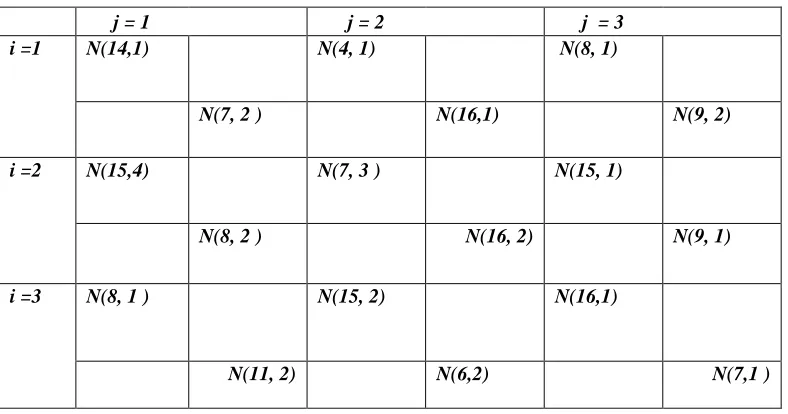
c1Rijk, c2Rijk c2Cijk and c2Cijk are given as follows. Using fuzzy approach, the pareto optimal solution of
the problem is obtained as x111=19.0415,
x131=12.9585, x211=5.9585, x221=7.0,
x232=27.0415, x321=0.0415,
x322=35.9565,
= 0.5634 and otherxijk are zeros.
Z1 = [680.4324, 1287.403] and
Z2= [671.7095, 1240.917].
9. Conclusion: This paper proposes a solution procedure for multi-objective interval solid transportation problem under stochastic environment using fuzzy programming approach. All source availability, destination demand and conveyance capacities have been taken as stochastic intervals for each criterion. Expectation of a random variable has been used to transform the problem into a classical multi-objective transportation problem where the objectives which are the right limit and centre of the interval objective functions are minimized. The main advantage of fuzzy programming is that, for a MOISTP with ‘p’ objective functions, this approach leads to p non-dominated solutions and one optimal compromise solution, whereas other algorithms leads to more than p non-dominated and dominated solutions from which the decision maker can choose a compromise solution.
Table–1. Interval cost matrix for first criterion consisting of 3 sources, 3 destinations and 2 conveyances .
Table–2. Interval cost matrix for second criterion consisting of 3 sources, 3 destinations and conveyances . j = 1 j = 2 j = 3
i = 1
[N(7, 2 ), N(15,1)]
[N(5, 1), N(13, 4)]
[ N(7, 1), N(12, 2)]
[N(9, 4 ), N(12, 1 )]
[N(7, 2 ), N(22, 1 )]
[N(9, 4 ), N(14, 2 )]
i = 2
[N(10, 2), N(14, 3)]
[N(7, 2 ), N(12, 3 )]
[N(7, 2 ), N(17, 1 ) ] [N(9, 3 ),
N(12, 4 )]
[N(5, 1 ), N(25, 4 )]
[N(5, 1 ), N(9, 2 )]
i = 3
[N(9, 2 ), N(24, 2 ) ]
[N(6, 3 ), N(15, 4 )]
[N(6, 2 ), N(15, 3 )]
[N(5, 2), N(25, 4 )]
[N(6,3), N(12, 3)]
[N(5,4 ), N(23,2)]
j = 1 j = 2 j = 3
i = 1
[N(6, 2 ),
N(14,1)]
[N(4, 1),
N(14, 4)]
[ N(8, 1),
N(13, 2)]
[N(7, 2 ),
N(14, 3 )]
[N(6,1),
N(20, 2 )]
[N(9, 2 ),
N(15, 3 )]
i = 2
[N(9, 2),
N(15, 4)]
[N(7, 3 ),
N(11, 3)]
[N(5, 1 ),
N(16, 2)]
[N(8, 2 ),
N(12, 3 )]
[N(6, 1 ),
N(23, 2 )]
[N(5, 1 ),
N(9, 2 )]
i = 3
[N(8, 1 ),
N(22, 4 )]
[N(5, 1 ),
N(14, 2)]
[N(6,1),
N(14, 2 )]
[N(5, 2),
N(24, 2 )]
[N(6,2),
N(11, 3)]
[N(7,1 ),
Table – 3. c1ijk transportation cost for first criterion
Table- 4. cijk2 transportation cost for second criterion. References:
[1] E.Shell, Distribution of a product by several properties, Directorate of Management Analysis, Proc. 2nd Symp. on Linear programming, Vol. 2, 1955, pp. 615-642, DCS/Comptroller H.Q. U.S.A.F., Washington, DC. [2] Basu, M., Pal, B.B., and Kundu, A., An algorithm for
optimum solution of solid fixed-charge transportation problem , Optimization31 (1994) 283-291.
[3] A.K.Bit, M.P.Biswal, S.S.Alam, Fuzzy programming approach to multi-objective solid transportation problem, Fuzzy Sets Systems. 57(1993) 183-194. [4] F.Jimenez, J.L.Verdegay, Uncertain solid transportation
[5] Lixing Yang and Linzhong Liu, Fuzzy fixed charge solid transportation problem and algorithm , Applied soft computing , 7(2007) 879-889.
[6] F.Jimenez, J.L.Verdegay, Solving fuzzy solid transportation problems by an evolutionary algorithm based parametric approach, European Journal of Operations Research, 117(1999) 485-510.
[7] Y.Li, K.Ida, M.Gen, R.Kobuchi, Neural network approach for multicriteria solid transportation problem,
Comput. Ind. Eng.33(1997) 465-468.
[8] Y.Li, K.Ida, M.Gen, Improved genetic algorithm for solving multiobjective solid transportation problem with fuzzy numbers, Comput. Ind. Eng. 33(1997)
589-j = 1 j = 2 j = 3
i =1 N(14,1) N(4, 1) N(8, 1)
N(7, 2 ) N(16,1)
N(9, 2)
i =2 N(15,4) N(7, 3 ) N(15, 1)
N(8, 2 )
N(16, 2) N(9, 1)
i =3 N(8, 1 ) N(15, 2) N(16,1)
N(11, 2) N(6,2) N(7,1 )
j = 1 j = 2 j = 3
i =1 N(14,1) N(4, 1) N(8, 1)
N(7, 2 ) N(16,1)
N(9, 2)
i =2 N(15,4) N(7, 3 ) N(15, 1)
N(8, 2 )
N(16, 2) N(9, 1)
i =3 N(8, 1 ) N(15, 2) N(16,1)
[9] M.Gen, K.Ida, Y.Li, E.Kubota, Solving bicriteria solid transportation problem with fuzzy numbers by a genetic algorithm, Comput. Ind. Eng. 29(1995) 537-541. [10] M.Inguichi, Y.Kume, Goal programming problem with
interval coefficient and target intervals, European Journal of Operations Research52 (1991) 345-360.
[11] R.E.Stuer, Algorithm for linear programming problems with interval objective function coefficient, Mathematics of Operations Research6 (1981) 333-348.
[12] S.Tong, Interval number and fuzzy number linear programming, Fuzzy Sets and Systems66 (1994) 301-306. [13] H.Ishibuchi, H.Tanaka, multiobjective programming in
optimization of the interval objective function, European Journal of Operations Research 48 (1990) 219-225. [14] B.Liu, Theory and Practice of Uncertain Programming,
Physica-Verlag, New York, 2002.
[15] B.Liu , Depenedent chance programming with fuzzy decisions, IEEE Transactions on Fuzzy Systems, 7(3)
(1999)354-360.
[16] Lixing Yang and Linzhong Liu, Fuzzy fixed charge solid transportation problem and algorithm , Applied soft computing , 7(2007) 879-889.
[17] Lixing Yang, Yuan Feng, A bicriteria solid transportation problem with fixed charge under stochastic environment,
Applied Mathematical Modeling31 (2007) 2668-2683. [18] G.Alefeld, J.Herzberger, Introduction to Interval
computations, Academic Press, New York, 1983. [19] R.E.Moore, Method and Applications of Interval Analysis,
SLAM, Philadephia, PA, 1979.
[20] A.Nagarajan, K.Jeyaraman, Mathematical modeling of solid fixed cost bi-criterion indefinite quadratic transportation problem under stochastic environment,
Emerging journal of engineering science and technology, Volume-02, N-03, March2009 – May 2009, pp.106 – 127. [21] S.K.Das, A.Goswami and S.S.Alam, Multi-objective transportation problem with intervsl cost, source and destination parameters, European Journal of Operations Research117(1999)100-112.
[22] Baoding Liu and Yian-Kui Liu, Expected value of fuzzy variable and fuzzy expected value models, IEEE Transactions on Fuzzy Systems,10(4) (AUGUST 2002) 445-450.
[23] L.A.Zadeh, Fuzzy sets, Information and control 8 (1965) 338-353.
[24] J.Zimmerman, Fuzzy programming and Linear programming with several objective functions, Fuzzy Sets and Systems 1(1978) 45-55.
[25] H.Liberling, On finding compromise solutions for multicriteria problems using the fuzzy min-operator, Fuzzy Sets and Systems6(1981) 105-118.
[26] A.Nagarajan and K.Jeyaraman, Mathematical modeling of solid fixed cost bi-criterion indefinite quadratic transportation problem under stochastic environment,
Emerging journal of engineering science and technology, Volume-02, Issue No-03, March 2009 – May 2009, pp.106 – 127.
[27] A.Nagarajan and K.Jeyaraman, Solution of expected value model for multi-objective interval solid transportation problem under stochastic environment using fuzzy programming approach, Emerging journal of engineering science and technology, Volume-04, Issue N 07, September 2009 – November 2009, pp. 53 – 70. [28] A.Nagarajan and K.Jeyaraman, Chance constrained goal
programming models for multi-objective interval solid transportation problem under stochastic environment,
International journal of applied mathematics analysis and applications, Volume-05, Issue No-02, July-December 2010, pp. 229 – 255.
[29] A.Nagarajan and K.Jeyaraman, Solution of chance constrained programming problem for multi-objective
interval solid transportation problem under stochastic environment using fuzzy approach, International journal computer applications, Volume-10- No .9, November 2010, pp. 19 – 29.