150 150
INTRODUCTION
Extreme loading scenarios might influence the durability and solidity of the structural elements. These loadings can be expressed as external loads, external moments, elevated temperature, and any other loads which can affect the structure during the operational lifetime. Concrete as a structural material has relatively high compressive strength, but significantly lower tensile strength, because of that it is usually reinforced with materials that are superior in tension such as steel. Reinforced
concrete structures may be exposed to natural fire during their lifetime. Therefore, it is very impor -tant to study the behavior of reinforced concrete during and after fire, and also to study the degree of temperature and duration it can endure. The study of real behavior for reinforced concrete structures during and after fire is very important to achieve a high level of safety.
The strength and stiffness of flexural concrete members are decreased during fire exposure de -pends on many factors including type of exposure, concrete and reinforced steel rebar properties, the Volume 13, Issue 2, June 2019, pages 150–156
https://doi.org/10.12913/22998624/109055
Studying the Flexural Behavior of Reinforced Concrete Beams
under the Effect of High Temperature: A Finite Element Model
Hamadallah Al-Baijat
1*, Mohammad Alhawamdeh
2, Aya Khawaldeh
31 Department of Civil Engineering, Faculty of Engineering, Tafila Technical University, P. O. Box (179) Tafila 66110, Jordan
2 Department of Civil Engineering, Faculty of Engineering, Tafila Technical University, P. O. Box (179) Tafila 66110, Jordan
3 Department of Civil Engineering, Faculty of Engineering, Jordan University of Science and Technology, P. O. Box (3030) Irbid 22110, Jordan
* Corresponding author’s e-mai: [email protected], [email protected]
ABSTRACT
The strength of concrete elements can be greatly affected by elevated temperature as in fires, and so a great concern must be taken regarding its behavior under such condition. In this paper, a finite element model was built up using ABAQUS software to investigate the flexural behavior of reinforced concrete (RC) beams subjected to service load under elevated temperature. The beam was simply supported and was loaded at one-third and two-third of span length. The study consisted of three RC beams models; the first model simulated a control beam specimen at ambient temperature 20 °C, while the other two models demonstrated damaged beams specimens according to two high temperatures 400 °C and 800 °C, respectively. Each RC beam had 2 m span length, 300 mm height and 200 mm width. The steel reinforcement configuration was 3ϕ16 mm (Grade 60) main bars at the positive moment region in the beam bottom, 2ϕ14 mm (Grade 60) secondary bars at the beam top, and ϕ10 mm /150 mm
closed stirrups. The model was validated by comparing its results with the theoretical results from ACI code and literature. Several mechanical properties were investigated including concrete compressive strength, modulus of elasticity, and reinforcing steel yielding strength. The test results showed a reduction in the flexural capacity of the
RC beams, tested at 400 °C and 800 °C, of 17.6% and 88.2%, respectively, with respect to the control beam. The
maximum service load carried by the beam, at one-third and two-third of the span length, decreased by 17.1% and 88.1% for the 400 ℃ and 800 ℃ high temperature, respectively. The results also showed an increase in deflection when the temperature increased due to the loss in stiffness.
Keywords: flexural behavior, reinforced concrete beam, high temperature, fire, finite element model, deflection.
Advances in Science and Technology
Research Journal
Accepted: 2019.04.20Revised: 2019.04.05151
Advances in Science and Technology Research Journal Vol. 13(2), 2019
load level, and boundary conditions [Kodur and Agrawal, 2016]. Kowalski [2010] indicated that concrete mechanical properties are significantly influenced by temperatures above 400°C to 500°C. Huang et al. [1999] indicated that the design against thermal loading in reinforced concrete structures is based on simplistic techniques, which have been created from the standard fire tests that do not take the real behavior of building during a fire. According to Knaack et al. [2011], there is a need for a predictive structural performance based on fire design principles as an alternative to the existing design methodology. The mechani -cal properties of the structural materials such as different grades of concrete and reinforced steel, the boundary conditions and all types of loading including thermal loading should be taken into de -sign requirements and considerations.
Chen et al. [2006] Performed an experimen -tal study on two different steel grades at elevated temperatures. High strength and mild structural steel used to investigate the mechanical proper -ties, young’s moduli and yield strengths at differ -ent levels of strain, while the thermal elongation and ultimate strengths for the two steel grades obtained at different values of temperatures. The test showed that the ACI code and some other codes are conservative for temperature increased up to 1000 °C in terms of yield strengths but un -conservative in terms of young’s moduli obtained from the case of transient-state tests. Ellingwood and Lin [1991] conducted a research program to investigate the behavior of reinforced concrete beams subjected to fire. Six reinforced concrete beams, designed to ACI 318-11 specifications, with a 20 ft (6.1 m) span and a 6 ft (1.8 m) cantile -ver were tested. Beams were casted using Normal weight concrete and Grade 60 reinforcing rebars, and were divided into two groups. The first group was tested according to ASTM E119 fire expo -sure of 550 °F to 1600 °F high temperatures for
four hours, while the second group was subjected to a short duration high intensity (SDHI). At this technique, fire rapidly increased to 1860 °F for the first 45 min, then rapidly cooled to 600 °F dur -ing 1 hr 40 min. Test results showed that flexural cracks were developed in the positive moment region of the span after 30 min of fire, and contin -ued to widen up to ¼ in through three hours and a half of fire exposure duration. The most important parameter affected by the elevated temperature of the reinforced concrete flexural member, beam, was the reinforcement temperature history.
Most of the previous studies focused on the mechanical properties (concrete compressive strength, steel yeilding strength, and the modu -lus of elasticity) of concrete and reinforcing steel while avoiding to assess the effect of increasing temperatures.The objectives of this study are to investigate the flexural behavior of RC beams subjected to different elevated temperature and to evaluate the reduction in the beams’ bending ca -pacity due to increase in temperature. The design of the RC beams will be conducted according to ACI 318-14 specifications.
METHODOLOGY
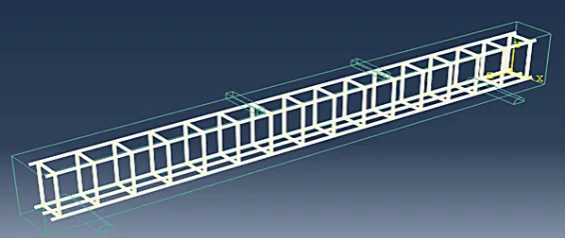
A finite element model were constructed using ABAQUS software to study the structural behav -ior of reinforced concrete beams subjected to el -evated temperatures. The model consisted of a RC beam with 2 m span length, 300 mm height, and 200 mm wide. The steel reinforcement comprised of 3ϕ16 mm (Grade 60) main bars at the positive moment region in the beam bottom, 2ϕ14 mm (Grade 60) secondary bars at the beam top, and ϕ10 mm /150 mm closed stirrups, as shown in Fig -ure 1. The beam design procedure followed ACI 318-14 specifications. Table 1 illustrates the theo -retical design data for the control beam specimen.
Advances in Science and Technology Research Journal Vol. 13(2), 2019
152
MODELING
Concrete
Concrete damaged plasticity model was used in ABAQUS to simulate concrete behavior in beams. To achieve this model, the strength and the corresponding longitudinal strain of confined concrete were represented by the following rela -tionships [Tsai, 1988]:
𝐸𝐸𝑐𝑐 = 8200 × 𝑓𝑓𝑐𝑐′0.375 (1)
𝜀𝜀𝑐𝑐𝑐𝑐 =𝑓𝑓𝑐𝑐 ′0.25
1153 (2) 𝑥𝑥 = 𝜀𝜀𝑐𝑐
𝜀𝜀𝑐𝑐𝑐𝑐 (3)
𝑟𝑟 = 𝑓𝑓𝑐𝑐′
5.2− 1.9 (4) 𝑛𝑛 = 7.2
𝑓𝑓𝑐𝑐′0.375 (5)
𝑓𝑓𝑐𝑐𝑐𝑐′ = 𝑛𝑛𝑥𝑥𝑓𝑓𝑐𝑐 ′
1+(𝑛𝑛−𝑟𝑟−1𝑟𝑟 )×𝑥𝑥+𝑟𝑟−1𝑥𝑥𝑟𝑟 (6)
𝑓𝑓𝑡𝑡′ =𝑓𝑓𝑐𝑐𝑐𝑐 ′ 0.5
3 (7)
𝜀𝜀𝑡𝑡𝑡𝑡=𝑓𝑓𝑡𝑡 ′
𝐸𝐸𝑐𝑐 (8) 𝐸𝐸𝑇𝑇
𝐸𝐸𝑜𝑜 = 1.0 + 𝑇𝑇
2000 ln[1100𝑇𝑇 ] 𝑓𝑓𝑓𝑓𝑟𝑟 0℃ < 𝑇𝑇 ≤ 600℃ (9)
𝐸𝐸𝑇𝑇 𝐸𝐸𝑜𝑜 =
690(1−1000𝑇𝑇 )
𝑇𝑇−53.5 𝑓𝑓𝑓𝑓𝑟𝑟 600℃ < 𝑇𝑇 ≤ 1000℃ (10)
1
𝐸𝐸𝑐𝑐 = 8200 × 𝑓𝑓𝑐𝑐′0.375 (1)
𝜀𝜀𝑐𝑐𝑐𝑐 =𝑓𝑓𝑐𝑐 ′0.25
1153 (2) 𝑥𝑥 = 𝜀𝜀𝑐𝑐
𝜀𝜀𝑐𝑐𝑐𝑐 (3)
𝑟𝑟 = 𝑓𝑓𝑐𝑐′
5.2− 1.9 (4) 𝑛𝑛 = 7.2
𝑓𝑓𝑐𝑐′0.375 (5)
𝑓𝑓𝑐𝑐𝑐𝑐′ = 𝑛𝑛𝑥𝑥𝑓𝑓𝑐𝑐 ′
1+(𝑛𝑛−𝑟𝑟−1𝑟𝑟 )×𝑥𝑥+𝑟𝑟−1𝑥𝑥𝑟𝑟 (6)
𝑓𝑓𝑡𝑡′ =𝑓𝑓𝑐𝑐𝑐𝑐 ′ 0.5
3 (7)
𝜀𝜀𝑡𝑡𝑡𝑡=𝑓𝑓𝑡𝑡 ′
𝐸𝐸𝑐𝑐 (8) 𝐸𝐸𝑇𝑇
𝐸𝐸𝑜𝑜 = 1.0 + 𝑇𝑇
2000 ln[1100𝑇𝑇 ] 𝑓𝑓𝑓𝑓𝑟𝑟 0℃ < 𝑇𝑇 ≤ 600℃ (9)
𝐸𝐸𝑇𝑇 𝐸𝐸𝑜𝑜 =
690(1−1000𝑇𝑇 )
𝑇𝑇−53.5 𝑓𝑓𝑓𝑓𝑟𝑟 600℃ < 𝑇𝑇 ≤ 1000℃ (10) where:
Ec is the concrete modulus of elasticity (MPa), x is the ratio of concrete strains,
εc is the longitudinal compressive concrete strain, εcc is the maximum confined concrete strain, fcc’ is the compressive strength (peak stress) of
confined concrete,
ft’ is the tensile strength of concrete, εtO is the tensile rupture strain in concrete,
n is the ratio of the initial tangent modulus to the secant modulus,
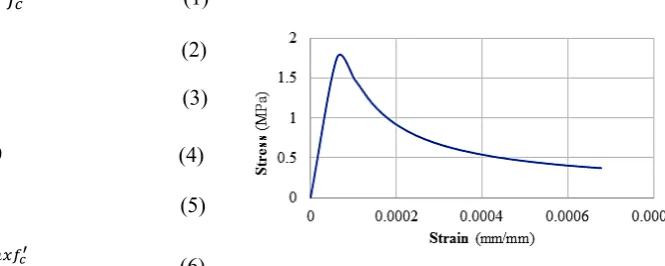
r is a factor to control the steepness rate for the descending portions of the stress-strain relation. These relationships yield the conventional stress-strain diagrams of concrete under com -pression and tension prior exposure to elevated temperature, as shown in Figures 2 and 3. Under uniaxial tension, the behavior of concrete is linear until reaching the micro-cracking, then mutate by softening response in strain.
Table 1. The theoretical design data for the control beam specimen
Main steel reinforcement (at bottom) Secondary steel reinforcement (at top)
Yield strength of steel reinforcement Concrete compressive strength Compression depth
Yield strain of main steel reinforcement
Strain in secondary steel reinforcement
Strength in secondary steel reinforcement
Nominal moment capacity Nominal load
where:
ƒc’ – average uniaxial concrete compressive strength of standard cylinder at 28 days (MPa),
fy – yield strength of steel reinforcement (MPa), fs’– strength in secondary steel reinforcement (MPa). As – mainsteel reinforcement (mm2),
As’ – secondarysteel reinforcement (mm2),
c – compression depth (mm).
ϵy – yield strain of main steel reinforcement. ϵs’ – strain in secondary steel reinforcement. Mn – nominal moment (moment capacity in kN·m). Pn – nominal load (load capacity in kN).
Fig. 2. Typical compressive stress-strain diagram for concrete prior exposure to high temperature
Fig. 3. Typical tensile stress-strain diagram for con
153 Advances in Science and Technology Research Journal Vol. 13(2), 2019
Steel reinforcement
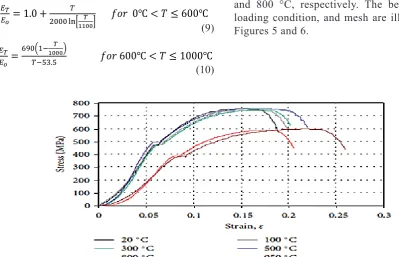
The stress-strain curve of the reinforcing steel bar is assumed to be linear elastic up to the yield stress of steel, followed by perfectly plastic be -havior. According to Topçu and Karakurt [2008], The yield strength of reinforcing steel bars is in -fluenced by exposure to elevated temperatures. Figure 4 illustrates the behavior of reinforced steel during elevated temperature.
Post heating model
The post-heating behavior of concrete was characterized using the following equations [Wong, 2011]:
1
𝐸𝐸𝑐𝑐= 8200 × 𝑓𝑓𝑐𝑐′0.375 (1)
𝜀𝜀𝑐𝑐𝑐𝑐=𝑓𝑓𝑐𝑐 ′0.25
1153 (2) 𝑥𝑥 = 𝜀𝜀𝑐𝑐
𝜀𝜀𝑐𝑐𝑐𝑐 (3)
𝑟𝑟 = 𝑓𝑓𝑐𝑐′
5.2− 1.9 (4) 𝑛𝑛 = 7.2
𝑓𝑓𝑐𝑐′0.375 (5)
𝑓𝑓𝑐𝑐𝑐𝑐′ = 𝑛𝑛𝑥𝑥𝑓𝑓𝑐𝑐 ′
1+(𝑛𝑛−𝑟𝑟−1𝑟𝑟 )×𝑥𝑥+𝑟𝑟−1𝑥𝑥𝑟𝑟 (6)
𝑓𝑓𝑡𝑡′=𝑓𝑓𝑐𝑐𝑐𝑐 ′ 0.5
3 (7)
𝜀𝜀𝑡𝑡𝑡𝑡=𝑓𝑓𝑡𝑡 ′
𝐸𝐸𝑐𝑐 (8) 𝐸𝐸𝑇𝑇
𝐸𝐸𝑜𝑜 = 1.0 + 𝑇𝑇
2000 ln[1100𝑇𝑇 ] 𝑓𝑓𝑓𝑓𝑟𝑟 0℃ < 𝑇𝑇 ≤ 600℃ (9)
𝐸𝐸𝑇𝑇 𝐸𝐸𝑜𝑜 =
690(1−1000𝑇𝑇 )
𝑇𝑇−53.5 𝑓𝑓𝑓𝑓𝑟𝑟 600℃ < 𝑇𝑇 ≤ 1000℃ (10) (9)
1
𝐸𝐸𝑐𝑐= 8200 × 𝑓𝑓𝑐𝑐′0.375 (1)
𝜀𝜀𝑐𝑐𝑐𝑐=𝑓𝑓𝑐𝑐 ′0.25
1153 (2) 𝑥𝑥 =𝜀𝜀𝑐𝑐𝑐𝑐𝜀𝜀𝑐𝑐 (3)
𝑟𝑟 = 𝑓𝑓𝑐𝑐′
5.2− 1.9 (4) 𝑛𝑛 = 7.2
𝑓𝑓𝑐𝑐′0.375 (5)
𝑓𝑓𝑐𝑐𝑐𝑐′ = 𝑛𝑛𝑥𝑥𝑓𝑓𝑐𝑐 ′
1+(𝑛𝑛−𝑟𝑟−1𝑟𝑟 )×𝑥𝑥+𝑟𝑟−1𝑥𝑥𝑟𝑟 (6)
𝑓𝑓𝑡𝑡′=𝑓𝑓𝑐𝑐𝑐𝑐 ′ 0.5
3 (7)
𝜀𝜀𝑡𝑡𝑡𝑡=𝑓𝑓𝑡𝑡 ′
𝐸𝐸𝑐𝑐 (8) 𝐸𝐸𝑇𝑇
𝐸𝐸𝑜𝑜 = 1.0 + 𝑇𝑇
2000 ln[1100𝑇𝑇 ] 𝑓𝑓𝑓𝑓𝑟𝑟 0℃ < 𝑇𝑇 ≤ 600℃ (9)
𝐸𝐸𝑇𝑇 𝐸𝐸𝑜𝑜=
690(1−1000𝑇𝑇 )
𝑇𝑇−53.5 𝑓𝑓𝑓𝑓𝑟𝑟 600℃ < 𝑇𝑇 ≤ 1000℃ (10) (10)
where:
EO is the modulus of elasticity at ambient temperature,
ET is the modulus of elasticity at temperature, T is the elevated temperature.
ABAQUS model
As previously mentioned, a finite element model using ABAQUS software was carried out to obtain the reduction in beam capac -ity due to elevated temperature. This research comprised of three reinforced concrete beam models, these models simulated a control beam specimen at ambient temperature 20 °C, and two damaged beam specimens subjected to 400 °C and 800 °C, respectively. The beam model, loading condition, and mesh are illustrated in Figures 5 and 6.
Fig. 4. Stress-strain curve of grade 60 (420 MPa) steel rebar [Topçu and Karakurt, 2008]
Fig. 5. Beam model with assigned mesh (a) before loading, (b) after loading
154
Fig. 6. Boundary and loading conditions used in the beam model (simply supported beam loaded at one-third and two-third of span length)
RESULTS AND DISCUSSION
After running the model, several parameters were evaluated under different temperature to assess the effect of elevated temperature on RC beams. These parameters included the concrete compressive strength, concrete modulus of elas -ticity, and steel reinforcement yielding strength. Using these parameters, the flexural behavior of reinforced concrete beams prior and post to el -evated temperature exposure was obtained. The reasulted data for both control and heated speci -mens was used to compare between these two conditions as shown in Table 2.
After comparing unheated and heated pa -rameters, the nominal load, nominal moment ca -pacities, and deflection have been obtained from the model as shown in Table 3. The table also provide the decrease in capacity and increase in deflection for the heat-damaged specimens.
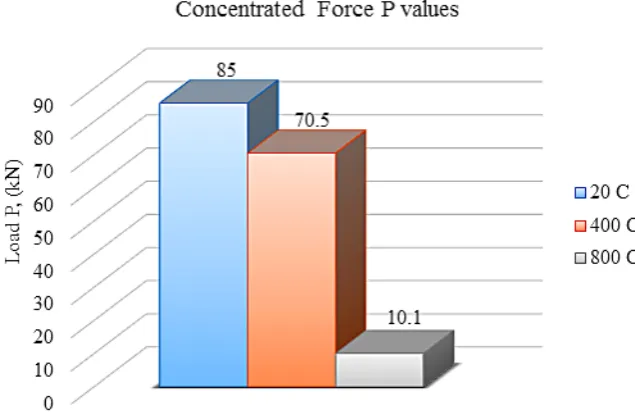
The relationship between the increasing ser -vice load and deflection was monitored along the model running process. Figure 7 shows the great reduction in stiffness while increasing the temperature. It was estimated that the stiffness decreased by 15.4% and 86.1% at 400 °C and 800 °C, respectively, with respect to the control beam. Figures 8 and 9 show the intensive reduc -tion in moment and load capacity, respectively.
CONCLUSIONS
A finite element model was used to assess the fire behavior of RC beams subjected to increasing service loading. After analyzing the results, the following conclusions were found:
1. The model succeed in describing the behav -iour of RC beams under elevated tempera
-Table 2. Comparison between concrete compressive strength, modulus of elasticity, and steel reinforcement yield -ing strength prior and post to elevated temperature exposure
Specimen Temperature (°C) Compressive strength fc’
(MPa)
Modulus of elasticity Ec
(MPa)
Steel reinforcement yielding strength fy
(MPa)
Decrease in fc’
(%)
Decrease in Ec
(%]
Decrease in fy
(%]
Control 20 28 28537 420 - -
-B - 400 400 15.6 22953 402 44.3 19.6 4.3
B - 800 800 0.3 5289 198 98.9 81.5 52.9
Table 3. Comparison between nominal capacity (Pn and Mn) and deflection of unheated and heated specimens
Specimen Temperature (°C) Nominal load, Pn
(kN)
Decrease in Pn
(%)
Nominal moment, Mn
(kN·m)
Theoretical strength
(MPa)
Decrease in Mn
(%)
Deflection at mid-span
(mm)
Increase in deflection,
(%)
Control 20 85 - 59.92 59.505 - 8.7
-B - 400 400 70.5 17.1 49.35 - 17.6 9 3.4
155
Advances in Science and Technology Research Journal Vol. 13(2), 2019
Fig. 7. Load versus deflection at mid-span for different temperature values
Fig. 8. Moment capacity of the beam for different temperature values
156
ture. It was validated by comparing its results with the theoretical results from ACI code and literature.
2. Steel reinforcement was not affected at 400 °C temperature (4.3% reduction in fy). While it greatly deteriorated at 800 °C (52.9% reduc -tion in fy).
3. The concrete lost about 44.3% of its compres -sive strength and 19.6% of its modulus of elas -ticity at 400 °C. While the reduction severely increased up to 98.9% in the compressive strength and 81.5% in the modulus of elasticity at 800 °C.
4. The reduction in beam’s flexural capacity was 17.6% and 88.2% for the 400 °C and 800 °C high temperature, respectively.
5. The maximum service load carried by the beam, at one-third and two-third of the span length, was 85 kN. This load decreased by 17.1% and 88.1% for the 400 °C and 800 °C high temperature, respectively.
6. The maximum deflection (at mid-span) in -creased by 3.4% and 17.2% for the 400 °C and 800 °C high temperature, respectively. This was referred to the loss in stiffness as tempera -ture increased.
7. Due to the intensive deterioration in steel’s yielding strength, concrete’s compressive strength, and modulus of elasticity. The flex -ural and load capacities decreased, at 800 °C, by 90% of their unheated values. Under such reduction, the RC beam is entirely destroyed.
REFERENCES
1. ACI Committee 318. 2014. Building Code Re
-quirements for Structural Concrete (ACI 318M-14) and Commentary (ACI 318RM-318M-14). American Concrete Institute, Farmington Hills, MI.
2. Chen J., Young B., and Uy B. 2006. Behavior of high strength structural steel at elevated tempera
-tures. Journal of Structural Engineering, 132(12), 1948-1954.
3. Ellingwood B., and Lin T.D. 1991. Flexure and shear behavior of concrete beams during fires. Jour
-nal of Structural Engineering, 117(2), 440-458.
4. Huang Z., Burgess I.W., and Plank R.J. 1999. Non
-linear analysis of reinforced concrete slabs subjec-ted to fire. Structural Journal, 96(1), 127-135. 5. Topçu I.B., and Karakurt C. 2008. Properties of re
-inforced concrete steel rebars exposed to high tem
-peratures. Research Letters in Materials Science, 2008, 1-4. doi:10.1155/2008/814137
6. Knaack A.M., Kurama Y.C., and Kirkner D.J. 2011. Compressive stress-strain relationships for North American concrete under elevated tempera
-tures. ACI Materials Journal, 108(3), 270.
7. Kodur V.K.R., and Agrawal A. 2016. An approach for evaluating residual capacity of reinforced con
-crete beams exposed to fire. Engineering Struc
-tures, 110, 293-306.
8. Kowalski R. 2010. Mechanical properties of con
-crete subjected to high temperature. Architecture Civil Engineering Environment, (2), 61-70. 9. Tsai W.T. 1988. Uniaxial compressional
stress-strain relation of concrete. Journal of Structural Engineering, 114(9), 2133-2136.