Research Journal
Volume 12, No. 2, June 2018, pages 298-306
DOI: 10.12913/22998624/92354 Research Article
SELECTION OF AN APPROPRIATE DISTRIBUTION CHANNEL FOR
HIGH-VALUE STONE
Nikoleta Mikušová1, Eva Tomková1, David Hrdlý2, Petr Průša2, Rudolf Kampf3
1 Faculty of Mining, Ecology, Process Control and Geotechnology, Technical University of Košice, Letná 9, 042
00 Košice, Slovakia, e-mail: [email protected], [email protected]
2 Department of Transport management, marketing and logistics. Jan Perner Transport Faculty, University of
Pardubice, Pardubice, Czech Republic, e-mail: [email protected], [email protected],
3 The Institute of Technology and Business in Ceske Budejovice, Okruzni 517/10, 370 01 Ceske Budejovice,
Czech Republic, e-mail: [email protected]
ABSTRACT
Selection of distribution channel type is an important decision of every manufactur-ing company and also for production engineermanufactur-ing. Appropriate choice of distribution channel can save considerable costs while maintaining a high level of customer ser-vice. Determination of an appropriate strategy for the management of enterprise dis-tribution channel. In this article, the selection of the type of disdis-tribution channel is
proposed using ANP method to determine the strength of influence of input factors on
the target set of potential options. Submitted model is very clear, understandable and according to the proposed methodology easy to implement, while also providing clear and understandable results during the selection of the type of distribution channel. The proposed model is primarily targeting for distribution of high-value stone which needs to decide which distribution strategy should be chosen or if to switch to another distribution strategy more suitable for the company needs.
Keywords: distribution, channel, model.
INTRODUCTION
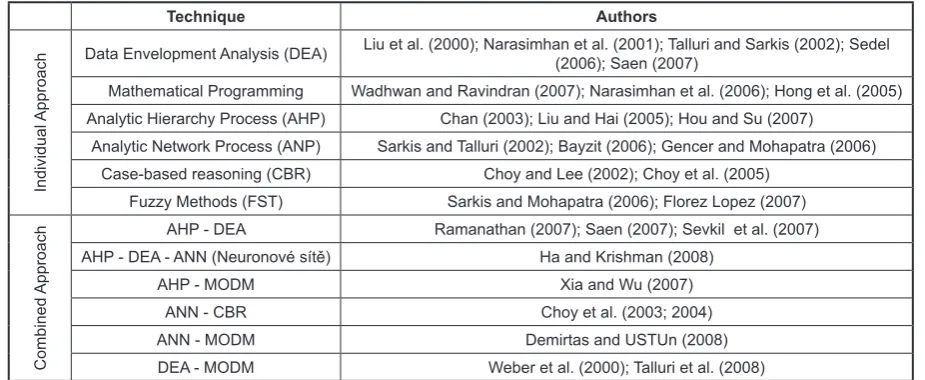
From the perspective of Multiple Criteria De-cision-Analysis (MCDM), there is a wide range of methods used for dealing with choice of not only the type of distribution channel. MCDM history goes back about 40 years ago, with Alias, et al. [2] reviewed over 70 of these techniques. Aruldoss M. et. al. [3], for example, compiled the inventory of multi-criterial methods with examples of their application. A plethora of studies uses MDCM to select and evaluate a supplier. Ho, W. et. al. [7, 8] and Agarwal, et. al. [1] prepared a summary of MCDM techniques and their use in choosing a supplier evaluation (Table 1).
Singh, A., and Malik, SK [26] divided MCDM in their work into two categories: Multi-Attribute
Decision Making (MADM) and Multi-Objective Decision Making (MODM). MADM focuses on the selection of the best alternative from the set
of pre-defined alternatives where the set is lim -ited by a number of input factors [20]. One of the recent studies (by [4]) seeks to raise awareness about the methodology of Multiple-attribute of Decision Making (MADM) in connection with Enterprise Resource Planning (ERP) projects. MODM, on the other hand, focuses on the design alternatives on the basis of the input factors [15]. The possibilities are usually endless and the aim
is to choose the possibility that best fits the con -straints and priorities set by the decision maker.
The basis for the decision making in MCDM is Saaty‘s approach [22], which builds on a large number of studies. Sha, DY, & Che, ZH [25] used Received: 2018.04.21
the AHP method to design a distribution chain network, where the focus was on the selection of a suitable partner, planning, distribution, and manufacturing. Kahraman, C., Cebeci, U., & Ulukan, Z. [12] dealt with a supplier selection us-ing MCDM approach with help of the so-called Fuzzy AHP method.
The MCDM approach has appeared in a number of studies focused on distribution logis-tics. Mallen B. [16] used this approach to select the distribution channel, where was this selec-tion subdivided into several stages. W. Ho and A. Emrouznejad [7] used a combination of AHP methods and logical operators SAS / OR for structural design of a distribution grid. G. Nilay Serbest and Vayvay O. [17] proposed a model for selecting the most appropriate distribution chan-nel using fuzzy AHP method.
PROBLEM DEFINITION
Only very few manufacturers sell their goods
directly to the final consumer. Between the pro
-ducer and the final consumer, there is a number
of intermediaries, which make up the distribution chain. Distribution chain then can be understood as “part of the logistics chain that begins when the
product leaves the company and ends at the final customer”. K.D. Zylstra [28] defined the objec -tive of distribution chain as an overcoming of the time, space and property inconsistencies in the course of the movement of goods and services to customers. The structure of the distribution chain is determined by functions/activities that each or-ganization in the chain carries out. From the dis-cussed company’s perspective, which is the
posi-tion of the manufacturer, its aim is to optimize distribution logistics for the customer. The aim is to design and build a suitable model for selecting the distribution chain, which will help the com-pany reduce losses in the distribution part of the logistics chain. The discussed company currently uses the local branches in the Czech and Slovak Republic. The given model should provide an an-swer as to whether this is desirable or recommend switching to another type of distribution channel.
Distribution chains are formed as a network of vertically aligned companies, without any
fixed structure. The specific structure largely de -pends on the nature of the distributed product and nature of the target market of the company. Even for companies producing similar products the “best” structure of the distribution chain cannot be unambiguously determined [6]. This should be created in relation to the overall business and marketing objectives of the company. The
dis-tribution chains thus differ in their length and
width. Length is the number of distribution levels between the manufacturer and the customer. The width is given by the number of participants in-volved in the distribution at given level.
The distribution system must be therefore
regularly inspected and modified by the manufac
-turer. Modification of distribution channels is es -sential if they do not function as planned, or if the way customers shop changed, the market expand-ed, new competition appearexpand-ed, new ways of dis-tribution are created or product moves to the next stage of its life cycle [29]. No distribution chan-nel remains competitive throughout the product’s
whole life cycle [21]. The first potential custom -ers may be willing to pay the price for a big cus-Table 1. Review of MCDM techniques in the scientific literature
Technique Authors
Individual
Approach
Data Envelopment Analysis (DEA) Liu et al. (2000); Narasimhan et al. (2001); Talluri and Sarkis (2002); Sedel (2006); Saen (2007)
Mathematical Programming Wadhwan and Ravindran (2007); Narasimhan et al. (2006); Hong et al. (2005) Analytic Hierarchy Process (AHP) Chan (2003); Liu and Hai (2005); Hou and Su (2007)
Analytic Network Process (ANP) Sarkis and Talluri (2002); Bayzit (2006); Gencer and Mohapatra (2006) Case-based reasoning (CBR) Choy and Lee (2002); Choy et al. (2005)
Fuzzy Methods (FST) Sarkis and Mohapatra (2006); Florez Lopez (2007)
Combined
Approach
AHP - DEA Ramanathan (2007); Saen (2007); Sevkil et al. (2007)
AHP - DEA - ANN (Neuronové sítě) Ha and Krishman (2008)
AHP - MODM Xia and Wu (2007)
ANN - CBR Choy et al. (2003; 2004)
ANN - MODM Demirtas and USTUn (2008)
tomer added-value, but other potential customers will move to cheaper distribution routes.
LOGICAL FRAMEWORK OF THE
PROPOSED MODEL
The proposed model is based on the goal
definition of the proposed study because of both
maximization and minimization factors, and also include the dependencies between these factors [13]. To create the model all alternatives must be related to all limiting factors. As already men-tioned, the creation of a model for the choice of distribution channel must take into account both the company’s perspective (minimization of cost factors) and the customer‘s perspective (maximi-zation of customer service factors). Alternatives - A high importance is apparent when selecting a suitable distribution model for the given com-pany. Distribution costs vary with the use of dif-ferent types of distribution channels and it is at the discretion of company management to state
its goal. For the proposed model four basic types
of distribution channels were identified:
• Direct distribution - Products are stored in a central warehouse, or directly at the manu-facturer, without the use of distribution cen-ters in the distribution chain. Orders are pro-cessed directly and manufacturer delivers the order directly to the customer (Figure 1).
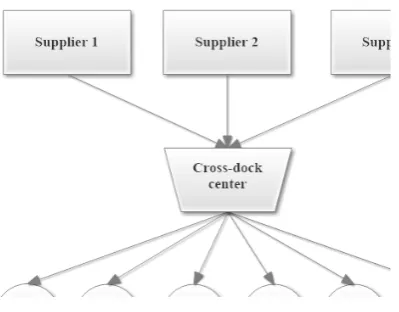
• Cross-dock center - goods are assembled, merged, or tailored to customer requirements only after the production in the cross-dock cen-ter with added value. The customer receives the all his orders in one package (Figure 2).
• Local branches or warehouses/distribution centers - local branches cover the market in order to achieve a strategic position for the customer (Figure 3).
• Offtake by the customer - storage is provided
in warehouses, or directly at the manufacturer
(also in local offices), with the difference that
the picking up of the goods is directed by the customer (Figure 4).
Fig. 1. Direct distribution
Fig. 2. Cross-dock center
Fig. 3. Local branches or warehouses
Selected factors of customer service - From the customer’s perspective, it is important to max-imize customer service. Costantino, F., Di Graviá, G. [5] determined the factors of customer service,
affecting the production rate of individual types
of distribution channels. Adjusted factors used for the proposed model are:
• Product Availability - period determining how available the demanded product is in the distribution chain, it is a unit of time, it is the goal is to maximize system availability.
• Customer satisfaction - a factor tracking cus-tomer‘s satisfaction with a type of the distri-bution chain. It is obtained by querying about customer’s experience, it is the goal is to achieve maximum customer satisfaction.
• Consolidation of orders - not all types of dis-tribution chains are suitable for merging or-ders, the goal is to merge multiple potential orders so that the customer receives only one complete order.
• Order tracking - an important factor guaran-teeing the possibility of accurate tracking of orders throughout the whole order process.
• Reliability of supply - the percent accuracy of ordered goods delivery.
• The speed of delivery - or also the distribu-tion chain performance, measuring the speed of delivery of orders.
• Reverse logistics – the difficulty of reverse logistics for different types of distribution
channels.
Selected cost criteria - Perspective of the company is limited by cost factors [5]. Revised factors are:
• Information - in the distribution chain every-thing has to be properly monitored, planned and kept in records. This obviously results in rising
of costs for each different distribution channels. • Storage - every distribution channel retains
a certain quantity of goods, which raises the cost of storage, handling, transportation with-in the warehouse etc. Expenses agawith-in depend on a type of distribution channel.
• Operational – covers all expenses related to the management and administration of the given type of distribution channel. More complex distribution channel arrangement results in higher operating costs.
• Boot - the initial costs of implementing a new type of distribution channel, or the cost of switching to this channel from another type of distribution channel.
• Transport - traffic volume in the transport chain. Cost factor with big influences on the final results of cost criteria.
PROPOSED MODEL
To achieve the best possible results in the choice of the type of grid a two-phase model was
designed. The model uses a modified version
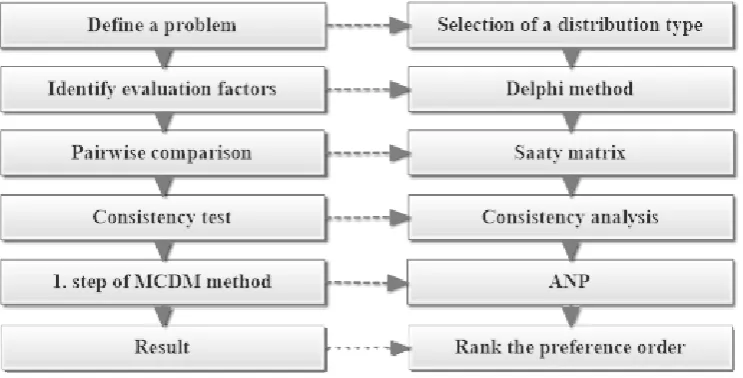
of Delphi method and a method of ANP, which provides partial results subsequently used in the TOPSIS method. The process of the proposed model is shown in Figure 5.
Delphi method - The first and most impor
-tant step of the proposed model is a pairwise
com-parison of input factors and their influence on the
resulting type of distribution routes. For this
pose, there is an assembled group of evaluators, consisting of logistics managers, researchers, but also professionals, in order to achieve a correct evaluation of these factors possible. For this pur-pose, the proposed method is Delphi [14] which is suitable for the determination of a professional estimate by a selected group of people. It’s a tech-nique that uses subjective opinions of members of the expert group in order to obtain overall consen-sus views. Delphi method can be simply seen as a kind of brainstorming session with clear rules.
Saaty method - To obtain the weighting of
individual factors a use of Saaty method is recom-mended [22]. The input to this method is the pair-wise comparison of individual factors obtained in Step I. Each expert group is also assigned a
weight, which represents the degree of influence
on the resulting model. This method takes into
ac-count different preferences between criteria and
a wide range scoring scale, which is intended for evaluation (Formula 1). Therefore, it is possible
to detect even slight differences in preferences
between the selected criteria, using the process of determining weight:
(1)
Values of 2, 4, 6, 8 are designed for evaluation of so-called interphase. This method compares each pair of criteria i and j. Their evaluations are entered in the Saaty matrix (Formula 2), accord-ing to the followaccord-ing rules:
(2)
This method is comprised of five steps
[22], which include weight calculation ʋi by using the standardized geometric mean of Saa-ty matrix‘s rows:
Consistency analysis - An important factor
to whom it is necessary to pay attention during pairwise comparison is consistency [22]. In case that we do not only transfer the exact
measure-ments to elemental scale but use judgment, there is almost always inconsistency. (If we say that a is 3 times greater than b, but only 1/5 times as good as c, c would have to be 15-times better than b to avoid inconsistency.) Given the characteristics of reciprocal matrices and eigenvalues, the minor
inconsistency does not have any effect in deter -mining the vector priorities.
The degree of consistency below the 0.10 (10%) value is considered acceptable [9]. For higher values the pairwise comparison matrix should be adjusted, otherwise, the results of the entire model quickly lose their predictive val-ue. Experimentally derived RI values reported by Saaty (1980) for a matrix of order 1-15 are shown in Table 2.
AHP / ANP method (Analytic Hierarchy
Proces / Analytic Network Process) - Method
of AHP [22, 23], which is widely discussed in lit-erature [10, 18, 27] is a method for priority setting which derives the relative priority based on pair-wise comparisons of elements at the same hierar-chical level using the absolute numbers at range from 1 to 9. Analytic Hierarchy Process (AHP) is a method that is appropriate for the hierarchical structure of the systems. Absolute numbers of the scale are approximations of weights ratio wj/wk which make it possible to deduce the weights of wj a wk. AHP method uses a general model for the weight synthesis in a hierarchical structure where wij are local weights of i element on a given level with relation to the j element from previous level of hierarchical structure, wj are weights of ele-ments of previous levels of hierarchical structure and ui is a global element weight in terms of all elements of the previous hierarchical structure levels. Method of ANP (Analytic Network Pro-cess) is a network generalization of AHP method (Analytic Hierarchy Process). Analytic network process (ANP) is a method that allows the sys-tem to include all possible interdependencies and feedbacks [23]. Strategic partnership of the chain units can be modeled using network structures. The structure of the ANP model is suitable for expressing dependencies within the network of supply / distribution relationships, where units of supply / distribution chains can be grouped into
so-called clusters and linked by streams affect
-Table 2. Experimentally derived RI values [22]
Rank 1 2 3 4 5 6 7 8 9 10 11 12 13 14 15
ing their dependency. These model clusters can represent suppliers, manufacturers, distributors, customers and these links between clusters
rep-resent possible influences between elements of different clusters and loops at individual clusters
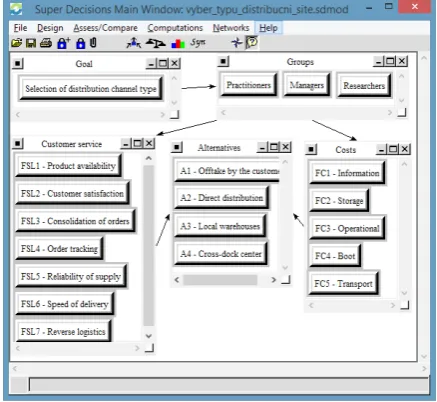
represent possible links between elements of the cluster. For dealing with the network structures using ANP. There is a program available named Super Decisions by CDF company (Creative De-cisions Foundation), which will be used in the proposed model.
THE APPLICATION OF THE PROPOSED
MODEL
To determine the most accurate values of pairwise comparison there were three groups of
evaluators created. The first group was composed
practitioners in the form of logistics manager, pur-chasing manager, and sales director. The second group consisted of a group of scientists, dealing with logistics, which drew on currently available studies and their own experience. The third group
was the professional community, using different
types of distribution channels in the form of trans-porters, customers and end customers.
Determination of input factors and suitable alternatives using a modified Delphi method - A model was designed based on the Delphi method, consisting of input conditions containing costs rel-evant to the choice of type of the distribution chain and the level of individual services, occurring in the distribution chain. From the perspective of each alternative of distribution channels, four sug-gested types were assessed by the Table 3.
Assembling the resulting pairwise
compar-ison matrix by using the Saaty method - From
the three resulting matrices obtained from each group of evaluators, the resulting matrix was cal-culated using the Saaty method. Individual groups were assigned a weight according to the degree of
their influence on the final model.
Determination of the linkages and the
re-sulting weights by ANP - To determine the
mu-tual linkages and calculate the resulting weights a Super Decisions program by CDF was used, which is useful in solving problems with multiple interrelated input factors. Solution by using AHP
method would be slow and inefficient. The assem -bled model in the program is shown in Figure 6.
Paired comparison obtained by using the meth-od of Delphi in the step II. was entered into the program to individual evaluation groups and by exporting an unweighted matrix was obtained for each factor. This matrix is shown in Table 4 and 5. Table 3. Input factors and a set of options for the proposed model
Selection of a distribution channel type
FC - Costs
FC1 - Information
A
- Alternatives
A1 - Offtake by the customer
FC2 - Storage FC3 - Operational
FC4 - Boot
A2 - Direct distribution FC5 - Transport
FSL
– Customer service
FSL1 - Product Availability FSL2 - Customer satisfaction
A3 - Local branches or warehouses / distribution centers FSL3 - Consolidation of orders
FSL4 - Order tracking FSL5 - Reliability of supply
A4 - Cross-dock center FSL6 - Speed of delivery
FSL7 - Reverse logistics
In conclusion, we calculate the proposed model using an ANP method. The results are shown in Table 6.
The results are clear. The best option for the proposed issue is set up a distribution channel with one cross-dock center or warehouse placed on the targeting market. The results have been
counted with an APN method and 3 different
values have been shown. Column Ideals (ideal variants) shows a variant with the higher weight as an ideal variant and the others are its shares.
These results are used for comparing values be-tween each other. Normals (normalized variants) shows weights normalized in an exact way then their sum is equal to 1. These values we can see in the AHP method. Raw (gross variants) is a vector acquired directly from the limited super matrix. These values are useful for future counting. The Table 6 is graphically illustrated in Figure 7.
The model results clearly show that the cur-rent model in the form of local branches is the least appropriate one. Introducing distribution Table 4. Unweighted ANP matrix of cost criteria
ANP matrix pro FC FC1 FC2 FC3 FC4 FC5
A1 0.4587 0.0346 0.3225 0.0473 0.4364
A2 0.1508 0.5475 0.4860 0.6210 0.0857
A3 0.3558 0.1078 0.1094 0.0622 0.2601
A4 0.0348 0.3101 0.0821 0.2694 0.2178
Table 5. Unweighted ANP matrix of customer service
ANP matrix pro FCL FSL1 FSL2 FSL3 FSL4 FSL5 FSL6 FSL7
A1 0.0419 0.4177 0.2654 0.0500 0.1768 0.5426 0.6629
A2 0.5329 0.0776 0.0344 0.1800 0.0845 0.0401 0.0449
A3 0.0608 0.1746 0.1821 0.0858 0.2754 0.3352 0.2270
A4 0.3643 0.3301 0.5180 0.6842 0.4634 0.0821 0.0652
Table 6. The result of the ANP method
Name Ideals Normals Raw
A1 - Offtake by the customer 0.864610 0.277077 0.092359
A2 - Direct distribution 0.689286 0.220892 0.073631
A3 - Local warehouses 0.566574 0.181567 0.060522
A4 - Cross-dock center 1.000000 0.320465 0.106822
channel in the form of the cross-dock center for the company is preferable from the viewpoint of
the level of customer service and of the significant
reduction of costs, which is shown primarily by eliminating losses in the distribution channel. The
company cannot afford the complete abolition of
local branches due to a local dealership, so the re-duction will be implemented in local warehouses,
which will result in sufficient cost reductions.
CONCLUSION AND FINAL DISCUSSION
Appropriate choice of the type of distribu-tion channel can save the enterprise
consider-able amount of financial resources. This article
focused on designing and building a model for selection of a suitable type of distribution chan-nel, mainly for to the expenses reduction of the existing distribution channel and simultaneously for assessment of its suitability for the company.
The proposed model provides a clear insight on the discussed issues of selecting the type of distribution channel for the company’s man-agement while considering various input fac-tors, with the possibility to modify these factors within the proposed model. The model is formed
by modified version of Delphi method and also
the method of ANP. The Delphi method is in this case based on pairwise comparison of input
factors and then their influence on the type of
distribution routes. The ANP method takes into
account different preferences between criteria
and a wide range scoring scale. The presented model is able to work with both qualitative and quantitative criteria.
Despite the quality and clarity of the pro-posed model, the greatest threat to the accuracy and relevance of the model is the input formation of pair evaluation. This evaluation may have a profound impact on the outcome of the model and even at small inconsistency level of input
evalu-ation, the outcome may be affected. In the pre -sented model, this is prevented by setting up three major evaluation teams of more members which
ensure removal of fluctuations or inconsistency of
evaluation. For each pair evaluation, there is also a consistency analysis which immediately warns you about any evaluation discrepancy.
ACKNOWLEDGEMENTS
This contribution is the result of the proj-ects VEGA 1/0403/18, VEGA 1/0063/16, VEGA 1/0708/16, KEGA 018TUKE-4/2016.
The authors would like to thank everyone who participated in this research for their valu-able suggestions, comments, and ratings. Big thanks also go to all employees of the discussed company for their patience and willingness dur-ing the input evaluation processdur-ing for the model creation. The work was created in connection
with the scientific research project of the Univer -sity of Pardubice no. 51030/20/SG550001.
REFERENCES
1. Agarwal P., Sahai M., Mishra V., Bag M. and Singh V. A review of multi-criteria decision-making tech-niques for supplier evaluation and selection. Inter-national journal of industrial engineering computa-tion, 2(4), 2011, 801-810.
2. Alias M.A, Hashim M., Zaiton S. and Samsudin S. Multi-criteria decision making and its applications: a literature review. Jurnal Teknologi Maklumat, 20(2), 2008, 129-152.
3. Aruldoss M., Lakshmi T.M. and Venkatesan V.P. A survey of multi-criteria decision-making methods and its applications. American Journal of Informa-tion Systems, 1(1), 2013, 31-43.
4. Bernroider E.W. and Mitlohner J. Characteristics of the multiple attribute decision-making meth-odology in enterprise resource planning software decisions. Communications of the IIMA, 5(1), 2015, 1-6.
5. Costantino F., Di Gravio G. and Shaban A. Multi-criteria logistics distribution network design for mass customization. International Journal of Ap-plied Decision Sciences, 7(2), 2014, 151-167. 6. Gašparík J. Definovanie predajných kanálov
železničného podniku. Perner´s Contacts, 2006, 3-9.
7. Ho W. and Emrouznejad A. Multi-criteria logistics distribution network design using SAS/OR. Expert Systems with Applications, 36(3), 2009, 7288-7298. 8. Ho W., Xu X. and Dey P.K. Multi-criteria decision making approaches for supplier evaluation and se-lection: A literature review. European Journal of Operational Research, 202(1), 2010, 16-24. 9. Chan F.T.S., Chan H.K., Lau H.C.W. and Ip R.W.L.
An AHP approach in benchmarking logistics per-formance of the postal industry. Benchmarking: An International Journal, 13(6), 2006, 636-661. 10. Isıklar G. and Buyukozkan G. Using a multi-crite
-ria decision-making approach to evaluate mobile phone alternatives. Computer Standards & Inter-faces, 29, 2007, 265-274.
12. Kahraman C., Cebeci U. and Ulukan Z. Multi-cri-teria supplier selection using fuzzy AHP. Logistics Information Management, 16(6), 2003, 382-394. 13. Kunz J. Complexity of performance measures and
decision quality. International Journal of Applied Decision Sciences, 3(4), 2010, 331-337.
14. Linstone H.A. and Turoff M. The Delphi method:
Techniques and applications, Vol. 29. Reading, MA: Addison-Wesley, 1975.
15. Lu J., Zhang G. and Ruan D. Multi-objective group decision making: methods, software, and applica-tions with fuzzy set techniques. Imperial College Press, 2007.
16. Mallen B. Selecting channels of distribution: a multi-stage process. International Journal of Physi-cal Distribution & Logistics Management, 26(5), 1996, 5-21.
17. Nilay Serbest G. and Vayvay O. Selection of the most suitable distribution channel using fuzzy An-alytic Hierarchy Process in Turkey. International Journal of Logistics Systems and Management, 4(5), 2008, 487-505.
18. Onut S. and Soner S. Transshipment site selec-tion using the AHP and TOPSIS approaches under fuzzy environment. Waste Management, 28, 2007, 1552-1559.
19. Qureshi M.N., Kumar P. and Kumar D. Selection of Transportation Company: An analytic network process (ANP) approach, 2013.
20. Rao R.V. Introduction to Multiple Attribute Deci-sion-making (MADM) Methods. Decision Making in the Manufacturing Environment: Using Graph
Theory and Fuzzy Multiple Attribute Decision Making Methods, 27-41.
21. Weiszer M., Fedorko G. and Molnar V. Bi-objective optimization of timetabling and vehicle scheduling in public transportation. Proc. of Carpathian Logistics Congress (CLC), Cracow, Poland 2013, 330-335. 22. Saaty T.L. The Analytic Hierarchy Process, 3rd ed.
McGraw-Hill, New York, NY, 1980.
23. Saaty T.L. How to make a decision: the analytic hierarchy process. Interfaces, 24(6), 1994, 19-43.
24. Selçuk P. Evaluation of third‐party logistics (3PL)
providers by using a two‐phase AHP and TOPSIS
methodology. Benchmarking: An International Journal, 16(5), 2009, 588- 604.
25. Sha D.Y. and Che Z.H. Supply chain network de-sign: partner selection and production/distribution planning using a systematic model. Journal of the Operational Research Society, 57(1), 2006, 52-62. 26. Singh A. and Malik S.K. Major MCDM Tech-niques and their application-A Review. IOSR Jour-nal of Engineering, 4(5), 2014, 15-25.
27. Wu C.R., Lin C.T. and Lin Y.F. Selecting the pref-erable bank assurance alliance strategic by using expert group decision technique. Expert Systems with Applications, 36(2), 2009, 3623-3629.
28. Zylstra K.D. Lean distribution: applying lean manufacturing to distribution, logistics, and supply chain. John Wiley & Sons, 2012.
![Table 2. Experimentally derived RI values [22]](https://thumb-us.123doks.com/thumbv2/123dok_us/8806575.1774889/5.595.84.289.521.593/table-experimentally-derived-ri-values.webp)