Available Online at www.ijpret.com
402
INTERNATIONAL JOURNAL OF PURE AND
APPLIED RESEARCH IN ENGINEERING AND
TECHNOLOGY
A PATH FOR HORIZING YOUR INNOVATIVE WORK
PERFORMANCE OPTIMIZATION OF MIXED FLOW IMPELLER USING BACKWARD
BLADES
MR. PARAG M. THETE1, PROF. H. D. THAKARE2
1.M. E. Second Year (Thermal Engineering), IBSS College of Engineering, Amravati 2.Assistant Professor, IBSS College of Engineering, Amravati
Accepted Date: 27/02/2014 ; Published Date: 01/05/2014
\
Abstract: Pump is a device mainly used for transporting liquid from lower level to higher
level. In pumps the mechanical energy is converted into hydraulic energy. The two main components of centrifugal pump are impeller and casing therefore, they must be carefully designed for better performance of pump. To improve the efficiency of centrifugal flow pump, Computational Fluid Dynamics (CFD) analysis is one of the advanced tools used in the pump industry. A detailed CFD analysis was done to predict the flow pattern inside the impeller which is an active pump component. From the results of CFD analysis, the velocity and pressure in the outlet of the impeller is predicted. CFD analyses are done using ANSYS CFX software. In this paper, the analysis will be done of the existing impeller along with the modified impeller by changing its inlet and outlet blade angle.
Keywords: Pump, Impeller, CFD.
Corresponding Author: MR. PARAG M. THETE
Access Online On:
www.ijpret.com
How to Cite This Article:
Available Online at www.ijpret.com
403 INTRODUCTION
Pump is a mechanical device generally used for raising liquids from a lower level to a higher one. This is achieved by creating a low pressure at the inlet and high pressure at the outlet of the pump. However, work has to be done by a prime mover to enable it to impart mechanical energy to the liquid which ultimately converts into pressure energy.
“The pumps are divided into two basic groups, depending on the way in which the liquid is transferred from suction side to the delivery side of the casing as positive displacement pumps and centrifugal pumps”. The centrifugal pump terms are firstly introduced by H. Addison. The centrifugal pumps are in the category of cased pumps. The moving element in centrifugal pumps is the impeller which is the rotor mounted on the rotating shaft and increases the moment of momentum of the flowing liquid in the impeller.
The turbine pumps are first used as lifting water from the small diameter water supplies and irrigation wells. However they are used in wide range of applications other then lifting water from irrigation wells such as used in circulation systems in the steel industry for cooling, water extraction from boreholes and rivers, sea water services, deep sea mining, extraction water from geothermal wells, city water district systems and etc.
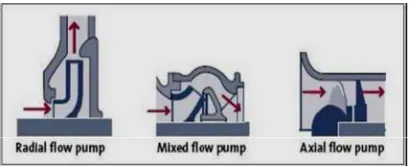
Pumps are also classified as radial flow pump, mixed flow pump and axial flow pump.(Shown in figure 1)
Figure 1. Types of pump
Available Online at www.ijpret.com
404 2. LITERATURE SURVEY
A Manivannan [1] , studied the CFD analysis of mixed flow pump and Based on the detailed design and CFD analysis of the mixed flow impeller, the following conclusions are derived. In the mixed flow pump the best efficiency point of the pump is found to be 11 lps. For the existing impeller, the head, power rating and efficiency are found out to be 19.24 m, 9.46 kW and 55% respectively.
Figure 2. Head developed by the existing and modified impellers
The impeller 1, the percentage increase in the head, power rating and efficiency are 3.22%, 3.9% and 7.27% respectively. the impeller 2, the percentage increase in the head, power rating and efficiency are 10.29%, 7.61% and 10.91% respectively. The impeller 3, the percentage increase in the head, power rating and efficiency are 13.66%, 12.16% and 18.18% respectively.(Shown in figure 2)
Available Online at www.ijpret.com
405
Kiran Patel [2], studied the CFD analysis of mixed flow pump derived that the Head predicted by CFD analysis is higher than the test result at rated point. It also concluded that Power predicted by CFD analysis is higher at rated point to compare with the test result as shown in figure 3.
Figure 3. Head versus Capacity Curve
Power predicted by CFD analysis is 5 to 10% higher at rated point. To compare with the test result, disc friction power loss calculated using NEL method the volumetric efficiency is determined. Pump efficiency considering disc friction loss and leakage loss is predicted and it was found within +5% ranges, at duty point shown in figure 4. Efficiency predicted by CFD analysis is higher than the test result. Leakage loss is predicted using. Efficiency is improved by 1% after matching stator angle and changing hub curve profile. Stator blade loading at hub and shroud has improved.
Figure 4. Efficiency versus Capacity Curve
Available Online at www.ijpret.com
406
Although the simplifications were done in the model, in order to adjust the geometry to the software limitations, numerical analysis using a CFD code, ANSYS® CFX® 11.0 presents results in agreement with the references. Three dimensional simulation of the entrance impeller interaction of a hydraulic disc pump.
The results obtained for the pressure fields, and therefore to the head performance curve, were satisfactory in the three conditions tested as shown in figure 5.
Figure 5. Results obtained in the simulations and manufacturer head curve.
Mitul G. Patel, Subhedar Dattatraya, Bharat J. Patel [4] carried out the analysis of the impeller used in the mixed flow submersible pump. Fluid flow (CFX) was used for the analysis purpose and due to constant mass flow rate, same boundary condition, i.e. the mass flow rate at the inlet and outlet was applied, the hub and shroud was defined as a wall. And obtained (1) pressure and velocity distribution in meridional view of impeller and in blade to blade view of impeller and concluded that the head generated by the CFX showed good agreement with the experimental head.
S. Rajendran and Dr. K. Purushothaman [5]presented the work that describes the simulation of
flow in the impeller of a centrifugal pump having head H = 10m and discharge Q = 0.0125
m3/sec. The flow pattern, pressure distribution in the blade passage, blade loading plot at 50%
span, stream wise variation of mass averaged total pressure was presented. He also concluded that CFD predicted value of head at the design flow rate is approximately H =9.4528 m, and pressure contours show a continuous pressure rise from leading edge to the trailing edge of the impeller due the dynamic head developed by the rotating pump impeller.
Available Online at www.ijpret.com
407
angles is evaluated and concluded that, when pumps operate at nominal capacity, the gain in the head is more than 6%, when outlet blade angle increases from 20° to 50°.
Swapnil Urankar, Dr. H S Shivashankar, Sourabh Gupta [7] had presented the impeller and volute designed by Walter K Jekat method and error triangle method, which was modified during this work by taking equal divisions and varying vane inlet angle from hub to shroud. The model prepared is been analyzed in CFD tool CFX and its performance is analyzed at different flow rates. At, inlet the boundary conditions was 0 pa, and at outlet 500 m3/hr, 1800 rpm. Finally, concluded that increase in efficiency is due to little twist provided at the leading edge of the vane by varying the leading edge angle from hub to shroud, and small modification in the vane can give very good results.
3. PROPOSED WORK
1) Collection of Experimental Data for Mixed Flow impeller from manufacturers catalogue.
2) Modeling of Mixed Flow impeller in SOLIDWORKS.
3) Meshing of Mixed Flow impeller in ANSYS Workbench Mesh Module.
4) CFD Analysis of Mixed Flow impeller in ANSYS CFX.
5) Comparison of Experimental Results with CFD Analysis Results (Validation).
6) Performance Optimization of Mixed Flow Impeller varying Inlet and Outlet Blade Angle.
CONCLUSION
As we can see in the literature survey different authors have conducted the experiments on the impeller and conducted the fluid analysis. Kiran patel and N ramakrishan had done in experiment Efficiency predicted by CFD analysis is higher than the test result. Head predicted by CFD analysis is 5 to 10 % higher than the test result at rated point. A. manivanan has done that CFD analysis is an effective tool to calculate quickly and inexpensively the effect of design and operating parameter of pump. By properly designing pump impeller the efficiency of pump can be improved. This paper will help to design the impeller which could have the more effective which will increase the efficiency of the submersible pump.
REFERENCES
1. A. Manivannan,” Computational fluid dynamics analysis of a mixed flow pump impeller” ,
Available Online at www.ijpret.com
408
2. Kiran Patel And N. Ramakrishnan,” CFD Analysis of Mixed Flow Pump”. Jyoti ltd.
3. Maitelli, C. W. S. de P.1;, V. M. de F.; da Mata, “Simulation Of Flow In A Centrifugal Pump Of
ESP Systems Using Computational Flui Dynamics” Brazilian Journal Of Petroleum And Gas V. 4 N. 1 P. 001-009 2010 Issn 1982-0593
4. Mitul G Patel, Subhedar Dattatraya, Bharat J Patel,” CFD Analysis of Mixed Flow Submersible
pump Impeller”, INDIAN JOURNAL OF APPLIED RESEARCH, Volume : 1 | Issue : 9 | June 2012
5. S. Rajendran and Dr. K. Purushothaman, Analysis of a centrifugal pump impeller using
ANSYS-CFX”, International Journal of Engineering Research & Technology (IJERT), Vol. 1 Issue 3, May – 2012
6. E.C. Bacharoudis, A.E. Filios, M.D. Mentzos, D.P. Margaris. “Parametric study of a centrifugal
pump impeller by varying the outlet blade angle”. The Open Mechanical Engineering Journal; 2, pp.75-83; 2008.
7. Swapnil Urankar, Dr. H.S. Shivashankar. “Design and CFD analysis of single stage, end suction,
radial flow centrifugal pump for mine dewatering application”. IJREAS, vol.2, issue 2, pp.6-18, Feb. 2012.
8. ONUR ÖZGEN, “Design Improvements on Mixed Flow Pumps by Means of Computational
Fluid Dynamics”,M. TECH Thesis.
9. HWOh and SYoon E, (2008), “ Hydrodynamically detailed performance analysis of a
mixed-flow waterjet pump using computational fluid dynamics”, Part C: Journal of Mechanical Engineering Science 2008 222: 1861
10.HWOh, (2010), “Design parameter to improve the suction performance of mixed- flow