M. Mohamed Shabi*,
Department of Pharmacy asiA Metropolitan University (AMU), G-8, Jalan Kemancahaya, Batu 9, 43200, Cheras,Selangor, Malaysia. E-mail: [email protected]
Address for correspondence
Mohamed Shabi. M et al. / JGTPS / 6(1)-(2015) 2479 – 2484
EFFECTS OF JASMINUM SAMBAC
FLOWER EXTRACT ON THE SEXUAL
BEHAVIOUR AND ESTROUS CYCLE MODIFICATION IN RATS
INTRODUCTION
Sexual relationship between both males and females is the most essential factor in marriage life. In orders to have a satisfactory intercourse in males, the reproductive organs must function normally. Continues failure to perform the function or disturbance to sexual response cycle is denotes as male sexual dysfunction. Continues failure to perform the function or disturbance to sexual response cycle is denotes as male sexual dysfunction. It is more common in men of all ages, ethnic and culture background [21].This condition is caused by multifactor which is associated with unhealthy life style, increasing age, psychological disorders and also side effects of medications [17]. Increasing prevalence of male sexual dysfunction, lead to an increase multiple types of modern treatment choices. But, because of their cost, undesired effects and availability, patients are hesitated to proceed with it [21].
Vast range of medicinally important plants is being used and their effects were scientifically proven, one of plant which is being studied was Jasmines (Jasminum). Jasmines are one of the flowering plants which are important too and rich with quiet number of medicinal purposes [5].
The traditional effects of the plant attracts scientist to study more about it pharmacological actions. The whole plant is used as astringent, aphrodisiac, antiseptic, anodyne, depurative, emmenagogue, emollient, antihelminth, deobstruant, dentifrice, suppurative, diuretics and tonic [15]. Regarding this, we aimed to study the effects of Arabian Jasmine (Jasminum sambac) which has been proposed for its traditional used in Ayurveda to improve sexual dysfunction but there is no evidence related research on the sexual behavior in animal models.
2. MATERIAL AND METHODS 2.1 Plant material
TheJasminum sambac(L.) Aiton flowers were collected at Penang, Malaysia in the month of June 2014. The collected flowers were sent to identification and authentification at University Putra Malaysia (UPM). The specimen voucher number is SK 2470/14. This study was done to investigate traditional used of Jasminum sambac in Ayurveda to improve sexual dysfunction and regulate menstrual flow. This led us to investigate the effect of the plant on sexual behavior and estrous cycle modification in rats. Animals were divided into 5 groups. Group 1 act as control received distilled water while Group 2, 3, 4 and 5 received 25, 50, 100 and 200 mg/kg body weight of the extract respectively. The results obtained significantly decrease the metestrous phase (p < 0.05) at doses of 25, 50, 100 and 200 mg/kg body weight when compare to control while increases the proestrous phase non-significantly when compare to control. It also non-significantly increases the number of cycle of female rats estrous cycle (p < 0.05) at the doses of 25, 50, 100 and 200 mg/ kg body weight by shortening the days of each phases when compared to control group while results obtained for sexual behaviours study were 50,100, 200 and 400 mg/kg body weight significantly increases the mounting frequency of male rats (p < 0.05) when compared to control and decreases mounting latency (p < 0.05) when compared to control. Thus, this study supports the acclaimed of the plant uses in folk medicine.
Key words: Jasminum sambac, estrous cycle, mounting frequency, mounting latency
ABSTRACT
Rohini Jayaraman
1,
Kalshini Balachandran
1,
M. Mohamed Shabi*
2,
Vasudeva Rao Avupati
21
Department of Biomedicine;
2Department of Pharmacy, Asia Metropolitan University (AMU), G-8, Jalan Kemacahaya, Batu 9,
43200, Cheras, Selangor, Malaysia
Journal of Global Trends in Pharmaceutical Sciences
Journal home page: www.jgtps.com
ISSN: 2230-7346
2.2 Preparation of extract
The flowers extract was prepared according to [6]. About 4 kilograms of the flowers was dried at 50°C
for 42 h. Then, the dried flowers were powdered and macerated in 95% ethanol at room temperature overnight. After elution, the macerated flowers residues were repeatedly done with equal volume of ethanol overnight and eluted again. Next, the ethanol elutes are combined and filtered through Whatmann filter paper no. 42. The filtered materials were then evaporated in waterbath at 60°C. Finally, the semisolid light yellow materials were stored in desiccators until is being use. During the experiment, the extract was dissolved in 1% Tween 80 for further studies.
2.3 Animals
The animals for the studies were obtained from animal house. The animals used for estrous cycle study were female Sprague-Dawley rats weighing 150-170 g and for sexual behaviour study were male Sprague-Dawley rats weighing 150-200 g and female rats weighing 155-165 g. All the animals were housed in clean polycarbonate cages with paddy husk as bedding and also in well-ventilated house conditions. The temperature was maintained at about 21 + 2°C, photoperiod at 12 h dark and 12 h light cycle. All the animals were allowed to free access of water and feed with standard commercial pellet chaw.
3.0 EXPERIMENTATION
3.1 Animal preparation for estrous cycle study
25 cyclic female rats were chosen for the study and divided randomly in group of five each.
Group-Iserved as control and received distilled water Group-IIreceived (25 mg/kg) of extract
Group-IIIreceived (50 mg/kg) of extract Group-IVreceived (100 mg/kg) of extract Group-Vreceived (200 mg/kg) of extract
Administration of extract was done orally once a day at 8 a.m. for 14 days. Then, the vaginal smears were collected from all the female rats to observe the changes in estrous cycle [11].
3.2 Collection and staining of sample
Collection and staining of vaginal smears were done according to [12] and [8] and with some modification by [4]. The smears were taken using sterile cotton-tipped swabs wetted in normal saline (NaCl 0.9%) and inserted gently into the rat’s vaginal opening. Later, the cotton-tipped was carefully rotated (one twist) against the vaginal wall to obtain the smear. During the collection of smear, the rats were not
anesthetized. Collected samples were spread on glass slide to make a smear, dried, fixed in absolute alcohol, stained with Papanicolaou stain and mounted in DPX and observed under light microscope.
3.3 Animal preparation for sexual behaviour study
Animals used for sexual behaviour study were 25 male rats. The male rats were then randomly divided into five groups containing 5 rats each group.
Group-Iserved as control and received distilled water Group-IIreceived (50 mg/kg) of extract
Group-IIIreceived (100 mg/kg) of extract Group-IVreceived (200 mg/kg) of extract Group-Vreceived (400 mg/kg) of extract
3.4 Male rat sexual behaviour test procedure
The sexual behaviour study of male rats was followed and modified from [21] and [1]. Before the commencement of the sexual behaviour study, the male rats were brought to the laboratory and trained with the female rats for 3 days. The test was carried out at dark or dim lighted area. In order to observe the libido-oriented mounting behaviour, non-estrous female rats were paired with male rats. The experiment is conducted for 3 hours from 9 a.m to 12 p.m during day time in a room temperature about 26-27°C. The experiment began after 1 hour of extract administration on Day 1, 3 and 5 by placing the one male rat into the plastic cage size 33.0cm x 20.0cm x 19.0cm and allowed to acclimatize for 15 minutes. Then, two female rats were introduced to the cage and the mounting behaviour was observed from the side of the cage for 15 minutes observatory period at the start of the first hour. Then, the female rats were separated for 105 minutes. Later, the female rats were reintroduced into the arena and the mounting behaviour was observed for 15 minutes as before at the third hour. The behaviour was recorded using video camera.
3.5 Parameters of sexual behaviour
Mounting frequency (MF) and mounting latency (ML). MF is the number of times the male assumed copulatory position but failed to achieve intromission-characterized by lifting of the male’s forebody over the hindquarter of the female and clasping her flanks with his forepaw. ML is the time interval between the introductions of the female to the first mount by the male.
4.0 STATISTICAL ANALYSIS
(n=5) followed by Duncan Multiple Range Test and p<0.05 was considered statistically significant.
5.0 RESULTS
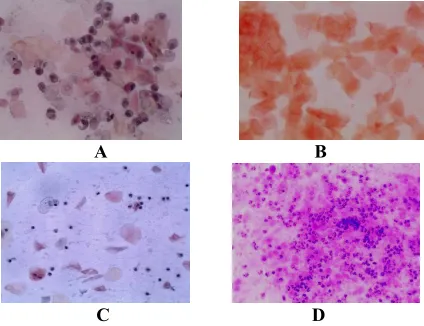
Figure 1 shows daily vaginal smear obtained as explained in materials and methods from a single female rat was stained with Papanicolaou stain. The microscope photographs under 40x magnifications represent each stage of the estrous cycle. Proestrous stage (A) shows mostly nucleated epithelial cells of
intermediate maturity, which become more mature orange cells toward the end of this phase. Estrous (B) is characterized by fully mature orange cells lacking a nucleus. Metestrous stage (C) is characterized by intermediate and fully mature epithelial cells admixed with inflammatory leukocytes. Diestrous stage (D) is characterized primarily by inflammatory cells with few immature epithelial cells.
A B
C D
Figure 1: Shows daily vaginal smear obtained as explained in materials and methods from a single female rat was stained with Papanicolaou stain.
Table I below shows that continuous administration of Jasminum sambacflowers extract for 14 days significantly decrease the metestrous phase (p < 0.05) when compare to control while increases the proestrous phase non-significantly when compare to control. The administration of the extract also significantly increases the number of cycle of female rats estrous cycle (p < 0.05) by shortening the days of each phases when compare to control group.
Table II below shows that ethanolic extract of Jasminum sambac flowers administration at 50, 100, 200 and 400 mg/kg body weight significantly increases the mounting frequency of male rats (p < 0.05) when compared to control following the administration of the extract on Day 1 and 5 at first hour and significantly reduces the mounting frequency (p < 0.05) at third hour of observation. But, mounting frequency of male rats on Day 3 does not showed any significant increases for the first hour for 50, 100 and 200 mg/kg body weight dose when compare to control and showed significant increases (p < 0.05) for 400 mg/kg body weight dose when compared to control. However, the male rats showed significant decreases on mounting frequency (p < 0.05) on the third hour for the 50, 100 and 200 mg/kg body weight doses and not for 400 mg/kg body weight dose.
Table IIIbelow shows that ethanolic extract of Jasminum sambacflowers administration at 50, 100,
200 and 400 mg/kg body weight does not showed Significant decreases on mounting latency of male rats (p < 0.05) when compared to control following the administration of the extract on Day 1 both at first and third hour of observation. But, the mount latency of male rats on Day 3 and 5 showed significant decreases (p < 0.05) both for the first and third hour of observations for 50, 100, 200 and 400 mg/kg body weight dose when compare to control. 6.0 DISCUSSION
The purpose of the present study was to find out the effects of the ethanolic extract of the Jasminum sambac flowers on estrous cycle of rats. Progression through the estrous cycle which is remarkably similar to those seen in the human menstrual cycle is the important landmarks of ovarian follicular development and the hormonal changes [4].
The estrous cycle is usually subdivided into four stages. Those referred as proestrous, estrous, metestrous, and diestrous. Proestrous stage is similar to the human follicular phase of the menstrual cycle and is dominated by elevated levels of estradiol, even though residual levels of progesterone may remain in the circulation through the beginning of this phase.
The last stage is the diestrous stage. It is best regarded as corresponding to the late luteal phase as in human menstrual cycle because high levels of circulating progesterone remain significantly during this stage [4]. These phases can be distinguished by the presence of cornified enucleated epithelial cells, nucleated epithelial cells and leukocytes which are found in the vaginal smear [11]. This current study revealed that treatment with ethanolic extract of Jasminum sambacflowers at different doses for 14 days showed significant changes in the duration of estrous cycle with decreases metestrous phase and non-significantly increases proestrous phase. The result obtained is against with the study done [16] using
Achyranthes aspera plant in rats showing prolonged metestrous with reduced proestrous phase indicates that the plant has anti-fertility effect and safe to use as contraceptive.
Since the obtained result is contraindicate, non-significant increased in proestrous phase which also similar to follicular phase in human menstrual cycle probably stimulate the ovarian follicles to develop faster. This mechanism occurs due to elevated level of follicle-stimulating hormone (FSH) which increases and shortens the follicular phase by stimulating the development of the follicles [7]. Elevated level of FSH is probably due to presence of phytoconstituents such as saponins, flavanoids and steroid in ethanolic extract of Jasminum sambacflowers.
These constituents act centrally whereby synthesized and secrete high amount of FSH [21].The quest for aphrodisiacs that can increase libido, potency and sexual pleasure goes back to centuries. Various substances of animal and plant source have been utilized in folk medicine of distinctive societies as aphrodisiacs, some of which have been identified pharmacologically to exert their effects on the hypothalamic-pituitary-testicular axis [21].
Numerous phytochemical studies have revealed many bioactive agents of J. sambac plant extract [5,6,14]. The presence of bioactive compounds such as saponins in Tribulus terrestrisextract [3]and in
Nymphaea stellata extract [10], alkaloid from Arctium
lappa extract [2] and presence of other agents such as sterols and phenolic compounds in Syzygium aromaticum [19] have been scientifically proven to be responsible for aphrodisiac activity in animal model studies. Aphrodisiac activity is exhibited by those bioactive agents either by increasing the biosynthesis and secretion of androgens or act directly on the central nervous system to modulate neurotransmitters action and gonadal tissues in man.
Mounting frequency (MF) and intromission frequency (IF) are useful parameter of sexual vigour, libido and potency [9,19]. While mounting frequency (MF) reflects sexual motivation and increases in intromission frequency (IF) shows the efficiency of erection, penile orientation and the ease by which ejaculatory reflexes are activated [21]. Therefore, the significant increase in MF following the administration of ethanolic extract of J. sambacflowers on Day 1 and subsequently at all the doses on other days of observation suggests improved libido. The similar findings were obtained by [18]in his study on Myristica
fragrans and Syzygium aromaticum while [21] on
Massularia acuminateplant.
Besides that, mounting and intromission latencies are considered as indicators of the sexual motivation in male rats [22]. ML and IL are inversely proportional to sexual motivation [21]. Therefore, the significant reduced in the mounting latency observed at the different doses of the J. sambacextract on Day 3 as well as at all the doses studied on Day 5 indicate reduction in the hesitation time of the male rats towards the females [20]. It may perhaps an indication of enhanced sexual appetitive behaviour in the male rats. All these further support the sexual function improving effect of the extract at these doses as similar results reported by [21] on Massularia acuminate while [22]on
Hibiscus cannabinusplant study.
In addition, enhancement of male sexual behavior also depends on the blood testosterone level. Improvement in sexual parameters indicates that the extract could have probably acted by increasing testosterone levels or by changes at neurotransmitter level or at cellular level [10]. Moreover, continuous administration of extract might also increased testosterone, indicating the association of hypothalamic-pituitary-gonadal axis stimulation. Increases in testosterone levels might have been due to the enhancement in the GnRH-LH signaling.
Table I: Effect of Jasminum sambacflower extract on estrous cycle of female rats
Group Treatment
(mg/kg) Number of cycle
Duration in days
Proestrous Estrous Metestrous Diestrous
I Control 1.80 + 0.49a 2.60 + 0.68a 4.40 + 0.24a 4.60 + 0.40b 2.40 + 0.51a II 25 2.40 + 0.24ab 3.20 + 0.49a 4.60 + 0.40a 3.00 +0.84ab 3.20 + 0.37a III 50 2.60 + 0.24ab 3.40 + 0.40a 3.80 + 0.97a 2.60 + 0.40a 4.20 + 0.97a IV 100 2.80 + 0.20ab 3.60 + 0.51a 3.80 + 0.49a 4.00 +0.45ab 3.60 + 0.87a V 200 3.00 + 0.32b 4.20 + 1.20a 4.20 + 1.24a 3.60 +0.68ab 2.00 + 0.63a
All values are expressed as mean ± SEM for five animals; Values not sharing common signs are differ significantly at p˂0.05 compared to control.
Table II: Effect of Jasminum sambacextract on mounting frequency of male rats Group Treatment
(mg/kg) Hour
Number of mounts/15mins
Day 1 Day 3 Day 5
I Control 1st 2.20 + 1.43a 2.20 + 0.66a 3.60 + 0.40a
3rd 1.40 + 1.17a 1.60 + 0.60a 3.00 + 0.32a
II 50 1st 4.40 + 2.38ab 6.20 + 1.88a 10.80 + 3.84ab
3rd 2.80 + 1.66ab 4.20 + 1.50ab 7.40 + 3.19ab
III 100 1
st 5.40 + 0.51ab 7.00 + 0.63a 11.60 + 0.81ab
3rd 3.20 + 0.86ab 4.60 + 0.98ab 8.40 + 1.03ab
IV 200 1
st 6.40 + 1.33ab 7.40 + 1.72a 12.00 + 1.92ab
3rd 3.80 + 0.73ab 5.60 +1.36ab 8.80 + 0.92ab
V 400 1
st 9.00 + 1.87b 13.00 + 2.61b 19.00 + 4.09b
3rd 5.80 + 1.93b 6.60 + 2.16b 13.60 + 4.13b All values are expressed as mean ± SEM for five animals; Values not sharing common signs are differ
significantly at p˂0.05 compared to control
Table III: Effect of Jasminum sambacextract on mounting latency of male rat
Group Treatment (mg/kg) Hour Day 1 Day 3 Day 5
I Control 1
st 229.00 + 1.41a 287.60 + 72.18b 345.20 + 7.06c
3rd 243.40 + 1.49a 308.40 + 77.43b 365.80 + 2.87c
II 50 1st 227.00 + 93.03
a 226.60 + 34.96ab 218.60 + 34.93b
3rd 237.00 + 97.15a 236.8 + 34.12ab 231.20 + 36.05b III 100 1st 222.00 + 6.88a 218.40 + 4.06ab 205.00 + 4.74b
3rd 233.00 + 7.81a 231.40 + 5.23ab 215.20 + 5.51b IV 200 1st 172.00 + 15.03a 216.60 + 13.91ab 199.00 + 17.35b
3rd 178.00 + 15.76a 226.20 + 26.98ab 208.20 + 14.87b
V 400 1
st
145.00 + 10.49a 134.20 + 17.37a 98.6 + 13.36a 3rd 156.00 + 10.49a 148.80 + 16.03a 109.20 + 12.08a All values are expressed as mean ± SEM for five animals; Values not sharing common signs are differ
significantly at p˂0.05
REFERENCES
1. Balamurugan G, Muralidharan P, Aphrodisiac activity and curative effects of Pedalium murex (L.) against ethanol-induced infertility in male rats. Turkish J.Biol. 2010: 34; 153-163.
2. Cao J.F, Zhang. Effect of aqueous extract of Arctium lappa L. (burdock) roots on the sexual behavior of male rats. BMC Complement Altern. Med. 2012: 12(8); 1-8. 3. Gauthaman K, Adaikan P.G. Aphrodisiac
properties of Tribulus Terrestrisextract
(Protodioscin) in normal and castrated rats. Life Sci. 2002: 71; 1385–1396.
5. Joy P and Raja D.P. Anti-bacterial activity studies of Jasminum grandiflorum and Jasminum sambac. Ethnobot. Leaflets. 2008: 12; 481-483.
6. Kunhachan P, Banchonglikitkul C, Kajsongkram T, Khayungarnnawee A and Leelamanit W. Chemical composition, toxicity and vasodilatation effect of the flowers extract of Jasminum sambac (L.) Ait. “G. Duke of Tuscany”. Evid. Based Complement. Alternat. Med. 2012: 2012; 1-7.
7. Liu Y, Gold E.B, Lasley B.L, and Johnson W.O. Factors Affecting Menstrual Cycle Characteristics. Am. J Epidemiol. 2004: 160 (2); 131–140.
8. Marcondes F.K, Bianchi F.J and Tanno A.P. Determination of the estrous cycle phases of rats: some helpful considerations.
Braz. J Biol. 2002: 62(4A); 609-614. 9. Mbongue, F.G.Y, Kamtchouing P, Essame
O.J.L, Yewah P.M, Dimo T and Lontsi D. Effect of the aqueous extract of dry fruits of Piper guineense on the reproductive function of adult male rats. Indian J Pharmacol. 2005: 37(1); 30–32.
10. Mohan M.R.M.K, Agilandeswari D, Madhu B.H, Mallikarjuna M.M, Sai S.P.J. Aphrodisiac activity of ethanolic extract of Nymphaea stellata leaves in male rats. Contemporary investigations and observations in pharmacy (CIOP). 2012: 1(1); 24-30.
11. Ngadjui E, Watcho P, Nguelefack T.B, Kamanyi A. Effects of Ficus asperifoliaon normal rat estrus cyclicity. Asian Pac. J Trop. Biomed. 2013: 3(1); 53-57.
12. Oluyemi K.A, Toxic effects of methanolic extract of Aspilia africana leaf on the estrous cycle and uterine tissues of wistar rats. Int. J. Morphol.2007: 25(3); 609-614. 13. Paccola C.C, Resende C.G, Stumpp T,
Miraglia S.M and Cipriano I. The rat estrous cycle revisited: a quantitative and qualitative analysis. Anim. Reprod. 2013: 10(4); 677.
14. Rahman M.A, Hasan M.S, Hossain M.A, and Biswas N.N. Analgesic and cytotoxic activities of Jasminum sambac (L.) Aiton. PhOL. 2011:1; 124-131.
15. Sandeep and Paarakh P.M. Jasminum grandiflorum linn (chameli): Ethnobotany, phytochemistry and pharmacology – a review. PhOL. 2009: 2; 586-595.
16. Shibeshi W, Makonnen E, Debella A, Zerihun L. Phytochemical, contraceptive efficacy and safety evaluations of the methanolic leaves extract of Achyranthes aspera L. in rats. PhOL. 2006: 3; 217-224. 17. Singh S, Nair V, and Gupta Y.K.
Evaluation of the aphrodisiac activity of Tribulus terrestris Linn. in sexually sluggish male albino rats. J Pharmacol. Pharmacother. 2012: 3(1); 43–47.
18. Tajuddin, Ahmad S, Latif A and Qasmi I.A. Aphrodisiac activity of 50% ethanolic extracts of Myristica fragrans Houtt. (nutmeg) and Syzygium aromaticum (L) Merr. & Perry. (clove) in male mice: a comparative study. BMC Complement Altern.Med. 2003: 3(6); 1-5.
19. Tajuddin, Ahmad S, Latif A and Qasmi I.A. Effect of 50% ethanolic extract of Syzygium aromaticum (L.) Merr. & Perry. (Clove) on sexual behaviour of normal male rats. BMC Complement Altern.Med. 2004: 4(17); 1-7.
20. Yakubu M.T and Afolayan A.J. Effect of aqueous extract of Bulbine natalensis (Baker) stem on the sexual behaviour of male rats. Int. J Androl. 2009: 32(6); 629-36.
21. Yakubu M.T and Akanji M.A. Effect of aqueous extract of Massularia acuminate stem on sexual behaviour of male wistar rats. Evid. Based Complement. Alternat. Med. 2010: 2011; 1-10.
22. Zade V and Dabhadkar D. Evaluation of potential aphrodisiac activity of Hibiscus cannabinus (Linn) seeds in male albino rat. Int. J. Pharm. Biol. Sci. 2013: 4(3); 27
How to cite this article:
Rohini Jayaraman, Kalshini Balachandran, M. Mohamed Shabi, Vasudeva Rao Avupati , Effects of
jasminum sambacflower extract on the sexual behaviour and estrous cycle modification in rats,
6(1): 2479 - 2484. (2015)