Nada et al. Page 1 of 5
TWO SIBLINGS WITH NEURODEVELOPMENT DELAY AND AUTISTIC BEHAVIOR
WITH THE SAME GENETIC MUTATION
Pop-Jordanova Nada*1 and Zorcec Tatjana2
1
Macedonian Academy of Sciences and Arts.
2
University Children Hospital.
Received date: 28 August 2018 Revised date: 18 September 2018 Accepted date: 09 October 2018
INTRODUCTION
Neurodevelopmental disorders include a broad spectrum of conditions, which are characterized by delayed motor and cognitive milestones and by a variable range of intellectual disability with or without an autistic behavior. Several genetic factors have been implicated in intellectual disability onset and exome sequencing studies have recently identified new inherited or de novo mutations in patients with neurodevelopmental disorders.
On the other side, autism spectrum disorder (ASD) is a condition that appears very early in childhood development, varies in severity, and is characterized by impaired social skills, communication problems, and repetitive behaviors. These difficulties can interfere with affected individuals' ability to function in social,
academic, and employment settings. People
with ASD also have an increased risk of psychiatric problems such as anxiety, depression, obsessive-compulsive disorder, and eating disorders. In the last decade the diagnostics of this condition is common, and it is referred as an epidemic.
A particular forms of neurodevelopmental disorder might be described as “running in a family” if more than one person in the family has similar condition. Some disorders that affect multiple family members are caused by gene mutations, which can be inherited.
Autism and mental retardation (MR) are often associated, suggesting that these conditions are etiologically related. Recently, array‐based comparative genomic hybridization (array CGH) has identified submicroscopic deletions and duplications as a common cause of MR, prompting us to search for such genomic imbalances in autism.
The knowledge about genetic involvement of this large group of disorders is rising. Till now, more than 100 gene’s mutation have been described as related to autistic syndromes. In this context, genetic analysis is indicated, especially in the case when two or more members of the same family have similar phenotypes. In this occasion whole exome sequencing (WES) represents a significant breakthrough in clinical genetics as a powerful tool for etiological discovery in neurodevelopmental disorders.
In the last decade, microarray-based copy number variation (CNV) analysis has been proved as a particularly useful strategy in the discovery of loci and
candidate genes associated with phenotypes
characterized by significant deficits in cognitive and adaptive skills during the developmental period and is widely used in the clinics with a diagnostic purpose. Research confirmed that copy‐number variations (CNVs) are a common cause of intellectual disability and/or multiple congenital anomalies.
Case Report www.wjahr.com
Volume: 2. Issue: 6. Page N. 01-05
Year: 2018
WORLD JOURNAL OF ADVANCE
HEALTHCARE RESEARCH
Corresponding author:Pop-Jordanova Nada
Macedonian Academy of Sciences and Arts.
ABSTRACT
Neurodevelopmental disorders with or without autism can be inherited and impose a genetic evaluation, especially when more members of a family are involved. In this article we report the case of two siblings who came for the first time to our attention at the age of 2, 6 years for a global neurodevelopmental delay associated with an autism spectrum disorder. CGH-array analysis showed the same characteristics in both, 16p.13.11-p12.3 duplication inherited by the father. Our results correspond to other, published in literature.
It was pointed out the importance to consider a CHD2 involvement in children with intellectual disability and autism spectrum disorder. The CHD2 gene is responsible for making a protein called chromodomain DNA helicase protein 2. This protein regulates gene activity through a process known as chromatin remodeling. Chromatin is the complex of DNA and proteins that packages DNA into chromosomes. The structure of chromatin can be changed to alter how tightly DNA is packaged. When DNA is tightly packed, gene expression is lower than when DNA is loosely packed. Chromodomain DNA helicase protein 2 appears to play an important role in the brain, especially it may help control development or functioning of neurons. At least nine CHD2 gene mutations have been identified in people with autism spectrum disorder (ASD), a varied condition characterized by impaired social skills, communication problems, and repetitive behaviors.
Quintela et all. 2015 published the clinical description and the family genetic study of a male patient with global developmental delay, disruptive and obsessive behaviors and minor dysmorphic features and a combination of two rare genetic variants: a maternally inherited 16p13.11-p12.3 duplication and a de novo 12p12.1 deletion affecting SOX5.
The SOX5 gene plays important roles in various developmental processes and has been associated with
several neurodevelopmental disorders, mainly
intellectual disability, developmental delay and language and/or speech delay as well as with behavior problems and dysmorphic features.
In this article we report the case of two siblings who came for the first time to our attention at the age of 2, 6 years for a global neurodevelopmental delay associated with an autism spectrum disorder. Genetic analysis showed same characteristics in both, inherited by the father.
CASE REPORT
Monica is now 4, 5 years, first examination was at 2, 5 years (November 2016). Clinical examination confirmed main problem in spoken language (deficit of expressive and receptive speech), poor nonverbal communication, poor glaze phenomena, she do not responded to own name, poor social contact, many stereotypies in the behavior, sensory difficulties, poor interest for play and social contacts. She obtained classical defectological and logopedic treatment, sensorial stimulation, JASPER and DTT treatment. Preschool based JASPER intervention in minimally verbal children with autism is highly used in this time. Additionally, DTT is used as a protecting agent that prevents oxidation of thiol groups. DTT is frequently used to reduce the disulfide bonds of proteins and, more generally, to prevent intramolecular and intermolecular disulfide bonds from forming between cysteine residues of proteins. For the last 6 months she obtained medication as Risperidone (antipsychotic) and Nootrop (stimulant) because of severe regression after varicella infection. Now she can verbalize several words (as normal children at 18 months), receptive speech is better as well as nonverbal communication, stereotypies are minimalized, she is better in general knowledge and skills, but the sensorial difficulties are still present and she has poor social skills.
His brother Marko is now 2, 6 years, the first
examination before few months, diagnosed as
neurodevelopmental delay, symptoms for ASD (not expressive nor receptive speech, not nonverbal
communication, not glaze phenomena, many
stereotypies, and sensory difficulties). Generally, the clinics is more severe than in his sister. He is treated similarly as the sister, and now is much better.
Mother in the moment is pregnant, and she is expecting twins, but without any genetic screening.
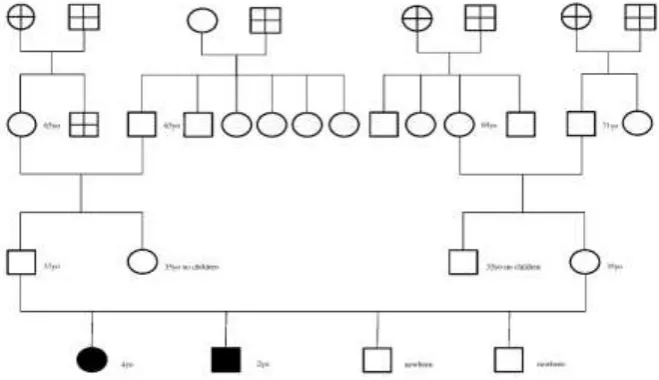
The organogram of this family is presented on Fig.1.
Genetic analysis was performed by the team of ICGBIT at Macedonian Academy of Sciences and Arts. The procedure was as follows:
1) Isolation of DNA with phenol-chlorophorm and
ethanol precipitation.
2) Array comparative genomic hybridization (aCGH)
with SurePrint G3 CGH 4x180 Kb; Oligo microarray kit, Agilent technologies; Mean distance between probes was 13 Kb; The analysis of the results was using Agilent genomic Workbench software and Database for genomic variants, UCSC genome browser, ClinVar database.
Obtained result was: ISCN arr cgh 16p.13.11-p12.3 (15,399,818- 18,069,668) x 3. The referent sequence: Human genome build 36 (hg 18).
Interpretation
The array comparative genomic hybridization of DNA material obtained for the patients showed chromosomic micro duplication of the short part of the chromosome in the 16p13.11-p12.3 region. The minimal size of the duplication is 2, 67 Mb. In the deleted region it was 11 genes as: MVP17L, C16orf45, KIAA0430, NDEI, MYH11, C16orf63, ABCC1, ABCC6, NOMO3, LOC 339047, XYLTI. The same duplication was found in the father. The database information confirms this duplication to be related with neurodevelopmental disorders, cognitive delay, some neuropsychiatric disorders, but also in people with “normal phenotype”.
DISCUSSION
Obtained results for our patients confirmed genetic etiology of neurodevelopmental delay as well as autistic behavior. It was especially confirmed by the same results obtained in father.
Searching in literature, we found the article of Ullmann R. et all. (2007) who describe a 1.5‐Mb duplication on chromosome 16p13.1 that was found by high‐resolution array CGH in four severe autistic male patients from three unrelated families, which corresponds with our results.
In a study of Tropeano M, Ahn JW, Dobson RJB, Breen G, Rucker J, Dixit A, et al. (2013), it was reported the evidence for a male-biased autosomal effect of 16p13.11 duplications and deletions in a sample of 10,397 individuals with a neurodevelopmental condition, analysed by whole-genome array comparative genomic hybridisation (aCGH). The CNVs identified included 28 duplications with size ranging from 0.8 Mb to 3.29 Mb and 18 deletions with size between 0.02 Mb and 3.26 Mb (2 non-NAHR mediated). It was suggested that copy number variants (CNVs) at chromosome 16p13.11 have been associated with a range of neurodevelopmental disorders including autism, ADHD, intellectual disability and schizophrenia.
As we mentioned before Quintela I et all. (2015)
described maternally inherited 16p13.11-p12.3
duplication and a de novo 12p12.1 deletion affecting SOX5 in in a male patient with global developmental delay, disruptive and obsessive behaviors and minor dysmorphic features. It was pointed that the 16p13.11 microduplication has been implicated in several neurodevelopmental and behavioral disorders and is characterized by variable expressivity and incomplete penetrance.
In this context Pinto AB et all (2017) published exome sequencing analysis in a pair of monozygotic twins which re-evaluates the genetics behind their intellectual disability and reveals a CHD2 mutation in two monozygotic twins. A CGH-array analysis revealed in both twins two maternally inherited duplications on chromosomes 8p22 and 16p13.11. Their work underlines the importance to consider a CHD2 involvement in children with intellectual disability and autism spectrum disorder.
Quintela I. et all. (2015) published article concerned
genetic involvement in children with
neurodevelopmental delay together with some
dysmorphic features. For example, in a first family, a 4q13.1‐q13.2 deletion of 3.84 Mb was identified in a mother with mild intellectual disability and in her two children, both with mild intellectual disability and attention deficit hyperactivity disorder; while in the second analyzed family, a de novo 4q13.2‐q13.3 deletion of 6.81 Mb was detected in a female patient, born to unaffected parents, with a diagnosis of mild intellectual disability, behavioral disorder and facial dysmorphism.
Recently Tumienė B. et all (2018) published genetic findings in epileptic patients. As pathogenic variants were identified in SOX5 gene, not previously associated with epilepsy, and UBA5, a recently associated with epilepsy gene.
Srivastava S. et all (2014) suggested the high diagnostic yield of WES and supported its use in pediatric neurology practices. This method may also lead to earlier
diagnosis, impacting medical management,
prognostication, and family planning. WES therefore serves as a critical tool for the child neurologist.
Generalized clinical use of Chromosomal Microarray Analysis (CMA) in etiological investigation of
neurodevelopmental disorders, has led to the
decipherment of many new copy number variations (CNV), such as those in 16p13.11. (Loureiro et al.2017).
Structural variation of the human genome results from
genomic rearrangements including deletions,
Although the widespread utilization of one such tool, array comparative genomic hybridization (aCGH) has lead to the discovery of many novel genomic disorders. One such CNV with a yet uncharacterized clinical phenotype is a rearrangement in chromosome 16p13.11, associated with epilepsy, multiple congenital anomalies and cognitive impairment,while duplications have been implicated in autism spectrum disorders, intellectual disability and schizophrenia. The Medical Genetics Laboratories at Baylor College of Medicine (BCM) has performed over 14 000 aCGH for clinical evaluation of subjects with developmental delay, dysmorphic features and/or multiple congenital anomalies from June 2007 to January 2010. During this period, they identified 56 patients with duplication and 30 patients with deletion of 16p13.11.
Authors concluded that the clinical spectrum associated with both duplications and deletions are quite variable and the manifestations are incompletely penetrant making genetic counseling of such families a challenging prospect (Nagamani et al. 2011).
CONCLUSION
Our case report confirmed the genetic involvement of arr cgh 16p.13.11 in neurodevelopmental delay combined with autistic behavior in two siblings and father in the same family.
Obtained results are supported in some other studies. However, the clinical spectrum associated with both duplications and deletions are quite variable and the manifestations are incompletely penetrant making genetic counseling of such families difficult.
However, genetic evaluation in the large spectrum of neurodevelopmental disorders is needed.
REFERENCES
1. American Psychiatric Association. Diagnostic and
statistical manual of mental disorders, 5th edn, Arlington, VA, 2013.
2. Anneke T. Vulto‐van Silfhout , Jayne Y.
Hehir‐Kwa, Bregje W.M. van Bon , Janneke H.M. Schuurs‐Hoeijmakers , Stephen Meader , Claudia J.M. Hellebrekers Clinical Significance of De Novo
and Inherited Copy‐Number Variation. Human
Mutation, 2015; 167(12): 3113-3120.
3. Goods KS, Ishijima E, Chang Ya.C, Kasari C.
Preschool Based JASPER Intervention in Minimally Verbal Children with Autism: Pilot RCT. J Autism Dev Disord., 2013; 43(5): 1050–1056.
4. Hannes FD, Sharp AJ, Mefford HC, de Ravel
T, Ruivenkamp CA, Breuning MH, Fryns
JP, Devriendt K, Van Buggenhout G, Vogels
A, Stewart H, Hennekam RC, Cooper M, Regan R, Knight SJ, Eichler EE, Vermeesch JR. Recurrent reciprocal deletions and duplications of 16p13.11: the deletion is a risk factor for MR/MCA while the
duplication may be a rare benign variant. J Med Genet, 2009; 46(4): 223-32.
5. Loureiro S, Almeida J, Café C, Conceição I, Mouga
S, Beleza A, Oliveira B, de Sá J, Carreira I, Saraiva J, Vicente A, Oliveira G. Copy number variations in chromosome 16p13.11-The neurodevelopmental clinical spectrum. Curr Pediatr Res, 2017; 21(1): 116-129.
6. Liu JY, Kasperavičiūtė D, Martinian L, et al.
Neuropathology of 16p13.11 deletion in epilepsy. PLoS One, 2012; 7: e34813.
7. Nagamani SC, Erez A, Bader P, et al. Phenotypic
manifestations of copy number variation in
chromosome 16p13.11. Eur J Hum Genet, 2011; 19:
280-286.
8. Nagamani SC, Erez A, Bader P, Lalani SR, Scott
DA, Scaglia F, Plon SE, Tsai CH, Reimschisel T, Roeder E, Malphrus AD, Eng PA, Hixson PM, Kang
SHL, Stankiewicz P, Patel A, Cheung SW.
Phenotypic manifestations of copy number variation
in chromosome 16p13.11. Eur J Hum Genet., 2011;
19(3): 280–286.
9. Nagamani SC, Zhang F, Shchelochkov OA, et al.
Microdeletions including YWHAE in the Miller-Dieker syndrome region on chromosome 17p13.3 result in facial dysmorphisms, growth restriction, and cognitive impairment. J Med Genet, 2009; 46: 825–833.
10. Nagamani SC, Erez A, Shen J, et al. Clinical
spectrum associated with recurrent genomic
rearrangements in chromosome 17q12. Eur J Hum
Genet, 2010; 18: 278–284.
11. Okuno T, Kondelis N. Evaluation of dithiothreitol (DTT) for inactivation of IgM antibodies. J Clin Pathol, 1978; 31(12): 1152–1155.
12. Pinto AM, Bianciardi L, Mencarelli MA, Imperatore
V,Di Marco C, Furini S, Suppiej A, Salviati L,Tenconi R, Ariani F, Mari F, Renieri A. Exome sequencing analysis in a pair of monozygotic twins re-evaluates the genetics behind their intellectual disability and reveals a CHD2 mutation. Brain and Development, 2016; 38(6): 590-596.
13. Quintela I, Barros F, Lago-Leston R, Castro-Gago
M, Carracedo A, Eiris J. A maternally inherited 16p13.11-p12.3 duplication concomitant with a de novo SOX5 deletion in a male patient with global developmental delay, disruptive and obsessive
behaviors and minor dysmorphic features. Am J Med
14. Quintela I, Barros F, Castro‐Gago M, Carracedo A, Eiris J. Clinical characterization of a male patient with the recently described 8q21.11 microdeletion
syndrome. Am J Med Genet A, 2015; 167(6): 1315–
1322.
15. Quintela I , Barros F, Fernandez‐Prieto M,
Martinez‐Regueiro R, Castro‐Gago M, Carracedo
A , Gomez‐Lado C, Eiris J. Interstitial
microdeletions including the chromosome band 4q13.2 and the UBA6 gene as possible causes of intellectual disability and behavior disorder. Am J Med Genet, 2015; 167 A(12): 3113-20.
16. Shinawi M, Liu P, Kang SH, Shen J, Belmont
JW, Scott DA, Probst FJ, Craigen WJ, Graham BH, Pursley A, Clark G, Lee J, Proud M, Stocco A, Rodriguez DL, Kozel BA, Sparagana S, Roeder
ER, McGrew SG, Kurczynski TW, Allison
LJ, Amato S, Savage S, Patel A, Stankiewicz
P, Beaudet AL, Cheung SW, Lupski JR. Recurrent reciprocal 16p11.2 rearrangements associated with global developmental delay, behavioural problems,
dysmorphism, epilepsy, and abnormal head size. J
Med Genet, 2010; 47(5): 332-41.
17. Srivastava S, Cohen JS , Vernon H, Barañano K, McClellan R, Jamal L, Naidu S. Clinical whole
exome sequencing in child neurology practice. Ann
Neurol, 2014; 76: 473–483.
18. Tropeano M , Ahn JW, Dobson RJB, Breen G,
Rucker J, Dixit A, Pal DK, McGuffin P, Farmer A, White PS, Andrieux J, Vassos E, Ogilvie CM, Curran S , Collier DA. Male-Biased Autosomal Effect of 16p13.11 Copy Number Variation in
Neurodevelopmental Disorders. PlosOne, 2013;
8(4): 1365.
19. Tumienė B, Maver A, Writzl K, Hodžić A, Čuturilo
G, Kuzmanić-Šamija R, Čulić V, Peterlin B.
Diagnostic exome sequencing of syndromic epilepsy patients in clinical practice.Clin Genet, 2018; 93(5): 1057-1062.
20. Ullmann R, Turner G, Kirchhoff M, Chen W,
Tonge B, Rosenberg C, Field M, Vianna‐Morgante AM, Christie L, Krepischi‐Santos AC. Array CGH identifies reciprocal 16p13.1 duplications and deletions that predispose to autism and/or mental