Available Online at www.ijpret.com
70
INTERNATIONAL JOURNAL OF PURE AND
APPLIED RESEARCH IN ENGINEERING AND
TECHNOLOGY
A PATH FOR HORIZING YOUR INNOVATIVE WORKAN EVALUATION OF OPTICAL CONDUCTIVITY OF PROTOTYPE NON-FERMI
LIQUID KONDO ALLOYS
S. R. VITTAL1, MIRZA ABBAS HUSSAIN2, L. K. MISHRA3
1. Department of Physics, G H Raisowi College of Engg. & Management, Waghoi, PUNE-411028
(Maharashtra).
2. 2 Department of Physics, Oriental College Patna-city, Patna (Bihar).
3. Department of Physics, Magadh University, Bodh-Gaya – 824234 (Bihar).
Accepted Date: 13/04/2014 ; Published Date: 01/06/2014
Abstract: An evaluation of real part of optical conductivity 1( ) as a function of for prototype non- Fermi Kondo alloys were performed at different temperature. Our evaluated results increases with frequency as per experimental observation but the magnitudes are smaller with the experimental data.
Keywords: Prototype, Non- Fermi, Kondo alloys, Optical conductivity, Frequency, Real-Part, heavy- fermion compounds, f-electron alloys, RKKY interaction.
Corresponding Author: MR. S. R. VITTAL
Access Online On:
www.ijpret.com
How to Cite This Article:
SR Vittal, Mirza Abbas Hussain, L. K. Mishra; IJPRET, 2014; Volume 2 (10): 70-79
Available Online at www.ijpret.com
71 INTRODUCTION
During the past 20 years there has been a great deal of interest in a narrow class of materials among the highly correlated metals, which exhibit non- Fermi liquid properties at low temperatures 1-6. One of the central points of Fermi -liquid theory is the existence of a single scale, the Fermi energy EF , and for energies E≤ EF and temperatures KβT ≤ EF the electronic
properties display universal behavior 7. Experimental works8-13 have indicated that several heavy-electron compounds and related alloys ( particularly f-electron alloys)display non-Fermi liquid behavior. Typically, the non –non-Fermi liquid behavior is observed as a diverging linear coefficient of specific-heat C for temperature T =0. There is strong T dependence of the magnetic susceptibility χ as T =0. The electrical resistivity ρ shows a peculiar T dependence (ρ =
A Tm having A > 0 and m =1 instead of the Fermi –liquid behavior m=2) In this paper, we have studied optical properties of some non –Fermi liquid alloys. Generally, optical investigations extending over a broad frequency range and at various temperatures are an efficient experimental tool for the simultaneous study of the energy and temperature of intrinsic parameter characterizing the systems. Of particular relevance in connection with the anomalous dc electrical resistivity, is the identification of energy and temperature dependence of the relaxation time.
In this paper, we have studied the optical properties of non-Fermi liquid Kondo alloys. The
Kondo alloys of our investigation is the evaluation of real part of optical conductivity 1( )as a function of at different temperatures for U02 Y0.8 Pd3 , U0.2 Th0.8 Pd2 Al3 and U Cu3.5 Pd1.5 . Our
theoretically evaluated results are of good agreement with the other theoretical workers 14,15 and also from the experimental data. 16,17
MATERIALS AND METHODS
As we know that heavy electron compound exhibit both types of behavior, Fermi Liquid behavior and Non-Fermi liquid behavior (Kondo Liquid). In the Fermi liquid behavior the low temperature resistivity is written as
( )T 0 AT
2
(1)
where o is the residual resistivity.
Available Online at www.ijpret.com
72 3
2
2 *
2
3 3
F
F F
k
K N k m
(2)
m* is the effective mass usually very high. Because of 4f and 5f electron heavy electron compounds behaves as non-Fermi liquid (Kondo liquid).
The energy per magnetic impurity is given by
1
( )
K F
F
K T E e
N E J
(3)
Where J is the coupling between f and Conduction electron and N E( F) is the density of the
Conduction electron state at EF. TK is the Kondo temperature. The remarkable feature of the
Kondo liquid is the formation of a sharp and narrow resonance in the density of state N E( F) at
EF. The electrons sitting in the narrow resonance are the new “heavy” quasi particle with
enhanced effective mass. These heavy electrons are responsible for the low temperature transport and thermodynamic properties.
For Kondo liquid there is an additional competing interaction of a magnetic nature, induced by the periodic array of magnetic impurities. This corresponds to (RKKY) (Runderman-Kittel-Kesuy-Yoshida) interaction, which defines an another relevant energy scale
K T RKKY J N EF 2
( )
(4)
For small J, TRKKY is larger than TK and magnetic ordering is expected. Otherwise for large J, the
formation of singlet Kondo will lead to a larger energy gain than by magnetic ordering. This shows that a heavy electron system balances Kondo fluctuation and correlation effect of the impurity magnetic moments. Such a behavior can also lead to the coexistence of various states, a heavy electron and magnetic order or even to a non-Fermi liquid state.
In such systems, there are two possible sources of scattering of electrons. One is the scattering of electrons off the impurities and other is the scattering from boson fluctuation.
If in the presence of impurities the conductivity is σi and in the presence of boson only the conductivity is σb then the total conductivity will be
1 1 1
i b
Available Online at www.ijpret.com
73 At sufficiently low temperature, only impurity scattering is relevant. If f is the energy parameter analogous to Debye frequency in the electron phonon electron and w is the bare
band width then for w f , impurity scattering is written as.
* 2
* * 2
( )
1 ( )
i i i ne m (6) Where F
k = Fermi wave vector
3 2 6 F Nk n
n = electron density
N is the orbital degeneracy of f-state. Generally conductivity is evaluated from the Kubo formula.
0 0
1
( , ) i t ( ) ( )
e e
T dte dt j i j t
V
> (7)
Where je is the electrical current, V is the system volume and b the inverse temperature, with the simplifying assumption of isotropic dispersion we have14
( , ) ( , )
3
r
T T
T
(8)
One can obtain the result
2
0
( ) ( )
( , )
4 ( , ) ( , )
p
A R
c c
i f f
T d T T
(9)Where c is the band electron self energy
A c
denotes the advanced and R
c
denotes the
Available Online at www.ijpret.com
74 equation (9) reduces to the standard transport integral expansion for the resistivity (T) is given by15
2
4 ( )
p
T
(10)
Where is given by
(11)
Where Af =1/N(EF)
N(EF) is the density of state at the Fermi surface and TK is the Kondo temperature. Now because
of the low frequency 2 departure of the full Kondo lattice self energy is seen that
1 2 2
6
( , )T [ ( K T) ]
(12)
Equation (12) is the well known result in the absence of inter-site interaction. Equation (12) also manifests the Fermi liquid nature of the Kondo like ground states
1 2 2
a() b K T( ) (13)
Where a and b are temperature and frequency independent constants
b/a = 2 for quasi-particle scattering rate (seen in photoemission experiments)
b/a = 22 for transport scattering rate (seen in optical experiment)
Drude gives the free charge carrier contribution to the electrodynamics response16 .The general formula for the complex dielectric function is
2 2
,
2 2
( )
( ) ( )
p p j
j
j j
i i
(14)
Where p and Г=1/τ is the Drude term are the plasma frequency and the damping (i.e.
Available Online at www.ijpret.com
75 frequency, the damping and the mode strength of the harmonic oscillator respectively. These
high frequency absorptions above the ultraviolet spectral range are taken into account by. Eqn. (14) is more general and can better reproduce the complex shape of the optical conductivity in heavy electron materials. Thompson et.al.10 have shown that the complex
conductivity can be written in terms of frequency and temperature dependent m* and Г.
( )
( ) * ( )
p
b
i m
m
2
4
(15)
mb is the band mass
2 1
2
( ) ( )
4
p
(16)
2
* 2
2
( ) ( )
4
p
m
(17)
Where
( ) 1( )i 2| ) (18)
RESULTS AND DISCUSSIONS
In this paper, we have studied the optical properties of prototype non-Fermi Kondo alloys. The Kondo alloys of our studies are U0.2Y0.8Pd3, U0.2 Th0.8 Pd2Al3 and UCu3.5Pd1.5 respectively. We
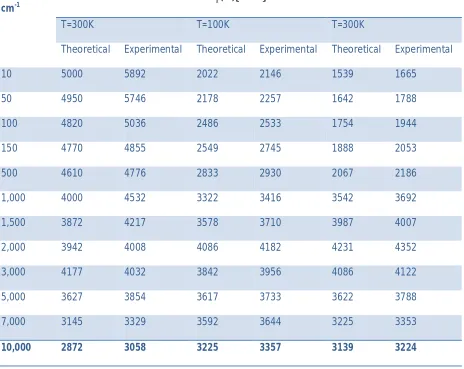
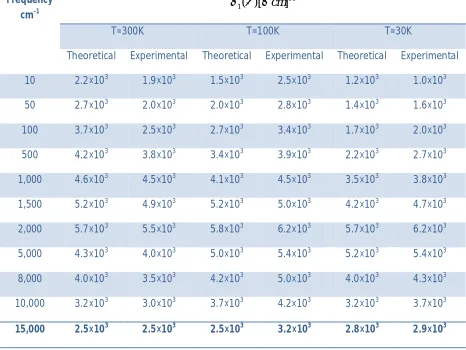
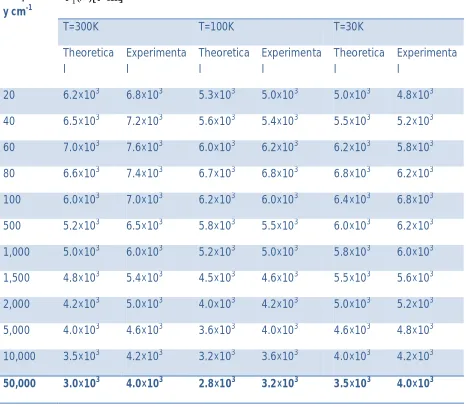
have evaluated the frequency dependent real part of ac conductivity 1( )at different temperature. The evaluated results are shown in table T1, T2 and T3 respectively. We have
shown the evaluated result of 1( )as a function of frequency for Kondo alloys U
0.2Y0.8Pd3 at
different temperature T=30K, 100K and 300K. We have compared our theoretically evaluated
results with experimental data. Our theoretical results show that for T=30K and 100K 1( ) increases with but for T=300K it decreases with .Our evaluated results for all the above three temperature are smaller than the experimental values. In case of Kondo alloy U0.2 Th0.8
Pd2Al3, our evaluated results for 1( )for all the three temperatures increases with but
Available Online at www.ijpret.com
76 evaluated results increases but results are smaller for T=30K and100K and larger for 300K. Recent theoretical results also exhibit similar behavior17-22.
CONCLUSION:
In this paper, we have evaluated the frequency dependent real part of ac conductivity for three different Kondo alloys (Non-Fermi alloys) for temperature from 30K to 300K. Our theoretical
results indicate that conductivity σ1(ω) increases with ω for all the three alloys from T= 30K to
100K. However, for Kondo Alloy U0.2Y0.8Pd3, σ1(ω) decreases with ω at T=300K.
Table T1
An evaluated result of real part of optical conductivity 1( ) as a function of at different temperature for U0.2Y0.8Pd3
Frequency
cm-1
1
1( )[ cm]
T=300K T=100K T=300K
Theoretical Experimental Theoretical Experimental Theoretical Experimental
10 5000 5892 2022 2146 1539 1665
50 4950 5746 2178 2257 1642 1788
100 4820 5036 2486 2533 1754 1944
150 4770 4855 2549 2745 1888 2053
500 4610 4776 2833 2930 2067 2186
1,000 4000 4532 3322 3416 3542 3692
1,500 3872 4217 3578 3710 3987 4007
2,000 3942 4008 4086 4182 4231 4352
3,000 4177 4032 3842 3956 4086 4122
5,000 3627 3854 3617 3733 3622 3788
7,000 3145 3329 3592 3644 3225 3353
Available Online at www.ijpret.com
77 Table T2
An evaluated result of real part of optical conductivity 1( )as a function of for Kondo liquid alloy U0.2 Th0.8 Pd2Al3 at different temperature
Frequency cm-1
1
1( )[ cm]
T=300K T=100K T=30K
Theoretical Experimental Theoretical Experimental Theoretical Experimental
10 2.2×10³ 1.9×10³ 1.5×10³ 2.5×10³ 1.2×10³ 1.0×10³
50 2.7×10³ 2.0×10³ 2.0×10³ 2.8×10³ 1.4×10³ 1.6×10³
100 3.7×10³ 2.5×10³ 2.7×10³ 3.4×10³ 1.7×10³ 2.0×10³
500 4.2×10³ 3.8×10³ 3.4×10³ 3.9×10³ 2.2×10³ 2.7×10³
1,000 4.6×10³ 4.5×10³ 4.1×10³ 4.5×10³ 3.5×10³ 3.8×10³
1,500 5.2×10³ 4.9×10³ 5.2×10³ 5.0×10³ 4.2×10³ 4.7×10³
2,000 5.7×10³ 5.5×10³ 5.8×10³ 6.2×10³ 5.7×10³ 6.2×10³
5,000 4.3×10³ 4.0×10³ 5.0×10³ 5.4×10³ 5.2×10³ 5.4×10³
8,000 4.0×10³ 3.5×10³ 4.2×10³ 5.0×10³ 4.0×10³ 4.3×10³
10,000 3.2×10³ 3.0×10³ 3.7×10³ 4.2×10³ 3.2×10³ 3.7×10³
Available Online at www.ijpret.com
78 Table T3
An evaluated result of real part of optical conductivity 1( ) as a function of for Kondo liquid alloy UCu3.5 Pd1.5 at different temperatures
Frequenc y cm-1
1
1( )[ cm]
T=300K T=100K T=30K
Theoretica l
Experimenta l
Theoretica l
Experimenta l
Theoretica l
Experimenta l
20 6.2×10³ 6.8×10³ 5.3×10³ 5.0×10³ 5.0×10³ 4.8×10³
40 6.5×10³ 7.2×10³ 5.6×10³ 5.4×10³ 5.5×10³ 5.2×10³
60 7.0×10³ 7.6×10³ 6.0×10³ 6.2×10³ 6.2×10³ 5.8×10³
80 6.6×10³ 7.4×10³ 6.7×10³ 6.8×10³ 6.8×10³ 6.2×10³
100 6.0×10³ 7.0×10³ 6.2×10³ 6.0×10³ 6.4×10³ 6.8×10³
500 5.2×10³ 6.5×10³ 5.8×10³ 5.5×10³ 6.0×10³ 6.2×10³
1,000 5.0×10³ 6.0×10³ 5.2×10³ 5.0×10³ 5.8×10³ 6.0×10³
1,500 4.8×10³ 5.4×10³ 4.5×10³ 4.6×10³ 5.5×10³ 5.6×10³
2,000 4.2×10³ 5.0×10³ 4.0×10³ 4.2×10³ 5.0×10³ 5.2×10³
5,000 4.0×10³ 4.6×10³ 3.6×10³ 4.0×10³ 4.6×10³ 4.8×10³
10,000 3.5×10³ 4.2×10³ 3.2×10³ 3.6×10³ 4.0×10³ 4.2×10³
50,000 3.0×10³ 4.0×10³ 2.8×10³ 3.2×10³ 3.5×10³ 4.0×10³
REFERENCES
1. J. Aarts and A. P. Volodui, Physica B 206-207 ,43 (1995)
Available Online at www.ijpret.com
79 3. A. H. Castro- Neto, G. Castika and B. A. Jones, Phys. Rev. Lett.(PRL) 81, 3531 (1998)
4. S. Kimura, A. Ochiai and T. Suzuki , Physica B 230-232, 705 (1997)
5. L. Degiorgi, M.B.Maple, Z. Fisk, C. Geibel and F.Steglish, Z. Phys.B102, 367 (1997)
6. A. J. Milles, Phys. Rev B48, 7383 (1993)
7. M. J. Rozenberg, G. Kotilar and H.Kajutar, Phys. Rev.B54, 8452 (1996)
8. A. Rosch, A. Schoder, O. Stockert and H. V. Lohneysen, Phys. Rev. Lett. (PRL) 79,159 (1997)
9. U. Zulicke and A. J. Milles, Phys. Rev.B51, 8996 (1995)
10.J. D. Thompson, R. Morshovick, Z. Fish, F. Bouguch and J. L. Sarrows ,J. Magn.Magn.Mater,226,5 (2001)
11.B. Bogen Beryer and H. V. Lohneysen , Phys. Rev. Lett.(PRL) 74,1056 (1995)
12.B. Andraka, Phys. Rev. B49, 3589 (1994)
13.M. A. Chernikov, L. Degiorgi, E. Felder, S. Paschen and H. R. Ott, Phs. Rev. B56, 1366 (1997)
14.P. Coleman, Phys. Rev. B 52, 872 (1995)
15.J. C. Cooley, M. C. Aronson and P. C. Canfield, Phys. Rev. B 55, 7533 (1997)
16.S. Kimura, M. Ikezawa, A. Ochia and Q. Nikala, J. Phys. Soc. Jpn. 65, 3591 (1996)
17.K. Maeda, M. Graff, S. Appeli and Q. Nikala, Phys. Rev. Lett. (PRL) 91, 087202 (2003)
18.G. R. Stewart, J. S. Kim, J. Alwood and S. M. Sherifi, Phys. Rev. B 73, 140401 (2006)
19.S. R. Appeli, K. Maeda, M. Graff, W. Montfroozy and O.O. Bernal, J. Appl. Phys. 108, 230514 (2008)
20.P. A. Estrela, S. R. Julian, A. Rosch, S. Kormr and Y. Aoki, J. Appl. Phys. 112, 234177 (2009)
21.S. Mortrunich, Physica, B275-276, 392 (2009)