Rational Design of Short Locked Nucleic
Acid-Modified 2
0
-
O
-Methyl Antisense Oligonucleotides
for Efficient Exon-Skipping In Vitro
Bao T. Le,
1,2Abbie M. Adams,
1Susan Fletcher,
1,2Stephen D. Wilton,
1,2and Rakesh N. Veedu
1,21Centre for Comparative Genomics, Murdoch University, Perth, WA 6150, Australia;2Perron Institute for Neurological and Translational Science, Perth, WA 6009, Australia
Locked nucleic acid is a prominent nucleic acid analog with un-precedented target binding affinity to cDNA and RNA oligonu-cleotides and shows remarkable stability against nuclease degradation. Incorporation of locked nucleic acid nucleotides into an antisense oligonucleotide (AO) sequence can reduce the length required without compromising the efficacy. In this study, we synthesized a series of systematically truncated locked nucleic acid-modified 20-O-methyl AOs on a phosphor-othioate (PS) backbone that were designed to induce skipping exon 23 from the dystrophin transcript inH-2Kb-tsA58mdx
mouse myotubes in vitro. The results clearly demonstrated that shorter AOs (16- to 14-mer) containing locked nucleic acid nucleotides efficiently induced dystrophin exon 23 skip-ping compared with the corresponding 20-O-methyl AOs. Our remarkablefindings contribute significantly to the exist-ing knowledge about the designexist-ing of short LNA-modified ol-igonucleotides for exon-skipping applications, which will help reduce the cost of exon-skipping AOs and potential toxicities, particularly the 20-OMe-based oligos, by further reducing the length of AOs.
INTRODUCTION
Locked nucleic acid (LNA) is one of the prominent nucleic acid ana-logs with excellent bio-physical properties and has attracted extensive interest in the development of therapeutics as well as diagnostics.1–3 LNA-modified oligonucleotides show very high binding affinity to both DNA and RNA oligonucleotides and increased stability against nuclease degradation compared with other chemistries, such as 20-O -methyl (20-OMe).4,5Introduction of LNA nucleotide monomers (
Fig-ure 1) improves the potency of therapeutic oligonucleotides in vitro
and in vivo over other nucleic acid chemistries when applied as anti-sense constructs, siRNAs, and anti-miRs and are also found to be well tolerated in animals.6–12
Duchenne muscular dystrophy (DMD) is a muscle-wasting genetic disease caused by protein-truncating mutations, commonly frame-shifting deletions of one or more exons in the dystrophin gene that abolish functional dystrophin expression.13–15Splice-switching AOs
to induce specific exon-skipping and restore the reading frame and expression of a partially functional dystrophin protein has been
explored as a treatment for DMD.16–21This most promising approach has been shown to slow the progression of the disease over several years.22Two such drug molecules, Exondys 5122,23(Sarepta Thera-peutics) and Drisapersen (BioMarin Pharmaceutical) targeting exon 51, were evaluated in phase 3 clinical trials. The drisapersen trials were halted in September 2013 after primary and secondary end-points were not met and life-threatening side effects were found.24 In contrast, Exondys 51, a phosphorodiamidate morpholino oligomer (PMO), has been given accelerated approval by the US Food and Drug Administration (FDA) for the treatment of DMD.25Exondys 51 has been shown to produce modest increases in dystrophin protein and showed an excellent safety profile in the trial participants.26However, PMO monomers are not compatible with the standard phosphorami-dite chemistry, and the current PMO synthesis chemistries are costly.
One approach to possibly limit toxicity of the phosphorothioate (PS) AOs that were investigated in previous studies,27–31 and further reduce costs, would be to truncate oligonucleotide length. Introduc-tion of LNA nucleotide monomers could be one approach, allowing AO length to be truncated by relying on properties such as high target binding affinity, mismatch recognition capability, and increased resis-tance to nuclease degradation. Because the current PMO chemistry is not compatible with the standard solid-phase oligonucleotide synthesis procedures, 20-OMePS AOs would be suitable to investigate the impact of LNA nucleotides to develop shorter exon-skipping AOs. Herein, we report the systematic truncation of 20
-OMePS-modi-fied AOs using LNA nucleotides by constructing 20-OMePS/LNA mixmers and 20-OMePS/LNA gapmer-like AOs to induce exon 23 skipping in the mouse dystrophin gene transcript in vitro.
RESULTS
In this study, we used a previously reported 20-mer 20-OMe AO on a PS backbone designed to induce exon 23 skipping in the mouse dystrophin gene transcript.32 The systematic truncation of the
Received 20 July 2017; accepted 6 September 2017; https://doi.org/10.1016/j.omtn.2017.09.002.
Correspondence:Rakesh N. Veedu, Centre for Comparative Genomics, Murdoch University, Perth, WA 6150, Australia.
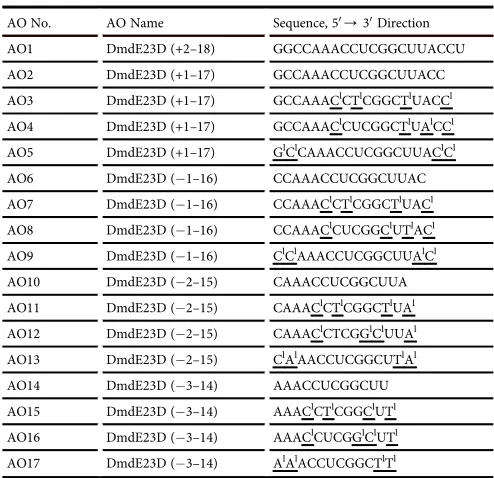
20-mer 20-OMePS AO (AO1) was performed by removing one to four nucleotides from both 50and 30ends simultaneously, and their corre-sponding LNA-modified variants were synthesized as mixmers and gapmers to generate 18-mer (AO2–AO5), 16-mer (AO6–AO9), 14-mer (AO10–AO13), and 12-mer (AO14–AO17) candidate AOs
(Table 1). All AOs were synthesized in house on a GE ÄKTA
oligo-pilot plus 10 synthesizer at 1mmol scale on a PS backbone. The effi -cacies of all AOs were evaluated for their ability to induce exon 23 skipping inH2K mdxmouse myotubes in vitro. For this purpose,
H2K mdxmouse myoblasts were plated on a 24-well plate, differen-tiated over 24 hr, and transfected with the AOs in complex with the cationic lipid Lipofectin, using a 2:1 (w/w) ratio initially at 100, 200, and 400 nM concentrations, to screen exon-skipping efficiency for all AOs, and later at 12.5, 25, 50, and 100 nM concentrations for the best-performing AOs. The cells were collected after 24 hr, RNA was isolated, and RT-PCR analysis was performed by ampli-fying across exons 20–26 to evaluate the skipping efficiency of the AOs as previously reported.33The PCR products were then analyzed using 2% agarose gel electrophoresis, and densitometry analysis of the gel images was performed using ImageJ software. The actual exon-skipping efficiency was determined by expressing the amount of exon 23 skipped RT-PCR product as a percentage of total dystrophin transcript products.
Evaluation of Systematically Truncated 20-OMePS AOs to Induce Exon 23 Skipping inmdxMouse Myotubes In Vitro
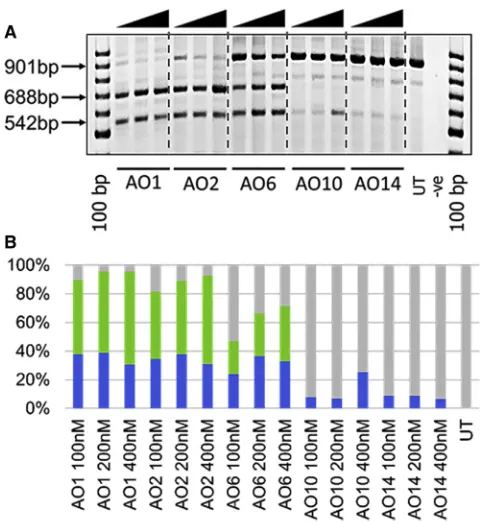
First, we tested the potential of the truncated 20-OMePS AOs including AO2 (18-mer), AO6 (16-mer), AO10 (14-mer), and AO14 (12-mer) in parallel with the 20-mer control AO1. As previ-ously reported,32,33AO1 showed efficient exon 23 (full-length prod-uct size 901 bp) skipping in vitro by yielding the deletion prodprod-uct of 688 bp at all concentrations (52% at 100 nM, 57% at 200 nM, and 65% at 400 nM;Figures 2A and 2B). The 18-mer AO2 with the two-nucleotide truncation also showed similar efficacy as the 20-mer control AO1 and induced exon-23 skipping levels of 49% at 100 nM, 53% at 200 nM, and 64% at 400 nM. However, a significant drop in the amount of 688 bp product was observed after transfection with the 16-mer AO6 (23% at 100 nM, 30% at 200 nM, and 39% at 400 nM). Notably, the 14-mer AO10 and the 12-mer AO14 failed to show any skipped product of 688 bp (Figure 2A). In all AO
trans-fections (all concentrations), an additional product band at 542 bp was also observed on the gel (Figure 2A) that corresponds to an out-of-frame exon 22/23 dual skipping product, in line with previous reports.32–36We found a similar trend of increasing amount of 542 bp
band at 100 and 200 nM concentrations (Figure 2B) and a decrease in yield at 400 nM for AO1, AO2, and AO6, but the 14-mer AO10 only showed the product at 400 nM.
Evaluation of Systematically Truncated LNA/20-OMePS AO Mixmers and Gapmers to Induce Dystrophin Exon 23 Skipping in
mdxMouse Myotubes In Vitro
We evaluated the impact of LNA nucleotides in truncated 20-OMePS AOs for which three different types, two mixmers and one gapmer-like AOs, were designed and synthesized by incorporating four LNA nucleotides into each sequence (Table 1). We evaluated the dys-trophin exon 23 skipping efficiencies of truncated LNA/20-OMePS AOs of sizes: 18-mers (AO3–AO5), 16-mers (AO7–AO9), 14-mers (AO11–AO13), and 12-mers (AO15–AO17) in vitro compared with the corresponding 20-OMePS unmodified AOs (Table 1).
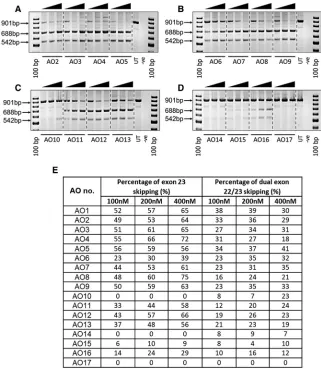
All 18-mer LNA/20-OMePS AOs, AO3, AO4 (mixmer 1 and 2), and AO5 (gapmer-like) showed efficient exon 23 skipping at all concen-trations, similar to that induced by the unmodified AO2 (Figure 3A). The mixmer construct AO4 induced the highest level of exon 23 skip-ping by yielding 66% and 72% of the 688 bp skipped transcript prod-uct at 200 and 400 nM concentrations, respectively, compared with 53% and 64% exon-skipping efficiency induced by the unmodified AO2 (Figures 3A and 3E). All 18-mer LNA/20-OMePS AOs also
Figure 1. Structure Representation of 20-OMethyl and LNA Nucleotide Monomers Used in This Study
Table 1. AO Names and Their Sequences Used in This Study
AO No. AO Name Sequence, 50/30Direction
AO1 DmdE23D (+2–18) GGCCAAACCUCGGCUUACCU
AO2 DmdE23D (+1–17) GCCAAACCUCGGCUUACC
AO3 DmdE23D (+1–17) GCCAAAClCTlCGGCTlUACCl
AO4 DmdE23D (+1–17) GCCAAAClCUCGGCTlUAlCCl
AO5 DmdE23D (+1–17) GlClCAAACCUCGGCUUAClCl
AO6 DmdE23D (1–16) CCAAACCUCGGCUUAC
AO7 DmdE23D (1–16) CCAAAClCTlCGGCTlUACl
AO8 DmdE23D (1–16) CCAAAClCUCGGClUTlACl
AO9 DmdE23D (1–16) ClClAAACCUCGGCUUAlCl
AO10 DmdE23D (2–15) CAAACCUCGGCUUA
AO11 DmdE23D (2–15) CAAAClCTlCGGCTlUAl
AO12 DmdE23D (2–15) CAAAClCTCGGlClUUAl
AO13 DmdE23D (2–15) ClAlAACCUCGGCUTlAl
AO14 DmdE23D (3–14) AAACCUCGGCUU
AO15 DmdE23D (3–14) AAAClCTlCGGClUTl
AO16 DmdE23D (3–14) AAAClCUCGGlClUTl
AO17 DmdE23D (3–14) AlAlACCUCGGCTlTl
induced the exon 22/23 deletion product of 542 bp at varying yields
(Figure 3E), but the band intensity was low at 400 nM in the case
of AO4.
The exon-skipping efficiency of 16-mer LNA/20-OMePS AO variants, AO7 (mixmer 1), AO8 (mixmer 2), and AO9 (gapmer-like) was tested under the same conditions as above in parallel with the corresponding 20-OMePS AO6. All LNA-modified truncated AOs induced the exon 23 deletion product of 688 bp at all concentrations tested, but higher exon-skipping levels were achieved at 200 and 400 nM (Figures 3B and 3E). Interestingly, the mixmer AO8 yielded a higher percentage of exon 23 skipping (75%) than any of 18-mer truncated AOs. In contrast, the exon-skipping efficiency of the unmodified 16-mer 20-OMePS AO was found to be significantly lower at all concentra-tions, compared with that of LNA-modified AOs (Figures 3B and 3E).
The efficacies of 14-mer LNA-modified 20-OMePS AO candidates (AO11, mixmer 1; AO12, mixmer 2; and AO13, gapmer-like) were also evaluated together with the unmodified 20-OMePS AO10. The LNA/20-OMePS 14-mer-AOs clearly showed the exon 23 deletion product of 688 bp at all concentrations tested, although the highest
ef-ficiency was observed at 400 nM (Figures 3C and 3E). Efficient exon 23
skipping was observed with the mixmer AO12 at 400 nM, yielding 66% of the skipped product, in line with the 20-mer 20-OMePS AO1. How-ever, the 14-mer 20-OMePS AO10 failed to induce exon 23 skipping at all concentrations. All LNA-modified 14-mer AOs also showed the exon 22/23 dual skipping product of 542 bp as a minor product at all concentrations tested (Figures 3C and 3E).
The 12-mer AOs, AO15 (mixmer 1), AO16 (mixmer 2), and AO17 (gapmer-like) also induced the exon 23 deletion product of 688 bp, but the yield was found to be low compared with the other longer AOs. The LNA/20-OMePS mixmer AO16 induced a higher percent-age of exon 23 skipping at 400 nM (29%;Figures 3D and 3E) than any of the other 12-mer AOs. Not surprisingly, the unmodified 12-mer 20-OMePS AO14 did not yield any exon 23 skipping, other than approximately 7% of the exon 22/23 dual skipping product (
Fig-ures 3D and 3E).
Exon-Skipping Efficacy Analyses of Promising LNA/20-OMePS AO Candidates at Lower Concentrations
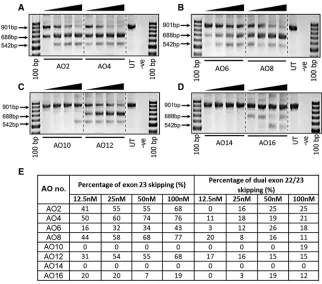
To further investigate the efficacy of truncated LNA-modified 20OMePS AOs, we then analyzed exon-skipping at lower concentra-tions (12.5, 25, 50, and 100 nM). For this purpose, the best-perform-ing four LNA/ 20-OMePS AO candidates for each size (AO4, AO8, AO12, and AO16) out of 12 candidates were evaluated along with their corresponding unmodified 20-OMePS AOs (AO2, AO6, AO10, and AO14). The 18-mer AO4 showed efficient exon 23 ping at 25, 50, and 100 nM compared with AO2, for which good skip-ping was observed at 50 nM and above (Figure 4A). The 16-mer LNA/ 20-OMePS AO8 also showed high exon 23 skipping efficacy at 25, 50, and 100 nM, whereas the control AO6 yielded significantly less exon 23 skipped product (Figure 4B). The 14-mer LNA/20-OMePS AO12 was also induced exon 23 skipping at 50 and 100 nM concentrations, but the 20-OMePS AO10 failed to induce any exon 23 skipping (
Fig-ures 4C and 4E). The 12-mer LNA/20-OMePS AO16 did not exhibit
good skipping efficacy, but the exon 23 skipped product was visible at low levels (up to 20%;Figures 4D and 4E), and the unmodified 12-mer AO14 failed to induce any exon 23 skipping at all concentrations tested. Notably, there were also bands detected at 542 bp correspond-ing to dual exon 22/23 skippcorrespond-ing, and this product was observed at low yields in all cases, except for the 14-mer and 12-mer unmodified AOs
(Figures 4C and 4D).
DISCUSSION
First described in 1993 by Dominski and Kole,37AO-mediated splice modulation of pre-mRNA is becoming a well-established therapeutic approach. In 2016, two AO drugs were approved by the FDA for the treatment of DMD (Exondys 51; PMO chemistry)25 and spinal muscular atrophy (Spinraza; 20-O-methoxyethyl PS chemistry).38 The 20-OMePS-based drug candidate, Drisapersen, also entered phase 3 clinical trials for the treatment of DMD, but the application was re-jected by the FDA because of failure to meet primary or secondary endpoints and life-threatening toxicity.24Alternative strategies are
required to further improve the efficacy and limit the toxicity of 20-OMePS AOs if they are to be used for clinical application.
Figure 2. RT-PCR Analysis of RNA Prepared from Myogenic Cells Transfected with Systematically Truncated 20-OMePS AOs
Incorporation of LNA nucleotides to construct shorter AOs with high affinity to the target sequence could be one approach to circumvent this problem. Aartsma-Rus et al.39reported the use of LNA-fully modified AOs to induce dystrophin exon 46 skipping in DMD patient cells and showed that the LNA AOs yielded higher levels of the exon-skipping product, but the sequence specificity was low when tested in mismatch experiments. This is not surprising, as higher numbers of LNA nucleotides could increase the possibility of off-target binding, and shorter molecules would anneal to off-target sites in the genome/transcriptome. However, regarding the specificity, it is worth mentioning that a short single-stranded 15-mer LNA-modified PS antisense oligonucleotide (AO) targeting the microRNA-122 called Miravirsen has advanced to phase 2A clinical trials. Administration of this short LNA oligo by subcutaneous injection in patients at the highest dose (7 mg/kg) for 4 weeks was found to be safe and exhibited significant decrease in hepatitis C virus RNA, indicating the target specificity of short LNA-modified oligos.40Later, Shimo et al.41also
reported the design of a series of LNA-modified AOs targeting
DMDtranscripts and evaluated their efficacy in inducing efficient exon 58 skipping in vitro.
Figure 3. RT-PCR Analysis of AO Candidates Inducing Exon 23 Skipping inH2K mdxMouse Myotubes
(A) 18-mer AOs, (B) 16-mer AOs, (C) 14-mer AOs, and (D) 12-mer AOs. The arrowheads above the gel images indicate increasing AO concentration (100, 200, and 400 nM). (E) Densitometry analysis of exon-skipping effi-ciency (see text description).
In this study, we explored the ability of LNA nu-cleotides to fine-tune the performance of 20-OMePS AOs by screening systematically truncated LNA-modified 20-OMePS mixmers and gapmer-like AOs to induce exon 23 skip-ping in the H2K mdx mouse myotubes in vitro. We designed and synthesized systemat-ically truncated series of LNA/20-OMePS AOs (from 18-mer to 12-mer) and their correspond-ing 20-OMePS sequences by systematically removing one nucleotide each from the 30and 50ends simultaneously, beginning with a previ-ously reported 20-mer sequence32,33(Table 1). Two mixmer types and one gapmer-like LNA/20-OMePS AOs were synthesized contain-ing four LNA nucleotides in each of the se-quences. In one of the mixmers, two LNA nu-cleotides were placed toward the 30end and in the middle region, while in the second mixmer design, three LNA nucleotides were placed to-ward the 30end and one LNA in the middle region. All gapmer-like designs had two LNA nucleotides positioned consecutively at both 30 and 50 ends. In line with our previous re-ports,34–36the efficacy of each AO wasfirst tested inH2K mdxmouse
myotubes in vitro at 100, 200, and 400 nM concentrations.
The results demonstrated that the 18-mer AO2 with two nucleotide truncations maintained similar efficacy to the 20-mer AO1, but further truncation of the AO2 sequence by additional two nucleotides (AO6) resulted in a significant drop in exon 23 skipping efficiency. Truncation of 20-OMePS AOs clearly affected the efficacy, as the 20-mer AO1 was found to be one of the best-performing AOs (but less efficient than the 25-mer AO)32in inducing exon 23 skipping in vitro, compared with the truncated variants, while the introduction of LNA nucleotides in the truncated 20-OMePS AOs improved the
The best-performing LNA-modified 20-OMePS AOs of each size identified above, 18-mer AO4, 16-mer AO8, 14-mer AO12, and AO16, along with the corresponding unmodified 20-OMePS AOs, were further evaluated for exon 23 skipping efficacy at lower concen-trations. In general, the AOs showed a similar trend in skipping effi -ciencies as discussed for those AOs at higher concentrations. The re-sults clearly demonstrated that all LNA/ 20-OMePS AOs were capable of inducing exon 23 skipping at lower concentrations, in a dose-dependent manner, whereas the exon 23 skipping efficiencies of the 20-OMePS control AOs were significantly lower and proportional to the length of the AOs. The 18-mer, 16-mer, and 14-mer LNA/ 20OMePS AO4, AO8, and AO12 showed higher exon 23 skipping
ef-ficacy at 25, 50, and 100 nM concentrations, in a dose-dependent manner, whereas the 12-mer AO16 was not effective. Although the unmodified 18-mer 20-OMePS AO showed similar efficacy as the LNA/20-OMePS variant, further reduction in size to a 16-mer signif-icantly affected the yield of exon 23 skipped transcript product. The 14-mer and 12-mer truncated sequences failed to induce any skip-ping, which may suggest that the 20-OMePS chemistry requires a min-imum length of 16 nucleotides in order to act as an exon-skipping AO sequence. The RT-PCR product of 542 bp corresponding to exon 22/ 23 dual skipping was also observed in all cases, except for the unmod-ified AO10 and AO14, but the product yield was less at lower concen-trations. To validate any potential off-target exon-skipping with the truncated LNA-modified short AOs, we have performed a quick experiment to see any possible changes on the widely expressed gene transcript (SMN1) using the total RNA isolated after the treat-ment with truncated LNA-modified 20-OMePs AOs (we used the
Figure 4. RT-PCR Analysis of AO Candidates Inducing Exon 23 Skipping inmdxMouse Myotubes at Low Concentrations
(A) 18-mer AOs, (B) 16-mer AOs, (C) 14-mer AOs, and (D) 12-mer AOs. The arrowheads above the gel images indicate increasing AO concentration (12.5, 25, 50, and 100 nM). (E) Densitometry analysis of exon skipping (see text description).
RNA sample of AO8 transfection at 100 nM). We did not observe any changes in the level of
SMN1RNA with and without the AO8 treat-ment (Figure S1). This experiment provides an indication that our AOs may be target specific.
In conclusion, truncation of AOs could sub-stantially reduce cost and AO chemistry-medi-ated side effects. Our results highlight that shorter exon-skipping AOs with high efficacy can be constructed using LNA nucleotides in combination with other chemistries, such as 20-OMePS AOs. Short LNA-modified 20-OMePS mixmer AOs were found to be more effective in inducing dystrophin exon 23 skipping in vitro at very low doses, compared with the unmodified 20-OMePS AOs. We suggest that shorter LNA-modified 20-OMePS AOs may offer great potential in improving effi -cacy and utility of 20-OMe AOs for therapeutic applications.
MATERIALS AND METHODS
Design and Synthesis of Chemically Modified AOs
All AOs (Table 1) were synthesized in house on GE ÄKTA oligopilot plus 10 (GE Healthcare Life Sciences) oligonucleotide synthesizer using standard phosphoramidite chemistry in 1mmol scale. All syn-thesis reagents were purchased from Merck Millipore. Synthesized ol-igonucleotides were deprotected and cleaved from the solid support by treatment with NH4OH (Merck Millipore) at 55C overnight,
and the crude oligonucleotides were then purified by desalting through the illustra NAP-10 columns (GE Healthcare Life Sciences).
Cell Culture and Transfection
H-2Kb-tsA58mdxmyoblasts42,43(H2K mdxcells) were cultured and differentiated as described previously.33 Briefly, when 60%–80% confluent myoblast cultures were treated with trypsin (Thermo Fisher Scientific) and seeded on 24-well plates pre-treated with 50mg/mL poly-D-lysine (Merck Millipore), followed by 100 mg/ml Matrigel (Corning, supplied through In Vitro Technologies) at a density of 2 104 cells/well. Cells were differentiated into myotubes in DMEM (Thermo Fisher Scientific) containing 5% horse serum (Thermo Fisher Scientific) by incubating at 37C in 5% CO2for
24 hr. AOs were complexed with Lipofectin (Thermo Fisher
manufacturer’s instructions, except that the solution was not removed after 3 hr.
RNA Extraction and RT-PCR
RNA was extracted from transfected cells using Direct-zol RNA MiniPrep Plus with TRI Reagent (Zymo Research, supplied through Integrated Sciences) as per the manufacturer’s instructions. The dystrophin transcripts were then analyzed by RT-PCR using SuperScript III Reverse Transcriptase (Thermo Fisher Scientific) across exons 20–26, as described previously.33PCR products were separated on 2% agarose gels in Tris-acetate-EDTA buffer, and the images were captured on a Fusion Fx gel documentation system (Vilber Lourmat, Marne-la-Vallee, France). Densitometry was per-formed by ImageJ software.44 The actual exon-skipping efficiency was determined by expressing the amount of exon 23 skipped RT-PCR product as a percentage of total dystrophin transcript products.
SUPPLEMENTAL INFORMATION
Supplemental Information includes onefigure and can be found with this article online athttps://doi.org/10.1016/j.omtn.2017.09.002.
AUTHOR CONTRIBUTIONS
B.T.L. performed the experiments and co-wrote the manuscript. R.N.V. conceived the idea, initiated the research, and co-wrote the manuscript. S.D.W. and S.F. provided suggestions. All authors proof-read and corrected the manuscript.
CONFLICTS OF INTEREST
S.D.W. and S.F. are consultants to Sarepta Therapeutics. B.T.L., A.A., and R.N.V. declare no conflicts of interest.
ACKNOWLEDGMENTS
R.N.V. greatly acknowledgesfinancial support from the Department of Health (Merit Award) the Western Australian Government; the McCusker Charitable Foundation; and the Perron Institute for Neurological and Translational Science. B.T.L. thanks the Murdoch International Postgraduate Scholarship scheme of Murdoch University.
REFERENCES
1.Veedu, R.N., and Wengel, J. (2010). Locked nucleic acids: promising nucleic acid an-alogs for therapeutic applications. Chem. Biodivers.7, 536–542.
2.Veedu, R.N., and Wengel, J. (2009). Locked nucleic acid as a novel class of therapeutic agents. RNA Biol.6, 321–323.
3.Imanishi, T., and Obika, S. (2002). BNAs: novel nucleic acid analogs with a bridged sugar moiety. Chem. Commun. (Camb.) (16), 1653–1659.
4.Elmén, J., Thonberg, H., Ljungberg, K., Frieden, M., Westergaard, M., Xu, Y., Wahren, B., Liang, Z., Ørum, H., Koch, T., and Wahlestedt, C. (2005). Locked nucleic acid (LNA) mediated improvements in siRNA stability and functionality. Nucleic Acids Res.33, 439–447.
5.Kierzek, E., Pasternak, A., Pasternak, K., Gdaniec, Z., Yildirim, I., Turner, D.H., and Kierzek, R. (2009). Contributions of stacking, preorganization, and hydrogen bonding to the thermodynamic stability of duplexes between RNA and 20-O-methyl RNA with locked nucleic acids. Biochemistry48, 4377–4387.
6.Petersen, M., and Wengel, J. (2003). LNA: a versatile tool for therapeutics and geno-mics. Trends Biotechnol.21, 74–81.
7.Jepsen, J.S., Sørensen, M.D., and Wengel, J. (2004). Locked nucleic acid: a potent nu-cleic acid analog in therapeutics and biotechnology. Oligonucleotides14, 130–146. 8.Veedu, R.N., and Wengel, J. (2011). Locked nucleic acid oligonucleotides: toward
clinical applications. In Medicinal Chemistry of Nucleic Acids, L.H. Zhang, Z. Xi, and J. Chattopadhyaya, eds. (John Wiley & Sons), pp. 335–348.
9.Wahlestedt, C., Salmi, P., Good, L., Kela, J., Johnsson, T., Hökfelt, T., Broberger, C., Porreca, F., Lai, J., Ren, K., et al. (2000). Potent and nontoxic antisense oligonucleo-tides containing locked nucleic acids. Proc. Natl. Acad. Sci. U S A97, 5633–5638. 10.Torres, A., Kozak, J., Korolczuk, A., Wdowiak, P., Domanska-Glonek, E.,
Maciejewski, R., and Torres, K. (2016).In vitroandin vivoactivity of miR-92a-Locked Nucleic Acid (LNA)-Inhibitor against endometrial cancer. BMC Cancer16, 822.
11.Di Martino, M.T., Gullà, A., Gallo Cantafio, M.E., Altomare, E., Amodio, N., Leone, E., Morelli, E., Lio, S.G., Caracciolo, D., Rossi, M., et al. (2014).In vitroandin vivo
activity of a novel locked nucleic acid (LNA)-inhibitor-miR-221 against multiple myeloma cells. PLoS ONE9, e89659.
12.Gallo Cantafio, M.E., Nielsen, B.S., Mignogna, C., Arbitrio, M., Botta, C., Frandsen, N.M., et al. (2016). Pharmacokinetics and pharmacodynamics of a 13-mer LNA-in-hibitor-miR-221 in mice and non-human primates. Mol. Ther. Nucleic Acids5, e336. 13.Davies, K.E., and Nowak, K.J. (2006). Molecular mechanisms of muscular
dystro-phies: old and new players. Nat. Rev. Mol. Cell Biol.7, 762–773.
14.Mercuri, E., and Muntoni, F. (2013). Muscular dystrophies. Lancet381, 845–860. 15.Arechavala-Gomeza, V., Anthony, K., Morgan, J., and Muntoni, F. (2012). Antisense
oligonucleotide-mediated exon skipping for Duchenne muscular dystrophy: progress and challenges. Curr. Gene Ther.12, 152–160.
16.Kole, R., and Krieg, A.M. (2015). Exon skipping therapy for Duchenne muscular dys-trophy. Adv. Drug Deliv. Rev.87, 104–107.
17.Mitrpant, C., Fletcher, S., and Wilton, S.D. (2009). Personalised genetic intervention for Duchenne muscular dystrophy: antisense oligomers and exon skipping. Curr. Mol. Pharmacol.2, 110–121.
18.Fletcher, S., Bellgard, M.I., Price, L., Akkari, A.P., and Wilton, S.D. (2017). Translational development of splice-modifying antisense oligomers. Expert Opin. Biol. Ther.17, 15–30.
19.Fairclough, R.J., Wood, M.J., and Davies, K.E. (2013). Therapy for Duchenne muscular dystrophy: renewed optimism from genetic approaches. Nat. Rev. Genet.
14, 373–378.
20.Bao, T.L., Veedu, R.N., Fletcher, S., and Wilton, S.D. (2016). Antisense oligonucleo-tide development for the treatment of muscular dystrophies. Expert Opin. Orphan Drugs4, 139–152.
21.Wilton, S.D., Veedu, R.N., and Fletcher, S. (2015). The emperor’s new dystrophin: finding sense in the noise. Trends Mol. Med.21, 417–426.
22.Mendell, J.R., Rodino-Klapac, L.R., Sahenk, Z., Roush, K., Bird, L., Lowes, L.P., Alfano, L., Gomez, A.M., Lewis, S., Kota, J., et al.; Eteplirsen Study Group (2013). Eteplirsen for the treatment of Duchenne muscular dystrophy. Ann. Neurol.74, 637–647.
23.Miceli, M.C., and Nelson, S.F. (2016). The case for eteplirsen: paving the way for pre-cision medicine. Mol. Genet. Metab.118, 70–71.
24. GlobeNewswire. GSK and Prosensa announce primary endpoint not met in phase III study of drisapersen in patients with Duchenne muscular dystrophy, https://globenewswire.com/news-release/2013/09/20/574726/10049265/en/GSK-and- Prosensa-Announce-Primary-Endpoint-Not-Met-in-Phase-III-Study-of-Drisapersen-in-Patients-With-Duchenne-MuscularDystrophy.html.
25.Syed, Y.Y. (2016). Eteplirsen:first global approval. Drugs76, 1699–1704. 26.Mendell, J.R., Goemans, N., Lowes, L.P., Alfano, L.N., Berry, K., Shao, J., Kaye, E.M.,
and Mercuri, E.; Eteplirsen Study Group and Telethon Foundation DMD Italian Network (2016). Longitudinal effect of eteplirsen versus historical control on ambu-lation in Duchenne muscular dystrophy. Ann. Neurol.79, 257–271.
28.Sarmiento, U.M., Perez, J.R., Becker, J.M., and Narayanan, R. (1994). In vivo toxico-logical effects of rel A antisense phosphorothioates in CD-1 mice. Antisense Res. Dev.
4, 99–107.
29.Galbraith, W.M., Hobson, W.C., Giclas, P.C., Schechter, P.J., and Agrawal, S. (1994). Complement activation and hemodynamic changes following intravenous adminis-tration of phosphorothioate oligonucleotides in the monkey. Antisense Res. Dev.4, 201–206.
30.Agrawal, S., Rustagi, P.K., and Shaw, D.R. (1995). Novel enzymatic and immunolog-ical responses to oligonucleotides. Toxicol. Lett.82-83, 431–434.
31.Agrawal, S., Jiang, Z., Zhao, Q., Shaw, D., Cai, Q., Roskey, A., Channavajjala, L., Saxinger, C., and Zhang, R. (1997). Mixed-backbone oligonucleotides as second gen-eration antisense oligonucleotides: in vitro and in vivo studies. Proc. Natl. Acad. Sci. U S A94, 2620–2625.
32.Wilton, S.D., Lloyd, F., Carville, K., Fletcher, S., Honeyman, K., Agrawal, S., and Kole, R. (1999). Specific removal of the nonsense mutation from themdxdystrophin mRNA using antisense oligonucleotides. Neuromuscul. Disord.9, 330–338. 33.Mann, C.J., Honeyman, K., Cheng, A.J., Ly, T., Lloyd, F., Fletcher, S., Morgan, J.E.,
Partridge, T.A., and Wilton, S.D. (2001). Antisense-induced exon skipping and syn-thesis of dystrophin in themdxmouse. Proc. Natl. Acad. Sci. U S A98, 42–47. 34.Le, B.T., Filichev, V.V., and Veedu, R.N. (2016). Investigation of twisted intercalating
nucleic acid (TINA)-modified antisense oligonucleotides for splice modulation by induced exon-skippingin vitro. RSC Advances6, 95169–95172.
35.Le, B.T., Chen, S., Abramov, M., Herdewijn, P., and Veedu, R.N. (2016). Evaluation of anhydrohexitol nucleic acid, cyclohexenyl nucleic acid and d-altritol nucleic acid-modified 20-O-methyl RNA mixmer antisense oligonucleotides for exon skipping
in vitro. Chem. Commun. (Camb.)52, 13467–13470.
36.Chen, S., Le, B.T., Rahimizadeh, K., Shaikh, K., Mohal, N., and Veedu, R.N. (2016). Synthesis of a morpholino nucleic acid (MNA)-uridine phosphoramidite, and exon skipping using MNA/20-O-methyl mixmer antisense oligonucleotide. Molecules21, 1582.
37.Dominski, Z., and Kole, R. (1993). Restoration of correct splicing in thalassemic pre-mRNA by antisense oligonucleotides. Proc. Natl. Acad. Sci. U S A90, 8673–8677. 38.Corey, D.R. (2017). Nusinersen, an antisense oligonucleotide drug for spinal
muscular atrophy. Nat. Neurosci.20, 497–499.
39.Aartsma-Rus, A., Kaman, W.E., Bremmer-Bout, M., Janson, A.A., den Dunnen, J.T., van Ommen, G.J., and van Deutekom, J.C. (2004). Comparative analysis of antisense oligonucleotide analogs for targeted DMD exon 46 skipping in muscle cells. Gene Ther.11, 1391–1398.
40.Gebert, L.F.R., Rebhan, M.A.E., Crivelli, S.E.M., Denzler, R., Stoffel, M., and Hall, J. (2014). Miravirsen (SPC3649) can inhibit the biogenesis of miR-122. Nucleic Acids Res.42, 609–621.
41.Shimo, T., Tachibana, K., Saito, K., Yoshida, T., Tomita, E., Waki, R., Yamamoto, T., Doi, T., Inoue, T., Kawakami, J., and Obika, S. (2014). Design and evaluation of locked nucleic acid-based splice-switching oligonucleotidesin vitro. Nucleic Acids Res.42, 8174–8187.
42.Bulfield, G., Siller, W.G., Wight, P.A., and Moore, K.J. (1984). X chromosome-linked muscular dystrophy (mdx) in the mouse. Proc. Natl. Acad. Sci. U S A81, 1189–1192. 43.Rando, T.A., and Blau, H.M. (1994). Primary mouse myoblast purification, character-ization, and transplantation for cell-mediated gene therapy. J. Cell Biol.125, 1275– 1287.