Copyright2007 Informa Healthcare ISSN: 0020-7454 / 1543-5245 online DOI: 10.1080/00207450600588881
NORMATIVE DATA AND A SHORT FORM OF THE
BARRATT IMPULSIVENESS SCALE
MARCELLO SPINELLA
Division of Social and Behavioral Sciences Richard Stockton College of New Jersey Pomona, New Jersey, USA
The Barratt Impulsiveness Scale is one of the most commonly used scales to measure impulsivity. It has demonstrated validity in several neuropsychiatric populations and correlates with objective neuropsychological measures and impulsivity-related behaviors in healthy individuals. Neuroimaging studies show that BIS scores relate to prefrontal structure and function, as well as central serotonergic function. This study reports normative data and demographic influences in a community sample (n=700). A 15-item short form of the BIS (BIS 15) is presented that retains the 3-factor structure (nonplanning, motor impulsivity, and attention impulsivity), and maintained good reliability and validity.
Keywords Barratt Impusiveness Scale, impulsivity, normative data, prefrontal, short form
The Barratt Impulsiveness Scale is one of the most commonly used scales to measure the construct of impulsivity. It has been widely used in a variety of research studies using both normal and clinical populations. Findings with BIS in research using clinical populations, neuropsychological measures, and neuroimaging studies strongly emphasize the validity of this self-rating instrument, making it a very useful research tool.
The BIS has been used in clinical populations of several neuropsychiatric conditions characterized by increased impulsivity, including bulimia, bipolar
Received 24 December 2005.
Address correspondence to Marcello Spinella, Ph.D., Division of Social and Behavioral Sciences, Richard Stockton College of New Jersey, P.O. Box 195, Pomona, NJ08240-0195, USA. E-mail: [email protected]
disorder, and borderline personality disorder (Paul et al., 2002; Swann et al., 2001; Dougherty et al., 1999). People with kleptomania also score higher than controls on the BIS (Bayle et al., 2003). Impulsivity is associated with increased risk and severity of several addictive behaviors such as substance abuse. BIS scores correlated with drug craving in women seeking treatment for substance abuse (Zilberman et al., 2003). In pathological gamblers, BIS scores related to illegal activites and risky sexual behaviors (Martins et al., 2004). BIS scores are higher in people with Binge Eating Disorder (BED), and BIS scores correlate with BED criteria an depression prior to binge eating episodes (Nasser et al., 2004).
BIS scores correlate with behavior and personality characteristics in normal community samples. Using Stunkard and Messick’s Eating Inventory (1985), eating disinhibition positively correlated with both attention and motor impulsivity, and hunger positively correlated with attention impulsivity (Lyke & Spinella, 2004). BIS scores (nonplanning and attention impulsivity) correlate inversely with aspects of empathy, including perspective taking and empathic concern (Spinella, 2005). Both impulsivity and empathy have been shown to relate to prefrontal functioning, particularly orbitofrontal regions.
The BIS correlates with objective neuropsychological measures of impulsivity (e.g., Carrillo-de-la-Pena et al., 1993). It also correlates with neuropsychological measures that have demonstrated sensitivity to prefrontal, particularly orbitofrontal dysfunction (Spinella, 2004). Errors on go/no-go and antisaccades correlated positively with the BIS motor impulsivity, attention impulsivity, and total score. Correct delayed alternations correlated inversely with motor impulsivity. These were significant despite controlling for age, sex, and education.
those borderline personality disorder performing a go/no-go task (Ruchsow et al., 2006). People with higher levels of impulsivity as measured by the BIS showed lower frontal delta and theta activity as well as a different topographical pattern of beta activity (Houston & Stanford, 2005). BIS scores also relate to measures of central serotonergic function (Sakado et al., 2003; Preuss et al., 2001; Manuck et al., 1998).
Despite the impressive amount of empirical evidence to support the BIS and indicate its usefulness, normative data have not been published in a community sample. This study tested the psychometric properties of the BIS in a non-clinical, community sample. It also sought to empirically derive a shorter, more concise form for use in larger surveys.
STUDY 1
Methods
Participants. Participants were a convenience sample (n=700; 418 female, 279 male, 3 did not specify sex) of individuals recruited by word-of mouth.. Research assistants were instructed to find community-dwelling non-institutionalized adults from the local community. In order to encourage more honest responding, participants filled out the questionnaires in private and sealed them in an envelope before returning them. There was no financial compensation for participating. The study was approved by an institutional review board and all subjects agreed to a consent form in accordance with the Declaration of Helsinki and the ethical principles of the American Psychological Association. Subjects raged in age from 15 to 89 years (M = 29.3, SD = 12.9), and had completed between 10 and 19 years of education (M=14.2,SD=1.9).
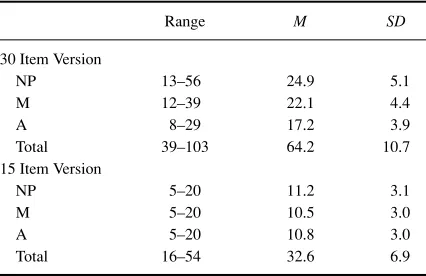
Table 1. Descriptive statistics for the 30-item and 15-item BIS in a normally distributed sample (n=700)
Range M SD
30 Item Version
NP 13–56 24.9 5.1
M 12–39 22.1 4.4
A 8–29 17.2 3.9
Total 39–103 64.2 10.7
15 Item Version
NP 5–20 11.2 3.1
M 5–20 10.5 3.0
A 5–20 10.8 3.0
Total 16–54 32.6 6.9
Results
Normative data. Descriptive statistics for the 30 item BIS are given in Table 1. A linear regression of demographic variables predicting the total score of the BIS was significant,F(3, 695) = 26.8,p < .001 (Table 2). The model accounted for 10.5% of the variance (Adjusted R2 = .101). Males scored
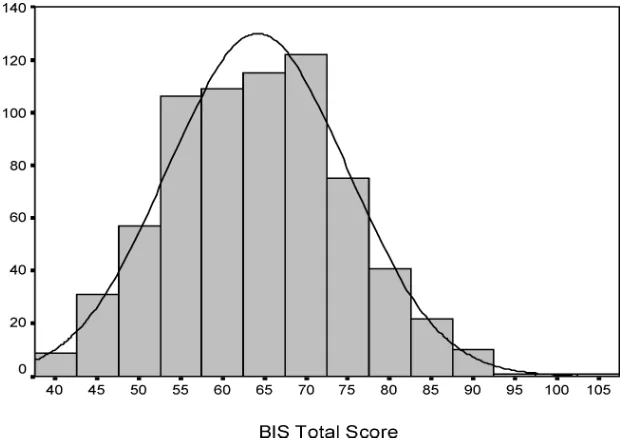
higher than females, and scores tended to decrease with age and education. A one-sample Kolmogorov-Smirnov Test indicated that scores were normally distributed (Z=1.02,p=.249, two-tailed significance) (Figure 1). Intrascale reliability (Cronbach’s alpha) for this sample was very good (.82) (DeVellis, 1991).
Table 2. Linear regression of demographic variables predicting the 30-item and 15-item BIS total scores
B SE Beta Partial Part p
BIS30
Age −.25 .03 −.30 −.30 −.30 <.001
Sex .85 .40 .08 .08 .09 .032
Education −.70 .21 −.12 −.13 −.12 .001 BIS15
Age −.16 .02 −.30 −.30 −.30 .000
Sex .49 .26 .07 .07 .07 .059
[image:4.432.79.369.456.573.2]Figure 1.Distribution of the 30-item BIS total scores (n=700).
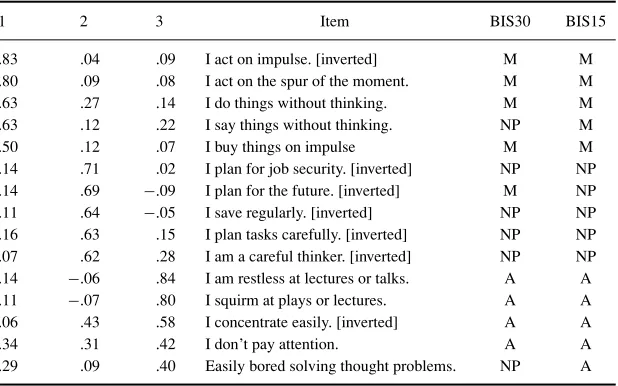
Development of a short form. The 30 items of the BIS were subjected to a factor analysis by principal components using Varimax rotation. A three factor solution was specified a priori based on previous studies showing a three-factor structure (Patton et al., 1995). Items factored in a manner that was highly consistent with the three established factors: nonplanning, motor impulsivity, and attention impulsivity. Five items with the highest loadings from each of the 3 factors were chosen and the factor analysis was re-run using only these 15 items. Eigenvalues, variance explained and intrascale reliability (Cronbach’s alpha) for each item is reported in Table 3. Collectively, these three factors explained 33.4% of the variance. Cronbach’s alpha for the total scale was very good (.81). As with the original scale, six of the items are inverted because they relate to lower impulsivity (e.g., “I plan for the future.”)
Descriptive statistics for the 15 item BIS (BIS15) are also given in Table 1. A linear regression of demographic variables predicting the total score of the BIS was significant,F(3, 695)=26.5,p<.001 (Table 2). The model accounted for 10.7% of the variance (AdjustedR2 =.103). Scores decreased with age
Table 3. Factor analysis of a 15-item version of the BIS. Abbreviations: A—Attention impulsivity, M—Motor Impulsivity, NP—Non-planning
1 2 3 Item BIS30 BIS15
.83 .04 .09 I act on impulse. [inverted] M M .80 .09 .08 I act on the spur of the moment. M M .63 .27 .14 I do things without thinking. M M .63 .12 .22 I say things without thinking. NP M
.50 .12 .07 I buy things on impulse M M
.14 .71 .02 I plan for job security. [inverted] NP NP .14 .69 −.09 I plan for the future. [inverted] M NP .11 .64 −.05 I save regularly. [inverted] NP NP .16 .63 .15 I plan tasks carefully. [inverted] NP NP .07 .62 .28 I am a careful thinker. [inverted] NP NP .14 −.06 .84 I am restless at lectures or talks. A A .11 −.07 .80 I squirm at plays or lectures. A A .06 .43 .58 I concentrate easily. [inverted] A A
.34 .31 .42 I don’t pay attention. A A
.29 .09 .40 Easily bored solving thought problems. NP A
normally distributed, as indicated by a Kolmogorov-Smirnov test (Z=1.15, p=.14, two-tailed significance). BIS15 scores correlated with the total scores of the full test (BIS30) (r=.94,p<.001), and they also correlated with the total of the remainder items not included in the BIS15 (r=.65,p<.001)
STUDY 2
Methods
Participants. Participants were a convenience sample (n =100; 49 female, 51 male) of community-dwelling individuals recruited by word-of mouth. This was a separate sample from studt 1, but identical procedures were followed. Subjects raged in age from 17 to 57 years (M =27.0,SD=11.2), and had completed between 8 and 18 years of education (M=14.0,SD=2.3).
Measures. Barratt Impulsiveness Scale. The 15-item version of the BIS developed in study 1 was used in this study.
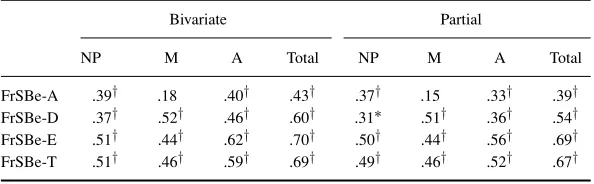
Table 4. Correlations between the BIS15 and Frontal Systems Behavior Scale (FrSBe)
Bivariate Partial
NP M A Total NP M A Total
FrSBe-A .39† .18 .40† .43† .37† .15 .33† .39† FrSBe-D .37† .52† .46† .60† .31∗ .51† .36† .54† FrSBe-E .51† .44† .62† .70† .50† .44† .56† .69† FrSBe-T .51† .46† .59† .69† .49† .46† .52† .67†
(N=100; two-tailed significance,∗p<=.01,†p<=.001). Partial correlations are control-ling for age, sex, and education. Abbrebiations: FrSBe-A—Apathy, FrSBe-D—Disinhibition, FrSBe-E—Executive dysfunction, NP—Nonplanning, M—Motor impulsivity, A—Attention impulsivity.
analysis: Apathy, Disinhibition, and Executive dysfunction. The scale shows high intrascale reliability in normal and clinical samples (Grace & Malloy, 2001). Validity of the instrument is further supported by studies in neurological populations. FrSBe scores correlated with objective measures of executive functions in people with multiple sclerosis (Chiaravalloti & DeLuca, 2003).
Results
BIS15 scores ranged from 20 to 51 (M=32.8,SD=6.5), which were consistent with the normative scores in study 1. Cronbach’s alpha for the BIS15 in this sample was.79. FrSBe scores ranged from 64 to 154 (M=103.5,SD=21.1), which is consistent with reported normative data in non-clinical samples (Grace & Malloy, 2001; Spinella, 2005).
Bivariate correlations showed moderate to strong relationships between subscales and the total scores of the FrSBe and BIS (Table 4). The only correla-tion that did not reach significance was between motor impulsivity (BIS15) and apathy (FrSBe-A). Partial correlations showed that these relationships remained significant after controlling for age, sex, and education.
DISCUSSION
associated with greater impulsivity (e.g., substance abuse, personality disorder, attention deficit hyperactive disorder). Nonetheless, the scores were normally distributed as would be anticipated from a large community sample. Demo-graphic variables were relevant to impulsivity scores. Age was the strongest predictor, which was moderate in magnitude. Sex and education level were also relevant, but their contribution was relatively small.
The 15-item version of the BIS created here was derived from items that had the highest loadings of on the three factors of the scale. The factor analysis closely replicated the higher order factor structure indicated by Patton and colleages (1995). There are three items that loaded on scales differently. On the 30-item BIS (BIS30), “I say things without thinking.” is included in the NP scale, while it loaded significantly on the NP scale in this sample. However, this grouping is logical because it factors with other items that involve a lack of behavioral self-inhibition. “I plan for the future” was included on the M scale of the BIS30, while here it logically loaded on the NP scale. Thirdly, “I am easily bored while sovling thought problems.” was part of the NP scale of the BIS30, while here it loaded on the A scale. Other items of the A scale similarly involve sustaining concentration. Thus the minor variations from the original designations involve items that factor logically into the three scales.
Study 2 showed moderate to strong relationships between the BIS15 and FrSBe, which has been validated in clinical populations and against objective neuropsychological measures of prefrontal functions. Thus, these two objectively validated scales self-rating scales of prefrontal system function showed strong intercorrelations.
This short version of the BIS correlated strongly with the full version and with the items non-included in the short version. It also showed good intrascale reliability, which did not decrease (in fact slightly increased) from the total scale. This scale also eliminates items that did not load well into any of the factors. These items (e.g., “I like puzzles,” and “I am happy-go-lucky”) may relate to impulsivity, but may also relate to other factors or could be interpreted differently by different people. As a shorter, more condensed and homogeneous scale, it can serve as a useful alternative to the longer scale while retaining good psychometric properties.
REFERENCES
Asahi, S., Okamoto, Y., & Okada, G. (2004). Negative correlation between right prefrontal activity during response inhibition and impulsiveness: A fMRI study.
Bayle, F. J., Caci, H., Millet, B., Richa, S., & Olie, J. P. (2003). Psychopathology and comorbidity of psychiatric disorders in patients with kleptomania.American Journal of Psychiatry,160(8), 1509–1513.
Carrillo-de-la-Pena, M. T., Otero, J. M., & Romero, E. (1993). Comparison among various methods of assessment of impulsiveness.Perceptual & Motor Skills,77(2), 567–575.
Chiaravalloti, N. D., & DeLuca, J. (2003). Assessing the behavioral consequences of multiple sclerosis: An application of the Frontal Systems Behavior Scale (FrSBe).
Cognitive and Behavioral Neurology,16, 54–67.
DeVellis, R. F. (1991).Scale development: Theory and applications. Newbury Park, CA: Sage.
Dougherty, D. M., Bjork, J. M., Huckabee, H. C., Moeller, F. G., & Swann, A. C. (1999). Laboratory measures of aggression and impulsivity in women with borderline personality disorder.Psychiatry Research,85(3), 315–326.
Grace, J., & Malloy, P. F. (2001).Frontal Systems Behavior Scale manual. Lutz, FL: Psychological Assessment Resources, Inc.
Hoptman, M. J., Volavka, J., Johnson, G., Weiss, E., Bilder, R. M., & Lim, K. O. (2002). Frontal white matter microstructure, aggression, and impulsivity in men with schizophrenia: A preliminary study.Biological Psychiatry,52(1), 9–14. Horn, N. R., Dolan, M., Elliott, R., Deakin, J. F., & Woodruff, P. W. (2003). Response
inhibition and impulsivity: An fMRI study.Neuropsychologia,41, 1959–1966. Houston, R. J., & Stanford, M. S. (2005). Electrophysiological substrates of
impulsiveness: Potential effects on aggressive behavior. Progress in Neuro-Psychopharmacology & Biological Psychiatry,29(2), 305–313.
Lyke, J. A., & Spinella, M. (2004). Associations among aspects of impulsivity and eating factors in a nonclinical sample.International Journal of Eating Disorders,
36(2), 229–233.
Martins, S. S., Tavares, H., da Silva Lobo, D. S., Galetti, A. M., & Gentil, V. (2004). Pathological gambling, gender, and risk-taking behaviors.Addictive Behaviors,
29(6), 1231–1235.
Manuck, S. B., Flory, J. D., McCaffery, J. M., Matthews, K. A., Mann, J. J., & Muldoon, M. F. (1998). Aggression, impulsivity, and central nervous system serotonergic responsivity in a nonpatient sample. Neuropsychopharmacology, 19(4), 287– 299.
Moeller, F. G., Hasan, K. M., & Steinberg, J. L. (2005). Reduced anterior corpus callosum white matter integrity is related to increased impulsivity and reduced discriminability in cocaine-dependent subjects: Diffusion tensor imaging. Neu-ropsychopharmacology,30(3), 610–617.
Nasser, J. A., Gluck, M. E., & Geliebter, A. (2004). Impulsivity and test meal intake in obese binge eating women.Appetite,43(3), 303–307.
Paul, T., Schroeter, K., Dahme, B., & Nutzinger, D. O. (2002). Self-injurious behavior in women with eating disorders.American Journal of Psychiatry,159(3), 408–411. Preuss, U. W., Koller, G., Bondy, B., Bahlmann, M., & Soyka, M. (2001). Impulsive traits
and 5-HT2 A receptor promoter polymorphism in alcohol dependents: Possible association but no influence of personality disorders.Neuropsychobiology,43(3), 186–191.
Ruchsow, M., Walter, H., Buchheim, A., Martius, P., Spitzer, M., Kachele, H., Gron, G., & Kiefer, M. (2006). Electrophysiological correlates of error processing in borderline personality disorder.Biological Psychology,72(2), 133–140.
Sakado, K., Sakado, M., Muratake, T., Mundt, C., & Someya, T. (2003). A psychometrically derived impulsive trait related to a polymorphism in the serotonin transporter gene-linked polymorphic region (5-HTTLPR) in a Japanese nonclinical population: Assessment by the Barratt impulsiveness scale (BIS). American Journal of Medical Genetics. Part B, Neuropsychiatric Genetics,121(1), 71–75. Spinella, M. (2004). Neurobehavioral correlates of impulsivity.International Journal
of Neuroscience,114(1), 95–104.
Spinella, M. (2005). Prefrontal substrates of empathy: Psychometric evidence in a community sample.Biological Psychology,70(3), 175–181.
Stunkard, A. J., & Messick, S. (1985). The three-factor eating questionnaire to measure dietary restraint, disinhibition and hunger.Journal of Psychosomatic Research,
29(1), 71–83.
Swann, A. C., Anderson, J. C., Dougherty, D. M., & Moeller, F. G. (2001). Measurement of inter-episode impulsivity in bipolar disorder.Psychiatry Research,101(2), 195– 197.
Zilberman, M. L., Tavares, H., & El-Guebaly, N. (2003). Relationship between craving and personality in treatment-seeking women with substance-related disorders.