Original Article
This is an open access journal, and articles are distributed under the terms of the Creative Commons Attribution-Non Commercial-ShareAlike 4.0 License, which allows others to remix, tweak, and build upon the work non-commercially, as long as appropriate credit is given and the new creations are licensed under the identical terms.
© 2017 Journal of Advanced Pharmacy Education & Research | Published by SPER Publication 438
Gross motor development in Egyptian preschool children with
attention deficit hyperactivity disorder: pilot study
Amira H. Mohammed
1, Hala A. Abdel Gawad
2, Mohamed Moustafa Mohamed Ahmed
31Lecturer in Department of Physical Therapy for Pediatric Disorders, Faculty of Physical Therapy, Delta University for Science and Technology, Egypt, 2Assistant professor
in Department of Physical Therapy for Gynecology and Pediatric Disorders and their Surgery, Collage of Physical Therapy, Misr University for Science and Technology, Egypt, 3Lecture of Physical Therapy Beni- Suef University, Egypt. Assisstant professor in Department of Physical Therapy, Faculty of Applied Medical Science, Jazan
University, KSA.
Correspondence: Hala A. Abdel, Gawad Assistant professor in Department of Physical Therapy for Gynecology and Pediatric Disorders and their Surgery, Collage of Physical Therapy, Misr University for Science and Technology, Egypt. E_mail: [email protected]
ABSTRACT
Objective: The present study aimed to assess gross motor development in Egyptian preschool children with attention deficit hyperactivity disorder and its relation to the total percentile scores of the ADHD Rating Scale-IV.
Methods: Fifteen Egyptian children suffering from attention deficit hyperactivity disorder (ADHD) according to the ADHD Rating Scale-IV participated in this study from both sexes (11 boys and 4 girls) with mean age 65.47 ±3.58 months. They were conducted by Peabody Developmental Motor Scale (PDMS- 2) to determine their gross motor skills.
Results: Based on the gross motor quotient classifications, the children suffering from ADHD had a significantly lower age equivalence in gross motor subsets than their chronological age.
Conclusion: We could conclude that children suffering from ADHD had a significant developmental delay in gross motor skills.
Keywords: ADHD, Gross, Motor, Preschool, Children, PDMS-2
Introduction
Attention deficit hyperactivity disorder (ADHD) is the highly frequent neurobehavioral disorders that affect the children at age ranged from 4-17 years old. Its prevalence among Egyptian children ranged from 21.8 % to 16.2 % based on the teacher and parents scales respectively. The interaction between genetic, environmental and neurobehavioral factors taught to be the causes of ADHD[1]. Boys have reported high incidence than girls. It was characterized by inattentiveness, impulsiveness and overactivity[2].
The diagnosis of ADHA requires assessment for the child in two different settings[3]. There are different diagnostic tools that were used to assess these children e.g. the International Classification of Mental and Behavioral Disorders 10th revision (ICD-10) and the Diagnostic and Statistical Manual of Mental Disorders 4th edition (DSM IV)[4]. ADHD Rating Scale-IV is one of these diagnostic tools. It is good valid and reliable tool. It provides valid information about the severity of ADHD[5,6].
Children suffering from ADHD had lower developmental motor skills than normal children. They were suffering from impairments in timing and motor coordination which decrease their self-confidence and participation in activities and increase the possibility of their exposure to a motor and cardiovascular disorder[7]. This study aimed to assess gross motor development in Egyptian preschool children with attention deficit hyperactivity disorder and its relation to the total percentile scores of the ADHD Rating Scale-IV.
Access this article online
Website: www.japer.in E-ISSN: 2249-3379
How to cite this article: Amira H. Mohammed, Hala A. Abdel Gawad, Mohamed
Moustafa Mohamed Ahmed. Gross motor development in egyptian preschool children with attention deficit hyperactivity disorder: pilot study. J Adv Pharm Edu Res, 2017 ;7(4):438-442.
439
4 sue 2017 | Vol 7 | Is Dec
-Oct Journal of Advanced Pharmacy Education & Research |
Subjects, instrumentations, and procedures: Subjects:
Fifteen Egyptian children suffering from attention deficit hyperactivity disorder (ADHD) participated in this study from both sexes (11 boys and 4 girls). This study was conducted in the period from March 2017 to October 2017. They were recruited from several kindergartens, according to the following criteria:
1. Their age ranged from 60 to 72 months.
2. They had no history of cerebral palsy, epilepsy or
head trauma.
3. They were suffering from attention deficit
hyperactivity disorder (ADHD) according to the ADHD Rating Scale-IV. ADHD Rating Scale-IV checklist was written by their teachers. The process of making a diagnosis was done by the therapist based on the screening tool[5].
The study was approved by an Ethics Committee of the
Cairo University. Child’s parents had signed a consent
form about the purpose of the study, its benefits and inherent risks, their committee with regard to time and money and Agreement to participate.
Instrumentations:
Before the following evaluation, the purposes and
procedures were fully explained to the children’s parents.
ADHD Rating Scale-IV checklist [5].
It was used to determine the child was diagnosed with ADHD or not.
Peabody Developmental Motor Scale (PDMS-2).
It was used to assess gross motor skills[9]. The children in this study were tested to determine the developmental skills levels.
Procedures:
Each child was examined individually, using ADHD Rating Scale-IV checklist. The child's teacher was asked to write the checklist. Then the therapist interpreted the total scores obtained from the checklist and she converted it to the percentile scores based on their total scores. If the child was diagnosed with ADHA, he/she was conducted to Peabody Developmental Motor Scale (PDMS- 2) to determine his/her gross motor skills. The Gross motor skills include assessment subsets for
stationary, locomotion and object manipulation. Each item of subsets scored as 2, 1 or 0. After administration of all tests in each subtest, raw and standard scores were intended for each one. Finally, the gross motor quotient (GMQ) was determined. The GMQ was converted into a description included in the PDMS-2 manual. This description reflected the child relative strengths and weakness of motor development[9].
Statistical analysis:
The mean value and standard deviation were calculated for each variable measured during the study. Paired t-test was calculated for chronological age and age equivalence in months variables measured during this study. We used level of significance 0.05.
The Bivariate Correlations procedure computed Pearson- a parametric test, to test the relationship between gross motor quotients and the percentile scores of ADHD Rating Scale-IV variables with ordered categories and their significance levels.
Results
The descriptive analysis of the measurable
variables.
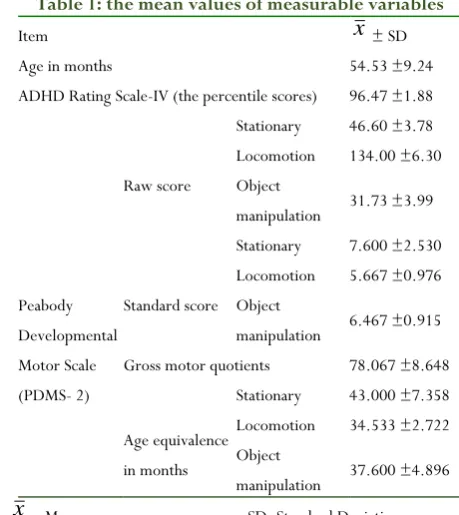
It is worth mentioning that the ages, ADHD Rating Scale-IV (the percentile scores) and Peabody Developmental Motor Scale (PDMS- 2) gross motor skills scoring variables (mean ±standard deviation) were summarized in table (1).
Table 1: the mean values of measurable variables
Item x ± SD
Age in months 54.53 ±9.24
ADHD Rating Scale-IV (the percentile scores) 96.47 ±1.88
Peabody Developmental Motor Scale (PDMS- 2)
Raw score
Stationary 46.60 ±3.78
Locomotion 134.00 ±6.30
Object
manipulation 31.73 ±3.99
Standard score
Stationary 7.600 ±2.530
Locomotion 5.667 ±0.976
Object
manipulation 6.467 ±0.915
Gross motor quotients 78.067 ±8.648
Age equivalence in months
Stationary 43.000 ±7.358
Locomotion 34.533 ±2.722
Object
manipulation 37.600 ±4.896
440 4 2017 | Vol 7 | Issue Dec
-Oct Journal of Advanced Pharmacy Education & Research |
Based on the gross motor quotient classifications, the quotient showed that there were two children with ADHD who had gross motor skills in the average range, six ADHD children scored below average gross motor and seven children had poor gross motor on the PDMS-2.
Chronological age and age equivalence in months
for stationary, locomotion and object
manipulation subsets.
Comparing the chronological age and age equivalence in months for stationary, locomotion and object manipulation subsets revealed significant delay in the gross motor subsets (stationary, locomotion and object manipulation) as (p<0.05), table (2).
Table 2: comparison between the chronological age and age equivalence in months for gross motor
subsets
Items Mean
difference t Sig. (2-tailed)
Percentage of developmental delay
Chronological age
– stationary age
equivalence in months
11.533.037 .009* 22.14%
Chronological age
– locomotion age
equivalence in months
20.007.791 .000* 36.68%
Chronological age
– object
manipulation age equivalence in months
16.936.793 .000* 31.04%
*: Significant
Pearson bivariate correlation between gross motor quotients and the percentile scores of ADHD Rating Scale-IV variables.
As shown in figure (1), there was no significant relationship between the gross motor quotients and the percentile scores of ADHD Rating Scale-IV which was
found to have insignificant relationships at 5% significance level.
Figure 1: The relationship between the gross motor quotients and the percentile scores of ADHD Rating Scale-IV
Discussion
This study was conducted to assess gross motor development in Egyptian preschool children with attention deficit hyperactivity disorder and its relation to the total percentile scores of the ADHD Rating Scale-IV. It was conducted to Egyptian children suffering from ADHD who have reported high incidence in the last years. It may be referred to the high exposure to risk factors (e.g.; passive smoking of mother during pregnancy, poor socioeconomic condition and birth order)[1]. The incidence of ADHD in pre-school and primary school age children was 6.5%[10]. One of the reliable and valid tools used to diagnose ADHA is ADHD rating scale-IV[11]. Children suffering from ADHD had movement behaviour problems. These problems include impairment of movement timing, difficulties in inhibiting motor responses, fine motor coordination and balance[8]. In this study, we were used Peabody Developmental Motor Scale (PDMS-2) which is good valid and reliable tool used to assess gross and fine motor skills in preschool children[12].
441
4 sue 2017 | Vol 7 | Is Dec
-Oct Journal of Advanced Pharmacy Education & Research |
development when compared to typically developing children[13,14]. These defects in motor behaviour can be due to decrease of the signals of prefrontal cortex by parietal cortex, basal ganglia, and cerebellum[15].
We recommended that considering medication, age, gender, and type of ADHD (inattentive, impulsive or combined) as factors that are not considered in our study. Also, further studies can be done for larger sample and higher age. Other skills like balance, fine motor, and timing of movement needed to be investigated for children suffering from ADHD.
Conclusion
We could conclude that children suffering from ADHD had a significant developmental delay in gross motor skills.
Conflict of interest
Authors have not declared any conflict of interest.
References
1. EL-Gendy. S. D., El-Bitar. E. A., El-Awady. M. A.,
Bayomy. H. A., and Agwa. E. M.: Attention-Deficit/Hyperactivity Disorder: Prevalence and risk factors in Egyptian primary School Children. The Egyptian Journal of Community Medicine 2017 Jan: 35 (1).
2. Shakir. L.N. and Sulaiman. K. H.: Prevalence of attention deficit hyperactivity among children attending outpatient clinic in psychiatric teaching hospital in Erbil city. Journal of Education and Practice 2016; 7 (23), 129-135.
3. James B, Alcott V.: Attention-deficit disorders. In: Sadock BJ, Sadock VA, editors. Kaplan and Sadock's synopsis of psychiatry: Behavioral sciences/clinical psychiatry. 10 ed. Philadelphia: Lippincott Williams & Wilkins; 2007. 1207-1217.
4. Lee SI, Schachar RJ, Chen SX, Ornstein TJ,
Charach A, Barr C et al. Predictive validity of DSM-IV and ICD-10 criteria for ADHD and hyperkinetic disorder. J Child Psychol Psychiatry 2008; 49(1):70-78.
5. DuPaul. G. J., Anastopoulos. A. D., Power. T. J.,
Reid. R., Ikeda. M., McGoey. K. E.: Parent ratings
of attention-deficit/hyperactivity disorder: Factor structure, normative data, and psychometric properties. J Psychopathol Behav Assess. 1998; 20(1):83–102.
6. Zhang. S., Faries. D.E., Vowles. M., Michelson. D.: ADHD Rating Scale-IV: psychometric properties from a multinational study as a clinician-administered instrument. Int J Methods Psychiatr Res. 2005;14 (4):186–201.
7. Kosari. S., Hemayat-Talab. R., Arab-Ameri. E., and Keyhani. F.: The Effect of Physical Exercise on the Development of Gross Motor Skills in Children with Attention Deficit / Hyperactivity Disorder. ZJRMS 2013; 15(2): 74-78.
8. Udal. A.F., Malt. U., Lovdahl. H., Gjaerum. B., Pripp. A. H., and Groholt. B.: Motor function may differentiate attention deficit hyperactivity disorder from early-onset bipolar disorder. Behavioral and brain functions, 2009, 5; 47.
9. Abdel Karim. A. E. and Mohammed. A. H.:
Effectiveness of sensory integration program in motor skills in children with autism. The Egyptian
Journal of Medical Human Genetics 2015; 16, 375–
380.
10. Soliman GT, Afify MF, Yehia MA, Abdel-Naem EA,
Abdalkarim SM. Attention deficit hyperactivity disorder, an epidemiological study of preschool and primary school children in Minia city. El-Minia Med Bul 2010; 21(1):171-179.
11. Purpura. D. J., Wilson. S. B., and Lonigan. C.J.: ADHD Symptoms in Preschool Children: Examining Psychometric Properties using IRT. Psychol Assess. 2010; 22(3): 546–558.
12. Piek. J., Hands. B. P., and Licari. M.: Assessment of motor functioning in the preschool period. Neuropsychology Review, 2012; 22 (4), 402-413.
442 4 2017 | Vol 7 | Issue Dec
-Oct Journal of Advanced Pharmacy Education & Research |
14. Neto. F. R., Goulardins. J.B., Rigoli. D., Piek. J. P., and De Oliveira.J. A.: Motor development of children with attention deficit hyperactivity disorder. Rev Bras Psiquiatr. 2015; 37(3).
15. Casey BJ, Nigg JT, Durston S: New potential leads