Turk. J. Fish.& Aquat. Sci. 20(6), 467-479 http://doi.org/10.4194/1303-2712-v20_6_05
Published by Central Fisheries Research Institute (SUMAE) Trabzon, Turkey in cooperation with Japan International Cooperation Agency (JICA), Japan
R E S E A R C H P A P E R
Comparative Transcriptome Analysis of the Gills from the
Chinese Mitten Crab (
Eriocheir japonica sinensis
) Exposed to
the Heavy Metal Cadmium
Dan Tang
1, Huayun Guo
1, Xueling Shi
1, Zhengfei Wang
1,*
1 Yancheng Teachers University, School of Ocean and Biological Engineering, Yancheng, China
Article History
Received 20 November 2018 Accepted 27 November 2019 First Online 04 December 2019
Corresponding Author Tel.: 86-515-88233587 E-mail: [email protected]
Keywords Transcriptome Chinese mitten crab Gill
Cadmium stress Detoxification
Abstract
Heavy metal Cadmium (Cd) pollution has become a potential environmental problem, and it threatens aquatic organisms including economic crabs and shrimps. Chinese mitten crab is a native species in East Asia, and it is the most important economic crab species in China. However, there are only a few studies about gills responding to Cd stress in the Chinese mitten crab at a molecular level. To gain better understanding of
the oxidative stress system (antioxidant defense) of the E. j. sinensis,in this study,
RNA-Seq was applied to obtain gene expression profile from the mitten crab’s gills in
response to Cd for 24h, and yielding 39,612,948 high-quality clean reads from which 570,847 transcripts and 504,889 unigenes are assembled by removing redundancy and
transcripts with low coverage.A total of 1544 differential expression genes (DGEs) are
identified. GO functional analysis and KEGG pathway analysis indicated some vital pathways and genes in response to the challenge. Four genes related to immune response and detoxification are selected to validate the DGE results by qRT-PCR. This comparative transcriptome provides valuable molecular information about on the mechanisms of the Chinese mitten crab responding to Cd that lays the foundation for further understanding of heavy metals stress.
Introduction
The Chinese mitten crab (Eriocheir japonica sinensis) is a widely-distributed group in streams and rivers along the eastern pacific coast of China to the Korean Peninsula (Wang et al., 2018; Xiong et al., 2001). The Chinese mitten crab has abundant nutrition and delicate taste, making it becomes a common food today and has high market demand and price in China (Li et al., 2018; Wu et al., 2007). The annual production of E. j. sinensis has increased sharply during the past two decades which is approximately 812,103 tons in 2016 (China Fisheries Yearbook, 2017). Thus, E. j. sinensis has become one of the most prevalent and commercially important aquaculture crabs in China. In addition, E. j. sinensis always was considered as a model organism in aquaculture studies (Cui et al., 2013).
macromolecules and variously physiological damage to animal tissues and organs (Thévenod 2009). Furthermore, Cd also generates DNA strand breaks and gene inactivation (Manna and Sil 2009), and alters gene expression to regulate activities of various enzymes (Overstreet 2000). Previous studies showed that effects of Cd exposure in many crustaceans which including Sinopotamon henanense (Sun et al., 2016), Macrobrachium rosenbergii (HAKaoud and ARezk 2011), and Gammarus fossarum (Silvestre et al., 2006). However, up to date, the research about E. j. sinensis is limited on the knowledge about the molecular basis of responding to Cd stress.
In crustaceans, the gills are multifunctional and generally regarded as a major organ of respiration (Burnett and Mcmahon 1985) and osmoregulation (Hu et al., 2015; Weihrauch et al., 2001). Additionally, the gills also play a critical role in xenobiotics entering organisms, material absorption and biological transformation because it associates with ambient environment directly (Wang et al., 2013). Previous studies have reported E. j. sinensis are threatened by Cd, but mostly focused on tissue-specific cadmium accumulation(Silvestre et al., 2005; Wang et al., 2001). Silvestre et al., (2005) found that the anterior gill in E. j. sinensis has highest level of cadmium accumulation, followed by the hepatopancreas and posterior gill. However, the studies on the molecular responses of differentially expressed genes are scarce in Chinese mitten crab gills exposed to Cd.
In recent years, with the development of next-generation sequencing, de novo transcriptomic approaches have been increasingly used to investigate physiological process and molecular characteristics of model and non-model organisms (Lou et al., 2017). Additionally, de novo transcriptome provides great breadth and depth of information that can be used to catalog all the genes expressed in the tissue, and facilitates detailed functional research of various proteins (Bain et al., 2016). To get better understanding about the molecular basis responses to Cd stress in E. j. sinensis, we used the comparative transcriptome of the gills to analyze the differentially expressed genes (DEGs) between exposed and unexposed to Cd by using Illumina sequencing platform and quantitative real-time PCR (RT-qPCR). The goal of this study is to improve a better understanding of molecular responses of E. j. sinensis when exposed to Cd and to provide a theoretical basis for the further researches on heavy metals stress.
Materials and Methods
Animals and Exposures
E. j. sinensis were purchased from Yangguang market in Yancheng, Jiangsu Province, China, on October 18th, 2017. Before experiments, the crabs were acclimated 2 days. Crabs were randomly divided to the treated group and the control group. The treated group
of three crabs was exposed to Cd for 24 hours at a concentration of 1mg/L prepared by dissolving 2.036 mg of CdCl2·2.5 H2O in 1L of clean water (without Cd). The
control group of three crabs was maintained under clean water for 24 hours at 20 ± 0.5°C. The crabs of each group were settled at tanks (36 cm × 20 cm × 18 cm) which contain one third water. During the whole processes, crabs were not fed. Then the gills samples of the E. j. sinensis from each group were rapidly removed, snap-frozen in liquid nitrogen, placed into 1.5 ml RNase-free tubes and immediately stored at -80 °C prior to the RNA extraction, respectively.
RNA Extraction, cDNA Library Preparation and Illumina Sequencing
Total RNA was isolated from the composite sample using a standard TRIzol Reagent Kit according to the manufacturer's instructions. RNA purity was confirmed spectrophotometrically using a NanoDrop 2000 and integrity were assessed using an Agilent 2100 Bioanalyser (Agilent Technologies, USA). Briefly, mRNA was purified using oligo (dT) magnetic beads. Purified mRNA was fragmented into smaller fragments (about 200 bp) by using a fragmentation buffer. Then, random-hexamer primers and reverse transcriptase were used to synthesize the first-strand. Next, Second-strand cDNA synthesis was subsequently performed as a stable double-stranded structure, after which end repair and addition of a base at 3′ ends were conducted. The suitable fragments were purified by 2% agarose gel electrophoresis and enriched by PCR amplification for 15 cycles to create a cDNA library. Finally, the library was
conducted by Illumina HiSeq™ 2000 platform (Illumina
Inc.).
Assembly and Annotation
In this study, the SeqPrep
(https://github.com/jstjohn/SeqPrep) and Sickle (https://github.com/najoshi/sickles) software were used to filter raw reads in FASTQ format by removing reads with sequencing adaptors, low quality (quality
scores ≤ 20) and unknown nucleotides (N ratio > 10%).
Following quality filtering, all downstream analyses were based on clean, high-quality data, and then clean reads were de novo assembled using Trinity software package (Haas et al., 2013). Longest transcripts of each
gene were pooled as “unigenes”.
469
Turk. J. Fish.& Aquat. Sci. 20(6), 467-479sequences based on their alignment using the Blast2GO software (Delanghe 2005).
Identification of Differentially Expressed Unigenes
To identify differential expression genes (DEGs) between two samples, the expression level of each unigene was measured by using the Fragments Per Kilobase of exon model per Million mapped reads (FPKM) method (Mortazavi et al., 2008). Differential expression analysis between samples was performed
using edgeR
(http://www.bioconductor.org/packages/2.12/bioc/ht ml/edgeR). Genes were considered significantly differentially expressed (DEGs) when FDR (false discovery rate) < 0.05 and log2|FC| >= 1. GO term
enrichment analysis and KEGG pathway functional enrichment analysis of the differentially expressed genes to determine the DEG functions and biological
pathways by Goatools
(https://github.com/tanghaibao/GOatools) and KOBAS (http://kobas.cbi.pku.edu.cn/home.do), respectively. We defined the corrected p value <= 0.05 as significantly enriched (Kanehisa et al., 2008).
Expression Analysis by Real-Time Quantitative PCR (qRT-PCR)
A total of 4 up-regulated genes associated with Cd stress were selected for qRT-PCR analysis to validate the Illumina sequencing result and the expression pattern. The gene-specific primers were designed by Primer Premier 5.0 (Table 1). Total RNA was extracted from the gills of three crabs in each group using TRIzol (Invitrogen). qRT-PCR analysis was performed on an Applied Biosystem 7500 real-time PCR system (Applied Biosystems, Thermo Fisher Scientific, Waltham, MA, USA) with 2 × SYBR Green qPCR Mix (Aidlab Biotechnologies Co., Ltd., China). The qRT-PCR reaction system (25 μl) consisted of 12.5 μL of 2 × SYBR qPCR Mix,
1 μL of forward and reverse primers,1 μL of cDNA, and 10.5 μL of RNase-free H2O. β-actin was used as the
reference gene to normalize target gene expression. The PCR program was set with an incubation step: 3 min at 95 °C, 40 cycles of 15 s at 94 °C, 15 s at 55 °C and 25 s at 72 °C, followed with the standard dissociation cycle. Each gene was repeated three technique replications and 2–△△CT method was used for analyzing relative
quantification (Thomas et al., 2008).
Results and Discussion
Illumina Sequencing and De Novo Assembly
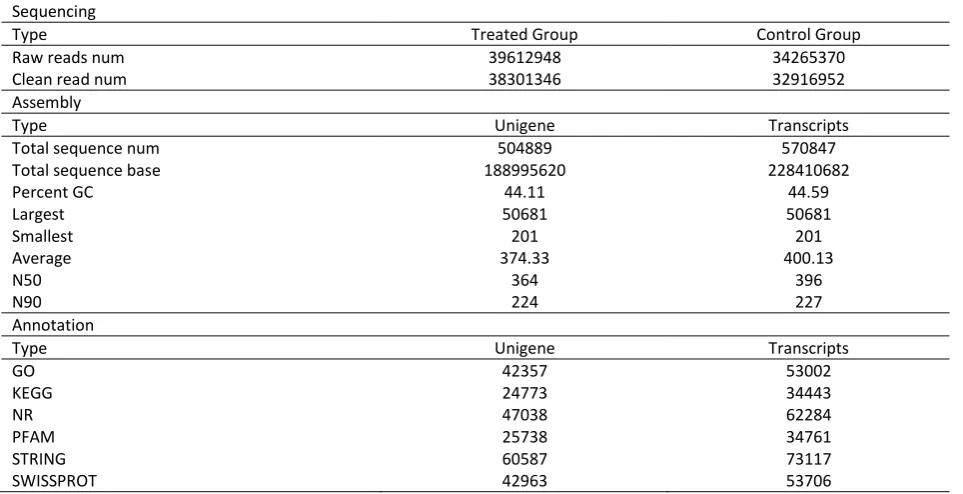
To get an overview of the transcriptomic characteristics of the Cd stress, two cDNA libraries were constructed between the gills of exposed and unexposed E. j. sinensis. We obtained 39,612,948 total raw reads and 34,265,370 total raw reads from treated group and control group samples, respectively. The raw reads were further filtered into clean reads. After assembly, we obtained 570,847 transcripts, which were further clustered into 504,889 unigenes. The unigenes comprised 188,995,620 bases, and the N50 length of 364bp with an average GC content of approximately 44.11%. The average length, largest length and smallest length were 374.33bp, 50681bp and 201bp, respectively. Detailed information relevant to overall assembly quality was summarized in Table 2.
Functional Annotation and Classification
All the unigenes were aligned to NR, String, Swiss-Prot, Pfam, GO and KEGG database, with a cut-off E-value of 1e-5. A total of 71,968 unigenes (13.11% of all unigenes) had significant hits in at least one of these databases, including 60,587 (84.19%), 47,038 (65.36%), 42,963 (59.70%) and 42,357 (58.86%) were mapped to String, NR, Swiss-Prot and GO databases, respectively. However, comparing to four databases, only 25738 (35.76%) and 24773 (34.42%) of the total sequences were matched against Pfam and KEGG databases. These annotation and classification will facilitate the following interpretation of the gene function in E. j. sinensis.
From the annotated information of six databases, all unigenes were annotated through Blast against the NCBI non-redundant (nr) protein database built for the invertebrate. The Blast top-hit species distribution of the annotated unigenes showed the highest homology to the Hyalella azteca (9838,20.92%), followed by Zootermopsis nevadensis (1547,3.29%), Trichuris trichiura (1121,2.38%), Capitella teleta (993,2.11%) and Plutella xylostella (950,2.02%). Except for the top 20 species with sequence hits, the largest number of the unigenes was hits in the other species (23619, 50.21%) due to limited genome information in curstaceans (Figure 1).
Table 1. Real-time quantitative PCR primers used in this study
Gene Name Forward primer sequence (5'-3') Reverse primer sequence (5'-3')
β-actin GATGGTGGGAATGGGTCA CCAACCGTGAGAAGATGACT
TRX TGATTTAGGTGGATGAGTTGG TTCCTCAATATGCCGTACCT
Prx3 GAGCCGAGAAGCAGACGA ACTCGCACTTCTCCCACC
HSP70 CTGGTTGTCGGAGTAGGTG ATTTCTCCACAGGCTCCA
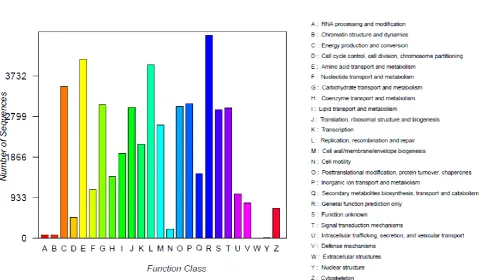
As an internationally standardized database of predicting the possible functions, COG analysis could help us understand the gene function distribution characteristics of the species. The results showed that of the 504,889 unigenes, 46,552 sequences had a COG classification. From the 25 COG categories, the cluster
for “Amino acid transport and metabolism” (4116, 8.84%) was the largest group, followed by the group for
“Replication, recombination and repair” (3993, 8.58%),
“Energy production and conversion” (3482, 7.48%),
“Inorganic ion transport and metabolism” (3095, 6.65%)
and “Carbohydrate transport and metabolism” (3064, 6.58%) (Figure 2).
Besides COG analysis, 24773 unigenes were successfully mapped to 380 KEGG pathways within 46 categories. Among these pathways, the highly represented categories were “Metabolic pathways”
(ko01100: 6637, 26.79 %), “Biosynthesis of secondary metabolites” (ko01110: 2869, 11.58%), “Biosynthesis of antibiotics” (ko01130: 2215, 8.94 %), “Microbial
metabolism in diverse environments” (ko01120: 1914, 7.72 %) and “Carbon metabolism” (ko01200: 1450, 5.85 %).
Differentially Expressed Genes (DEGs) in the Gill of E. j. sinensis
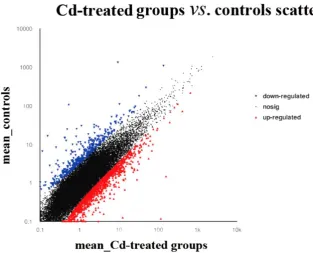
To identify genes display significant changes in expression during Cd stress, we analyzed differentially expressed genes by comparing the Cd treated library with the control library. The expression level of each unigene was measured by FPKM method. We judged the statistical significance of gene corrected p-value < 0.05 and the log 2 |FC| >= 1. A total of 1544 genes were
significant differentially expressed in gills of crabs.
Among these DEGs, 1084 genes were up-regulated and 460 genes were down-regulated compared with the control group (Figure 3). This analysis showed Cd stress had significant effect on the gene expression in E. j. sinensis, and the larger number of up-regulated genes suggested that most of the DEGs were mainly associated with stress response.
GO Analysis of DEGs
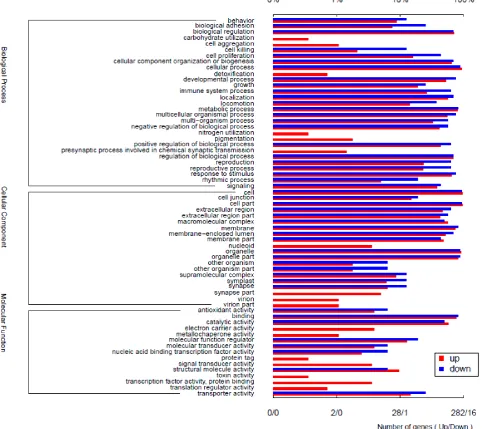
To obtain a better understanding of biological functions and gene interaction of DEGs, all DEGs were annotated in GO terms and significantly enriched in three GO categories, including Biological Process (BP, 29 categories), Cellular Component (CC, 20 categories), and Molecular Function (MF, 15 sub-categories) (Figure 4). Within the Biological Process,
“cellular process” (GO: 0009987, 275 DEGs), “metabolic process” (GO: 0008152, 239 DEGs), “biological regulation” (GO: 0065007, 211 DEGs), “regulation of biological process” (GO: 0050789, 203 DEGs) and
“cellular component organization or biogenesis” (GO: 0071840, 193 DEGs) were mostly prevalent term. Under Cellular Component category, “cell” (GO: 0005623, 285 DEGs) comprised the largest proportion, followed by
“cell part” (GO: 0044464, 284DEGs), “organelle” (GO: 0043226, 271 DEGs), “organelle part” (GO: 0044422, 247 DEGs) and “membrane” (GO: 0016020, 222 DEGs). In Molecular Function category, “binding” (GO: 0005488, 229 DEGs) was the predominant GO term, followed by “catalytic activity” (GO: 0003824, 171 DEGs), “transporter activity” (GO: 0005215, 45 DEGs),
“molecular function regulator” (GO: 0098772, 39 DEGs) and “structural molecule activity” (GO: 0005198, 28 DEGs).
Table 2. Summary of transcriptome characterization of E. j. sinensis
Sequencing
Type Treated Group Control Group
Raw reads num 39612948 34265370
Clean read num 38301346 32916952
Assembly
Type Unigene Transcripts
Total sequence num 504889 570847
Total sequence base 188995620 228410682
Percent GC 44.11 44.59
Largest 50681 50681
Smallest 201 201
Average 374.33 400.13
N50 364 396
N90 224 227
Annotation
Type Unigene Transcripts
GO 42357 53002
KEGG 24773 34443
NR 47038 62284
PFAM 25738 34761
STRING 60587 73117
471
Turk. J. Fish.& Aquat. Sci. 20(6), 467-479Figure 1. Species distribution of BLASTx matches the hepatopancreas transcriptome unigenes. Each piece of fan indicates the number of top BLAST matches against the Genbank non-redundant (Nr) protein database for various species.
In addition, among all the 64 GO terms, “synapse part”, “electron carrier activity”, “signal transducer activity”, “transcription factor activity, protein binding”,
“nucleoid”, “pigmentation”, “presynaptic process involved in chemical synaptic transmission”, “cell aggregation”, “virion”, “virion part”, “metallochaperone
activity”, “detoxification”, “translation regulator activity”, “carbohydrate utilization”, “nitrogen utilization”, “protein tag” and “toxin activity” from three GO categories were all up-regulated DEGs with no down-regulated DEGs (Figure 5). It is worth noting that the “synapse part” (14), “electron carrier activity” (11) and “signal transducer activity” (10) categories had the most participating genes in these GO terms. Synapse is a structure that permits a neuron to pass an electrical or chemical signal to another neuron or to the target effector cell. Both “electron carrier activity” and “signal transducer activity” are involved in stress signal transduction (Liu et al., 2017). These findings indicate the importance of signal transduction in the stress response of the E. j. sinensis caused by Cd stress.
Pathway Analysis of DEGs
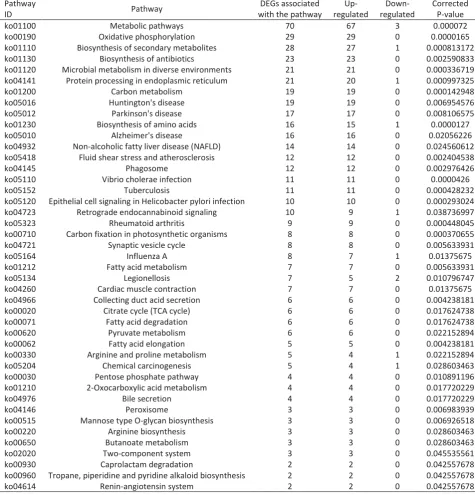
KEGG is a database for biological systems that integrates genomic, chemical, and systemic functional information (Kanehisa et al., 2007). In this study, all DEGs were assigned into KEGG metabolic and regulatory pathways to identify the biological pathways involved in Cd stress. These genes were mapped into 238 pathways in the KEGG database and 43 pathways were significantly enriched (corrected P-value<0.05) (Table 3). The DEGs were mainly concentrated in the pathways of
“Metabolic pathways” (67 up-regulated, 3 down-regulated), “Biosynthesis of secondary metabolites” (27 up-regulated, 1 down-regulated), “Oxidative phosphorylation” (26 up-regulated, 0 down-regulated),
“Biosynthesis of antibiotics” (23 up-regulated, 0 down-regulated) and “Microbial metabolism in diverse environments” (21 up-regulated, 0 down-regulated) (Table 3). These pathways were all classified with metabolites pathway and most DEGs were up-regulated. Remarkably, our study found that 29 DEGs were all significant up-regulated in the Oxidative phosphorylation pathway (Figure 4). As we all know, oxidative phosphorylation in mitochondria is a major pathway to supply energy in the basic activities of life through electron transport chain to generate 3’ -adenosine triphosphate (ATP) (Saraste 1999). DEGs involved in the Oxidative phosphorylation pathway were all significant up-regulated, indicating that E. j. sinensis needs more ATP to provide more energy for biochemical activities caused by Cd stress.
Gill associates with ambient environment directly, and it is one of the most important organs involved in osmoregulation in crustaceans (Li et al., 2014). As we all know, Na+/K+-ATPase (NKA) is a widespread P-type
ATPase that plays an important role in the regulation of hematopoietic osmotic pressure (Ahearn et al., 1999; Crambert et al., 2000). In general, alterations to the ion environment could increase membrane fluidity, which may contribute to the changes of NKA enzyme. Here, several pathways directly related to the active regulation of the NKA enzyme were detected, such as
“Collecting duct acid secretion” (ko04966),
A
Turk. J. Fish.& Aquat. Sci. 20(6), 467-479Figure 4. The KEGG pathway of metabolism of Oxidative phosphorylation. The enzymes in the red boxes are associated with the upregulated genes.
4
7
3
Tu
rk.
J.
Fis
h
.&
Aq
u
a
t.
S
ci.
20
(6
),
467
-4
(ko04976) (Table 3). The regulatory genes of NKA in these pathways were all up-regulated, suggesting that the NKA strengthened the ion exchange function necessary to maintain the osmotic balance required for normal survival after Cd stress. Other regulators were also found in these pathways, including solute carrier organic anion transporter family member 5A1 (SLC5A1), calcineurin B-like protein 1 (CBL1) and serine proteinase inhibitor 2 (SPI2) which may related to metal ion transport (Fe2+, Cd2+, Co2+, Cu2+, Mn2+, Ni2+, Pb2+, Zn2+)
and were expressed in the gill (Hui et al., 2017). In addition, three pathways were found that connected with the amino acid metabolism, including “Biosynthesis of amino acids” (ko01230), “Arginine and proline metabolism” (ko00330) and “Arginine biosynthesis”
(ko00220) (Table 3). Free amino acids also played a vital role in osmoregulation, the results implied these pathways might all take part in resistant to Cd stress. In addition, we used cadmium in the form of Cadmium chloride. Chloridion is an essential element for
organisms and participate in various kinds of biological function, such as cellular immunologic response, cellular proliferation, differentiation and apoptosis (Xu et al., 2017). Therefore, the active uptake of chloridion also affects various physiological functions of crabs, particularity in osmoregulation. Chinese mitten crab must be required to maintain the proper ion balance, which is need more changes in the adaptive process. Certainly, the mechanism of adaptive process is very complex, and need more in-depth research in the future work.
Identification of Putative Genes for Responding Cd Stress
We examined the gills transcriptome of Cd-treated and untreated E. j. sinensis primarily to identify a variety of candidate genes that might be functionally associated withCd toxicity response mechanism. Considering the significance of immune genes in the toxic environment,
475
Turk. J. Fish.& Aquat. Sci. 20(6), 467-479we identified 74 up-regulated unigenes and 10 down-regulated unigenes in “immune system process”, including HSP family members and Proteasome family members. To our knowledge, HSP plays a critical role in molecular chaperones of innate immune responses (Jiang et al., 2009; Wu et al., 2014). Notably, HSP60 play a crucial role in the process of pathogenic and protective immune responses and is implicated in autoimmune disease (Yang et al., 2013). HSP70 could suppress apoptosis by directly binding to Apaf-1, which could prevent recruitment of caspases from the apoptosome complex (Lu et al., 2016). In our research, we noted that many HSP members related to immune resistance had higher levels of expression in treated E. j. sinensis,
including HSP60 and HSP70. The increased expression of these HSP genes is in line with previous reports (Sun et al., 2014), which tends to confirm the important role of these proteins in protecting this species from the stress induced by Cd challenge. Peroxisomes are related to immune responses and antioxidant defence (Blander and Medzhitov 2004; Zhou et al., 2015). Here, proteasome subunit alpha type-4 (PSMA4), proteasome alpha 3 (PSMA3) and proteasome subunit alpha type-5 (PSMA5) were all up-regulated, this increase suggesting the enhancement in immune responses and antioxidant defence of the crab caused by Cd stress
Exposure to heavy metals can promote the generation of ROS in crabs, and ROS production
Table 3. Significant enrichment of pathways for DEGs between Cd treated crabs and the control. The pathway ID was obtained from the KEGG database. Pathways with a corrected P-value of <0.05 were significantly enriched.
Pathway
ID Pathway
DEGs associated with the pathway
Up- regulated
Down- regulated
Corrected P-value
ko01100 Metabolic pathways 70 67 3 0.000072
ko00190 Oxidative phosphorylation 29 29 0 0.0000165
ko01110 Biosynthesis of secondary metabolites 28 27 1 0.000813172
ko01130 Biosynthesis of antibiotics 23 23 0 0.002590833
ko01120 Microbial metabolism in diverse environments 21 21 0 0.000336719
ko04141 Protein processing in endoplasmic reticulum 21 20 1 0.000997325
ko01200 Carbon metabolism 19 19 0 0.000142948
ko05016 Huntington's disease 19 19 0 0.006954576
ko05012 Parkinson's disease 17 17 0 0.008106575
ko01230 Biosynthesis of amino acids 16 15 1 0.0000127
ko05010 Alzheimer's disease 16 16 0 0.02056226
ko04932 Non-alcoholic fatty liver disease (NAFLD) 14 14 0 0.024560612
ko05418 Fluid shear stress and atherosclerosis 12 12 0 0.002404538
ko04145 Phagosome 12 12 0 0.002976426
ko05110 Vibrio cholerae infection 11 11 0 0.0000426
ko05152 Tuberculosis 11 11 0 0.000428232
ko05120 Epithelial cell signaling in Helicobacter pylori infection 10 10 0 0.000293024
ko04723 Retrograde endocannabinoid signaling 10 9 1 0.038736997
ko05323 Rheumatoid arthritis 9 9 0 0.000448045
ko00710 Carbon fixation in photosynthetic organisms 8 8 0 0.000370655
ko04721 Synaptic vesicle cycle 8 8 0 0.005633931
ko05164 Influenza A 8 7 1 0.01375675
ko01212 Fatty acid metabolism 7 7 0 0.005633931
ko05134 Legionellosis 7 5 2 0.010796747
ko04260 Cardiac muscle contraction 7 7 0 0.01375675
ko04966 Collecting duct acid secretion 6 6 0 0.004238181
ko00020 Citrate cycle (TCA cycle) 6 6 0 0.017624738
ko00071 Fatty acid degradation 6 6 0 0.017624738
ko00620 Pyruvate metabolism 6 6 0 0.022152894
ko00062 Fatty acid elongation 5 5 0 0.004238181
ko00330 Arginine and proline metabolism 5 4 1 0.022152894
ko05204 Chemical carcinogenesis 5 4 1 0.028603463
ko00030 Pentose phosphate pathway 4 4 0 0.010891196
ko01210 2-Oxocarboxylic acid metabolism 4 4 0 0.017720229
ko04976 Bile secretion 4 4 0 0.017720229
ko04146 Peroxisome 3 3 0 0.006983939
ko00515 Mannose type O-glycan biosynthesis 3 3 0 0.006926518
ko00220 Arginine biosynthesis 3 3 0 0.028603463
ko00650 Butanoate metabolism 3 3 0 0.028603463
ko02020 Two-component system 3 3 0 0.045535561
ko00930 Caprolactam degradation 2 2 0 0.042557678
ko00960 Tropane, piperidine and pyridine alkaloid biosynthesis 2 2 0 0.042557678
promotes oxidation of cellular components and oxidative stress (Zenteno-Savín et al., 2006). Thus, crabs generate some antioxidant enzymes to clear the ROS and avoid oxidative damage. In order to understand the potential molecular mechanism for the damage of Cd stress, DEGs that associated with “detoxification” and
“antioxidant activity” were considered to be potential candidate genes which are important for the response to acute Cd stress (Table 4). Among the “antioxidant activity” category, 11 DEGs were identified, which comprised 10 up-regulated genes, including glutathione peroxidase (GPx, c398007_g1), glutathione S-transferase (GST, c404726_g2), thioredoxin (TRX, c405622_g2), peroxiredoxin 5 (Prx5, c407190_g1), peroxinectin (Pxt, c407949_g1), peroxiredoxin 3 (Prx3, c412223_g2), prostaglandin D synthase (PGDS, c411308_g2), lipoxygenase (LOX, c411883_g2), glutathione S-transferase (GST, c396511_g1) and
protein Smaug homolog 1 (SAM1, c405735_g4). Of which, glutathione S-transferase 1 (GST1, c396511_g1) and protein Smaug homolog 1 (SAM1, c405735_g4) also belonged to “detoxification” category. Among these up-regulated genes, GST plays a critical role in protecting organisms against the toxicity of ROS [superoxide anion (O2-),hydrogen peroxide (H
2O2) and hydroxyl radical
(OH-)] (Roch 1999). GST also is considered as major
superfamily of antioxidant enzymes which facilitates the elimination of electrophiles. The increasing of GST activity has also been reported in the swimming crab (Portunus trituberculatus) treated with the elevated ambient ammonia-N (Ren and Pan 2014). Recently, GST has been cloned from the hemolymph of E. j. sinensis and this research also investigates the distribution of GST mRNA in different tissues in haemocytes of crabs challenged with Aeromonas hydrophila, providing a better understanding of the function of GST gene in this
Table 4. List of identified candidate genes potentially involved in Cd response in E. j. sinensis based on gene ontology (GO)
Terms from blast hits. Seq_id Gene description Rgulate
detoxification c396511_g1 glutathione S-transferase up
c405735_g4 protein Smaug homolog 1 up
toxin activity c407817_g1 clip domain serine proteinase 2 up
antioxidant activity
c398007_g1 glutathione peroxidase up
c404726_g2 glutathione S-transferase up
c405622_g2 thioredoxin up
c407190_g1 peroxiredoxin 5 up
c407949_g1 peroxinectin up
c412223_g2 peroxiredoxin 3 up
c411308_g2 prostaglandin D synthase up
c411883_g2 lipoxygenase up
c411065_g1 cyclooxygenase down
477
Turk. J. Fish.& Aquat. Sci. 20(6), 467-479species to resist oxidative stress (Zhao et al., 2010). According previous research, GPx is anti-oxidative enzyme that reduces organic and inorganic hydroperoxides to the corresponding alcohols at the expense of reduced glutathione (Borchert et al., 2018). GPx can keep the cellular redox balance and protect against oxidative damage by reducing hydroperoxides at the expense of glutathione (Bain et al., 2016). These results revealed that the upregulation of GST and GPx was involved in stress response and adaptation, and similar upregulation was observed in Sinopotamon henanense (Sun et al. 2016). These genes could be major targets for Cd tolerance, and further experiments are necessary to determine the exact function of these proteins.
Validation of RNA-Seq by qRT-PCR
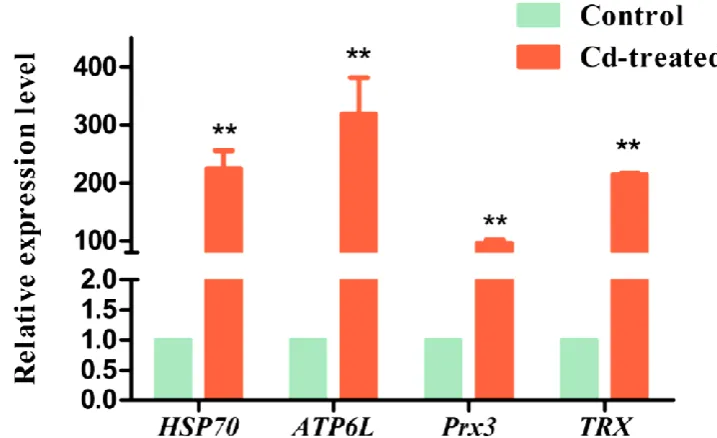
To verify the gene expression profile identified by RNA-Seq, 4 genes associated with Cd response in each comparison were selected for further detection of the relative mRNA expression level by qRT-PCR. The results showed that the expressions of the four genes (HSP70, ATP6L, Prx3, TRX)were more than control group, which were in agreement with the RNA-Seq expression profile (Figure 6). This result also indicates that these genes were involved in the response to Cd.
Conclusion
In this study, we successfully constructed comparative gills transcriptomes dataset in treated group and control group of Chinese mitten crab and functionally annotated a total of 504,889 unigenes. Most of these genes had an annotation with matches in the NR, String, Swiss-Prot, Pfam, GO and KEGG database. Additionally, we identified 1544 DEGs in the gill after Cd stress. The results of the GO and KEGG pathway enrichment analyses indicated that the DEGs mainly related to signal transduction, oxidative phosphorylation and osmoregulation were enriched after Cd stress. A number of genes that are potentially relevant to immune responses, antioxidant, and detoxification were also identified. These results set the stage for expanding the genetic resources available for E. j. sinensis, and also provide important information for further research on the molecular basis of osmoregulation, detoxification and immune response resulting from Cd stress in crabs.
Acknowledgements
This study was funded by the National Natural Science Foundation of China (grant number 31702014), and Doctoral Scientific Research Foundation of Yancheng Teachers University to ZFW, and Open Foundation of Jiangsu Key Laboratory for Bioresources of Saline Soils (grant number JKLBS2016007), and Yancheng Teachers University Undergraduate Training
Programs for Innovation and Entrepreneurship to RBL and XLS.
References
Ahearn, G.A., Duerr, J.M., Zhuang, Z., & Brown, R.J. (1999). Ion Transport Processes of Crustacean Epithelial Cells.
Physiological and Biochenical Zoology, 72(1), 1-18. https://doi.org/10.1086/316643
Altschul, S.F., Madden, T.L., Schäffer, A.A., Zhang, J., Zhang, Z., Miller, W., & Lipman, D.J. (1997). Gapped BLAST and PSI-BLAST: a new generation of protein database search
programs. Nucleic Acids Research, 25(17), 3389-3402.
https://doi.org/10.1093/nar/25.17.3389
Bain, P.A., Gregg, A.L., & Kumar, A. (2016). De novo assembly
and analysis of changes in the protein-coding
transcriptome of the freshwater shrimp Paratya
australiensis (Decapoda: Atyidae) in response to acid
sulfate drainage water. BMC Genomics, 17-890.
https://doi.org/10.1186/s12864-016-3208-y
Blander, J.M., & Medzhitov, R. (2004). Regulation of Phagosome Maturation by Signals from Toll-like
Receptors. Science, 304(5673), 1014-1018.
https://doi.org/10.1126/science.1096158
Borchert, A., Kalms, J., Roth, S.R., Rademacher, M., Schmidt, A., Holzhutter, H.G., Kuhn, H., & Scheerer, P. (2018). Crystal structure and functional characterization of selenocysteine-containing glutathione peroxidase 4 suggests an alternative mechanism of peroxide
reduction. Biochimica et Biophysica Acta (BBA) -
Molecular and Cell Biology of Lipids, 1863(9), 1095-1107. https://doi.org/10.1016/j.bbalip.2018.06.006
Burnett, L.E., & Mcmahon, B.R. (1985). Facilitation of CO2
excretion by carbonic anhydrase located on the surface of the basal membrane of crab gill epithelium.
Respiration Physiology, 62(3), 341-348. https://doi.org/10.1016/0034-5687(85)90089-1 Crambert, G., Hasler, U., Beggah, A.T., Yu, C., Modyanov, N.N.,
Horisberger, J.D., Lelièvre, L., & Geering, K. (2000). Transport and pharmacological properties of nine
different human Na, K-ATPase isozymes. Journal of
Biological Chemistry, 275, 1976-1986.
https://doi.org/10.1074/jbc.275.3.1976
Cui, Z., Li, X., Liu, Y., Song, C., Hui, M., Shi, G., Luo, D., & Li, Y. (2013). Transcriptome profiling analysis on whole bodies
of microbial challenged Eriocheir sinensis larvae for
immune gene identification and SNP development. Plos
One, 8(12), e82156.
https://doi.org/10.1371/journal.pone.0082156 Delanghe, R. (2005). Blast2GO: a universal tool for annotation,
visualization and analysis in functional genomics
research. Bioinformatics, 21(18), 3674-3676.
https://doi.org/10.1093/bioinformatics/bti610 Fu, F.L., & Qi, W. (2011). Removal of heavy metal ions from
wastewaters: a review. Journal of Environmental
Management, 92(3), 407-418.
https://doi.org/10.1016/j.jenvman.2010.11.011 Gaspic, Z.K., Zvonaric, T., Vrgoc, N., Odzak, N., & Baric, A.
(2002). Cadmium and lead in selected tissues of two commercially important fish species from the Adriatic
Sea. Water Research, 36(20), 5023-5028.
https://doi.org/10.1016/S0043-1354(02)00111-2 Haas, B.J., Papanicolaou, A, Yassour, M., Grabherr, M., Blood,
P.D., Bowden, J., Couger, M.B., Eccles, D., Li, B., & Lieber,
from RNA-seq using the Trinity platform for reference
generation and analysis. Nature Protocols, 8, 1494-1512.
https://doi.org/10.1038/nprot.2013.084
Hu, D., Pan, L., Zhao, Q., & Ren, Q. (2015). Transcriptomic response to low salinity stress in gills of the Pacific white
shrimp, Litopenaeus vannamei. Marine Genomics, 24(3),
297-304. https://doi.org/10.1016/j.margen.2015.07.003 Hui, M., Song, C., Liu, Y., Li, C., & Cui, Z. (2017). Exploring the molecular basis of adaptive evolution in hydrothermal vent crab Austinograea alayseae by transcriptome
analysis. Plos One, 12(5), e0178417.
https://doi.org/10.1371/journal.pone.0178417 Jiang, S., Qiu, L., Zhou, F., Huang, J., Guo, Y., & Yang, K. (2009).
Molecular cloning and expression analysis of a heat shock protein (Hsp90) gene from black tiger shrimp (Penaeus monodon). Molecular Biology Reports, 36(1), 127-134. https://doi.org/10.1007/s11033-007-9160-9 Kanehisa, M., Araki, M., Goto, S., Hattori, M., Hirakawa, M.,
Itoh, M., Katayama, T., Kawashima, S., Okuda, S., & Tokimatsu, T. (2008). KEGG for linking genomes to life
and the environment. Nucleic Acids Research,
36(suppl_1), D480–D484.
https://doi.org/10.1093/nar/gkm882
Kaoud, H.A., & Rezk, A. (2011). Effect of exposure to cadmium on the tropical freshwater prawn Macrobrachium
rosenbergii. Journal African Journal of Aquatic Science ,
36(3), 253-260.
https://doi.org/10.2989/16085914.2011.636899 Li, E., Wang, S., Li, C., Wang, X., Chen, K., & Chen, L. (2014).
Transcriptome sequencing revealed the genes and pathways involved in salinity stress of Chinese mitten
crab, Eriocheir sinensis. Physiological genomics, 46(5),
177-190.
https://doi.org/10.1152/physiolgenomics.00191.2013 Li, Q., Wu, X., He, J., Liu, Q., & Cheng, Y. (2018). Can genetic
diversity be maintained during mass selection of the
Chinese mitten crab, Eriocheir sinensis?. Aquaculture
Research, 49(4), 1606-1615. https://doi.org/10.1111/are.13616
Liu, Y., Su, H., Li, R., Li, X., Xu, Y., Dai, X., Zhou, Y., & Wang, H.
(2017). Comparative transcriptome analysis of
Glyphodes pyloalisWalker (Lepidoptera: Pyralidae) reveals novel insights into heat stress tolerance in
insects. BMC Genomics 18, 974.
https://doi.org/10.1186/s12864-017-4355-5
Lou, F., Gao, T., Cai, S., & Han, Z. (2017). De novo assembly and
annotation of the whole transcriptome of Oratosquilla
oratoria. Marine Genomics. 18, 17-20.
https://doi.org/10.1016/j.margen.2017.08.003 Lu, X., Kong, J., Sheng, L., Dai, P., Meng, X., Cao, B., & Luo, K.
(2016). Transcriptome Analysis of the Hepatopancreas in
the Pacific White Shrimp (Litopenaeus vannamei) under
Acute Ammonia Stress. Plos One,11(10), e0164396.
https://doi.org/ 10.1371/journal.pone.0164396 Manna, P., & Sil, P.C. (2009). Taurine plays a beneficial role
against cadmium-induced oxidative renal dysfunction.
Amino Acids, 36, 417-428.
https://doi.org/10.1007/s00726-008-0094-x
Mortazavi, A., Williams, B.A., Mccue, K., Schaeffer, L., & Wold, B. (2008). Mapping and quantifying mammalian
transcriptomes by RNA-Seq. Nature Methods, 5(7),
621-628. https://doi.org/10.1038/nmeth.1226
Overstreet, J.D. (2000). Effects of arsenic, cadmium, chromium, and lead on gene expression regulated by a battery of 13 different promoters in recombinant HepG2
cells. Toxicology and Applied Pharmacology, 168(2),
79-90. https://doi.org/10.1006/taap.2000.9014
Ren, Q., & Pan, L. (2014). Digital gene expression analysis in the
gills of the swimming crab (Portunus trituberculatus)
exposed to elevated ambient ammonia-N. Aquaculture,
434(20), 108-114.
https://doi.org/10.1016/j.aquaculture.2014.08.008 Roch, P. (1999). Defense mechanisms and disease prevention
in farmed marine invertebrates. Aquaculture, 172(1-2),
125-145.
https://doi.org/10.1016/S0044-8486(98)00439-6 Saraste, M. (1999). Oxidative Phosphorylation at the fin de
siècle. Science, 283, 1488−1493.
https://doi.org/10.1126/science.282.5407.1488 Silvestre, F., Dierick, J.F., Dumont, V., Dieu, M., Raes, M., &
Devos, P. (2006). Differential protein expression profiles
in anterior gills of Eriocheir sinensis during acclimation to
cadmium. Aquatic toxicology, 76(1), 46-58.
https://doi.org/10.1016/j.aquatox.2005.09.006 Silvestre, F., Duchêne, C., Trausch, G., & Devos, P. (2005).
Tissue-specific cadmium accumulation and
metallothionein-like protein levels during acclimation
process in the Chinese crab Eriocheir sinensis.
Comparative Biochemistry Physiology Part C:Toxicology & Pharmacology, 140(1), 39-45.
https://doi.org/10.1016/j.cca.2005.01.004
Sun, M., Li, Y.T., Liu, Y., Shao, C.L., & Wang, L. (2016). Transcriptome assembly and expression profiling of
molecular responses to cadmium toxicity in
hepatopancreas of the freshwater crab Sinopotamon
henanense. Scientific report, 6, 19405. https://doi.org/10.1038/srep19405
Sun, S., Xuan, F., Ge, X., Fu, H., Zhu, J., & Zhang, S. (2014). Identification of differentially expressed genes in
hepatopancreas of oriental river prawn, Macrobrachium
nipponense exposed to environmental hypoxia. Gene,
534(2), 298-306.
https://doi.org/10.1016/j.gene.2013.10.036
Thévenod, F. (2009). Cadmium and cellular signaling cascades:
to be or not to be? Toxicology and applied
pharmacology, 238(3), 221-239.
https://doi.org/10.1016/j.taap.2009.01.013
Thomas, S., Kenneth, D., & Livak, J. (2008). Analyzing real-time
PCR data by the comparative CT method. Nature
Protocols, 3(6), 1101-1108.
https://doi.org/10.1038/nprot.2008.73
Wang, J., Ren, T., Han, Y., Zhao, Y., Liao, M., Wang, F., & Jiang, Z. (2015). Effects of dietary vitamin C supplementation
on lead-treated sea cucumbers, Apostichopus japonicus.
Ecotoxicology and Environmental Safety, 118, 21-26. https://doi.org/10.1016/j.ecoenv.2015.04.009
Wang, J., Zhang, P., Shen, Q., Wang, Q., Liu, D., Li, J., & Wang, L. (2013). The effects of cadmium exposure on the oxidative state and cell death in the gill of freshwater
crab Sinopotamon henanense. Plos One,8(5), e64020.
https://doi.org/10.1371/journal.pone.0064020
Wang, L., Yang, X., Wang, Q., & Wang, D. (2001). The accumulation of Cd~(2+) and the effect on est in five
tissues and organs of Eriocheir sinensis. Acta Zoologica
Sinica,47(Suppl.), 96-100. https://doi.org/1522515 Wang, Z., Bai, Y., Zhang, D., & Tang, B. (2018). Adaptive
evolution of osmoregulatory-related genes provides insight into salinity adaptation in Chinese mitten crab,
479
Turk. J. Fish.& Aquat. Sci. 20(6), 467-479Weihrauch, D., Ziegler, A., Siebers, D., & Towle, D.W. (2001). Molecular characterization of V-type H(+)-ATPase (B-subunit) in gills of euryhaline crabs and its physiological
role in osmoregulatory ion uptake. Journal of
Experimental Biology,204(1), 25-37. https://doi.org/11104708
Wu, X., Cheng, Y., Sui, L., Zeng, C., Southgate, P.C., & Yang, X. (2007). Effect of dietary supplementation of phospholipids and highly unsaturated fatty acids on reproductive performance and offspring quality of
Chinese mitten crab, Eriocheir sinensis (H.
Milne-Edwards), female broodstock. Aquaculture, 273(4),
602-613. https://doi.org/10.1016/j.aquaculture.2007.09.030 Wu, X., Tan, J., Cai, M., & Liu, X. (2014). Molecular cloning, characterization, and expression analysis of a heat shock
protein (HSP) 70 gene from Paphia undulata. Gene,
543(2), 275-285.
https://doi.org/10.1016/j.gene.2013.11.103
Xiong, L.W., Wang, Q., & Qiu, G.F. (2001). Resources and
Culturing Situation of Chinese Mitten Crab (Eriocheir
sinensis) and Species Character Conservation. Journal of Lake Sciences, 13(3), 267-271.
https://doi.org/10.18307/20010311
Xu, B. P., Tu, D. D., Yan, M. C., Shu, M. A., & Shao, Q. J. (2017). Molecular characterization of a cDNA encoding
Na+/K+/2Cl- cotransporter in the gill of mud crab (Scylla
paramamosain) during the molt cycle: Implication of its
function in osmoregulation. Comp Biochem Physiol A Mol Integr Physiol, 203, 115-125. https://doi.org/ 10.1016/j.cbpa.2016.08.019
Yang, Y., Ye, H., Huang, H., Li, S., Zeng, X., Gong, J., & Huang, X. (2013). Characterization and expression of SpHsp60 in hemocytes after challenge to bacterial, osmotic and thermal stress from the mud crab Scylla paramamosain.
Fish & Shellfish Immunology, 35(4), 1185-1191. https://doi.org/10.1016/j.fsi.2013.07.029
Zenteno-Savín, T., Saldierna, R., & Ahuejote-Sandoval, M. (2006). Superoxide radical production in response to
environmental hypoxia in cultured shrimp. Comparative
Biochemistry and Physiology Part C: Toxicology & Pharmacology,142(3-4), 301-308.
https://doi.org/10.1016/j.cbpc.2005.11.001
Zhao, D., Chen, L., Qin, C., Zhang, H., Wu, P., & Zhang, F. (2010). A delta-class glutathione transferase from the Chinese
mitten crab Eriocheir sinensis: cDNA cloning,
characterization and mRNA expression. Fish & Shellfish
Immunology, 29(4), 698-703.
https://doi.org/10.1016/j.fsi.2010.06.002
Zhou, M.T., Qin, Y., Li, M., Chen, C., Chen, X., Shu, H.B., & Guo, L. (2015). Quantitative Proteomics Reveals the Roles of Peroxisome-associated Proteins in Antiviral Innate
Immune Responses. Molecular & Cellular Proteomics,