International Journal of Electronics Communication and Computer Engineering Volume 7, Issue 3, ISSN (Online): 2249–071X
Compressing Encrypted Images and Data Using
Auxiliary Information
Smita Kadam
PG student (VLSI), Dept. of Electronics, BVDUCOE, Pune, India. Email ID : [email protected]
Prof. Meena Chavan
Assistant Professor, Dept. of Electronics,BVDUCOE, Pune, Maharashtra, India. Email ID : [email protected]
Abstract −−−− Now-a-days, in every sector, security and reliable end to end transmission is of main concern. Encrypting an image before transmitting is considered. Encryption enhances the security of file or an image by shuffling the content which can be unscrambled by only one who knows the encryption key. If this image is transferred on insufficient bandwidth it won’t be transmitted. Hence for effective transmission, compression of encrypted image is needed. Compression encodes information, reducing its bandwidth or bits required. This paper proposes transmission of compressed image with hidden encrypted data using auxiliary information.
Keywords −−−− Encryption, Compression, Secret Key, Interpolation, Discrete Cosine Transform (DCT), Peak Signal to Noise Ratio (PSNR), Mean Square Error (MSE), Correlation Coefficient (CC), Structural Similarity (SSIM).
I.
I
NTRODUCTIONCompressing encrypted multimedia is one of the prominent technologies which reduce the amount of data with hiding the plain text context [6][10]. In some cases, the content owner performs encryption for privacy protection and compression is left for the channel or any other storage device provider who doesn’t have the encryption key [5]. At the receiver end, content owner reconstructs this compressed encrypted image using the secret key. Any encrypted image is assumed to be secured and compressing this image is not given more importance.
In lossless compression method, the Slepian-Wolf theorem gives the theoretical bound of lossless coding rate, when some side information is unavailable at the encoder side, but available at the decoder side. In [1], compression of cipher text is done by using LDPC codes while prediction errors are encrypted rather than the image pixels. Progressive manner decomposition is done on encrypted image and rate-compatible punctured turbo code is used for compressing the data in most significant plane [8]. Different algorithms for encrypted video compression are presented in [3]. Advance encryption standard (AES) algorithm is used for cipher-text encryption in [2]. In [9], lossy compression method for sparse reconstruction of gradient projection is exploited and plaintext content is reconstructed.
Proposed scheme is mentioned in section 2. Section 3 describes the implemented result. The comparative analysis of PSNR, MSE, CC, and SSIM are analyzed in table. Section 4 gives the conclusion regarding proposed scheme.
II.
P
ROPOSEDS
CHEMEa)
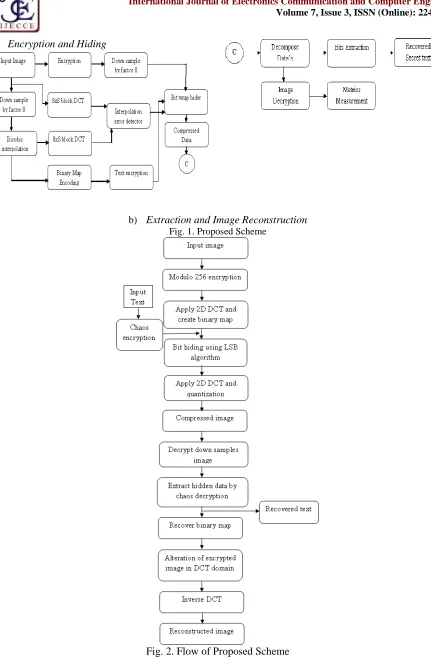
Encryption and Hiding
b)
Extraction and Image Reconstruction
Fig. 1. Proposed Scheme
International Journal of Electronics Communication and Computer Engineering Volume 7, Issue 3, ISSN (Online): 2249–071X
A. Encrypting Image and Generation of Auxiliary
Information
In this phase, original image is encrypted. Encryption is done by adding pseudo random number into the image pixel. Pseudo random number generator generates any random number. Original image is resized to value 256*256. This uncompressed original image of pixel value within [0,255] is further used. Let N1 and N2 denote number of rows and columns of original image. Let N be the number of all pixels (N=N1×N2). Content owner now, generates N pseudo random numbers uniformly distributed within [0,255]. Encrypted image is produced by modulo-256 addition. Data of encrypted image is given by(E(i,j)),
E(i,j) = mod((inp(i,j)+k(i,j)),256) for
1≤i≤N1 and 1≤j≤N2 (1) Here, inp(i,j) is the gray value of pixel position i, j and k(i,j) is pseudo random generated numbers.
Fig. 3. Input image of Baboon
Figure 3 shows input image of Baboon and figure 4 shows encrypted image of baboon. Image content cannot be revealed by attacker without any prior awareness of secrete key.
Fig. 4. Encrypted image of Baboon
For proper transmission bandwidth requirement must be satisfied. If bandwidth is sufficient, there is no need of compressing image or any other operation. But if the bandwidth is insufficient and message of “Insufficient Bandwidth” is displayed, then the content owner needs to compress image. Content owner generates the auxiliary information in two parts, for convenience of data compression and for reconstructing the image at receiver side.
Down sampling of sub-image is generated of size N1/8×N2/8 assuming N1 and N2 both are multiples of 8.
D(i,j) = inp(8*i,8*j)
1≤i≤N1/8 and 1≤j≤N2/8 (2) Where, D(i,j) denotes down sampling of input image. Using bi-cubic interpolation, pixel values are estimated according to sub-image.
Interpolated image pixel values are denoted as (i,j). Original and interpolated images is divided into number blocks of size 8×8. 2D discrete cosine transform (DCT) is performed on each block. Average of interpolated image is calculated as,
Suv(u,v) = (3)
Difference between the original and interpolates image is measured as Suv(u,v).
Table 1: Values of auxiliary information.
Binary map is now calculated by the content owner. ( , ) ( , )
( , ) ( , ) ( )
256 256
d
I i j k i j inp i j k i j
B ij = + ⊕ +
Fig. 5. Binary image of Baboon
As xor function is used, similarity in original image and interpolated image gives Suv(u,v) as 0 and rest small portion gives Suv(u,v) as 1. Amount of data in auxiliary information is relatively low when amount of data in encrypted and original image is nearly same.
B.
Compression of Encrypted Image
Considering channel resource is unlimited, encrypted image can be directly transmitted by the channel provider. This image cannot be retrieved without the secrete key. Only the authorized person having the secrete key can decrypt the encrypted image and retrieve the original image. For limited channel resource, channel provider performs data compression using quantization method. Channel provider uses the auxiliary information from the content owner. 2D-DCT is implemented on encrypted image. Implementation is done in block by block manner. Compression is performed in 64 DCT sub-bands using different quantization parameters.
-DCT
0≤i≤
, 0≤j≤
Coefficients are reorganized in a sub-band as a vector and orthogonal transformation is performed.
=A , 1≤u, v≤8.
Here, A is public pseudo random orthogonal matrix with size (N1N2/64)×(N1N2/64) and is generated by orthogonalizing a pseudo random matrix. The reconstruction error is uniformly scattered over all the DCT coefficients in a same sub-band using orthogonal transformation. This gives a better visual quality to reconstructed result. For each sub-band, positive real
value of and is selected and further
calculates
, 1≤u, v≤8 , 1≤T≤N1N2/64
Here, round operation gives nearest integer and mod operation gives reminder. Down sampling of encrypted image is performed.
( , ) (8 ,8 ),
D
E i j =E i j 1≤i≤N1/8 , 1≤j≤N2/8, binary sequence of
( , ) ( , ) ( , ) 1 2
(1), (2)... ,
64
T
u v u v u v N N
Q Q Q
the values of ∆( , )u v and M( , )u v, and second part of
auxiliary information is collected to form compressed encrypted data.
A ratio of amount of compressed data to the original data is called compression ratio and is given by,
R=
=
where Ls is second part of auxiliary information.
C.
Data Hiding
Data hiding is a process of hiding secret message into an image such that unintended observer may not be able to see or recognize the secret message. Data hiding in proposed scheme is done with encrypted image and encrypted text.
Most common technique with best result for data hiding is LSB i.e. least significant bit. This technique embeds message bit directly into the LSB plane of image [7]. Even though text is inserted into image, no distortion is observed and thus image will be identical to the original image [4].
International Journal of Electronics Communication and Computer Engineering Volume 7, Issue 3, ISSN (Online): 2249–071X
cryptography. Initial conditions and system parameters are more sensitive in chaotic systems. Chaos scheme is symmetric as same parameters are used for encryption and decryption.
D.
Image Reconstruction
As shown in figure 1(b), at receiver side we have compressed encrypted data. To reconstruct the original image, following steps are performed.
1. Decrypt the down sampled image and interpolate it with factor 8.
2. Hidden data is extracted from the image and it is converted into character.
3. Chaos decryption is done after extracting the data to recover secrete encrypted text.
Dtext(ch)=Ecxhar(ch)⊕Eth,
Where Ecxhar(ch) is the decimal conversion of decrypted data.
4. Compressed image is decomposed to get the
encrypted sub-image . Values
of ,
and second part of auxiliary information is decomposed.
5. Sub-image should be decrypted to retrieve the original sub-image and using bi-cubic interpolation, interpolated image (i,j) is obtained. Using second part of auxiliary information values of B(i,j) is retrieved.
6. Calculate
B
′
(i,j)=B(i,j)
⊕
Where, k(i,j) is pseudo random numbers generated from secrete key. From (4), we can write,
B
′
(i,j)=
From equation (1) following relation of E(i,j), inp(i,j) ,k(i,j) can be obtained
( , )
E i j =
Denoting
( , )
k i j =
then we can write,
E(i,j)=inp(i,j)+
(i,j)
An estimate of encrypted image obtained at the receiver can be written as,
7. In this step, modification according to Q (uv)(t) is done on encrypted image. 2D DCT is performed in
block by block manner and coefficients are organized in 64 sub-bands as 64 vectors.
-DCT
0
≤
i
≤
, 0
≤
j
≤
Calculate
=A
, 1
≤
u, v
≤
8.
and
,1
≤
u, v
≤
8, 1
≤
T
≤
N1N2/64.
Inverse orthogonal transform is performed,
Now perform inverse 2D DCT
-IDCT
0
≤
i
≤
, 0
≤
j
≤
Reconstructed image is obtained in this step
The test image of Baboon of size 256×256 was used as original image in the experiment.
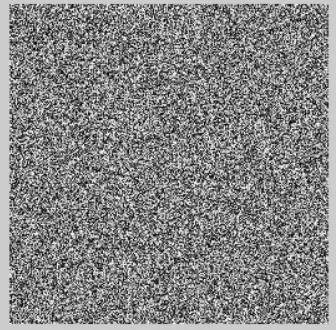
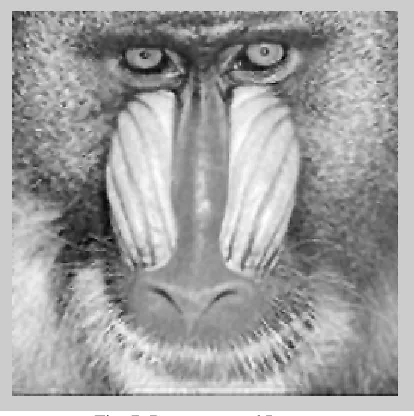
Table 2 shows experimental values of Mean square error (MSE), Peak signal to noise ratio (PSNR), Correlation Coefficient (CC) and structural similarity (SSIM). Comparison is done with and without encrypted text that is used while data hiding. With encrypted data PSNR has improved and MSE has reduced. PSNR is the ratio between signal and noise. PSNR should be large as signal should me more than noise. MSE is the difference between the estimator and the estimated value. MSE should be as small as possible. SSIM measures the similarity between two images. Its value lies in between -1 to 1. When the value is 1, both the images are similar. CC gives the statistical relation between the two or more random values or observed values. Figure 6 and Figure 7 shows decompressed encrypted image and the reconstructed image respectively. Text that is encrypted from the original secrete text message is
±iǬXVN©b ñÆÙ and the recovered secrete text message is as follows, ENCRYPTED TEXT
Table 2: Experimental result METHOD
PARAMETER
Without Encrypted Data
With Encrypted Data
MSE 3.8803 0.9014
PSNR 42.2422 48.5818
CC 0.9915 0.9843
SSIM 0.9076 0.8451
Fig. 6. Decompressed encrypted image
Fig. 7. Reconstructed Image
IV.
C
ONCLUSIONThis scheme shows compressing encrypted data, using auxiliary information. Also it performs hiding the encrypted data to an encrypted image. At receiver side, original image and encrypted data are reconstructed. Simulated result shows PSNR and MSE by using encrypted text data hiding is significantly better than existing methods. This scheme can be widely used in defense security system and multimedia applications.
R
EFERENCES[1] A. Kumar, and A. Makur, 2008. Distributed Source Coding Based Encryption and Lossless Compression of Gray Scale and Color Images. Multimedia signal Processing, 2008 IEEE 10th Workshop on Multimedia Signal Processing,760-764. [2] D. Klinc, C. Hazayy, A. Jagmohan, H. Krawczyk, and T.
Rabinz, 2009. On Compression of Data Encrypted with Block Ciphers. Proceedings of IEEE Data Compression Conference, 213–222.
[3] D. Schonberg, S. C. Draper, C. Yeo, and K. Ramchandran, 2008. Toward Compression of Encrypted Images and Video Sequences. IEEE Trans. Information Forensics and Security, 3(4), 749–762.
[4] Karen, Bailey, and Kevin Curran, 2006. An evaluation of image based steganography methods. Multimedia Tools and Applications, Springer, 30(1), 55-88.
[5] N. S. Kulkarni, B. Raman, and I. Gupta, 2009. Multimedia Encryption: A Brief Overview. Recent advances in Multimedia Signal Processing and Communication, SCI 231, 417–449.
[6] P. Ishwar, V. M. Prabhakaran, D. Schonberg, and K. Ramchandran, 2004. On Compressing Encrypted Data. IEEE Transactions on Signal Processing, 52(10), 2992–3006. [7] R. Chandramouli, and Nasir Memon, 2001. Analysis of LSB
International Journal of Electronics Communication and Computer Engineering Volume 7, Issue 3, ISSN (Online): 2249–071X
[8] W. Liu, W. Zeng, L. Dong, and Q. Yao, 2010. Efficient Compression of Encrypted Grayscale Images. IEEE Trans. Signal Processing, 19(4), 1097–1102.
[9] X. Zhang, Y. Ren, G. Feng, and Z. Qian, 2011. Compressing Encrypted Image Using Compressive Sensing. Proceedings of the 7th International Conference on Intelligent Information Hiding and Multimedia Signal Processing, 222-225. [10] Z. Erkin, A. Piva, S. Katzenbeisser, R. L. Lagendijk, J.
Shokrollahi, G. Neven, and M. Barni, 2007. Protection and Retrieval of Encrypted Multimedia Content: When Cryptography Meets Signal Processing. EURASIP Journal on Information Security, 1–20.
A
UTHOR'
SP
ROFILESmita S. Kadam obtained Bachelors Degree in Electronics and Telecommunication from Smt. Indira Gandhi College of Engineering, Navi Mumbai, Mumbai University, India in year 2013. She is currently pursuing her Master’s degree in VLSI (Electronics) from Bharathi Vidypeeth Deemed University, College of Engineering Pune, India.