41
_______________________________________________________________
_______________________________________________________________
FORMULATION AND EVALUATION OF GASTRO RETENTIVE
FLOATING MICROBEADS OF SUMATRIPTAN
Arun kumar B
1*,
K Mahalakshmi
1,
V.Uma Maheshwara Rao
21Department of Pharmaceutics, CMR College of Pharmacy, kandlakoya (v), Medchal road, Hyderabad – 501 401, A.P, India. 2Principal, CMR College of Pharmacy, kandlakoya (v), Medchal road, Hyderabad – 501 401, A.P, India.
ABSTRACT
Sumatriptan is a potent and selective 5-hydroxytryptamine agonist. It is an effective agent in the treatment of acute migraine attack. Sumatriptan is rapidly but incompletely absorbed following oral administration and undergoes first pass metabolism resulting in a low absolute bioavailability of 15%. The biological half-life of Sumatriptan is about 2.5 hr.. The aim was to develop gastro retentive floating microbeads which improve the absolute bioavailability of Sumatriptan by avoiding the presystemic metabolism and thereby to reduce the dose frequency. Drug and polymer compatibility was studied by subjecting physical mixtures of drug and polymers to FTIR spectrophotometry, capability of floating in the gastric condition was evaluated. The beads were prepared by Ionotropic gelation method. By using Sodium alginate, hydroxyl propyl methylcellulose K4M and Guar gum grade in 1:1, 1:2, 1:3 ratios. The beads were evaluated for percent drug entrapment efficiency, and in vitro drug release. The in vitro drug release study of the beads was carried out in simulated gastric media by USP dissolution method. Beads formulated employing Sodium alginate alone could not sustain the drug release, whereas beads formulated with mixture of Sodium alginate and copolymers demonstrated sustained release of Sumatriptan for 12h.
Key words: Sumatriptan, Gastric residence time, Floating drug delivery systems.
INTRODUCTION
Oral delivery of drugs is the most preferable route of drug administration due to ease of patient compliance and flexibility in formulation [1]. Several difficulties are found while designing controlled release systems, especially to obtain better absorption and enhanced bioavailability. Floating drug delivery system (FDDS) or Hydro dynamically balanced system (HBS) are among the several approaches of controlled drug delivery systems that have been developed in order to increase the gastric retention time of dosage. [2,3]. Gastro retentive floating drug delivery system (GRFDDS) has bulk density lower than gastric fluids and thus remains buoyant in the stomach without affecting the gastric emptying rate for a prolonged period of time [4] Both single and multiple unit system have been developed. Both have several advantages over immediate release dosage form including the minimization of fluctuations in drug concentration in plasma and at the site of action over prolonged periods of time [5]. But among them the multiple unit dosage
forms may be better suited because they are claimed to reduce the inter subject variability in absorption and lower the probability of dose dumping [6]. Such a dosage form can be distributed widely throughout the gastrointestinal tract, affording the possibility of a longer lasting and more reliable release of the drug from the dosage form.
Sumatriptan is a potent and selective 5-hydroxytryptamine agonist chemically it is 3-[2-(dimethyl amino) ethyl ]-N-methyl-1H-indol-5-methanesulfonamide butane-1,4-dioate it is an effective agent in the treatment of acute migraine attack. It provides rapid symptoms relief up to 85-90% of migraine patient within two hours of treatment. It is white amorphous powder, freely soluble in water and is rapidly but incompletely absorbed following oral administration and undergoes first pass metabolism resulting in a low absolute bioavailability of 15%. The biological half-life of Sumatriptan is about 2.5 hr. [9,10] In the present study an attempt has been made to develop and characterize floating microbeads of
*Corresponding Author Arun kumar B E mail: [email protected]
International Journal
of
Pharmacy Review & Research
www.ijprr.com
42
Sumatrriptan by inotropic gelation method. On oral administration, it prolongs the gastric residence time, increases the drug bioavailability and sustained the action for a longer period of time.
MATERIALS AND METHODS Materials
Sumatriptan was obtained from Dr. Reddy’s Lab, Hyderabad, India. Sodium alginate was purchased from Krishna Pectins Pvt. Ltd, India ,GURGUM was obtained from S.D. Fine Chem. Ltd, India, HPMCK4M was obtained from Colorcon Industries, India calcium chloride was taken from B. F.Goodrich Chemicals Co.,USA ,Water was from Universal Medicare Pvt. Ltd, Mumbai.
Methods
FTIR spectroscopy
The drug ‐ excipients interaction were studied using Fourier transform infrared spectrophotometer (FTIR 1615, Perkin Elmer, USA). An IR spectrum for the drug was recorded in a FTIR for pure drug and physical mixture of pure drug and polymers with Potassium Bromide (KBr) pellets. The spectra were scanned over the 3600 to 400 cm‐1 range.
FORMULATION DESIGN
Preparation of Microbeads: Ionotropic gelation technique
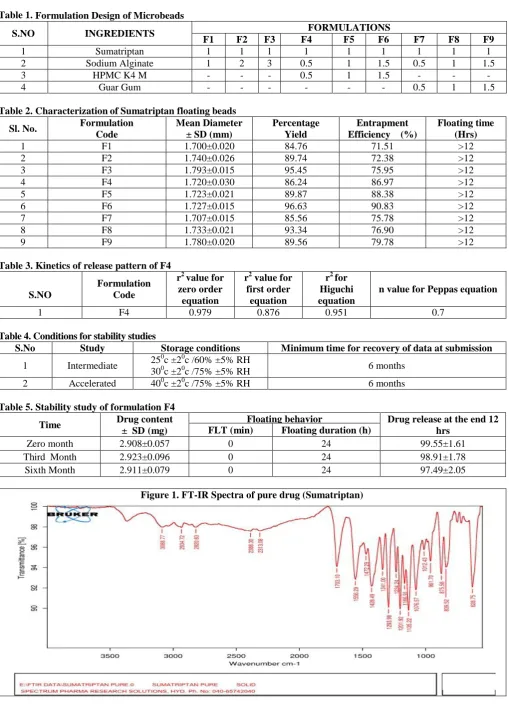
Microbeads of Sumatriptan were prepared by Ionotropic gelation technique. In the present work three sets Microbeads were prepared by using (1:1,1:2,1:3)sodium alginate alone in different concentrations and with different concentrations of polymers like, HPMCK4m ,Guar gum and Calcium chloride as counter ion. The detailed composition of the various formulations prepared is as mentioned in Table 1.
Preparation of Sodium alginate Microbeads
The beads were prepared in three batches. In the first set three formulations of microbeads were prepared (F1, F2, F3). Solutions of Sodium alginate in different ratios were used. In the second set another three formulations were developed with HPMC K4M and Sodium alginate in different ratios (F4,F5,F6). In the third set Guar gum was used along with the sodium alginate in different ratios (F7,F8,F9).a polymer solution was prepared in 100ml of deionized water. In 50ml of polymer solution, weighed quantity (250mg) of Sumatriptan was dispersed uniformly in all three solutions separately. Bubble free dispersion was dropped through a syringe into 100ml aqueous calcium chloride solution and stirred at 100rpm. After stirring for 10minutes, the gelled beads were separated by filtration, washed with distilled water, air dried and finally dried at 600 for 6 hours in oven.
EVALUATION OF PHYSICOCHEMICAL PARAMETERS OF FLOATING BEADS Determination of bead diameter
The diameter of a sample of gel beads (25 beads)
of each formulation was determined using a dial thickness meter. Measurement for each sample was repeated ten times. Mean diameter and standard deviations were recorded.
Surface morphology (SEM)
Scanning electron microscopy has been used to determine particle size distribution, surface topography, texture, and to examine the morphology of fractured or sectioned surface. SEM is probably the most commonly used method for characterizing drug delivery systems, owing in large to simplicity of sample preparation and ease of operation. SEM studies were carried out by using JEOL JSM T-330A scanning microscope (Japan). The samples were gold coated prior to the scanning. For examination of the internal structure of the beads, they were cut in half with a steel blade [11].
Percentage yield
Percentage practical yield of Sumatriptan beads was calculated to know about percentage yield or efficiency of any method, thus it helps in selection of appropriate method of production. Practical yield was calculated as the weight of Sumatriptan beads recovered from each batch in relation to the sum of starting material [11].
The percentage yield of Sumatriptan beads prepared was determined by using the formula.
Drug Entrapment Efficiency
200 mg beads were crushed using a porcelain mortar and a pestle, and dispersed in suitable solvent (0.1 N HCl). The dispersion was sonicated for 15 minutes and left overnight for 24 hrs, then the dispersion was filtered. A 1 ml sample was taken and diluted with suitable solvent (0.1 N HCl), and analysed using a UV-visible spectrophotometer at λmax of 230 nm [11].
The percentage drug entrapment efficiency (%EE) of each bead formulation was calculated using the following equation:
Actual Drug Content
EE (%) = X 100 Theoretical Drug Content
Buoyancy behavior
The time between the introduction of the FDDS into the medium and its buoyancy to the upper one third of the dissolution vessel (floating lag time) and the floating ability was determined using USP dissolution tester apparatus II (Paddle method). Fifty beads were put in the vessel and the paddles were rotated at 50 rpm in 900 ml 0.1 N HCl pH 1.2, maintained at 37±0.5 °C for 12 hours. The floating ability of the beads was measured by visual observation. The preparation was considered to have buoyancy, only when all beads floated on the test solution immediately [12-13].
43
In vitro release characteristics of Sumatriptan floating gel beads (n=3) were evaluated employing USP XIV dissolution testing apparatus 2 (paddle method).The dissolution test was performed using 900 ml of 0.1 N HCl buffer as dissolution medium maintained at 37±0.5 ºC. The contents were stirred at 50 rpm. A 5 ml aliquot of the solution was withdrawn at predetermined time intervals for 12 h and fresh 5ml dissolution media was replaced to maintain sink condition. The sample aliquots were analyzed spectrophotometrically at a wavelength of 230nm (UV spectrophotometer, 1601, Shimadzu, Japan) [13].
STABILITY STUDIES
Stability studies were carried out according to ICH guidelines by storing the Formulation F4. Both intermediate and the accelerated stability studies were done simultaneously at 250c ±20c /60% ±5% RH ,300c ±20c /75% ±5% RH 400c ±20c /75% ±5% for a period of six months in a programmable environmental test chamber (CHM-10S, Remi Instruments Ltd., Mumbai, India). The samples were withdrawn at 30 and 60 days and analyzed for the drug content, floating behavior and in vitro drug release.
RESULTS AND DISCUSSION FTIR spectroscopy
Compatibility studies were performed using FTIR spectrophotometer. The FTIR spectrum of Pure drug and physical mixture of drug and polymers were studied. The characteristic absorption peaks were observed at 1076.57cm-1,1293.98 cm-1,1556 cm-1,1703cm-1,2934cm-1 for the pure Sumatriptan and absorption peaks were observed at 1080 cm-1 ,1295cm-1 ,1558 cm-1 ,1716 cm
-1,2850 cm-1 for drug and polymer mixture show that how
they were in official limits (±100 cm-1) the drug is compatible with excipients (Fig 1 & Fig 2).
Surface morphology (SEM)
SEM analysis of the f4 formulation showed that the external morphology was smooth as in the (Fig.3 and 4) show the internal structure was solid without pores.
Determination of beads diameter
The prepared beads were almost spherical and translucent. The mean surface diameter of 09 formulations was between 1.700±0.020 mm (SD) and 1.793±0.015 (SD) (Table 6.2.3). It was found that incorporation of copolymers such as HPMC K4 and Guar gum to the alginate bead formulations result in further increasing of the bead diameter as in case of formulations F1 to F9 in each batch (Table 2.). As the process parameters were kept constant, the added materials were responsible for the change in the size of the beads.
Percentage yield
The percentage yield for Sumatriptan beads were found to be 84.76%, 89.74%, 95.45%,86.24%, 89.87%, 96.63%, 85.56%, 93.4%, 89.56% for formulations
F1, F2, F3, F4, F5, F6, F7, F8, F9 respectively as shown in the (Table 2) .In each batch as the concentration of polymers was increased the yield was increased.
Entrapment efficiency
Entrapment efficiency increased with increase in the polymer concentration in each batch of formulation. The results obtained are given in (Table 2). A maximum of 90.83% drug entrapment efficiency was obtained in Sumatriptan beads which were prepared using sodium alginate and HPMC K4 M (F6) and minimum entrapment was 71.51% in F1 prepared using sodium alginate, alone from which it is inferred that a combination of polymers would entrap more than a single polymer and also by increasing the polymer concentration, the encapsulation efficiency can be increased.
Buoyancy test (floating test)
The beads were for found to be floating for 12 hrs. and they remained buoyant throughout the dissolution studies.
In Vitro release profile
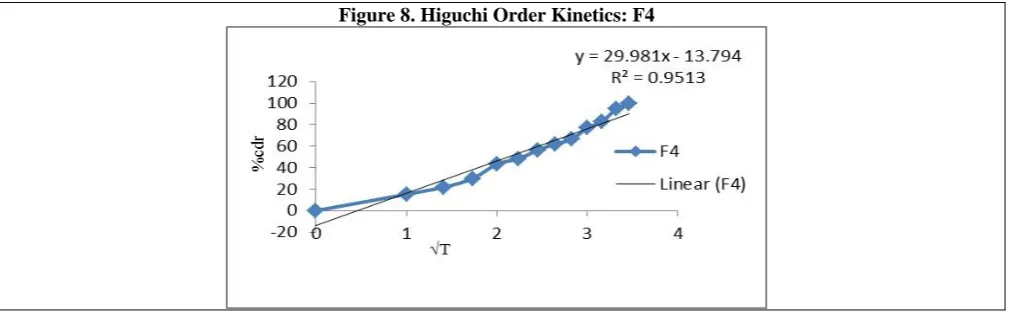
In vitro drug release study of Sumatriptan floating beads was carried in 0.1N HCl (pH 1.2), for a period of 12h.In the 0.1N HCl, the beads exhibited a biphasic release profile as an initial rapid drug release phase (burst effect) was followed by a sustained, gradually increasing drug release phase after 1h extending up to 12h. Formulation F4 contained sodium alginate and HPMCK4M, could sustain the Sumatriptan release up to 12h. It released complete drug at the end of 12h. Whereas formulations contained Sodium alginate alone F1, F2 and F3 released 98.21%, 99.21% and 101.2% of drug respectively at the end of bellow 10h.The formulations contained sodium alginate and HPMC K4 M; F4, F5 and F6 released 99.84%, 9 2 . 6 3 % and 91.33% of the drug at the end of 12h respectively. The formulations contained sodium alginate and Guar gum; F7, F8 and F9 released 80.85%, 72.93% and 64.5% of the drug at the end of 12h respectively (Fig 6). F4 has shown good release patter and followed zero order kinetics and Higuchi mechanism of release (Fig 7 & Fig 8).
STABILITY STUDIES
44
Table 1. Formulation Design of Microbeads
S.NO INGREDIENTS FORMULATIONS
F1 F2 F3 F4 F5 F6 F7 F8 F9
1 Sumatriptan 1 1 1 1 1 1 1 1 1 2 Sodium Alginate 1 2 3 0.5 1 1.5 0.5 1 1.5 3 HPMC K4 M - - - 0.5 1 1.5 - - - 4 Guar Gum - - - 0.5 1 1.5
Table 2. Characterization of Sumatriptan floating beads Sl. No. Formulation
Code
Mean Diameter ± SD (mm)
Percentage Yield
Entrapment Efficiency (%)
Floating time (Hrs)
1 F1 1.700±0.020 84.76 71.51 >12 2 F2 1.740±0.026 89.74 72.38 >12 3 F3 1.793±0.015 95.45 75.95 >12 4 F4 1.720±0.030 86.24 86.97 >12 5 F5 1.723±0.021 89.87 88.38 >12 6 F6 1.727±0.015 96.63 90.83 >12 7 F7 1.707±0.015 85.56 75.78 >12 8 F8 1.733±0.021 93.34 76.90 >12 9 F9 1.780±0.020 89.56 79.78 >12
Table 3. Kinetics of release pattern of F4
S.NO
Formulation Code
r2 value for zero order equation
r2 value for first order
equation
r2 for Higuchi equation
n value for Peppas equation
1 F4 0.979 0.876 0.951 0.7
Table 4. Conditions for stability studies
S.No Study Storage conditions Minimum time for recovery of data at submission
1 Intermediate 25
0
c ±20c /60% ±5% RH
300c ±20c /75% ±5% RH 6 months 2 Accelerated 400c ±20c /75% ±5% RH 6 months
Table 5. Stability study of formulation F4 Time Drug content ± SD (mg)
Floating behavior Drug release at the end 12 hrs
FLT (min) Floating duration (h)
Zero month 2.908±0.057 0 24 99.55±1.61 Third Month 2.923±0.096 0 24 98.91±1.78 Sixth Month 2.911±0.079 0 24 97.49±2.05
45
Figure 2. FT-IR Spectra of physical mixture of polymers and drug
Figure 3. Scanning electron microscopy of (a) external and (b) internal structure of blank floating beads (F4)
Figure 4. Scanning electron microscopy of (a) external and (b) internal structure of drug loaded floating beads (F4)
46
Figure 8. Higuchi Order Kinetics: F4
CONCLUSION
The inotropic gelation method was successfully ustilised for developing microbeads of Sumatriptan. Drug and polymers were subjected for the compatibility study using FTIR Spectrophometry, which suggested that there is no interaction between the drug and polymer. All the beads shown satisfactory floating characteristics. The in vitro drug release study shown that Sodium alginate alone could not sustain the drug release for sufficient period of time whereas incorporation of rate controlling polymers such as HPMC K4, and Guar gum as copolymers can effectively sustain the drug release from the beads. The results shown that beads formulated with mixture of Sodium alginate and HPMC K4 M (F4) shown the highest drug release compared to other formulations. So the formulation F4 was selected for stability studies and
surface morphological studies by scanning electron microscopy. To analyze the mechanism of drug release from the beads, the in vitro release data was fitted into various release models. It was observed that the release of the drug followed Zero Order kinetics and Higuchi model mechanism of drug release The selected formulations did not show much change in drug content, floatability or in vitro drug release profile after storage as per the ICH guidelines during stability study for six months.
ACKNOWLEDGMENT
` Sincere thanks to K Mahalakshmi and Dr .V. Uma Maheshwara Rao for their guidance and support in completion of this research work and also to CMR College of Pharmacy for providing the infrastructure.
REFERENCES
1. Surana S and Kotecha RK. An overview on various approaches to oral controlled drug delivery system via gastro retention. Int J Pharm Rev Res, 1(2), 2010, 68-72.
2. Shah SH, Patel JK and Patel NV. Stomach specific drug delivery system: A review. Int. J PharmTech Res, 1, 2009, 623-633.
3. Deshpande, Shah NH, Rhodes CT and Malick W. Development of a novel controlled-release system for gastric retention. Pharm Res., 14, 1997, 815-819.
4. Baumgartner S, Kristel J, Vreer F, Vodopivec P and Zorko B. Optimization of floating matrix tablets and evaluation of their gastric residence time. Int J Pharm., 195, 2000, 125-135.
5. Singh BN and Kim KH. Floating drug delivery systems: an approach to oral controlled drug delivery via gastric retention. J Contrl. Rel., 63, 2000, 235-259.
6. Tripathi GK and Singh S. Formulation and In-vitro evaluation of pH sensitive oil entrapped buoyant beads of amoxicillin. Int J Drug Delivery, 3, 2011, 125-132.
7. Mishra S and Pathak K. Formulation and evaluation of oil entrapped gastroretentive floating gel beads of loratadine.
Acta Pharmaceutica., 58, 2008, 187-197.
8. Brahmankar DM, Jaiswal SB. Biopharmaceutics and pharmacokinetics: A treatise. 1st ed., Vallabh Prakashan, New Delhi, 2002.
9. British Pharmacopoeia. I, 2003, 261-262. 10. British Pharmacopoeia. I, 2003, 297-298.
11. Halder A, Maiti S, Sa B. Entrapment efficiency and release characteristics of polyethyleneimine treated or untreated calcium alginate beads loaded with propranolol resin complex. Int J Pharm, 302, 2005, 84-94.
12. Mishra B, Rajanikanth PS. Preparation an in vitro characterization of gellan based floating beads of acetohydroxamic acid for eradication of H. pylori. Acta pharm., 57, 2007, 413-427.