Iran University of Medical Sciences
____________________________________________________________________________________________________________________
1. (Corresponding author) Assistant Professor Educational Development Center (EDC), Faculty of Medicine, Tehran University of Medical
Sciences, Tehran, Iran & Affiliated Assistant Professor of LIME and Clinical Education Science Departments, Karolinska Institute, Sweden. [email protected]
2. MD, Oncologist- Associate Professor, Faculty of Medicine, Tehran University of Medical Sciences, Imam Khomeini Hospital, Tehran, Iran. [email protected]
3. MD, Msc Ed Director of Educational Development Center (EDC), Faculty of Medicine, Sabzevar University of Medical Sciences, Sabzevar, Iran. [email protected]
4. PhD in Epidemiology, Faculty of Medicine, Bojnord University, Bojnord, Iran. [email protected]
5. MD, PhD Candidate Deputy of Research at Qom University of Medical Sciences, Iran. [email protected]
6. MSc, Nursing in Critical Care Nursing and Midwifery Care Research Center, Tehran University of Medical Sciences, Tehran, Iran. [email protected]
Contextualization and standardization of the supportive
leader-ship behavior questionnaire based on socio- cognitive theory in
Iran
Mandana Shirazi1, Amir Hosein Emami2,Seyed Jamal Mirmoosavi3, Seyed
Moham-mad Alavinia4, Hadi Zamanian5, Faezeh Fathollahbeigi6, Italo Masiello7
Received:10 November 2013 Accepted:26 February 2014 Published:8 November 2014
Abstract
Background: Effective leadership is of prime importance in any organization and it goes through changes based on accepted health promotion and behavior change theory. Although there are many leadership styles, transformational leadership, which emphasizes supportive leadership behaviors, seems to be an appropriate style in many settings particularly in the health care and educational sectors which are pressured by high turnover and safety demands. Iran has been moving rapidly forward and its authorities have understood and recognized the importance of matching leadership styles with effective and competent care for success in health care organiza-tions. This study aimed to develop the Supportive Leadership Behaviors Scale based on accepted health and educational theories and to psychometrically test it in the Iranian context.
Methods: The instrument was based on items from established questionnaires. A pilot study validated the in-strument which was also cross-validated via re-translation. After validation, 731 participants answered the ques-tionnaire.
Results: The instrument was finalized and resulted in a 20-item questionnaire using the exploratory factor analysis, which yielded four factors of support for development, integrity, sincerity and recognition and explain-ing the supportive leadership behaviors (all above 0.6). Mappexplain-ing these four measures of leadership behaviors can be beneficial to determine whether effective leadership could support innovation and improvements in med-ical education and health care organizations on the national level. The reliability measured as Cronbach’s alpha was 0.84.
Conclusion: This new instrument yielded four factors of support for development, integrity, sincerity and recognition and explaining the supportive leadership behaviors which are applicable in health and educational settings and are helpful in improving self –efficacy among health and academic staff.
Keywords: Contextualization, Socio- cognitive Theory, Standardization, Supportive Leadership Behavior Ques-tionnaire.
Cite this article as:Shirazi M, Emami A.H, Mirmoosavi S.J, Alavinia S.M, Zamanian H, Fathollahbeigi F, Masiello I. Contextualization and standardization of the supportive leader-ship behavior questionnaire based on socio- cognitive theory in Iran.Med J Islam Repub Iran 2014 (8 November). Vol. 28:125.
Introduction
There are many leadership styles used by effective leaders, but two of the most com-mon approaches are transactional and
trans-formational styles. These styles are seen in a wide range of domains such as politics, business, education, sport, law (1), health system, nursing and police work (2).
actional leadership is identified by a sense of duty based on reward and punishment to reach goals (3). In this style, emphasis is put on the interaction between leaders and their subordinates, asserting a sense of self-worth in the followers. Transformational leadership focuses on shaping change by emphasizing supportive leadership behav-ior (SLB) (4, 5) for which people feel in-spired and committed. Leaders who make use of SLB show concern for followers’ needs, consideration and understanding, trust and respect, friendship and encour-agement, and they help followers develop their abilities and careers. The transforma-tional leadership approach leans toward a search of subordinates’ happiness (6). Based on the findings of some research in the healthcare sector and nursing, it is noteworthy to mention that transformation-al leadership styles can reduce work-life conflict(7), increase staff job satisfaction (7,8) and psychological wellbeing (7) and result in effectiveness and better leadership outcomes (9).
There is no one “right” way to lead in a way that fits all situations, but the imple-mentation of transformational leadership and of SLB can be appropriate in many cir-cumstances. This may become apparent in the current health care sector, which is pressured by a global shortage of health care workers, demanding patients and fiscal constraints. Employees are being asked to do more than ever before: making sugges-tions for continuous improvement, handling complex problems quickly, and taking greater responsibilities on the front line while the resources and support are being decreased. Due to the standardization of competences and globalization, in general employees do not tend to remain at the same job for their entire working career. Employees' loyalty has therefore shifted dramatically since the 60’s and 70’s (6). Employees bring value to the customer, especially in the health care system where effective quality care is promised and of-fered to the patient (6).Therefore, to keep a competent staff, which thrives and delivers
effective quality patient care, leaders of health system organizations ought to make use of SLB (10). In one study conducted in nursing homes, a large number of nurses left their job because of insufficient com-munication skills, weak teamwork and non-supportive leadership in their workplace. In that study, it was revealed that the annual average turnover rate of the nurses was be-tween 70% and 100%. Furthermore, it was demonstrated that this problem reduced the quality of care (11). Therefore, it was sug-gested that a supportive work environment be developed to solve this dilemma (11); other researchers also found the same re-sults (8, 12).
Transformational leadership consequenc-es on health sector call for more attention, and training should be provided based on key leadership competencies (8, 13). Due to the significant effect of leadership on health professions with the increasing complexi-ties of medical education, leadership styles and their development have become in-creasingly important in medical education (14). Multiple studies have developed or researched many courses, programs, curric-ula, etc., to promote leadership styles in medical education (15-19).
The current Iranian research on leadership style and its effects on subordinates reveals that task-oriented behavior is the dominant style among Iranian leaders in the health care and educational systems (11). This style focuses on accomplishment and in-creases the rate of subordinates’ burn out (20). Research shows that in the field of medical education and health care, Iranian leaders should apply cooperative learning to improve critical thinking among their staff. Leaders should be able to encourage new ideas to promote the organizational outcomes, improve learning abilities, lead change and spur innovation among them-selves and their followers (20).
Assessing the effects of SLB on subordi-nates' satisfaction and performance has provided valuable data for the health care administration in recent years, and it has had a tremendous effect on the quality of
health care services (21, 22). In Iran, as in many other developing countries, employ-ees are suffering from lack of supportive leadership (un- published data). More re-search on supportive leadership is needed to promote supportive leadership styles es-pecially in healthcare and educational or-ganizations, which need a valid and reliable tool to assess leaders' performance. The available instruments in the world may not be appropriate to assess SLB and its' corre-lation with educational theory in the Iranian context, and therefore developing a new instrument in this field is a serious demand. The aim of this study was to develop a val-id tool for assessing supportive behavior among leaders by standardizing and devel-oping the Iranian version of a SLB instru-ment for nurses through a cross-sectional and correlation study using factor analysis.
Methods Design
This cross-sectional, correlational study consisted of a pilot study followed by the first phase of a randomized control trial (RCT) to develop and validate a question-naire, which on a national level determines whether effective supportive leadership could maintain innovation and improve-ments in medical education institutions and health care organizations. The study was conducted between June 2009 and Novem-ber 2010. The pilot study was conducted in June 2009 while the data for the first phase of the study were collected in September 2009 after the pilot study. Both phases of the study had been approved by The Ethical Committee of Tehran University of Medi-cal Sciences, Tehran, Iran. All participants were informed about the study and its aims, and they participated in the project volun-tarily.
Development of the Questionnaire
The first step in the development of the questionnaire items was reviewing the re-lated literature on the concept of SLB. To the best of our knowledge, no similar ques-tionnaire had been developed in Iran.
Therefore, from the field of behavioral leadership, relevant SLB questions were extracted from the three different question-naires of Developmental Leadership (DL), Hersey and Blanchard's Situational theory (HBS) and Ohio State (OSQ) (23-25); and then they were translated to Persian. A group of experts, consisting of two medical education specialists (MS, SJM), one man-agement specialist in education (AE), one epidemiologist (SMA), and one researcher in the field of medical education (SJMM) assessed the first draft of the translated questionnaires. Questions were extracted from three original questionnaires (DL), (HBS) and (OSQ), which were not directly relevant to the supportive leadership behav-ior, but they had some questions pertain-ing to supportive leadership. The expert panel developed and added some new SLB related questions to make the questionnaire more complete and comprehensible. Final-ly, the first draft of the Iranian question-naire consisting of a 50-item Likert-scale questionnaire was developed. The face and content validity of the instrument was en-sured through the two rounds Delphi meth-ods, and finally the results of Delphi was discussed in the expert panel and was ap-proved by the consensus of the panel. The expert panel consisted of ten faculty mem-bers of TUMS from different fields (medi-cal education, management, epidemiology and psychology), who were selected based on their specialty and availability. The re-sponses were based on a five-point scale: “completely agree”, “agree”, “Do not know“, “disagree” and “completely disa-gree”. Scoring of each item was between one for “completely agree “to 5 for “com-pletely disagree”. The instrument could yield an overall ranging from 40 to 200.
Pilot Study
The number of the participants in the pilot study was 20 nurses with different qualifi-cations, who were excluded from the main sample population.
The reliability of the questionnaire was
assessed via a test-retest approach. The questionnaire was answered twice by the participants of the pilot study and in a 10-day interval. We used Kappa as a measure of agreement between the two measure-ments. All the items with Kappa less than 0.7 were excluded because the agreement was low in those cases. The results of the assessment were discussed within the group of experts, and the required modifications were made accordingly. The remained number of the items in the questionnaire was 40, and the mean Kappa for all ques-tions was 0.86.
To ensure external validity, the question-naire was cross-validated by retranslating it to English and sending it to an authority in the field, Gerry Larsson, to seek his advice. The content validity of the questionnaire was assessed through the experts’ consen-sus. Finally, 40 items were determined. The instrument could yield an overall score ranging from 40 to 200.
The First Phase of the Study
The first phase of the study was conduct-ed at all 16 hospitals of Tehran University of Medical Sciences (TUMS, the largest University located in the capital of Iran, Tehran) to determine the validity and relia-bility of the developed questionnaire. We assessed the leadership performance of 110 head nurses, including 6 subordinates for each head nurse, making a total of 660 sub-ordinate nurses with different levels of
nursing education such as registered nurses and nurse aids (N = 621); some of the nurs-es (N = 39), however, did not agree to par-ticipate in the study (Fig. 1). The total number of the participants was 731 and in order to increase the response rate, the re-searchers visited the participants and talked with them about the project, and this result-ed in a response rate of 94%. We also pro-vided credit points toward Continuing Nursing Education (CNE) to all those who answered the questionnaire.
Statistical Analysis
To better understand the dimensions un-derlying the questionnaire, an exploratory factor analysis was conducted based on principle axis factoring and varimax rota-tion. This analysis was used for data reduc-tion to identify a small number of factors that could explain most of the variance ob-served in a much larger number of manifest variables. The Kaiser-Meyer-Olkin (KMO) measure of sampling adequacy in factor analysis was used. Cronbach’s Alphas were calculated to evaluate the internal reliability and item homogeneity of the scales. SPSS version 16 was used to analyze the data.
Nominating the Factors
The expert panel, consisting of one psy-chologist, two nursing management spe-cialists, and two medical educationalists nominated the factors based on the content of the questions in each domain.
Fig.1. Hierarchy of nursing samples in the study
Results
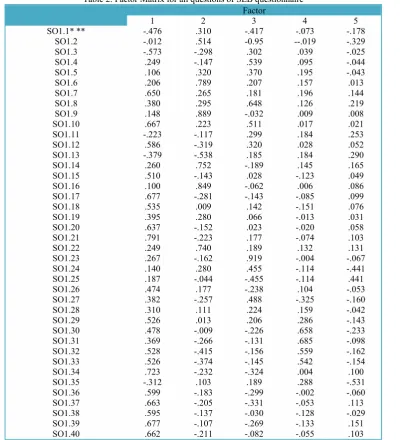
KMO showed that 95% of the variance was caused by 5 underlying factors with an Eigen value larger than one: 15.31, 3.99, 2.69, 1.48, 1.38, respectively (Tables 1 and 2). Thus, in the first step of the study, we selected a five-factor solution for further analysis from the scale which consisted of 40 mixed items of positive and negative oriented leadership behaviors. Gradually, the questionnaire was streamlined and
re-tested for validity. We decided to remove items with loading of less than 0.6 (1, 2, 3, 4, 5, 10, 11, 12, 13, 1518, 19, 24, 25, 26, 27, 28, 29, 33, 35.), and this resulted in the removal of one factor and a final version of 20-item questionnaire with a four- factors solution. Considering the varimax rotation analysis, factor 1 accounted for 20.07 % of the explained variance and was related to support for development; factor 2 explained 11.84% of the variance regarding integrity;
Table1. Load of each item in the four factors (loading below 0.6 are not presented in the table). Variance, eigen values, and Cronbach’s alphas are also shown
Questions Factors
1 (20.07% of total variance)
2 (11.84% of total
variance) (11.77% of total3 variance)
4 (6.35% of total
variance)
1. He "needles" foremen under him for
greater effort. 0.79
2. He backs up the members in their
actions. 0.65
3. He is friendly and approachable. 0.65
4. He makes group members feel at
ease when talking with them. 0.90
5. He tries to keep the foremen under him in good standing with those in higher authority
0.75
6. Expresses values that have an
hu-manistic basis. 0.85
7. Accepts responsibility for the
opera-tions–even in hard times. 0.68 8. Encourages to develop my abilities .64 9. Inspiration to think creativity 0.61 10. Inspires me to try new working
methods 0.74
11. Looks for the mistakes. 0.92
12. He encourages his junior officials immediately after they have accom-plished their tasks successfully.
0.66
13. He encourages his junior officials regularly after they have accom-plished their tasks successfully.
0.70
14. He formally encourages his junior officials in group meetings because of their proper performance
0.60
15. Creates enthusiasm for a task. 16. He emphasizes high morale among
his underhand authorities. 17. He gives appropriate feedback to
subordinate regarding their individ-ual and group performance
0.72 0.60
0.67
18. Creates chummy, flexible and dy-namic environment
19. Mentioned his ideas and strategies for his followers
20. He makes possibility for growing up and learning new skill among subordinates for achieving the or-ganizational goals
0.60
0.68
0.66
factor 3 represented 11.77% of the ex-plained variance and was related to sinceri-ty; and finally, factor 4 accounted for 6.35% of the explained variance and was related to recognition. Table 1 demonstrates the load of each item on the four factors.
The reliability estimate measured as Cronbach’s alpha of the20-item question-naire was 0.84. The Cronbach’s alpha for all factors were all above 0.6 except for Factor 3 which was 0.37.
Discussion
SLB style was in line with the fundamen-tal socio- cognitive theory in learning; for instance, Bandura emphasized context,
in-dividual and personal behavior as the three important elements of this theory. The SL B is based on two out of the three issues of Bandura theory (individual and personal behavior). The psychometric findings of the instrument endorsed the usefulness of the scale.
The first factor analysis of the 40 SLB items was carried out and streamlined to a 20-item questionnaire. The items explained the leadership behaviors in four correlated factors as below:
1) Support for development 2) Integrity
3) Sincerity 4) Recognition Table 2. Factor Matrix for all questions of SLB questionnaire
Factor
1 2 3 4 5
SO1.1* ** -.476 .310 -.417 -.073 -.178
SO1.2 -.012 .514 -0.95 --.019 -.329
SO1.3 -.573 -.298 .302 .039 -.025
SO1.4 .249 -.147 .539 .095 -.044
SO1.5 .106 .320 .370 .195 -.043
SO1.6 .206 .789 .207 .157 .013
SO1.7 .650 .265 .181 .196 .144
SO1.8 .380 .295 .648 .126 .219
SO1.9 .148 .889 -.032 .009 .008
SO1.10 .667 .223 .511 .017 .021
SO1.11 -.223 -.117 .299 .184 .253
SO1.12 .586 -.319 .320 .028 .052
SO1.13 -.379 -.538 .185 .184 .290
SO1.14 .260 .752 -.189 .145 .165
SO1.15 .510 -.143 .028 -.123 .049
SO1.16 .100 .849 -.062 .006 .086
SO1.17 .677 -.281 -.143 -.085 .099
SO1.18 .535 .009 .142 -.151 .076
SO1.19 .395 .280 .066 -.013 .031
SO1.20 .637 -.152 .023 -.020 .058
SO1.21 .791 -.223 .177 -.074 .103
SO1.22 .249 .740 .189 .132 .131
SO1.23 .267 -.162 .919 -.004 -.067
SO1.24 .140 .280 .455 -.114 -.441
SO1.25 .187 -.044 -.455 -.114 .441
SO1.26 .474 .177 -.238 .104 -.053
SO1.27 .382 -.257 .488 -.325 -.160
SO1.28 .310 .111 .224 .159 -.042
SO1.29 .526 .013 .206 .286 -.143
SO1.30 .478 -.009 -.226 .658 -.233
SO1.31 .369 -.266 -.131 .685 -.098
SO1.32 .528 -.415 -.156 .559 -.162
SO1.33 .526 -.374 -.145 .542 -.154
SO1.34 .723 -.232 -.324 .004 .100
SO1.35 -.312 .103 .189 .288 -.531
SO1.36 .599 -.183 -.299 -.002 -.060
SO1.37 .663 -.205 -.331 -.053 .113
SO1.38 .595 -.137 -.030 -.128 -.029
SO1.39 .677 -.107 -.269 -.133 .151
SO1.40 .662 -.211 -.082 -.055 .103
High-quality leadership relies on attitudi-nal qualities of a leader (22). Examples of highly significant leadership qualities are integrity, honesty, humility, courage, com-mitment, sincerity, passion, confidence, positivity, wisdom, determination, compas-sion and sensitivity which are in line with andrological learning theories in the socio-cognitive domain. Bandura (26) empha-sized the importance of context (interper-sonal and culture), behavior (developmen-tal behavior) and individual (sincerity) ef-fects on the learning process which is well adapted to the supportive leadership behav-ior model (27). Leaders with these types of behavioral qualities tend to attract follow-ers (28). The four factors of SLB in our study could be considered in academic leadership as well as healthcare system. Moreover, the results of the application of this model could improve the performance of the followers and increase their loyalty to the system.
One of the strengths of this study was its appropriate theoretical frame work, select-ed basselect-ed on social cognitive and ecological theories, which could be applied in manag-ing health care organizations as well as ed-ucational institutions. Secondly, the large sample size in this study provided the nec-essary element for the standardization of the instrument. Moreover, the advanced construct validity of the instrument was un-derpinned by exploratory factor analysis.
Support for Development
The first factor solution is related to the notion of support for staff development by supervisors. Those qualities which contrib-uted to the support of development in the followers' behavior are included staff changing, adapting and moving forward. The essential issues embedded in the fac-tors of emotion, intrinsic elements of teamwork development, mutual support, innovative thinking and responsibility are in line with cognitive capability items (27).
Bass and colleagues emphasized the char-acteristics of rational leaders who want to develop subordinates’ capability to develop
creativity and innovation (4, 5). Macgilton believes that supportive supervisors listen to their staff carefully in order to under-stand their views; they also seek the ex-pressed needs of the staff and try to find their capabilities, and help them develop individual and social values (29). However, researchers argue that nursing supervisors do not believe in supportive leadership be-cause of the rigidity defined by the profes-sional status and the intrinsic differences among them and their followers (2, 30). Nursing leadership styles ought to be con-sidered by health care organizations when establishing a positive organizational cul-ture. Since their effect on subordinate per-sonal development is still a subject of dis-cussion, close attention to contextual fac-tors is also a necessity for a successful staff development and self- efficacy.
Integrity
The second factor, integrity, supports in-terpersonal context, and it develops from trustworthiness, encouragement and good interpersonal communication skills, which could help the followers to achieve their goals and be more committed. Our findings are compatible with those reported in a qualitative study assessing the impact of supportive leadership in an Australian po-lice work environment (2). SLB demon-strates the usefulness of integrity as a first step towards a climate change-process in an organization. These behaviors can increase consciousness and strengthen management practices based on the identification of in-dividual and workplace issues. Involving subordinates in decision making, arranging counseling meetings, open-door policy and providing feedback are important work-place strategies that are emphasized in SLB practices. In other studies, integrity also underpins a "build up the good communica-tion skill with staff" where supervisors play a role of coaching and mentoring. In a me-ta-analysis, the role of supervisors was studied with respect to organizational commitment and burnout (5, 31). There-fore, when intending to improve the quality
of a healthcare or educational organization, it seems crucial to consider the integrity behaviors within a coaching role that a su-pervisor can play in decreasing burnout among staff (32).
Sincerity
The third factor is related to sincerity. Items in this factor show high loadings on demonstrating friendly and approachable behavior. In this case, supervisors do not actively look for followers’ mistakes but collaborate with them on a more personal level, fixing positive behavior which can lead to organizational change. Consistent to our findings, a qualitative study confirms our findings in which a supervisor stated: “You earn the person’s respect by giving them respect, and that goes a long way,” and “It doesn’t take any more time to treat staff with respect (33) if you want to achieve greater goals”. A friendly and sin-cere relationship between a leader and a subordinate is an important issue for achieving success in health care and aca-demic organizations (34).
Recognition
The last factor which had the lowest vari-ance was the supervisors’ recognition of the subordinates’ performance. In a study by Horn (35) on development of leadership, culture was considered to be an important factor. Culture provides a supportive envi-ronment in which everyone is recognized and appreciated. The leader may even play the role of “a parent” in the organization and try to meet the demands of the mem-bers and this leads to the feeling of comfort and security in the members. However, it is debatable whether or not this approach is beneficial for the development of organiza-tions. On the other hand, in agreement with the concept of this factor “contingent re-ward”, a behavior emphasized by Boss and Atonakis, illustrates the transformational power which is achievable when the super-visors recognize and praise the followers’ good work (5,32).
This is also in agreement with cultural
and contextual issues which directly affect the followers’ performance; and in an aca-demic leadership, it will affect the learners’ situation and improve their self-efficacy and will also help them to promote their capability (31, 36).
Conclusion
The use of supportive leadership behav-iors grows in importance when successful improvement of health organizations and academic leadership is desired. Mapping the SLB can prove beneficial for sustain-ment when organizational changes are ini-tiated. The significant factors of supportive leadership behavior are support for follow-ers’ development, integrity, sincerity and recognition. SLB builds up a dynamic sup-portive model, consisting of “integrity" and "recognition" which affect contextual level, "sincerity" which works on the personal level and "support for development" which affects behavior. Our results seem promis-ing with respect to the development of an instrument as a valid and reliable measure of SLB capacity based on socio- cognitive theories and with respect to its application in the Iranian context and perhaps other contexts.
Acknowledgements
The authors wish to thank Christer Sandhal for his help in designing the study.
Conflict of interest
No conflict of interest has been declared by the authors.
References
1. Bass BM, Riggo RE. Transformational Lead-ership. 2nd Ed. New Jersey: Lawrence Erlbaum Associates; 2006.
2. Muller J, Maclean R, Biggs H. The impact of a supportive leadership program in a policing organ-isation from the participants' perspective. Work. 2009; 32(1):69-79.
3. Jolson MA, Alan J, Dubinsky FJ, Yammarino, Lucette B, Comer. Transforming the Sales Force with Leadership. Sloan Management Review. 1993; spring: 95-106.
4. Bass BM, Avolio BJ. Transformational
ership and Organizational Culture. Public Admin-istration Quarterly. 1993; 17(1):112-21.
5. Bass B M, Bass R R. The Bass handbook of leadership: theory, research, and managerial appli-cations. New York: Free Press; 2008.
6. The Loyalty Research Center, In Leatherman RW. Quality Leadership Skills: Standards of Lead-ership Behavior. Massachusetts: HRD Press; 1990.
7. Munir F, Nielsen K, Garde AH, Albertsen K, Carneiro IG., Mediating the effects of work-life con-flict between transformational leadership and health-care workers' job satisfaction and psychological well-being. J Nurs Manag. 2012;20(4):512-21.
8. Abualrub RF, Alghamdi MG, The impact of leadership styles on nurses' satisfaction and inten-tion to stay among Saudi nurses. J Nurs Manag. 2012;20(5):668-78.
9. Casida J, Parker J. Staff nurse perceptions of nurse manager leadership styles and outcomes. J Nurs Manag. 2011; 19(4):478-86.
10. Leatherman RW. Quality Leadership Skills: Standards of Leadership Behavior
Massachusetts: HRD Press; 2008.
11. Anderson RA, Corazzini KN, McDaniel RR. Complexity Science and the Dynamics of Climate and Communication: Reducing Nursing Home Turnover. Gerontologist. 2004; 44(3):378-88.
12. Thyer GL., Dare to be different: transforma-tional leadership may hold the key to reducing the nursing shortage. J Nurs Manag. 2003 Mar; 11(2):73-9.
13. Murphy L. Transformational leadership: a cascading chain reaction. J Nurs Manag. 2005; 13(2):128-36.
14. Steinert Y, Naismith L, Mann K. Faculty de-velopment initiatives designed to promote leader-ship in medical education. A BEME systematic re-view: BEME Guide No.19. Med Teach. 2012; 34(6):483-503.
15. Haan CK, Zenni EA, West DT, Genuardi FJ. Graduate medical education leadership develop-ment curriculum for program directors. J Grad Med Educ. 2011; 3(2):232-5.
16. Edler A, Adamshick M, Fanning R, Piro N. Leadership lessons from military education for postgraduate medical curricular improvement. Clin Teach. 2010; 7(1):26-31.
17. Frugé E, Mahoney DH, Poplack DG, Horo-witz ME. Leadership: "They never taught me this in medical school". J PediatrHematolOncol. 2010; 32(4):304-8.
18. Malling B, Mortensen L, Bonderup T, Scherpbier A, Ringsted C. Combining a leadership course and multi-source feedback has no effect on leadership skills of leaders in postgraduate medical education. An intervention study with a control group. BMC Med Educ. 2009; 10(9):72.
19. Varkey P, Peloquin J, Reed D, Lindor K, Harris I. Leadership curriculum in undergraduate medical education: a study of student and faculty
perspectives. Med Teach. 2009; 31(3):244-50. 20. Hassanian M. Leadership Style of the Heads of the Departments in Hamadan. IJME. 2004; 12(4):108-12.
21. Yang C, Wang Y, Chang S, Guo S, Huang M. A Study on the Leadership Behavior, Safety Culture, and Safety Performance of the Healthcare Industry. World Academy of Science, Engineering and Technology. 2009; 53:1148-55.
22. Ferile E, Shortell S. Improving the Quality of Health Care in the United Kingdom and the United States. A Framework for Change. Milbank Quar-terly. 2001; 79(2):281-315.
23. Larsson G. The Developmental Leadership Questionnaire (DLQ): Some psychometric proper-ties. Scandinavian Journal of Psychology.2006; 47:253-62.
24. Hersey p, Blanchard K H. Situational Leader-ship, Perception, and the Impact of Power. Group Organization Management. 1979; vol.4 (4):418-28. 25. Halpin AW. LEADER BEHAVIOR DE-SCRIPTION QUESTIONNAIRE. Columbus, OH The Ohio State University. 1962.
26. Bandura, A., Self‐efficacy1994: Wiley Online Library.
27. Rimer, B.K. and K. Glanz, Theory at a glance: A guide for health promotion practice2005: US Department of Health and Human Services, National Institutes of Health, And National Cancer Institute.
28. Hersey P, Blanchard KH, Johnson DE. Man-agement of Organizational Behavior: Leading Hu-man Resources. Ninth Ed. New Jersey: Prentice Hall; 2008.
29. McGilton KS, Hall LM, Wodchis WP, Petroz U. Supervisory support, job stress, and job satisfac-tion among long-term care nursing staff. J Nurs Adm. 2007; 37(7-8):366-72.
30. Foner N. The caregiving dilemma: Work in an American nursing home. Berkeley: University of California Press; 1994.
31. Leiter M, Maslach CH. The impact of Inter-personal environment on burnout and organiza-tional commitment. Journal of Organizaorganiza-tional Be-havior. 1988; 9:297-308.
32. Antonakis J. The validity of the transforma-tional, transactransforma-tional, and laissez-faire leadership model as measured by the Multifactor Leadership Questionnaire (MLQ5X). Dissertation Abstracts International. 2001; 62(01):233-91.
33. Smith RG. Leadership Development. Journal of Trauma Nursing. 2006; 13(3):122-5.
34. Scott, G., H. Coates, and M. Anderson, Aca-demic Leadership Capabilities for Australian Higher Education. 2008.
35. Horn S D. RN staffing and long-term care. American Journal of Nursing 2006; 106(3):15-6.
36.Glanz, K. and B.K. Rimer, Theory at a glance:
A guide for health promotion practice, 1997, US Department of Health and Human Services, Public
Health Service, National Institutes of Health, Na- tional Cancer Institute.