Vol. 10, No. 3, 2018 Article ID IJIM-01122, 8 pages Research Article
Image Compression Method Based on QR-Wavelet Transformation
N. Biranvand ∗†, H. Parvizi Mosaed ‡
Received Date: 2017-09-06 Revised Date: 2017-11-16 Accepted Date: 2018-05-18
————————————————————————————————–
Abstract
In this paper, a procedure is reported that discuss how linear algebra can be used in image compression. The basic idea is that each image can be represented as a matrix. We apply linear algebra (QR factorization and wavelet transformation algorithms) on this matrix and get a reduced matrix out such that the image corresponding to this reduced matrix requires much less storage space than the original image.
Keywords: Image compression; Wavelets; Matrix factorization; PSNR.
—————————————————————————————————–
1
Introduction
E
nof technology, we have to handle a vasttering the digital age and increasing growth amount of information that must be stored and retrieved in an efficient and effective manner, which often presents difficulties. As a result of it, various compression techniques are in demand which can help to reduce the size of data files. The image is actually a kind of redundant data i.e. it contains the same information from certain perspective of view. By using data compression techniques, it is possible to remove some of the redundant information contained in images. The vital purpose of compression techniques is reducing information redundancy for minimiz-ing transmission bandwidth and archivminimiz-ing costs [18,16]. So the size in bytes of a graphics file is∗Corresponding author. [email protected], Tel: +(98)2161048453.
†Faculty of Sciences, Imam Ali Officers University, Tehran, Iran.
‡Faculty of Sciences, Imam Ali Officers University, Tehran, Iran.
minimized without degrading the quality of the image to an unacceptable level. The reduction in file size allows more images to be stored in a certain amount of disk or memory space and re-duces the time necessary for images to be sent over the internet or downloaded from web pages. Performance of compression techniques depends on some criteria such as quality of image, pression ratio (speed of compression and com-putational complexity), memory resources, and power consumption [17].
Compression techniques can be either lossless or loosy [15]. If removing the redundancy is a re-versible process and has no information loss, this is called lossless compression. On the other hand, if it has an information loss, it will be called lossy compression technique. In lossless compression approach, decompressed image is identical to the original one [19]. In lossy compression, data loss is incurred and the compressed image is not usu-ally the same as the original one, but forms a close approximation to the original image and compres-sion ratio is very high. Therefore, some form of distortion measure is required. Distortion
sure is a mathematical quantity that specifies how close is an approximation image to the original image. The most commonly used distortion mea-sures in image compression are MSE and PSNR that will be described in Section4.
The goal of this research is to find out a transfor-mation based compression approach which have low computational complexity and be able to con-centrate the signal energy in the smallest num-ber of parameters. Transform based techniques are based on converting input vectorX (may be image) through transform T into another form
Y which is less correlated than X. Transform
T does not compress any data; the compres-sion comes from processing and quantization of
Y components. For this target there is a de-scription of discrete cosine transform and discrete wavelet tyransform (DWT) [8]. Wavelets provide a mathematical way of encoding information in such a way that it is layered according to level of details. This layering facilitates approximations at various intermediate stages. These approxi-mations can be stored using a lot less space than the original data. Here a low complex 2D image compression method using wavelets and the QR matrix decomposition is presented.
2
Background
2.1 QR decomposition
There is a class of compression schemes that are based purely on linear algebra and are completely insensitive to analytical origin of the operator. This class consists of the singular value decom-position (SVD) [7], the so-called QR, QLP fac-torizations [13] and several others. The QR ma-trix decomposition appears in fields related di-rectly with algebra, such as linear equations, least squares problems, constrained least squares prob-lems, the pseudo-inverse of a matrix with linearly independent columns and the inverse of a nonsin-gular matrix. Also its usefulness in applications concerning image processing has been evaluated. Among these appliations we can mention patron recognition, secret communiaction of digital im-ages, quantization, and compression of images as much as of video sequences [1].
In QR decomposition any matrixA of sizem×n
can be factored as
A=QR,
where Qis an m×n matrix satisfyingQQT =I
and R is ann×n upper triangular matrix. If A
is non-singular, this factorisation is unique. In [14], Naderahmadian and Hosseini proved that if the columns of matrix A are correlated then the absolute value of elements of the first row of matrixR is larger than the absolute value of the other rows. Based on this fact, small change in the first row of matrix R will not lead to image distortion, ifA is an image matrix.
Theorem 2.1 [5] Suppose that A is an m×n matrix, l = min(m, n), and k is an integer such that 1≤k≤l. Then there exists a factorization
AP =QR, (2.1)
where P is ann×npermutation matrix, Qis an m×l matrix with orthonormal columns, andRis an l×n upper triangular matrix. Furthermore, splitting Q and R,
Q=
(
Q11 Q12
Q21 Q22 )
, R=
(
R11 R12
R21 R22 )
,
(2.2)
in such thatQ11 andR11 arek×kmatrices,Q21
is(m−k)×k, Q12isk×(l−k),Q22 is(m−k)×
(l−k),R12isk×(n−k)andR22is(l−k)×(n−k),
results the following inequalities
σk(R11)≥σk(A)
1
√
1 +k(n−k), (2.3)
σ1(R22)≤σk+1(A) √
1 +k(n−k), (2.4) ∥R−111R12∥F≤
√
k(n−k), (2.5)
where {σi}ri=1 are singular values of the matrixA
with σ1 ≥σ2 ≥ · · · ≥σr>0.
Remark 2.1 Let ε=σk+1(A) be a very small
number. Therefore, the inequality (2.4) implies that A can be well approximated by a low rank matrix such that
∥A−
[
Q11
Q21 ]
[R11|R12]P∗∥2≤ε √
1 +k(n−k).
While Theorem (2.1) asserts the existence of QR factorization with the properties (2.3), (2.4), (2.5) , it says nothing about the cost of constructing such a factorization numerically. The following theorem asserts that a factorization that satisfies bounds that weaker than (2.3), (2.4), (2.5) by a factor of √ncan be computed in O(mn2) opera-tions.
Theorem 2.2 [5] For an m×n matrix A that satisfies the inequalities
σk(R11)≥σk(A)
1
√
1 +nk(n−k), (2.7)
σ1(R22)≤σk+1(A) √
1 +nk(n−k), (2.8) ∥R−111R12∥F≤
√
nk(n−k), (2.9)
a factorization of the form (2.1)can be computed in O(mn2) operations.
Remark 2.2 The complexity O(mn2) in The-orem (2.2) is a worst-case bound. Typically, the number of opeations required is similar to the time required for simple pivoted Gram-Schmidt algorithm;O(mnk).
Theorem (2.1) tells us how to obtain approxima-tions of small rank for a matrix. This result has been used to compress an image in the following way.
An image (matrix) A of size m×n has initially
m×n entires to store. So if we consider Ak
de-fined as
Ak=
[
Q11
Q21 ]
[R11|R12]P∗, (2.10)
instead of A, then we have an approximation of
A which can be stored with k(m+n) +mn val-ues. Clearly, a compromise between the precision of approximation and desired compression ratio must be achieved. The compression algorithm is competitive when with a small value of k we get already a good quality of the resulting image. All popular image compression techniques work on the sub-block of original image instead of com-pressing the whole image at once. If a portion of the image is simple, then only a smaller k needs to be used to achieve satisfactory approximation. On the other hand, if the image is complex, then larger k would have to be used in order to main-tain the image quality. To see the effect of this
rank selection scheme, we can observe the fact that the ranks used for each sub-block are in-deed correlated with the complexity of the im-age. So, to obtain a better adaptation to the concrete characteristics of a given image we apply the QR algorithm to the matix by blocks. A fur-ther reduction in the ranks used can be achieved by subtracting the mean of the original image be-fore perfromaning the QR decomposition. Then the mean is added back to the QR construction to obtain the the reconstructed image.
2.2 Wavelet transform
Wavelets are a more general way to represent and analyze multiresolution images that can also be applied to 1D signals. Wavelets are a class of functions constructed from dilation and trans-lation of a single function called the mother wavelet. When the dilation and translation pa-rameters a and b are vary continuously, the fol-lowing family of continuous wavelets are obtained
ψab(t) =|a|−12ψ
(
t−a a
)
, a, b∈R, a̸= 0.
When the parameters a and b are restricted to discrete values as a = 2−k, b = n2−k, then, we have the following family of discrete wavelets
ψkn(t) = 2
k
2ψ(2kt−n), k, n∈Z,
where the function ψ, the mother wavelet, sat-isfies ∫Rψ(t)dt = 0. We are interested in the case where ψkn constitutes an orthonormal
ba-sis of L2(R). A systematic way to do this is by means of multiresolution analysis (MRA). In 1910, Haar [6] constructed the first orthonor-mal basis of compactly supported wavelets for
L2(R). It has the form{2j/2ψ(2jt−k) :j, k∈Z}
where the fundamental wavelet ψ is constructed as follows: Construct a compactly supported scal-ing function φ by the two-scale scaling relation
φ(t) = φ(2t) +φ(2t−1) together with the nor-malization constraint ∫ φ(t)dt = 1. A solution of this recursion that represents φ in L2(R) is
compactly supported wavelets for L2(R). They have led to a significant literature and develop-ment, both in theoretical and applied arenas. Later in 1989, Mallat [9] studied the properties of multiresolution approximation and proved that it is characterized by a 2π-periodic function. From any MRA, one can derive a function ψ(t) called a wavelet such that{2j/2ψ(2jt−k) : j, k∈Z} is an orthonormal basis ofL2(R). The MRA showed
the full computational power that this new basis for L2(R) possessed. In the same year, Mallat [10] applied MRA for analyzing the information content of the images.
Note that a system :k∈Z is called a Riesz ba-sis if it is obtained from an orthonormal baba-sis by means of a bounded invertible operator [20].
Definition 2.1 The increasing sequence
{Vk}k∈Z of closed subspaces of L2(R) with scaling function φ∈V0 is called MRA if
(i) ∪kVk is dense in L2(R) and∩kVk={0},
(ii) f(t)∈Vk iff f(2−kt)∈V0,
(iii) {φ(t−n)}n∈Z is a Riesz basis forV0.
Note that (iii) implies that the sequence {2k/2φ(2kt−n)}nis an orthonormal basis forVk.
Letψ(t) be the mother wavelet, then
ψ(t) =∑
n∈Z
anφ(2t−n),
and {2k/2ψ(2kt−n)}k,n∈Z forms an orthonormal
basis forL2(R) under suitable conditions. Over the past few years, a variety of powerful and sophisticated wavelet-based schemes for im-age compression have been developed and imple-mented. Wavelet based transform represent a sig-nal with good resolution in time and frequency using a set of basis functions called wavelets [11]. The 2D wavelets used in image compression are separable functions. Their implementation can be obtained by first applying low pass filter on rows to produce L and H subbands, then apply high pass filter on columns to produce four sub-bands LL (approximate subband), LH, HL, and HH (detail subbands). Then, in the second level, each of these four subbands is self-decomposed into four subbands LL2, LH2, HL2, HH2, and so on. It can be decomposed into 3,4, . . . levels. At
each level, we just store the differences (residuals) between the image at that level and the predicted image from the next level and we can reconstruct the image by just adding up all the residuals. One of the advantages of wavelets method is that the residuals are easier to store. Also, wavelet cod-ing schemes at higher compression avoid blockcod-ing artifacts and are better matched to the HVS (Hu-man Visual System) characteristics.
3
Proposed Technique
As we said in the previous section wavelet trans-formation can help to improve the compression capablities of the QR algorithm. Unifying the featured aforementioned concepts, we construct our algorithm as the following multistage process.
(i) Image A is read.
(ii) Consider X=A−mean.
(iii) X is converted into a column vector Y of size mn×1 and Y is resorted as increasing order to obtain Y′. Meanwhile record the original position of the element ofY′, it will be used in step (x).
(iv) Y′is reshaped back tom×nimageX′. Then
X′transformed using wavelet transformation which decomposes image into 4 different fre-quency bands as explained in Section (2.2). (v) Step 4 is applied on upto 3 Level
decompo-sition on LL block. We get one approxima-tion image of size m/8×n/8 and nine de-tails images of different size (3 images of size
m/8×n/8, 3 images of size m/4×n/4 and 3 images of sizem/2×n/2).
(vi) Approximation image (LL subband) result-ing from iteration 3 is divided into non-overlapping blocks{bij} of size m1×n1.
(vii) Apply QR decomposition to each block to obtain two components Qij and Rij, where they can spilit such as equation (2.2).
(ix) Perform inverse wavelet transform to X′′
and other subbands HL , LH and HH ob-tained in step (v).
(x) X′′ is converted into a column vector of size
mn×1 and by using the position vector in step iii, rearrange this vecor. Then reshape back final vector tom×nimage matrix. By adding back the mean value to this matrix we can obtain compressed image XC.
At this algorithm, we can choose different values ofkand compare the results with each other and select the best ones. In this paper we choose the rank of each block as the value of k.
4
Experimental Analysis
In this section, the feasibility and robustness of the proposed image compression method are analysed by simulation experiments. All simulation experiments are conducted on a per-sonal computer using MATLAB version R2015b. We apply the QR and QR-wavelet methods to some normal images such as the Cameraman image (256×256, gray scale) and Moon image (256 × 256, gray scale), with the purpose of studying the pros and cons of these methods. There is a need for specifying methods that can judge image quality after reconstruction process and measure the amount of distortion due to compression process as minimal image distortion means better quality. There are two types of image quality measures, subjective quality measurement and objective quality measure-ment [12]. Subjective quality measurement is established by asking human observers to report and judge image or video quality according to their experience, and these measures would be relative or absolute. Absolute measures classify image quality not regarding to any other image but according to some criteria of television allocations study organization. On the other hand, relative measures compare image against another and choose the best one.
Objective measures are mathematical measures that measure the amount of image distortion and image quality. Those measures are
(1) Mean Square Error (MSE) which is defined as
M SE= 1
mn m
∑
i=1
n
∑
j=1
(I(i, j)−Ic(i, j))2
(4.11) where I is original image and Ic is com-pressed image with the same sizem×n.
(2) Peak-Signal-To-Noise ratio (PSNR) which measures the size of error relative to peak value of I(i, j) (for 8 bit pixel maxI(i, j) equals 255) of the signal and it is given by
P SN R= 20 log10max√ I(i, j)
M SE . (4.12)
(3) Compression Ratio (CR) is the ratio of the storage space required to store original image to that required to store a compressed image compression ratio is a term that is being used to describe and measured with bits per pixel (bpp) as described as follows
CR= Entries of the original image Entries stored in the compressed image.
When reconstructed image is close to original one, this means that MSE between two images is low. On the other hand, higher PSNR means better image quality. CR can be used to judge how compression efficiency is, as higher CR means better compression.
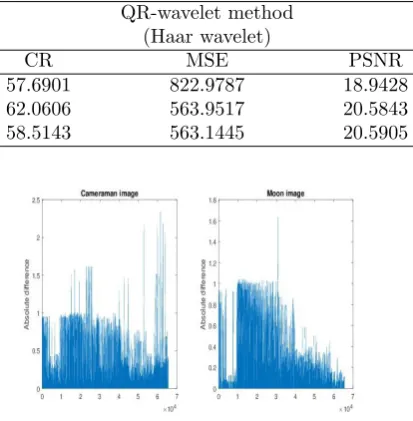
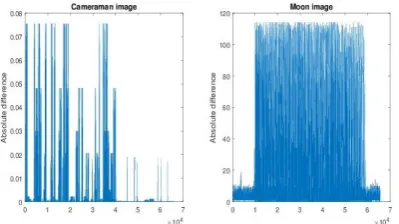
Figures 1 and 2 show the results of the com-pression with QR-wavelet method used for ’cam-eraman’ and ’moon’ images with block size 16. Figures 3 and 4 show the absolute difference be-tween the original image and the reconstructed image with block size 16.
Table 1: Image quality and Compression ratio for cameraman image.
QR decomposition QR-wavelet method (Haar wavelet)
Size of blocks CR MSE PSNR CR MSE PSNR
4 2 0.0038 72.2250 48.7619 7.1783e-05 89.5022 8 4 0.0104 67.8862 41.7959 1.1914e-04 87.3017 16 8 0.0225 64.5499 35.9298 1.8799e-05 95.3211
Table 2: Image quality and Compression ratio for moon image.
QR decomposition QR-wavelet method (Haar wavelet)
Size of blocks CR MSE PSNR CR MSE PSNR
4 2 0.0044 71.6726 57.6901 822.9787 18.9428 8 4 0.0118 67.3961 62.0606 563.9517 20.5843 16 8 0.0246 64.1883 58.5143 563.1445 20.5905
(i.e. larger MSE and smaller PSNR values). Thus, it is necessary to strike a balance between storage space required and image quality for good image compression. Generally, choice of block size depends on the application. For instance, in some applications, if image quality is impor-tant then higher values of block size are chosen but sometimes storage space is more important than image quality , in that case lower block size values are taken.
Figure 1: QR-wavelet method with size of blocks=16
Figure 2: QR-wavelet method with size of blocks=16
Figure 3: Absolute difference between the original image and the reconstructed images by QR-wavelet method with size of blocks 16 for ’cameraman’
5
Conclusion
Figure 4: Absolute difference between the original image and the reconstructed images by QR-wavelet method with size of blocks 16 for ’moon’
robust under transmission and decoding errors, and also facilitates progressive transmission of images. Wavelet compression is very efficient at low bit rates and provide an efficient decomposi-tion of signals prior to compression.
References
[1] R. J. Anderson, F. A. Petitcolas, On the limits of steganography, IEEE Journal on Selected Areas in Communications, 16(4) (1998) 474-481.
[2] I. Daubechies, Ten lectures on wavelets, So-ciety for Industrial and Applied Mathemat-ics, (1992).
[3] I. Daubechies, Orthonormal bases of com-pactly supported wavelets,Communications on Pure and Applied Mathematics, 41(7) (1988) 909-996.
[4] G. H. Golub, C. F. Van Loan, Matrix com-putations,JHU Press, (2012).
[5] M. Gu, S. C. Eisenstat, Efficient algorithms for computing a strong rank-revealing QR factorization, SIAM Journal on Scientific Computing, 17(4) (1996) 848-869.
[6] A. Haar, Zur theorie der orthogonalen funk-tionensysteme, Mathematische Annalen, 69(3) (1910) 331-371.
[7] S. Kahu,R. Rahate, Image compression us-ing sus-ingular value decomposition, Interna-tional Journal of Advancements in Research and Technology, 2(8) (2013) 244-248.
[8] Z. N. Li, M. S. Drew, J. Liu, Fundamen-tals of multimedia, Upper saddle river (NJ),
Pearson Prentice Hall, (2004).
[9] S. G. Mallat, Multiresolution approxima-tions and wavelet orthonormal bases of
L2(R),Transactions of The American Math-ematical Society, 315(1) (1989) 69-87.
[10] S. G. Mallat, A theory for multiresolution signal decomposition: the wavelet represen-tation,IEEE Transactions on Pattern Anal-ysis and Machine Intelligence, 11(7) (1989) 674-693.
[11] A. Mammeri, B. Hadjou, A. Khoumsi, A survey of image compression algorithms for visual sensor networks, ISRN Sensor Net-works, (2012).
[12] O. Marques, Practical image and video pro-cessing using MATLAB,John Wiley & Sons, (2011).
[13] P. G. Martinsson, V. Rokhlin, A fast di-rect solver for boundary integral equations in two dimensions,Journal of Computational Physics, 205(1) (2005) 1-23.
[14] Y. Naderahmadian, S. Hosseini-Khayat, Fast and robust watermarking in still images based on QR decomposition, Multimedia tools and applications, 72(3) (2014) 2597-2618.
[15] S. J. Pinto, J. P. Gawande, Performance analysis of medical image compression tech-niques, In Internet (AH-ICI), 2012 third Asian Himalayas international conference on IEEE, (2012) 1-4.
[17] H. S. Samra, Image compression techniques,
International Journal of Computers and Technology 2 (2a) (2012) 49-52.
[18] Y. Q. SHi, H. Sun, Image and video com-pression for multimedia engineering, 2nd edi-tion, CRC press,Taylor and Francis Group, (2008).
[19] S. Singh, V. Kumar, H. K. Verma, DWT-DCT hybrid scheme for medical image com-pression, Journal of Medical Engineering and Technology, 31(2) (2007) 109-122.
[20] R. M. Young, An introduction to nonhar-monic Fourier series, Revised Edition, 93
Academic Press, (2001).
Nader Biranvand is Instructor at Imam Ali Officers’ University, Tehran, Iran. He is currently PhD student in Applied Mathematics at Islamic Azad University of Shahr Rey. His research interests are mainly in the areas of numerical analysis, fractional differential equations, fuzzy differential equations, wavelets, image processing and game theory.