Understanding the Conceptual
Development Phase of Applied
Theory-Building Research:
A Grounded Approach
Julia Storberg-Walker
This article presents a provisional grounded theory of conceptual development for applied theory-building research. The theory described here extends the understanding of the components of conceptual development and provides generalized relations among the components. The conceptual development phase of theory-building research has been widely debated and discussed in a variety of disciplines,most notably in sociology and management theory. The breadth and number of these contributions makes it difficult for many human resource development (HRD) theorists to select the most appropriate process or framework to follow,and guidelines or a framework are needed to further the development of HRD theory. This grounded study contributes toward that gap. The study found that a five-component framework of conceptual development emerged from creating an HRD theory on human capital transformation.
There has been a diversity of calls for explicit theory-building research in publications relevant to HRD (Holton, 2003; Mankin, 2001; O’Dougherty & Willmott, 2001; Swanson, 2001; Van de Ven, in press). Torraco (2004) specified four areas of need: (1) new HRD theory, (2) more explicit HRD theory-building research methods, (3) a clearer understanding of HRD’s theoretical foundation, and (4) more published work that describes both the process of theory-building research and the theory itself. This article contributes to the fourth need: we need more published work that describes both the process of theory-building research and the outcome of the process.
Themethodofinquiryusedhereisgroundedtheory,withconstantcomparative and theoretical sampling practices. Glaser and Strauss (1967) introduced grounded theory as a strategy for qualitative research as a response to the “extreme
HUMANRESOURCEDEVELOPMENTQUARTERLY, vol. 18, no. 1, Spring 2007 © Wiley Periodicals, Inc.
64 Storberg-Walker
positivism” (Suddaby, 2006, p. 1) in order to counter “the dominant view that quantitative studies provide the only form of systematic social scientific inquiry” (Charmaz, 2000, p. 509). This article presents a provisional grounded theory of the conceptual development phase of applied theory-building research.
Conceptual development is arguably the most substantive and important component of theory-building research. According to Lynham (2002), this phase requires “that the theorist formulate initial ideas in a way that depicts current, best, most informed understanding and explanation of the phenomenon, issue, or problem relevant in the real world context” (p. 231). The formulation of ini-tial ideas is a process that is offered as a prescription in dozens of ways: as cate-gories and attributes of units (Dubin, 1978), in visual form (Whetten, 1989, 2002), as thought trials (Weick, 1989), or through the constant comparative method (Glaser & Strauss, 1967), to name a few. Conceptual development can be considered the first step toward building theory or, when using grounded theory, is second after application (Egan, 2002). There is so much literature on conceptual development from sociology, anthropology, organization theory, HRD, and management science that it is difficult to come to terms with what is impor-tant for a particular inquiry and what is peripheral. Theorists are likely to find it difficult to select a process because the options are so numerous. In addition, little guidance is provided to create criteria for selecting the best process. Of course, the process selected should be generated by the phenomenon under examination (Lynham, 2002), not from a list of favorites. Readers are told to match the process to the phenomenon, but after that, the theorist is left with a bewildering array of alternative conceptual development processes.
Thus, the dilemma facing theorists is selecting the most appropriate conceptual development process for the topic under study. In order to build a theory of some HRD phenomenon, what process should be followed, what key decisions need to be made, and how does a theorist justify her decisions? This was the dilemma I experienced during an earlier theory-building study. That study produced two results: the first, and the intended outcome of the study, was completing the operationalization phase of theory building for a new theory of human capital transformation (my dissertation, entitled “Towards a Theory of Human Capital Transformation Through HRD” (Storberg-Walker, 2004). The second result was a surprise: a model of conceptual development emerged from the practice of generating the theory of human capital transformation through HRD. (Following Dubin, 1978, and Whetten, 1989, 2002, the words modeland theory will be used interchangeably in this article.)
This second result is the focus of this article. It describes the research process and presents the findings for two research questions: (1) What are the critical components of conceptual development that I need to know? (2) What are the relationships among the components? In order to answer these questions, I used a grounded approach to identify themes and patterns within the theory-building literature, compare them to each other and the phenom-enon being investigated, and engage in theoretical sampling during this
process. I undertook these steps in order to make informed decisions about what processes to use during the conceptual development phase of applied theory-building research. These same decisions are likely to be faced by future HRD theorists, and the results of this study could contribute toward more con-sistent and informed HRD theories—one of Torraco’s four concerns (2004) about the future of theory-building research in HRD.
This article is presented in six sections: the grounded theory of concep-tual development (findings), methods, data collection and analysis, discussion, limitations, and conclusion and implications. There are many different strate-gies for writing up grounded research (Charmaz, 2000), and writing is complicated by the iterative, constant comparative practice of moving from data collection, to analysis, and back to data collection. Unlike positivist research, the grounded theorist does not know in advance what data to collect; the decision on data collection is based on the technique of theoretical sam-pling. So the practice of grounded theory does not lend itself to a standard research manuscript; normally data collection and analysis would be presented first and the theory or findings second. However, if this tactic were used, read-ers would be presented with “a jumble of literature consultation, data collec-tion, and analysis conducted in ongoing iterations that produce many relatively fuzzy categories that, over time, reduce to fewer, clearer conceptual structures. Theory would be presented last” (Suddaby, 2006, p. 637).
The findings of the study—the grounded theory of conceptual development— are presented first in order to provide a framework for the subsequent sections. A description of the grounded methods used for the study is presented second. Vivid descriptions of data and analysis are presented next, offering compelling details about the practice of generating theory. This part of the article presents the closest reality of what actually happened during the study. Some advance organiz-ers are embedded in the section, but it seeks to clearly describe the back-and-forth flow between conceptual development and the content of “Towards a Theory of Human Capital Transformation Through HRD” (Storberg-Walker, 2004). The dis-cussion of the results is next, followed by a description of the limitations of this study. Finally, conclusions and implications for future research are offered.
Findings: The Grounded Theory
of Conceptual Development
The grounded theory of conceptual development was generated while I was developing my dissertation (Storberg-Walker, 2004). This situation supports Egan’s assertion (2002) that grounded theory can emerge from practice: the practice, in this case, was building a theory. The problem of the original study, in addition to building the theory, was how to build the theory. To answer this question, two research questions were posed and answered: (1) What are the critical components of conceptual development? (2) What are the relationships between the components? This case study found that five critical components
Understanding Conceptual Development 65
66 Storberg-Walker
emerged during the conceptual development phase of applied theory-building research. Furthermore, the case study found that the components had varying relations with each other that ebbed and flowed over time. Consequently, two elements of the grounded theory were generated: (1) conceptual categories such as components and their conceptual properties and (2) generalized rela-tions among the categories and their properties (Glaser & Strauss, 1967).
Figure 1 illustrates the five components of conceptual development. The study found that each of these five components was necessary during this
HUMANRESOURCEDEVELOPMENTQUARTERLY• DOI: 10.1002/hrdq
Figure 1. Conceptual Development Phase of Theory-Building Research in Applied Disciplines
Conceptual Integration: Study, Learn About, Experience, and Immerse
Yourself in the Problem, Phenomenon, Situation, Dilemma, Contradiction, Tension, or Puzzle of the Application of the
Phenomenon
The Contextual Environment in Which the Research and Application of the Phenomenon under Investigation Are Experienced.
Identify and Resolve Preliminary Research Design
Issues Identify and Understand Alternative Theory-building
Processes Identify and
Resolve Paradigmatic
Issues
Identify and Complete the Appropriate
Theoretical Modeling
Process
Identify and Resolve Core Theoretical Issues
Completed Conceptual Development Phase Integrated and Resolved Paradigm, Core Theories, Preliminary Research Design,
phase of theory building. At any point in time, findings suggested that a component may interact with or influence another. At other times, a compo-nent may be dormant or in the background. The theorist, depicted as the conceptual integration circle in the middle, undergoes an intense mental gymnastic in order to simultaneously think about, assess, evaluate, select, and integrate the five components during the conceptual development phase.
The theorist is placed in the center of the figure to reinforce the primacy of her or his decisions in the process of conceptual development. In the grounded theory of conceptual development, the theorist was embedded and actively gen-erating ideas and hypotheses. The theorist was immersed in the practice of developing concepts, actively sampling different theoretical literature, using logic, reflection, and cognitive processes. According to Glaser and Strauss (1967), “When the theorist begins to hypothesize with the explicit purpose of generating theory, the researcher is no longer a passive receiver of impressions but is drawn naturally into actively generating and verifying [her] hypotheses” (p. 39). The theorist relies on her “beliefs and feelings” (p. 225) and “intelli-gence and ingenuity” (p. 163) to “master [her] data” (p. 46). It is evident that the process of grounded theory assumes that the functionalist subject-object distinction is invalid. The theorist draws from experience and practice, bined with literature and methodological techniques (including constant com-parison and theoretical sampling), in order to generate the grounded theory.
A brief description of each component is provided here. Subsequent sections illuminate how each component emerged from my immersion in the case study.
Component 1: Identify and Understand Alternative Theory-Building Research Processes. In this study, I found that the theorist needed to search the literature to understand the available options to build theory in order to make the most informed decisions as possible. For example, a theorist could be faced with a choice of building a new theory through meta-analysis (Yang, 2002), case study research (Eisenhardt, 1989), narrative (Pentland, 1989), or imagination (Weick, 1989). The theorist needs to understand the alternatives and convince the reader that the selected method is the best for creating the theory. The action verbs used in the study to satisfy this need were:
• Find:The study strategized to seek out a wide variety of information about
theory building research.
• Understand:I read and reread the literature, thought about the
implica-tions of selecting one or more specific processes for the emerging theory, and compared and contrasted the processes and the consequences of the selection.
• Select:Based on the understanding generated from above, I identified and
selected the theory-building research method most appropriate to the study.
• Make explicit:In the finished dissertation (Storberg-Walker, 2004), I attempted
to clearly articulate the decision process leading to the selection.
Understanding Conceptual Development 67
68 Storberg-Walker
• Justify: In my dissertation, I attempted to convince readers that my selection
was the optimal one for the theory.
Component 2: Identify and Resolve Paradigmatic Issues. Lynham (2002) argued that theorists need to explicitly state their paradigmatic assumptions in order to complete the conceptual development phase. One of the required tasks, then, is to understand, acknowledge the differences of, and select the appropriate paradigms for building a theory. Some argue that paradigms are not selected like methods are. However, my study found evidence that theo-rists develop better theory by applying different paradigmatic assumptions on the topic being addressed. Developing these alternative theories increases the chances of unexpected or novel findings (Poole and van de Ven, 1989; Weick, 1989).
The tactic used in the study was to purposively problematize the issue of paradigm. Thought trials of all four of Burrell and Morgan’s typology of para-digms (1979) were considered and their implications drawn out. The world of the emerging theory was thus seen in four different ways: functionalist, inter-pretivist, radical humanist, and radical structuralist. These thought trials illuminated similarities and differences, and the process contributed to a deeper understanding of the subtleties and nuances of how paradigms can influence the shape and scope of the emerging theory.
Component 3: Identify and Resolve Core Theory Issues. This study found that core or foundational theory issues were the keystone to the emerging the-ory. In Figure 1, the conceptual integration is placed in the anchor position of the five components to reinforce its central character in the grounded theory of conceptual development. These foundational theory issues need to be iden-tified and resolved during the conceptual development phase for two related reasons. First, foundational theories serve the purpose of strengthening a new theory by specifying and confirming its assumptions. Second, founda-tional theories can be used as a tool to explore contradictions, tensions, and oppositions between opposing potential answers to the research question. That is, opposing foundational theories can serve to illuminate opportunities for new theoretical development. For this study, both aspects of the foundational theories served to strengthen the theory of human capital transformation through human resource development. The significance of this component will be made clear in the next sections.
Component 4: Identify and Resolve Preliminary Research Design Issues. The study found that some research design decisions can directly shape the constructs and relationships among them. Since the output of the conceptual development phase includes constructs and their relationships, these findings suggest that theorists should consider research design issues that have the potential to shape the evidence that is sought and gathered. For this study, I identified two research design issues as having the potential to shape constructs and relationships: levels of analysis issues and temporal issues.
Focusing on the levels issue, I found that it was necessary to logically extend the abstract assumptions and foci of the foundational theories to the concrete level of evidence in order to avoid any problems with multilevel research. The study eventually determined to narrow the scope of the theory based on the multilevel research challenges that were identified in the literature.
Component 5: Identify and Select the Appropriate Modeling Process. The output of the conceptual development phase is often a model that explains or illustrates the connections among the concepts of the theory. This study found that the process of modeling is a generic one of building applied theory that appeared and reappeared in the theory-building research literature. In addi-tion to helping theorists create a visual representaaddi-tion of a theory, the process of modeling can also inform and shape the theorist’s intellectual processes of conceptual development.
Theory and Practice Link. To summarize these findings, the grounded theory of conceptual development emerged out of the actual practice of build-ing theory. Each of the five components of the theory describes key actions and decision points during the process of conceptual development. The identifi-cation of the five components answered the first research question: What are the critical components of conceptual development?
In addition to identifying the critical components of conceptual develop-ment, this study illuminated how each of the components was related to the others. The “identify and resolve foundational theories” component was iden-tified as the keystone and influenced the outcome of the other components. The iterative strategy of grounded theory magnified the interdependencies of the components, and multiple connections and influences were identified. These relations and interdependencies consequently answered the second research question: What are the relationships between the components?
Methods
Charmaz (2000) wrote that “grounded theory methods consist of systematic inductive guidelines for collecting and analyzing data to build middle-range theoretical frameworks that explain the collected data” (p. 509). Key words in this definition are systematic and analysis. The system of collecting data in grounded theory is theoretical sampling. Also, there is a particular form of analysis: comparative analysis. Glaser and Strauss (1967) introduced theoret-ical sampling and comparative analysis in order to enhance the credibility and relevance of new theories. They suggested that the criteria for judging a theory “be based . . . on the detailed elements of the actual strategies used for collecting, coding, analyzing and presenting data, and on the way people read the theory” (p. 224). Consequently, in grounded theory, the method begins with the idea of generating a theory and ends when the provisional theory is written down in a manuscript, and the theory is judged on the level of detail and descriptions of the phenomenon.
Understanding Conceptual Development 69
70 Storberg-Walker
The methods used in this study followed the analytical strategies that Glaser and Strauss (1967) recommended. Grounded theory is most often used for soci-ological studies to compare different groups of people; however, these strategies are also used to analyze library materials (Charmaz, 2000; Glaser & Strauss, 1967; Suddaby, 2006). The first strategy, theoretical sampling, “is the process of data collection for generating theory whereby the analyst jointly collects, codes, and analyzes [her] data and decides what data to collect and where to find them, in order to develop [her] theory as it emerges” (Glaser and Strauss, 1967, p. 45). The second analytical strategy is the constant comparative method, a qualitative approach to data that is designed “to generate theory more systematically . . . by using explicit coding and analytic procedures” (p. 102). There are four stages of the constant comparative method: “1. comparing incidents applicable to each category, 2. integrating categories and their properties, 3. delimiting the theory, and 4. writing the theory” (p. 105).
Once my study started, I began to be immersed in two domains: the domain of theory building and the domain of the HRD phenomenon under investigation (human capital transformation through HRD). Consequently, both domains contributed to this study, and I began collecting data from two separate domains of literature: theory-building research methods and litera-ture relevant to the content of the phenomenon.
The theory-building literature initially included gathering a wide variety of data from the library. The library is “immensely useful” (Glaser & Strauss, 1967, p. 179) for generating theory. The study began with a partial framework and method for theory building and was not locked into any one specific method. “The initial decisions for theoretical collection of data are based . . . on a general subject or problem area . . . [and] not based on a preconceived theoretical framework” (p. 45). Much like a sociologist can turn to the library to access multiple cases of the sociological phenomenon of interest, a theorist can turn to the library to access multiple examples of building theory. How-ever, the purpose or strategy of collecting multiple cases is not to increase the sample size. The strategy is to obtain a wide variety of examples of the phenomenon (theory building) in order to generate as many properties or categories as possible.
The initial literature on theory building was diverse, represented alterna-tive paradigms, and came from multiple disciplines. I reviewed and compared key scholars whom Torraco (2004) identified. The initial focus of the com-parative analysis was to identify and understand the diverse processes of build-ing theory in the existbuild-ing literature. The review included journal articles (primarily from the Business Source Premier database) and scholarly work by often-cited theory-building research scholars. Key words used in the search were theory, theory building, theory-building research, theory development, and theory-building process.
As the study progressed, my data collection was redirected in response to the analytical findings emerging from the comparative analysis of the selected
theory-building literature. Unlike traditional research methods, the data collection was not planned in advance; it emerged as a result of the ongoing interactions between the different theory-building methods, as well as between the methods and the topic of human capital transformation through HRD. Based on the ongoing analysis, the study identified that the process of conceptual development, as a subprocess of the whole applied theory-building research process, was problematic. For example, the process was depicted as a detailed categorization of units and attributes (Dubin, 1978) with little or no guidance on how I should interact with the phenomena being theorized. And the process was described as a cognitive process focused on the phenomena with few or no details about concept attributes or analytical foci (Weick, 1989; Whetten, 1989, 2002).
As a result of this problem, the data collection narrowed to identifying and gathering more information about the conceptual development phase of theory-building research. The research questions were formed, exclusively focusing on conceptual development.
Data Collection and Analysis
For this project, I collected data about theory building and about human capital transformation.
Initial Theory-Building Data Collection and Analysis. In the first stage of building data collection, I focused on the whole process of theory-building research; consequently, my initial data collection strategy was to iden-tify and review the major theory-building research literature. Three categories emerged through an iterative process of analyzing the contents of the data, find-ing themes and patterns by comparfind-ing the different data, turnfind-ing back to data collection based on the initial analyses, and ultimately sorting the data into sensible categories. This process of analysis, comparison, and data collection continued until the data seemed saturated—that is, the continued theoretical sampling was not generating new categories of theory-building processes.
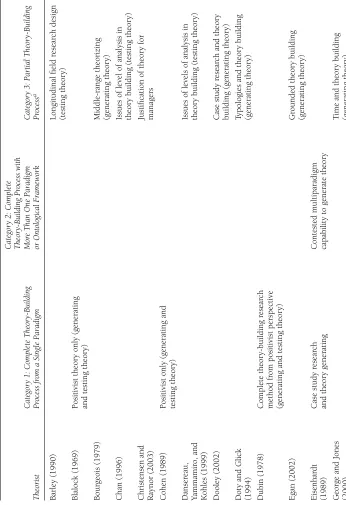
As Table 1 illustrates, three categories emerged and reached a point of data saturation. Category 1 was composed of the data that contained complete theory-building processes or described all of the phases of theory-building research from a single paradigm. For example, Dubin’s seven-step functional-ist process (1978), Yang’s theory building through meta analysis (2002), and Turnbull’s social constructivist process (2002) were placed in category 1. The theory-building processes in this category covered all the steps or phases of theory-building research (coveredis used purposively as a vague term to represent the divergent ways that the data explained or described the theory building process). Category 2 was different from category 1 in one important way: it included descriptions of the complete theory-building process data that could accommodate (through evidence and ontology) multiple paradigms. This category included Lynham’s General Method (2002), Van de Ven’s
Understanding Conceptual Development 71
T
able 1.
Contributions to Theor
y-Building Resear
ch in Applied Disciplines
Category 2: Complete Theory-Building Pr
ocess with
Category 1: Complete Theory-Building
Mor
e Than One Paradigm
Category 3: Partial Theory-Building
Theorist
Pr
ocess fr
om a Single Paradigm
or Ontological Framework
Pr
ocess
a
Barley (1990)
Longitudinal field r
esear ch design (testing theor y) Blalock (1969) Positivist theor
y only (generating
and testing theor
y)
Bour
geois (1979)
Middle-range theorizing (generating theor
y)
Chan (1996)
Issues of level of analysis in theor
y building (testing theor
y)
Christensen and
Justification of theor
y for
Raynor (2003)
managers
Cohen (1989)
Positivist only (generating and testing theor
y)
Danser
eau,
Issues of levels of analysis in
Yammamir
o, and
theor
y building (testing theor
y)
Kohles (1999) Dooley (2002)
Case study r
esear
ch and theor
y
building (generating theor
y)
Doty and Glick
Typologies and theor
y building (1994) (generating theor y) Dubin (1978) Complete theor y-building r esear ch method fr
om positivist perspective
(generating and testing theor
y) Egan (2002) Gr ounded theor y building (generating theor y) Eisenhar dt
Case study r
esear ch Contested multiparadigm (1989) and theor y generating
capability to generate theor
y
Geor
ge and Jones
T
ime and theor
y building
(2000)
(generating theor
Gioia and Pitr
e
Multiparadigm r
esear
ch (not clear
(1989)
regar
ding generating or testing theor
y)
Jick (1979)
Qualitative and quantitative methods combine (testing theor
y)
Kerlinger (1973)
Positivist theor
y only
(generating and testing)
Lazersfeld and
Positivist theor
y only
Menzel (1969)
(generating and testing)
Lewis and Grimes
Meta-triangulation (primarily
(1999)
testing theor
y)
Lynham (2002)
General method of theor
y-building r
esear
ch
in applied disciplines (generating and testing theor
y)
Osigweh (1989)
Concept fallibility and theor
y
building (testing one aspect of the theor
y)
Pentland (1999)
Narrative analysis and theor
y
building (testing theor
y)
Poole and van de
Multiple thought trials fr
om
V
en (1989)
dif
fer
ent perspectives; using
paradox to cr
eate theor y (generating theor y) Reynolds (1971) Positivist theor y only
(generating and testing)
Rousseau (1985)
Issues of level of analysis in theor
y
building (testing theor
y)
Strauss and Corbin
Contested multiparadigm
Gr
ounded theor
y (generating theor
y)
(1990)
capability
Torraco (2002)
Comparative analysis of theor
y-building r
esear
ch
in applied disciplines (r
eview)
(
Continued
T
soukas (1989)
Influence of r
ealist knowledge
claims and idiographic r
esear
ch
on theor
y generation and testing
Tu
rnbull (2002)
Inductive theor
y generation
V
an de V
en Contested Pr ofessional science (in pr ess) mono-paradigm diamond model pr
ocess (testing is
(generating and testing
fr om positivist theor y) frame) W eick (1989,
Imagination may include
Disciplined imagination
1995, 2001)
multiple paradigms for
(generating theor
y)
generating theor
y
only (not testing)
Whetten (2002)
Modeling implies
Modeling-as-theorizing
mono-paradigm theor
y
(generating and testing theor
y)
Yang (2002)
Methods of meta
Meta analysis (generating and
analysis imply testing theor y) positivist frame Zaheer , Albert, Implied positivist T
ime and theor
y-building:
and Zaheer
frame
specification of r
elevant
(1999)
timescale (testing theor
y) Sour ce: Adapted fr om Storber g-W alker (2006).
aExamples ar
e conceptual development or r
esear
ch design.
T
able 1.
Contributions to Theor
y-Building Resear
ch in Applied Disciplines
(
Continued
)
Category 2: Complete Theory-Building Pr
ocess with
Category 1: Complete Theory-Building
Mor
e Than One Paradigm
Category 3: Partial Theory-Building
Theorist
Pr
ocess fr
om a Single Paradigm
or Ontological Framework
Pr
ocess
diamond model (in press), and Eisenhardt’s theory building through case studies (1989), among others.
The distinction between the mono- and multiparadigm theory-building research processes was relevant to the study due to the nature of the HRD phe-nomenon of interest. In other words, based on the review of the literature rel-evant to human capital transformation through HRD, I adopted the position that mixed-method research was the best way to understand the processes and outcomes. A strict quantitative study would not be able to analyze the emer-gent processes of learning and working as well as a qualitative study, and a strict qualitative study would not be able to analyze outcomes as well as quantitative studies can. Consequently, the study clearly focused on finding a theory-building process that could accommodate both forms of research.
In addition to the mono- and multiparadigm categories of theory-building research, a third category emerged. The study found that in addition to complete theory-building processes identified in categories 1 and 2, the litera-ture contained numerous examples of literalitera-ture focusing on a specific phase or part of the overall theory-building journey. For example, Weick (1989) did not address operationalization or theory testing, two important phases of applied theory building. Category 3 encompassed this large body of literature that focused on one or more specific components or perspectives of theory build-ing research in applied disciplines. (See Table 1 for details about the specific contributions in this category.) Many different ways to complete concep-tual development were included in this category, and unlike the first two cate-gories, the implications of selecting one over another were not at all obvious. It was relatively simple to distinguish monoparadigm from multiparadigm theory-building processes and to understand the consequences of each. However, for the conceptual development processes in the third category, the implica-tions of selecting one over the other was not obvious. Furthermore, how the different aspects of conceptual development related to or influenced each other was unstated or written in a way that was inaccessible to the average theorist.
At this point in the study, it became clear that a deeper analysis of the conceptual development phase of theory-building research was needed. This triggered a return to the library and a focused search on conceptual develop-ment. This return to the library in response to an initial analysis is an example of theoretical sampling: the initial data analysis illuminated a problem or issue or generated a hint of a hypothesis, which called for new data to be collected. The initial analysis found that important questions regarding specific concep-tual development strategies, and the relationships between the different strategies, were not answered. Furthermore, the consequences of deciding one strategy over another were not clear. From this problematic situation, the two research questions were posed: What are the critical components of concep-tual development? What are the relationships between the components?
Understanding Conceptual Development 75
76 Storberg-Walker
Emergence of the Grounded Theory of Conceptual Development. This section primarily focuses on category 3, and the analysis is presented in a nar-rative manner to convey the itenar-rative movement among the twenty-four different examples of theory-building data and the content of the theory (human capital transformation through HRD). It illustrates how the grounded theory of conceptual development with its five components emerged through the constant interplay of two types of data: theory-building data (from the literature listed in category 3) and content data relevant to theory of human capital transformation through HRD. Content data were drawn primarily from the disciplines of management, sociology, and HRD. (A more complete expla-nation of content data can be found in Storberg-Walker, 2004.)
Importance and Relevance of Core Theory Issues. At the beginning of the
study, the critical relevance of core theories was not fully understood. This lack of understanding was perpetuated by the manner in which core theories and how they relate to other aspects of theory building were discussed in much of the theory-building literature. Either core theories were given a peripheral or cursory mention, or they did not seem to be explicitly addressed at all. It was only by the grounded method of constant comparison of the alternative conceptual development frameworks that a deeper understanding of core theories emerged.
I found that the keystone to the grounded theory of conceptual develop-ment is identifying and resolving core theory issues. This is the most influen-tial component of the conceptual development phase of theory-building research and includes identifying foundational literature, specifying explicit core theories from that literature, and exploring the impact of those explicit alternative core theories on the process of evidence gathering and analysis. This component justifies and influences two of the four other components (paradigm issues and research design) and guides the identifica-tion and resoluidentifica-tion of the other two (theory building and modeling processes). Core theories are the foundational theories that a new theory builds on. A clear example of core theories is the three-legged stool model of HRD (Swanson, 2001). The core theories of HRD in this model are economic, psychology, and sys-tems theories. The model suggests that these three theories somehow interact with each other to generate new understandings and theories of HRD.
There are deep ontological and epistemological implications to core theo-ries. Continuing the example of the three-legged stool, close examination of the core theories illuminates critical assumptions about reality and evidence (data). By identifying economic theory as a core theory of HRD, for example, a theorist is making critical decisions about paradigms (there is an objective reality out there) and evidence (data can be objectively obtained through quan-titative research methods). Selecting economic theory delimits the emerging theory to a positivist or postpositivist paradigm because it fundamentally shapes the world of the emerging theory. The emerging theory must be logi-cally consistent with the core theory; consequently, in the three-legged stool
example, HRD theories must be positivist or postpositivist in order to be logically consistent with the assumptions of economic theory.
How the Core Theories Emerge in This Study. For this study, three
frame-works from the theory-building literature (see Table 1) combined to illu-minate the importance of core theories and their impact on the generation of the theory of human capital transformation. The frameworks were Poole and van de Ven’s suggestion (1989) to use paradox or competing frameworks to uncover novel theories; Weick’s description (1989) of selection criteria that suggested theorists actively seek to expand their usual frame of reference (for example, change the criteria from which decisions are made); and Whetten’s suggestion (1989, 2002) to visually model the emerging theory in order to easily distinguish core from peripheral ideas and theories. Although all twenty-four frameworks in Table 1 contributed in some manner to the emerging grounded theory of conceptual development, these three distinctly influenced the emerging theory.
For example, a comparison of Whetten (2002) and Weick (1989) on the issue of core theories led to new understandings about paradigms and research methods. In addition, the comparison brought the relationships between the components into focus. In relational terms, the core issues component heavily influenced the research design component and exerted a moderate influence on the selection of theory-building processes. Thus, both research questions were starting to be addressed as the constant comparative and theoretical sampling tactics were being deployed in the study.
At the beginning of the study, Whetten’s suggestion (2002) to “keep in mind that many of the more detailed and technical discussions of relationship types [between core theories and concepts] . . . have a strong methodological orientation” (p. 55), held little meaning. A relationship between core theories and methods seemed too obvious to have any surprising influence on con-ceptual development. However, comparing this comment with some of Weick’s suggestions (1989) enabled a deeper and more significant meaning to emerge. During a discussion of the role of imagination, Weick (1989) suggested that a wide variety of thought trials containing alternative core theories could be con-jured up to explain or understand the topic of interest. He argued that “self-conscious manipulation of the selection process [for example, deciding what core theory to include] is the hallmark of theory construction. . . . The greater the number of diverse criteria applied to a conjecture, the higher the proba-bility that those conjectures which are selected will result in good theory” (Weick, 1989, p. 523).
Following Weick’s suggestion (1989), the study then conjured up a wide variety of possible ways to understand human capital transformation through HRD. Some of these included functionalist core theories—for example, Becker’s human capital theory (1993) and social constructivist core theories such as Lave and Wenger’s (1991) situated learning theory. After going through these thought trials, only then did Whetten’s assertion (2002) about the methodological
Understanding Conceptual Development 77
78 Storberg-Walker
implications of core theories become more obvious and relevant. Whetten was suggesting a relationship between core theory and research design, but he was not advocating for generating wide alternatives or multiparadigm research in order to improve the theory. Weick (1989) was hinting that diversity in core theories generates good theory, but he did not connect the diversity to the methods necessary to collect evidence. Comparing these two created the oppor-tunity for me to hypothesize that more diversity in thought trials led to more diversity in research design and that the diversity was beneficial because it can lead to better theory. This new understanding coincidentally supported one of the initial decisions I made in the study: that the topic of the study can be best understood from a multiparadigm perspective.
At the same time that the constant comparison was generating more understanding of conceptual development, I was analyzing the core literature of the theory of human capital transformation through HRD. The overlap enabled me to leverage the strength of both processes and make better deci-sions for the theory. I mentally laid out a thought trial to the research design stage to understand the implications of that trial. Then I reversed the process and “played backward” an alternative research design to the more abstract thought trial stage. These activities generated not only an understanding of what happens in conceptual development, but also linked concept develop-ment with seeking out alternative research design possibilities and selecting theory-building research processes. Typically the literature on theory build-ing does not claim that preliminary research design decisions are necessary during the conceptual development phase. This explicit connection between research design and conceptual development can assist HRD theorists in making more informed decisions and possibly more relevant theories in the future.
The constant comparison provided another understanding that is likely to be beneficial to future theorists. The strategy of comparison revealed that mul-tiparadigm theory-building studies are more likely to generate relevant theo-ries than single-paradigm studies. This finding is supported by Weick’s call (1989) for wide variation in ideas, as well as Poole and van de Ven’s suggestion (1989) to embrace paradox. The intellectual thought trials, comparative analy-sis, and active search for competing or paradoxical ideas worked together to generate a wide diversity of thought trials that eventually led to the creation of two alternative research designs—one functionalist and one interpretivist. Because one of the elements of the theory was capital (it was clear that part of the literature would come from economics) one aspect of the theory needed to be examined with quantitative research methods. It was also clear that part of the literature would come from the learning and participation literature, which can be more qualitative in nature. The paradox was resolved through the alternative research designs that I identified and created through active engagement with competing explanations, perspectives, and paradigms.
Narrowing the Scope of Core Theories. Somewhere around this stage of the study, it became clear that further distinctions needed to be made within each core literature in order to narrow the scope of the emerging theory further.
The literature review on the content of the theory suggested a relationship among human capital, social capital, and HRD interventions. These were the three main concepts of the emerging theory supported by the review. However, there was a diverse literature on both human and social capital, and the study needed to identify and justify the most relevant ideas and core theories from that literature. For example, the emerging theory needed to describe the rela-tionship between the broad concepts of human and social capital. This relationship is contested in the literature: Becker (1993) argued that human capital generates social capital, and Coleman (1988) argued that social capital generates human capital. Both core theories could be used as a specific theoretical foundation for the new theory, but the implications of selecting one over the other were not clear. I then returned to the theory-building literature to understand the possible criteria for and implications of the selection.
The study reviewed functionalist instructions for how to generate more focused and specific concepts from broader concepts. Dubin (1978), a recog-nized functionalist theory-building scholar in the HRD literature (Torraco, 2004, 2005), argued that “in principle there are no limitations on the selection of units to be employed in a theoretical model” (p. 78). (Dubin refers to con-cepts as units, and to reflect his intentions accurately, in this section I use unit rather than concept.) Dubin’s work on theory building provides explicit instruc-tions for creating units of a theory.
According to Dubin (1978), the “discovery of new units to be employed in theory building is basically achieved through a process of classification. . . . We either take a broad unit and subdivide it, or we elaborate a residual unit into a substantive one and thus extend the existing classification scheme” (p. 79). Extending is more common than subdividing, according to Dubin, and subdividing includes such quantitative methods as factor analysis and scale analysis. Extension involves adding new categories to some existing classifica-tion scheme or making new specificaclassifica-tions of existing categories. Subdividing is more appropriate when a discipline is well established, and extension is used to explore the breadth of units in a newer discipline. Based on these distinc-tions, I decided to extend the classifications of one broad unit, social capital, of the emerging theory of human capital transformation.
I initially speculated that social capital enhances or adds to how much human capital is transformed through working in an organization. This speculation was supported in the literature by Adler and Kwon (2002) and Tsai and Ghoshal (1998), among others. I also speculated that HRD interventions could increase the possibility that social capital would be used to transform human capital (also supported in the literature; see Garcia, 2006; Tenkasi & Chesmore, 2003). However, social capital had not been theoretically connected to both human
Understanding Conceptual Development 79
80 Storberg-Walker
capital and the planned change interventions of HRD in the work environ-ment. Thus, the emerging theory sought to expand the concept of social capital to include how it transforms human capital through focused HRD interventions.
Following Dubin (1978), my first step was to identify the various ways social capital was classified in the literature. I found three basic alternative con-ceptions of social capital: (1) social capital exists because of the configuration of network ties (Burt, 1997), (2) social capital exists because of the type of net-work ties (Granovetter, 1973), and (3) social capital exists because of the resources in the network (Lin, 2001). Note that these concepts do not include the outcomes of social capital, which the majority of social capital literature is concerned with. This classification scheme focuses on the fundamental expla-nation of social capital—the mechanisms for its existence. Social capital exists for one of three reasons: configuration or type of network tie or resources in the network. Each of these could be a unit in the emerging theory, and all three could contribute toward human capital transformation as conceived by the study. However, in order to limit the scope of the emerging theory and make it as focused (that is, as parsimonious) as possible, I attempted to iden-tify the most relevant explanation of social capital and exclude the other two plausible explanations.
I found that Dubin’s method (1978) was not focused on helping theorists decide which unit to select; instead, he was more focused on explicating the details, requirements, and limitations of how units are created and used in the-ory. For example, he classified the types of units, the differences between event and unit, attribute and unit, real and nominal units, primitive and sophisti-cated units, and collective and member units. He suggested that “it is not uncommon to strain for consistency in or among units of analysis” (p. 86) and suggested that the different units should be related together in some cohesive way. However, although his laws of interaction provide detailed information about how units can be linked together (categorical, sequential, or determi-nant), it was difficult to parse out the implications of choosing one set of rela-tions over another. As the theory of human capital transformation through HRD was beginning to emerge, it was still unclear how decisions about units and relationships would affect the impact, relevance, and rigor of the theory. The constant comparative analytical strategies of grounded theory again offered some clarity.
I compared Dubin’s laws of interaction (1978) to other theory-building lit-erature, including Whetten’s modeling as theorizing (2002). Whetten (2002) offered some specific suggestions for determining the relations among constructs: (1) determine the role of your core construct in your explanation, (2) develop a core sequence through the constructs, (3) identify potential mod-erator constructs that may change the relationship between two other con-structs, or (4) identify specific relationships and patterns of relationships using arrows and feedback loops in the graphic model.
The visual representation of the model or theory was a helpful tool for integrating many of the alternative suggestions I found in the theory-building literature. Whetten’s modeling process (2002) was used to illuminate how alternative paradigms and methods could have a potential impact on the the-ory of human capital transformation through HRD, was able to expose alter-native relationships (for example, Dubin’s 1978 typology of relationships), and was a way to generate alternative ideas and thought trials (Weick, 1989). I used Whetten’s model (2002) for each of the three options for the social capital concept and analyzed the resulting models in terms of how they related to various HRD interventions. In addition, alternative understandings of the possible strategies and tactics HRD could take to intervene in the transforma-tion process became explicit. The visual and sequential process of the modeling process illuminated how HRD can affect theory in terms of its role as a catalyst for transformation and also in terms of moderating or mediating the concepts in the emerging theory.
I reached the ultimate decision of which specific version of social cap-ital to adopt through thinking through or imagining the different impacts each alternative conception of social capital would have on the emerging theory of human capital transformation through HRD. Lin’s resource theory of social capital (2001) was identified as the best way to conceptualize social capital for three reasons: it was consistent with the resource-based view of human capital, it was consistent with the literature on structural and intellectual capital, and it suggested that HRD interventions can develop higher levels of human capital transformation by focusing on moti-vation, such as investments with expected returns, a key concept in Lin’s theory (2001).
This decision about the concept of social capital brought with it Lin’s core literature (2001) that shaped the scope, assumptions, and operationalization of the theory. This fundamental decision was justified by constantly compar-ing the alternative theory-buildcompar-ing processes as listed in column 3 of Table 1. Dubin’s method (1978) of classifying concepts contributed toward delimiting the definition of the concept of social capital and thus the theory. Weick’s method of disciplined imagination (1989) provided alternative data to justify one definition of social capital over the others. And Whetten’s method (1989, 2002) illuminated the moderating role that motivation could potentially play in human capital transformation.
From this decision and others like it, the rest of the emerging theory was shaped through logical inference. That decision meant that the assump-tions that grounded Lin’s work (2001) needed to be integrated into the theory of human capital transformation through HRD, and future theory-building research decisions needed to be logically connected and consistent. Thus, the “identify and resolve core theory issues” component of the grounded theory was the keystone to the theory of human capital transformation through HRD.
Understanding Conceptual Development 81
82 Storberg-Walker
Discussion
Because this is an example of grounded theory building, it is important to clar-ify what this theory of conceptual development signifies. This is a provisional theory of the components and their relations of the conceptual development phase of applied theory-building research. This theory of a subprocess of applied theory building began to emerge from selecting and comparing a diverse array of cases of theory-building research from the standard exemplars as noted by Torraco (2004). The cases were then compared to uncover themes, patterns, and gaps. The initial comparison yielded a tentative theory of theory building and problematized the task of conceptual development. This led to a subsequent search for more cases specifically focused on conceptual develop-ment. Eventually, through comparing alternative theory-building frameworks and juxtaposing them with the content of human capital transformation through HRD, I formed a grounded theory of conceptual development.
In grounded theory, the data collection is not held to the traditional rules of evidence, and the experience and capacity of the theorist are key inputs to theory generation. According to Glaser and Strauss (1967), “The constant com-parative method is not designed . . . to guarantee that two analysts working independently with the same data will achieve the same results; it is designed to allow, with discipline, for some of the vagueness and flexibility that aid the creative generation of theory” (p. 103). Consequently, this grounded theory is a provisional attempt at generalizing the process of conceptual development from one theory-building case.
The components that emerged from the study are closely connected to the data: multiple variations on theory building and diverse literature on human capital transformation. As the grounded theory of conceptual development emerged, the process of crafting the theory of human capital transformation began to be influenced by the new understandings of conceptual development. Ultimately it became clear that the emerging grounded theory of conceptual development eventually could be wholly imported to the conceptual develop-ment phase of the General Method (Lynham, 2002). Although Lynham’s General Method described the complete process of applied theory building, the conceptual development phase was not specified. This grounded theory fills that gap and illuminates the key processes, decisions, and steps for devel-oping new social science theory, and thus enhances the ability of the General Method to produce credible and consistent HRD theory.
Following is a brief description of how each component influenced the process of developing the theory of human capital transformation.
The Influence of Component 1 on the Theory of Human Capital Transformation Through HRD. This component required the theorist to identify and understand alternative theory-building processes. The preceding section illustrated how the constant comparative process led to the emergence of this component. However, the most relevant input to the creation of this
component was the multiparadigm nature of the phenomenon of human capital transformation. Due to this fact, typical and popular monoparadigm theory-building perspectives and processes were not appropriate. Conse-quently, there was a need to search for and select the best method for the study. This component required finding, understanding, selecting, making explicit, and then justifying which theory-building research methods and perspectives I would adopt.
During the study, I took the following action steps:
• Find:I conducted a literature review and subsequent theoretical sampling
on theory-building research methods and processes (see Table 1).
• Understand: I devoted considerable time to reading and understanding,
sorting and comparing, critiquing, analyzing, and synthesizing the theory-building and conceptual development literature. This is a process that is never really complete, and yet theorists are required to make deci-sions about how to move forward in building the theory without a complete and total understanding of the material. Fortunately, the General Method (Lynham, 2002) encouraged my thinking about theory-building research as an iterative process, so I could revisit and tweak decisions as a part of the research. It was normal to make decisions during the process and amend them later based on new information or a new understanding.
• Select:Based on the understanding developing from the comparative
analy-sis, I selected the General Method (Lynham, 2002) to guide the overall theory-building journey. This was the first hard decision in component 1: Which theory-building research method and perspective should be used? Due to the multiparadigm nature of human capital transformation through HRD, the choice was limited to methods that could accommodate more than one paradigmatic perspective.
• Make explicit:This part of component 1 had two parts: I needed to clarify
the decisions on which method to follow, and my work resulting from the study had to clearly identify the theory-building research method that I selected.
• Justify:Over the course of the study, the iterative nature of theory-building
research encouraged reframing and reworking certain segments of the man-uscript with the intention of strengthening the justification for each theo-retical decisions. By clearly connecting the data to the theory, I offered evidence to readers to support the decisions.
The result of completing this component of conceptual development was the selection of the General Method (Lynham, 2002) as the most appro-priate theory-building research process for addressing the theory of human capital transformation through HRD. The General Method allowed multi-paradigm inquiry, subsumed the multi-paradigm to the phenomenon, presented the process as iterative, and encouraged me to incorporate multiple ways of
Understanding Conceptual Development 83
84 Storberg-Walker
understanding the topic during the theory research process. A number of mul-tiparadigm scholars support this decision, because ultimately “using different theory-building approaches to study disparate issues is a better way of foster-ing more comprehensive portraits of complex organizational phenomena” (Gioia & Pitre, 1989, p. 587).
Influence of Components 2, 3, and 4 on the Theory of Human Capital Transformation Through HRD. These three components were linked together during the creation of the theory of human capital transformation through HRD: specify paradigms, identify and justify foundational theories and perspectives, and identify and resolve preliminary research design issues. How my study dealt with these three conceptual issues shaped how the the-ory was generated and how the thethe-ory will be tested and applied in the real world.
These issues required understanding, analysis, resolution, and integration in order to complete the conceptual development phase. The components have been presented together as a group because of the deep influences each has on the other: deciding on which paradigm to adopt is intricately connected to research design and foundational theory issues, and deciding which theories should be relied on lead directly to a certain paradigm as well as the appro-priate research design option. Alone, each component is significant, but dur-ing the conceptual development phase of theory builddur-ing, it is unlikely that a decision about one will not have an impact on the others.
Some scholars suggest that paradigms cannot be selected by a theorist; this suggestion perpetuates the paradigm incommensurability problem cur-rently facing social scientists. Emerging literature suggests that paradigm incommensurability can be minimized or overcome when social scientists view the process of knowledge generation, as well as the social nature of determining what constitutes a contribution to new knowledge, from a per-spective of bricolage. The details of how each component shaped the theory of human capital transformation are presented below through the process of bricolage.
Component 2. Lynham (2002) argued that theorists need to explicitly
state their paradigmatic assumptions in order to complete the conceptual development phase. One of the required tasks, then, is to understand, acknowledge the differences of, and select the appropriate paradigms for building a theory when using the General Method. Ultimately, due to the nature of human capital transformation through HRD, my study focused on developing a multiparadigm theory. The study produced two different research designs, from two different paradigms, in order to test the theory of human capital transformation. New knowledge would be generated from the different paradigmatic perspectives, which could then be compared and contrasted for further analysis and theory development.
Component 3. This is the keystone to conceptual development. After
exploring the issues surrounding foundational or core theories, it was clear
that the study could be presented in a variety of ways depending on which foundational theory I selected.
Component 4. The study found that theorists are required to make
important preliminary research design decisions at the beginning of the theory-building research process in applied disciplines. This may seem backward to some, but noted scholars (Poole, Van de ven, Dooley, & Holmes, 2000; Rousseau, 1985; Van de Ven, in press; Zaheer, Albert, & Zaheer, 1999) have argued that complicated organizational phenomena require careful specification of important research design issues on the front end of theory building. “In the long run, the best theory is only as good as its evidence” (Poole et al., 2000, p. 5) that is used to confirm, disconfirm, or adapt the theory being examined.
In addition to the basic quantitative and qualitative distinction between research designs, two other important research design issues emerged during the study: 1evels of analysis and temporal issues. For example, the selection of Lin’s resource theory of social capital (2001) led to the realization that stan-dard social network analysis research methods would not provide the evidence necessary for the theory. Consequently, the study returned to the literature to identify alternative research methods that could be used to test the emerging theory. In addition, by selecting Lin’s (2001) concept of social capital, the typ-ical levels of analysis guidelines regarding mono- or multilevel research would not hold. This is because social capital analysis often focuses on the relation-ships between levels, not on the levels themselves.
The study also found that how the theory considers time is relevant. According to George and Jones (2000), “time can and should play a more important role [in theory building] because it can change the ontological description and meaning of a theoretical construct and of the relationships between constructs. . . . We suggest that theorists explicitly incorporate mul-tiple aspects of temporality onto the ‘what, how, and why’ building blocks of their theories” (p. 657). Consequently, the time issue was embedded in the next component, modeling.
The Influence of Component 5 on the Theory of Human Capital Trans-formation Through HRD. In this study, I selected Whetten’s modeling (2002) as a theorizing process to use during the conceptual development theory-building phase. I selected this model for two reasons: it clearly articulated the process of modeling, and it illuminated the relationships among the different types of concepts in the emerging theory of human capital transformation through HRD.
Impact of the Five-Component Model. The discussion describes how each component of the grounded theory of conceptual development was embodied in the process of crafting the theory of human capital transformation through HRD. The five-component theory was an unexpected result of having to do theory building, and it offers theorists one way to understand two key issues: the key components of conceptual development and how the components are related to each other.
Understanding Conceptual Development 85
86 Storberg-Walker
Limitations
Since grounded theory is a process that combines data with the researcher’s own knowledge and experience, each grounded theory that emerges is a unique look at some phenomenon. Theorists are cautioned “to remind your-self that you are only human and that what you observe is a function of both who you are and what you hope to see” (Suddaby, 2006, p. 635). Conse-quently, one of the limitations of the manuscript is generated from the meth-ods and intentions of grounded theory itself: the theory is provisional and not generalizable. It is a heuristic or pedagogical device that describes one instance of one phenomenon.
Hindsight also illuminates methodological and analytical limitations within the study. First, although a general understanding of grounded theory permitted the study to proceed in that manner, I discovered (and continue to discover) the deeper implications of theoretical sampling and comparative analysis after the study ended. For example, I did not use the practice of memo writing to identify and eventually justify theoretical sampling decisions con-sistently in the study. Since the credibility of the study is drawn from the retelling or actual writing of the theory, I risked missing or losing important ideas by not writing them down as I encountered them. These important ideas potentially serve as compelling evidence that convince readers of the credibility of the study.
The theoretical sampling significantly mirrors the practice as described by Glaser and Strauss (1967), but some improvements could be made. I had a specific end date, and thus the sampling and comparative analysis had to end at a certain time. This limitation artificially ended the grounded process at a point when confirmation was in its early stages. The implications of this are twofold: with more time, more theoretical sampling could have strengthened the data saturation, and with more time, the comparative analysis might have changed the details of the grounded theory of conceptual development. For example, further analysis may have determined that there are really two or three broad components of conceptual development rather than five. The heavy influence of identifying and selecting core theories on two of the four components suggests that the two components may eventually be found within the core theory component. However, these details do not fundamentally alter the scope or value of the theory as presented in this article.
Finally, because many of the techniques of grounded theory rely on the experience, creativity, and expertise of the researcher, grounded theory build-ing has been called developmental. In other words, the more one does grounded theory building, the better one gets at it. “Grounded theory is an interpretive process that depends upon the sensitivity of the researcher to the tacit elements of the data or meanings that may not be apparent from a mere superficial reading of denotative content. Many grounded theory researchers describe this interpretation as occurring subconsciously” (Suddaby, 2006, p. 639).
As a theorist becomes more practiced at grounded theory research, more credible and relevant theories are likely to result.
Conclusions and Implications for HRD
This article presents one way to think about the process of conceptual devel-opment during applied theory-building research. The grounded theory of conceptual development described here emerged out of a theory-building research study, and consists of five interrelated components: (1) identify and understand alternative theory-building research perspectives and processes, (2) identify and resolve paradigmatic issues, (3) identify and resolve core theory issues, (4) identify and resolve preliminary research design issues, and (5) identify and select the appropriate modeling processes.
The intention of the original study was to develop a theory of human capital transformation through human resource development that could incor-porate different paradigmatic perspectives and methods. The outcome of the first component was the decision to select Lynham’s General Method of The-ory Building Research in Applied Disciplines (2002) because it offers a generic, universal, and multiparadigm theory-building research process. However, the method left most of the detailed decisions to complete each phase up to me to make. I was led by clear expectations of the outcome of each phase, so it is clear and unambiguous to the theorist what must happen during each phase. Perhaps because of the lack of details in the General Method, I was forced to look for and adopt a process for developing the concepts of the theory. The result, the grounded theory of conceptual development, is one way to fill the gap in the General Method. The five components require the theorist to con-ceptually integrate paradigm, alternative theory building, research design, core theory, and modeling issues. Each component may influence the others, and all must be convincingly described in order to produce a credible, logically integrated, well-grounded, and explicit theory.
Through the grounded theory of conceptual development, HRD theorists are given a new tool, or perspective, of theory-building research. By making the components explicit, illustrating how they emerged during the process, and showing how the components influenced each other, readers are given an example of a theory-building research process undertaken to explain a topic of interest to HRD. This example may assist others during their theory-building journey and may provide new insights and connections in that most compli-cated and abstract phase of theory building: conceptual development.
Future research on this grounded theory could refine, extend, or amend the components described in this article. When there are multiple grounded theories of conceptual development, it may be possible to begin to think about a formal theory of conceptual development. This may be highly abstract, but one of the only ways to get there is to conduct multiple grounded studies
Understanding Conceptual Development 87