Optimized design and performance evaluation of an electric
cup-chain potato metering device
Niu Kang
1,2,
Fang Xianfa
1,2,
Liu Yangchun
2,
Lü Chengxu
2,
Yuan Yanwei
2*
(1. College of Engineering, China Agricultural University, Beijing 100083, China; 2. State Key Laboratory of Soil-Plant-Machine System Technology, Chinese Academy of Agricultural Mechanization Sciences, Beijing 100083, China)
Abstract: The cup-chain metering device is commonly used in potato planters despite its problems of missing-seeding, double-seeding and ground wheel sliding. A mechanical-electrical design was developed for planters to resolve these problems. A regression experiment was conducted with three factors (chain speed, chain tightening distance and cup tilting) and two indicators (missing-seeding rate and double-seeding rate). Based on the results of regression experiment, a numerical regression model was built and a multi-objective optimization method was used to get an optimal solution. Subsequently, the optimized device was tested in the field. The device design presents a tilting seed cup with a guard plate and an electric control system. The laboratory test showed that the missing-seeding rate increased with the chain speed. It initially decreases and then increases with the chain tightening distance and cup tilting angle. The double-seeding rate declines with chain speed. It increases initially and declines afterward with the chain tightening distance. The optimization resulted in a missing-seeding rate of 4.39% and a double-seeding rate of 8.78% under the parameters of 0.32 m/s seeding speed, 0.94×10⁻³ m
tightening distance, and 12.5° cup tilting angle. The field test demonstrated that electric control instead of ground wheel-driven chain enables fast seeding and precise intra-row seeding distance.
Keywords: potato planter, cup-chain metering device, multi-objective optimization, regression method
DOI: 10.3965/j.ijabe.20171002.2547
Citation: Niu K, Fang X F, Liu Y C, Lü C X, Yuan Y W. Optimized design and performance evaluation of an electric cup-chain potato metering device. Int J Agric & Biol Eng, 2017; 10(2): 36–43.
1 Introduction
Potato is the fourth largest staple crop in China. The potato planting area and production of China have ranked first in the world in recent years[1]. In 2013, the planting area in China was 6.7 million hectares. The mechanical sowing rate was 23%[2]. Currently, the common metering devices used in potato planters include
Received date: 2016-04-20 Accepted date: 2016-12-11
Biographies: Niu Kang, PhD candidate, research interest: mechanical design and theory, Email: [email protected];
Fang Xianfa, research fellow, research interests: agricultural mechanization, Email: [email protected]; Liu Yangchun, PhD, research interests: virtual reality and control. Email: [email protected]; Lü Chengxu, PhD, research interest: intelligent agricultural machine, Email: [email protected].
*Corresponding author: Yuan Yanwei, research fellow, research interests: virtual reality and control. Chinese Academy of Agricultural Mechanization Sciences, P.O. Box 25, No.1 Beishatan, Dewai St, Beijing 100083, China. Tel: +86-10-64882658; Email: [email protected].
cup-chain, air suction and belt conveyor[3-6]. Air suction metering devices work with high negative pressure and are only applicable for large power tractors. Belt conveyors have already been applied because of their high efficiency and less missing-seeding (a seed cup failed filled seed) and double-seeding (a seed cup filled with two seeds). However, the low metering spacing precision of belt conveyors as influenced by seed size needs to be improved[7,8]. Cup metering is the most widely used metering device because of its high reliability, low cost and adjustable plant spacing. It can be utilized in intra-row and line spacing. However, cup metering still has the problem of missing-seeding (MS), double-seeding (DS), and ground wheel sliding[9,10].
variation of around 20%. Earlier studies in Canada and the USA showed even higher coefficient of variations up to 69%[8,11-13].
Based on the drive type, cup style can be divided into cup-chain and cup-belt. Cup-belt is often utilized in large tractors because of its strong demand for power, as demonstrated by the highly reliable German Grimme GL series potato planter that combines mechanical, electrical, hydraulic, and controller features with high reliability[14,15]. Cup-chain is utilized in small and medium tractors with low power demands. Influenced by polygonal action, the cup-chain metering device has a vibration effect and has higher missing-seeding rate (MSR) and lower double-seeding rate (DSR) than cup-belt metering device[16,17]. Artificial assistance metering can resolve these problems effectively but with increased labor intensity and potential safety problems[18-20]. Hongzhu Nongji Co. Ltd. (China) designed a motor vibration device to reduce the double-seeding rate of metering devices and improve metering performance. Lu designed a mechanical vibration device to reduce the double-seeding rate[21]. PARMA Company designed a stirring cam to solve the seed blocking problem[22]. Cup size has a significant effect on metering performance. Cup size is generally 1.2 to 1.6 times of the potato size. Hongzhu Nongji Co. Ltd. (China) designed a combination cup to improve device adaptability to different seed sizes. Han Heng conducted research on the belt-cup potato metering device[23]. In this study, the influence of belt tension, planter working speed, position of the vibration wheel, and seed filling height on misses and multiples indexes was revealed through experiments.
In the current research, a cup-chain potato metering device equipped tilting cups with guard plates are designed and constructed. The difference between the actual center distance and theoretic center distance is defined as chain tightening distance (CTD). This device was laboratory tested with three factors, namely, chain speed (CS), CTD, and cup tilting angle (CTA), and three indicators, namely, MSR, DSR and spacing. A regression experiment was conducted with three factors (CS, CTD and CTA) and two indicators (MSR and DSR).
Based on the regression experiment result, a numerical regression model is built and a multi-objective optimization method is used to get an optimal solution. Subsequently, the optimized device was tested in the field. The device designed presents a tilting seed cup with a guard plate and an electric control system. A control system for metering was developed to resolve the slipping of the ground wheel. The metering chain is driven by a motor, and the driving speed is determined by tractor speed, which is achieved by differential GPS.
2 System design
2.1 Working principle and analysis of factors
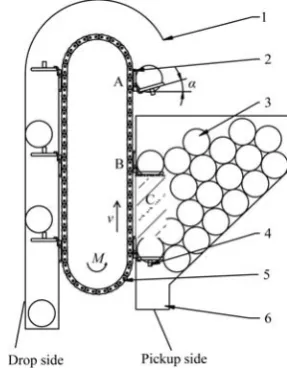
The cup-chain potato metering device is shown in Figure 1. The cup-chain device goes through the potato pile and isolates one potato from the others for single grain metering. The metering direction is marked as v in Figure 1. Metering success rate is determined by the number of potato seeds in region C and is influenced by the potato flow behavior and metering speed. Furthermore, the potato can be dropped from the cup because of equipment bumps and chain shaking.
1. Sheet-metal duct 2. Guard plate 3. Potato seeds 4. Seed cup 5. Chain 6. Seed box
Figure 1 Schematic of the cup-chain potato metering device
can be dropped from the cup.
Figure 2 shows the forces acting on the potato in the tilted cup. The forces acting on the potato include gravity G, supporting force P from the cup, and supporting force N from the guard plate. While the potato tends to separate from the cup under the conditions of device bumping and chain shaking, the guard plate acts as friction force f on the potato which prevents the shedding phenomenon occurs. Friction force increases and the shaking phenomenon decreases with the increase in CTA. Meanwhile, the effective area that contributes to metering decreases, which leads to an increase in MSR.
Figure 2 Stress analysis of a potato
The metering chain should neither be too tight nor too loose. A metering chain that is too tight causes a polygonal action, with the results of MSR increase and DSR decrease. A metering chain that is too loose easily causes chain shaking and collision with other components, with the results of MSR increase and DSR decrease.
On the basis of predecessor findings and above analysis, studied factors in this paper are CS, chain tightening tension, and CTA. Chain tightening tension is evaluated by CTD.
Ground wheel slipping is mainly the result of lacking driving capacity, which can be caused by huge load torque or ground drive failed attached to the soil/residue surface. To solve this problem, a motor was employed to drive the metering device instead of the ground wheel. Working speed was measured by differential GPS. A metering control system was developed to control the metering speed according to the ground wheel speed. 2.2 Mechanical system design
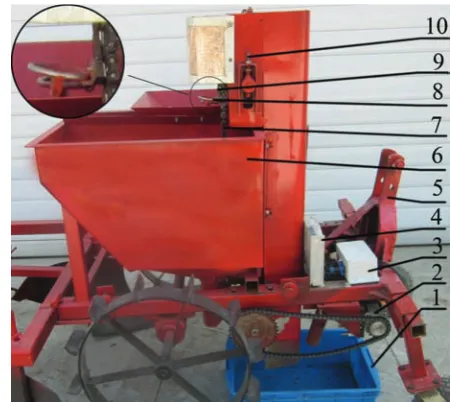
The mechanical system is an improvement of the potato planter type 1220 produced by Menoble Company. The structure is shown in Figure 3.
Metering speed was set by driver 4 and implemented by motor 2. The relationship between metering speed v
and motor rotational speed n is as follows: 1000 60 i n
z p v
× ⋅
=
⋅ ⋅
where, p is chain pitch, m; i is total drive ratio; z is metering sprocket teeth.
CTD α was adjusted by the distance between the driven and drive sprockets. Center distance α0 was calculated by the sprocket number, sprocket teeth count, and chain pitch count. The actual center distance is α1, so,
α=α1 –α0
Guard plate 9 is replaceable, and CTA can be changed.
1. Collecting box 2. Motor 3. Controller 4. Driver 5. Frame 6. Seed box 7. Chain 8. Seed cup 9. Guard plate 10. Tightener
Figure 3 Structure of the metering test device 2.3 Control system design
Figure 4 Schematic of the control system 2.4 Tests
2.4.1 Test apparatus
Type PS70 precision planetary gear box (Newstart Gear Transmission Co., Ltd.), type SGMJV-04ADE6S servo motor (Yaskawa Electric Corporation), type SGDV-2R8A01B002000 servo driver (Yaskawa Electric Corporation), and analysis software DPS v7.05 and Matlab R2012A were utilized.
2.4.2 Test materials
The future development trend of potato seeds will utilize entire potatoes rather than diced potatoes[24]. In this test, the seed material was naturally matured and harvested manually. The species is Holland 15, cultivated by Zhangjiakou Academy of Agricultural Sciences. According to user guide of type 1220 potato planter, the mean diameter of potato seed selection is 56 mm. 2.4.3 Test method
A laboratory test was conducted according to the standard GB/T 6242-2006 Equipment for Planting-Potato Planters-Method of Testing[25-29]. On the basis of test scheme, each parameter was set. Then, the seed box was filled with the potato seeds.
By mounting two laser sensors on seed discharge hole, the number of missing-seeding can be calculated with logic output. The number of double seeding can be observed. Then, MSR and DSR can be calculated. With the furrow coverer of potato planter removed, the plant spacing can be measured easily.
3 Test results and analysis
3.1 Test model
Test conducted with quadratic general rotary unitized
design regression testing method. Multi-objective optimization method is used to get an optimal solution[24]. According to the related technical standard and preliminary test results, the value of each factor and range were determined.
The best level of value was encoded as space factor 0 according to the factor value range. Each factor code was determined.
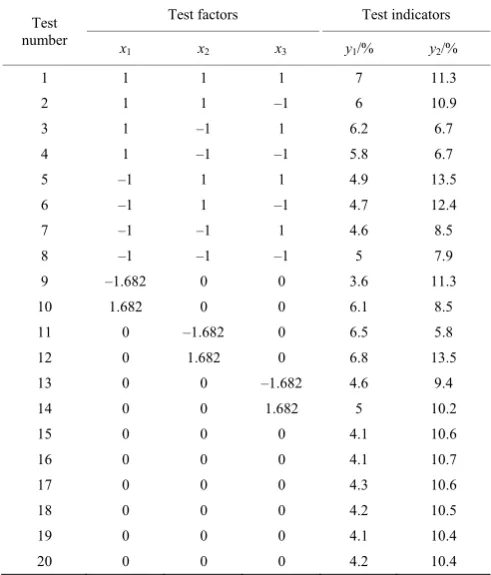
In the test index, y1 is MSR and y2 is DSR. Experimental factors x1, x2, and x3are the encoded values of CS v, CTD d, and CTA α. The coding of the regression test is shown in Table 1. The design and results are shown in Table 2.
Table 1 Factors and levels of regression experiment
Coding level CS v/m·s-1 CTD d/10 m−3 CTA α/(°)
1.682 0.71 4 18.7 1 0.61 3.2 16 0 0.46 2 12 –1 0.3 0.8 8
–1.682 0.2 0 5.3
Table 2 Scheme and results of regression experiment
Test number
Test factors Test indicators
x1 x2 x3 y1/% y2/%
1 1 1 1 7 11.3 2 1 1 –1 6 10.9 3 1 –1 1 6.2 6.7
4 1 –1 –1 5.8 6.7
5 –1 1 1 4.9 13.5
6 –1 1 –1 4.7 12.4
7 –1 –1 1 4.6 8.5 8 –1 –1 –1 5 7.9 9 –1.682 0 0 3.6 11.3 10 1.682 0 0 6.1 8.5
11 0 –1.682 0 6.5 5.8
12 0 1.682 0 6.8 13.5
13 0 0 –1.682 4.6 9.4
14 0 0 1.682 5 10.2
15 0 0 0 4.1 10.6 16 0 0 0 4.1 10.7 17 0 0 0 4.3 10.6 18 0 0 0 4.2 10.5 19 0 0 0 4.1 10.4 20 0 0 0 4.2 10.4
The regression equation of MSR is:
1 1 2 3
2 2 2
1 2 3
1 2 1 3 2 3
4.1662 0.7326 0.1102 0.1371
0.2447 0.8811 0.2271
0.125 0.2 0.15
y x x x
x x x
x x x x x x
= + + + +
+ + +
+ +
(1)
2 1 2 3
2 2 2
1 2 3
1 2 1 3 2 3
10.5333 0.8354 2.2882 0.2523
0.224 0.3124 0.2593
0.0875 0.1625 0.1125
y x x x
x x x
x x x x x x
= − + + −
− − −
− +
(2)
The F-tests of regression Equations (1) and (2) are shown in Table 3. The comparison of the calculated result with F0.01(9,10)=4.94 shows that both of the regression equations are remarkable. The regression model can reflect actual situations well.
Table 3 F-test for MSR and DSR
Indicators Source Sum of squares
Degree of
freedom F-value Significance
MSR
Regression 20.1554 9 2.2395 525.83
Residual 0.0426 10 0.0043
Sum 20.1980 19
R=0.9150 S=0.141 α=0.00
DSR
Regression 84.8813 9 9.4313 1229.74
Residual 0.0767 10 0.0077
Sum 84.9580 19
R=0.9983 S=0.1255 α=0.00
3.2 Factor effect analysis 3.2.1 Main effect analysis
The partial regression coefficients were standardized because the factors were substituted by dimensionless linear. Two factors were fixed on level 0, so the third factor influences were determined.
2 1( ) 4.1662 0.73261 1 0.2447 1
y x = + x + x (3)
2 1( ) 4.1662 0.11022 2 0.8811 2
y x = + x + x (4)
2 1( ) 4.1662 0.13713 3 0.2271 3
y x = + x + x (5)
2 2( ) 10.5333 0.83541 1 0.224 1
y x = − x − x (6)
2 2( ) 10.5333 2.28822 2 0.3124 2
y x = + x − x (7)
2 2( ) 10.5333 2.25233 3 0.2593 3
y x = + x − x
(8)
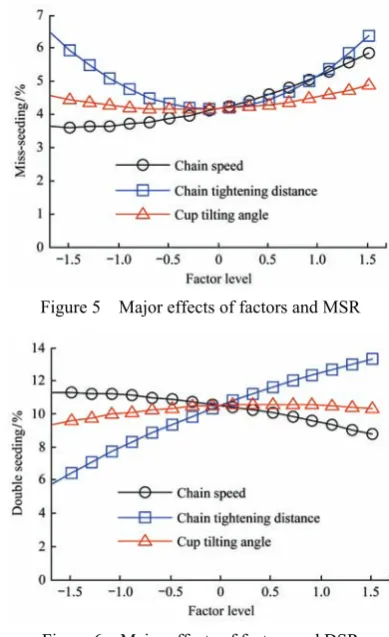
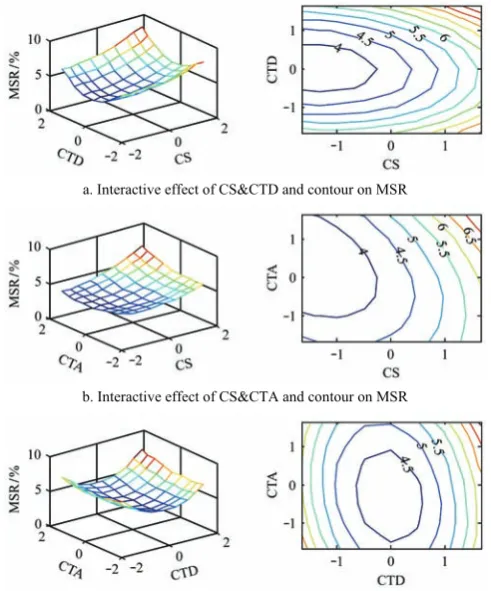
The main effects between each factor and MSR and DSR are shown in Figures 5 and 6. MSR increases with CS; it initially decreases and then increases with CTD and CTA. DSR declines with CS; it increases initially and then decreases afterward with CTD. With CTA, it initially decreases and then increases. CS and CTD have a greater influence on MSR and DSR than CTA.
The test results show that the chances that the potato will fall to the cup decreases with the increase in CS, thus, MSR increases and DSR decreases.
The chain easily slackens and swings during vertical lifting with the decrease in CTD. MSR increases
because a potato can easily fall from the cup. The chain free swinging phenomenon disappears, MSR decreases, and DSR increases with the increase in CTD. As CTR increases, the polygonal action becomes significant, chain shaking intensifies, MSR increases, and DSR decreases.
The chances that a potato will fall from the cup can be improved by increasing CTA appropriately. The MSR rate increases with the increase in CTA. Thus, with the increase in CTA, MSR decreases initially and then increases, which is contrary to DSR.
Figure 5 Major effects of factors and MSR
Figure 6 Major effects of factors and DSR
3.2.2 Response surface analysis
When one factor is fixed at level 0, the binary quadratic equation of the other two factors is determined. The interaction equations of MSR and DSR are presented by Equations (1) and (2). The interactive effect of the factors and contour on MSR and DSR are shown in Figures 7 and 8.
a. Interactive effect of CS&CTD and contour on MSR
b. Interactive effect of CS&CTA and contour on MSR
c. Interactive effect of CTD&CTA and contour on MSR
Figure 7 Interactive effect of factors and contour on MSR
a. Interactive effect of CS&CTD and contour on DSR
b. Interactive effect of CS&CTA and contour on DSR
c. Interactive effect of CTD&CTA and contour on DSR
Figure 8 Interactive effect of factors and contour on DSR
Figure 8 shows that the interactive influence of factors on DSR is significant. The interactive influence sequence is as follows: CS and CTD, CS and CTA, CTD and CTA. DSR is less than 20% when CS is greater
than 0.3 m/s, CTD is less than 2×10⁻³ m, and CTA is in the range of 8° to 16°.
3.3 Parameter optimization of the regression model The national standards for potato planter performance indicators are as follows: MSR of less than 10% and DSR of less than 20%. For DSR and MSR, smaller is better. Based on the above model, the mathematical model for determination is as follows:
1
2
min ( )
min ( )
[ 1.682, 1.682] j
j j
F X y
F X y
X
= = ∈ −
The model is a multi-objective optimization problem. Sequential quadratic programming method is utilized to solve this problem. The method is accomplished by the “fgoalattain” function of the MATLAB optimization toolbox. By using coded formula back substitution to optimize the variables, the actual values of each optimized factor were determined as follows: CS is 0.32 m/s, CTD is 0.94×10⁻³ m, CTA is 12.5°, MSR is 4.39%, and DSR is 8.78%.
To verify the reliability of the optimized results, a test was conducted. The results are shown in Table 4. The authentication and predicted values are similar. The test results show that the regression model is reliable and can be used to predict and analyze the potato metering device.
Table 4 Experimental scheme and results for prediction verification
Number
Test scheme Results
CS v/m·s-1 CTD d/10-3 m CTA α/(°) MSR y1/% DSR y2/%
1 0.32 0.94 12.5 4.6 8.4
2 0.32 0.94 12.5 4.9 9.0
3 0.32 0.94 12.5 4.3 8.6
3.4 Field test
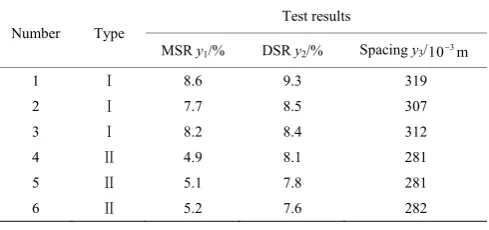
The field test scheme and results are shown in Table 5. Type Ⅰ is type 1220 potato planter designed by Menoble Corporation. Type Ⅱ is the planter with optimization parameters.
Table 5 Field experimental scheme and results
Number Type
Test results
MSR y1/% DSR y2/% Spacing y3/10 m−3
1 Ⅰ 8.6 9.3 319
2 Ⅰ 7.7 8.5 307
3 Ⅰ 8.2 8.4 312
4 Ⅱ 4.9 8.1 281
5 Ⅱ 5.1 7.8 281
6 Ⅱ 5.2 7.6 282
The test results show that the MSR of type Ⅱ decreases from 8.2% to 5.1% and DSR drops from 8.7% to 7.8% compared with those of type Ⅰ. The average intra-row space is 281.3 3
10 m−
× , which is better than that of type Ⅰ (312.7×10 m−3 ).
4 Conclusions
(1) Within the scope of the test, the MSR increases with the CS; it initially decreases and then increases with the CTD and CTA. The DSR declines with the CS, increases initially, and decreases afterward with the CTD; meanwhile, it initially decreases and then increases with the CTA.
(2) MSR and DSR are both influenced by CS significantly, which determines the filling time. Chain tightening extent is decided by CTD, which is important to chain shaking and polygonal action. CTA has a large influence on the stability of the potato in the cup.
(3) The optimization results show a MSR of 4.39% and a DSR of 8.78% under the parameters of 0.32 m/s seeding speed, 0.94×10⁻³ m tightening distance, and 12.5° cup tilting angle.
(4) The field test indicates that electric control instead of ground wheel-driven chain enables the increase in seeding speed and precision in intra-row seeding distance.
Acknowledgments
The authors acknowledged the financial support by the State's Key Project of Research and Development Plan (2016YFD0700103) and National Natural Science Foundation of China (31301241).
[References]
[1] Lv J Q, Tian Z E, Yang Y, Shang Q Q, Wu J E, Li Z H, et al. The development situation, existing problems and
development trend of potato machinery. Journal of Agricultural Mechanization Research, 2015; 37(12): 258–263. (in Chinese)
[2] Liu Q W, Wu J M, Wang D, Sun W, Wang G P, Shi L R. Current status and progress of the potato seeder. Journal of Agricultural Mechanization Research, 2013; 35(6): 238–241. (in Chinese)
[3] Yang L, He X T, Cui T, Zhang D X, Shi S, Zhang R, et al. Development of mechatronic driving system for seed meters equipped on conventional precision corn planter. Int J Agric & Biol Eng, 2015; 8(4): 1–9.
[4] Jiang Y Y. Combination of agricultural machinery and agronomy in their scientific and technological innovations. Transactions of the CSAM, 2007; 46(3): 163, 179–181. (in Chinese)
[5] Lü J Q, Yang Y, Li Z H, Shang Q Q, Li J C, Liu Z Y. Design and experiment of an air-suction potato seed metering device. Int J Agric & Biol Eng, 2016; 9(5): 33–42.
[6] Tang H J, Lv Z Q, Liu S F. The design of new potato planter. Journal of Agricultural Mechanization Research, 2015; 37(12): 148–151. (in Chinese)
[7] Ebrahem I Z, Ayman A E, Guidetti R. New small potato planter for Egyptian agriculture. Journal of Agricultural Engineering, 2011; 42(3): 7–13.
[8] Buitenwerf H, Hoogmoed W B, Lerink P, Müller J. Assessment of the behavior of potatoes in a cup-belt planter. Biosystems Engineering, 2006; 95(1): 35–41.
[9] Ilyes S, Popescu S, Voicu E. Experimental device for the researches on the precision of the tubers planting distance within the row for different potato planters. in Research People and Actual Tasks on Multidisciplinary Sciences/ Proceedings of the Third International Conference, Lozenec: Bulgaria, 2011; 2: 153–158.
[10] Szczepaniak J, Pawlowski T, Grzechowiak R, Kromulski J, Rutkowski J. Experimental tests and computer simulations of a combination tractor/potato planter: the identification and optimization of parameters. Applied engineering in agriculture, 2015; 31(5): 126–136.
[11] McPhee J E, Beattie B M, Corkrey R, Fennell F M. Spacing uniformity—yield effects and in-field measurement. American Potato Journal, 1996; 73(1): 167–171.
[12] Sieczka J B, Ewing E E, Markwardt E D. Potato planter performance and effects on non-uniform spacing. American Potato Journal, 1986; 63: 25–37.
[13] Liu H J, Liu J F, Li J P. Comprehensive utilization technology of orchard pruning branches. Journal of Agricultural Mechanization Research, 2011; 33(2): 214–217, 221.
index and in-row spacing uniformity in an automatic potato planter. Journal of Agricultural Sciences, 2012; 18(2): 126–136.
[15] Al-Gaadi K A. Performance evaluation of a cup-belt potato planter at different operation conditions and tuber shapes. American-Eurasian Journal of Agricultural & Environmental Sciences, 2011; 10(5): 821–828.
[16] Al-Gaadi K A, Marey S A. Effect of forward speed and tuber characteristics on tuber spacing uniformity for a cup-belt potato planter. Middle East Journal of Scientific Research, 2011; 8(8): 753–758.
[17] Zheng D H, Chen W, Du W L, Fan M S, Liu G S. The study and analysis of cup seed sowing technology and uniformity. Journal of Agricultural Mechanization Research, 2016; 38(7): 106–109. (in Chinese)
[18] Szczepaniak J. Parameters identification of agricultural combination tractor-potato planter model. Journal of Research and Applications in Agricultural Engineering, 2008; 53(2): 16–20.
[19] Hamid A, Ahmad D, Rukunuddin I H. Performance of sweet potato transplanting machine on mineral and bris soils. AMA-Agricultural Mechanization, in Asia Africa and Latin America, 2010; 41(1): 55–59.
[20] Pawlowski T, Kromulski J. Control theory models of the agricultural set (tractor-potato planter) driver. 4th International Symposium on Applications of Modelling as an Innovative Technology in the Agri-Food-Chain-Model-IT, 2007; 802(Madrid): 227–331.
[21] Lu Y F, Sun C Z, Wang F M, Su G L, Shi D Y. The
improved design of potato planter seeding-unit. Journal of Agricultural Mechanization Research, 2015; 37(12): 140–143. (in Chinese)
[22] Song Y M, Wang F E. The general development of potato machinery at home and abroad. Journal of Agricultural Mechanization Research, 2008; 25(9): 224–227.
[23] Han H, Chen W, Du W L, Zheng D H, Liu G S. Analysis and test of the factors influence the seeding performance of potato planters. Journal of Agricultural Mechanization Research, 2016; 43(3): 209–217.
[24] Zhang Y, Li L X, Han H Y, Du M J, Dou Y C. Development status and prospect of mechanized planting micro potato. Journal of Anhui Agri. Sci. 2015; 43(4): 372–375. (in Chinese)
[25] GB/T 6242-2006. Equipment for planting-Potato planters-Method of testing.
[26] Zhang G Z, Zang Y, Luo X W, Wang Z M, Zhang Q, Zhang S S. Design and indoor simulated experiment of pneumatic rice seed metering device. Int J Agric & Biol Eng, 2015; 8(4): 10–18.
[27] Yu J J, Liao Y T, Cong J L, Yang S, Liao Q X. Simulation analysis and match experiment on negative and positive pressures of pneumatic precision metering device for rapeseed. Int J Agric & Biol Eng, 2014; 7(3): 1–12.
[28] Ren L Q. Optimization experiment design and analysis. Beijing: Higher Education Press, 2003: 79–84. (in Chinese) [29] Qi J T, Jia H L, Li Y, Yu H B, Liu X H, Lan Y B, et al.